At exactly nine o’clock on a Friday morning, Margaret Whitmore stepped through the gap beside Samuel Reed’s northern fence.
She wore a pale blue athletic suit, white walking shoes, and sunglasses large enough to hide most of her face. A stainless-steel water bottle swung from one hand.
Three new signs stood directly in front of her.
PRIVATE AGRICULTURAL PROPERTY
ACTIVE FERTILIZER APPLICATION
DO NOT ENTER
A length of bright orange chain had also been stretched across the gap she had used every morning for the past month.
Margaret stopped.
She read the signs.
Then she lifted the chain, ducked beneath it, and continued walking.
Two hundred yards away, Samuel watched from the cab of his tractor.
He had known she might come.
That was why the signs were there.
It was why he had photographed them before beginning work.
It was why a trail camera attached to the fence post was recording the entire entrance.
Samuel was not interested in trapping anyone.
He was interested in fertilizing the northern field, preserving evidence, and finally proving that Margaret Whitmore believed rules applied only when she wrote them.
Behind his tractor, a commercial applicator spread liquid cattle manure across the newly planted field in a wide, carefully calibrated pattern.
The work was legal.
The material was ordinary agricultural fertilizer purchased from a licensed dairy operation.
The application plan had been filed with the county three days earlier. Weather conditions were suitable, waterways had been buffered, and every required setback had been measured.
Samuel had done everything correctly.
Margaret kept walking.
At first, she moved with the same confidence she always carried when crossing his property.
Then the smell reached her.
She slowed.
Her head turned toward the tractor.
Samuel continued following the marked application route.
Margaret looked down at the darkened soil ahead of her. Then she looked behind her at the signs she had ignored.
A reasonable person would have returned to the subdivision.
Margaret did not.
She moved east, apparently intending to circle around the treated rows and complete the walking route she had invented across Samuel’s farm.
The applicator completed its turn.
A low arc of liquid fertilizer began crossing the next section of field.
Samuel saw Margaret enter the marked operating zone.
He shut down the pump immediately.
But machinery did not stop in the same instant a switch was touched.
The remaining pressure inside the lines discharged across the field.
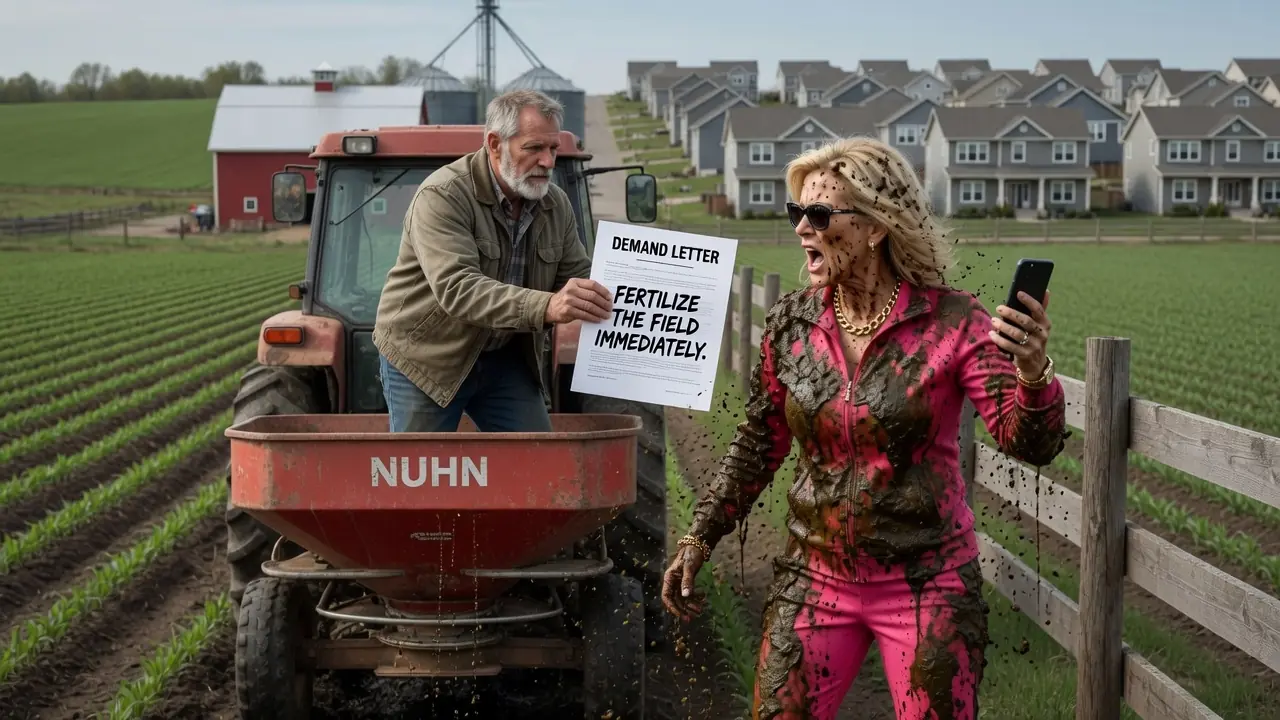
Margaret screamed.
By the time the final spray fell, brown liquid covered one sleeve, both legs, and most of her white shoes.
Samuel stopped the tractor.
He climbed down slowly and remained a safe distance away.
Margaret stood with her arms held away from her body, staring at herself in disbelief.
“What is wrong with you?” she shouted.
Samuel looked toward the warning signs.
“I’m fertilizing the field.”
“You sprayed me!”
“I shut the system down when I saw you enter the operating lane.”
“You knew I would be here!”
“I knew you had ignored previous warnings.”
Her face turned red.
“You did this deliberately.”
Samuel reached into the document pouch attached to his belt and removed the letter she had delivered five days earlier.
It carried the letterhead of the Meadowbrook Hills Homeowners Association.
The most important sentence was underlined.
You are hereby directed to treat and fertilize the currently barren landscape to promote the lush green appearance required by community standards.
Samuel held it up.
“You ordered me to fertilize the land.”
Margaret stared at the paper.
“That does not mean animal waste!”
“This is a working farm.”
“You attacked the HOA president!”
Samuel glanced toward the orange chain she had crossed.
“No. The HOA president entered an active agricultural operation after reading three warnings.”
Margaret pulled out her phone.
“I’m calling the sheriff.”
“Please do.”
Samuel returned to the tractor.
He did not restart the applicator.
Instead, he sat inside the cab and waited while Margaret stood at the edge of the field, covered in the exact organic fertilizer she had demanded he use.
The Reed farm had belonged to Samuel’s family for eighty-seven years.
His grandfather, Amos Reed, purchased the original sixty acres after returning from the Second World War. He cleared stones by hand, planted corn with borrowed machinery, and built the first barn from timber cut along the creek.
Samuel’s father expanded the operation to one hundred and forty acres.
He introduced soybeans into the crop rotation, repaired the drainage system, and paid off the final mortgage twelve years before his death.
When Samuel inherited the land, he made his father a simple promise.
He would keep it working.
The farm was not enormous by Iowa standards. Samuel did not own a fleet of modern combines or thousands of acres stretching beyond the horizon.
He planted corn and soybeans in rotation, leased a small section for hay, and raised enough chickens to sell eggs locally.
The work provided a living.
More importantly, the land was paid for.
The deed was clean.
There were no easements across the northern field, no public paths, and no agreements granting recreational access.
For most of Samuel’s life, the neighboring properties belonged to other farmers.
They understood planting schedules.
They understood chemicals, machinery, and the danger of walking through fields without permission.
Then Arthur Henley retired.
His wheat farm bordered Samuel’s northern boundary. None of Arthur’s children wanted the land, so he sold ninety acres to Franklin Residential Development.
Within eighteen months, the wheat field became Meadowbrook Hills.
The subdivision contained seventy-two houses, curved streets, ornamental trees, and a stone entrance sign promising:
COUNTRY LIVING WITH MODERN ELEGANCE
Samuel found the phrase amusing.
The development removed nearly every feature that had made the property country land.
The old hedgerows disappeared.
The pond was reshaped into a decorative basin.
The barns were demolished.
Streetlights replaced the darkness that once allowed Samuel to see the Milky Way clearly from his porch.
Still, Samuel tried to remain optimistic.
New neighbors were not automatically bad neighbors.
Several residents introduced themselves politely. One family began buying eggs from him every Saturday. Another asked whether their children could watch the combine during harvest from behind the fence.
Samuel welcomed them.
The problems began with footprints.
In early May, Samuel drove to the northern field shortly after sunrise.
He had spent two days preparing and planting the section. The soil remained soft and dark, with perfectly spaced rows extending toward the subdivision fence.
Fresh footprints cut diagonally across them.
They were too small to belong to work boots.
Beside them were paw prints from two dogs.
Several seeded rows had been crushed.
Samuel followed the tracks to a narrow opening where the developer had failed to connect two sections of fencing properly.
That afternoon, he saw a woman walking along the subdivision side.
Two white dogs trotted beside her on pink leashes. She wore a broad sun hat and pointed toward Samuel’s land while speaking into her phone.
Samuel raised one hand in greeting.
She looked directly at him.
Then she turned away.
A week later, he found her standing in the middle of the northern field.
The dogs were off their leashes, running between the rows.
Samuel stopped the tractor and walked toward her.
“Good morning.”
The woman placed both hands on her hips.
“Can I help you?”
Samuel almost looked around to confirm she had asked the question while standing on his land.
“This is private property.”
“I’m taking my dogs for a walk.”
“You’re walking through a planted field.”
She looked down.
The first soybean shoots had only begun breaking through the soil.
“It looks like dirt.”
“It’s still a crop.”
She sighed.
“The Meadowbrook charter designates this area as natural community open space.”
“No, it doesn’t.”
“I helped draft the charter.”
Samuel pointed toward the farmhouse in the distance.
“This farm has never been part of Meadowbrook.”
The woman’s expression became patient in the insulting way of someone explaining a simple fact to a confused child.
“I’m Margaret Whitmore, president of the Meadowbrook Hills HOA. I think I understand our planning documents better than you do.”
“I’m Samuel Reed. I own the ground beneath your shoes.”
Margaret clicked her tongue at the dogs.
“You should review the community plans.”
She walked away before Samuel could respond.
That evening, he removed the deed, survey, and county plat map from the metal cabinet in his office.
Everything confirmed what he knew.
The northern fence followed the surveyed property boundary.
No recreational easement existed.
The subdivision ended precisely at the line.
Samuel called the county planning office the next morning.
A clerk named Jennifer Morris reviewed the parcel records.
“Your property is zoned agricultural,” she said. “It is not part of the subdivision or the HOA.”
“Could their development documents somehow claim recreational use?”
“Not without a recorded easement or agreement from the owner.”
“There is neither.”
“Then they have no right to use it.”
Samuel described Margaret’s claim.
Jennifer became quiet.
“That is a new one.”
“I was hoping you’d say it was common and easily corrected.”
“It may still be easily corrected.”
It was not.
Margaret returned two mornings later.
This time, she brought four residents.
They entered through the fence gap with dogs, travel mugs, and the confidence of people who believed they had been invited.
Samuel approached the group.
“Everyone needs to leave the field.”
Two residents looked uncomfortable.
A younger man immediately pulled his dog closer.
Margaret remained still.
“We’re using the approved walking route.”
“There is no approved walking route.”
She gestured toward the emerging plants.
“This is basically an empty field.”
“You’re standing on soybean rows.”
“When it becomes a proper crop, we’ll be more careful.”
Samuel looked at the others.
“This is private agricultural property. The HOA has no jurisdiction here. Entering without permission is trespassing.”
The younger man apologized and returned toward the fence.
A woman followed him.
Margaret called after them.
“You do not need to leave. The board has reviewed this.”
Neither came back.
Samuel looked at Margaret.
“Have you actually shown the full board my deed?”
“The board does not require your permission to interpret community planning standards.”
“My deed is not open to interpretation.”
She walked away with the remaining residents.
The visits continued.
Sometimes Margaret came alone.
Sometimes she brought five or six people.
Dogs ran across the rows.
One child pulled several young plants from the soil.
A resident left a plastic water bottle that later became caught inside a cultivator.
Samuel photographed every incident.
He repaired the fence gap twice.
Both times, the wire was cut within days.
He installed a trail camera.
The footage showed Margaret using garden clippers to reopen the passage before her morning walk.
That was when Samuel hired an attorney.
Rachel Moreno practiced agricultural and property law in the county seat.
She reviewed the deed, videos, photographs, and HOA correspondence.
“They have no claim,” she said.
“Can we make them stop quickly?”
“I can send a formal notice. If they continue, we pursue an injunction and damages.”
“How long?”
“Several weeks at best. Possibly months if they fight.”
Samuel looked toward the photographs of damaged rows.
“Planting season doesn’t wait for civil court.”
“No.”
Rachel leaned forward.
“But do not create a trap or confront anyone with machinery. Continue documenting. Post warnings. Call the sheriff when they trespass.”
Samuel nodded.
He wanted the behavior stopped.
He did not want anyone injured.
Rachel sent a certified notice to Margaret and the HOA’s registered office.
It stated clearly that the farm was outside Meadowbrook’s boundaries, that no easement existed, and that all unauthorized entry must stop immediately.
Margaret signed for her copy.
Five days later, she slipped a letter beneath Samuel’s front door.
The document looked official from a distance.
At the top was the Meadowbrook logo.
Below it, Margaret had written:
NOTICE OF COMMUNITY LAND DESIGNATION AND LANDSCAPE NONCOMPLIANCE
The letter claimed the HOA board had formally designated Samuel’s northern field as shared open space under its community planning authority.
It then declared the field aesthetically deficient because it appeared barren and uneven.
Samuel was instructed to fertilize it immediately to create “lush green growth consistent with neighborhood expectations.”
Daily fines would begin if he failed to comply.
Samuel read the letter four times.
Then he called Rachel.
She laughed once when she reached the paragraph claiming the HOA could designate property it did not own.
“I’m sorry,” she said. “This is legally ridiculous.”
“She put it in writing.”
“Yes.”
“Can I charge them for crop damage?”
“We’ll need an agricultural assessment.”
“What about the order to fertilize?”
“Samuel.”
“I have to fertilize that section anyway.”
Rachel became quiet.
“What exactly are you thinking?”
“Standard liquid manure application.”
“That is legal if you follow environmental rules and ordinary agricultural practice.”
“I always do.”
“Do not time it to strike anyone.”
“I won’t.”
“Post clear warning signs.”
“I will.”
“Close the access point.”
“I already intend to.”
“Use cameras.”
“Yes.”
“And shut the equipment down if anyone enters the operating zone.”
Samuel looked toward Margaret’s letter.
“I understand.”
Rachel sighed.
“I know that tone.”
“What tone?”
“The tone farmers use before doing something technically correct and socially unforgettable.”
“I’m fertilizing my crops.”
“Make sure that is all you are doing.”
It was.
The northern field needed nutrients before the next growth stage.
Samuel contacted Prairie Valley Dairy Cooperative and ordered a legal commercial load of liquid cattle manure.
He filed an application plan with the county, checked the weather, established buffer zones, and scheduled delivery for Friday.
The previous evening, he installed warning signs at every possible entrance.
He repaired the cut fence.
At the gap Margaret usually used, he placed an orange chain and three signs.
He photographed everything with time stamps.
Then he set a trail camera facing the entrance.
At eight thirty Friday morning, the tanker arrived.
The driver helped connect the applicator.
Samuel tested the pressure on a secluded strip.
At eight fifty-five, he began the first pass.
At nine, Margaret lifted the chain.
The sheriff’s deputies arrived twenty-three minutes after Margaret’s call.
Deputy Paul Jensen parked near the access road.
Deputy Monica Reyes stopped farther away and immediately moved upwind.
Margaret stood near the fence, still covered in manure.
“You need to arrest him,” she said before either deputy could ask a question. “He deliberately attacked me with hazardous material.”
Samuel waited beside the tractor.
Jensen took notes.
“Were you on his property?”
“This is HOA community land.”
Samuel handed him a folder.
Inside were copies of the deed, survey, zoning record, Rachel’s trespass notice, photographs of the warning signs, the county manure application plan, and Margaret’s demand that he fertilize the field.
Jensen read the HOA letter twice.
Then he looked at Samuel.
“She sent this?”
“Yes.”
Margaret pointed at him.
“He waited for me!”
Samuel removed his phone and opened the trail-camera recording.
The video showed Margaret approaching the signs.
It showed her stopping long enough to read them.
It showed her lifting the orange chain and walking into the field.
The tractor remained far in the background.
Jensen watched the next clip, recorded from the tractor camera.
Samuel’s hand moved toward the control.
The applicator shut down as Margaret entered the marked operating zone.
The remaining pressure discharged before the spray stopped completely.
Reyes reviewed the environmental paperwork.
“This is a standard agricultural application,” she said.
Margaret turned toward her.
“That substance is a public-health hazard.”
“On agricultural land, properly applied manure is lawful fertilizer.”
“He targeted me!”
Jensen looked toward the warning signs.
“You crossed a barrier after reading three notices.”
“I have a right to walk here.”
“Do you have an easement?”
“The HOA designated it as shared space.”
“Do you have a recorded document showing the property belongs to or is controlled by the HOA?”
Margaret’s voice became sharper.
“The community charter—”
“That isn’t what I asked.”
She stared at him.
Jensen handed Samuel’s papers back.
“Based on what we have here, Mr. Reed was conducting a lawful farm operation on his own property. The video shows him shutting the applicator down after you entered the operating area.”
“He knew my schedule.”
“He also put up barriers.”
Margaret pointed toward her clothes.
“Look at me!”
Jensen’s expression remained professional.
“I can see you.”
Reyes pressed her lips together and looked toward the road.
Samuel suspected she was trying not to smile.
Jensen continued.
“Mrs. Whitmore, Mr. Reed has formally notified you not to enter this property. Today you crossed a marked barrier. He can request that we issue a trespass warning.”
Margaret looked toward Samuel.
He nodded.
“I’m requesting it.”
Jensen documented the warning.
“If you return without the owner’s permission, you may be cited or arrested depending on the circumstances.”
Margaret’s mouth opened.
No sound came out.
Finally, she looked at Samuel.
“You have not heard the last of this.”
Samuel pointed toward the fence.
“You’re still on my property.”
She left through the gap.
The deputies remained while Samuel restarted the tractor.
Before leaving, Reyes approached the cab.
“You planned the application for nine?”
“I begin most fieldwork after the morning moisture lifts.”
“You knew she usually walked at nine.”
“I knew she had been trespassing at nine.”
Reyes looked toward the signs.
“You gave her every warning.”
“Yes.”
“Keep the footage.”
“My lawyer already has a copy.”
She nodded.
“Smart.”
Margaret sent three new violation notices the following week.
One alleged a public-health hazard.
Another claimed Samuel’s tractor noise violated Meadowbrook quiet hours.
The third imposed daily fines for refusing to remove “offensive agricultural materials” from community open space.
Rachel responded to the HOA’s registered address rather than Margaret personally.
Her letter was twelve pages long.
It included maps, deeds, police documentation, the trespass warning, crop-damage estimates, and copies of Margaret’s unauthorized notices.
Rachel warned that any attempt to collect fines or assert control over the farm would result in claims for trespass, interference with agricultural operations, property damage, and abuse of process.
The letter reached the full board.
That changed everything.
Two board members contacted Samuel separately.
The first was a retired accountant named Leonard Pike.
“I owe you an apology,” Leonard said. “The board never voted to designate your farm as common property.”
“Margaret said it had.”
“She told us you had agreed to temporary walking access.”
“I agreed to nothing.”
Leonard became quiet.
“She did not show us your attorney’s first letter.”
The second caller was board secretary Alicia Morgan.
She sounded angry.
“Margaret drafted those violation notices herself. They were never entered into the association management system.”
“Then they weren’t official?”
“No.”
“She used the HOA letterhead.”
“Yes.”
“Did the board authorize the walks?”
“No. She described the field as an existing public path.”
Samuel looked through the window at the damaged northern rows.
“Several residents followed her onto private property.”
“I understand.”
“Do they?”
“They do now.”
The board distributed Rachel’s legal notice to every homeowner who had participated in the walks.
The effect was immediate.
Residents who had trusted Margaret’s claim realized they could be individually liable for trespass and crop damage.
Several sent written apologies.
One offered to reimburse Samuel for plants his children had pulled.
Another admitted that Margaret told the group Samuel was merely a tenant resisting a planned community trail.
No one entered the field again.
The HOA scheduled an emergency meeting.
Margaret entered the clubhouse wearing a dark suit and the expression of someone prepared to explain why every other person had misunderstood her.
The room was full.
Samuel attended with Rachel but sat near the back.
Alicia read the issue into the record.
“President Whitmore issued notices and represented privately owned agricultural land as association common property without board authorization.”
Margaret raised one hand.
“The land was displayed as green space in the developer’s preliminary sales map.”
Rachel stood.
“A marketing illustration is not a deed.”
Margaret ignored her.
“I acted to preserve neighborhood access and property values.”
Leonard placed a county plat on the projector screen.
The boundary line was unmistakable.
“The developer’s final recorded plan ends here,” he said. “Mr. Reed’s farm begins here. No trail crosses the line.”
Margaret looked toward Samuel.
“He deliberately covered me in waste.”
Samuel said nothing.
Rachel answered.
“The sheriff’s report and video show Mrs. Whitmore disregarding posted warnings, crossing a physical barrier, and entering an active farm operation. Mr. Reed stopped the application when she entered the spray lane.”
Several residents whispered.
Alicia played the fence-camera footage.
Margaret appeared on the screen.
She stopped before the signs.
She read them.
Then she lifted the chain.
A man seated near the front turned toward her.
“You told us there were no signs.”
Margaret’s face hardened.
“They were placed there to intimidate residents.”
“They said active fertilizer application.”
“They were still intended to frighten us.”
Samuel finally spoke.
“They were intended to prevent exactly what happened to you.”
The room became quiet.
One of the residents who had joined Margaret’s walks stood.
“You told us the farmer had already agreed to the path.”
“I said the community documents recognized access.”
“That’s not what you said.”
A second resident stood.
“You said the board had confirmed it.”
Margaret turned toward the directors.
“Are you going to allow this ambush?”
Leonard looked tired.
“This is not an ambush. It is a review of actions you took using the board’s name.”
The directors voted to suspend Margaret’s authority pending an investigation.
Three days later, she resigned.
Her resignation letter accused the board of surrendering to intimidation from an “aggressive industrial farming interest.”
Samuel’s farm had one tractor old enough to vote and a barn that leaned during strong winds.
He found the phrase industrial farming interest more flattering than insulting.
Rachel pursued compensation for the damaged crop rows.
Samuel did not seek a fortune.
An agronomist calculated the cost of lost plants, reseeding, labor, fence repair, and time spent documenting the repeated trespass.
The HOA’s insurer negotiated a settlement.
In return, Samuel released claims against the residents who had entered the field while relying on Margaret’s false statements.
Margaret remained responsible for her own conduct and legal expenses.
The board adopted a written policy forbidding officers from asserting authority over property outside the recorded subdivision boundary.
They also permanently closed the northern walking route.
A proper trail was constructed entirely within Meadowbrook’s land the following year.
Samuel allowed the neighborhood children to watch harvest from a marked viewing area beside the fence.
He did not blame them for the adults’ mistakes.
The family who bought eggs from him continued coming each Saturday.
One morning, the mother brought her youngest son.
The boy looked across the northern field.
“Is this where Mrs. Whitmore got sprayed?”
His mother became embarrassed.
“Evan.”
Samuel loaded two cartons into her basket.
“It is.”
“Did you do it on purpose?”
Samuel considered the question.
“I fertilized on purpose.”
“But did you spray her on purpose?”
“No.”
He pointed toward the fence.
“She walked past signs telling her not to enter.”
The boy looked thoughtful.
“So she sprayed herself?”
His mother tried to hide a smile.
“That is enough questions.”
Samuel handed the boy a small bag of sweet corn.
“Farm rule,” he said.
“What?”
“When someone tells you not to walk near moving equipment, listen.”
Evan nodded seriously.
“Yes, sir.”
Margaret remained in Meadowbrook for another year.
She rarely walked near the northern boundary.
When Samuel saw her vehicle, she usually turned onto another street before reaching the farm.
Some residents wanted her expelled from community activities.
Samuel never encouraged it.
He wanted the trespassing stopped, not a public campaign to destroy her.
Her authority had depended on people believing she represented something larger than herself.
Once the board records, maps, and videos became visible, that authority disappeared.
The humiliation in the field became the part people joked about.
It was not the most important consequence.
The important consequence was that residents began questioning documents before obeying them.
They requested meeting minutes.
They checked maps.
They demanded recorded votes.
They stopped allowing one confident person to convert personal opinions into community law.
That change lasted longer than the smell.
By October, the northern soybeans were ready for harvest.
The plants were thinner along the route Margaret’s walking groups had repeatedly used. A faint diagonal scar remained across the rows.
Samuel could see it clearly from the combine.
Most of the field had recovered.
Land often did, when given time and protection.
His father used to say farming was an argument with uncertainty.
Weather could ruin a season.
Markets could collapse.
Machines could fail at the worst moment.
The only sensible response was to control what could be controlled and prepare evidence for everything else.
Samuel harvested until sunset.
Along the Meadowbrook side of the fence, several families watched from the official viewing area.
Children waved when the combine passed.
Samuel raised one hand.
Near the new trail stood one of the residents Margaret had once led into his field.
The man waited until Samuel stopped near the grain cart.
“I wanted to apologize in person.”
“You already sent a letter.”
“I followed her without asking you.”
Samuel climbed down from the cab.
“You believed someone who sounded certain.”
“That isn’t much of an excuse.”
“No.”
The man looked toward the property line.
“She made it sound official.”
“Official language is easy.”
“What’s hard?”
“Checking whether it is true.”
The man nodded.
“My daughter wants to learn where food comes from.”
Samuel looked toward a girl waiting by the fence.
“Bring her Saturday morning. Stay on the marked side until I meet you.”
The man appeared surprised.
“You’d allow that?”
“You asked.”
That was the difference Margaret had never understood.
Permission was not weakness.
A boundary was not hostility.
Private land did not become community property simply because someone desired access.
Good neighbors respected the word no so that yes could still mean something.
The following spring, Samuel found a new letter in his mailbox.
It carried official HOA letterhead and the signatures of every board member.
For one brief moment, he expected another dispute.
Instead, the letter thanked him for cooperating on the new trail design and confirmed in writing that the association recognized the full surveyed boundary of the Reed farm.
A handwritten note appeared at the bottom.
We promise not to provide future landscaping instructions to a man who owns a manure spreader.
Samuel laughed aloud.
He pinned the letter above his kitchen desk beside Margaret’s old demand to fertilize the landscape.
He kept both.
One represented authority used carelessly.
The other represented a community capable of learning.
Years later, people in Meadowbrook still told the story of the morning their former HOA president crossed a warning chain wearing a pale blue tracksuit.
The details became exaggerated.
Some claimed Samuel had hidden behind a barn waiting for her.
Others said the manure spreader fired like a cannon.
One child insisted Margaret had been thrown backward ten feet.
None of that happened.
The truth was simpler.
A woman convinced herself she controlled land that did not belong to her.
The owner warned her.
Then his lawyer warned her.
Then signs warned her.
Then an orange chain warned her.
She crossed anyway.
Samuel had not needed revenge.
He only needed to continue farming while allowing Margaret to experience the consequences of believing her own authority was greater than a deed, a fence, and common sense.
The northern field remained agricultural land.
Corn rose there the next summer.
Soybeans returned the year after that.
The Meadowbrook trail stayed on the subdivision side.
Dogs remained on leashes.
Residents waved from behind the fence.
And every spring, before Samuel began spreading fertilizer, he inspected the warning signs carefully.
Not because Margaret Whitmore might return.
Because rules mattered most when the person enforcing them was also willing to follow them.
Samuel Reed had never belonged to the HOA.
His farm had never been community property.
And the only instruction Margaret ever successfully gave him was the one she regretted most.
Fertilize the land.