She heard the laughter before the carriage wheels had stopped turning.
It drifted across the bright gravel sweep of Halewick Court, light and elegant and sharp enough to cut silk. Miss Lydia Fernsby sat very still inside the hired carriage, one hand resting on the latch, the other closed around the folded letter of invitation in her lap. For a moment, she did not move. Outside the window, late summer sunlight spilled over the lawns, over the white stone steps, over ladies in pale gowns and gentlemen in polished boots who looked as if they had been born knowing where to place their hands.
Lydia had not.
She was the daughter of a country surgeon, twenty-three years old, practical by upbringing and stubborn by necessity. Her gown was clean brown muslin, altered twice, brushed carefully, and entirely unsuited to a duke’s house party. The ribbon at her waist had been dyed at home in a saucepan. Her gloves were mended at the thumb. Her bonnet, though respectable, had lost its fashionable shape sometime during the last three miles of rough road.
The laughter came again.
This time she saw the man responsible.
Lord Sebastian Harrow, heir to the Duke of Halewick, stood at the foot of the steps with one shoulder braced against a stone column, surrounded by three young gentlemen who clearly found him brilliant. He was tall, dark-haired, and beautifully careless, with the sort of face people forgave before it had even finished offending them. His riding coat fit him like vanity made visible. His smile was slow, polished, and faintly cruel.
His eyes moved over Lydia as she stepped down from the carriage.
The worn bag.
The plain gown.
The unfashionable bonnet.
Then he said something too low for her to hear, and the gentlemen beside him laughed.
Lydia felt the sting of it rise beneath her skin, quick and hot. But her father had taught her how to stitch wounds while men shouted, how to stand steady when blood made others faint, and how to remain useful when foolish people mistook loudness for strength.
So she lifted her chin, thanked the driver, and walked up the steps as if Halewick Court had been expecting her all its life.
She had been invited by Mrs. Althea March, her late mother’s closest friend, now companion to the Duchess of Halewick. Althea had written that the duchess wanted “fresh company, sensible conversation, and young people about the place.” Lydia suspected this was a charitable way of saying that someone had remembered her mother kindly and wished to do her daughter a favor.
She accepted the favor because life offered too few to waste.
The house party was to last nine days. There would be dinners, card evenings, a picnic by the lake, several morning rides, and, most prominently, an archery contest on the sixth afternoon. Halewick Court was famous for its summer archery tournaments. The duchess liked to call them “gentle sport.” Lydia had always found that description amusing. There was nothing gentle about a bow drawn properly. There was strength in it, discipline, breath, aim, silence.
She had been shooting since she was ten.
Her father had taught her after one winter when she had been too ill to ride but too restless to stay indoors. He had made her first bow himself from ash wood, badly shaped but beloved. Later, the old gamekeeper in their parish had corrected her stance, then her grip, then her pride. By sixteen, Lydia could split a willow wand at thirty yards. By twenty, she could place three arrows close enough to make even the gamekeeper grunt approval.
But at Halewick, she said nothing of this.
Let them see the dress first. Let them see the mended gloves. Let them decide she was harmless.
A person underestimated was a person given room to breathe.
The first two days passed exactly as Lydia expected. She was placed near the end of the dinner table, between a deaf colonel and a young lady who asked whether surgery was terribly vulgar. Lady Cassandra Bell, a beauty with pearls in her hair and calculation in her smile, called Lydia “refreshingly simple” in a tone that suggested simplicity was a contagious condition. Two gentlemen forgot her name while speaking directly to her.
Lord Sebastian remembered it only when mocking her.
“Miss Fernsby,” he said on the third morning as she stood in the rose garden examining a cracked marble fountain, “are you studying stonework or merely avoiding society?”
Lydia turned.
He stood behind her with his hat in one hand, looking amused by his own existence.
“Is there a difference, my lord?”
His brows lifted.
“A considerable one.”
“Then I must be studying stonework.”
“Do you find it interesting?”
“Yes.”
“More interesting than people?”
“Often.”
Something flickered in his expression. Surprise, perhaps. He recovered quickly.
“I had not imagined a surgeon’s daughter would have such refined architectural interests.”
“And I had not imagined a marquess’s son would have so little imagination,” Lydia replied.
The silence that followed was brief but satisfying.
Sebastian’s mouth curved, not in kindness, but in interest. “You are sharper than you look, Miss Fernsby.”
“How fortunate,” she said. “You are exactly as sharp as you look.”
He laughed then, truly laughed, and Lydia found it irritating that the sound was not unpleasant.
Still, she did not forgive him.
Forgiveness was not owed to handsome men simply because they became entertaining.
By the fifth day, Lydia had learned the rhythm of the house. Lady Cassandra wanted Sebastian’s attention and resented anyone who interrupted its path. The duchess was kinder than fashion required. Mrs. Althea March watched everything and said little. Sebastian drifted through rooms like a man accustomed to admiration and secretly bored by it.
That was the most dangerous discovery.
He was not stupid.
Cruelty in a stupid man was dull. Cruelty in an intelligent one was a choice.
On the sixth afternoon, the archery field had been arranged on the south lawn beneath a row of ancient lime trees. Bright ribbons marked the distance. The targets stood in clean white circles at the far end of the grass. Servants carried lemonade and ices beneath striped awnings. Ladies gathered in muslin, gauze, and silk, their parasols tilted like blossoms. Gentlemen tested bows with excessive confidence and insufficient skill.
Lydia wore the same brown muslin gown.
She had replaced the ribbon at her waist with a dark green one borrowed from Althea, which improved the dress only slightly. No one expected her to compete. That much was obvious. When the steward read the list and reached her name, several heads turned.
“Miss Lydia Fernsby.”
Lady Cassandra blinked. “You entered?”
“I did.”
“How brave.”
Lydia smiled faintly. “How observant.”
Sebastian, who had just sent an arrow impressively near the center of his target, looked over from the competitors’ line. His expression did not hold laughter this time, but it held doubt, which was almost worse.
“You shoot, Miss Fernsby?” he asked.
“When required.”
“And is this required?”
She accepted the bow from the steward and weighed it in her hand. It was a little heavier than the one she favored, but balanced well enough.
“I find it has become so.”
The spectators quieted.
Lydia stepped to the mark.
At once the world narrowed.
Not because the people vanished. They did not. She could feel them watching: Lady Cassandra with her sharpened smile, Sebastian with his newly alert stillness, the gentlemen waiting to be amused, the ladies waiting to pity. But their watching became distant, like sound heard underwater.
There was only the bow.
The string.
The target.
Her breath.
She settled her feet in the grass. Lifted her elbow. Drew slowly, feeling the familiar strain move through her back and shoulder. The ribbon at her waist stirred in the breeze. A curl escaped beneath her bonnet and brushed her cheek.
She did not hurry.
Her father’s voice came back to her, warm and steady from years ago.
Do not aim at the center, Lydia. Know it is already yours.
She loosed.
The arrow flew clean.
It struck the dead center of the target with a sound that seemed impossibly small for how completely it changed the afternoon.
For one heartbeat, no one moved.
Then applause broke out, uneven at first, then rising fast. The duchess clapped with open delight. Mrs. March laughed aloud. The deaf colonel shouted, “Excellent!” though no one had spoken to him. Lady Cassandra’s smile became so rigid it looked painful.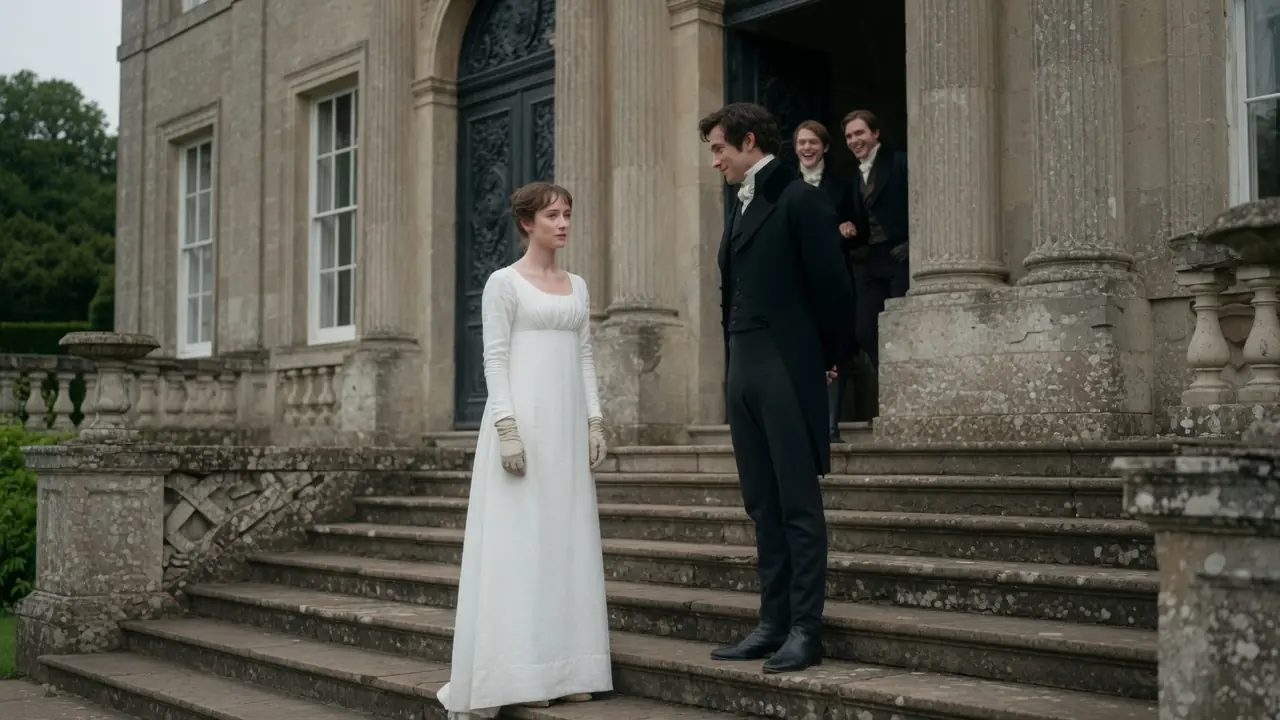
Lydia lowered the bow.
She did not look at Sebastian immediately.
That would have made the victory too easy.
She accepted the second arrow.
The steward’s hands trembled slightly as he offered it to her. Lydia almost felt sorry for him.
She stepped back into position.
Drew.
Loosed.
The second arrow landed so close to the first that the two shafts quivered together.
This time the silence came before the applause.
By the third arrow, no one pretended surprise anymore. They watched with the strange reverence people reserve for competence that has embarrassed their assumptions.
Lydia drew once more.
For a brief instant, the breeze shifted.
She waited.
A lesser archer would have released. A nervous one would have rushed. Lydia simply held, still as carved wood, until the air settled. Then she let the arrow go.
It struck the center again.
Perfect.
Absolute.
Unanswerable.
The lawn erupted.
Lydia turned then.
Sebastian was staring at her.
Not smiling. Not laughing. Not performing for anyone.
His face had changed in a way she would remember long afterward. It was the expression of a man discovering that the small, plain thing he had dismissed as insignificant was, in fact, a blade concealed in linen.
He crossed the grass slowly.
The applause softened around them, not because people lost interest, but because they had gained too much of it.
“Miss Fernsby,” he said.
“My lord.”
His gaze moved from the target back to her face. “That was extraordinary.”
“Yes.”
The answer escaped before she could restrain it.
A faint color rose along his cheekbones. Good. He deserved discomfort.
“I have been discourteous to you,” he said.
“You have.”
“And arrogant.”
“Frequently.”
“And foolish.”
She considered him. “That depends. Are you finished?”
A startled laugh moved through the nearby guests, quickly smothered. Sebastian did not look away.
“I would like to be.”
Something in the honesty of that answer unsettled her.
He removed his hat, not casually now, but properly. “I mistook your quiet for absence. Your plainness for poverty of spirit. Your position for your worth. I was wrong in every particular.”
Lydia’s hand tightened around the bow.
Across the lawn, Lady Cassandra watched with the expression of a woman witnessing a door close from the wrong side.
“You apologize well,” Lydia said.
“I have had very little practice.”
“That is evident.”
His mouth almost curved, but he stopped it. Wise man.
“Will you allow me to begin again?”
Lydia looked at him for a long moment.
Behind him, the target stood with three arrows clustered at its heart. Behind her, the house glittered with windows and judgment. Between them lay the first truly honest silence they had shared.
“To begin again,” she said, “requires more than a sentence.”
“I know.”
“Do you?”
“I am beginning to.”
She studied him. Without laughter, without that polished cruelty, Sebastian looked younger. Not weak. Simply less protected by charm.
“At breakfast tomorrow,” she said, “you may ask me how I learned to shoot.”
His eyes warmed. “I would like that very much.”
“I have not finished.”
He straightened. “No.”
“You may ask because you wish to know the answer. Not because it is amusing, not because the room is watching, and not because discovering one skill in me has made me suddenly acceptable.”
His expression sobered.
“You were acceptable before,” he said quietly. “I was merely too vain to notice.”
Lydia had no immediate answer to that.
It annoyed her.
“Breakfast, then,” she said.
“Breakfast.”
“And if you laugh at me again, Lord Sebastian, I shall assume you are volunteering to hold the next target.”
For one second he stared at her.
Then he laughed.
Not cruelly this time. Not brightly for an audience. It was helpless, warm, and entirely real.
Lydia found, to her inconvenience, that she liked it.
The following morning, Sebastian arrived at breakfast without his usual cluster of admirers. He took the seat beside Lydia only after asking whether it was free. This, she decided, was progress.
“How did you learn?” he asked.
So she told him.
She told him of her father’s garden, of the ash-wood bow, of the old gamekeeper who smelled of tobacco and rain, of winter afternoons spent practicing until her fingers ached. She told him that archery had taught her not to fear being watched, because the target did not care who approved. It only recorded whether she had been steady.
Sebastian listened.
Truly listened.
That was more disarming than his apology.
Over the remaining days of the house party, he did not transform into a saint. Lydia would have distrusted that. He still made the occasional careless remark, though he now caught himself afterward. He still carried too much pride in his shoulders. He still knew exactly how handsome he was, which was unfortunate but perhaps incurable.
But he tried.
He walked with her in the mornings and asked better questions. He introduced her properly to guests who had ignored her. When Lady Cassandra called Lydia’s skill “surprising for someone of her background,” Sebastian replied, “Talent is often surprising to those who have mistaken privilege for accomplishment.”
That remark traveled through the drawing room like a candle flame touching dry paper.
Lydia did not thank him for it.
Later, when they were alone near the terrace, she said, “I did not need defending.”
“I know,” he replied. “I was not defending you. I was correcting the room.”
That answer pleased her more than it should have.
On the final evening, the duchess hosted a small assembly in the long gallery. Music played, candles burned, and the guests who had once dismissed Lydia now spoke to her with eager politeness. It was almost comic, how quickly society revised its opinions when forced by evidence.
Sebastian approached as the second dance ended.
“Miss Fernsby,” he said, bowing. “Would you do me the honor?”
Lydia looked at his offered hand.
“You understand,” she said, “that dancing with the surgeon’s daughter may damage your reputation.”
His expression remained solemn, though his eyes betrayed him.
“Then I shall have to endure the tragedy.”
“And if people laugh?”
“I will try not to deserve it.”
It was a good answer.
Not perfect. But good.
She placed her hand in his.
As they joined the dance, Lydia caught sight of herself in the tall gilt mirror at the end of the gallery. Brown muslin. Mended gloves. Dark green ribbon. A woman who had arrived as an object of laughter and was leaving as someone no one in that house would ever again presume to measure by fabric alone.
Years later, people would say Lord Sebastian Harrow fell in love with Miss Lydia Fernsby when she placed three arrows in the center of a target at Halewick Court.
Lydia would always say that was not quite true.
“The arrows only made him look,” she would say. “He began to change when he learned to see.”
And because she valued accuracy above romance, she would add, “There is a very great difference.”