The loose black shoelace lay across the sidewalk like a thin snake waiting to trip her.
For eighty-six-year-old Ruth Bellamy, it might as well have been a locked gate.
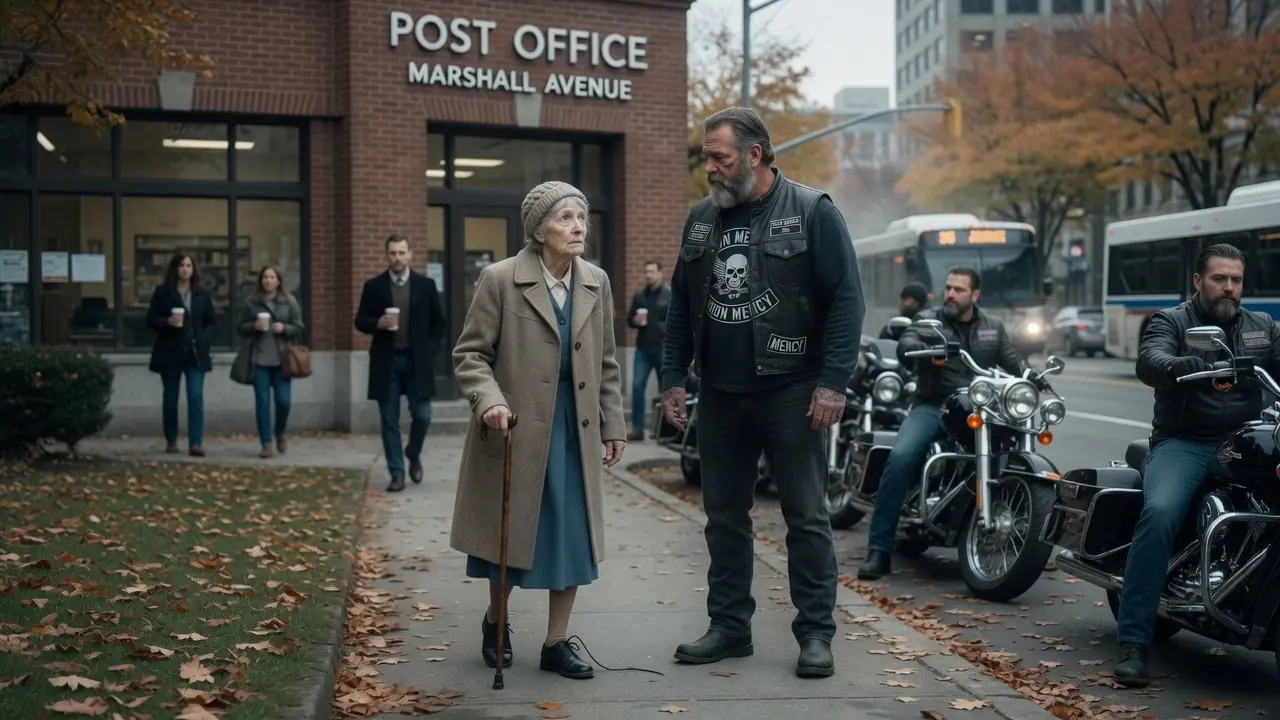
She stood outside the old post office on Marshall Avenue, one hand gripping her cane, the other pressed against the pocket of her beige coat where her pension check waited to be mailed. The morning air was sharp with autumn cold. Buses hissed at the curb. Office workers hurried past with coffee cups and phones pressed to their ears.
No one looked down.
No one saw the lace.
No one saw Ruth trying to bend.
Her knees trembled. Her back tightened. Pain shot through her hip before her fingers even reached halfway to her shoe. She straightened with a small gasp, cheeks burning from the humiliation of such a tiny failure.
A shoelace.
That was all.
Once, Ruth had carried laundry baskets up three flights of stairs. She had raised two boys, worked thirty-four years at a library, buried a husband, and survived a heart surgery the doctors said would require more courage than most people had.
Now she could not reach her own shoe.
The city moved around her as if she were a mailbox or a lamppost. A young man bumped her shoulder and muttered, “Sorry,” without slowing down. A woman stepped around her cane. A delivery driver cursed at traffic. Ruth swallowed the ache in her throat and tried again to bend.
The world tilted.
She grabbed her cane with both hands.
“Easy now,” she whispered to herself. “Just easy.”
Then she heard them.
At first, it was only a distant growl beneath the city noise.
Then the growl became thunder.
Heads turned along the sidewalk. A few pedestrians stepped backward. Cars slowed near the curb as six motorcycles rolled down Marshall Avenue in tight formation, chrome flashing beneath the gray morning sky.
The engines were loud enough to rattle the post office windows.
The riders looked even louder.
Black leather jackets. Heavy boots. Denim vests covered in patches. Beards, tattoos, dark glasses, scarred hands wrapped around handlebars. The motorcycles stopped at the curb directly in front of Ruth.
Her breath caught.
The lead rider shut off his engine.
The sudden silence felt almost worse.
He was huge, broad through the shoulders, with a thick gray beard and a face carved by hard years. His leather vest carried a patch that read: Iron Mercy MC. Beneath it, smaller letters read: No One Rides Alone.
Ruth had heard enough stories about motorcycle clubs to know she should be afraid.
And she was.
The big man removed his sunglasses. His eyes were dark, steady, and unreadable. He looked at Ruth, then at the shoelace lying loose across her orthopedic shoe.
For one awful second, she thought he might laugh.
Instead, he stepped off his bike and walked toward her.
Ruth’s fingers tightened around her cane.
“Ma’am,” he said, his voice low and rough, “you need a hand?”
Ruth lifted her chin.
She had no idea where the courage came from. Maybe from old age. Maybe from exhaustion. Maybe because pride had already failed her and honesty was the only thing left.
“Yes,” she said, barely above a whisper. “Could you tie my shoe?”
The big man did not smile.
He did not look embarrassed for her.
He simply nodded.
Then he lowered himself onto one knee in the middle of the sidewalk.
Leather creaked. His huge hands reached for the thin black lace with surprising care. Around them, the sidewalk slowed. People who had hurried past Ruth moments earlier now stopped to stare.
The biker looped the lace, crossed it, pulled it snug, then tied a firm double knot. He checked the other shoe too, tightening it gently so she would not trip.
“There,” he said, looking up at her. “That should hold.”
Ruth stared down at him.
Her eyes filled before she could stop them.
“Thank you,” she whispered. “You have no idea how much that helps.”
The biker stood slowly. He was so tall that Ruth had to tilt her head back to see his face.
“My name’s Cole,” he said. “Most folks call me Bishop.”
“Ruth Bellamy.”
“Good to meet you, Miss Ruth.”
Behind him, the other bikers remained by their motorcycles, quiet and watchful. One of them, a younger man with red hair and a nervous smile, lifted a hand in greeting. Ruth gave him the smallest wave.
From across the street, in the front window of a small flower shop, Hannah Price had seen everything.
She had been trimming roses when the motorcycles arrived. Like everyone else, she had looked up with alarm. Marshall Avenue was not the sort of street where bikers usually stopped in formation. It had banks, a post office, a bakery, a pharmacy, and elderly people who moved slowly with walkers and canes.
Hannah knew Ruth.
Every Tuesday and Friday, Ruth walked to the post office, then stopped by the flower shop window to admire the yellow roses. She never bought them. She always said, “Maybe next week,” with a smile that told Hannah next week was a dream they both understood.
Hannah had also seen the man.
The man in the brown jacket.
He had appeared three times in two weeks, always on Ruth’s post office days. He stood near the newspaper box or leaned against the wall by the alley. He never mailed anything. Never bought anything. Never spoke to anyone.
He only watched.
At first, Hannah told herself she was imagining it. Cities were full of people waiting for rides, taking smoke breaks, killing time.
But this man’s attention was too still.
Too narrow.
And today, he was there again.
Half-hidden beside the newspaper box, eyes fixed on Ruth’s purse.
Hannah felt cold despite the warmth of the flower shop.
Outside, Bishop was speaking to Ruth.
“You headed somewhere, ma’am?”
“Just inside to mail this,” Ruth said, patting her coat pocket. “Then the pharmacy. Then home.”
“By yourself?”
“I have been walking by myself for eighty-six years.”
Bishop nodded. “That’s a strong record.”
Ruth gave him a sharp look. “Don’t you start treating me like glass.”
One of the bikers coughed into his fist to hide a laugh.
Bishop’s mouth twitched.
“No, ma’am.”
Ruth looked toward the post office door, then at the busy sidewalk. “Well. I suppose I should go in before I become an attraction.”
“You already are,” Bishop said.
This time, Ruth smiled.
Hannah made a decision.
She grabbed a small bundle of yellow roses from the counter, pushed open the flower shop door, and hurried across the street.
“Mrs. Bellamy!”
Ruth turned. “Hannah, dear.”
Hannah reached them slightly out of breath.
“For you,” she said, placing the roses gently in Ruth’s free hand.
“Oh, I can’t take these.”
“You can. They were waiting for you.”
Ruth’s face softened with surprise.
Bishop watched the exchange quietly.
Hannah leaned closer to him as if adjusting the paper around the flowers. Her voice dropped to a whisper.
“The man in the brown jacket by the newspaper box. He’s been watching her for days.”
Bishop’s expression did not change.
But his eyes moved.
Just once.
Toward the newspaper box.
Then back to Hannah.
“Thank you,” he said softly.
Hannah stepped away, heart pounding.
The man in the brown jacket shifted when Bishop looked in his direction. Not enough for most people to notice. Enough for Bishop.
The other bikers noticed Bishop noticing.
The whole group changed without moving much at all.
The younger red-haired rider wandered toward the curb and leaned against a parking meter, casually placing himself between Ruth and the man. Another biker, thin and sharp-eyed, crossed his arms and watched the reflection in a shop window. A heavyset rider with a braided beard stepped behind Ruth, not close enough to frighten her, but close enough to block anyone coming from the alley.
Ruth looked around.
“What is happening?”
Bishop turned back to her with calm patience.
“Miss Ruth, would you mind if we walked with you today?”
Her eyebrows rose. “All of you?”
“Some of us.”
“I am perfectly capable of mailing a letter.”
“Yes, ma’am.”
“And picking up my prescription.”
“Yes, ma’am.”
“And walking home.”
“I believe you.”
“Then why are you offering?”
Bishop glanced toward the brown-jacketed man, then met Ruth’s eyes.
“Because being capable doesn’t mean you should have to be alone.”
Ruth’s lips parted.
For a moment, the noise of Marshall Avenue seemed to fade.
She looked down at the yellow roses in her hand, then at the big biker who had just knelt to tie her shoe in front of half the street.
Finally, she nodded.
“Well,” she said, “if you insist on escorting me, try not to look so gloomy. People will think I’m being arrested.”
The red-haired biker laughed out loud.
Bishop smiled. “We’ll do our best.”
They walked into the post office like a strange parade.
Ruth in the center, small and upright, cane tapping against the floor. Bishop beside her. Two bikers behind. One at the door. One outside near the motorcycles. The man in the brown jacket watched from the sidewalk but did not enter.
Inside, Ruth mailed her pension paperwork. The clerk stared at the bikers and forgot to ask if she wanted tracking.
“No tracking,” Ruth said gently. “Just stamps, dear.”
Bishop placed money on the counter before Ruth could open her purse.
She frowned. “I can pay for my own stamps.”
“I know.”
“Then move your hand.”
He moved it.
The clerk tried not to smile.
After the post office, they walked to the pharmacy. Bishop kept his pace matched to Ruth’s slow steps. He did not hurry her. He did not hover. He simply moved beside her like a wall that had decided to be kind.
The man in the brown jacket followed half a block behind.
Hannah watched from her flower shop window, one hand over her mouth.
At the pharmacy, Ruth collected her prescription. When she turned toward the door, the man in the brown jacket appeared outside, pretending to look at his phone.
Bishop saw him.
So did the others.
The sharp-eyed biker stepped outside first and stood near the entrance. The man in the brown jacket looked up, startled. Then he saw the rest of the bikers through the glass.
His face changed.
He turned and walked away quickly.
Not running.
But not casual anymore.
Bishop gave one quiet order.
“Mouse. Plate.”
The red-haired rider pulled out his phone and snapped a photo as the man climbed into a faded green sedan parked near the alley. The license plate was visible for one second before the car pulled away.
Ruth had seen enough to understand.
Her hand trembled against her cane.
“He was following me?”
Bishop did not answer too quickly.
“We think so.”
“Why?”
The heavyset biker with the braided beard spoke gently. “Because some people look for easy targets.”
Ruth flinched.
Bishop’s face hardened.
“And some people learn they picked wrong.”
Ruth looked up at him, fear and anger mixing in her eyes.
“I hate that I didn’t notice.”
“You were living your life,” Bishop said. “That’s not a crime.”
Her eyes filled.
“I thought I was just old and foolish.”
“No, ma’am.”
His voice dropped lower.
“You were alone. There’s a difference.”
The bikers walked Ruth home that day.
All the way.
They climbed the narrow stairs to her second-floor apartment above the dry cleaner. They checked the hallway light, the lock on her door, the loose chain latch, and the window that did not close properly near the fire escape.
Ruth tried to protest.
They ignored her politely.
Bishop placed his business card on the little table beside her door.
Iron Mercy MC
Cole “Bishop” Maddox
“My number is on the back,” he said. “You call if you see that man again.”
“I don’t like bothering people.”
“You won’t be bothering us.”
“I don’t like needing help.”
“None of us did at first.”
That stopped her.
Ruth looked at the men in her doorway. Rough faces. Scarred hands. Leather jackets. Careful eyes.
“You boys know something about that?”
Bishop gave a small, tired smile.
“Yes, ma’am. We do.”
Later that week, police arrested the man in the brown jacket.
His name was Allen Pike. He had been suspected in several robberies involving elderly people near post offices, pharmacies, and banks. He watched their routines. He waited until they were alone. He chose people he believed no one would protect.
Hannah’s warning, Mouse’s photo, and Bishop’s call to an old friend in the police department gave detectives the evidence they needed.
Ruth read the news article three times at her kitchen table.
Then she folded it carefully and placed it beside the yellow roses, now drying in a vase.
The next Tuesday, Ruth stood at her apartment door wearing her beige coat and sensible shoes.
She had told herself she would go to the post office alone.
She had even made it halfway down the stairs.
Then fear rose in her chest so sharply she had to sit on the landing.
She hated the fear most of all.
At ten o’clock, the sound came.
A low rumble outside.
Ruth went to the window.
Five motorcycles waited at the curb.
Bishop stood beside the lead bike, holding a small paper bag from the bakery.
He looked up and lifted two fingers in greeting.
Ruth laughed before she cried.
When she reached the sidewalk, Bishop handed her the bag.
“Blueberry muffin,” he said.
“I didn’t ask for breakfast.”
“No, ma’am.”
“You are very bossy.”
“Yes, ma’am.”
She took the muffin.
That became their routine.
Every Tuesday and Friday, the Iron Mercy riders arrived at ten. Sometimes all six came. Sometimes only Bishop and Mouse. They walked Ruth to the post office, then the pharmacy, then the flower shop, where Hannah always kept one yellow rose waiting.
At first, people stared.
Then they smiled.
Then they began to wave.
The sight became part of Marshall Avenue: a tiny elderly woman with a cane, escorted by bikers who looked like trouble and acted like family.
Ruth changed too.
She stood a little straighter.
She laughed more.
She began sitting with the bikers at the small diner near the pharmacy, drinking tea while they drank black coffee strong enough to wake the dead.
She learned their real names.
Bishop was Cole Maddox, a widower who still wore his wedding ring on a chain under his shirt.
Mouse was Peter, the youngest, who had grown up in foster homes and joined the club because Bishop once helped him fix a broken bike and then never stopped checking on him.
The heavyset biker was Abram, called Bear, who cooked better than anyone expected.
The sharp-eyed one was Vince, called Watch, who had been a security guard before an injury cost him his job.
They learned her stories too.
Her husband, Harold, had loved jazz and terrible jokes.
Her sons lived far away and called less than they should.
She had once wanted to travel to Italy but spent the money on Harold’s medical bills and never regretted it.
She had been afraid of becoming invisible.
The bikers understood that more than she expected.
“People see the leather and think they know us,” Bishop told her one afternoon.
Ruth stirred her tea.
“People see wrinkles and think they know me.”
He looked at her.
She looked back.
Then both of them smiled.
Months passed.
The Iron Mercy riders did more than escort Ruth.
They fixed the broken handrail in her building.
They installed a better lock.
They carried groceries for three other elderly tenants.
They started offering Tuesday escorts for anyone who needed to go to the bank, pharmacy, post office, or doctor.
No big announcement.
No charity banner.
Just motorcycles arriving, engines rumbling, men stepping down and asking, “Who needs a ride or a walk today?”
The neighborhood began to change.
A young man who had once laughed at Ruth started holding doors open for older residents.
The pharmacy placed chairs near the prescription counter.
The post office added a bench outside.
Hannah put a sign in the flower shop window:
If you need help crossing, carrying, reaching, or waiting, come inside. You are not invisible here.
Bishop pretended not to care when she told him the sign was inspired by him.
But Ruth saw his eyes.
One year after the shoelace incident, Marshall Avenue held a small block party.
It began as Ruth’s eighty-seventh birthday celebration and somehow turned into half the neighborhood crowding around folding tables filled with food. The Iron Mercy riders parked their motorcycles along the curb. Children asked to sit on them. Elderly women asked if the bikers could reach things on high shelves. Bear grilled sausages. Mouse handed out lemonade. Hannah brought a cake decorated with yellow roses.
Ruth sat at the center of it all, wearing a blue dress and the same black shoes.
Double-knotted, of course.
Bishop sat beside her.
“You know,” Ruth said, “I was terrified of you that first day.”
“I know.”
“You looked like a criminal.”
“I’ve been told.”
“I thought, well, Ruth, this is how it ends. Taken out by a giant biker because you couldn’t tie a shoe.”
Bishop laughed, a deep sound that made several people turn.
Ruth smiled.
“But then you knelt.”
His laughter faded.
She looked at the street where it had happened.
“That was the moment I knew I was wrong. Dangerous men don’t kneel to help old women unless there’s something good still alive in them.”
Bishop was quiet.
Then he said, “You asked for help like it was the bravest thing in the world.”
“It felt like it.”
“It was.”
Ruth reached over and patted his hand.
“Then I suppose we both did something brave.”
Years later, when Ruth Bellamy passed away peacefully at ninety-four, the funeral procession stretched for blocks.
At the front was the hearse.
Behind it rode the Iron Mercy Motorcycle Club.
Not six bikes.
More than sixty.
Engines rumbled low through the streets of Marshall Avenue as neighbors stood on sidewalks holding yellow roses. Hannah closed the flower shop for the day. The post office clerk came. The pharmacist came. Elderly residents from Ruth’s building came in a small bus the club had rented for them.
Bishop spoke at the service.
He stood before the church in his leather vest, gray beard longer now, voice rough with grief.
“First time I met Miss Ruth,” he said, “she asked me to tie her shoe.”
A soft laugh moved through the pews.
“I thought I was helping her with something small. A knot. A lace. Twenty seconds of my day.”
He paused, looking down at his hands.
“But she gave us something bigger. She gave us a chance to be seen differently. She reminded us that strength is not worth much if it never kneels. She reminded this whole street that nobody should have to grow old unseen.”
His voice thickened.
“She called us her boys. And I think every man here tried to become worthy of that.”
After the funeral, Hannah hung a photograph in the flower shop window.
It showed Ruth Bellamy sitting at the diner with a yellow rose in her hand, surrounded by six bikers in black leather. Bishop was beside her, trying not to smile and failing.
Beneath the photo was a small brass plaque:
It started with a shoelace.
It became a family.
Every Tuesday and Friday, the motorcycles still came.
The Iron Mercy riders still parked outside the post office at ten. They still walked with elderly neighbors. They still carried groceries, fixed locks, reached high shelves, and tied shoes when fingers could no longer do it.
And whenever someone asked Bishop why a motorcycle club spent its mornings escorting old people down Marshall Avenue, he would point to Ruth’s photograph in Hannah’s window.
“Because one day,” he would say, “an old woman was brave enough to ask a scary-looking man for help.”
Then he would smile.
“And that scary-looking man was lucky enough to hear her.”
The city never became perfect.
People still hurried.
Cars still honked.
Strangers still looked away too often.
But on Marshall Avenue, something had changed.
If an old woman stopped on the sidewalk, someone noticed.
If a cane slipped, someone reached.
If a shoelace came undone, no one laughed and no one walked past.
Because everyone remembered Ruth Bellamy.
And everyone remembered the day a biker knelt in the middle of the city, tied a simple black shoelace, and pulled an entire neighborhood back into kindness.