The snow came down so thick that the road disappeared beneath the tires of twelve Harley-Davidsons.
The Iron Wolves Motorcycle Club had been riding for almost six hours, trying to beat the storm before it swallowed the mountain roads completely. But by the time they reached the small town of Mill Creek, the sky had turned white, the wind had turned cruel, and even the strongest riders in the group knew they could not keep going much longer.
At the front rode Jack “Bear” Lawson, a fifty-two-year-old biker with a gray beard, broad shoulders, and eyes that had seen too many hard years to scare easily. His leather jacket was frozen stiff at the collar. Snow clung to his gloves. His hands were numb on the handlebars.
Behind him, eleven riders followed in a tight line, their headlights glowing weakly through the blizzard.
They looked dangerous to anyone watching from a window.
Black leather.
Heavy boots.
Tattooed hands.
Big engines.
But that night, they were not dangerous men looking for trouble.
They were freezing men looking for shelter.
“Bear,” one of the riders called through the radio, his voice breaking through static. “We can’t ride much farther.”
Bear already knew it.
One of the younger riders, Tommy, had started shaking badly. Old Frank, the club’s oldest member, was riding slower than usual, his bike drifting whenever the wind slammed into them. The road ahead was invisible. The nearest motel was still miles away.
If they kept going, someone would crash.
Bear lifted one hand and signaled the group to slow down.
Through the storm, he saw a small house at the end of a narrow road. The porch light was on, glowing soft and yellow through the snow. Smoke rose from the chimney. The roof was old. The porch leaned slightly to one side. But to the bikers, it looked like the safest place in the world.
Bear guided the motorcycles carefully into the driveway.
One by one, the bikes stopped.
The engines died.
For a moment, the only sound was the screaming wind.
Inside the house, seventy-four-year-old Clara Whitmore stood frozen behind her kitchen curtain.
She had been making tea when she heard the rumble.
At first, she thought it was a snowplow. Then the sound grew louder, deeper, rougher. When she looked out, she saw motorcycles pulling into her driveway.
Not one.
Not two.
A whole group of them.
Her heart began to pound.
Clara lived alone. Her husband had died eight years ago. Her children had moved away. Most nights, the house was quiet except for the ticking clock and the old furnace humming in the basement.
She was not used to strangers.
Especially not men like these.
They were huge, covered in leather, standing in the snow beside their motorcycles. One had a beard down to his chest. Another had tattoos on his neck. A few wore patches she could not read from the window.
Clara stepped away from the curtain.
“No,” she whispered. “No, no, no.”
Someone knocked on the front door.
Not loudly.
Just three careful knocks.
Clara did not move.
The knock came again.
Then a man’s voice called through the storm.
“Ma’am? We’re sorry to bother you. We don’t want trouble. We just need a place to stand out of the wind for a little while.”
Clara held one hand to her chest.
Every sensible thought told her to stay quiet. Let them go away. Call someone. Lock the door.
But then she looked through the curtain again.
The men were not laughing. They were not pushing at her door. They were standing back from the porch, giving her space.
One of them was helping an older man stay on his feet.
Another had his arms wrapped around a younger rider who was shaking so badly he could barely stand.
They were not trying to frighten her.
They were freezing.
Clara looked toward the photograph of her late husband, Henry, on the wall.
Henry had always stopped for stranded people. He used to say, “Cold don’t ask if a man is good or bad before it kills him.”
Clara closed her eyes.
“Oh, Henry,” she whispered, “you would open the door, wouldn’t you?”
The wind slammed snow against the windows.
The young rider outside stumbled.
That decided it.
Clara unlocked the door and opened it just a crack.
The man standing on the porch immediately stepped back and raised both hands.
“Ma’am,” he said gently, “my name is Jack Lawson. Folks call me Bear. We’re caught in the storm. We just need to warm up enough to keep riding when it passes. We won’t hurt you.”
Clara studied his face.
He looked rough.
But his eyes were tired, not cruel.
She looked past him at the other bikers shivering in the snow.
Then she opened the door wider.
“Well, don’t just stand there turning into statues,” she said. “Get inside before you freeze to death.”
For a second, none of the bikers moved.
Bear blinked, surprised.
“Ma’am, are you sure?”
“No,” Clara said. “But I’m doing it anyway.”
Bear gave a small nod.
“You heard the lady. Boots wiped. Helmets off. Be respectful.”
Twelve bikers entered Clara Whitmore’s tiny house like schoolboys afraid of misbehaving.
They wiped their boots on the mat. They removed their helmets. They stood awkwardly in her front room, dripping snow onto the old rug, trying to make themselves smaller than they were.
Clara pointed toward the living room.
“Sit where you can. Not all at once on the couch. That thing is older than half of you.”
A few of the bikers smiled.
Bear helped old Frank into the armchair near the fireplace. Tommy, the youngest rider, sat on the floor with a blanket around his shoulders, still shaking.
Clara went to the hallway closet and pulled out every blanket she owned.
“You,” she said, pointing at a giant biker with a shaved head. “Help me carry these.”
The man jumped up. “Yes, ma’am.”
“What’s your name?”
“Moose.”
Clara paused. “Of course it is.”
The room laughed softly.
That little laugh changed something.
The fear in the house began to loosen.
Clara made tea in her biggest pot. She found an old tin of cocoa and mixed it with hot milk. She opened a package of crackers, cut up the last block of cheese, and placed everything on a plate.
It was not much food for twelve grown men.
But it was warm.
And it was offered with kindness.
Bear noticed the nearly empty cupboard when Clara opened it.
His expression changed.
“Miss Clara,” he said quietly, “we can’t take your food.”
“You already did when you walked in half-frozen,” she replied. “Now eat.”
“We can pay.”
She turned and gave him a sharp look.
“This is not a diner.”
“No, ma’am.”
“Then stop talking foolish.”
Bear lowered his head, almost smiling.
“Yes, ma’am.”
The bikers ate carefully, taking small portions, making sure everyone had some. One of them, a soft-spoken rider named Manny, insisted on washing the cups. Moose carried firewood from the back porch. Another rider checked the old furnace when it made a strange rattling sound.
Clara watched them from the kitchen doorway.
They were not what she had expected.
They said please and thank you. They called her ma’am. They helped each other without being asked. When old Frank coughed, three men turned at once to make sure he was all right.
Bear stood near the fireplace, warming his hands.
“You live here alone, Miss Clara?”
“I do.”
“Family nearby?”
“Not nearby enough.”
He nodded, understanding more than she said.
The storm grew worse outside. The roads vanished beneath snow. The radio warned people not to travel until morning.
Bear looked at the window, then back at Clara.
“We’ll stay on the porch if you want. We don’t want to make you uncomfortable.”
Clara looked at the twelve men in her living room. Big, rough-looking men wrapped in flowered blankets, holding mugs of cocoa like children after a long day.
She sighed.
“Nobody’s sleeping on my porch in this weather. You can stay until morning. But if anybody snores too loud, I’m waking you up.”
Moose raised one hand. “That’ll be Frank.”
Frank opened one eye. “Lies.”
The room laughed again.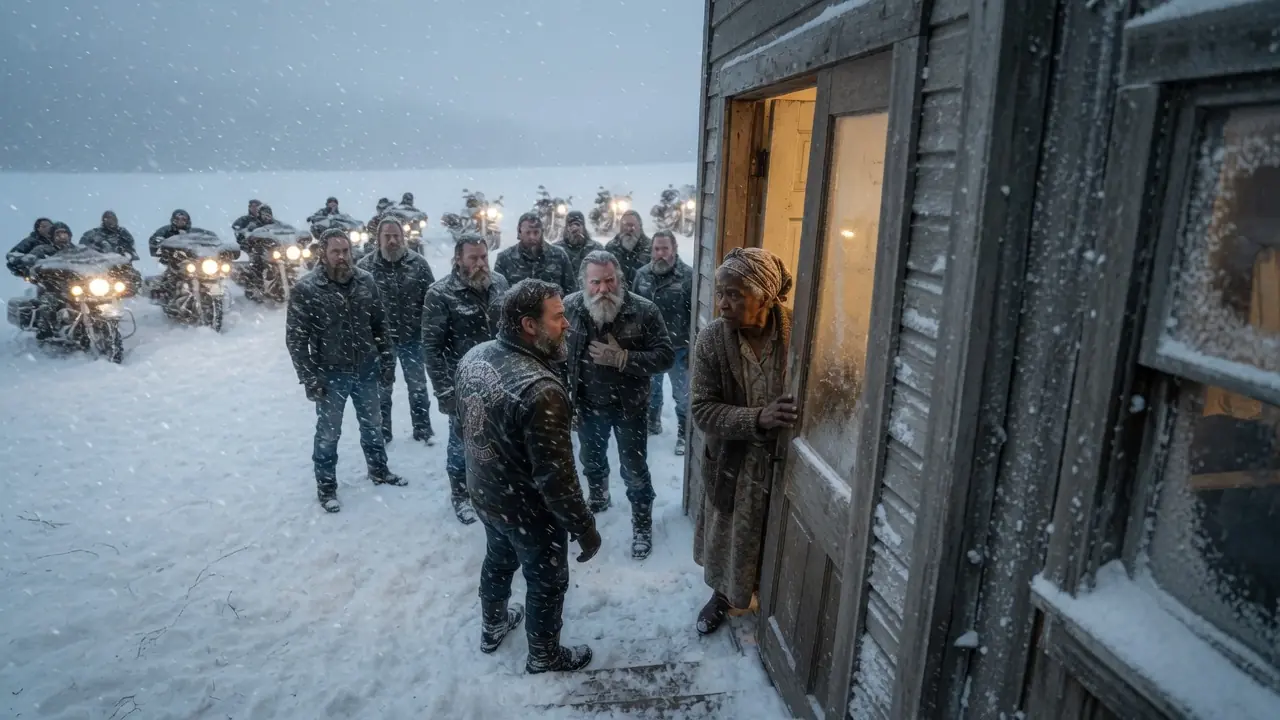
That night, Clara’s little house became warmer than it had been in years.
The bikers spread out wherever they could. Some slept sitting up. Some took the floor. Bear stayed awake the longest, sitting near the window, watching the snow, making sure his men were safe.
Clara woke once around two in the morning and found him still there.
“You don’t sleep?” she asked.
“Not much.”
“War?”
Bear was quiet for a moment.
“Some.”
“My Henry was the same way.”
Bear looked at the photograph on the wall.
“He served?”
“Army. Good man. Stubborn as a mule.”
Bear smiled. “Best kind.”
Clara sat in the chair across from him.
For a while, neither of them spoke.
Then Bear said, “Most people wouldn’t have opened that door.”
Clara looked toward the sleeping bikers.
“I almost didn’t.”
“Why did you?”
She folded her hands in her lap.
“Because you looked cold.”
Bear stared at her as if that answer meant more than she knew.
By morning, the storm had passed.
Sunlight shone over a world buried in white.
The bikers woke quietly, folding Clara’s blankets with surprising care. Manny cleaned the kitchen. Moose shoveled her porch and front walkway without being asked. Another rider cleared snow off her car, even though it had not run in months.
Bear tried again to give Clara money.
She refused before he finished reaching into his pocket.
“Miss Clara, please.”
“No.”
“You kept us alive last night.”
“I gave you a roof and cocoa.”
“That was more than we had.”
She shook her head.
“You boys needed help. I had a door. That’s all.”
Bear looked at her for a long moment. Then he took a business card from his vest and placed it on the kitchen table.
Iron Wolves Motorcycle Club
Jack Lawson, President
“If you ever need anything,” he said, “you call me.”
“I won’t.”
“I know. Keep it anyway.”
Old Frank walked over and took Clara’s hand between both of his.
“You reminded me of my mother,” he said softly. “She would have opened the door too.”
Clara’s eyes filled with tears.
“Well, then she raised you right.”
One by one, the bikers thanked her.
They shook her hand. Some hugged her gently after asking permission. Tommy, the young rider who had been shaking so badly the night before, could barely speak.
“You saved me from doing something stupid,” he said. “I thought I could ride through it.”
Clara patted his arm.
“Young men always think they can ride through everything. That’s why old women have to open doors.”
The bikers laughed.
Then the engines started.
Clara stood on her porch wrapped in Henry’s old coat, watching twelve Harleys roll carefully down the snow-covered street. Bear was the last to leave. He lifted one hand to her before turning onto the road.
By noon, the house was quiet again.
Too quiet.
Clara washed the mugs, folded the last blanket, and put Bear’s card in the drawer beside Henry’s photograph.
She thought that was the end of it.
She was wrong.
Three days later, Clara heard motorcycles again.
This time, the sky was clear.
She stepped onto the porch and saw the Iron Wolves turning onto her street.
But they were not alone.
Behind the motorcycles came two pickup trucks, a van, and a trailer loaded with lumber, groceries, firewood, and tools.
Bear parked in front of the house and removed his helmet.
Clara crossed her arms.
“Jack Lawson, if you brought me money, you can turn right around.”
Bear smiled.
“No money, Miss Clara.”
Moose climbed out of a truck carrying a toolbox.
Manny carried bags of groceries.
Frank held a new winter coat still in plastic.
Tommy carried a box of canned food.
Clara looked from one man to another.
“What is all this?”
Bear stepped onto the walkway.
“This is us saying thank you.”
“I told you I don’t need payment.”
“It’s not payment,” Bear said. “It’s gratitude.”
Before Clara could argue, Moose pointed toward the porch roof.
“That thing’s about one snowstorm away from coming down.”
Another biker looked at the broken railing. “Steps are bad too.”
Manny held up the grocery bags. “And no one who feeds twelve bikers should have empty cupboards.”
Clara’s mouth opened, but no words came out.
Bear’s voice softened.
“You opened your door when you were scared. You gave us warmth when you barely had enough for yourself. You treated us like people when most folks see the leather and look away. Let us do this.”
Clara looked at the men.
They were waiting, not pushing.
Just like they had waited outside her door in the storm.
Finally, she whispered, “I don’t know how to accept help.”
Bear nodded.
“Most of us didn’t either.”
That broke something open in her heart.
She stepped aside.
“All right,” she said. “But nobody touches Henry’s roses.”
The bikers went to work.
Moose repaired the porch railing. Diesel fixed the steps. Manny filled the kitchen shelves with groceries. Frank stacked firewood beside the back door. Tommy cleaned the gutters. Bear called a friend who worked in heating repair, and by evening, Clara’s old furnace was running better than it had in years.
Neighbors came out to watch.
At first, they looked suspicious.
Then they saw the bikers carrying lumber, shoveling snow, fixing broken boards, and laughing with Clara as if they had known her all their lives.
Mrs. Donnelly from next door walked over slowly.
“Clara, are you all right?”
Clara looked at the bikers working around her house.
“I think I’m better than all right.”
Bear introduced himself politely. Moose fixed Mrs. Donnelly’s loose mailbox before she could even ask. Manny carried groceries to another elderly neighbor. Tommy helped a boy repair the chain on his bicycle.
By sunset, the whole street had changed.
Not because money had fallen from the sky.
Not because anyone had planned a miracle.
But because twelve bikers had been given shelter by one old woman, and they had decided kindness like that deserved to come back home.
Before leaving, Bear stood with Clara on the repaired porch.
The wood was steady beneath their feet now.
“You know,” he said, “we’ve ridden through this town a hundred times. Never stopped.”
Clara looked down the street, where children were waving at the bikers.
“Maybe the storm made you stop.”
“Maybe,” Bear said. “Or maybe it brought us where we were supposed to be.”
Clara smiled.
“You always talk like that?”
“Only when old ladies make me think too much.”
She laughed.
For the first time in months, the sound felt easy.
The Iron Wolves came back the next week.
And the week after that.
At first, they said they were just checking the porch. Then the furnace. Then the firewood. Then somehow Sunday supper became a tradition.
Clara cooked what she could. The bikers brought what she could not. Sometimes they filled her kitchen until there was no room to move. Sometimes only Bear came by with coffee and a quiet question.
“You doing all right, Miss Clara?”
And for the first time in a long time, Clara could answer honestly.
“I am.”
By spring, the Iron Wolves had repaired three more porches on her street, delivered groceries to five elderly neighbors, and started a winter emergency fund for people who could not afford heat. They never made a big announcement. They never asked for praise.
They just showed up.
The sound of motorcycles no longer frightened Clara’s neighborhood.
When people heard the engines now, they looked out the window and smiled.
Because they knew the Iron Wolves were not coming to cause trouble.
They were coming to check on someone.
One year later, on the first heavy snowfall of winter, Clara stood at her kitchen window with a mug of real coffee in her hands.
Her cupboards were full.
Her porch was strong.
Her house was warm.
On the wall beside Henry’s photograph hung another picture: Clara standing in the snow with twelve bikers around her, all of them smiling like family.
Then she heard it.
A familiar rumble.
Clara opened the door before they could knock.
Bear stood on the porch with snow in his beard and a grin on his face.
Behind him, the Iron Wolves waited with grocery boxes, firewood, and one badly wrapped Christmas wreath.
Clara shook her head.
“You boys planning to get trapped in another storm?”
Bear smiled.
“No, ma’am. This time we came before the storm.”
Clara stepped aside.
“Well, don’t just stand there freezing. Get in here.”
The bikers laughed and entered the warm little house.
And Clara, who had once been afraid to open her door, now kept it ready for them.
Because sometimes family does not arrive the way you expect.
Sometimes it comes wearing leather.
Sometimes it rides through snow on Harleys.
Sometimes it knocks gently in the middle of a storm and asks only for a place to stand out of the wind.
And sometimes, when you open the door, kindness does not just enter your house.
It comes back again and again, until your whole life is warmer than before.