“I object.”
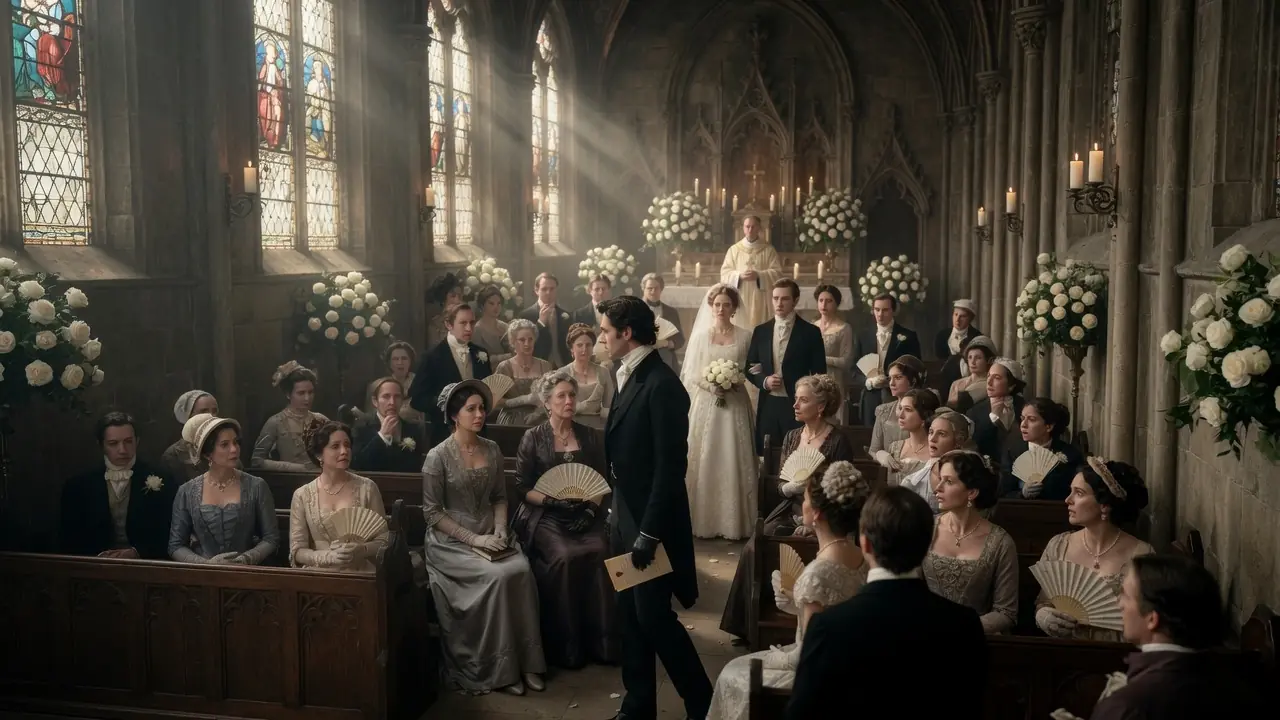
The words were not shouted. They were spoken softly, almost gently, yet they sliced through St. Stephen’s Chapel like a blade through silk. The priest froze mid-sentence. The rustle of satin stopped. Eighty aristocratic guests turned in perfect unison toward the back of the church.
At the last pew stood a man dressed entirely in black, tall, broad-shouldered, unmoving. He looked less like a wedding guest and more like a man attending a funeral, but he was not looking at the bride, nor at the groom waiting stiffly beside her. His cold gray eyes were fixed on the woman seated alone in the third row, the woman in gray silk, the woman who had been forced to watch her own fiancé marry her sister.
In that terrible, suspended moment, Miss Cecily Davenport felt the world tilt because the man who had spoken those words was not merely interrupting a wedding. He was declaring war.
Six weeks earlier, life at Fenwick Close in Hertfordshire had still seemed ordinary. The manor stood among rolling green hills where the air carried the scent of jasmine and fresh-cut grass. On warm evenings, the Davenport family took tea in the garden beneath the wisteria vines.
It was there that Cecily had once believed love could be trusted. At twenty-three, she was neither young nor old by London standards. Yet in the cruel arithmetic of the marriage market, each passing season weighed heavily. Her younger sister, Lady Dorinda, however, never felt such pressure.
Dorinda possessed the sort of beauty that silenced rooms: golden curls that caught candlelight like spun honey, blue eyes wide with practiced innocence, and a laugh that drifted across ballrooms like music. Men noticed Dorinda immediately. Cecily required a second glance. Dark hair, thoughtful eyes, a quiet elegance that only revealed itself slowly.
Most men never bothered with that second look. But one man had, or so she had believed.
Lord Hugh Fenwick, second son of the Earl of Bassington, had courted Cecily for fourteen months. Fourteen months of dinners, garden walks, carriage rides, and polite letters sealed with careful wax. He had danced with her at every assembly. He had spoken privately with her father.
In society, such attentions carried meaning. They were not promises written in law, but they were close enough. A gentleman did not court a lady publicly for a year only to discard her. To do so was more than unkind. It was ruin.
Cecily learned this truth on a quiet Tuesday afternoon. Sunlight streamed through her bedroom window as she sat reading a worn volume of Tennyson. The door opened. Her mother entered.
Lady Marion Davenport was still handsome at fifty-two, though time had sharpened her beauty into something cold and calculating. She regarded her elder daughter with the same mild disappointment she might show a poorly arranged painting.
“Put the book down, Cecily. We must speak.”
A tremor of unease passed through Cecily. Her mother never sat on the bed beside her. Never spoke gently. Yet now Lady Marion folded her gloved hands and said calmly, “Lord Fenwick called on your father this morning.”
Cecily’s heart lifted.
“He asked for Dorinda’s hand in marriage.”
The words seemed to drift through the room without meaning.
“That is not possible,” Cecily said quietly. “He has been courting me for over a year.”
Her mother’s lips thinned. “He has reconsidered.”
The silence that followed felt suffocating.
“Dorinda is younger,” Lady Marion continued, as though explaining something obvious, “more beautiful, more agreeable, a better match in every respect.”
Cecily’s throat tightened. “You arranged this.”
“I encouraged it.”
The calm cruelty of the statement struck harder than any raised voice.
“A mother’s duty,” Lady Marion said, “is to secure the best futures for her daughters.”
“You mean Dorinda’s future.”
“You should be grateful,” her mother replied coolly. “Your sister’s marriage will elevate the family.”
Cecily felt something inside her chest fracture cleanly in two.
The weeks that followed became a slow, exquisite humiliation. Dorinda moved through the house in glowing excitement, choosing fabrics, discussing flowers, admiring herself in mirrors. She visited Cecily often.
“I hope you are not angry with me,” she said sweetly one afternoon. “Hugh says he always admired you, but when he met me, he simply couldn’t help himself.”
The smile behind those words was not innocent. Cecily understood the truth instantly. Dorinda had pursued him deliberately. And Hugh, Hugh had been weak enough to follow.
The final cruelty came days before the wedding.
“You will attend,” Lady Marion said.
Cecily looked at her in disbelief. “You are asking me to watch him marry her.”
“I am telling you to.”
Her mother’s voice turned icy.
“If you refuse, you will leave this house without allowance, without support, and without a family willing to claim you.”
Cecily turned toward her father. Mr. Davenport stood by the window, pale and silent.
“Father?”
He looked away.
That was his answer.
And so, on a bright May morning, Cecily Davenport sat in the third pew of St. Stephen’s Chapel, wearing a simple gray gown, the color of surrender. Her hands were folded tightly in her lap. Her sister walked down the aisle in white satin and Brussels lace.
Lord Hugh Fenwick waited at the altar, smiling proudly. The priest lifted his book.
“If any person here present knows of any lawful impediment why these two should not be joined together in holy matrimony—”
“I object.”
The quiet voice echoed again in Cecily’s memory as she turned toward the man at the back of the chapel. He was already walking forward, tall, commanding, dangerously calm. The Duke of Montrose.
And as he approached the altar, the entire church seemed to understand that this moment would not merely stop a wedding. It would destroy reputations and perhaps begin something far more dangerous, because the Duke’s gaze never left Cecily.
The chapel doors stood open behind him, letting in pale morning light that spilled across the stone floor as Lysander Vane, Duke of Montrose, walked slowly down the aisle. Each step echoed. No one spoke. Even the priest seemed to forget how.
Dorinda Davenport stood frozen halfway between triumph and terror, her white satin skirts trembling around her ankles. Lord Hugh Fenwick had gone the color of old parchment. But the Duke paid them no attention. His gaze remained fixed on Lady Cecily.
She felt it like warmth against cold skin.
For six weeks, she had endured humiliation without protest. She had trained herself not to feel the whispers, the pitying glances, the quiet cruelty of her own family. Yet now the entire chapel watched her, and the most powerful man in England was walking toward her as though she were the only person who mattered.
A murmur rippled through the guests.
“Montrose.”
“What is he doing here?”
“He never attends weddings.”
When the Duke reached the altar, he stopped with deliberate calm. The priest cleared his throat nervously.
“Your Grace, this is most irregular.”
“Yes,” Lysander replied mildly. “That is rather the point.”
A faint tremor ran through the room.
He turned to face Lord Hugh Fenwick.
“Lord Fenwick,” he said in a voice of polite civility, “before you proceed any further, I must ask whether you recall declaring, on at least three separate occasions, your intention to marry Miss Cecily Davenport.”
Hugh swallowed. “That was a misunderstanding.”
“Was it?”
The Duke removed a folded document from the inside pocket of his coat.
“The letters you wrote to her suggest otherwise.”
Gasps whispered across the pews.
Lady Marion Davenport rose sharply. “This is outrageous. Your Grace has no authority to interfere in our family affairs.”
Lysander’s head turned slowly toward her. The look he gave her was not angry. It was worse.
“Madam,” he said quietly, “when a gentleman publicly courts a lady for fourteen months, he creates an understanding recognized by every drawing room in England.”
He paused.
“When that gentleman then abandons her to marry her sister,” his voice dropped slightly, “it becomes society’s affair.”
Dorinda’s bouquet trembled violently.
“Hugh,” she whispered.
Hugh’s eyes darted between them like a trapped animal.
“You cannot prove anything,” he said hoarsely.
The Duke unfolded the paper.
“I can prove quite a great deal.”
He spoke with unhurried precision.
“Witnesses from the Harrington Ball, the Ashbury Dinner, and two garden walks at Fenwick Close.”
Murmurs grew louder.
“And of course, the letters in which you wrote,” his gray eyes flicked briefly toward Cecily, “that Miss Davenport was the only woman you intended to marry.”
The silence that followed was devastating.
Hugh’s face crumpled. Dorinda looked suddenly very small inside her wedding lace. Lady Marion’s lips pressed into a thin line of fury.
“This is slander,” she said sharply. “My younger daughter has done nothing improper.”
“Indeed,” Lysander replied. His gaze slid to Dorinda. “And yet, it is remarkable how quickly Lord Fenwick’s attention shifted once her beauty became available.”
A ripple of uncomfortable laughter spread through the chapel. Dorinda flushed scarlet.
“This is humiliating,” she cried.
“Yes,” said the Duke calmly. “That is precisely what your sister has endured for six weeks.”
For the first time, every eye turned fully toward Lady Cecily. She had not moved. Her back remained perfectly straight, but the pressure of a hundred stares pressed against her skin like heat.
Lysander looked at her again, and when he spoke next, his voice softened.
“Miss Davenport,” he said quietly.
Her breath caught.
“You have been wronged.”
The words seemed to settle into the chapel like falling snow.
“You were courted publicly, promised consideration, then abandoned in favor of convenience.”
He paused.
“And yet, you were asked to sit here today and witness the spectacle.”
His gray eyes darkened.
“That injustice cannot be permitted.”
Lady Marion scoffed. “And what exactly do you intend to do about it, Your Grace?”
The Duke folded the document neatly. Then he said something that made the entire chapel stop breathing.
“I intend,” Lysander said calmly, “to ensure Miss Davenport receives the future that was stolen from her.”
Dorinda spoke nervously. “By ruining us?”
“No.”
His gaze returned to Cecily.
“By offering her something far greater.”
And in that charged moment, every person in the chapel understood.
The Duke had not merely come to stop a wedding.
He had come for her.
The silence inside St. Stephen’s Chapel deepened until it became unbearable. Every noble guest leaned forward because the Duke of Montrose had just turned the entire scandal toward a single woman sitting quietly in the third row.
Cecily felt the weight of a hundred eyes settle upon her shoulders. For six weeks, she had been invisible. Now the most feared man in England was looking at her as though she were the center of the world.
She forced herself to breathe.
“Your Grace,” Lady Marion said sharply, breaking the silence. “Whatever grievance you believe exists, this spectacle must end. My younger daughter’s wedding will proceed.”
Lysander Vane did not even glance at her. Instead, he stepped away from the altar and walked down the aisle toward Cecily.
The whispering began immediately.
“Montrose is going to her.”
“Good God.”
“Does he even know the girl?”
Each step was measured, unhurried, and utterly certain. By the time he reached the third pew, Cecily’s heart was beating so loudly she feared the entire chapel could hear it.
He stopped directly in front of her.
Up close, he was even more formidable. Tall enough to cast a shadow across her lap. Dark hair falling in careless waves over a strong brow. Eyes the color of winter storms.
For a long moment, he simply looked at her.
Not with curiosity.
With recognition.
“Miss Davenport,” he said quietly.
His voice was deep, calm, and unexpectedly gentle.
Cecily rose slowly to her feet. She had never spoken to this man before. Yet the way he looked at her made it seem as though he had known her all his life.
“You do not know me,” he continued.
A faint murmur swept the pews.
“But I know you.”
Dorinda scoffed loudly from the altar. “This is absurd.”
Lysander ignored her. His eyes never left Cecily.
“I know,” he said softly, “that you attend musical evenings and listen when everyone else talks.”
Cecily blinked in confusion.
“I know you read poetry while pretending to observe dancing.”
Her pulse quickened.
“I know you gave your favorite book to a servant’s child last winter because he had never owned one.”
A ripple of astonishment moved through the chapel. Lady Marion’s expression shifted from outrage to alarm.
“How could you possibly—”
“Because,” Lysander said calmly, “I have been watching.”
Cecily felt a strange warmth spread through her chest.
Watching.
Not judging.
Not overlooking.
Watching.
“For three years,” he added.
The confession fell over the room like thunder.
Three years.
Even Cecily’s composure faltered.
“You watched me?” she whispered.
“Yes.”
His answer held no apology.
“I first saw you at Lord Ashbury’s musical.”
Memory flickered suddenly. A crowded drawing room. A Beethoven quartet. And the strange feeling that someone across the room had been observing her.
“You closed your eyes during the second movement,” he said.
Cecily’s breath caught.
“You listened,” Lysander continued softly, “as though the music mattered more than the audience.”
His gaze softened in a way that made her pulse tremble.
“In a room full of people performing for each other, you were the only person who forgot to pretend.”
The chapel had become utterly silent. Even Dorinda stood frozen.
“Since that night,” the Duke continued, “I have seen you overlooked, compared, dismissed.”
A flicker of something dark passed through his eyes.
“And today, I watched as you were asked to endure the greatest humiliation society can impose upon a lady.”
Cecily felt heat rise behind her eyes.
He had seen it.
All of it.
The six weeks of quiet cruelty. The forced attendance. The gray dress.
“I will not allow that injustice to stand,” he said quietly.
The words were not dramatic, but they carried the absolute certainty of power.
Lady Marion rose again. “This is outrageous.”
But Lysander raised a single hand.
She fell silent.
He then did something that caused a collective gasp to ripple across the chapel. He extended his hand toward Cecily.
Not commanding.
Offering.
“If you will permit it,” he said quietly, “I would like to remove you from this place.”
Her heart thundered.
“You are asking me to leave my sister’s wedding.”
“No.” His eyes held hers steadily. “I am asking you to walk away from people who never deserved you.”
The chapel waited. Dorinda stared in fury. Hugh looked pale and terrified. Lady Marion’s face had gone rigid with disbelief.
But Cecily was looking only at the Duke. At the strange warmth in his gray eyes. At the hand he held out with such calm certainty.
For the first time in weeks, something inside her chest loosened.
A choice.
Finally.
And slowly, very slowly, Cecily Davenport placed her hand in his.
The gasp that followed echoed through the chapel. And the Duke of Montrose closed his fingers gently around hers.
A ripple of shock swept through St. Stephen’s Chapel as Cecily’s hand settled into the Duke’s gloved palm. For a moment, neither of them moved. His grip was steady, warm, protective. As though this moment had been inevitable.
Dorinda recovered first.
“You cannot be serious,” she cried, her voice cracking across the quiet chapel. “This is my wedding.”
Lysander did not even turn his head. His gaze remained on Cecily.
“Miss Davenport,” he said softly. “Are you certain you wish to remain here?”
Cecily’s heart pounded against her ribs. The room felt suffocating. The white roses. The staring guests. Her sister in bridal silk beside the man who had once whispered promises beneath moonlight.
For six weeks, she had endured it.
But now.
Now someone was offering her escape.
Lady Marion’s voice cut sharply through the air. “Cecily, sit down at once.”
Her tone held the brittle command of a woman used to obedience.
“Do not make a greater spectacle of yourself than you already have.”
Cecily felt the old instinct stir. The reflex to comply. To swallow humiliation quietly. Yet the Duke’s hand tightened slightly around hers.
A silent reminder.
You are not alone.
She lifted her chin.
“No.”
The single word fell into the chapel like a stone dropped into still water.
Lady Marion’s eyes flashed with fury. “You ungrateful girl.”
“Enough.”
Lysander’s voice was quiet, but it carried such authority that even the priest startled.
He turned then, slowly, to face the congregation.
“You have all witnessed the circumstances of this wedding,” he said evenly.
His gaze swept the pews. Nobles. Merchants. Neighbors. People who had spent weeks whispering about Cecily’s humiliation.
“And you have all watched in silence.”
Several guests shifted uncomfortably.
“Society enjoys spectacle,” the Duke continued coolly. “Particularly when it costs nothing.”
His eyes hardened.
“But this one ends now.”
Dorinda’s face burned crimson. “You cannot simply take her.”
Lysander finally looked at her. It was not a cruel look. Merely dismissive.
“Miss Davenport,” he said calmly. “You have already taken something that did not belong to you.”
Dorinda faltered.
Hugh attempted to speak. “Your Grace. Surely we can discuss this privately.”
“No.”
The Duke’s answer came without hesitation.
“There will be no private discussions.”
He gestured lightly toward the gathered witnesses.
“This matter has been public from the beginning.”
The implication hung heavily in the air. Hugh’s reputation, already fragile, was crumbling by the minute.
Lysander turned back to Cecily.
“Shall we go?”
Her pulse raced. Outside those chapel doors lay uncertainty. Inside waited a lifetime of quiet humiliation.
She looked once more toward the altar. Hugh would not meet her eyes. Dorinda clutched her bouquet like a shield. Lady Marion’s expression held nothing but cold resentment.
Cecily realized suddenly that no one here had ever fought for her.
Not once.
Except the man standing beside her.
“Yes,” she said softly.
The Duke inclined his head. Then, with perfect composure, he tucked her hand into the crook of his arm.
Gasps echoed again as they turned toward the aisle. Guests parted instinctively. No one dared block the path of the Duke of Montrose.
Their footsteps sounded together against the stone floor. Cecily felt strangely calm now. Each step carried her farther from the life she had known. From her mother’s calculations. From Dorinda’s glittering rivalry. From Hugh’s weak promises.
At the chapel doors, Lysander paused. Sunlight spilled across the threshold.
He glanced down at her briefly.
“You may still change your mind,” he said quietly. “I will take you wherever you wish.”
Cecily looked back once. The altar. The shattered wedding. The family that had asked her to smile while her heart broke.
Then she stepped into the sunlight.
“No,” she said softly. “I think I have already changed it.”
Outside, a black carriage waited beneath the blooming chestnut trees. The Duke guided her toward it. And as the chapel doors closed behind them, whispers erupted inside the church that would spread across England by nightfall.
But Cecily Davenport did not hear them.
Because the moment she stepped into the carriage beside the Duke, she realized something extraordinary.
For the first time in years, someone had chosen her.
The door closed with a quiet, decisive click. For a moment, the world outside vanished. No whispering guests. No furious mother. No shattered wedding.
Only the steady rhythm of hooves as the Duke’s carriage rolled away from St. Stephen’s Chapel.
Cecily sat opposite Lysander Vane, her hands folded tightly in her lap. The air inside the carriage smelled faintly of cedar and leather.
And him.
She had done something reckless. Utterly unthinkable. Walked out of her sister’s wedding on the arm of a duke. Society would devour the story by evening.
Yet Lysander looked completely untroubled. He watched her quietly as though studying something precious and fragile.
“Are you frightened?” he asked at last.
His voice had lost the commanding edge it carried inside the chapel. Now it was almost careful.
Cecily considered the question honestly.
“I should be,” she admitted.
“And yet?”
She glanced at him. The gray eyes that had silenced an entire church now held something far softer.
“Yet I am mostly bewildered.”
A faint smile touched his mouth. “That is a reasonable response.”
The carriage turned onto the country road. Fields rolled past in shades of spring green. Cecily hesitated before speaking again.
“You said you had been watching me for three years.”
“Yes.”
“You investigated my life.”
“Yes.”
His calm honesty startled her.
“And you interrupted a wedding because of it.”
“Yes.”
The directness might have been alarming. Instead, it made her unexpectedly curious.
“Why?” she asked.
Lysander leaned back slightly, long legs stretched before him. For the first time, he looked uncertain.
“I did not intend to interfere today,” he said after a moment.
“You simply happened to attend?”
“No.” A hint of dry humor touched his voice. “I attended specifically to interfere.”
Despite herself, Cecily laughed softly. The sound surprised them both.
“But why me?” she pressed. “You could marry any woman in England.”
“That is precisely the difficulty.”
His expression grew thoughtful.
“For twelve years, I have been presented with every suitable lady society could produce.”
“And you refused them.”
“Every one.”
The carriage rocked gently as they traveled. Outside, the countryside blurred past.
“And then you saw me at a concert,” she said quietly.
“Yes.”
“What could possibly have been so remarkable?”
Lysander studied her for a long moment.
“You were listening.”
Cecily frowned slightly. “That seems a rather small accomplishment.”
“Not in a ballroom,” he said softly. “Everyone else was performing, flirting, calculating.”
His gaze deepened.
“You were the only person who forgot to pretend.”
Something in his tone made her pulse quicken.
“I watched you that night,” he continued. “And afterward, I made inquiries.”
“You had me investigated?”
“Yes.”
“Thoroughly, I imagine.”
“Completely.”
The honesty was almost disarming. Cecily shook her head slowly.
“You are a very alarming man, Your Grace.”
“Most people think so.”
“Do you?”
He considered. “No.”
His answer came quietly.
“I believe I am a man who recognized something extraordinary and refused to lose it.”
Her breath caught slightly.
“You hardly know me.”
“I know more than you think.”
His voice softened again.
“I know you read philosophy when everyone expects you to read novels.”
Her eyes widened.
“I know you correct historical inaccuracies in conversation when you forget you are supposed to remain silent.”
Color rose in her cheeks.
“And I know,” he added gently, “that you have been told all your life that you were less than your sister.”
The carriage seemed suddenly very still.
Cecily looked down at her hands.
“That is hardly a secret.”
“No.” His voice dropped. “But it is a lie.”
The words hung between them. She looked up slowly. Lysander’s gaze held an intensity that made her chest tighten.
“You deserved better than what happened today,” he said quietly. “And I intend to make certain you receive it.”
Cecily searched his face. “Why?”
For the first time, the powerful Duke of Montrose looked completely unguarded.
“Because,” he said softly, “from the moment I saw you, I never wanted anyone else.”
The carriage rolled onward beneath the spring sky. And Cecily realized, with a strange mixture of fear and wonder, that her life had just taken a path she could never have imagined.
Rain began just outside Hertford village. A soft English rain that blurred the countryside into muted shades of green and silver. The Duke’s carriage slowed as the horses climbed a narrow lane lined with ancient hedgerows.
Cecily watched the raindrops gather on the window glass. Her pulse had not settled since leaving the chapel.
“You are very quiet,” Lysander said.
She glanced toward him. “I am trying to understand what has just happened.”
“A fair endeavor.”
“You have effectively ruined a wedding.”
“That wedding ruined itself.”
“And now everyone in England will believe you carried me away out of romantic impulse.”
His mouth curved faintly. “That belief would be convenient.”
Cecily studied him more carefully now. The calm confidence. The unsettling certainty.
“You planned this,” she said quietly.
The Duke did not deny it. “Yes.”
A strange chill ran down her spine. “For how long?”
His gray eyes held hers. “Long enough.”
The carriage slowed suddenly. Outside, voices echoed down the lane. Cecily leaned toward the window. Two figures stood beside a waiting coach.
One of them stepped forward.
Her breath caught.
“Hugh!”
Lord Fenwick looked pale, his usually tidy appearance disheveled and desperate. He raised a hand to halt the carriage.
“Your Grace, we must speak.”
Lysander’s expression hardened instantly. The carriage stopped. Rain tapped softly against the roof.
“What does he want?” Cecily asked.
“Redemption,” Lysander said quietly. “Or survival.”
Before she could respond, the carriage door opened. Hugh climbed inside without invitation. His eyes were wild.
“You must stop this madness,” he said urgently. “Montrose, you cannot simply destroy a man’s life.”
Lysander regarded him with chilling composure. “You appear to have managed that quite well yourself.”
Hugh turned to Cecily.
“Cecily, please tell him to stop the legal action.”
Her brow furrowed. “What legal action?”
The Duke’s gaze flickered briefly toward her.
Hugh laughed bitterly. “You did not tell her?”
The tension inside the carriage tightened.
“Tell me what?” Cecily demanded.
Hugh leaned forward. “The Duke has filed a breach of promise suit against me.”
The words struck like thunder.
Cecily turned slowly toward Lysander.
“You are suing him for me?”
“Yes.”
“Without asking?”
His voice remained steady. “You were wronged.”
“And you decided to fight my battle for me?”
Hugh scoffed. “He intends to ruin me.”
Lysander’s gaze sharpened dangerously. “That depends entirely on how quickly you disappear.”
Hugh slammed his fist against the seat. “You cannot bully me forever.”
The Duke’s patience finally snapped. In one swift movement, he seized Hugh by the front of his coat. The speed of it made Cecily gasp.
Lysander’s voice dropped to a quiet, lethal tone.
“You will listen carefully.”
Rain hammered harder against the carriage roof.
“You courted her publicly for over a year,” Lysander continued coldly. “You encouraged affection. You spoke of marriage.”
Hugh struggled against his grip.
“You then abandoned her for the novelty of her sister.”
His gray eyes turned icy.
“And today, you expected her to sit politely while you celebrated that betrayal.”
Hugh stopped struggling. For the first time, genuine fear crept into his expression.
“You will not speak her name again,” Lysander said. “You will not approach her. You will not write to her. You will not exist anywhere near her.”
His voice became almost gentle.
“And if you attempt to do so, I will ensure that every door in England closes to you permanently.”
The threat did not need to be louder. The power behind it was unmistakable.
Lysander released him. Hugh stumbled backward out of the carriage into the rain. The door slammed shut again.
Inside, silence settled heavily.
Cecily stared at the Duke.
“You planned everything,” she whispered.
He did not look away. “Yes.”
Her voice trembled slightly. “You arranged lawsuits, confronted my fiancé, interrupted a wedding.”
The rain slowed outside.
“And you did it all because of me.”
For the first time since the chapel, the Duke looked uncertain.
“Yes.”
The carriage began moving again. Neither of them spoke for several minutes. Finally, Cecily said quietly, “You are a very dangerous man, Your Grace.”
Lysander’s expression softened.
“Only to those who harm you.”
The carriage rolled toward the distant silhouette of a vast estate rising through the mist. And Cecily felt the strange certainty that the most difficult conversation between them had not yet begun.
The rain had stopped by the time the carriage turned through the iron gates of Montrose Park. Cecily leaned toward the window. Before her rose a vast Palladian estate of honey-colored stone, its tall windows glowing faintly in the late afternoon light.
Ancient oaks lined the sweeping drive, their branches arching overhead like a cathedral. The carriage rolled to a stop before the grand entrance. A line of servants waited on the steps.
Not for the Duke.
For her.
Cecily blinked in surprise as the footman opened the door. Lysander stepped down first and turned to offer his hand.
“You prepared all of this,” she said quietly.
“I hoped,” he replied, “that one day you might arrive.”
She hesitated only a moment before placing her hand in his. As they climbed the steps together, the entire staff bowed.
“Welcome to Montrose Park, Miss Davenport,” the housekeeper said warmly.
Something unfamiliar tightened in Cecily’s chest.
Respect.
Not pity.
Inside, the house felt vast yet strangely peaceful. Sunlight filtered through tall windows onto polished marble floors. The scent of beeswax and fresh roses lingered in the air.
Lysander led her into a long gallery overlooking the gardens. For a moment, neither of them spoke.
Finally, Cecily turned toward him.
“You watched me for three years,” she said quietly.
“Yes.”
“You planned today.”
“Yes.”
“And you intend to ruin Hugh Fenwick completely.”
The Duke met her gaze calmly. “He deserves it.”
Cecily studied him carefully. “You are powerful enough to destroy anyone who crosses you.”
“That is unfortunately true.”
“And you think that power gives you the right to decide everything.”
A flicker of uncertainty crossed his face.
“No.”
She stepped closer. “Then listen to me.”
The Duke of Montrose, feared in Parliament and whispered about in drawing rooms, stood completely still.
“You saved me today,” Cecily said softly.
His shoulders tightened.
“But I will not exchange one cage for another.”
The words hung between them.
“I will not belong to you simply because you decided I should,” she continued.
His voice dropped almost to a whisper.
“I never intended to cage you.”
“Then do not control my life.”
A long silence followed. Wind rustled through the open windows.
Finally, Lysander spoke.
“Tell me what you want.”
Cecily held his gaze steadily.
“I want honesty.”
“You have it.”
“I want freedom.”
“You shall have it.”
“And I want to choose you,” she said quietly. “Not be chosen.”
For the first time, the Duke looked almost vulnerable.
“And if you choose otherwise?”
Her lips curved faintly. “Then you must learn to survive disappointment.”
A slow breath escaped him. “That will be difficult.”
She smiled properly now. “Yes.”
The tension in the room softened. After a moment, he extended his hand again.
Not commanding.
Offering.
“Then allow me to begin properly.”
His gray eyes warmed slightly.
“Miss Cecily Davenport, may I court you?”
The question carried no arrogance, only sincerity. Cecily studied him for a long moment: the terrifying Duke, the man who had stopped a wedding with two quiet words, the man who had watched her for years when no one else had bothered to see her.
Slowly, she placed her hand in his.
“Yes,” she said softly.
And somewhere far behind them, in drawing rooms and gossip circles across England, society would whisper for years about the day a duke stood in a chapel and said, “I object.”
But none of them would truly understand the moment that mattered most. Not the scandal. Not the lawsuit. Not the ruined wedding.
The moment that mattered was this one, when a powerful man learned to ask, and a woman who had once been invisible chose to say yes.