Your honor, the state objects. A child cannot stand at his felony hearing.
Then explain to me, Mr. Whitfield, why there is a young man at my defense table.
My name is Aiden Davis, your honor. I am 10 years old. The defendant is my father, and I am here because every lawyer in this state gave up on him.
Young man, do you understand this is a court of law?
Yes, sir. I have read the Georgia Code twice.
And you believe you can do what trained attorneys could not?
No, sir. I believe I can ask what they never asked. One question. That is all I need.
Your honor, the state's time is valuable.
So is an innocent man's freedom, sir.
Have you ever had to fight for someone you love while everyone doubted you?
To understand how this boy got here, we go back two years.
Two years earlier, the Davis family lived in a narrow blue house on Carver Street on the south side of Milbrook, Georgia. The paint peeled above the porch. The screen door sang on rusty hinges. But every evening the smell of Grace Davis's cornbread drifted through that door, and laughter usually followed it.
Nathan Davis fixed engines for a living. Eighteen years at Callaway Autoworks and not one missed shift. His hands were cracked and stained with oil that never fully washed out.
The whole neighborhood knew those hands. When Miss Eddie's old sedan died in the church parking lot, Nathan brought it back to life for free. When the Hendersons couldn't afford a new alternator, he found a used one and charged nothing for the labor.
People can't help being broke, he liked to say. But a man can always help.
His son Aiden was eight years old then, small for his age, quiet in a way that made adults forget he was in the room. But that boy forgot nothing.
He read cereal boxes at breakfast. He read repair manuals in his father's garage. He read the dictionary page by page, the way other kids watched cartoons.
One night, Grace quizzed him from the refrigerator warranty booklet just for fun. Aiden recited paragraph four from memory, word for word.
Every Friday night, father and son kept a ritual. Two folding chairs in the garage, two glasses of sweet tea. Nathan would start a sick engine and ask, "What's wrong with her?"
Aiden would close his eyes and listen until he found the answer hiding inside the noise.
Everything broken leaves a clue, Nathan always said. You just have to be patient enough to find it.
Remember those words. They will matter more than anyone in Milbrook could have guessed.
That spring, on the night of March 12th, a man in a gray hoodie walked into Hutchkins Liquor on Route 9. He showed a pistol, emptied the register, and vanished into the dark with three hundred dollars. No one was hurt.
The security camera caught twelve seconds of grainy footage. A tall Black man, broad shoulders, work boots. The timestamp in the corner read 8:12 p.m.
Three nights later, headlights flooded the Davis living room. Aiden was at the kitchen table doing homework when the door shook under heavy knocking.
Four officers stood on the porch. Flashlights swept the hallway. Grace's voice cracked as she asked what this was about.
Nathan came out in his undershirt with his hands already raised, calm even then. There's a mistake, he kept saying. I was at work that night. Call my shop, please. There's a mistake.
They cuffed him under the porch light where the whole street could see. Mrs. Pearson watched from her window. The Henderson boys watched from their bikes.
And Aiden watched from the doorway, pencil still in his hand as four strangers folded his father into the back of a patrol car.
Nathan turned once before the door closed. He found his son's eyes. He mouthed four words through the glass. I will come home.
The charge landed the next morning. Armed robbery. The evidence was thin, but it was loud. Twelve seconds of blurry video. A timestamp. And a witness who told detectives he was fairly sure about what he saw.
Bail was set at fifty thousand dollars. For the Davis family, it might as well have been fifty million.
Grace took a second job cleaning offices at night. She came home smelling of bleach hours after Aiden's bedtime and checked on him anyway.
Most nights he was still awake, staring at the ceiling, listening for the sound of a truck that never pulled into the driveway.
At school, teachers began speaking to Aiden in softer voices. At church, conversations dropped to whispers when Grace walked past.
The town had already decided which story it wanted to believe.
But in a small bedroom on Carver Street, an eight-year-old boy kept replaying one simple fact. His father was at work that night. Somebody somewhere had made a mistake.
And every mistake, like every broken engine, leaves a clue.
Or that the only person who would ever find that clue was sitting at her kitchen table finishing his homework.
The trial lasted four days. It took the town of Milbrook less time than that to make up its mind.
Nathan's court-appointed lawyer was a man named Gary Pitman. He carried a battered briefcase and the tired eyes of a man juggling ninety cases at once.
He met Nathan for the first time twenty minutes before jury selection. Twenty minutes for a man facing fifteen years.
Plead it out, Pitman said through the visitation glass. They'll offer six years, maybe five with good behavior.
I'm not pleading guilty to something I didn't do, Nathan answered. I was at work. Pull my time card.
Pitman wrote something in his folder. He never pulled the card.
The courtroom on the first day smelled of old varnish and cold air conditioning. Grace sat in the second row wearing her church dress. Aiden sat beside her, eight years old, his feet not quite reaching the floor.
He had brought a notebook. Nobody thought anything of it. He wrote down everything.
Prosecutor Preston Whitfield owned that room the way some men own a stage. Silver cufflinks. A voice built for closing arguments. He was three months away from announcing his campaign for district attorney. And he had not lost a felony trial in six years.
Ladies and gentlemen, he told the jury, the evidence will be brief because the truth is simple.
Then came the footage. Twelve seconds on a courtroom screen. A tall man in a gray hoodie, broad shoulders, work boots.
The same build as Nathan Davis, the same walk, Whitfield said, playing the video again in slow motion. And in the corner, glowing white, the timestamp. 8:12 p.m.
Nathan's shift at Callaway Autoworks started at 9:00 that night. He had told detectives he left home around 8, stopped for gas, and drove across town, which meant on paper he had no alibi for 8:12, a window of forty minutes with no one to vouch for him.
Whitfield leaned on that window until it cracked. He had the time, Whitfield told the jury. He had the build and the man on that screen walks into that store like a man who knows exactly what he came for.
Dale Hutchkins took the stand on day two. The store owner kept twisting a paper cup in his hands. He testified that the robber was tall and moved like a working man.
When Whitfield asked if that man was sitting in the courtroom, Hutchkins hesitated. He looked at Nathan for a long moment.
I believe so, he said quietly. I believe that's him.
I believe. Two words doing the work that proof was supposed to do.
Pitman's cross-examination lasted eleven minutes. He asked nothing about the camera, nothing about the lighting, nothing about the timestamp glowing in the corner of the screen.
In the second row, a small hand wrote five words in a notebook. Nobody asked about the clock.
The jury came back in three hours. On the count of armed robbery, we find the defendant guilty.
Grace made a sound Aiden had never heard before. Not quite a scream, something deeper, like a wall giving way inside a house.
Nathan stood very still. He had pressed his own shirt that morning in the county jail, working the collar flat because he believed the truth would be enough.
Judge Cole handed down the sentence two weeks later. Fifteen years in state prison. The gavel came down once, clean and final, like a door closing somewhere far away.
On the courthouse steps that afternoon, Whitfield buttoned his jacket and spoke into a row of microphones. Today, Milbrook is safer, he said. Justice does not check your address before it finds you.
Cameras flashed. Somewhere behind the crowd, a woman in a church dress guided her son through a side door away from the lenses.
Aiden did not cry in the courtroom. He cried that night into his pillow with the lights off so his mother would not hear. Then he stopped. He did not cry again.
What followed was the slow arithmetic of losing everything. Grace's paycheck from the diner could not carry a mortgage alone. The bank took the blue house on Carver Street in the spring.
They moved into a one-bedroom apartment above a laundromat where the radiator clanked all night and the window faced a brick wall. Grace gave Aiden the bedroom. She slept on the couch for two years and never once called it a sacrifice.
At his new school, Aiden ate lunch alone. Word travels fast in a town like Milbrook. Kids whispered. Some parents whispered louder. Teachers were kind in the careful way people are kind to something fragile.
Aiden kept his head down and his grades up. The notebook from the trial stayed under his mattress. Some nights he read his own pages like scripture, looking for the sentence everyone else had skipped.
The first appeal was filed by Pitman, who misspelled Nathan's middle name on the cover page. It was denied in eleven pages. No new evidence, the ruling said. No grounds for reversal.
The system had graded its own homework and given itself a passing mark.
Visits to Hartwell State Prison happened on the first Saturday of every month. Three hours on a bus each way. Grace and Aiden learned the routine by heart.
Empty your pockets. Walk through the metal detector. Wait in the gray room with the bolted tables and the clock that seemed to move slower than any clock on Earth.
Each month, the glass and the gray walls taught the same lesson. The state had fifteen years. The Davis family had nothing but Saturdays.
Nathan got thinner every month. The uniform began to hang off his shoulders. One Saturday in his second winter, he came to the table with a bruise riding high on his cheekbone.
He said he slipped in the kitchen. He smiled when he said it. The smile was the part Aiden could not stand.
I'm okay, son, Nathan said. Tell me about school.
Aiden looked at the bruise, then at his father's eyes. Dad, what time did you clock in the night it happened?
Nathan blinked. Nine, maybe a minute after. Why?
The robbery was at 8:12. The store is on Route 9. Your shop is on the other side of town, eleven miles. I measured it on the library map.
Grace touched her son's arm.
Nathan looked at the boy for a long, quiet moment, and something moved behind his eyes. Hope is a dangerous thing in a place like Hartwell.
He pushed it down. Don't you carry this, he whispered when the guards called time, holding his boy as long as the rules allowed. You hear me? This is not yours to fix.
But on the long ride home, Aiden pressed his forehead against the cold bus window and watched the pines blur past.
Fifteen years. He would be twenty-three when his father came home. His mother would have spent her best years on a couch above a laundromat. The folding chairs in the garage were already gone.
Somebody had made a mistake. His father had said it himself in another life over sweet tea and engine noise. Everything broken leaves a clue. You just have to be patient enough to find it.
The question came on a Tuesday night over a pot of rice and beans stretched to last three days.
Mom, what is the law exactly?
Grace looked up from her plate. What do you mean, baby?
The thing that took Dad. Is it a person? Is it a book? Because if it's a book, I can read it.
Grace opened her mouth and found she had no answer. Her son was nine years old by then, and he was not asking the way children ask. He was asking the way engineers ask. He wanted the schematics.
The next afternoon, Aiden walked into the Milbrook Public Library and asked where they kept the books about the law.
Mrs. Lton, who had run the front desk for thirty years, pointed him toward the paperback novels about lawyers.
No, ma'am, Aiden said politely. The real ones.
She studied him over her glasses. Then she walked him past the fiction, past the encyclopedias to a dim corner where the Georgia Code sat in heavy green volumes nobody had touched in years.
He came back the next day and the day after that and every day the doors were open.
The words fought him at first. Habeas corpus. Evidentiary. Jurisdiction. Post-conviction relief.
He kept a list of every word he did not know and attacked the dictionary at night the same way he had once attacked the refrigerator warranty.
He filled one notebook, then a second, then a third. Mrs. Lton began saving the corner table for him.
When another librarian objected that legal volumes could not go out on a child's card, Mrs. Lton issued him an adult card on the spot and dared the world to say one word about it.
Months passed. The boy grew taller. The stack of notebooks grew faster.
He learned that a guilty verdict was not always the end of a road. He learned the phrase that would become his ladder. Extraordinary motion for new trial based on newly discovered evidence.
He learned that before you can fight a case, you have to hold it in your hands.
So he wrote a letter to the clerk of court requesting copies of his father's file under the Open Records Act. He rewrote that letter eleven times until it sounded like an adult.
The copying fees came to thirty-two dollars. He earned every cent raking leaves and hauling bottles to the recycling center.
The envelope arrived two months later, thick as a phone book. Two hundred pages. Police reports. Witness statements. The full trial transcript.
He read it the way his father listened to engines, slowly, patiently, over and over, waiting for the wrong note.
He read Whitfield's closing argument so many times he could recite it. He drew maps of Route 9. He taped timelines to his bedroom wall on butcher paper.
Some nights Grace found him asleep at his desk, cheek resting on a page of testimony, and carried him to bed without waking him.
On the next prison Saturday, Aiden said nothing about any of it. He had decided his father would not hear a word until there was something real to hold.
Grace worried at first. She asked his teacher if it was healthy, a boy spending every free hour with law books.
The teacher said most kids hide from grief in games or silence. Her son had simply chosen a heavier shield.
Grace let him be. She started packing him a sandwich for the corner table.
Eleanor Brooks had been watching him for months before she ever said a word.
She was seventy-one years old, retired after four decades of practicing law, and she came to the library every morning for the crossword and the quiet.
But the quiet kept being interrupted by the same small boy hauling the Georgia Code to his corner table like a man carrying firewood.
One afternoon, curiosity won. She sat down across from him.
That's an odd choice of reading, young man.
It's not reading, ma'am. It's studying.
And what are we studying?
How to reopen a case?
Eleanor smiled the way adults smile at children playing office. Whose case?
My father's.
The smile faded. Something in the boy's voice did not belong to a child.
She decided to test him gently, the way you tap a wall to find the stud.
All right. Tell me the standard for newly discovered evidence in this state.
Aiden closed his book and counted on his fingers.
The evidence must be found after the trial. It must not have been missed through lack of diligence. It must be material. It must not be merely cumulative. It must be likely to produce a different verdict.
He went through every requirement one by one in plain words.
Eleanor put down her pencil. The crossword sat unfinished for the first time in years.
She asked harder questions. He answered most of them. Where he failed, he failed like a first-year law student, not like a nine-year-old.
When she asked who had taught him, he shrugged. The green books, ma'am, and the dictionary.
She looked at him for a long moment. Forty years in courtrooms had taught her what talent looked like. It had also taught her how often talent gets buried by zip codes and skin and circumstance.
Bring me the file, she said at last. I will look at it once. Understand me. I am retired.
Yes, ma'am.
He brought everything the next morning. The transcript. The maps. The timelines. Three notebooks written in careful pencil.
Eleanor opened the folder, intending to skim. She read until the library closed around her.
That night, she sat at her kitchen table until two in the morning, tea going cold beside the transcript.
Eleven minutes of cross-examination. Not one question about the camera. A man doing fifteen years on twelve seconds of blurry video and two words from a nervous witness.
I believe.
She called Grace Davis the next day.
Mrs. Davis, my name is Eleanor Brooks. I am an attorney and I would like to help your family. No, there is no fee. Please don't insult me by asking twice.
But that Sunday at her kitchen table, Eleanor laid out the hard truth for both of them.
The law has a cruel rule, she said. It does not care that the defense was lazy. It does not care that the case was thin. To reopen this, we need something new, something the jury never saw. Without that, we have nothing.
Something new.
Aiden went home, sat on his bed, and stared at the printed still from the security footage until his eyes burned.
It had been there all along, in plain sight, in the corner of the frame, waiting for someone patient enough to find it.
The discovery came on a Thursday night in October, a few minutes past eleven. Grace was asleep on the couch.
Aiden sat at his desk with the printed still from the security footage, the page he had studied more than any other page on Earth.
A yard-sale magnifying glass moved slowly across the frame. The robber's shoulder. The register. The shelf of bottles. The back wall above the cooler door.
There was a clock on that wall. Round. White-faced. Slightly blurred.
He had seen it a hundred times and never once thought about it. Because why would anyone study a clock when the timestamp already tells you the time?
He leaned closer.
The hour hand sat just past nine. The minute hand pointed at the two. 9:12.
The timestamp in the corner of the very same frame read 8:12 p.m.
One frame. Two clocks. One hour apart.
Aiden stopped breathing for a moment.
Then he moved fast, pulling his notebook from the shelf, flipping to a page he had copied months earlier and never needed.
The robbery happened on the night of March 12th. Daylight saving time began that year on March 10th. Two days before the robbery, every clock in Georgia jumped forward one hour.
Every clock that someone remembered to change.
Dale Hutchkins had changed his register. He had changed the wall clock above the cooler. But the store's old camera system never got touched. It was still running on wintertime, stamping every frame one hour behind the world.
Which meant the man in the gray hoodie did not walk into Hutchkins Liquor at 8:12. He walked in at 9:12.
And at 9:04 that same night, Nathan Davis swiped his card at the gate of Callaway Autoworks, eleven miles across town. The machine printed it in ink. 9:04 p.m.
Eight minutes before the robbery, he was inside a fenced lot under floodlights, surrounded by co-workers.
That time card had been sitting in the case file for two years, useless under the old timeline, unbeatable under the true one.
Aiden checked the math again, then again.
Then he walked into the living room on unsteady legs and shook his mother's shoulder.
Mom, wake up. I found it.
Eleanor made him prove it the next morning. She attacked the theory from every side the way Whitfield would.
Maybe the wall clock was broken. Maybe it was wrong.
Aiden slid his answers across her kitchen table one by one.
The camera model, an old system with no automatic time update. The sunset tables for March. The time card. The eleven miles. Two independent clocks against one forgotten machine.
Eleanor sat back and took off her glasses, her hands steady through forty years of verdicts. We are not entirely steady now.
Forty years, she said quietly. Forty years. And the best catch I have ever seen comes from a boy with a yard-sale magnifying glass.
She drafted the extraordinary motion for a new trial that week. Newly discovered evidence. A timestamp error invisible to everyone who had ever looked at the case because everyone had looked at the wrong clock.
Aiden read every page before she filed it. He found two typos. She let him fix them himself.
Then came the silence. Six weeks of it. Every afternoon, Aiden checked the mailbox before he checked anything else in his life.
The envelope from the Superior Court arrived on a cold Tuesday. Grace could not bear to open it, so Aiden did.
Motion granted. Evidentiary hearing scheduled. The Honorable Harlon Cole presiding.
A hearing is a door cracked open, Eleanor warned him that night. Nothing more. And Preston Whitfield will spend every minute trying to slam it shut.
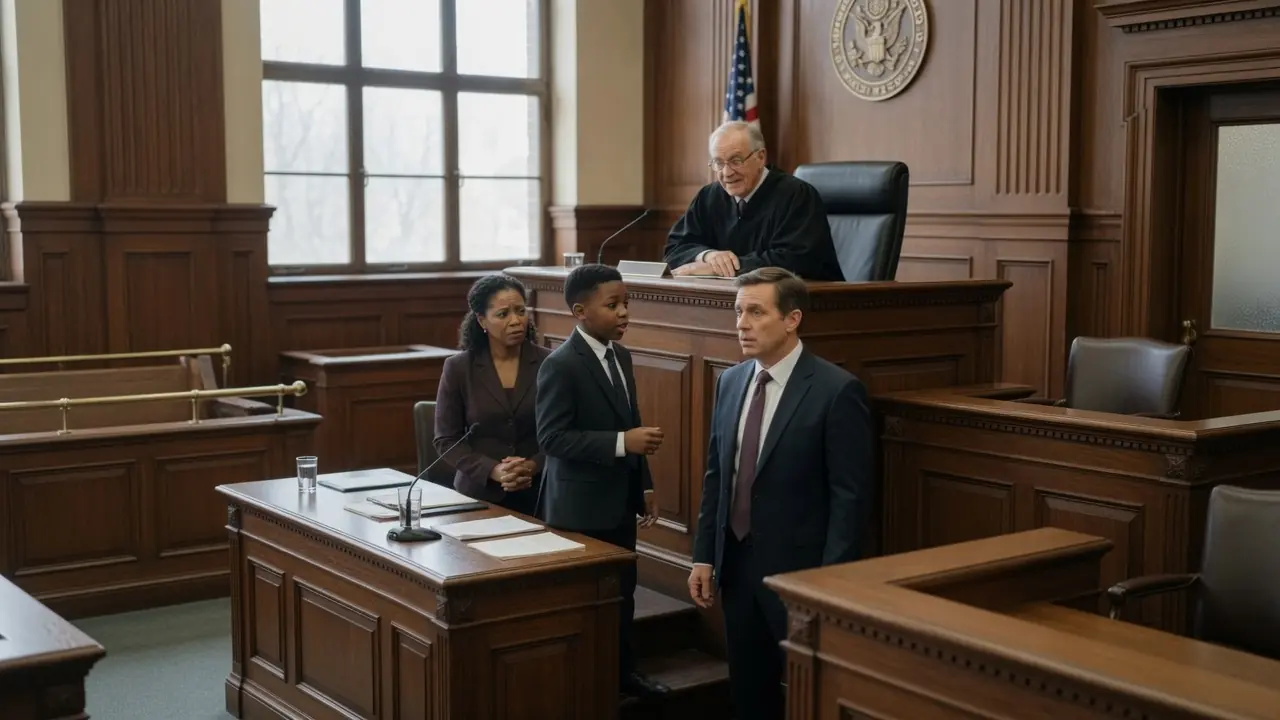
The hearing fell on a gray morning in February, nearly three years after the gavel first came down on Nathan Davis.
Word had traveled. The courtroom held more people than the trial ever had. Reporters filled the back row. Men from Callaway Autoworks sat shoulder to shoulder in clean shirts. Mrs. Lton closed the library desk for the day. Half of Carver Street came in their church clothes.
Nathan entered through the side door in a suit Eleanor had sent to the prison. It hung loose on him now. He kept touching the collar the way a man touches something he no longer trusts to be real.
His eyes found Grace. Then they found his son seated at the defense table with a stack of folders, and Nathan Davis had to look at the ceiling for a while.
Whitfield had arrived early, flanked by two assistants and a cart of file boxes. He looked exactly as he had three years ago, only more polished. The district attorney election was four months away.
He paused at the defense table on his way past and lowered his voice for Eleanor alone.
Retirement was kinder to you than this morning will be, counselor.
Then it should be a short morning, Eleanor said without looking up.
Judge Harlon Cole took the bench at nine sharp. He had a reputation in that courthouse. Fair. Impatient. Allergic to theater.
Eleanor rose.
Eleanor Brooks for the defense, your honor. I am counsel of record, but with the court's permission, the new evidence will be presented by my associate. He found it.
She placed her hand on Aiden's shoulder.
Your honor, the state objects. A child cannot stand as counsel in a felony hearing.
Then explain it to me, Mr. Whitfield. Why is there a young man at my defense table?
My name is Aiden Davis, your honor. I am ten years old. The defendant is my father and I am here because every lawyer in this state gave up on him.
The room stirred.
Cole removed his glasses and looked at the boy for a long moment.
Miss Brooks, is this a performance?
No, your honor. It is the opposite of one. The court has discretion over who may address it in an evidentiary hearing. Mr. Davis will speak under my direct supervision. No one alive knows this evidence better. I would only be reading his notes aloud.
Your honor, the state's time is valuable.
So is an innocent man's freedom, sir.
The words were out of Aiden's mouth before he could weigh them. Somewhere behind him, a pew creaked.
Whitfield's jaw tightened.
Judge Cole tapped his pen twice against the bench, and something that was almost a smile passed behind his eyes and was gone.
I will allow it, Cole said. Under supervision. Within limits. Young man, this courtroom runs on rules. Break one and you sit down. Are we clear?
Yes, sir.
The clerk brought a wooden step so the lectern would not swallow him.
Aiden climbed it, opened his folder, and began.
His voice cracked on the very first sentence. A reporter in the back row chuckled, and the sound landed on the boy like cold water.
Aiden stopped. He found his father's eyes across the room. Nathan nodded once, slow and steady, the same nod he used to give over a stubborn engine.
Take your time. Listen for the wrong note.
Aiden started again, and this time his voice held.
Your honor, the defense submits exhibit A, a still frame from the state's own security footage, the same twelve seconds that convicted my father.
We are not asking the court to look at anything new. We are asking the court to look at the corner everyone skipped.
He walked them through it plain and unhurried.
The timestamp reading 8:12 p.m. The round wall clock above the cooler door. Hands frozen at 9:12. Daylight saving time beginning two days before the robbery. The camera system, an old model with no automatic update, confirmed by the manufacturer's own manual, submitted as exhibit B.
Two clocks in one frame, your honor. They cannot both be right.
Whitfield was on his feet before the echo faded.
Objection. Pure speculation. Counsel is asking this court to overturn a jury verdict based on a smudge. That clock is a blur in a blurry video. It could read nine. It could read anything. Was the wall clock even accurate? Was it running at all? There is no foundation.
He turned, buttoned his jacket, and addressed the bench with the calm of a man who had won this room a hundred times.
The defense has built a castle on a photograph, your honor. The state convicted Nathan Davis on evidence. Twelve seconds of him in that store at that register. A child's homework project does not outweigh a jury.
Mr. Whitfield raises a fair point, Cole said. The clock alone is a question, not an answer. Who can speak to that camera system? Who maintained it? Who set its time?
The owner, your honor, Aiden said. Mr. Dale Hutchkins. He is on our witness list.
Cole checked the list, then the clock on his own wall, and made his decision.
We will hear from Mr. Hutchkins after the recess. Thirty minutes.
The gavel came down. The room exhaled all at once.
Eleanor leaned toward Aiden and spoke under the noise.
The door is open. Now comes the part where they try to slam it.
Thirty minutes in a courthouse. That is a lifetime.
The hallway outside courtroom four filled with low voices and squeaking shoes.
Grace found a bench by the window and held her son's hand the way she had held it at the funeral of her own mother, tight enough to anchor them both.
Aiden did not talk. He watched everything.
He watched the deputies lead his father toward the holding room, wrists chained to a belly belt, paper slippers under the borrowed suit.
Nathan slowed as he passed. The deputies allowed it. Two seconds, maybe three.
Father and son looked at each other through the moving crowd.
Nathan tipped his chin up. Stand tall.
Aiden tipped his chin up back.
The deputies moved on, and the chain made a small, terrible music down the corridor.
He watched Dale Hutchkins, too. The store owner sat alone at the far end of the hall, turning a foam coffee cup in his hands, the same way he had turned that paper cup on the witness stand three years ago.
He had aged badly. He kept his eyes on the floor tiles. Twice he stood up as if to leave, and twice he sat back down.
And then Aiden watched something that made his stomach drop.
One of Whitfield's assistants, the tall one with the red folder, walked the length of the hall and settled into the seat beside Hutchkins.
The conversation lasted four minutes. The assistant did all the talking. Hutchkins kept shaking his head smaller and smaller each time, like a man being talked out of something he never said out loud.
When the assistant left, Hutchkins looked gray.
Eleanor.
Aiden tugged her sleeve and told her what he had seen.
Eleanor's face did not change. That frightened him more than anything.
She guided him into the small attorney's room off the hallway and shut the door against the noise.
Listen to me now, she said. Everything we have runs through that scared man with the coffee cup. The clock means nothing unless Hutchkins says under oath that he never changed the camera's time.
If he gets up there and swears he reset it or says he can't remember, the photograph becomes a smudge again. The motion dies and the law will never let us open this door twice.
He told the police the system was old, Aiden said. It's in the report.
He said a lot of things. Fear edits memory, son. And that man has had three years and one hallway conversation to get afraid.
She crouched, joints cracking until her eyes were level with his.
The judge is letting you ask the questions. That was your evidence and your right, and I made it part of the deal. But understand what that means. Whitfield will object to everything. Cole's patience is thin. You will get one clean question before they box you in. Maybe one.
Then I only need one.
Which one? You wrote out nine.
Aiden reached into his folder and took out a single sheet of paper.
Eight of the nine questions had pencil lines through them. He had crossed out the last one on the bus that morning and written a new one beneath it in small, careful letters.
He turned the sheet around and let her read it.
Eleanor read it twice. Then she sat back slowly.
You're not going to ask him about the camera at all.
No, ma'am. If I ask about the camera, he gets to say, I don't remember. People remember other things better.
For a long moment, the old lawyer just looked at him. This boy in a tie cut down from his father's who had taught himself the law out of green library books because the grown world had shrugged and moved on.
Forty years of juries told her the question was either brilliant or fatal. She could not tell which. That had only ever happened to her twice.
A knock. The bailiff's voice through the door. Court's back in five.
Grace was waiting in the hall. She knelt and straightened Aiden's tie. And for one moment, he was not a legal associate. He was her little boy, and her hands trembled on the knot.
Whatever happens in there, she whispered. Your father already got back the thing he lost. Somebody fought for him.
The doors of courtroom four opened.
Dale Hutchkins rose from his bench like a man walking to his own sentencing.
And in his pocket, folded small, Aiden Davis carried one question.
Dale Hutchkins swore the oath with a dry mouth and sat down like the chair might break.
Judge Cole looked at the defense table.
Young man, the court will allow you to examine the witness within limits. Make them count.
Aiden climbed the wooden step. He did not open his folder. He left the single sheet of paper folded in his pocket because he knew it by heart.
And he looked at the nervous man in the witness chair the way his father had taught him to listen to engines. Patiently. Kindly even.
Mr. Hutchkins, what time does your store close?
Whitfield rose halfway.
Objection. Relevance. The defense's entire theory is about a camera and counsel is asking about business hours.
It goes directly to the timeline, your honor, Aiden said.
I'll allow it. Answer the question, sir.
Hutchkins blinked. Of all the questions he had braced for, this was not one. And that was the point. There was nothing to fear in it. Nothing to forget.
Nine, he said. Nine o'clock. Every night for thirty years. My daddy closed at nine and so do I.
Thank you, sir.
Aiden lifted one page from the table.
This is your statement to Officer Mercer the night of the robbery. State's evidence, page eleven. You said, and I'm reading your words, The man came in while I was counting out my register to close. Is that true?
It's true. I was counting the drawer. I counted at closing. Always have.
You were closing up.
I was closing up.
Aiden set the page down.
The courtroom had gone very quiet. The kind of quiet that has weight.
Mr. Hutchkins, if your store closes at nine o'clock, what were you doing counting your closing drawer at twelve minutes past eight?
Nobody moved. Somewhere in the gallery, a chair creaked and stopped, ashamed of itself.
Hutchkins opened his mouth and closed it again. His eyes went to the prosecution table and found no help there because there was no help to give.
Then his face changed. The fear drained out of it, and underneath the fear was something that had been buried for three years. Plain confusion. Plain truth.
It wasn't eight, he said slowly. It couldn't have been eight. I was closing. I remember the drawer in my hands. I remember looking at my clock when he walked in because I thought ten more minutes and I'd have been gone.
He stared at nothing, doing the arithmetic of his own memory.
It was after nine. It was always after nine. I told them that. I thought the video proved me wrong. I thought I remembered it wrong.
Judge Cole leaned forward.
Mr. Hutchkins, the court has one question of its own. The camera system in your store. After the time changed that spring, did you ever reset its clock?
The room held its breath, and the answer fell out of him like something he was glad to finally set down.
That old box, your honor, I never touched that thing in my life. It came with the store. The man who installed it is dead. I changed my wall clock and my register and went on with my business. I didn't even know the camera had a clock to change.
Eleanor was already standing.
Your honor, defense exhibit C, the county dispatch log. Mr. Hutchkins's emergency call was received at 9:16 p.m. Four minutes after the robbery.
If the robbery happened at 9:12, one hour and four minutes after it, if you believe the timestamp. Exhibit D, Nathan Davis's time card stamped at the gate of Callaway Autoworks at 9:04 p.m., eleven miles away. And exhibit E, the sworn affidavit of his shift foreman confirming he was on the floor with his crew from 9:04 until midnight.
She let it land, then finished quietly.
Every clock in this case agrees, your honor. The wall clock. The dispatch log. The time card. The witness's own memory. Every clock except one. And that one was never set.
At the defense table, Nathan Davis sat with his fists pressed together under his chin, shaking, while three years of a stolen life were handed back to him, one exhibit at a time.
Whitfield fought. He demanded the dispatch log's chain of custody. Eleanor had it.
He suggested the foreman was a friend covering for a friend. The foreman was in the gallery sitting next to a row of Callaway men, all of them on the record.
He argued a man could leave a fenced lot unseen, drive eleven miles, rob a store in work boots, and drive back. He heard the sentence as it left his mouth, heard the gallery hear it, and stopped.
For the first time in six years, Preston Whitfield stood in a courtroom with nothing to say.
No further questions, he managed and sat down.
Aiden gathered his page and stepped off the wooden step.
He looked very small walking back to the defense table, and the silence he walked through was enormous.
Judge Cole studied the still frame for a long moment.
Two clocks. One frame.
The court will take a brief recess, he said, and return with its ruling.
The recess lasted forty minutes. Nobody left the courtroom. Nobody risked losing a seat.
When Judge Cole returned, he sat in silence for a moment, looking at the papers before him as if weighing more than paper.
Then he began to read and his voice carried to the last row.
This court finds that the conviction of Nathan Davis rests on a single piece of evidence, a video timestamp now shown to be an error by one full hour. The corrected timeline is corroborated by the dispatch log, by the witness's original statement, by his testimony today, and by the defendant's own employment records, which placed him eleven miles from the scene eight minutes before the crime.
He set down one page and took up another.
The room did not breathe.
The verdict cannot stand. The conviction is vacated. The state is directed to show cause within thirty days why this matter should not be dismissed entirely.
He looked up.
Mr. Davis, this court orders your immediate release, and this court offers you something it owes you, which is an apology.
The gavel came down, and the room came up. All of it. All at once.
A deputy crossed to Nathan Davis and unlocked the cuffs, and the sound they made coming off was small and dry. Nothing like the music they deserved.
Nathan stood there rubbing his wrists, a free man in a borrowed suit, looking like he had forgotten how to move without permission.
Then his son hit him at a dead run.
Nathan went down on one knee and caught him.
And the two of them stayed like that in the middle of the courtroom floor, the boy's face buried in his father's collar, the father's hand spread across the back of the boy's head, the way he used to hold him as a baby.
Grace reached them a second later, and the three of them folded into one shape.
The gallery stood. The Callaway men stood first, then the church pews, then everyone.
And the sound was not cheering exactly. It was lower than that and better.
You found the clue, Nathan kept saying into his son's hair. You found it. You found it.
You told me where to look, Aiden said.
When the room finally quieted, Judge Harlon Cole did something the bailiffs had never seen in his courtroom.
He came down off the bench. He crossed the floor and stood in front of a boy whose head did not reach his shoulder and offered his hand.
Yesterday morning, I asked your attorney whether you were a performance, Cole said. I came close to refusing you this room. That would have been the worst mistake of my career, son. This court has been doing its job for thirty years. Today, you reminded it what the job is.
Aiden shook his hand.
Thank you for letting me ask my question, sir.
One question, Cole said, and shook his head slowly. I've watched ten thousand lawyers. Most of them would have asked nine.
Preston Whitfield packed his boxes alone. His assistants had already started for the door.
He paused at the rail on his way out and, to whatever credit remains a man like that, he stopped in front of Nathan Davis.
The state will not contest the dismissal.
He said it was the closest thing to an apology he knew how to carry.
Then he walked out past the reporters and not one camera turned to follow him.
Within a month, the district attorney's office would announce a review of every conviction built on that camera, and Whitfield's name would quietly leave the campaign posters before the election ever came.
Dale Hutchkins waited by the doors. He stood twisting his cap until the family reached him, and then his words came out broken.
I let them tell me my own memory was wrong. Three years. Mr. Davis, I am so sorry. I am so deeply sorry.
Nathan looked at him for a long moment. He had earned the right to refuse the man's hand.
Aiden watched his father, learning one last thing.
You raised your hand today and told the truth, Nathan said, and took it. That's the man I'll remember.
Outside, February had turned bright and cold.
Nathan Davis walked down the courthouse steps with his wife under one arm and his son under the other, and he stopped halfway, lifted his face into the sun, and stood there until his eyes stopped shining.
Take your time, Grace said softly. They had it now.
One year later, on a corner lot off Route 9, a new sign went up over an old garage.
Davis and Son Auto Repair.
Nathan hung it himself, and when the bolts were tight, he stood back and looked at the second word longer than the first.
The state paid Nathan a settlement for the years it took. He used part of it to buy the lot.
He fixed Miss Eddie's sedan the first week free of charge because some things in a man do not change no matter what is done to him.
Grace sleeps in a bedroom now. The couch is just a couch.
Aiden went back to being a kid, mostly. He plays ball badly. He still reads too late under the covers.
But on the first Saturday of every month, he rides his bike to the public library where an old lawyer holds a corner table and teaches him what the green books cannot.
Eleanor Brooks framed exactly one thing from her forty years of practice and hung it in her kitchen. A sheet of paper with nine questions on it. Eight crossed out in pencil.
The law schools will wait for him. They already know his name. The boy who beat a fifteen-year sentence with a wall clock, a time card, and one question nobody thought to ask.
His father said it best back when it was just engine noise and sweet tea.
Everything broken leaves a clue. You just have to be patient enough to find it.