The rain had not yet begun when Helena Ward was summoned to the Duke of Ravensmere’s study, but the house already sounded as if it were waiting for a storm.
Ravensmere Hall was an old house, the kind built to outlast generations of grief. Its corridors were long and narrow, its windows tall and stern, its portraits dark with varnish and judgment. Helena had spent the last four months inside its walls as a hired archivist, restoring the late duchess’s letters and cataloging the estate papers no one had touched since the old Duke’s death. It was quiet work, invisible work, and Helena had come to depend on that invisibility.
But there was nothing invisible about standing before the Duke’s desk while three pairs of eyes measured her like a stain on the carpet.
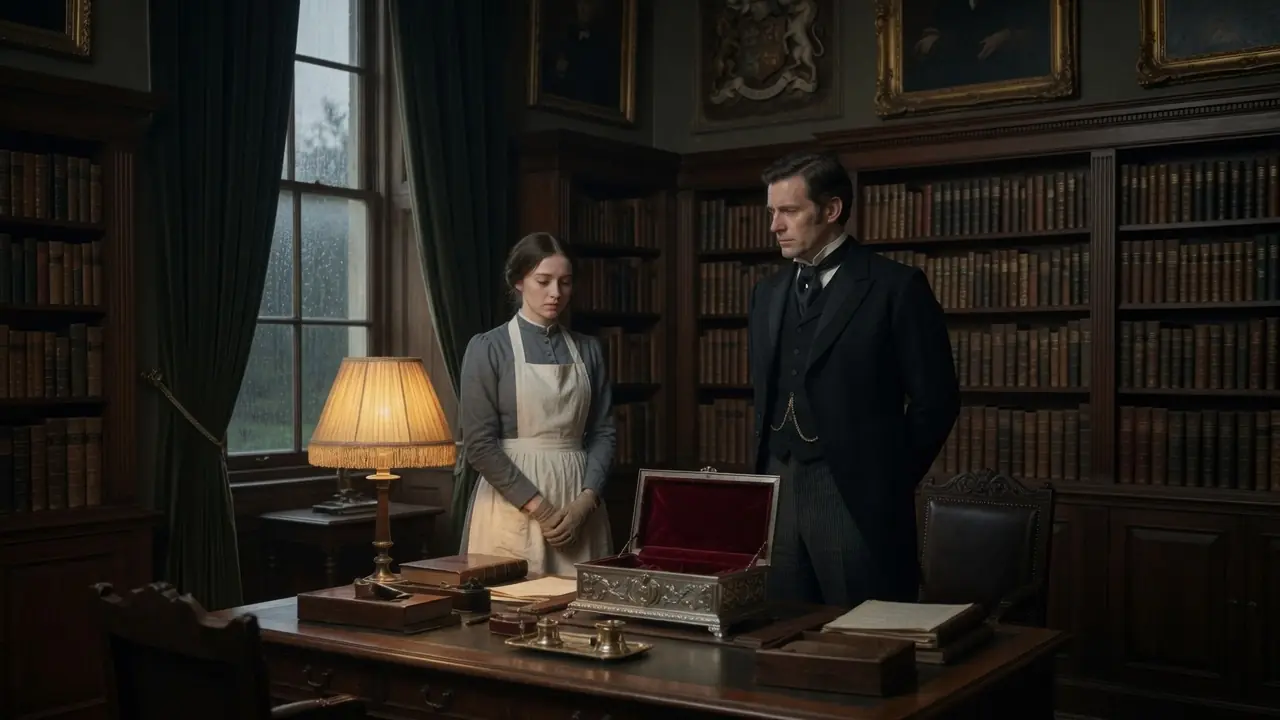
Adrian Vale, Duke of Ravensmere, sat behind the great blackwood desk with his hands folded before him. He was thirty-four, tall, dark-haired, and known throughout the county as a man who smiled so rarely people remembered the occasion for years afterward. His face was severe in the lamplight, all hard lines and controlled silence. Beside the fireplace stood Lady Maribel Vale, his widowed aunt, draped in mourning silk though her husband had been dead for eight years. Near the window lounged Mr. Percy Vale, the Duke’s cousin, elegant, pale, and faintly bored.
On the desk lay an empty silver casket.
Helena knew that casket. She had seen it in the archive room that morning, open beside a stack of estate inventories. It had contained a gold signet ring set with a black onyx stone, the old ducal seal, the one used before Adrian inherited. The ring had belonged to his father.
Now the casket was empty.
“The ring is missing,” the Duke said.
His voice was calm, which made the accusation worse. Anger might have suggested uncertainty. Calm meant he had already decided.
Helena kept her hands still at her waist. “I am sorry to hear that, Your Grace.”
“Are you?” Lady Maribel asked softly.
Helena looked at her. The older woman’s face was composed into an expression of wounded delicacy, but there was satisfaction hiding beneath it, fine and sharp as a needle.
Mr. Percy straightened from the window. “I left the ring on the archive table just after luncheon. Miss Ward was alone there afterward. No one else had reason to enter.”
Helena turned her gaze to him. “You also returned twice before tea.”
Percy’s brows rose. “Did I?”
“Yes.”
“How observant of you.”
The Duke’s eyes shifted to Helena then. They were gray, not soft gray, but the color of winter water beneath ice. “Did you take the ring?”
“No, Your Grace.”
“Then where is it?”
“I do not know.”
The answer hung in the air, small and useless.
Lady Maribel sighed. “Adrian, really, must we prolong this? The girl has no family, no references beyond a village vicar, and she has had access to every locked drawer in the archive room for months. It is unfortunate, but not complicated.”
She had been poor long enough to understand how quickly a room could turn against a woman with no one powerful enough to speak for her. A duchess’s ring went missing, and the poor woman became a thief before she opened her mouth. That was not evidence. That was architecture. The house itself was built to make that conclusion easy.
The Duke rose.
He did not raise his voice. He did not need to.
“I cannot keep a suspected thief in my household,” he said. “You will leave Ravensmere by morning. Mrs. Keene will see that your wages are paid through the week.”
For one moment, Helena felt something inside her sway. Four months of careful work. Four months of dust, ink, cracked leather, and sleepless evenings spent reconstructing the history of a family that did not even bother to see her clearly. All of it undone by one careless cousin and one cold duke.
She could have defended herself. She could have named every hour of her day, every paper she had touched, every careless movement Percy had made in the archive room. She could have said that a thief would not have spent weeks repairing mouse-chewed estate records no one else valued. She could have begged.
She did none of those things.
Begging required belief that the listener had a heart available to be moved.
Helena gave a small curtsy.
“As you wish, Your Grace.”
Something flickered in the Duke’s face. It was not remorse. Not yet. Perhaps only surprise that she did not collapse beneath his judgment.
“You may go,” he said.
Helena went.
She walked through the corridor with her spine straight and her face calm. Only when she reached the servants’ stair did she press one hand against the wall. The stone was cold beneath her palm. She breathed once, then again, until the trembling passed.
Her room was beneath the eaves, small, narrow, and clean. A single trunk stood at the foot of the bed. A chipped basin sat beneath the window. On the sill she had placed three pressed leaves from the west garden, each tucked carefully between scraps of paper. They were the only decorations she had allowed herself.
She packed slowly.
Two dresses. One shawl. A tin of needles. A packet of letters from the vicar who had taught her Latin when she was twelve and told her that a mind was a country no one could legally steal.
At the bottom of the trunk lay her notebooks. She touched them last.
They contained months of work: transcriptions, catalog entries, genealogical corrections, notes on disputed land grants, letters from the old Duke to his steward, references to leases no one currently living seemed to know existed. She had restored a history this family had neglected. The irony was almost amusing.
A knock came at the door.
“Come in,” Helena said.
Mrs. Keene, the housekeeper, entered with a candle in one hand and a folded cloak in the other. She was a tall, spare woman with silver hair and a mouth that looked as if it had been made for disapproval. Yet her eyes, usually sharp as pins, were full of quiet anger.
“I heard,” she said.
Helena closed the trunk. “I expect everyone has.”
“Not everyone believes it.”
“That matters less than one might hope.”
Mrs. Keene crossed the room and laid the cloak on the bed. “It will rain before dawn. Take this.”
“I cannot.”
“You can, and you will. It belonged to my sister. She would have liked you.”
That nearly undid Helena. Not the Duke’s accusation. Not Lady Maribel’s contempt. Kindness, always, was the thing most likely to break her.
“Thank you,” she whispered.
Mrs. Keene looked at the trunk, then at Helena. “You should know something. Mr. Percy is careless with objects that do not belong to him. Lady Maribel protects him as if foolishness were a family virtue. His Grace should know better, but grief has made a locked room of him.”
Helena gave a faint, tired smile. “Then I hope he is comfortable inside it.”
The housekeeper’s mouth twitched, almost a smile and almost a sorrow.
“Where will you go?”
“The village first. After that, wherever work can be found.”
“You should not have to leave like this.”
“No,” Helena said. “But people often leave places in ways they should not have to.”
Mrs. Keene touched her shoulder once, briefly. “Wait until morning. Do not walk the road in the dark.”
“The Duke ordered me gone by morning. I intend to obey him precisely.”
Mrs. Keene’s face hardened. “Proud girl.”
“Yes,” Helena said softly. “It is one of the few luxuries I can afford.”
After the housekeeper left, Helena sat beside her trunk and listened to the wind gather itself around Ravensmere Hall.
Below stairs, the Duke did not sleep.
Adrian had dismissed servants before. He had discharged dishonest stewards, lazy grooms, a valet who sold gossip to London papers. He had done what duty required and felt nothing beyond irritation at the inconvenience.
This felt different.
He stood in his study long after Helena Ward had gone, staring at the empty silver casket on his desk. His aunt had retired satisfied. Percy had gone to the billiard room and ordered brandy. The house had settled into its usual nighttime silence, but the silence no longer belonged to him. It pressed against him.
The girl’s face would not leave his mind.
Not pretty in the fashionable sense. Not striking enough to command a ballroom. But still. Still. There had been something in the way she looked at him after he condemned her. No fear. No guilt. No appeal. Only a quiet withdrawal of respect, so complete he had felt it like a door closing.
It troubled him.
He disliked being troubled.
Adrian lifted the casket. It was polished silver, engraved with his father’s crest. The old ducal ring had not been worn in years. His father had kept it near him until the final illness, twisting it around his finger whenever he read difficult letters. After his death, Adrian had put it away because grief made cowards of practical men.
Percy had asked to see it that morning. Why?
Adrian frowned.
His cousin had claimed an interest in family history. Percy had never been interested in anything older than last season’s waistcoats. And yet Adrian had allowed him into the archive room, allowed him to handle the ring, allowed him to accuse a woman whose work Adrian had never once inspected.
He turned sharply and left the study.
The archive room lay beyond the old library, in a wing of the house most of the family avoided. Adrian had not entered it since approving Helena Ward’s employment. He had expected dust, disorder, the familiar smell of neglect.
Instead, he opened the door and stopped.
The room had been transformed.
The air smelled faintly of lavender, paper, and beeswax. The long tables were clear. The broken shelves had been repaired. Boxes that once spilled letters and legal papers in every direction were now labeled by year and subject in a careful, elegant hand. Estate maps had been flattened and weighted beneath clean cloth. Ledgers stood upright instead of collapsing in damp piles.
He moved inside slowly.
On the central table lay a catalog book. He opened it.
The first pages listed the contents of the south archive: leases, marriage settlements, correspondence, household accounts, tenant petitions. Each entry included dates, condition notes, cross-references. It was not a servant’s inventory. It was scholarship. Patient, disciplined, exacting scholarship.
Adrian turned another page.
His eyes caught a note in the margin.
“Bundle 1721-B appears misfiled. Correspondence references the Ravensmere eastern boundary dispute, not household expenditures. Compare with map drawer 4, vellum survey marked A.V., likely misdated by later hand.”
He stared at it.
No one in his family had known what to do with the eastern boundary dispute for three generations. Solicitors had charged absurd sums to produce less clarity than this woman had written in one margin.
A cold unease moved through him.
He crossed to the table where Percy claimed to have left the ring. A brandy glass stood near the edge. Beside it lay a stack of opened letters. A chair had been pushed back carelessly.
Percy.
Adrian picked up the glass and smelled it. Brandy. Strong. He closed his eyes briefly, then opened the nearest ledger. Nothing. He checked beneath the blotter. Nothing. He looked through the loose letters, the drawers, the floor near the table.
Then he noticed the fire screen.
It had been moved.
Behind it sat a small coal scuttle, and inside, half-hidden beneath crumpled paper, something black and gold caught the lamplight.
Adrian reached down.
The ring lay at the bottom of the scuttle.
Not stolen. Not lost. Dropped. Hidden by accident or carelessness, probably knocked from the table when Percy reached for his glass and then swept away with discarded papers by a servant who did not know what had fallen.
For several seconds, Adrian did not move.
The ring was cold in his palm.
Shame came slowly at first, then all at once. It filled his chest until breathing became difficult. He had been wrong. Worse than wrong. He had been unjust. He had taken the word of a vain fool over the dignity of a woman who had given order, intelligence, and care to a neglected part of his house.
He looked around the archive room again, and this time he saw not shelves and labels but labor. Hours. Months. A mind at work. A person at work.
And he had not even known her name until he accused her.
Helena Ward.
The name struck him now with the force of indictment.
Adrian left the room at once.
He went first to Mrs. Keene. The housekeeper opened her door after the second knock, her gray braid over one shoulder, her expression already accusing.
“Where is Miss Ward?” he asked.
Mrs. Keene looked at him for a long moment. “Has Your Grace misplaced another valuable object?”
The rebuke was quiet and deserved.
“I found the ring,” he said. “She did not take it. I was wrong.”
Mrs. Keene’s face changed, but not enough to be mercy. “Yes.”
“Where is she?”
“She was in her room an hour ago.”
“Was?”
“She said she would obey your command precisely.”
Adrian felt the words like a blade turned inward.
He went to the attic himself. Her room was empty. The bed was made. The basin was clean. The sill held three pressed leaves beneath paper scraps, left behind like evidence that she had once permitted herself to belong here in the smallest possible way.
The trunk was gone.
He stood in the doorway, cold spreading through him.
Then he turned and ran.
By the time he reached the stable yard, rain had begun. Not a gentle rain, but a hard autumn downpour that came slanting across the stones and struck the lanterns until the light shook.
“Bram,” he called.
The stable master emerged from the tack room, startled and half-buttoned. “Your Grace?”
“Has Miss Ward left the estate?”
Bram rubbed a hand over his face. “I saw someone walking toward the north gate not ten minutes ago. Small figure. Carrying a trunk.”
“In this weather?”
“Aye.”
“Saddle Orion.”
Bram hesitated. “He’s restless tonight.”
“Now.”
Minutes later, Adrian rode through the north gate with the rain cutting across his face and the ring burning like a brand in his pocket.
The road from Ravensmere curved through a line of beech trees before dropping toward the village. In daylight it was pretty. In the storm it was a black corridor of mud and wind. Orion fought the bit, hooves striking sparks from hidden stone. Adrian leaned forward and urged him on.
He had not ridden like this in years.
Not since the night his younger sister died.
The thought came unbidden and struck hard.
Eleanor had been seventeen, bright, impossible, always laughing in rooms where laughter had been discouraged. She had ridden out in a storm after an argument with their father. Adrian had been away in London. By the time they found her, it was morning.
After that, he had learned control the way some men learn prayer. He controlled accounts, tenants, servants, emotions, rooms. He believed control was virtue. He believed certainty was strength. But tonight, chasing a woman he had wronged into the rain, he understood certainty could also be cruelty wearing a noble coat.
He rode harder.
At the bend near the old stone mile marker, he saw her.
A small figure in a borrowed dark cloak, struggling with a trunk too heavy for her slight frame. The wind tore at her skirt. Rain flattened her hair against her face. She had stopped beneath a bare tree, not for shelter — there was none — but to shift the weight of the trunk from one hand to the other.
Adrian pulled Orion to a halt and dismounted before the horse had fully settled.
“Miss Ward.”
She turned.
Even soaked to the skin, even exhausted, she did not look defeated. She looked at him as she had in the study: calm, guarded, complete unto herself.
“Your Grace,” she said.
The formality hurt. It should have. He had earned it.
“I found the ring,” he said.
She looked at him for a long moment. “I am glad.”
“It was not stolen. It was in the archive room. Percy must have knocked it into the coal scuttle.”
“I see.”
There was no triumph in her voice. No bitterness either. That made it worse.
Adrian stepped closer, then stopped when her posture changed almost imperceptibly. Not fear. Boundary.
He respected it.
“I wronged you,” he said. “I accused you without sufficient cause. I dismissed you without inquiry. I failed to look at the evidence, and I failed to look at you.”
Rain struck the road around them, hissing in the mud.
Helena said nothing.
He continued, because silence from her was not permission to stop. It was a test of whether his apology had substance or merely shape.
“I went to the archive room. I saw your catalog. Your repairs. Your notes. I saw work I had no right to ignore and intelligence I had no right to underestimate.”
Her eyes flickered once.
“You should not have needed my recognition to be treated justly,” he said. “But I should have given it long before tonight.”
The wind moved between them.
“What do you want, Your Grace?” she asked quietly.
The question was simple. It was also devastating.
He had been a duke too long. People assumed he wanted, and then arranged themselves accordingly. No one asked him to name it plainly.
“I want you to return to Ravensmere,” he said. “Not as a maid. As archivist, properly titled and properly paid. With a written reference stating the truth of your character and skill. With a written apology from me, if you will accept it.”
Her expression remained guarded. “And if I do not?”
“Then I will have the reference and wages delivered wherever you choose. I will not hinder you.”
That seemed to surprise her.
He reached into his coat and withdrew the old ducal ring. Rain ran over the black stone. He held it out, not for her to take, but for her to see.
“I thought this mattered because it belonged to my father,” he said. “Tonight I learned it matters less than the person I nearly ruined over it.”
Helena looked down at the ring. Then at him.
“You are very late in learning that.”
“Yes.”
The answer came without defense. It seemed to cost him less than it should have and more than he expected.
For the first time, something in her face shifted. Not softness. Not forgiveness. But perhaps the faintest easing of disbelief.
“My work matters to me,” she said.
“I know.”
“No,” she said. “You discovered that tonight. You do not know it yet.”
He accepted the correction with a slight bow of his head. “Then teach me how to know it.”
A strange silence followed.
The rain began to lessen, though the wind still worried at the branches overhead. Dawn had not come, but the east was paling.
Helena looked down the road toward the village. Then back toward Ravensmere Hall, hidden beyond the curve and the trees. Her fingers tightened around the handle of her trunk.
“I will return,” she said at last. “For the archive. Not for you.”
Relief moved through him so sharply he nearly closed his eyes.
“That is more than I deserve.”
“Yes,” she said.
The corner of his mouth almost moved. Not quite a smile. Something humbler.
“May I carry your trunk?”
She studied him, then released the handle.
“You may.”
He took it. It was heavier than he expected. That, too, felt deserved.
He gestured toward the horse. “Will you ride?”
“No.”
“Then I will walk.”
“You need not.”
“I know.”
And so the Duke of Ravensmere walked back through the mud beside the woman he had falsely accused, leading his restless horse with one hand and carrying her trunk with the other.
They did not speak for most of the road.
But the silence between them was no longer the silence of his study, shaped by power and judgment. It was something rawer, less certain, and more honest. It held no forgiveness yet. It held no easy repair. But it held the possibility of both.
When the first gray light of morning touched the towers of Ravensmere Hall, Helena Ward crossed back through the gate on her own feet.
Adrian walked beside her, not ahead.
Mrs. Keene was waiting at the servants’ entrance, a shawl around her shoulders and a satisfaction in her eyes she did not trouble to hide. She looked at the Duke carrying Helena’s trunk, then at Helena herself.
“Breakfast is hot,” the housekeeper said. “And the archive fire has been lit.”
Helena’s composure nearly broke then. Only nearly.
“Thank you,” she said.
Adrian set the trunk down gently.
Helena turned to him. “I will begin again after breakfast.”
“No,” he said.
Her eyes sharpened.
He corrected himself at once. “Forgive me. What I mean is, you will begin again when you choose.”
She held his gaze for a moment. Then she nodded.
It was not trust. Not yet.
But later, when Adrian entered the archive room and found Helena at the central table, her damp hair pinned back, her notebook open, her pencil moving steadily across the page, he understood something that humbled him more than any accusation could have done.
Justice was not completed by admitting wrong.
It began there.
And every morning after, when he came to the archive not to command but to ask, not to inspect but to learn, he found her there among the papers and the dust and the quiet histories, restoring what others had neglected.
The old ring was returned to its casket.
The archive was placed under Helena Ward’s authority.
And the Duke of Ravensmere, who had once believed power meant never being questioned, began the long and difficult education of becoming a man worthy of the woman who had returned not because he deserved it, but because her work did.