The little house at the end of Willow Creek Road looked smaller than Ethan Hale remembered.
For three years, he had carried it inside his head like a photograph that would not fade. White porch rails. Blue front door. A crooked wind chime hanging beside the window. Two flowerpots his wife, Anna, had painted yellow because she said the house needed something cheerful in winter.
He had pictured this road so many times that the real thing almost felt wrong.
The gravel was thinner now. The maple tree by the mailbox had grown wider, its branches stretching over the drive like it had been waiting longer than anyone else. The porch had been repainted. The front door was no longer blue. It was red now, deep and warm, with a brass handle Ethan did not recognize.
He stopped at the edge of the yard with a small canvas bag over one shoulder and a paper-wrapped box tucked under his arm.
Inside the box was a wooden music box shaped like a little house. He had found it in a small shop during one of the long months when coming home had felt more like a promise than a place. When wound, it played a soft, imperfect version of “You Are My Sunshine.”
Anna used to sing that to their daughter, Grace, when she was a baby.
Ethan had kept the music box wrapped for the whole journey home.
He had not called ahead.
That had been the foolishness of it, maybe. The romance of it. The thing he had fed himself during lonely nights and silent mornings. He wanted the surprise. He wanted Anna to open the door and stare at him for half a second before laughing and crying at the same time. He wanted Grace to come running, taller now, older now, but still his little girl. He wanted his son, Caleb, who had barely been speaking when Ethan left, to hear his name and know him.
He wanted the life he remembered to be waiting with the lights on.
It was almost nine in the evening. Warm light glowed through the kitchen curtains. A bicycle lay on the grass near the porch, pink streamers limp against the handlebar. Beside it was a smaller red scooter. Ethan stared at them longer than he meant to.
The children were bigger.
Of course they were.
Time had not stopped simply because he had been gone.
He walked up the porch steps slowly. The third board still gave beneath his weight. That, at least, had not changed. He almost smiled.
Then he heard Anna laugh.
The sound came from inside, bright and soft and alive.
Ethan closed his eyes.
For three years, that laugh had been his compass. When everything else felt uncertain, when he lay awake staring at ceilings that were not his own, when he wondered whether the children still remembered the shape of his face, he would close his eyes and hear Anna laughing in the kitchen.
Now she was.
She was right there.
He reached for the door.
It was unlocked.
The house smelled like tomato sauce, laundry soap, and something sweet baking in the oven. Ethan stepped inside quietly, his heart beating so hard it seemed impossible the whole house did not hear it.
From the hallway, he could see into the kitchen.
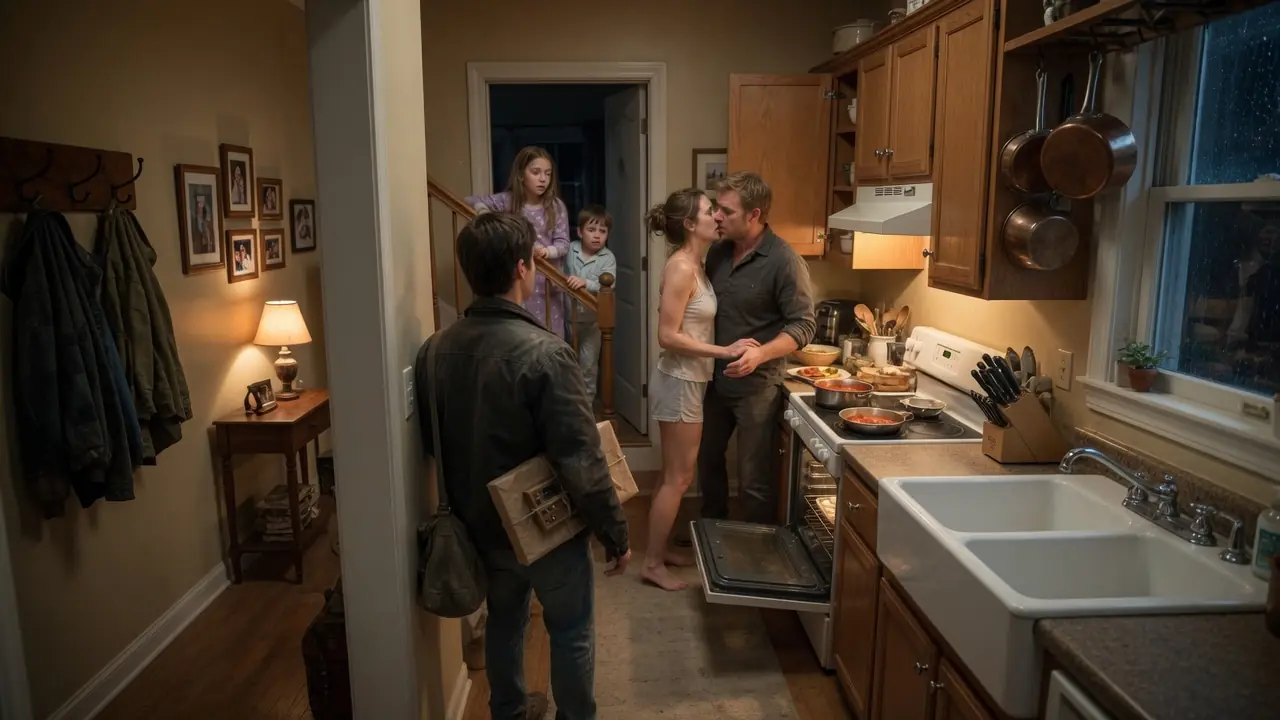
Anna stood at the counter in a green sweater he did not recognize, her hair tied loosely at the back of her neck. She was laughing down at a man who was kneeling on the floor with a dish towel pressed dramatically to his chest as if he had been wounded.
Anna laughed harder. “You stepped on one block, Mason.”
“One block can end a man.”
“You are ridiculous.”
“Yes,” he said, looking up at her with a smile so warm and familiar that Ethan felt his fingers go numb around the paper-wrapped box. “But I made you laugh.”
Anna’s face softened.
The man rose from the floor. He was perhaps Ethan’s age, maybe a little older, with kind eyes and sleeves rolled to his elbows. He moved easily in the kitchen, as though he knew which cabinet held the plates, which drawer stuck, which corner of the counter had to be avoided because it always caught a hip.
He reached past Anna for a spoon.
She turned at the same time.
Their shoulders touched.
Neither of them moved away.
Then Mason leaned down and kissed her forehead.
It was not a stolen kiss. Not uncertain. Not new.
It was the kind of kiss that belonged to ordinary evenings and shared grocery lists and children asleep upstairs.
Ethan could not move.
The house seemed to tilt around him.
He had imagined a hundred versions of coming home. He had imagined tears, anger, forgiveness, silence, even awkwardness. He had not imagined another man standing barefoot in his kitchen, making his wife laugh over a child’s toy.
The paper around the music box crinkled in his hand.
Anna heard it.
She turned.
For one second, her face did not understand what her eyes were seeing.
Then all the color left her.
“Ethan?”
The name broke open the room.
Mason turned. His smile vanished at once. He looked from Anna to Ethan, then to the bag on Ethan’s shoulder, then back to Anna. Understanding arrived slowly and painfully.
Ethan stepped into the kitchen.
“Anna,” he said.
His voice sounded calm. Too calm. It was the kind of calm that came when the heart had already been hit and the body had not yet understood it was bleeding.
Anna gripped the edge of the counter. “You said next week.”
“I finished early.”
“I didn’t know.”
“No,” he said. “I wanted to surprise you.”
Her mouth trembled.
The oven timer beeped.
No one moved.
Mason reached over and turned it off.
The small, ordinary gesture nearly destroyed Ethan.
“Who is he?” Ethan asked.
Anna closed her eyes.
Mason stood very still, his hands open at his sides. He looked neither guilty nor defensive. That made it worse somehow.
“My name is Mason,” he said quietly.
Ethan looked at him.
“I asked Anna.”
Mason nodded once. “I know.”
Anna whispered, “Ethan, please.”
“Please what?”
She took one step toward him, then stopped when he did not move. “Let me explain.”
Before he could answer, a door opened upstairs.
Small feet crossed the ceiling.
Anna’s face crumpled.
“Mom?” a sleepy voice called from the stairs.
Ethan turned toward the hallway.
Grace stood halfway down, wearing purple pajamas with stars on them. Her hair was longer than he remembered, falling past her shoulders in tangled waves. She was not the little girl from the picture he carried. She was eight now, tall and narrow and blinking in the light.
Behind her, Caleb appeared, smaller and round-cheeked, rubbing one eye with his fist.
“Mommy?” he asked. “Is Mason okay?”
The question landed harder than any accusation could have.
Ethan stared at his son.
Caleb looked back at him with open confusion.
Grace’s gaze moved from Ethan’s face to the bag on his shoulder. She came down one more step, hesitant.
“Who are you?” she asked.
Anna covered her mouth.
Ethan felt something inside him fold in on itself.
He had thought pain would be loud.
It was not.
Sometimes pain was a little girl standing on the stairs, asking her own father who he was.
“It’s me,” Ethan said softly. “It’s Dad.”
Grace’s hand tightened around the banister.
Caleb moved behind her.
Anna began to cry silently.
Mason looked down.
Ethan stood in the kitchen with the box under his arm and understood, all at once, that being loved and being remembered were not the same thing.
Grace looked frightened, not because he had done anything frightening, but because he was a stranger claiming a place in her life that someone else had been filling every day.
Caleb whispered, “Mason reads the dragon book.”
Ethan nodded, though he did not know why.
Anna took a shaky breath. “I showed them pictures. I talked about you. I did. I never stopped. But they were so little when you left, and then months became years, and every time I thought you were coming back, something changed.”
“I wrote,” Ethan said.
“I know.”
“I called when I could.”
“I know.”
“Then how did this happen?”
The question did not come out angry.
It came out broken.
Anna wiped her cheeks. “Slowly.”
That was worse than any confession.
“Slowly?” he repeated.
She nodded. “At first Mason was just someone from town who helped with the back fence after the storm. Then the car died and he drove Grace to school for a week. Then Caleb had the fever and I hadn’t slept in two days, and he sat in the waiting room until morning because I was scared. Then the washing machine flooded. Then Grace started asking why you didn’t come home for her birthday, and I didn’t know how to answer without making promises I couldn’t keep.”
Ethan looked at Mason.
“You were here for all that?”
Mason’s jaw tightened.
“Yes.”
“And you thought that made this your house?”
“No,” Mason said.
His voice was quiet, but steady.
“I thought it meant they needed someone to show up.”
The words struck Ethan in a place no anger could protect.
Anna shook her head quickly. “He didn’t come in trying to take anything. He didn’t. I was the one who kept asking for help. I was the one who leaned on him. I was the one who got tired of eating dinner alone and pretending I was still married to a voice on the phone.”
Ethan flinched.
Anna saw it and cried harder.
“I’m sorry,” she whispered. “I didn’t mean it like that.”
“Yes, you did.”
She looked at him, devastated.
Ethan swallowed.
“And maybe you were right.”
Grace came down another step. Her eyes were wet now. “Mom, is he mad?”
Ethan looked at her.
He wanted to say no.
He wanted to be the father who could make this room safe with one sentence.
But he was mad.
He was so mad his hands felt cold.
Mad at Anna. Mad at Mason. Mad at the years. Mad at himself for being gone even when leaving had not felt like a choice. Mad at the red door, the new handle, the bicycles, the forehead kiss, the burned smell of dinner, the fact that his son knew which book Mason read at bedtime.
But the children were watching.
So Ethan set the paper-wrapped box on the table with both hands, carefully, as if it were fragile enough to cut him.
“I’m not mad at you,” he said to Grace.
She searched his face. “Are you really our dad?”
“Yes.”
Caleb whispered, “But Mason is here.”
“I know.”
“Are you going to make him leave?”
The room stopped breathing.
Anna looked at Ethan with terror in her eyes.
Mason’s face tightened, but he said nothing.
Ethan looked at Caleb.
His son. His little boy. The child he had missed losing teeth, learning letters, growing tall enough to reach the sink. The child who had no memory of him except pictures and stories. The child who now feared that Ethan’s return meant losing the man who had tucked him in.
Ethan understood then that he had come home expecting to be the answer.
Instead, he had become the disruption.
He picked up his bag.
Anna stepped forward. “No. Ethan, no. Don’t go.”
“I can’t stay here tonight.”
“We can talk.”
“If I stay, I’ll say something the kids will remember forever.”
Anna stopped.
That was the truth, and she knew it.
Mason spoke for the first time in several minutes. “I can leave.”
Ethan turned to him.
Mason held his gaze. “Tonight. Right now. If that helps.”
Caleb started crying.
Grace turned sharply toward Mason. “No.”
The word was small, but full of panic.
Mason closed his eyes.
Ethan looked at the children, then at Anna.
There it was. The impossible shape of the thing.
If Mason stayed, Ethan had to stand in his own kitchen beside another man who had become necessary.
If Mason left, the children would lose the person who made the house feel safe.
Either way, someone bled.
Ethan slowly shook his head.
“No,” he said. “Don’t leave tonight.”
Anna stared at him.
Mason did too.
Ethan’s voice roughened. “They’re scared enough.”
Grace began to cry silently.
Ethan wanted to go to her. He did not. Not yet. He could not make her choose comfort from a stranger because blood demanded it.
Instead, he crouched slightly so his eyes were closer to hers.
“I’m going to come back tomorrow,” he said. “If your mom says it’s okay. We can meet somewhere that isn’t confusing. Maybe the park. Maybe the diner near the bridge.”
Grace wiped her face with her sleeve. “Do we have to?”
The question hurt.
He let it.
“No,” he said. “You don’t have to. But I’ll be there.”
Caleb sniffed. “Can Mason come?”
Anna made a sound like she had been struck.
Ethan looked at Mason.
Mason looked away.
For a moment, Ethan hated him after all. Not because Mason had done anything cruel, but because the children needed him enough to ask.
Then Ethan forced himself to look back at Caleb.
“If you want him there,” Ethan said, “he can come.”
Caleb nodded a little.
Ethan stood.
Anna came to him then, close enough that he could see the lines beside her eyes that had not been there before. She looked older. Not less beautiful. Just more marked by years he had not witnessed.
“I waited,” she said.
“I know.”
“I waited until waiting started hurting the kids.”
Ethan closed his eyes for one second.
When he opened them, the anger was still there, but beneath it was something heavier.
Understanding.
Not forgiveness. Not yet.
But understanding.
“I don’t know what we are now,” he said.
Anna’s lips trembled. “Neither do I.”
“I don’t know how to be their father.”
“You are their father.”
“No,” Ethan said quietly. “I’m their father by truth. I have to become their father by trust.”
Anna began crying again, but differently this time.
He looked past her to Mason.
“You took care of them?”
Mason nodded.
“Even when it was hard?”
“Yes.”
Ethan’s throat tightened.
“Then thank you.”
Mason looked as if the words hurt him.
“I’m sorry,” he said.
Ethan nodded once.
“I know.”
He took one last look around the kitchen.
The table had a scratch near the edge from where Grace, as a toddler, had banged a spoon against it. The wall near the pantry had a new height chart marked in pencil. Lily? No. Not Lily. Grace. His mind stumbled over the names in its own grief. Grace at six. Grace at seven. Caleb at four. Caleb at five.
Years written on a wall.
Years he could not get back.
The music box sat unopened on the table.
He touched the top of it once.
“Wind it for them,” he said to Anna. “Not tonight. When they’re ready.”
“What does it play?” she whispered.
He looked at her.
“You know.”
Her face crumpled.
Ethan turned before he lost the strength to leave gently.
At the front door, Grace called out.
“Ethan?”
He stopped.
Not Dad.
Not yet.
But his name.
He turned around.
She stood at the bottom of the stairs now, one hand holding Caleb’s. “Will you really be at the diner?”
“Yes.”
“Even if we don’t come?”
“Yes.”
She nodded, as if filing away a fact she did not yet trust.
“Okay.”
It was not acceptance.
But it was a beginning.
Ethan stepped outside into the cool night. Behind him, the red door closed softly. He stood on the porch for a moment, looking at the broken wind chime trembling in the breeze.
Then he walked down the steps.
His bag felt heavier than before.
At the end of the driveway, he looked back once. Warm light filled the kitchen window. He could see shadows moving inside: Anna’s, Mason’s, the children’s. A family shape.
Not the one he remembered.
Not one he knew how to enter.
But not necessarily one that had no room for him.
That was the mercy and the cruelty of it.
The life he had dreamed of was gone.
The people were still there.
Tomorrow, he would sit in a diner and wait for children who might not come. Tomorrow, he would begin the long, humiliating work of becoming familiar to his own son and daughter. Tomorrow, he would learn whether Anna’s heart had any room left for the man she had once loved, or whether love had changed its name while he was away.
Tonight, Ethan Hale walked beneath the maple branches and kept breathing.
Some men lose their homes in a single fire, a single storm, a single signed paper.
Ethan lost his in the quiet accumulation of days he was not there.
And if he wanted any part of it back, he knew now it would not be by turning a key.
It would be by knocking.