The rain had been falling since sundown, hard and steady, turning the old highway outside Blackthorn Roadhouse into a silver ribbon of water and reflected headlights. Every few minutes, thunder rolled across the open country, deep enough to shake the glass bottles lined up behind the bar. The wind came in restless bursts from the north, pushing sheets of rain beneath the porch roof and rattling the rusted metal sign that hung above the entrance.
The sign had once been bright red, or so the older men said. Now it was mostly blackened iron and chipped paint, with only a few stubborn neon letters still working.
BLACKTHORN ROADHOUSE.
The B flickered. The R buzzed. The last E had died years ago.
Nobody ever fixed it.
People did not come to Blackthorn for polished wood, polite service, or a clean bathroom. They came because it stood alone at the edge of nowhere, halfway between the county line and the old mining road, where cell service died and rules softened. Truckers stopped there when the rain got too heavy. Drifters stopped there when they had nowhere else to go. But mostly, Blackthorn belonged to bikers.
On that particular night, it belonged to the Iron Wolves.
Their motorcycles were parked in two long rows outside the roadhouse, chrome wet with rain, black leather seats shining under the broken porch lights. Big touring bikes, low-slung choppers, patched-up old machines that looked as if they had survived wars, funerals, and several bad decisions. Their engines had gone quiet, but the smell of gasoline and hot metal still lingered in the damp air.
Inside, the place was alive.
Classic rock growled from an old jukebox in the corner. Pool balls cracked beneath a hanging lamp. Boots struck the wooden floorboards. Beer glasses slammed against tables scarred by knives, rings, and decades of elbows. Smoke curled lazily toward the ceiling fans, even though the county had banned indoor smoking years ago. Nobody at Blackthorn had paid attention to the county since 1999.
The Iron Wolves filled almost every chair.
They wore leather cuts with the same patch stitched across the back: a silver wolf’s head beneath a crown of fire. Some patches were new, clean-edged, and bright. Others had faded almost gray, the threads worn down by years of sun and rain. The men and women beneath those patches were just as varied. Some were young, loud, and restless, still trying to prove they deserved the road name their brothers had given them. Others were old enough to move slowly, drink carefully, and speak only when they had something worth saying.
At the center of the room, under the biggest light, sat the new generation.
Rafe Maddox, twenty-nine years old, broad-shouldered and handsome in a dangerous, careless way, leaned back in his chair with one boot on the table. A silver ring flashed on each of his fingers. A black snake tattoo curled from beneath his collar and climbed the side of his neck toward his jaw. He had become the loudest voice among the younger Wolves, and lately, the loudest voice had begun to sound a lot like leadership.
Around him sat his closest friends: Cutter, Diesel, Knox, and a red-haired woman called Saint, who smiled like a knife and never laughed unless somebody else was bleeding emotionally or physically. They were not cruel people, exactly. But they were young, and youth often mistook cruelty for strength.
At the far end of the bar sat Eli Granger.
He had once been called Gravel because of his voice, which sounded like stones dragged across dry pavement. These days, most of the younger Wolves called him Old Eli, though never to his face. His beard had gone white. His hands were swollen at the knuckles. He drank slowly and watched everything.
Eli had been with the Iron Wolves since before most of the room had been born. He had ridden under three presidents, two wars, four clubhouses, and one woman whose name was spoken like scripture by those who remembered her.
But the young ones did not remember.
That was the problem with legends. If nobody told them properly, they became decoration. A patch on a jacket. A faded photograph above a bar. A story old men told when the whiskey turned them sentimental.
Rafe slammed his empty glass on the table and grinned.
“Another round!” he called.
The bartender, a heavy man named Burt with a towel over one shoulder and a permanent expression of disappointment, looked over. “You paying for this round, Maddox?”
Rafe spread his arms. “Burt, you wound me.”
“You owe me for last Friday.”
“That was club business.”
“You broke my mirror.”
“Mirror had an attitude.”
A wave of laughter moved through the table.
Burt muttered something about children wearing leather and poured the drinks anyway.
Eli watched from the end of the bar, his face unreadable.
Rafe noticed him watching and lifted his glass.
“Something on your mind, old man?”
Eli did not answer right away. He took a sip of whiskey, set the glass down, and turned it slowly between two fingers.
“Plenty.”
“That supposed to scare me?”
“No.”
Rafe smirked. “Good. Because these days everybody keeps talking like the Wolves are some museum piece. Like we gotta bow to every ghost who wore the patch before us.”
Eli’s eyes narrowed slightly.
Around the room, a few of the older members went quiet. Cutter and Diesel kept laughing, but not as loudly.
Rafe continued, warming to his own voice. “I respect history. Sure. But history doesn’t keep engines running. History doesn’t scare rivals off our road. History doesn’t pay for gas. We’re the Wolves now.”
Saint lifted her beer. “Hear, hear.”
Knox slapped the table. “About time somebody said it.”
Eli looked at Rafe for a long moment.
“You don’t know what you’re saying.”
Rafe’s smile sharpened. “Then teach me.”
Eli turned back to his drink. “Not tonight.”
“That’s what I thought.”
The young Wolves laughed again. The older ones did not.
Outside, thunder cracked so close that the windows trembled in their frames. Rain swept against the glass like handfuls of gravel.
Then the door opened.
It did not burst open. It did not slam against the wall. It opened slowly, with a tired wooden groan that somehow cut through the music, laughter, and storm.
A cold wind pushed inside first.
Then came the old woman.
She stood in the doorway for a moment, framed by rain and darkness. She was small, no taller than five feet three, maybe less because of the slight curve in her back. Her hair was white, pulled into a low knot at the nape of her neck. A long gray coat hung from her shoulders, heavy with rain. In one hand, she held a black cane with a silver handle worn smooth from years of use.
Water dripped from the hem of her coat onto the floor.
Nobody moved.
The jukebox kept playing. Rain whispered behind her. The neon sign outside buzzed faintly, painting one side of her face red, then black, then red again.
Burt straightened behind the bar. “Evening, ma’am.”
The old woman gave him a small nod and stepped inside.
Her boots were old black leather, cracked but polished. They made soft sounds against the floorboards. Tap. Drag. Tap. Drag. Not a dramatic entrance. Not the stride of someone trying to be noticed. Just an old woman crossing a room full of people who assumed she did not belong there.
That assumption lasted about five seconds before someone at Rafe’s table snorted.
It was Cutter.
He looked at the others, eyebrows raised, as if the universe had handed him a gift.
“Well, boys,” he said, loud enough for the whole room, “looks like bingo night got rained out.”
Laughter burst from the table.
The old woman kept walking.
Diesel leaned back, showing yellowed teeth. “Ma’am, the church fundraiser is three towns over.”
Knox cupped his hands around his mouth. “You lost, Grandma?”
Saint tilted her head, studying the woman with amusement. “Maybe she heard we had warm milk.”
The laughter grew.
Some of the older bikers shifted uncomfortably. One woman near the pool table frowned. Burt’s mouth tightened. Eli did not laugh at all. He had gone completely still, one hand around his glass, his eyes fixed on the old woman’s face.
Rafe watched her with lazy amusement as she approached the bar.
The old woman climbed onto a stool with slow, careful effort. For a second, it seemed she might slip, and a younger man near the bar instinctively started to rise. But she lifted one hand without looking at him, a small gesture that said plainly: do not help me unless I ask.
The man sat back down.
She placed her cane against the bar, removed her wet gloves finger by finger, and folded them neatly beside her.
Burt came over.
“What can I get you, ma’am?”
The old woman looked up.
Her face was lined deeply, not delicately. The years had not touched her gently. They had carved their record into her skin with sun, smoke, grief, laughter, and long roads. But her eyes were startling. Pale gray. Clear. Cold in the way mountain water is cold.
“Whiskey,” she said. “Neat.”
Behind her, someone coughed a laugh.
Rafe leaned forward.
“Whiskey?” he called. “You sure, ma’am? That stuff bites.”
The old woman did not turn.
Burt hesitated only a moment before reaching for the bottle.
“House?”
“No,” she said.
Burt paused.
She lifted her eyes to the top shelf.
“Red Canyon Reserve. If that bottle isn’t just for show.”
The room quieted a little.
Red Canyon Reserve was expensive, old, and rarely ordered. Burt kept one bottle for special occasions and people with more money than sense. Most of the young Wolves drank cheap beer or whatever burned fastest going down.
Burt took down the bottle. “Good choice.”
The old woman said nothing.
He poured.
The glass touched the bar with a soft click.
She lifted it in one hand, looked at the amber liquid for a second, then drank it all in a single swallow.
No grimace.
No cough.
No breathless wince.
She set the empty glass down exactly where Burt had placed it.
“Again.”
The laughter faded another degree.
Rafe’s smile changed. It did not vanish, but it became less certain.
Cutter leaned toward him and whispered something. Rafe chuckled, rose from his chair, and walked toward the bar with the exaggerated confidence of a man who believed every room became his when he stood up.
He stopped two stools away from the old woman.
“Impressive,” he said. “For a lady your age.”
The old woman looked at the mirror behind the bar instead of him.
“Careful,” she said.
Rafe’s eyebrows lifted. “Careful?”
“With compliments that carry insults in their pockets.”
A few people murmured.
Rafe laughed once, short and sharp.
“You got some fire in you.”
“I had more once.”
“Did you?”
“Yes.”
Rafe looked her over. He saw the gray coat, the white hair, the cane, the thin fingers, the careful posture. He did not see anything else because he did not know how to look.
“You know where you are?” he asked.
“Blackthorn Roadhouse.”
“You know who we are?”
The old woman finally turned her head slightly. “Loud.”
A ripple of laughter moved through the room, different this time. Not mocking her. Mocking him.
Rafe’s jaw tightened.
“We’re Iron Wolves.”
“So I gathered.”
“That patch means something.”
The old woman’s eyes moved to the wolf-and-crown emblem on his leather cut. She studied it for a long second.
“It used to.”
The room went very still.
At the end of the bar, Eli shut his eyes.
Rafe took one step closer.
“What did you say?”
The old woman reached for the second whiskey and held it without drinking.
“I said it used to.”
Cutter stood up. Diesel followed. Knox pushed his chair back with a loud scrape. Saint remained seated, smiling, though her eyes had sharpened.
Burt’s hand moved beneath the bar, where he kept a baseball bat. Eli noticed and shook his head once. Burt froze.
Rafe’s voice dropped.
“You walk in here out of the rain, wearing a coat older than me, and you insult my club?”
“Your club?” the old woman asked.
“My family.”
She looked at him then, fully.
Something in that look made the hair on the back of Rafe’s neck lift. He hated that it did. He hated it immediately. So he smiled harder.
“You think biker blood runs through a whiskey glass?” he said. “You think ordering top shelf makes you one of us?”
“I never asked to be one of you.”
“Good.”
“I was one of you before you knew what an engine sounded like.”
The silence became complete.
Even the jukebox seemed too loud now.
Rafe stared at her, then threw his head back and laughed.
That broke the spell.
Cutter laughed first, then Diesel, then half the room. It was an ugly laughter, too relieved to be natural.
“Did you hear that?” Rafe called. “Grandma says she was one of us.”
Knox slapped the bar. “Maybe she rode a scooter.”
Saint smiled. “Careful. She might have terrorized the retirement home.”
The old woman did not react.
Rafe leaned closer.
“You ever been on a bike, ma’am?”
“Yes.”
“What, passenger seat?”
“No.”
“You ever ride through a storm?”
“Yes.”
“Ever ride from Nevada to Texas without sleeping?”
“Yes.”
“Ever bury a brother?”
The old woman’s hand tightened around the whiskey glass. Only Eli saw it.
“Yes,” she said softly.
For the first time, Rafe hesitated.
Then pride, that stupid young engine, roared back to life in him.
“Names,” he said. “If you rode with Wolves, give me names.”
The old woman stared at him.
“Thomas Bell.”
Eli’s head lifted.
“June Merrick.”
At the pool table, an older woman named Rosie turned pale.
“Samuel Ortiz. Benny Vail. Ruthless Jack Callahan. Peter Knox, before his boy took his name and forgot his manners.”
Knox stopped smiling.
The old woman continued, her voice steady.
“Eli Granger.”
Every eye in the room moved toward the old man at the end of the bar.
Eli slowly stood.
His face had changed. The years seemed to fall from him and gather again differently. He was not Old Eli now. He was Gravel, road captain of the southern run, survivor of Red Canyon, keeper of a debt he had never been able to repay.
He removed his cap.
Rafe looked between them.
“You know her?”
Eli did not answer him.
He stared at the old woman as if she were impossible.
Then he whispered, “Mara?”
The name passed through the room like cold wind.
Most of the young Wolves did not understand it at first. A few did. They stiffened. Older members turned toward the bar completely. Someone near the jukebox reached over and turned the music down.
The old woman looked at Eli.
“Hello, Gravel.”
Eli’s mouth trembled.
“No,” he said. “No, you’re dead.”
Mara smiled faintly. “I’ve been called worse.”
Eli took one step toward her, then stopped, as if afraid she would disappear if he came too close.
Rafe looked annoyed now, unsettled by a conversation happening above his head.
“Who is Mara?”
Nobody answered.
He turned to Cutter. Cutter shrugged. Diesel looked blank. Saint’s smile had vanished.
Eli spoke without taking his eyes off the woman.
“Mara Hawkins.”
The name meant nothing to some of them. To others, it meant bedtime stories told by fathers with leather jackets hanging in the hall. To a few, it meant the old photograph above the back hallway, the one so faded nobody looked at it anymore.
Burt whispered, “Queen Wolf.”
That name meant something.
Queen Wolf.
Even Rafe had heard that one.
Not the full history, maybe. Not the truth. But he had heard enough campfire talk, enough drunken legends, enough arguments between older men to recognize the shape of the myth.
Queen Wolf had been the first woman to lead the Iron Wolves. Some said she had not led them officially because the old charter would not allow it. Others said the charter had burned the night she took command, and nobody had dared write another rule against her. She had unified five biker chapters that had hated one another for years. She had ridden through desert heat, winter passes, police roadblocks, and rival territory with a calm that made harder men follow her without question.
She had been there at Red Canyon.
Everybody knew Red Canyon, even if they did not know anything else.
The young Wolves had reduced it to a phrase. Red Canyon. The fire. The betrayal. The night half the club might have died if someone had not led them out.
Someone.
Queen Wolf.
Rafe stared at the old woman.
“No,” he said.
Mara picked up her whiskey and took a small sip.
“No?”
“You’re not her.”
“And why is that?”
“Because Queen Wolf would be...” He stopped.
Mara waited.
Rafe swallowed. “She’d be different.”
“Different how?”
“I don’t know. Bigger.”
A dry smile crossed Mara’s face.
“Men have always made women smaller in life and larger in legend. It helps them sleep.”
Nobody laughed.
Rafe’s face darkened.
“Anyone can say a name.”
“Yes.”
“Anyone can know stories.”
“Yes.”
“You expect us to bow because you walked in here and said some old words?”
“No.”
Mara set down the glass and began unbuttoning her coat.
The room seemed to hold its breath.
She moved slowly, not because she wanted drama, but because age had made speed expensive. One button. Then another. The wet gray coat opened at the throat, then the chest. Beneath it, she wore a black sleeveless shirt, faded soft from years of washing.
Rafe rolled his eyes, trying to recover control of the room.
“What is this? A magic trick?”
Mara slipped the coat from her shoulders.
It fell against the stool behind her.
The first tattoo appeared on her right arm.
It was old ink, blurred at the edges, softened by time and skin, but unmistakable: a silver wolf running through flames.
A low sound moved through the older Wolves.
Then she turned slightly.
On her left shoulder was a highway disappearing into a storm cloud, with five small stars above it. Each star represented one of the original chapters brought under one banner. Most of the young Wolves did not know that. Eli did. Rosie did. Burt did. Their faces changed as they saw it.
Mara reached up and pulled the back of her shirt collar down just enough to reveal the tattoo between her shoulder blades.
The entire bar went silent.
A wolf’s head beneath a crown of fire.
Not the modern patch. Not the cleaned-up version stitched onto factory leather. This one was rougher, older, more feral. Around it, in faded script, were four words:
RIDE FREE. BURY PROUD.
Below that, in smaller letters almost swallowed by age:
MARA “QUEEN WOLF” HAWKINS
IRON WOLVES — FIRST ROAD CAPTAIN
Eli bowed his head.
Not nodded.
Bowed.
His cap was clutched in both hands, his white hair exposed beneath the yellow light.
“Queen Wolf,” he said.
Rosie bowed next.
Then Burt.
Then a man near the jukebox. Then two older riders by the pool table. Then a woman with silver rings in both ears who had once thought herself too proud to bow to anyone.
One by one, the older Wolves stood.
Their chairs scraped the floor like a slow wave of thunder.
They removed their caps.
They lowered their eyes.
The younger riders looked around, confused, then alarmed, then ashamed without understanding why.
Rafe remained standing straight.
His pride fought a losing war against the room.
Cutter looked at him, then at Mara, then lowered his head.
Diesel followed.
Knox did too, his face pale.
Saint stood last among Rafe’s table. She stared at Mara with something close to wonder, then bowed her head slowly and deeply.
Only Rafe remained.
Mara looked at him.
He tried to hold her gaze. For three seconds, he managed.
Then he lowered his head.
Not far. Not fully. But enough.
Mara watched him for a moment.
“Lower,” Eli said.
Rafe’s head snapped toward him.
Eli’s voice was quiet. “You heard me.”
Rafe’s jaw flexed. His hands curled into fists.
Mara raised one hand.
“Leave him.”
Eli looked at her.
She picked up her coat, draped it over one arm, and took her cane.
“He’ll either learn respect,” she said, “or the road will teach him in a way that leaves scars.”
Rafe said nothing.
But his face burned.
Mara turned back to the bar. “Burt?”
The bartender blinked, startled to hear his name.
“Yes, ma’am.”
“You still serve pie here?”
Burt stared at her, then laughed once in disbelief. It was not mockery. It was relief. It was memory cracking open.
“Apple, if you can call it pie.”
“I’ve eaten worse.”
“I remember.”
His voice broke slightly on the words.
Mara sat again.
Nobody else sat until she did.
That was the beginning of the second silence.
The first silence had been shock.
The second was reverence.
Burt placed a plate of apple pie before her. The crust sagged. The filling had spilled out one side. Mara looked at it with grave attention.
“You were always a terrible cook,” she said.
“I’m the bartender.”
“You were terrible at that too.”
A few older Wolves laughed softly. Even Burt smiled.
Rafe stood awkwardly near the bar, unsure whether to leave, sit, speak, or disappear.
Mara took a bite of the pie, chewed, and sighed.
“Still terrible.”
This time more people laughed.
The room breathed again, but differently. The noise did not return to its old careless height. Conversations resumed in murmurs. The jukebox stayed low. Rain kept beating against the windows, but now it seemed farther away.
Eli approached slowly.
“May I?”
Mara gestured to the stool beside her.
He sat.
For a while, neither of them spoke.
Then Eli said, “We looked for you.”
“I know.”
“Years.”
“I know.”
“We heard you died near Sonora.”
“I almost did.”
“We heard you crossed the border.”
“I did.”
“We heard you killed a man.”
Mara took another bite of pie.
“Only one?”
Eli stared at her, then began to laugh. It came out rough and surprised, as if his body had forgotten how. Mara smiled faintly.
After the laughter faded, Eli’s eyes filled with old pain.
“Why didn’t you come back?”
The question was quiet, but half the room listened.
Mara set down her fork.
“Because I had given everything I had to the Wolves, and when Red Canyon ended, there was nothing left in me that knew how to stay.”
Eli looked at the bar.
“You saved us.”
“I lost twelve.”
“You saved thirty-eight.”
“I remember the twelve.”
Eli had no answer.
Nobody did.
Mara looked toward the rain-streaked window, and for a moment the roadhouse disappeared from her eyes. She was somewhere else. Younger. Faster. Surrounded by firelight and screaming engines, by smoke thick enough to blind, by men calling her name not in reverence but terror.
Red Canyon had not been a battle, exactly. It had been an ambush turned wildfire. A rival club, corrupt deputies, a gasoline truck, bad timing, and betrayal from inside the Wolves’ own ranks. The official papers called it an accident. The men who survived called it hell.
Mara had ridden into the smoke three times.
The first time, she led out the southern chapter.
The second, she brought out two wounded men tied to the back of her bike with belts.
The third, she went back for her husband.
She came out without him.
Nobody asked about that.
Not directly.
Eli glanced at her left hand. No ring. There had not been one for decades, probably.
“Jacob would have wanted you to come home,” he said.
Mara’s face did not change, but her eyes hardened.
“Jacob was home.”
Eli bowed his head. “I’m sorry.”
“So am I.”
Rafe listened from a few feet away.
He had heard the name Jacob Hawkins too. Not often. Always with Mara’s. King and Queen, some old men called them. Not actual royalty. Something rougher and truer. Jacob had been president of the Wolves when the club still fought itself more than outsiders. Mara had been his wife, yes, but that was the least interesting thing about her. She rode better than most men, fought smarter than all of them, and understood loyalty not as obedience, but as responsibility.
That detail had never made it into the stories Rafe remembered.
He had remembered the fire. The crown. The name.
He had missed the grief.
Mara finished half the pie and pushed the plate away.
“That’s enough punishment.”
Burt took it with a grin. “Coffee?”
“Black.”
“You always hated coffee.”
“I still do.”
He poured it anyway.
Rafe finally found his voice.
“Why are you here?”
Every head turned.
Eli stiffened. “Watch your tone.”
Mara lifted a hand again.
“It’s a fair question.”
Rafe stood with his shoulders squared, but his arrogance had thinned. Beneath it was embarrassment. Beneath that, curiosity.
Mara studied him.
“What’s your name?”
“Rafe Maddox.”
“Maddox.” Her eyes moved to his patch. “Who gave you that cut?”
“Cole Maddox. My father.”
“Cole is dead?”
“Three years.”
She nodded once. “He rode hard.”
Rafe’s expression flickered.
“You knew him?”
“He tried to race me outside Amarillo when he was nineteen. Nearly killed himself on a turn because he spent more time looking at me than the road.”
A few older riders chuckled.
Rafe did not know what to do with that image of his father: young, reckless, foolish, human.
“He never told me that,” Rafe said.
“Men rarely preserve stories where they look stupid.”
That got a real laugh.
Even Rafe almost smiled.
Almost.
Mara sipped the coffee, grimaced, and set it down.
“I came because I heard things.”
“What things?”
“That the Wolves had forgotten themselves.”
Rafe’s mouth tightened. “From who?”
“Roads talk.”
“That supposed to mean something?”
“It means people are less loyal to your secrets than you think.”
Saint stepped closer now, arms crossed. “What did you hear?”
Mara looked at her.
Saint did not flinch, though she looked less amused than before.
“I heard the Iron Wolves shake down small repair shops that used to be under their protection. I heard a boy from Mill Creek got beaten for wearing a jacket he bought at a thrift store. I heard a woman named Clara Reeves asked for help when her husband disappeared on Route 6, and your chapter told her help required payment first.”
The shame that entered the room was not equal. Some faces showed confusion. Others looked away too quickly.
Rafe spoke sharply. “That wasn’t club business.”
“No?” Mara asked.
“No. That was—” He stopped.
“Convenient?”
Rafe looked at Saint. She looked back, unreadable.
Mara’s voice remained calm.
“The patch does not stop at your shoulders. It reaches every place your shadow falls. When people fear your jacket more than they trust it, you are not wolves. You are dogs chasing scraps.”
Cutter looked angry. “You can’t talk to us like—”
Eli turned so fast the stool creaked.
Cutter shut his mouth.
Mara did not even look at him.
“When I wore that patch,” she said, “people knew three things. If you were cruel to the weak, we came. If you betrayed family, we came. If you rode alone and broke down in Wolf country, we came. We did not ask what you could pay. We did not ask whether helping looked profitable. We did not confuse fear with respect.”
Rafe’s cheeks burned again.
“You think it’s that simple now? Times changed.”
“They always do.”
“There’s pressure. Money. Rival clubs. Cops. Everyone wants a piece.”
Mara nodded.
“And so you gave them one?”
Rafe had no answer.
The words landed harder because she did not shout them.
Mara turned slightly, addressing the whole room now.
“I did not come here to reclaim a throne. I am too old for thrones, and I never liked chairs much anyway. I came because I wanted to see whether the Iron Wolves still existed, or whether all that remained was leather, noise, and boys playing outlaw with borrowed history.”
The insult should have caused an explosion.
Instead, it caused silence.
Because every person in that room knew there was enough truth in it to hurt.
A woman near the window spoke.
“What do you want from us?”
Mara looked at her.
“Nothing.”
“Then why say all this?”
“Because someone should.”
Eli’s voice was rough. “Stay.”
Mara turned to him.
He looked older than he had ten minutes ago.
“Stay one night,” he said. “Talk to them. Talk to us. Help us remember.”
Mara’s face softened, but only slightly.
“I didn’t come to be worshipped, Gravel.”
“I’m not asking you to be worshipped.”
“What are you asking?”
He swallowed.
“To forgive us.”
That word changed the air.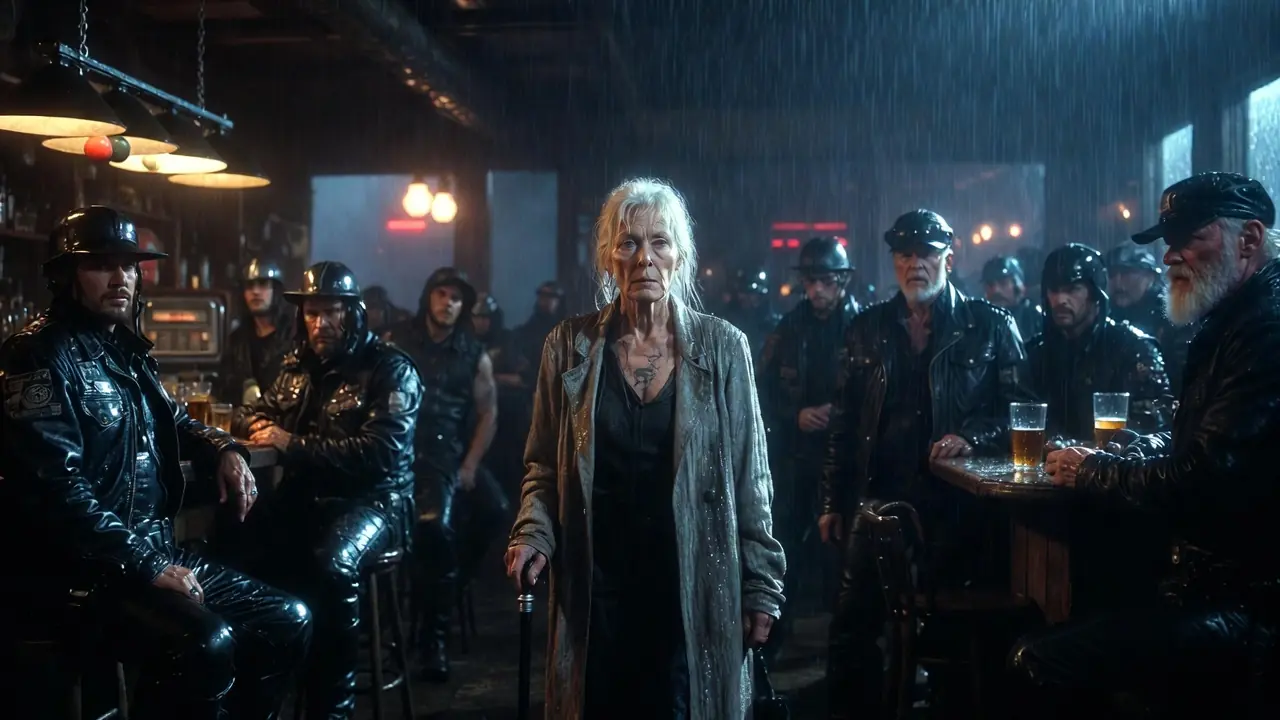
Mara looked around the room, at the bowed heads that had risen but not fully recovered, at the young faces uncertain of themselves, at the old faces full of memory and regret.
“Forgiveness is not a blanket,” she said. “You don’t throw it over a mess and call the room clean.”
Eli nodded slowly.
“No,” he said. “But maybe it’s a door.”
Mara considered that.
Outside, the rain softened for the first time all night.
Rafe spoke again, quieter.
“What happened at Red Canyon?”
Eli closed his eyes.
Mara turned toward the young man.
“You wear the patch and don’t know?”
Rafe looked down.
“I know pieces.”
“That is worse than knowing nothing.”
He accepted the blow without defending himself.
Mara picked up her coffee, remembered she hated it, and put it back down.
“Red Canyon happened because pride is blind, greed is patient, and loyalty without honesty becomes a loaded gun.”
No one interrupted.
So she told them.
Not the version sung in bars. Not the clean legend. Not the story where Queen Wolf rode through fire like something immortal and emerged with the club behind her. She told them about the months before. About tension between chapters. About money missing from charity runs and protection funds. About Jacob refusing to believe betrayal could grow inside a family he loved. About Mara seeing signs and being called suspicious, emotional, stubborn.
She told them about a man named Vance Keller, a Wolf with a silver tongue and a hunger no road could satisfy. Vance had sold routes, names, and meeting places to rivals and crooked deputies. He had not meant for the gasoline truck to overturn. He had not meant for the canyon brush to catch fire. Betrayal often told itself it never meant the worst part.
But fire did not care what anyone meant.
It came anyway.
Mara described the smoke. The heat. The sound of engines refusing to start. The screams of men who had laughed that morning. The way the canyon walls turned orange. The way Jacob looked at her when they both understood there was room for one bike to pass through the narrow break, not two.
Nobody moved.
Even Rafe had stopped breathing normally.
“I ordered him to go,” Mara said. “He ordered me to lead them out. We had been married fourteen years, and in that moment neither of us was husband or wife. We were Wolves. That meant the family came first.”
Her voice stayed steady, but her hand had closed into a fist.
“He made me choose.”
Eli bowed his head.
Mara continued.
“So I chose the living. I have been choosing them ever since.”
A long silence followed.
Then Saint asked, very softly, “What happened to Vance?”
Mara looked at her.
“He lived.”
That surprised them.
Rafe frowned. “He lived?”
“For a while.”
The room went colder.
Mara’s eyes did not.
“Vengeance is easy to romanticize from a distance. Up close, it stinks of blood and fear. We found him three weeks later. Half the club wanted him dead before sunset. Maybe I did too.”
“What did you do?” Saint asked.
“I stripped his patch from his back in front of every chapter. I took his bike. I took his name from the books. I marked him oathless, roadless, and brotherless. Then I let him walk.”
Cutter looked confused. “That’s all?”
Mara turned toward him.
“He had spent his life building himself out of fear and reputation. I took both. Death would have ended him in a second. Exile made him live with himself.”
Eli added quietly, “He lasted six months.”
Nobody asked more.
Mara turned back to Rafe.
“That is what happened at Red Canyon. Not glory. Not myth. Cost.”
The word seemed to settle on the shoulders of every person wearing the patch.
Cost.
For a long time, nobody spoke.
Then Burt cleared his throat.
“There’s something you should see.”
Mara looked at him.
He nodded toward the back hallway.
She followed his gaze.
There, half-hidden beyond an old cigarette machine and a stack of beer crates, hung a framed photograph. It had been on that wall for years. Most people walked past it without noticing. The glass was dusty. The frame had gone crooked. The picture inside had faded yellow with time.
Mara stood slowly.
Eli rose as if to help, then stopped himself.
She took her cane and walked toward the hallway. The crowd parted without being asked.
When she reached the photograph, she stood before it for a long time.
The picture showed twenty-three riders standing in front of Blackthorn Roadhouse, though the building looked younger then, freshly painted and proud. In the center stood Jacob Hawkins, dark-haired and smiling, one arm around a woman in a sleeveless denim vest. The woman was younger than anyone in the room had ever seen her. Strong shoulders. Black hair loose in the wind. Eyes sharp with mischief. A cigarette between two fingers. A wolf patch on her back.
Mara lifted one hand but did not touch the glass.
“We took this the day after Kansas,” Eli said behind her.
“I remember.”
“You punched Tommy Bell in the mouth ten minutes later.”
“He deserved it.”
“He did.”
A small laugh moved through the older members.
Mara’s fingers hovered near Jacob’s face.
The room watched her grief without daring to intrude.
Then Rafe stepped forward.
He stopped several feet away.
“I’m sorry,” he said.
Mara did not turn.
“For laughing,” he continued. “For what I said. For not knowing.”
She looked at the photograph another moment, then faced him.
“Apology accepted.”
He seemed surprised by how quickly she said it.
“But not completed,” she added.
His brow furrowed.
“Words open the door,” Mara said. “Action walks through.”
Rafe nodded slowly.
“What do I do?”
Mara looked at the patch on his chest.
“You start with Clara Reeves.”
He blinked.
“The woman whose husband disappeared?”
“Yes.”
“I don’t know where he is.”
“Then find out.”
“That could take—”
Mara’s eyes sharpened.
Rafe stopped.
She stepped closer to him.
“You wanted to be the Wolves now. Be them.”
There it was.
Not an insult. Not a challenge shouted across a bar.
A command.
Rafe felt it settle in his bones.
“Yes, ma’am,” he said.
A murmur went through the room. Not because he had agreed. Because of how he had said it.
Mara looked at Saint.
“You ride with him?”
Saint straightened. “Yes.”
“Then make sure he asks questions before he throws punches.”
Saint almost smiled. “That may be difficult.”
“Most worthwhile things are.”
Mara turned to Cutter, Diesel, and Knox.
“And you three.”
They looked like schoolboys caught stealing.
“If I hear you mocked another stranger for age, weakness, poverty, grief, or anything else that made you feel tall for five seconds, I will come back.”
Diesel swallowed.
Cutter tried to laugh and failed.
Knox said, “Yes, ma’am.”
Mara looked around the whole room.
“You will clean that photograph.”
Burt nodded quickly.
“You will put the names of the Red Canyon dead beneath it, not just the survivors.”
Eli’s eyes shone.
“You will reopen the emergency fund.”
Rosie said, “We can do that.”
“You will send riders to Clara Reeves before sunrise.”
Rafe said, “I’ll go.”
“No,” Mara said. “You’ll lead it. Leadership is not volunteering for the dramatic part. It is making sure the quiet parts get done.”
Rafe absorbed that.
“Yes, ma’am.”
Mara turned to Eli.
“And you.”
He looked startled.
“You knew they were forgetting.”
His face tightened.
“You knew the stories were turning thin. You knew the young ones were growing loud because nobody gave them anything deeper to carry.”
Eli looked down.
“Yes.”
“Don’t hide behind age. Old wolves still have teeth, even if they prefer soup.”
That broke the tension. Laughter spread through the room, warm and embarrassed.
Eli smiled despite himself.
“Yes, Queen Wolf.”
Mara frowned.
“And stop calling me that every other sentence. It makes me sound dead.”
“You were dead until twenty minutes ago.”
“Fair.”
The laughter grew.
For the first time since she entered, the roadhouse felt less like a room full of strangers and more like something wounded remembering it had once been whole.
The storm outside faded into a softer rain.
Burt poured another whiskey and set it in front of Mara without asking.
She looked at it.
“I didn’t order this.”
“On the house.”
“You can’t afford that.”
“I couldn’t afford the mirror Rafe broke either, but here we are.”
Rafe winced as several people laughed.
Mara lifted the glass.
“To the twelve,” Eli said quietly.
The room changed instantly.
Glasses rose.
Caps came off again.
Even the young ones understood enough now.
Mara held her whiskey at chest height.
“To Thomas Bell,” she said.
Eli answered, “To Tommy.”
“To June Merrick.”
Rosie whispered, “To June.”
“To Samuel Ortiz.”
Burt said, “To Sam.”
One by one, Mara named them all.
Each name was answered by someone who remembered, or by someone who had only just learned but spoke anyway.
When the last name faded, Mara looked toward the photograph.
“And to Jacob Hawkins,” she said.
The room answered as one.
“To Jacob.”
She drank.
This time, she did not drink to impress anyone. She drank like a woman swallowing fire she had carried for forty years.
Afterward, the room stayed quiet.
Then Rafe did something nobody expected.
He removed his leather cut.
The motion shocked Cutter so badly he nearly dropped his beer.
Rafe held the vest in both hands and walked to Mara.
Eli stood halfway, alarmed.
Mara watched.
Rafe stopped before her and lowered the cut.
“I don’t think I earned this the way I thought I did.”
His voice was rough.
“My father gave it to me. I wore it like inheritance was the same as honor.”
Mara said nothing.
Rafe swallowed.
“I’m not asking you to take it. I’m asking what I need to do to deserve putting it back on.”
That was the first truly honest thing he had said all night.
Mara looked at the cut. Then at him.
“Put it on.”
Rafe hesitated.
She raised an eyebrow.
“Did I stutter?”
He put it back on slowly.
Mara reached up, gripped the front of the leather, and pulled him down until his face was closer to hers. The room held its breath again.
“You don’t become worthy by taking off the weight,” she said. “You become worthy by carrying it correctly.”
Rafe’s eyes shone, though whether from shame, anger, or something softer, even he did not know.
“Yes, ma’am.”
“And stop calling me ma’am like I’m your school principal. It ages me.”
“You are—”
The room froze.
Mara’s eyes narrowed.
Rafe wisely changed course.
“Yes, Mara.”
A smile tugged at her mouth.
“Better.”
She released his vest.
Rafe stepped back.
From outside came the sound of an engine.
Everyone turned.
A single headlight swept across the window, then went dark beneath the porch. A moment later, the door opened again and a teenage girl stepped inside, soaked from the rain and trembling with cold.
She was maybe seventeen, wearing a cheap raincoat and muddy sneakers. Her face was pale with fear.
The room shifted instantly. After everything Mara had said, nobody laughed.
Burt came forward. “You okay, kid?”
The girl looked at the room full of bikers and almost backed out.
Mara’s voice stopped her.
“Come in. Shut the door before the storm follows you.”
The girl obeyed, shivering.
“My car died,” she said. “About two miles back. I saw the lights. I didn’t know where else to go.”
Rafe looked at Mara.
The lesson had arrived faster than expected.
Mara looked back at him.
He nodded.
Then he turned to Cutter, Diesel, Knox, and Saint.
“Grab tools. Tow strap. Dry jacket. Somebody get her tea.”
Burt blinked. “Tea?”
Rafe looked at him. “You have tea?”
“No.”
“Then make coffee weak enough to lie.”
Saint was already taking off her jacket and placing it around the girl’s shoulders. Cutter and Diesel moved toward the door. Knox grabbed a flashlight. Rosie brought a towel.
The girl stared, overwhelmed.
“I don’t have much money,” she said.
Rafe stopped.
For half a second, the old version of him might have made a joke.
Instead, he looked at Mara.
Then he looked at the girl.
“You don’t need money in Wolf country.”
Mara said nothing.
But Eli saw her smile.
It was small. Almost invisible.
Enough.
The young bikers headed into the rain. Engines started outside, one after another, not roaring for attention but waking for purpose. Headlights cut through the storm.
Rafe paused at the door and turned back.
“Mara?”
She looked at him.
“When we find Clara Reeves’s husband... if we find him... what then?”
“Then you help.”
“What if the story is bad?”
Mara’s face softened into something sad and ancient.
“Most stories are, somewhere in the middle.”
Rafe nodded.
“What matters is how they end,” she added.
He looked at her a moment longer, then stepped into the rain.
The door closed behind him.
The roadhouse settled.
Mara returned to the bar, suddenly looking very old.
Eli noticed.
“You need rest.”
“I need a better bartender.”
Burt, from behind the bar, said, “I heard that.”
“You were meant to.”
Eli smiled.
For another hour, Mara stayed.
The older Wolves came to her one by one. Some spoke. Some only knelt briefly beside her stool and touched her hand. She remembered more names than seemed possible. She asked about children, injuries, dead wives, rebuilt bikes, broken promises. She remembered who had hated onions, who had sung badly in Nebraska, who had been afraid of bridges but rode them anyway.
The young ones who remained listened.
By midnight, the rain had slowed to mist.
Rafe and the others returned, bringing the teenage girl’s car behind them on a tow strap. They were soaked, muddy, and laughing with the clean exhaustion of having done something useful. The girl had called her mother from Burt’s landline and now sat near the kitchen, wrapped in Saint’s jacket, drinking terrible coffee with both hands.
Rafe came inside last.
He did not announce himself.
He simply looked at Mara and nodded.
She nodded back.
A beginning.
Not redemption. Not yet.
A beginning.
At one in the morning, Mara stood.
The room quieted immediately.
Eli rose too.
“You leaving?”
“Yes.”
“Where will you go?”
“Forward.”
“That’s not an answer.”
“It has served me well.”
He looked pained. “Will we see you again?”
Mara put on her gray coat. It hid the tattoos, the scars, the proof. Once more, she became a small old woman with white hair and a cane.
“That depends.”
“On what?”
“On whether I have to come back and scare children.”
Rafe, from across the room, said, “We’re not children.”
Mara looked at him.
He lowered his eyes slightly.
“Not all the time,” he corrected.
“Progress,” Mara said.
Burt came around the bar with a small cloth bundle.
“For the road,” he said.
Mara opened it. Inside was a slice of apple pie wrapped in foil.
She stared at it.
“Are you trying to kill me?”
“Maybe you’ll get hungry.”
“I survived Red Canyon.”
“I know.”
“I survived a knife fight in Tulsa.”
“I heard.”
“I survived three winters in Montana.”
“Very impressive.”
“This pie may finish what all of them started.”
Burt grinned.
She took it anyway.
Then she walked toward the door.
This time, nobody mocked the tap of her cane.
Tap. Drag. Tap. Drag.
Every sound felt ceremonial.
At the entrance, she stopped and turned back.
The Iron Wolves stood. All of them. Young and old, proud and ashamed, legends and fools, unfinished people wearing the weight of a symbol larger than themselves.
Mara looked at them for a long moment.
Then she spoke.
“Remember this. Leather can be bought. Engines can be rebuilt. Tattoos can be inked in an afternoon. A reputation can be faked for a little while if the room is dark enough.”
Her eyes moved from face to face.
“But honor is slow. It is built in silence, paid for in sacrifice, and proven when nobody is cheering. If you want to be feared, any coward with a weapon can manage that. If you want to be respected, become the kind of people others are safer for having known.”
The words settled into the wood, the smoke, the walls, the photograph in the hallway.
Mara opened the door.
Cold night air entered.
Outside, beneath the porch, stood an old black motorcycle.
Nobody had noticed it before. It was parked beyond the main lights, partly hidden in shadow and rain. It was not flashy. It was not polished for show. The tank was scratched. The leather seat was worn. But the machine had presence. History seemed to cling to it like dust.
Eli let out a soft laugh of disbelief.
“You still have Jacob’s bike.”
Mara looked over her shoulder.
“No.”
She stepped into the mist.
“It has me.”
The old woman crossed the porch. No one offered help. No one dared insult her by assuming she needed it.
She strapped the cane along the side of the bike with practiced hands, swung one leg over the seat, and settled into place. For a moment, with her white hair beneath the porch light and her gray coat moving in the wind, she looked impossibly fragile.
Then the engine started.
It did not cough. It did not hesitate.
It roared.
Deep, old, and alive.
Every biker in the roadhouse felt that sound in the chest.
Mara Hawkins looked once through the rain-streaked window at the family she had left and found again in one wounded night.
Then she rode out from under the porch and onto the wet highway.
The red taillight became a small ember in the mist.
Then it vanished.
Inside Blackthorn Roadhouse, nobody moved for a long time.
Finally, Rafe walked to the back hallway.
He took down the photograph.
For one terrible second, Eli thought he meant to remove it.
Instead, Rafe carried it to the bar and asked Burt for a rag.
Together, they cleaned the glass.
Saint found a notebook beneath the register and began writing the names Mara had spoken. Eli corrected spellings. Rosie added dates. Burt cleared a space on the wall where everyone could see.
By dawn, the photograph hung straight for the first time in years.
Beneath it was a handwritten sign:
THE RED CANYON TWELVE
THEY PAID THE COST.
WE CARRY THE ROAD.
At sunrise, Rafe led six riders toward Mill Creek to find Clara Reeves and ask how the Iron Wolves could help. Not what she could pay. Not what they would gain. Help.
By noon, Cutter and Diesel had repaired the teenage girl’s car and refused the twenty dollars her mother tried to give them.
By evening, Knox had visited the thrift store boy and apologized so awkwardly that the boy laughed, which somehow made it worse and better at the same time.
A week later, the emergency fund reopened.
A month later, Blackthorn Roadhouse changed in ways outsiders barely noticed. The music was still loud. The whiskey still burned. The bikes still lined the road like steel animals. The Wolves still wore leather and looked like trouble to anyone who judged from a distance.
But stranded travelers stopped getting charged for help.
Widows got firewood before winter.
Shop owners stopped locking their doors when the bikes rolled in.
And when an old person entered the roadhouse, nobody laughed.
Not once.
Sometimes, late at night, when the rain came hard from the north and the neon sign flickered red against the windows, someone would tell the story again.
They would tell it to new prospects polishing bikes outside.
They would tell it to young riders too impressed with their own noise.
They would tell it to anyone who thought strength had to arrive loudly.
They would say:
Once, on a stormy night, an old woman walked into Blackthorn Roadhouse with a cane, a gray coat, and rain dripping from her sleeves. The young Wolves laughed because they saw age and mistook it for weakness. They saw silence and mistook it for fear. They saw a woman alone and mistook her for someone without power.
Then she took off her coat.
And beneath the years, beneath the wrinkles, beneath all the things fools use to measure worth, there was the wolf.
Not a costume.
Not a memory.
The real thing.
Mara “Queen Wolf” Hawkins.
First road captain.
Widow of Red Canyon.
The woman who rode through fire and carried the living out.
The legend who returned not to be worshipped, but to remind the Iron Wolves that respect was not demanded from the world. It was earned from it.
And if the storyteller was old enough, they would always end the same way:
“So when a stranger walks through that door, you look twice. When the weak ask for help, you move first. When the road teaches you humility, you thank it. And when an old woman orders whiskey neat…”
Here the storyteller would pause, letting the young ones lean closer.
“You pour the good bottle.”