I stood in the barn doorway that Thursday morning watching Grandpa Gus freeze like somebody had unplugged him from the world. Thirty seconds passed, maybe longer. His weathered hands hung at his sides, tools forgotten while his eyes traced the lines of our John Deere Model B like he was seeing it for the first time. Or maybe seeing a ghost. The machine looked different. It was different. I'd made sure of that.
Three weeks earlier, I was nobody. Just Marigold Hartwell, fifteen years old, too tall and too clumsy, the girl who wore her dead father's work shirts because they had pockets deep enough for wrenches. The girl whose hands always carried the smell of machine oil no matter how hard Grandma Lorelei made me scrub before supper. The girl the other kids at Oak Ridge High whispered about when they thought I couldn't hear. But I'm getting ahead of myself. To understand why Grandpa stood there like the ground had opened beneath him, you need to know about that Sunday in late July when everything started to crack.
The Hartwell farm sat on sixty acres of Kansas flatland where the horizon stretched so far you could watch tomorrow coming at you across the wheat fields. Our house wore white paint that had given up fighting the sun years ago, turning gray and peeling in long strips that curled like wood shavings. The barn still held its red color better though rust ate at the tin roof in one corner where Grandpa kept meaning to patch it. We'd lived through worse than peeling paint. The drought of '66 had killed forty percent of our crop and left the soil cracked and mean. We owed $3,800 to First National Bank of Oak Ridge due September 15th, six weeks away.
Grandma kept a ledger in the kitchen drawer, her careful handwriting tracking every penny we had left. $127.50. Not nearly enough. But the real heart of everything, the piece that kept us alive or would kill us trying, was the John Deere Model B sitting in the barn. Green and yellow paint faded to ghosts of their original colors. Grandpa had bought it in 1946 when he came back from the war, used even then. Twenty-one years of plowing, planting, harvesting. Twenty-one years of keeping us fed.
Grandpa Augustus Hartwell didn't talk much about the war. Didn't talk much about anything, really. Sixty-eight years old, tall and lean as a fence post, skin dark from decades under the Kansas sun. He had a way of moving through the world like he was trying not to disturb it, like if he stayed quiet enough the bad things might not notice him. The only thing he ever said about fighting in Europe was this. Equipment you can trust saves lives. Learned that at Normandy. Then his jaw would set and the conversation was over. Every evening at 6:00 he'd walk out to the barn and spend an hour with that tractor. Checking oil, greasing fittings, running his hands over belts and hoses. It was like watching someone perform a religious ritual. Maybe it was one. Maybe that machine was the only God he still believed in after whatever he'd seen in France.
The tractor meant even more after 1960. After we lost my father. Jasper Hartwell was twenty-five when he died. I was eight. The details lived in the spaces between what people would tell me, the way adults edited their sentences when I walked into rooms. An accident, they said. The tractor, they said. Quick, they said, like that made it better. Grandpa never talked about it at all. He just got quieter, spent longer hours in the barn, held his tools like they might slip away if he loosened his grip.
Goldie, she'd say, sitting across from me at the kitchen table while I did homework. Being smart isn't knowing what to do. It's knowing when not to do something. I should have listened better. My full name was Marigold Hartwell after the flowers my mother loved. Most people called me Goldie. Fifteen years old that summer, five foot four, skinny in a way that made me look breakable even though I could carry feed sacks that made grown men grunt. My hair was brown with blonde streaks from the sun, cut short because long hair got caught in machinery. Grandma hated it, said I looked like a boy. Maybe I did. I didn't care much about looking like the other girls at Oak Ridge High School anyway. They wore dresses with patterns, shoes with little heels, talked about Beatles albums and which boys had the nicest cars. I wore jeans with oil stains, work boots that used to be my father's, read Popular Mechanics like other girls read romance novels.
The other girls thought I was strange. They weren't wrong. While they were learning to curl their hair, I was taking apart alarm clocks to see how the gears meshed. While they practiced walking in heels, I was learning to read engine compression by sound alone. I didn't have friends at school, just Iris, my sister, and she was barely around anymore. Iris Hartwell was everything I wasn't. Twenty years old, beautiful in that effortless way some people have, blonde hair that actually stayed where she put it. She'd graduated nursing school two years ago and worked at Mercy Hospital forty miles away in Junction City. Made $80 a week and sent home whatever she could spare after rent and gas. We were opposites, Iris and me. She was organized, graceful, knew how to talk to people without making them uncomfortable. But she never treated me like I was defective for being different. You don't need to be like everyone else, she'd tell me during her weekend visits. You just need to be yourself. Easy for her to say. She fit in everywhere.
My father, Jasper Hartwell, died when I was eight. Seven years gone, but I still remembered his hands showing me how to hold a wrench, the pressure needed to tighten a bolt without stripping threads. His voice explaining that engines were just metal put together in the right order, nothing to be afraid of. Goldie, he'd said more than once, it doesn't matter if you're a girl or a boy when it comes to mechanics. Metal doesn't care, it just needs someone who understands it. Don't let anybody tell you different. After he died, I kept learning on my own. Seven years of library books, magazine subscriptions I paid for with birthday money, taking apart anything people would let me touch. I fixed bicycles for neighbors, lawn mowers, small engines. They'd pay me a dollar or two, sometimes just give me a pie or a jar of preserves. But there was one machine I'd never been allowed to touch. The John Deere. That was Grandpa's territory, sacred ground. I could watch him work on it, hand him tools, but my hands never went near the important parts.
Mrs. Dorothea Finch lived alone in a small house on the edge of Oak Ridge filled with welding equipment and metal stock. Everyone called her Dotty. Fifty-eight years old, widowed since 1963 when her husband's heart gave out. Dotty Finch was the only welder within fifty miles. And she was a woman. The men in town didn't like that. Made comments about women doing men's work, said it wasn't natural. But when their equipment broke and needed welding, they came to her anyway because she was better than any man they could find. She'd fix their problems, charge them fair rates, and they'd pay while looking at their feet. I started helping her when I was thirteen. Cleaning her house, cooking meals, doing laundry. In exchange, she taught me to weld. Not just how to strike an arc and run a bead, but how to understand what the metal was doing, how heat changed its structure, where strength lived in a joint. Welding isn't about melting metal together, she'd say, face shield raised, showing me a perfect bead. It's about understanding what the metal needs. Listen to it. Feel it. Respect it. Two years she'd been teaching me. I got good. Good enough that she sometimes let me handle small jobs while she supervised. But she'd warned me early on. Never practice on something you can't afford to lose. You understand me? Never. I'd nodded. Agreed. Meant it at the time.
That Sunday, July 23rd, 1967 started like most Sundays. Church in the morning, Grandma's pot roast for lunch, the afternoon stretching lazy and hot. Then Iris drove up in her Ford Falcon, dust trailing behind her on the gravel road. She came inside carrying worry in her shoulders, the kind of tension that meant bad news was coming. The hospital raised prices on insulin, she said, sitting at the kitchen table while Grandma poured iced tea. They need another $200 this month. Grandma Lorelei didn't say anything, just sat down, opened her ledger, ran her finger down the columns of numbers. Her face stayed neutral, but I saw her hand shake slightly before she closed the book. $200. We didn't have it. Wouldn't have it. The math was simple and cruel.
Around 3:00 an engine sound came up the driveway. Not the familiar rattle of our neighbors' trucks, but something newer, smoother. I looked out the window and saw Weston Caldwell's red Jeep. West was sixteen, a year older than me. His father, Nathaniel Caldwell, owned 400 acres on the other side of Oak Ridge, the biggest farm in the county. Five tractors, all new. A white two-story house that looked like it belonged in a magazine. A black Mercedes sedan that Nathaniel drove to church on Sundays. West climbed out of his Jeep wearing clean jeans and a polo shirt, looking like he'd never touched dirt in his life. He wandered over to where Grandpa was checking fence posts. Saw your old Model B in the barn, West said loud enough that I could hear from the porch. My dad says tractors that old belong in museums. Says it's a wonder yours still runs. Grandpa didn't answer, just kept working. West looked over, saw me standing there. His grin got wider. Oh right, you're a girl. Probably don't understand much about machinery anyway, do you? My hands curled into fists. I stayed quiet. Watched him climb back in his Jeep and drive away, dust rising behind him like an insult.
That night I couldn't sleep. Lay in bed listening to the house settle, to crickets outside my window. Around 11:00 I heard voices from the kitchen. Grandpa and Grandma talking low. I crept to my bedroom door, opened it just enough to hear. Loralei, we don't have the money. I know, Gus. The bank note's due in six weeks. We can't make it. Silence. Long enough that I thought maybe the conversation was over. Then Grandma's voice, so quiet I almost missed it. Maybe we should consider selling the farm. More silence. Then something I'd never heard before. Grandma Lorelei crying. Not loud, not dramatic, just small broken sounds that made my chest hurt. I closed my door, sat on my bed, stared at the wall. Something had to change. We needed money. We needed the farm to produce more, faster, better. We needed that old tractor to work like it was worth something. And maybe I needed to prove something, too. Prove that West Caldwell was wrong. Prove that being a girl didn't make me useless. Prove that my father had been right when he said I could do this work.
The idea started forming then, though I didn't recognize it yet, not fully. Just a whisper in the back of my mind saying, What if? The next morning I went up to the attic. We kept most of my father's things up there, boxes and trunks nobody had the heart to sort through. I dug through them until I found an old leather journal. The cover worn soft with age. Inside my father's handwriting. Neat, careful, the letters slanting slightly to the right. I flipped through pages of notes about crops, weather, expenses. Then I found an entry from June 15th, 1960. Today I tried to modify the carburetor on the John Deere. Thought I could increase horsepower by twenty percent if I changed the fuel mixture and airflow. I was wrong. Failed completely. Nearly destroyed the engine. Dad was furious. Said I was reckless. Maybe he was right, but someday someone will figure out how to make these old machines work better. Maybe it'll be Goldie, my smart girl. She'll be better than I was. The page was dated three weeks before he died. I sat in the dusty attic holding my father's journal and cried, not just because he was gone, but because he'd believed in me. Written it down. Left it there like a message he knew I'd eventually find. He thought I could do this. That's when the idea stopped being a whisper and became a plan.
For the next six weeks I prepared. Every day after my chores were done, I rode my bicycle three miles into town to the library, checked out books on internal combustion engines, carburetor design, exhaust systems. The librarian, Mrs. Patterson, started setting aside books she thought I'd like. I filled notebooks with diagrams, calculated airflow rates, fuel ratios, compression changes. Drew forty-seven different versions of how I could modify our tractor's carburetor to increase power output without sacrificing reliability. I needed to test my ideas before touching the John Deere. Mrs. Finch had an old engine in her workshop, pulled from her late husband's truck. Dead, useless, perfect for experimentation. I worked on it three times. The first attempt I forgot to torque down a bolt properly. The whole assembly rattled apart when I tried to run it. The second time I welded a bracket at the wrong angle. The metal cracked under stress. The third time everything held together. The modified carburetor pulled more air, mixed fuel better, ran smoother than the original design. Mrs. Finch found me in her workshop that afternoon grinning at a greasy engine that actually worked. What exactly are you planning to do with all this knowledge? Her voice wasn't angry, just curious. Maybe concerned. Just learning, I said. She looked at me for a long moment, her eyes sharp behind her safety glasses. She knew I was lying, but she didn't press.
The opportunity came in late August. Grandpa's cousin, Temperance, who lived in Kansas City, fell and broke her leg. Grandpa needed to drive up and help her make sure she had everything she needed. Four days, he said. Iris volunteered to go with him, help with the nursing care. Grandma Lorelei had to go to Springfield, a town two hours away, to buy insulin and meet with the bank about extending our loan. The local bank had turned us down. Springfield was our last chance. She'd be gone two days. That meant I'd have the farm to myself for forty-eight hours. The night before they all left, I lay in bed reviewing my plan. Every step memorized, every tool accounted for, every possible problem anticipated. I thought about what my father had written. Don't fix what's already working. Thought about what Mrs. Finch had warned. Never practice on something you can't afford to lose. Thought about what Grandma had taught me. Being smart is knowing when not to do something. But I also thought about Grandma crying in the kitchen. About owing money we couldn't pay. About West Caldwell's smug face saying girls don't understand machinery. About my father believing I could do this. If we didn't try something different, we'd lose the farm anyway. At least this way, if I succeeded, we'd have a chance.
I got out of bed, went to my desk, wrote out a list of everything I'd need, checked it three times, put it in my pocket. Tomorrow I'd start, Tuesday morning, August 29th. They left before sunrise. Grandpa's truck heading north to Kansas City. Grandma's car heading east to Springfield. Iris riding with Grandpa. I waited until both vehicles disappeared from sight. Then I walked to the barn. The John Deere sat in its usual spot, morning light slanting through gaps in the barn walls, dust motes floating in the beams. It looked smaller than I remembered. Or maybe I'd just gotten bigger. My heart hammered against my ribs, my hands shook. This was the moment. Start or walk away. Change everything or leave it alone. I pulled out Iris's Polaroid camera, the one she'd left on the kitchen counter. Started taking pictures, the carburetor from every angle, every hose connection, every wire, every bolt. Twenty-three photographs total. Then I opened my notebook and started sketching, adding measurements, writing notes in the margins. Documentation. If something went wrong, I'd need to know exactly how to put it back.
The carburetor came off easier than I expected. I'd watched Grandpa remove it dozens of times for cleaning. My hands knew the movements, even if my brain was screaming that this was wrong, this was forbidden, this was the sacred machine and I was violating it. But the bolts turned. The fuel line disconnected. The whole assembly lifted free. I set it carefully on the workbench, this piece of metal that had been mixing air and fuel for twenty-one years, keeping my family fed and housed and alive. The new carburetor I'd ordered from a catalog sat waiting in my toolbox. Larger venturi, better atomization, more precise fuel metering. Modern design that would let the engine breathe properly. But when I tried to install it, I hit a problem. One of the mounting bolts had rusted fused to the engine block. I tried for two hours with every tool in the barn. It wouldn't budge. I'd need help. Equipment I didn't have. Which meant going to Mrs. Finch.
I rode my bicycle the three miles to her house, hot August sun beating down, my shirt sticking to my back. She was in her workshop, torch in hand, working on something for a customer. I need to borrow a penetrating wrench. She raised her face shield, looked at me. Really looked. What kind of penetrating wrench? The heavy-duty kind. Her eyes narrowed. What are you working on, Goldie? I didn't answer. Couldn't make myself say it out loud. You're touching the John Deere, aren't you? My silence was confession enough. That's the stupidest thing you've ever tried to do. I know. But my voice came out stronger than I felt. But I have to try. I have to prove I can. Mrs. Finch set down her torch, pulled off her gloves. Her face was hard. Prove it to who? That Caldwell boy, your grandpa, or yourself? All of them. She shook her head. You understand what happens if you mess this up. That tractor is all your family has. You break it, they lose everything. I know. And you're still going to do it. Yes. She stared at me. I stared back. Neither of us blinked. Finally, she sighed. If you're determined to do something this insane, at least do it right. I'm coming with you.
We worked together for the rest of Tuesday and all of Wednesday. The penetrating wrench freed the rusted bolt. The new carburetor installed cleanly. Mrs. Finch checked every connection I made, caught two mistakes before they became problems. The exhaust modification was harder. I designed a new manifold that would reduce back pressure, let the engine expel waste gases more efficiently. But welding it required precision I hadn't quite mastered yet. My first attempt cracked. Mrs. Finch made me grind it down and start over. Wrong angle. The heat's not distributing evenly. Try again. Second attempt, same result. Crack in the weld. Too much heat this time. I'm burning through. Control your torch. Third attempt took four hours. My hands ached. My back hurt from bending over the work. Sweat dripped into my eyes, but the weld held. Perfect bead, even heat distribution, strong joint. Mrs. Finch inspected it with a critical eye, running her fingers along the metal. That'll do. Wednesday evening, we finished installing the air intake system. Everything was ready. All the parts in place, all the connections tight. Rest tonight, Mrs. Finch said. Tomorrow we test it. But I couldn't rest. Went back to the barn after she left, checked and rechecked every single bolt, every wire, every hose connection. Looking for anything I'd missed, any mistake waiting to destroy everything.
At 10:15, the phone rang in the house. I ran to answer it. Goldie. It's Iris. Hey, I'm calling to let you know Grandma's coming home early. Tomorrow afternoon, around 4:00. My stomach dropped. Early? Why? Bank in Springfield is closed tomorrow for a holiday. She got her business done today, so she's driving back. I looked at the clock. 10:16. Grandma would be home in eighteen hours. The tractor wasn't tested yet. Wasn't proven. I needed at least a day to run it, make sure everything worked, adjust anything that needed adjusting. Goldie, you there? Yeah. Thanks for letting me know. I hung up. Sat on the kitchen floor, stared at nothing. Mrs. Finch was still outside loading tools into her truck. I went to tell her. We'll have to work through the night. And she did. Stayed with me, kept me going when exhaustion made my hands clumsy. We drank coffee she made on Grandma's stove, bitter and strong enough to strip paint. Around 3:00 in the morning, while we were waiting for the engine to cool before making final adjustments, she told me a story. My husband did something like this once. Fixed my father's truck without asking permission. Trying to prove he was worthy of me. Did it work? The truck ran. He made a mess of it, but I married him anyway. We had twenty-eight years together before his heart gave out. She smiled, looking at something I couldn't see. Sometimes the bravest thing isn't succeeding, it's trying at all.
Five o'clock Thursday morning. The modifications were complete. Everything checked, double-checked, ready. Time to see if any of this actually worked. I climbed into the John Deere's seat. The metal was cold despite the August heat. My hands found the key, turned it. Deep breath. I pressed the starter button. The engine turned over once, twice. Nothing. Panic flooded through me. I'd broken it. Killed the only thing keeping my family alive. Mrs. Finch leaned in, checking connections. Found a loose wire I'd somehow missed. Here. Try again. I turned the key, pressed the button. The engine turned three times, four. Then it roared to life with a sound I'd never heard before. Deeper, stronger, like something sleeping had finally woken up. I sat there feeling the vibrations through the seat, listening to the engine sing in a voice that was familiar but transformed. Now we test it. I drove the tractor out of the barn into Thursday morning sunlight. The engine pulled smoothly, responded to throttle input like it had been waiting all these years to run properly. This was going to work. It had to.
I spent the next hour running that tractor through every test I could imagine. Pulled it around the property boundaries, up the slight incline behind the barn, through the soft dirt near the irrigation ditch. The engine never faltered, never coughed or sputtered or showed any sign of weakness. Mrs. Finch watched from the fence line, arms crossed, face unreadable. Around noon, I heard another engine. Different pitch, lighter. My heart seized when I recognized the sound of Iris's Ford Falcon coming up the driveway. She wasn't supposed to be back until tomorrow. None of them were. I killed the tractor engine, climbed down. Iris parked near the house, got out slow. Her nurse's uniform wrinkled from the long drive. She looked tired. Then she looked at me. Then at the barn. Her eyes went wide. She walked toward me with steps that got faster, angrier, until she was almost running. Pushed past me into the barn and stopped dead when she saw the tools still scattered across the workbench.
The old carburetor sitting in pieces, oil stains on the concrete floor. What did you do? Her voice came out small and tight, like she was afraid of the answer. I improved it, made it stronger. Iris spun around, her face pale. You took apart the tractor. Our tractor. The only thing keeping this farm alive. I can explain. Explain what? That you experimented on the one piece of equipment we absolutely cannot afford to lose. Mrs. Finch stepped into the barn. Iris, listen to her. But Iris wasn't listening to anyone. She looked between me and Mrs. Finch, understanding dawning. And you helped her. You knew what she was doing, and you helped. The girl needed supervision. I wasn't going to let her kill herself alone. Iris put both hands over her face. When she dropped them, her eyes were wet. Do you have any idea what grandpa will do when he finds out? What this will do to him? The words hit harder than I expected. I hadn't really thought about grandpa's reaction beyond hoping he'd be impressed. Hadn't considered that seeing his precious tractor modified might hurt him in ways I couldn't predict. It works, Iris. It works better than before. Just let me show you. Iris wiped her eyes with the back of her hand. One day. You get one day to prove it. If there's any problem, anything at all, you tell grandpa the second he gets home. Promise me. I promise. She looked at me for a long moment, then nodded and walked back to the house. Her shoulders shook like she might be crying. Mrs. Finch touched my arm. Show me what it can do. For real this time.
The south field behind the house stretched forty acres, mostly flat, except for a gentle rise at the far end. We kept it fallow this year, letting the soil rest, but it still made good testing ground. I hitched up our heaviest plow, the five-blade monster that always made the old tractor struggle. Used to take grandpa most of a day to work through half the field with this implement. Started the engine. Engaged the transmission. Felt the tractor dig in and pull. The plow cut through earth like it was soft butter. The engine maintained steady RPMs. No bogging down, no straining. I could actually shift into a higher gear than we'd ever used with this load. Mrs. Finch stood at the field edge, watching. After twenty minutes, she waved me over. Take a break. You're grinning like an idiot. I shut down and climbed off. My hands were shaking from adrenaline, not fatigue. It's working. It's actually working. So far. But working for twenty minutes and working for twenty years are different things. Iris came out of the house carrying two glasses of lemonade. Handed one to me, one to Mrs. Finch. She'd stopped crying, but her eyes were still red. How much have you done? About two acres? Iris looked at the field, at the clean furrows, at the tractor sitting there like it was resting instead of exhausted. That would have taken Grandpa all morning. I know. She took a long drink of lemonade.
Be careful. Please. I went back to work, plowed for another hour, the sun climbing higher, heat building until sweat soaked through my shirt, but the tractor kept pulling, kept working, kept proving that everything I'd done was right. At the far end of the field, I needed to turn around. Wide arc, plenty of room, nothing complicated. I'd made this turn a hundred times on smaller equipment. But I forgot something crucial. This wasn't the old tractor anymore. It was stronger, faster, more responsive than what my muscle memory expected. I gave it too much throttle coming out of the turn. The rear wheels, already stressed from pulling the heavy plow through resistant soil, lost traction. The whole machine lurched sideways. I yanked the steering wheel trying to correct, but momentum had other ideas. The tractor slewed toward the irrigation ditch, picking up speed. I hit the brakes. Too late. We went over the edge. Not a flip, thank God, just a hard slide down the embankment, the tractor tilting at forty-five degrees threatening to roll, but somehow staying upright. Metal screamed. Something underneath crashed against rocks. Then we stopped, wedged in the ditch at an angle that made my stomach hurt to look at. I killed the engine with shaking hands, climbed out carefully trying not to shift the weight distribution. My legs barely held me when I hit solid ground. Iris was running across the field. Mrs. Finch right behind her. I heard Iris screaming my name, her voice cracking with panic. She reached me, grabbed my shoulders, checked me for injuries with practiced nurse efficiency. Are you hurt? Goldie, are you hurt? I'm fine. You're not fine. You almost died. I didn't. The tractor's stable, but it wasn't stable, and it wasn't fine, either. The exhaust pipe I'd so carefully welded had caught a boulder on the way down.
Cracked clean through. Oil dripped from somewhere underneath forming a dark puddle that spread across the ditch bottom. Long scrapes gouged the tractor's side where it had scraped against dirt and rock. Mrs. Finch slid down into the ditch assessing the damage with the cold eye of someone who'd seen plenty of mechanical disasters. Exhaust is broken. You've got a loose oil line, maybe worse. And we're going to need a winch to get this thing out. When's your grandma due back? Iris checked her watch. Three hours, maybe less. Mrs. Finch looked at me. Well, we'd better work fast. She hiked back up the embankment, drove her truck across the field, positioned it at the top of the ditch. Her son Everett showed up thirty minutes later with a commercial grade winch and chain that could probably pull a house off its foundation. Everett was twenty-eight, built like his father had been, quiet like his mother. He looked at the John Deere, at me, at the whole situation, and just shook his head. Let's get it out first, talk later. Hooking up the winch took fifteen minutes. Getting the angle right took another ten. Then Everett started pulling, the winch motor winding, chain going taut. The tractor shifted, groaned, didn't move. More power. The truck's engine revved higher. The tractor lurched upward, six inches, a foot, two feet. Metal squealed. Something underneath tore loose, clattered down the ditch. Keep going, another foot, another. The tractor crested the edge of the embankment, tilted back toward level, finally sat flat on solid ground again. We'd gotten it out, but the damage was obvious even from a distance. Oil still leaked from the disconnected line leaving a trail across the field. The exhaust pipe hung at an angle, the weld I'd been so proud of split apart. Mud and scratches covered the bright green paint. Iris looked at her watch again. Two hours, ten minutes. We worked like surgical teams in an emergency room. Mrs. Finch and I tackled the exhaust pipe rewelding the break while Everett and Iris traced the oil leak to its source.
A mounting bracket had come loose, nothing catastrophic, but needing immediate attention. The welding went faster this time. My hands knew what to do even if my mind was screaming about time running out. The weld held, not beautiful, but functional. Everett tightened the oil line, topped off the reservoir with fresh oil from Grandpa's supply in the barn. Iris found touch-up paint and covered the worst of the scratches, though nothing could hide them completely if someone looked close. Four fifteen. We were out of time. Start it. Let's see if it runs. I turned the key. The engine fired up, but that sound I'd been so proud of this morning was different now. A small tick, tick, tick in the rhythm. Something not quite right. What's that noise? Mrs. Finch listened, her face grim. Could be nothing. Could be something working itself loose. Won't know without tearing it down again. We don't have time for that. No, we don't. So what do I do? She looked at me hard. You pray your grandma doesn't notice. And tomorrow you tell your grandpa everything. Iris drove the tractor back to the barn while I cleaned up tools, hid evidence, tried to make everything look normal. We'd just gotten the barn doors closed when Grandma Lorelei's car appeared on the driveway. I walked out to meet her forcing my breathing steady, keeping my hands from shaking. You're home. How did it go? Grandma got out slowly moving like someone who'd spent too long in a car seat. She looked at me, really looked, and I felt like she could see straight through to everything I'd done.
The bank agreed to extend the loan. We have until December now. That's great, isn't it? Her voice was flat. We still owe the same amount, just have more time to fail. She walked past me toward the house, then stopped, turned back. What did you do to the tractor? My heart stopped. Nothing. Why? She pointed at the ground. There's fresh oil on the driveway, and I can see it on your shirt. I looked down. She was right. Oil stains I'd missed dark against the fabric. The truth caught in my throat. I wanted to lie, to deny, to buy more time, but Grandma's eyes held mine, and I couldn't do it. I modified it while you were gone. I'm sorry. She didn't yell, didn't even look particularly angry, just tired, so tired. Does it still work? Yes. Better than before. For now. Her voice carried weight I didn't understand yet. Come inside. We'll talk about this after supper. But we didn't talk about it after supper. Grandma went to her room early claiming exhaustion from the drive. I lay awake most of the night waiting for consequences that didn't come. Around midnight I heard footsteps in the hallway. My door opened a crack. Grandma's silhouette stood there backlit from the hall. Tomorrow morning your grandfather will see what you've done, and you will tell him everything. The whole truth. No lies, no excuses. Understand? Yes, ma'am. What you did was dishonest, Goldie, not because you modified the tractor, but because you hid it from us. Trust matters more than machinery. She closed the door. I stared at the ceiling, her words echoing. I hadn't thought about it that way. Hadn't considered that the real betrayal wasn't touching the John Deere, but doing it in secret. Making decisions that affected everyone while pretending I was acting alone.
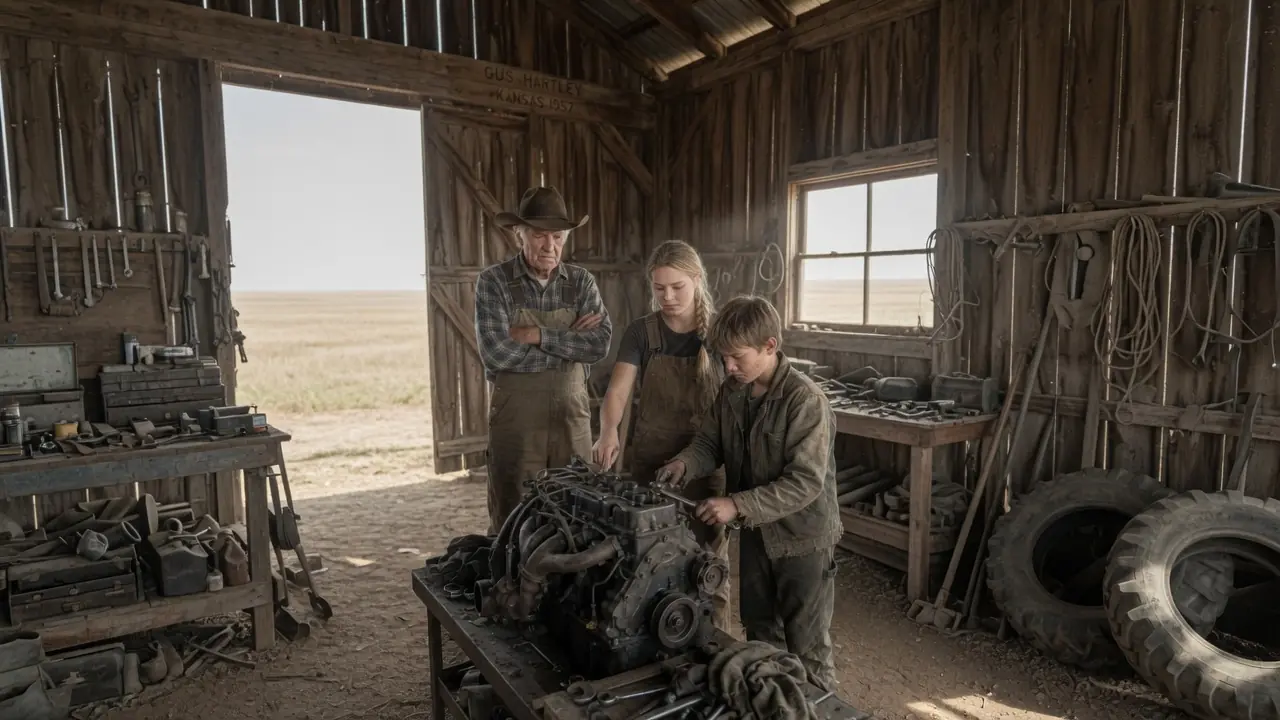
Friday morning arrived too fast. I barely slept, kept jolting awake thinking I'd heard Grandpa's truck. Finally gave up around 5:00 and went downstairs. Grandma was already up making coffee, moving through the kitchen with her usual precise efficiency. He'll be home around 6:30. I suggest you're in the barn when he arrives. I drank coffee I didn't want, ate toast that tasted like cardboard, watched the clock tick toward judgment. Six twenty. I walked to the barn. The John Deere sat in its usual spot looking almost normal in the dim light. Almost like nothing had changed. But everything had changed. I'd changed it. Broken some invisible rule that I hadn't fully understood until it was too late. Six thirty came and went. Six forty-five. Seven o'clock. Then I heard it. Grandpa's truck engine, that distinctive rattle that meant he needed a new muffler, but would probably drive it until it fell off completely. The truck pulled up to the house. The engine died. Door opened and closed. Footsteps approached the barn. I stood next to the tractor, hands at my sides trying to figure out where to look when he walked in. The barn door opened. Grandpa Gus stepped inside carrying his overnight bag, looking road worn and tired. His eyes went to the John Deere, and he froze. Just stopped moving, stopped breathing, stopped being anything except a man staring at something impossible. I counted seconds in my head. Ten, twenty, thirty. His face went through changes I'd never seen before. Confusion first, his eyes tracking over the modified carburetor, the new air intake, the different exhaust configuration. Then recognition as he understood what he was seeing, then something that looked like horror. The overnight bag slipped from his hand. Hit the floor with a soft thump. Grandpa took three steps toward the tractor, reached out and touched the new carburetor like he was checking if it was real. His other hand went to his shirt pocket, pulled out something small. My father's journal, the one I'd left in the barn by accident, too rushed and panicked to remember it.
When Grandpa looked at me, his eyes were wet. You knew Jasper tried this. His voice came out barely above a whisper, rough like gravel. Yes, sir. I found his journal. I read what happened. And you did it anyway? I learned from his mistakes. Did it differently. Grandpa walked around the tractor slowly inspecting every change I'd made. His hands trembled when he touched the welds, traced the new fuel lines, examined the modified mounting brackets. This tractor is all we have. You understand that? Without it, we lose everything. I know. Then why would you risk it? Because we're losing everything anyway. The words burst out of me louder than I meant. We owe money we can't pay. Grandma needs medicine we can barely afford. If we keep doing what we've always done, we fail. At least this way there's a chance. Grandpa turned away from me, put both hands on the tractor's hood, leaned his weight against it. His shoulders shook. I realized with shock that he was crying. I'd never seen Grandpa Gus cry. Not when Grandma got her diabetes diagnosis, not at any of the funerals I could remember, not ever. But he was crying now, and I didn't know what to do except stand there and feel like the worst person in Kansas. I lost your father to this machine. The words came out broken, separated by gasps for air. Your father? He was so confident, so sure he could improve it. I told him to leave it alone. He didn't listen. Grandpa straightened up, wiped his face with his sleeve, but the tears kept coming. The accident wasn't random, Goldie. He was working on the tractor while it was running, trying to adjust something. Thought he could do it live. I told him it was dangerous. He said he knew what he was doing. The engine caught his shirt, pulled him in. By the time I got to him, it was too late. I stood there, my own eyes burning, understanding for the first time the weight of what I'd done. I hadn't just modified a tractor, I'd reopened a wound that had never really healed. I didn't know. I'm so sorry. I didn't know that's how it happened. Now you do. Now you know why I can't lose you, too. The barn door opened. Grandma Lorelei stepped inside, her presence somehow making the space feel less crushing. Frank, that's enough. Her voice was gentle but firm. Goldie is not Jasper. She didn't work on a running engine. She spent six weeks preparing. She learned proper welding from Dottie Finch. She had a plan.
But she lied to us. Yes, she did. And that was wrong. Grandma turned to look at me. Very wrong. Trust is sacred in this family, and you broke it. Then back to Grandpa. But lying about the project doesn't mean the project itself was foolish. Our granddaughter isn't reckless, she's desperate. And maybe we should have been listening when that desperation started showing. I wasn't desperate. I just wanted to help. By putting yourself at risk, by gambling with our livelihood without asking. The words stung because they were true. I had gambled with equipment we couldn't afford to lose, with trust I hadn't earned, with consequences I hadn't fully considered. Grandma moved closer, stood between Grandpa and me like a referee. What's done is done. The tractor is modified. Now we need to know if it works. Frank, you need to test it. Grandpa looked at her like she'd suggested jumping off a cliff. Test it unless you want Goldie's work to be meaningless. Test it. See what she's built, then decide. He stared at the John Deere for a long moment, then nodded once, short and sharp. All right, we'll test it. But if anything is wrong, anything at all, we stop immediately. He looked at me. Get in. We're going to Northridge field. My stomach dropped. Northridge, the field with the heaviest clay soil in the county, the field where my father had died. That seemed intentional. A test with layers I wasn't ready to face. We walked across the property in silence. Grandpa drove, I sat on the fender, Grandma and Iris followed in Grandma's car. Mrs. Finch must have seen us heading out because her truck appeared, too, parking at the field edge. The whole family gathered to watch me either save us or destroy us. Grandpa engaged the transmission, started pulling the same five-blade plow I'd used yesterday. The tractor dug in, muscles of steel and combustion coming to life. For ten minutes, everything was perfect. The engine pulled smoothly through soil that normally made it labor. The power increase was undeniable even to someone as skeptical as Grandpa. I saw his grip on the steering wheel loosen slightly. Saw something like hope start to show in his face. Then the ticking sound I'd heard yesterday came back, louder now, more insistent. Grandpa heard it instantly, killed the engine, climbed down. What's that noise? I don't know. It started after the accident yesterday.
What accident? I told him everything. The test run, the lost traction, the slide into the ditch, the damage, the rushed repairs. Every detail I'd been hoping to hide. Grandpa's face went through several colors. Red, white, red again. You crashed it. You crashed it and didn't tell me. I was going to tell you. I promised Iris I would. But you didn't tell me when I first walked in. You let me find out like this. He knelt next to the tractor, started examining the undercarriage. I knelt beside him, watching him trace fuel lines, check mounting points, feel for anything loose. His hand stopped on something I couldn't see, stayed there a long moment. Goldie, look at this. I crawled under further. He was pointing at a gasket, old and cracked, barely holding together. That's been failing for weeks, maybe months. It's not from your modifications. How can you tell? Because this is original equipment, and it's rotted through. He kept examining, his movements getting more focused. Found the oil line that had come loose in the crash, traced it to its connection point. This wasn't loose because of the accident. The mount was already failing. The crash just finished what was already breaking. He slid out from under the tractor, oil-stained and thoughtful. If you hadn't taken this machine apart, I never would have found these problems. Another two weeks, maybe three, and this engine would have seized completely. During harvest season. So I saved it accidentally. The exhaust work you did is sloppy. You rushed the welds after the accident, and it shows. But the core modifications, the carburetor, the intake system, the design work, those are solid. He stood up, looked at me straight on. You had no right to do this without permission. You broke our trust and put yourself in danger, but you also might have saved this farm from total disaster. I didn't know what to say. Sorry felt too small. Thank you felt wrong. We're going to fix this properly, you and me, together. Then we're going to set rules about what you can and cannot touch without asking. Yes, sir. Mrs. Finch walked over from where she'd been watching. Everett stood by her truck, probably fighting the urge to say something like, I told you so. The girl did good work, Gus, with supervision. With supervision being the key phrase.
Grandpa looked at Mrs. Finch with something that might have been gratitude. Thank you for keeping her alive. Someone had to. She's too stubborn to quit once she starts something. Wonder where she gets that from. Grandma Lorelei said, looking pointedly at Grandpa. The next week was a blur of work. Grandpa and I rebuilt the engine mounts properly, replaced the failing gasket, redid my exhaust welds with professional precision. Mrs. Finch supervised, pointing out mistakes, demanding we do things right instead of fast. Iris brought lunch out to the barn every day, watched us work with relief in her eyes. The crisis had passed. We were still a family. By the following Friday, the John Deere ran perfectly. No ticking, no leaks, just smooth power that made Grandpa shake his head in what might have been admiration. News spread through Oak Ridge the way news always did in small towns. People talked, came by to see the modified tractor. Some were impressed, some thought we were crazy. Virgil Brennan showed up on a Saturday morning, hat in hand. Heard your granddaughter's got a knack for machinery. I've got an International Harvester that's been giving me trouble. Think she could take a look? Grandpa glanced at me, then back at Virgil. She could, but there are conditions. One, I supervise the whole job. Two, you pay a fair rate for both our time. Three, you understand that we're learning as we go. Virgil nodded. Fair enough. Fifty dollars sound reasonable? Fifty, more money than I'd ever earned in my life. That evening, Grandpa called me into the barn. He looked serious, which wasn't unusual, but also uncertain, which was. If you're going to do this work on other people's equipment, we need rules. I'm listening. First rule, complete honesty. You tell me everything you're planning every step of the way. No secrets. I promise. Second, no rushing. We work careful, methodical, quality over speed. Okay. Third, we work together.
You don't take on jobs without me or Mrs. Finch present, not until you've got at least two years more experience. That's fair. He pulled something from his workbench drawer, a small box wrapped in brown paper. This is for you. Early birthday present. I unwrapped it carefully. Inside was a set of precision measuring tools. Micrometers, calipers, gauges, professional-grade equipment that must have cost him a month's worth of crop money. You're talented, Goldie. Your father would be proud, but talent without discipline is dangerous. These tools will help you learn precision. Use them well. I couldn't speak, just nodded and held the box like it was made of something more precious than steel. The Virgil Brennan job started the following Monday. His International Harvester 1958 had a completely different engine architecture than our John Deere, different fuel system, different cooling, different everything. Grandpa warned me from the start, every machine is unique. What worked on ours won't necessarily work on his. I thought I understood, but understanding and truly knowing are different things. We spent three days diagnosing Virgil's problem, traced it to a carburetor issue similar to what our John Deere had. I was confident I knew the solution, had done this before, could do it again. When Grandpa suggested using a type A gasket for the rebuild, I disagreed. Type B would be better. It's newer, can handle higher temperatures. Are you sure this engine runs hotter than ours? I'm sure. Grandpa looked at me for a long moment, then nodded. Your call, but you own the results. We installed everything carefully, precisely. I was so certain I was right. Three days later, Virgil called. His voice on the phone was tight with anger. The tractor's completely dead, engine seized. I need you out here now. We drove over immediately. One look under the hood told the story.
The type B gasket had failed under the higher heat, caused a catastrophic breakdown that spread through multiple systems. Virgil stood there with his arms crossed, face red. This isn't a simple fix. This is a total rebuild. Do you have any idea what you've done? Harvest starts in two weeks. Without this tractor, I lose my whole crop. Mr. Brennan, I'm so sorry. I'll fix it. I'll make it right. Fix it. With what? I need a complete replacement engine. That's five hundred dollars. Where's a fifteen-year-old farm girl going to get five hundred dollars? The number hit like a physical blow. Five hundred, more than our family had saved, more than I could earn in years. Grandpa pulled Virgil aside, spoke in low tones I couldn't hear. Virgil shook his head, walked away to his truck without looking back. On the drive home, Grandpa didn't say anything. Didn't need to. The silence was louder than any lecture. That night, the family held a council around the kitchen table. Grandma had her ledger open, pencil in hand, running numbers that didn't add up. We have one hundred forty-seven dollars in savings. Not enough. Iris spoke up, I have two hundred eighty in my account, savings for nursing school. I can use that. Absolutely not, Grandma said. That's your future. I'll quit school, get a job, pay it back. No, Grandpa said firmly. You made the mistake, but we don't sacrifice your education for it. I sat there feeling like the weight of everyone's disappointment might crush me into the floor. Saturday morning, Mrs. Finch's truck pulled into our driveway. She got out carrying an envelope. Inside our kitchen, she set the envelope on the table. Five hundred dollars. Dotty, we can't accept this. Yes, you can. This is money Goldie earned working for me over the past two years. I've been saving it for her. Consider it an advance on future wages. But that's your money. No, it's hers. She worked for it. Now she's paying for her education. She looked at me directly. But there's a condition. You take this money, you commit to learning properly. No more shortcuts, no more assumptions. You study, you practice, you listen to people with more experience. Understood? Yes, ma'am. And you pay me back, not in dollars, in becoming the best mechanic in this county. I took the envelope with shaking hands. It felt heavier than paper should. We paid Virgil Brennan that afternoon. He accepted the money without comment, but his eyes, when he looked at me, carried something that wasn't quite forgiveness. Over the next three months, I learned more from failure than I ever had from success.
Grandpa and Mrs. Finch taught me properly, slowly. Every machine got treated as unique. Every assumption got questioned. Every shortcut got called out. I fixed Virgil's tractor correctly, refusing payment. He thawed slightly, eventually sent another customer my way with the grudging recommendation that I was careful now, thorough, could be trusted. Word spread, slowly. I wasn't the miracle girl mechanic. I was the girl who'd made a massive mistake and learned from it. That was better anyway, more honest. Our John Deere kept running strong. The modifications held up through harvest season, through winter, through another planting cycle. The extra power let us finish work faster, take on some custom work for neighbors, earn money that slowly pulled us away from the edge of financial collapse. By late November, we'd saved enough to make the first major payment on the extended bank loan. The farm was still standing. That would have to be enough for now.
Christmas 1968 arrived with snow that turned the Kansas fields into blank pages. The farmhouse smelled like Grandma's gingerbread and the pine tree Grandpa and I had cut from the back forty. Iris came home for three days, her nursing uniform replaced with a red sweater that made her look younger than twenty. We gathered in the living room after dinner, the tree lights casting colored shadows across walls. Grandpa handed me a package wrapped in brown paper and twine, heavier than it looked. Open it. Inside was a tool box, not just any tool box, a machinist's chest made of oak and brass, the kind professionals used, with drawers that slid on ball bearings and compartments lined with felt. It must have cost more than we'd made from two months of custom work. Grandpa, this is too much. No, it's exactly right. You've earned it. But remember what it represents. His voice carried weight that had nothing to do with the gift itself. I trust you now, but trust has to be maintained every single day. One lie, one hidden mistake, and we're back to where we started. I won't let you down. I know. That's why I'm giving you this. Grandma handed me something smaller, a framed photograph I'd never seen before. My father at maybe twenty, standing next to the John Deere, grease on his hands and a smile on his face. He would have been proud of who you're becoming, but prouder that you learned from his mistakes instead of repeating them. Her fingers touched the frame gently, like the glass might break. You don't have to prove anything to anyone, Goldie, not to that Caldwell boy, not to the town, not even to yourself. You're already enough. The words settled somewhere deep. I'd spent so long trying to prove I could do things that I'd forgotten to ask whether I needed to prove anything at all. That night, lying in bed while snow fell outside my window, I made a list of things I wanted to learn, not to impress anyone, just to know. Electrical systems, hydraulics, metallurgy, diesel engines. The list filled two pages before sleep finally took me.
Spring of 1969 brought more customers. A farmer from three counties over who'd heard about the girl who could resurrect old equipment, a widow whose late husband's tractor had been sitting unused for five years, an elderly man who wanted to keep his father's 1940 Farmall running just a little longer. Each job was different. Each one taught me something. And each one I did with Grandpa or Mrs. Finch watching, checking, making sure I didn't rush or assume or take shortcuts. Virgil Brennan stopped by in April with a case of motor oil and an apology. I was hard on you last fall, harder than I should have been. You made a mistake, but you owned it. That counts for something. He set the oil on our porch. I've been telling people you're reliable now. Slow, but reliable. Hope that's all right. Slow was fine. Slow meant careful. Slow meant I was learning to value precision over speed, thoroughness over flash. That summer Weston Caldwell's father had trouble with his newest International Harvester. The dealership couldn't figure out the problem, left the machine sitting in their shop for three weeks with no answers. Nathaniel Caldwell didn't want to ask us for help. His pride wouldn't allow it.
But his desperation eventually won. He showed up on a Tuesday afternoon driving his black Mercedes, parking it like he was afraid Kansas dirt might contaminate the paint. I hear you've developed some skill with engines. Some. My tractor has been at the dealership for a month. They're incompetent. I need someone who actually understands machinery. I could feel Grandpa tensing beside me, ready to turn this man away. But I touched his arm gently. We can look at it. But we work methodically. Could take a week or more to diagnose. I don't pay for time. I pay for results. Then you might want to stick with the dealership. We charge for both time and results. And we don't rush. Nathaniel's face reddened. He wasn't used to being told no, especially not by a teenage girl in oil-stained coveralls. Fine. But I expect updates every day. And if you can't fix it, you don't get paid. Deal. After he left, Grandpa looked at me with something between admiration and concern. You know his son humiliated you. Called you stupid for being a girl interested in machines. I know. And you're still going to help his father. The tractor doesn't care whose farm it's on. It just needs to be fixed. That's more mature than I would have been at your age. We spent three days at the Caldwell farm, which was everything ours wasn't. New buildings, fresh paint, equipment that looked like it belonged in showrooms. Their John Deere collection made our single Model B look like a museum piece. West avoided me the first day. Stayed in the house, probably embarrassed. But on day two, curiosity got the better of him. He wandered out to where Grandpa and I were working on his father's International Harvester, hands in his pockets, trying to look casual. Figure out what's wrong yet? Still diagnosing. Complex electrical fault in the fuel injection system. He watched us work for maybe ten minutes, silent. Then I'm sorry about what I said last year. About girls not understanding machines. Okay. That's it. Just okay? What do you want me to say, West? That it hurt. It did. That you were wrong. You were. But holding grudges takes energy. I'd rather use it learning things. He sat on a hay bale looking younger than sixteen.
My dad expects me to take over the farm. Four hundred acres, all the newest equipment, everything. But I don't understand any of it. I can drive a tractor, but I couldn't fix one if my life depended on it. So learn. From who? My dad doesn't have time to teach. The dealership guys just want to sell us new parts. Mrs. Finch teaches welding on Saturday mornings. The library has books on engine mechanics. Or you could just admit you're interested and find someone to mentor you. West looked at me like I'd suggested something revolutionary. The idea that he could simply ask for help seemed foreign to him. Would you teach me? Not for free or anything. I'd pay. Before I could answer, Grandpa spoke up. You'd have to start at the beginning. Basic tools, basic principles. No shortcuts because you're impatient or think you're above manual labor. I'm not above anything. I just want to understand what I'm doing instead of pretending I know. All right, then. Saturdays. You come to our place, help with whatever needs doing, and we'll teach you while we work. We fixed Nathaniel Caldwell's tractor on the fourth day. The problem was subtle, buried deep in the electrical system where most mechanics wouldn't think to look. But Grandpa had seen similar issues before, and between his experience and my systematic approach, we traced it down. When the engine roared to life perfectly, Nathaniel's expression went through several changes before settling on something that might have been respect. How much do I owe you? Three hundred. That's four days at our standard rate. He wrote the check without argument. As we were packing up, he cleared his throat. My son tells me he's been pestering you about learning mechanics. He asked if we'd teach him. We said yes. Nathaniel's jaw worked like the words were fighting to get out. I'd appreciate if you did. The boy needs to understand the equipment he'll inherit. And apparently I don't have the patience to teach him. It wasn't exactly a thank you, but it was close enough.
A week after we fixed his father's tractor, West appeared at our barn door one Saturday morning. Seven o'clock sharp, wearing clothes he clearly didn't mind ruining. He didn't say much at first, just watched as Grandpa and I serviced the neighbor's grain auger. After an hour of silent observation, he finally spoke. Can I help? Grandpa handed him a wrench. Start by learning which end does what. Over the following weeks, something unexpected happened. West kept showing up. Seven o'clock every Saturday morning, stayed until we sent him home at dusk. He worked hard, asked smart questions, took notes in a small leather journal like the ones engineers used. He wasn't the arrogant boy who'd sneered at our old tractor anymore. Or maybe he was, but the arrogance had redirected itself toward learning instead of showing off. We didn't become friends, exactly. But we developed a kind of mutual respect, two people learning the same lessons from different starting points. The high school counselor pulled me aside in October. Have you thought about college, Goldie? Your grades are excellent, especially in math and science. I hadn't thought about college. College was for people with money and plans, neither of which seemed to apply to me. We need the farm. I can't leave Grandma and Grandpa. There are scholarships, programs specifically for girls interested in engineering.
You could commute to Kansas State or even apply to bigger schools. I'll think about it. But I didn't think about it. Not seriously. The idea felt too big, too far away from the life I knew. Two weeks later, Mrs. Finch brought it up while we were welding frame repairs for a neighbor's trailer. That counselor talked to you about college. How did you know? Oak Ridge is a small town. Everyone knows everything. She raised her welding shield, examined her work critically. My husband wanted to be an engineer. Studied for two years before money ran out and he had to come back to work the farm. He never regretted the decision, but he never stopped wondering what if. You think I should go? I think you should have options. And options require preparation. Applications, test scores, portfolios of work. I barely know what I want to do next month. How am I supposed to plan for four years from now? You don't plan the whole journey, just the next step. Then the step after that. She pulled out a welding rod, handed it to me. Make this bead perfect, not good enough. Perfect. That's how you build a future, one perfect step at a time. November brought early snow and a letter from a school I'd never heard of. Massachusetts Institute of Technology. Someone had sent them my name, probably that counselor, and they were inviting me to apply for their engineering program. The letter sat on my dresser for a week. I'd take it out, read it, put it back. MIT was for geniuses, for rich kids with prep school educations, for people who belonged in places like that. Not for farm girls from Kansas who smelled like tractor grease. Grandma found me staring at the letter one evening. What's holding you back? I don't belong there. Look at me. Look at where I come from. She sat on my bed, patted the space beside her.
When I was your age, women weren't supposed to manage money. That was men's work. I taught myself bookkeeping from library books, practiced on my father's farm accounts when he wasn't looking. People said I was being uppity, getting above my station. What did you do? I kept doing it anyway. Got so good that eventually people had to admit I was right. Changed what was possible for women in this town. Her hand found mine. You think you don't belong there because no one like you has gone before. But someone has to be first. Why not you? Because I'm scared. Good. Fear means it matters. I filled out the MIT application on a Saturday in December. Took the required tests at a high school in Junction City. Wrote essays about modifying tractors and learning from failure and understanding that the bravest thing isn't succeeding on the first try. Sent it all off in January and tried not to think about it. The John Deere Model B kept running through another winter, another spring. We used it for our own work and hired it out for custom jobs, the extra income slowly building our savings to numbers that would have seemed impossible two years ago. Iris got married in June. Small ceremony at the Methodist Church, reception in the parish hall with cake and punch. She looked radiant in a simple white dress. Marcus looked terrified and everyone cried during the vows. I stood next to her as maid of honor wearing a dress that felt foreign after years of coveralls and work boots. At the reception she pulled me outside into the warm evening air. I'm scared, Goldie. Scared of moving away, scared of being a wife, scared of all the things that could go wrong. You're the bravest person I know. No, you are. You took apart the tractor that kept us alive. That's the scariest thing anyone in this family has ever done. She smoothed her dress, looked back at the parish hall where Marcus was dancing with Grandma. But scared doesn't mean don't do it. It just means it matters enough to be worth the fear. In May 1970 I got my acceptance letter from MIT. Full scholarship. Room, board, tuition, everything covered. They wanted me to start that fall. I sat at the kitchen table, letter in hand, unable to process what it meant.
Grandma saw it first. Her face lit up brighter than I'd seen in years. Goldie, this is extraordinary. I can't go. The farm needs me. The farm needs you to become everything you're capable of being, not to stay small because you're afraid of being large. But who'll help Grandpa with the custom work? Who'll fix things when they break? West has been training for eight months. He's competent now. And there are other mechanics. The farm survived before you, it'll survive while you're at school. Grandpa came in from the barn, read the letter over Grandma's shoulder. I waited for him to say I couldn't go, that they needed me too much. When do you leave? August. But I'm not going. Yes, you are. His voice was firm, the tone that meant argument was pointless. Your father would have given anything for an opportunity like this. You're going to take it and you're going to make us proud. Not because you owe us anything, but because it's what you're meant to do. The summer passed in a blur of preparation and goodbyes. I trained West on the more complex repairs making sure he understood not just how but why. He proved to be a quick study when his pride wasn't in the way. Dr. Patricia Hartwell from MIT visited in July, a recruitment trip through the Midwest. We sat on the front porch drinking iced tea while she asked about my work. You made significant mistakes with that first customer's tractor. Yes, ma'am. And you learned from them. I tried to. That's more valuable than never making mistakes in the first place. MIT will be hard, harder than anything you've done. Most of your classmates will come from prep schools with resources you've never had, but you understand practical applications they've only read about.
That's worth more than any advantage. The night before I left the whole family gathered for dinner. Pot roast, mashed potatoes, green beans from Grandma's garden. The same meal we'd eaten hundreds of times, but tonight it tasted different. Like memory instead of sustenance. After dessert Grandpa asked me to walk with him to the barn. The John Deere sat in its usual spot, twenty-three years old now, still running strong. He put his hand on the hood. This machine taught you something important. Want to know what I think it is? What? That sometimes you have to risk what you have to protect what you love. You risked our livelihood because you loved this family. That was simultaneously the bravest and most foolish thing I've ever seen. He turned to face me. MIT is another risk. You'll be leaving everything familiar, going somewhere you might fail. But if you don't go, you'll always wonder what could have been. And wondering is worse than trying. What if I do fail? Then you come home. We'll still be here. The farm will still be here. Failure isn't final unless you let it be. Grandpa pulled an envelope from his jacket pocket. This is from your father's journal. The page after the one you read. I cut it out years ago, kept it separate. Thought you should have it now. Inside a single page of my father's handwriting. If you're reading this, Goldie, it means I'm gone. And it means you found my notes about the tractor modifications. I know I failed. Know I was reckless. But I also know you'll want to try. So here's what I learned from my failure. Don't work alone.
Don't hide what you're doing. Don't let pride convince you that asking for help is weakness. And if you succeed where I failed, don't stop there. Take what you learn and build something bigger. Because that's what progress is. Each generation standing on the shoulders of the one before, reaching a little higher. I love you. I'm proud of you. I always will be. I read it three times, tears blurring the words. He knew you'd do great things. Now go prove him right. Grandpa drove me to the airport. At security, he handed me a small wooden box. Open it when you get to Boston. The flight gave me time to think. The scared fifteen-year-old who'd taken apart a tractor. The failing sixteen-year-old who'd learned from disaster. The growing girl who'd discovered she was stronger than fear. Back in my dorm room, I opened Grandpa's box. Inside was a photograph of him standing next to the John Deere in 1946, young and hopeful. And a note. You've already done the hard part. Everything from here is just details. Classes started the next week. Advanced dynamics, thermal systems, design optimization. Junior year, when everything got serious. But I was ready. Ready to prove that sometimes the biggest risks lead to the greatest rewards. That trust once broken and rebuilt becomes stronger than if it had never been tested. That each generation stands on the shoulders of the one before, reaching a little higher. Ready to be exactly who I was meant to be.