“I don’t care what they look like. They’re freezing, and one of them might be dying. You open that door, Ethan, or I will.”
Hattie Tate said those eleven words without raising her voice, and in sixty-eight years of living, Ethan had never once ignored her when she used that tone. He opened the door. Four massive men stumbled out of the rain and into his garage, soaking wet, covered in leather and tattoos, breathing like broken engines.
That night cost Ethan and Hattie almost nothing. What came after, none of them were ready for.
The letter was still on the kitchen table when Ethan came in for breakfast. He had not moved it in three days. He told himself it was because he kept forgetting. That was a lie, and he knew it, and Hattie knew it, and neither of them said a word about it because some truths are easier to live with when they stay folded up inside an envelope with a bank’s logo stamped on the corner.
Hattie set his coffee down in front of him without asking. After forty-one years of marriage, she did not need to ask. Two sugars, a splash of cream, hot enough to mean business, but not hot enough to scald. She had been making it that way since before Naomi was born, since before Ethan’s hair went from golden to silver at the temples, since before the corporate chain shop opened up on the bypass road three miles north and started bleeding their customer base dry.
One oil change at a time.
“Eggs are almost done,” she said.
“Thank you, Hat.”
That was their whole conversation some mornings, not because they had nothing to say, but because they had been saying things to each other for so long that sometimes just existing in the same room together was its own kind of language. Ethan wrapped both hands around the mug and stared out the window at the garage.
His garage. Tate’s Auto and Repair, Route 9, Millhaven, Kentucky. The sign had been up there for thirty-one years. He had painted it himself, black letters on a white background, clean and simple because he believed clean and simple told people what they needed to know.
He fixed cars. He fixed them right. He charged what was fair. He stood behind his work.
For thirty-one years, that had been enough.
It was not enough anymore.
“You need to call the bank today,” Hattie said from the stove.
Not accusing, not nagging, just stating a fact the way she stated all hard facts, calmly, clearly, like a woman who had decided a long time ago that pretending difficult things were not real only made them more difficult later.
“I know.”
“Ethan.”
“I said I know, Hat.”
She turned around and looked at him. He did not meet her eyes right away, and when he finally did, she held his gaze for a long moment, reading him the way she had always been able to, the way that used to drive him crazy when they were young and he thought he was hiding something.
“What are you going to tell them?” she asked.
He looked down at the mug. “I’m staying. I don’t know yet.”
The truth was he had nothing to tell them that he had not already said twice before. He had asked for extensions. He had restructured. He had done everything the loan officer suggested with that sympathetic half-smile that people get when they already know how something ends but are too polite to say so out loud.
The garage had a second mortgage on it. The diner, Hattie’s Little Diner attached to the east side of the property, was operating at a loss for the second quarter in a row. And the final payment deadline that the bank had set, the one printed on the letter currently sitting three feet from Ethan’s coffee mug, was eleven days away. He had four thousand dollars in the operating account.
He needed twenty-two thousand.
The back door opened and Naomi blew in like a small tornado, backpack half-zipped, ponytail crooked, holding her physics textbook against her chest like it was the most important object in the world, which, knowing Naomi, it probably was.
“Morning, Gran. Morning, Grandpa.”
She kissed Hattie on the cheek, grabbed a piece of toast off the counter without breaking stride, and dropped into the chair across from Ethan. She opened her textbook before she had even fully sat down.
“Good morning to you, too,” Ethan said dryly.
“Sorry, sorry.” She looked up and grinned that wide, bright, uncomplicated grin that she had had since she was about four years old and had not changed a bit in thirteen years. “I’ve got a calc test second period, and Mr. Hendrix said the last problem is going to be something we’ve never seen before. He said that like it was a threat, but honestly, I think he’s just trying to scare us.”
“Is it working?”
“A little, but I figured out the derivative pattern last night, so I think I’m good.” She took a bite of toast. “Can I use the garage after school? I want to finish rebuilding that carburetor you set aside for me.”
Ethan almost smiled. Almost. “Yeah, it’s on the workbench.”
Naomi was seventeen and already understood engines better than most adults who had been working on them for a decade. She had a gift, the same gift Ethan had recognized in himself at her age. That particular kind of mind that could look at a broken mechanical system and instinctively understand not just what was wrong, but why it was wrong, and what it would take to make it right.
Except Naomi had taken that gift and built something bigger on top of it. She was applying to engineering programs. Good ones. The kind of schools with scholarship committees and application deadlines and prerequisite requirements that demanded not just ability, but documented, certified, gold-standard proof of ability.
The applications cost money. The visits cost money. Even the postage cost money. Ethan had not told her that yet.
He looked at her sitting across from him, seventeen years old and completely absorbed in her textbook, chewing her toast, her pencil already moving across a scratch pad beside her plate, and he felt something cold and quiet settle into his chest. The kind of weight you carry when you know something that the person across from you does not know yet, and you are not sure how to tell them. And every single day you do not tell them, the weight gets a little heavier.
“Naomi,” he said.
She looked up.
He almost said it. He almost said, “Sweetheart, there’s something I need you to understand about this year and what it might mean for your plans.” He almost laid it all out the way Hattie would have, clearly, calmly, like a woman who knew that hard things did not get easier by being avoided.
Instead, he said, “Study hard today.”
She grinned again. “Always do.”
And she went back to her textbook.
Hattie put scrambled eggs on the table. She did not look at Ethan. But she reached past him to set down the salt shaker and let her hand rest on his shoulder for just a moment, two seconds, maybe three, before she pulled it back.
That was enough. That was her telling him, “I know. I see you. We’ll get through this.”
He put his hand over hers before she could move away, held it there for a moment, then let go. Because that was the other thing about forty-one years. You learn that sometimes you hold on and sometimes you let go, and the whole art of it was knowing which moment called for which.
The first customer that morning was Pete Gallagher, sixty-three, drove a 2009 Ford F-150 that he had owned since it was new and treated like a family member. Pete came in every six weeks, regular as a clock, for oil changes and tire rotations and whatever else the truck decided it needed, which was not much because Pete was the kind of man who maintained his vehicle the way Ethan’s grandfather had taught him.
A vehicle should be maintained with respect, with consistency, and with the understanding that a machine would take care of you as long as you took care of it first.
“How’s the wife?” Pete asked, settling into the plastic chair in the waiting area with his newspaper.
“Good. She’s good.” Ethan slid under the truck. “How’s yours?”
“Complaining about my driving again. Says I brake too hard.” A pause. “I do brake too hard.”
“You always have.”
“Yeah, well, some things don’t change.”
Ethan worked quietly for a moment. He liked Pete, like most of his regulars. That was the thing about a small independent shop. You did not just know cars, you knew people.
You knew Pete’s truck was a little sensitive in cold starts because of that repair he had done on the fuel injector eighteen months ago. You knew that Mrs. Whitmore’s Buick always pulled left after a certain mileage because of a factory alignment quirk in that year’s model. You knew things that a chain shop with rotating technicians and diagnostic computers could not know because knowing things like that required time and attention and the kind of care that could not be standardized.
But caring about people’s cars did not pay the twenty-two thousand dollars.
“Heard the AutoNation on the bypass is doing free inspections this month,” Pete said from behind his newspaper.
Ethan kept his eyes on the drain plug. “Heard that, too.”
“Load of nonsense, you ask me. Free inspections.” Pete lowered the paper slightly, the way he did when he was about to say something he had been thinking about for a while. “They find something on that free inspection every single time. Remarkable, isn’t it?
Goes in fine, comes out needing four hundred dollars of work.”
“Remarkable,” Ethan agreed.
“People don’t see it.”
“No. They see free.”
Pete was quiet for a moment. “You know I’m not going anywhere, Ethan. Just so you know.”
Ethan thought about the letter on the kitchen table. He thought about twenty-two thousand dollars in eleven days and the way Naomi had looked that morning with her physics textbook and her applications and her whole shining future sitting right there in that crooked ponytail.
“I appreciate that, Pete,” he said, and he meant it.
By noon, he had had three customers. Three. On a Tuesday. Five years ago, a Tuesday in September would have had eight, ten cars minimum.
His bay would have been full, and he would have been thinking about whether it was time to hire another guy part-time. That was before. Before the bypass, before the chain, before the whole economic machinery of small-town commerce started grinding in a direction that crushed the people who had built those towns one service at a time.
He sat on the stool in the bay and ate the sandwich Hattie had brought him and thought about calling the bank the way he told her he would. He did not call. He told himself he would do it after the afternoon. Then he told himself he would do it tomorrow.
He had been telling himself tomorrow for about three weeks now, and the letter on the table kept sitting there, getting heavier in his peripheral vision like something with a pulse.
Hattie came into the bay at 2:30. She had a look on her face, not angry, not panicked, something more careful than that. The look she got when she had been turning something over in her mind and had decided it was time to put it on the table between them.
“I talked to Tommy Sears today,” she said.
Ethan looked up. Tommy Sears was their accountant, had been for fifteen years.
“He thinks we should talk to the bank about voluntary restructuring before the deadline,” she said. “He thinks if we go in proactively, explain the situation in person, bring the diner revenue projections for next quarter…”
“Hattie.”
“There might be some flexibility on the timeline. Not a guarantee, but—”
“Hattie.”
She stopped.
“How much flexibility?” he asked.
She paused. “He doesn’t know.”
“So we go in, we explain everything they already know, and we hope.”
“Yes,” she said. “We hope.”
Ethan was quiet for a moment. He looked at his hands. Forty years of mechanical work had left them mapped with calluses and old grease that never fully came out no matter how hard he scrubbed.
Working man’s hands, his father would have called them. His father had said that like it was the highest compliment a man could receive.
“Okay,” he said finally. “Okay, we’ll go in.”
“Yeah. We’ll go in.”
He looked at her. “Make the appointment.”
She nodded, but she did not leave right away. She stood there for a moment in that specific way she had when there was something else, something she was trying to figure out how to say.
“You need to tell Naomi,” Hattie said quietly. “Before we go in, before any of this, she needs to know what’s happening.”
“I know.”
“I know.” His voice came out rougher than he meant it to. He softened it. “I know, Hat. I’ll tell her.
Tonight after dinner, I’ll sit her down.”
Hattie held his eyes for a long moment, then nodded and walked back toward the diner. Ethan sat alone in the bay with the silence and the smell of oil and old metal.
Outside, the sky had gone the color of dirty dishwater, thick, swollen clouds building from the west, the kind that meant serious weather was coming. The weather app on his phone, which Naomi had installed for him last spring after the third time he had been caught off guard by rain while he had engine parts laid out in the drive, showed a red band of storms coming across the county line by 8:00 or 9:00 that night.
He looked at the sky for a long minute, then he went back to work. The afternoon brought two more customers. One of them, a woman named Carla Benson, who drove a bruised Honda Civic with 190,000 miles on it, sat in the waiting area while he replaced her alternator and talked on the phone the whole time in a low, anxious voice about something involving her landlord.
Ethan did not listen, but the tone was familiar. That sound of a person dealing with more than one thing at once and not quite managing either one.
At 5:30, Naomi came through the side door with her backpack and her textbook and that same energized look she always had after a good day at school, the look that meant her brain had been fed something interesting and was still chewing on it.
“How was the test?” Ethan asked.
“I think I got a hundred,” she said matter-of-factly, not bragging, just reporting. “The last problem was a related-rates question. Hendricks tried to disguise it as a real-world scenario, but once you saw the structure, it was obvious.”
She dropped her bag. “Can I still work on the carburetor?”
“Sure.”
She moved to the workbench and started pulling on a pair of shop gloves. She was comfortable here. She had always been comfortable here in the garage, with the tools, with the logic of mechanical systems.
When she was eight, she used to sit on the old wooden stool beside him and hand him wrenches and ask him questions about how things worked, the endless, patient why questions of a child who needed to understand everything from the ground up.
“Why does the timing chain matter, Grandpa? What happens if it goes? How does the fuel get from the tank to the engine? What makes a carburetor different from fuel injection? If a car doesn’t start, what’s the first thing you check?”
He had answered every question, all of them, and she had stored the answers like files organized and indexed, pulled them out later in context, built on them, asked more questions. He had known then. He had known she was going to be something.
He stood at the bench across from her, organizing parts he had already organized twice today because it gave his hands something to do while his brain kept circling the same thought.
Tell her tonight. Sit her down.
“Naomi,” he said.
She looked up, waiting.
“How are your applications going?”
Something shifted in her face, a guarded kind of light, like a candle with its hand cupped around it. “Good, I think. I’m finishing the second essay this week, the one for State’s engineering honors program.” She paused. “The deadline for that scholarship is October fifteenth.”
“Right.”
“Grandpa.” She set the carburetor piece down, tilted her head slightly the way she did when she was analyzing something. “Is everything okay?”
He looked at her, seventeen years old, sitting in his garage with motor oil on the back of her hand and a future in her eyes that deserved to be protected at almost any cost.
“Weather’s coming in bad tonight,” he said. “Make sure you’re inside before eight.”
She studied him for another second, then let it go. “Okay.”
He turned back to his bench. He had not told her. He tried. He had opened his mouth with the intention of saying the words, and something had moved in his chest.
Something made of equal parts love and shame and the specific crushing fear that a man feels when he believes he has failed the people who depend on him, and the words had not come out.
Tomorrow, he told himself.
Tomorrow, and he believed it less than he ever had.
By 7:00, the wind had picked up considerably. Hattie closed the diner at 6:30, a half hour early, because the last two tables had left when the lightning started and there was no point keeping the lights on for an empty room.
She came through the connecting door between the diner and the back of the garage at 7:15 with leftover soup in a pot and the news that the power had flickered twice on the diner side.
“Generator’s gassed up?” she asked.
“Did it last week.”
“Good.” She set the pot on the small camp stove they kept in the back corner for exactly these situations. “Naomi’s inside. Finished up about an hour ago. She’s doing her essay.”
Hattie nodded and stirred the soup. Outside, the rain had moved past the preliminary warning stage into something serious. The kind of rain that you did not just hear on the roof, but felt through the walls.
A constant percussive pressure that turned the world beyond the garage doors into a wall of moving gray. Ethan stood at the small side window looking out at Route 9. The road was barely visible.
The streetlight at the corner of his lot, the one the county had put in fifteen years ago after he had written three letters about the safety hazard, threw a cone of light that showed rain falling so hard it looked almost solid.
“Nobody should be out in this,” he said.
“No,” Hattie agreed. “Storm’s worse than they forecast.”
“Usually is.”
He watched the road for another minute. Nothing moved. The whole world beyond his property line had gone dark and wet and completely still.
He went back to his workbench. He was resealing a valve cover, the work mechanical and familiar enough that his hands could do it while his mind went elsewhere, when Hattie said very quietly from across the garage, “Ethan.”
Something in her voice made him put down the gasket.
“What?”
She was at the window. “Look.”
He crossed to stand beside her. Out on Route 9, barely visible through the rain and the darkness, were shapes, moving shapes, hunched, slow-moving figures. And beside each figure, the unmistakable angular outline of a motorcycle being pushed, not ridden, pushed by hand through a flooded road in the middle of a storm that had no business letting anyone be out in it.
Ethan counted four of them.
“Lord,” he said softly.
“They’ve been walking a while,” Hattie said. “Look at how they’re moving.”
She was right. Even through the rain in the distance, he could see it, the particular exhausted, desperate forward lean of people who had been pushing through something physical for too long and were running on nothing but stubbornness and the need to get somewhere, anywhere that was not where they were.
He watched them for a moment. They were heading past his property. There was nothing further down Route 9 for another four miles. Nothing open.
Nothing lit. Nothing. Just road and darkness and that rain.
His hand moved toward the side door, then stopped. Because as the figures passed under the edge of his lot’s light, he could see them more clearly. He could see the leather, the cuts, the patches, and even through the rain in the distance, he could read, not the words exactly, but the shape and style of the patch on the back of the nearest jacket well enough to recognize what it meant.
He had never had any trouble with that particular group, had never had any dealings with them at all, positive or negative, but he was sixty-eight years old and he lived in the world, and he knew what people said. He knew the reputation that came with that patch the way everyone did from news stories and movies and the particular nervous energy that crossed people’s faces when the subject came up.
His hand stayed on the door handle. He did not open it. He stood there for fifteen, twenty seconds.
Hattie had come to stand beside him. She was looking at the same thing he was looking at.
Then she said it, eleven words, quietly, without drama. “I don’t care what they look like. Bring them in.”
He turned to look at her. She was already looking at him. Her eyes were steady, not naive, not reckless, not the look of someone who had not thought it through.
It was the look of someone who had thought it all the way through, all the way to the end of every possible outcome, and had arrived at a decision grounded not in fear, but in something much more fundamental than fear.
“They’re freezing,” she said, “and one of them, look at the one on the left, Ethan. Look at how he’s moving.”
He looked. The figure on the far left was staggering, not exhaustion staggering, something different, something that went beyond the physical effort of pushing a dead motorcycle through a flood.
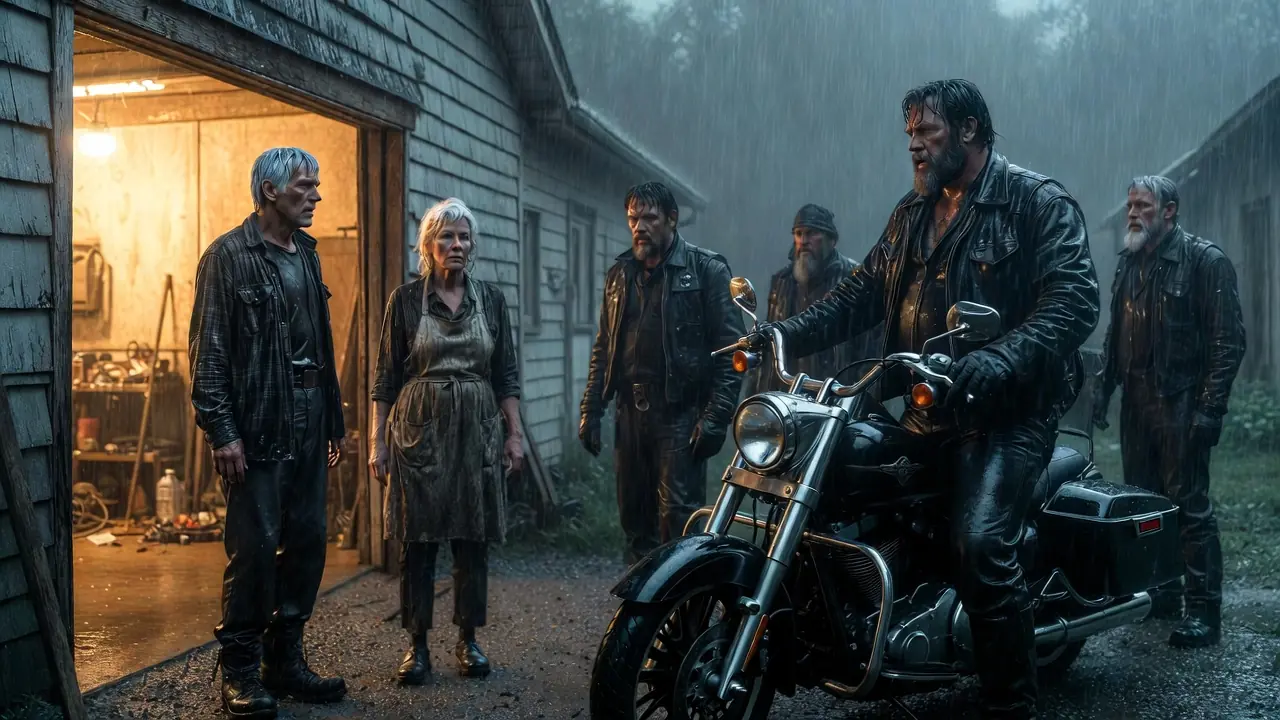
Ethan Tate opened the door. He stepped out into the rain without a jacket and waved his arm wide, high, unmistakable toward the four figures on Route 9. He did not know it then.
He did not know that one of those men would be unconscious on his garage floor within the hour with a heart that was shutting down. He did not know that by morning his life would have changed in ways he could never imagine if he tried. He just knew that Hattie had told him to bring them in, and in forty-one years, that had always been enough.
The biggest of the four almost ran into him before he saw him. Ethan had come out far enough that the rain was soaking through his shirt and the wind was loud enough that it swallowed normal speech.
The man pulled up short, startled, water pouring off the brim of his helmet, and for a split second they stood there staring at each other, this silver-haired mechanic in his soaked button-down and this massive, soaking wet biker with thirty years of road on his face and a look of absolute, weary exhaustion.
Ethan pointed at the garage. “Get inside,” he said over the wind. “All of you, now.”
The big man stared at him. Ethan could see him doing the calculation, the fast, suspicious risk assessment that a man like that would do instinctively, reading intent, reading body language, looking for the angle.
Ethan did not have an angle. He was just a sixty-eight-year-old mechanic standing in his own driveway in the rain, getting soaked to the skin, telling strangers to come inside. Something in the big man’s face shifted.
He turned back to the others and made a gesture, short, decisive, no second-guessing. And they came, all four of them. They pulled their dead bikes up the drive and through the open bay door, and Ethan followed them in and pulled the door down behind them.
For a moment, everyone just stood there while the storm hammered the roof and the fluorescent lights hummed overhead and four drenched, exhausted bikers dripped onto the concrete floor of Tate’s Auto and Repair. The one on the left, the one Hattie had pointed out, was bent forward over his bike with both hands on the handlebars and his head down, breathing in a way that did not sound like a man who was just tired.
Hattie was already moving toward him.
“What’s his name?” she asked the big man.
He looked at her, then at Ethan, then back at her. “Diesel,” he said. His voice was a deep Kentucky gravel scraped rough by weather and years and probably a fair amount of cigarettes. “His name’s Diesel.”
“How long has he been like this?”
“Last twenty minutes, maybe thirty. He said it was nothing. Said he was just cold.”
Hattie crouched down in front of the man named Diesel and put her hand on his face. She looked up at him and said in the calm, clear voice of a woman who had made a decision and was going to see it through, “Diesel, I need you to look at me.”
He looked at her.
What Ethan saw in Diesel’s face in that moment, this hard, weathered, road-beaten man who had probably never asked anyone for anything in his adult life, was something so plain and so human that it stopped Ethan in his tracks.
It was relief. Pure, exhausted, unguarded relief. Like a man who had been holding something up by himself for a very long time and had just been told by someone who meant it that he could put it down.
“Okay,” Diesel said.
His knees buckled.
Ethan moved. Diesel’s knees hit the concrete, and Ethan caught him. Not planned, not graceful, just reflex, sixty-eight years old, and he moved faster than he had in a decade. Arms out, shoulder dropping, taking the weight of a man who probably had sixty pounds on him without breaking stride.
The big biker on Diesel’s left, the one who had spoken, the one Ethan would later learn went by the name Church, grabbed the other side, and together they lowered Diesel to the floor without letting his head hit.
“What’s wrong with him?” Ethan asked.
“He’s got a heart thing,” Church said. The words came out clipped tight, the voice of a man who was scared and was managing it by keeping everything small and controlled. “He’s on medication. He had it in his saddlebag.”
“Had it?”
Church’s jaw tightened. “Saddlebag flooded up the Minnesota. We lost it about six miles back when we went through that low crossing.”
Hattie was already on her knees beside Diesel. She had two fingers on the side of his neck, eyes focused, counting. Ethan watched her and felt the particular stillness that came over him in emergencies.
The same stillness that had served him in thirty years of mechanical crises, the ability to narrow down to what was in front of him and deal with that and only that.
“His pulse is irregular,” Hattie said, calm, precise. “How long has he had the heart condition?”
Church looked at the other two men behind him.
One of them, younger, mid-thirties, wide-set eyes under a soaked bandana, spoke up. “Eight years. He had a procedure. He’s supposed to carry his medication all the time, but in the rain…”
“What medication?” Hattie said.
“Metoprolol and aspirin. The aspirin’s important.”
Hattie looked at Ethan. He was already moving toward the back cabinet, the one that had been a first aid kit in theory and a general emergency repository in practice for twenty years. He pulled it open and started going through it with the same methodical speed he used when diagnosing an engine, not frantic, not slow, just deliberate.
“I’ve got aspirin,” he called out.
“Get it.”
He had it in his hand and was back in fifteen seconds. Hattie had Diesel’s jacket partly unzipped and was talking to him in a low, steady voice, the kind of voice that did not ask how you felt.
It told you where you were and what was happening and what came next, because that kind of voice was an anchor, and a drowning man needs an anchor more than he needs sympathy.
“Diesel,” she said, “stay with me. You hear me? You’re in a garage on Route 9. You’re safe. We’re going to give you aspirin and get you warm, and you’re going to be fine, but I need you to chew this, not swallow it.
Can you do that?”
Diesel’s eyes were open, barely. His skin had gone a gray-white that Ethan did not like the look of at all.
“Yeah,” Diesel said.
The word came out like it cost him something.
“Good man,” Hattie said. And the way she said it, simple, warm, without a trace of fear, Ethan saw Diesel’s eyes focus slightly, like the words had given him something to hold onto.
Church was standing three feet back, arms crossed over his chest, watching. The other two men were further back near their bikes, and they were doing that thing that men in crisis situations do when they do not know what their role is, standing very still, trying to stay out of the way, not looking at each other.
Ethan straightened up and turned to face all three of them.
“I need blankets,” he said. “I’ve got some in the back room, top shelf on the right. One of you go get them.” He looked at Church. “You go.”
Church blinked, looked at him for one half second, the automatic resistance of a man not accustomed to being told what to do, and then went.
Ethan turned to the younger one. “What’s your name?”
“Ricky.”
“Ricky, there’s a camp stove back there, too. The blue one on the second shelf. Bring it out here. Hattie has soup on the back stove. Bring that, too.”
Ricky moved.
The fourth man, older, heavy-set, completely silent since they had come through the door, was standing nearest to the bikes. He had a long gray beard and the kind of face that had been weathered by so much weather it had stopped reacting to it.
Ethan pointed at him. “You need to call 911.”
The man’s expression did not change. “Diesel doesn’t do hospitals.”
“Diesel doesn’t get a vote right now.”
A pause. The silent man looked at Church, who had come back with blankets and caught the last exchange. Church looked at Ethan, then at Diesel on the floor, then made a decision.
“Preacher’s right,” Church said. “Diesel said no hospitals. He said it a hundred times. Last year, when he had the episode in—”
“I understand that,” Ethan said. “And if he comes around in the next few minutes, and the color comes back, and his pulse steadies, I’ll respect that. But right now, in this moment, that man looks like he might be having a cardiac event on my floor.
And if that’s what’s happening, this garage is not equipped, and I am not a doctor, and neither is my wife.” He let that sit for exactly one second. “So, you’re going to make the call, or I’m going to make the call, but the call is getting made.”
Church held his gaze long enough that it meant something. Then he pulled his phone out of his jacket. The call went through. Church gave the address, kept it short, and hung up.
Hattie had Diesel wrapped in a blanket now and was talking him through slow, controlled breathing. In for four, hold for two, out for six. And somewhere in the last three minutes, something had shifted because Diesel’s color, while still bad, was not the frightening gray it had been when he had first gone down.
His eyes were fully open. He was following Hattie’s voice.
“You a nurse?” he asked her.
The words were weak, but they were there.
“Retired,” she said.
That surprised Ethan. It still surprised him sometimes even now, even after all the years, that the woman who ran a small-town diner and made the best biscuits in three counties had once worked trauma nursing for eleven years before they had moved to Millhaven, and she had traded hospital shifts for breakfast rushes.
She never led with it, never used it to make herself sound impressive, but in moments like this one, it came back as naturally as breathing.
“You’re going to be all right,” she told Diesel. “Your pulse is stabilizing. You’re warming up. The aspirin is working, but you need to keep breathing the way I’m showing you, and you need to stay awake for me.”
“Bossy,” Diesel said.
“My husband says the same thing.” She did not move from his face. “He’s usually grateful for it later.”
Something moved across Diesel’s expression, something between a grimace and a smile.
“Yeah,” he said. “Okay.”
Ricky had the camp stove going, and the soup was heating, and Church had deployed the remaining blankets with the efficiency of a man accustomed to making quick decisions in difficult circumstances. The fourth man, Preacher, Ethan had gathered from the exchange, was standing with his back against one of the bikes, arms folded, watching everything with those unreadable eyes.
Ethan moved to stand near him, not crowding, just near.
“Where were you trying to get to tonight?” Ethan asked.
Preacher was quiet for a moment. “Bowling Green chapter meetup. We left late because of a job overrun. Figured we could beat the weather.”
“You figured wrong.”
“Yeah.” Not defensive, just stating it. “We did.”
“How far did you push those bikes?”
Preacher glanced at him sideways. “Six, seven miles. Road flooded completely about two miles past the county marker. We tried to wait it out, but Diesel was already…”
He stopped, started again. “We knocked on doors, four of them. Nobody answered. One guy answered, took one look at us, and shut it in our faces.”
Ethan did not say anything.
“Third house, woman called the police. We were gone before they got there.” Preacher paused. “We’re not another stop.”
Like he had started to say something and then reconsidered whether saying it was worth the effort.
“People see the patch, and they decide the story before anything happens.”
“I know,” Ethan said quietly.
Preacher looked at him directly for the first time.
“You know?”
“I’ve been watching people decide stories about other people before anything happens my whole life,” Ethan said. “Doesn’t make it right. Just makes it common.”
Preacher was quiet, then said, “You hesitated before you opened the door. I saw you standing at the window.”
Ethan held the man’s gaze. He could have denied it. He did not.
“Yeah, I did.”
“What made you come out anyway?”
Ethan thought about Hattie’s eleven words.
“My wife,” he said simply.
Preacher looked at Hattie across the garage floor, at the small gray-blonde woman on her knees beside a man twice her size, talking him through his breathing with the focused calm of someone who had seen worse and handled it and would handle this, too.
Something in Preacher’s face, in that weathered-stone-still face, moved. Barely. Just at the edges.
“She always like that?” he asked.
“Every single day,” Ethan said, “for forty-one years.”
Church appeared at Ethan’s other shoulder. He had been quiet for the last few minutes, doing what needed doing without being asked, straightening things, making room, keeping himself useful. Ethan had noticed that.
He noticed things like that.
“Paramedics are maybe twenty minutes out,” Church said. “Storm’s slowing them down on Rural Seven.”
“She’ll keep him stable,” Ethan said.
He meant Hattie. He said it without hesitation.
Church looked at him. Really looked at him. The sustained, assessing look of a man recalibrating something.
“You don’t know us,” he said. “We show up out of nowhere. One of us goes down on your floor. You’re running around getting blankets and aspirin and calling ambulances like—”
He stopped.
“Like what?” Ethan said.
“Like it’s nothing,” Church said. “Like it’s just a Tuesday.”
“It is Tuesday,” Ethan said.
Something in Church’s face cracked open just slightly. Not a smile, exactly. Something quieter than that. The particular expression of a man who has been braced for something and found out it is not coming and does not quite know what to do with the absence of it.
“Why?” Church asked. Direct. Simple.
Ethan looked at him. “Because you were in the rain and you needed in.”
Church stared at him. “That’s it?”
“That’s it.”
The soup was warm. Hattie called Ricky over and he brought it, and she got a mug of it into Diesel’s hands and stayed right there while he drank it, watching his color, talking to him in that low, steady voice.
Ricky crouched nearby watching her, and Ethan noticed that the young man’s hands were shaking slightly. Not from cold, or not just from cold. From fear.
He had been scared for Diesel the whole time and had been covering it with movement, with doing things, because that was how some people handled fear, and it was one of the more honest ways.
“He’s going to be okay,” Ethan said to Ricky.
Ricky looked up. “You sure?”
“His color’s better. He’s talking. He’s got soup in him. My wife is watching him.”
Ethan let a beat pass. “I’m as sure as I know how to be.”
Ricky let out a breath, long, slow, like a pressure valve releasing.
“He’s the reason most of us started riding, you know. Not because of the club stuff. Because of him. He’s the one who actually…” He shook his head, looked at his hands. “He’s the one who gives a damn about people.
Not just members, just people. He’s the first one there when something goes wrong for anybody. Doesn’t matter what they look like or where they come from.”
He said it without apparent awareness of the irony, but Ethan heard it, and he thought it was one of the more interesting things he had heard in a long time.
“Sounds like a good man,” Ethan said.
“He is,” Ricky said. “He really is.”
Naomi appeared in the doorway that connected to the house. She had pulled on her sweatshirt, and her hair was down, and she stopped in the doorway and took in the scene. Four strangers, bikes, blankets, her grandmother on the floor with a sick man in about two seconds.
Then she came all the way in without any apparent hesitation.
“What do you need?” she said to Hattie.
Hattie looked up. “There’s ibuprofen in the medicine cabinet upstairs and the good blanket from the hall closet, the heavy one. And put the kettle on while you’re up there.”
Naomi was already turning. Gone and back in four minutes with everything Hattie had asked for and also a dish towel, which she offered to Diesel to wipe his face with, and which Diesel accepted with the careful courtesy of a man who was aware he was in someone else’s house and wanted to act accordingly.
“Thank you,” he said to her.
“You’re welcome,” Naomi said. She looked at him the way she looked at everything that needed to be understood, steadily, without flinching. “How are you feeling?”
“Better than ten minutes ago,” Diesel said.
“Good. That’s the direction things should go.” She looked at Hattie. “His color’s better.”
“I know,” Hattie said.
“His hands are still cold.”
“I know that, too.”
Naomi crouched down and tucked the heavy blanket more securely around Diesel’s legs, matter-of-factly, the way you do a thing when the thing needs doing and you are the one there to do it.
Diesel watched her do it with an expression that Ethan could not fully name, something between bewilderment and a gratitude so large it had not quite found its shape yet.
“How old are you?” Diesel asked her.
“Seventeen,” Naomi said.
“You’re not scared of us?”
She tilted her head slightly. “Should I be?”
Diesel looked at her for a long moment. “Most people are.”
“Most people are scared of a lot of things that turn out to be fine,” Naomi said.
Then she stood up and went to help Ricky with the camp stove because the kettle had boiled and the tea needed making, and she was, at her core, her grandmother’s granddaughter.
Church had been standing close enough to hear that exchange. He turned away and looked at the wall for a moment, jaw working, and Ethan recognized that particular movement, the face of a man who was holding something in because the place and the time are not right for letting it out.
The paramedics arrived nineteen minutes after Church’s call. Two of them, young, efficient, professional. They came through the bay door with their kit and went straight to Diesel, and Hattie briefed them in the calm, precise language of her former profession.
Rhythm irregularity. Aspirin administered. Pulse stabilizing. No loss of consciousness beyond the initial buckling.
The younger paramedic looked at her with the particular respect of someone who recognizes competence when they meet it. “You do this before?” he asked.
“A long time ago,” Hattie said.
They worked on Diesel for twelve minutes. Vitals, EKG strip, IV line. Diesel gave them resistance about the hospital transport. A low, stubborn argument that he was fine now, that he felt better, that he did not need to go.
Church overrode him in the flat, final tone of a man who had run out of patience for that particular conversation.
“You’re going,” Church said. “Don’t argue with me, Diesel. Not tonight.”
Diesel looked at him, looked at Hattie, looked at Ethan, who met his eyes and said nothing, just held steady, and something in that steadiness seemed to count for something because Diesel let out a long breath and said, “Fine.”
They loaded him onto the stretcher. As they were moving toward the door, Diesel reached out and caught Hattie’s wrist. She turned to look at him.
He did not say anything for a moment, just held her wrist in his big, rough hand and looked at her with those gray, road-weathered eyes.
“You didn’t have to,” he said finally. “Any of this.”
“Hush,” Hattie said, not dismissive, warm, the way she would say it to anyone she cared about.
“I mean it,” Diesel said.
“I know you do,” she said. “Now you go with these boys, and you let them take care of you, and you don’t argue with anyone tonight. You hear me?”
Diesel looked at her for another moment, then nodded once, the smallest movement, the most genuine one.
They took him out into the rain. Church stood in the bay door and watched until the ambulance was gone. Then he turned back around and stood there in the garage, this large, exhausted, soaking wet man, and for the first time since he had come through the door, the control he had been running on visibly started to slip.
Not collapse. Just slip. The edges of it showing.
“I need to know his name,” Church said quietly, looking at Ethan.
“Ethan Tate,” Ethan said.
Church nodded, seemed to be memorizing it. “I’m Marcus Church. People call me Church.” He looked at Hattie.
“And you’re Hattie,” she said.
“Hattie,” Church repeated. “Okay.”
He looked at the floor, then around the garage, then back at Ethan. “We need to dry out, and we need to figure out what to do about the bikes. I’m not asking you to—”
“The bikes can stay,” Ethan said. “You can stay. There’s room.”
Preacher, still against the wall, looked up. Ricky stopped what he was doing. Even Church went still for a second.
“We’re strangers,” Church said carefully, like he was making sure Ethan understood something Ethan might have missed.
“You pushed dead bikes six miles through a flood,” Ethan said. “You knocked on doors and got shut out. One of your men went down on my floor, and you handled it without a single bit of drama. And my wife fed you soup.”
He looked at all three of them. “You’re not strangers anymore.”
The silence in the garage was different after that. Something in it had changed, the particular quality of silence that happens when a room full of people all process the same thing at the same time, and none of them have words for it yet.
Ricky sat down on the stool near the workbench. He put his elbows on his knees and his head in his hands for a moment, not crying, but close to it, or close to whatever was on the other side of everything he had been carrying for the last two hours. And Preacher crossed the garage without a word and sat down on the floor beside him and put a hand briefly on the back of his neck.
One touch, gone in a second. But it meant something. Ethan could see it meant something.
Hattie brought the remaining soup out in mugs. She handed them out without ceremony, without making a moment of it, the way she had been doing things for sixty-six years, because it needed doing and she was there.
Church took his mug and wrapped both hands around it and stared at the floor. He said very quietly, more to himself than anyone, “Last four places we knocked, four doors.”
“I know,” Ethan said.
“Third one.” Church stopped, started over. “Woman at the third one called the police before we even finished talking. We weren’t threatening anyone. We were standing on a porch in the rain asking if anyone had a phone to call for a tow.”
“I know,” Ethan said again.
Church looked up. “You said that like you’ve been on the other side of it.”
“Not the same side, but I know what it is to have people look at you and decide before you speak.”
Church studied him. “What do people look at and decide about you?”
Ethan thought about the letter on the kitchen table. The bank’s logo. The final deadline. The four-thousand-dollar operating account.
The look on the face of the loan officer who already knew how the story ended.
“That I’m done,” he said quietly. “That the game is over.”
Church looked at him for a long moment. Something passed between them, not sympathy exactly, because these were not men built for sympathy in either direction. Something more like recognition.
The particular recognition of one person who has been written off looking at another person who has been written off and seeing through whatever differences exist between their lives the same fundamental thing.
“Is it?” Church asked.
“I don’t know yet,” Ethan said.
Outside, the storm was still running full force, hammering the roof, flooding Route 9, making the whole night feel sealed off from the rest of the world. Inside the garage, the camp stove burned and the soup was warm, and four wet, exhausted men slowly stopped being strangers in the same space and became something else.
Something without a precise name, but real.
Naomi came back through the connecting door with a plate of Hattie’s cornbread and set it on the workbench. She pulled up the second stool and opened her physics textbook. Nobody told her she was strange for doing it.
Nobody looked at her sideways. Ricky, after a minute, glanced over at the book and said, “What chapter?”
“Electromagnetism,” she said without looking up.
“I was decent at that,” Ricky said.
Naomi looked at him. “Were you an engineering student?”
“Two years,” Ricky said. “Didn’t finish.” He paused. “Long story.”
“Most of them are,” Naomi said.
And she went back to her reading. Preacher from the floor let out a sound that might have been a laugh. Small, brief, but there.
Church looked at Ethan from across the garage, and Ethan looked back, and neither of them said a word, because the moment did not need words. It needed exactly what it had, four strangers and two people who had opened a door sitting in a warm place out of the rain, eating cornbread and waiting for morning.
None of them knew yet what morning would bring.
But it was coming.
Ethan did not sleep that night. He told himself he was keeping an eye on the bikes, that there was still work to do, that the storm had rattled something loose in the roof junction above the east bay, and he needed to check it before water got into the electrical panel.
All of that was true. None of it was the reason. The reason was that he kept replaying the moment, the weight of the man coming into his arms, the gray color of his skin under the fluorescent lights. And underneath that replay, running quiet and constant like an engine left idling in a closed space, was the other thing.
The letter on the kitchen table. The number twenty-two thousand. The look on Naomi’s face when she talked about her scholarship deadline without knowing that the floor beneath that deadline was crumbling.
He sat on the stool near the workbench at 2:00 in the morning while Church and Preacher and Ricky slept on the folding cots Hattie had pulled from the storage room. She had produced them without fanfare, the way she produced everything that was needed, as if she had spent forty-one years quietly preparing for exactly the situations that arrived.
And he turned a socket wrench over and over in his hands without using it on anything.
Church woke at 2:40. Ethan heard him before he saw him. The particular stillness of a man who comes awake all at once, no gradual surfacing, just asleep and then not.
Church sat up and looked around the garage with clear eyes. Then he looked at Ethan on the stool and said quietly enough not to wake the others, “You haven’t slept.”
“I’m fine.”
“That’s not what I said.”
Ethan set the socket wrench down. “Old habit. I don’t sleep well when something’s unresolved.”
Church swung his legs off the cot and sat forward with his elbows on his knees. He looked at his phone. Ethan had given them the garage Wi-Fi password, another thing that had happened without much deliberation, just Naomi offering it before he had thought to, and then set it face down on the cot beside him.
“Hospital says he’s stable,” Church said. “Cardiac arrhythmia. They’ve got him on a drip and they’re monitoring through the night. Doctor says he’ll probably be there two, three days.”
Ethan let out a breath he had not entirely realized he had been holding. “Good.”
“He’s already arguing with the nurses about his diet.”
Something in Church’s voice, not quite a smile, but the sound of one. “So, yeah, he’s fine.”
They sat in the quiet for a moment. The storm had reduced itself to a steady rain now, the violent part spent. The remainder was just the long trailing end of a system that had run out of fury and was finishing on principle.
“You want to know something strange?” Church said.
“Probably.”
“In twenty-two years of riding, we’ve broken down maybe a dozen times in places that weren’t our territory. Small towns, middle-of-nowhere roads, county lines where nobody knows us.” He paused. “Tonight was the first time anyone let us in.”
Ethan looked at him. “First time?”
“First time,” Church said. “Usually it’s phone calls from a distance, tow trucks if we’re lucky. Parking lots. One time a gas station let us wait under the overhang, but the owner stood at the door the whole night watching us like we were going to rob him between here and nowhere.”
“That must get old,” Ethan said.
“You stop expecting different,” Church said flatly, not asking for sympathy, just naming a fact the way men name facts when they have processed them long enough to lose the sharp edges. “You stop expecting different, and then when it is different…”
He stopped.
“It hits different.”
Ethan was quiet. Outside, the rain tapped at the roof with the patience of something that had nowhere else to be.
“I saw the notice,” Church said.
Ethan went still.
“On the board behind the workbench. Partial view of it from the cot.” Church met his eyes. “Bank letterhead. I wasn’t reading your mail, just saw it.”
Ethan did not say anything.
“How bad?” Church asked.
“Bad enough,” Ethan said. “The diner, too. Everything. The whole property.”
He said it without drama, without self-pity, because he had had enough weeks with it now that the drama had worn off, and what was left was just the plain shape of it.
“Thirty-one years we’ve been here. The chain shop opened on the bypass two years ago, and it was slow at first, and then it wasn’t slow at all, and now…” He stopped, made himself finish. “Now we’re eleven days from the deadline and about eighteen thousand short of where we need to be.”
Church absorbed that, said nothing.
“My granddaughter’s in there right now writing college applications,” Ethan said. “Engineering programs. She’s…” He stopped again.
Something in his chest tightened in the specific way it had been tightening every time he thought about Naomi for the last three weeks.
“She’s the best thing in this family, the best thing I’ve seen in sixty-eight years. And she doesn’t know yet about any of it.”
“You haven’t told her?”
“No.”
Church looked at him steadily. “Why?”
“Because I don’t know how to tell a seventeen-year-old girl that the ground under her future is not where she thought it was,” Ethan said. “Because every time I open my mouth to say it, I think about the way she looks when she’s working on an engine in here. And I…”
He stopped hard. “I just haven’t found the words.”
Church was quiet for a long moment. When he spoke, his voice had shifted slightly. Still low, still controlled, but with something underneath it that had not been there before.
“I had a daughter,” Church said.
Ethan looked at him.
“She’s twenty-three now, lives in Nashville. We don’t…” He cleared his throat. “We don’t talk much. That’s on me. Long story, wrong choices, all the standard ways a man can get that wrong.”
He paused.
“But I remember what it felt like when she was seventeen, and she had this thing she wanted. She wanted to go to this art school in Chicago, and I couldn’t make it happen.” He looked at his hands. “Difference is, I had reasons that were my own fault.
You’re sitting here because you did everything right, and the world moved around you.”
Ethan did not respond immediately. He looked at Church. This man he had not known six hours ago, this stranger in his garage in the middle of the night, and felt something move in him that he had not expected to feel.
Not pity in either direction. Just the particular solidity of one honest thing recognizing another honest thing.
“I’m sorry about your daughter,” Ethan said.
Church nodded once. “Yeah.”
He picked up his phone again. “Get some sleep, Ethan. You’ve done enough for one night.”
Ethan did not sleep, but he let the quiet settle back around them both, and that was something.
Hattie appeared at 5:30 like she always did. The woman had never owned an alarm clock in her life and had never needed one. She moved through the garage checking on the three men without waking any of them, pulled the blanket that had slipped off Ricky’s shoulder back up, and then appeared beside Ethan with two cups of coffee and the particular look she wore when she was seeing something clearly that she wanted him to see, too.
“He told you,” she said.
Not a question.
“Church about the hospital?”
“About his daughter.”
Ethan looked at her. “You heard that?”
“I was in the doorway for part of it.” She handed him the coffee. “I wasn’t eavesdropping. I just didn’t want to interrupt.”
“Hat.”
“He’s a good man,” she said quietly. “All three of them. Different from us, but that doesn’t mean…” She stopped, looked down at her cup. “It never means what people think it means.”
The morning came in slow and gray, the aftermath of the storm hanging in the air with the particular heavy stillness of a world that had been thoroughly soaked and was now just sitting with it.
Naomi was up at 6:15, which was earlier than usual, and Ethan knew immediately that she had been awake for part of the night. She had that look, not tired exactly, but thoughtful in a way that was more than school thoughtful.
She poured herself coffee, she had started drinking it this fall, another small sign of the seventeen becoming eighteen becoming something more, and she stood in the connecting doorway and looked at the three sleeping men on the cots and then at Ethan.
“How is the man who collapsed?” she asked.
“Stable,” Ethan said. “He’ll be okay.”
She nodded, looked at the cots again. “Church is awake,” she said. “He’s pretending not to be, but he opened his eyes when I came in.”
Church, from the cot nearest the workbench, said without moving, “Kid’s observant.”
“She is,” Ethan said. “Seventeen going on forty.”
“Forty-two,” Naomi corrected, and went to start the breakfast.
Ricky woke next, then Preacher, and within twenty minutes Hattie had moved the operation into the diner side, opening it early, which she never did. Just pulling the connecting door wide and waving everyone through into the warm space with the booth seats and the coffee machine and the smell of bacon that she had started because she knew, in the way she always knew these things, that what these men needed right now was not just warmth, but normalcy.
The particular normalcy of sitting at a table and being fed a meal by someone who meant it. They came in and they sat down, and it was almost comically awkward for about two minutes. Three large men in worn leather taking up the vinyl booths of a small roadside diner, while a sixty-six-year-old woman in an apron moved around them with plates and coffee like this was any Tuesday morning.
Then something cracked open, and it stopped being awkward. Ricky was the first to say please. It was so automatic, so unselfconscious that Preacher looked at him like he had done something unexpected.
And Ricky said, “What? My mom raised me right.”
And Preacher said, “Your mom’s the only one who’d argue that.”
And Ricky threw a balled-up paper napkin at him, and Church said, “Both of you quit it.”
And just like that, the table breathed.
Naomi sat at the counter with her notebook because the application essay due date was not moving for anyone, but she was listening. And Ethan could tell she was listening the way she always listened to things that interested her, with that particular split-focus attention where her hand kept moving on the page, but her ears were somewhere else entirely.
Preacher was the one who started talking, which surprised Ethan, given that the man had barely said fifty words since he had come through the door. But something about the bacon or the coffee or the simple fact of being fed without being asked to justify his existence first seemed to have loosened something in him.
“I did twenty-two years,” Preacher said out of nowhere.
Church looked at him. “You don’t have to.”
“I know I don’t have to,” Preacher said mildly. He looked at Ethan. “Army. Two tours overseas, rest of it stateside training. Got out in 2009.”
He wrapped both hands around his mug. “People ask me sometimes how I ended up where I did, riding the club, all of it. And I tell them the truth, which is that when I got out, I didn’t know how to be in regular places anymore.”
He paused.
“Grocery stores, movie theaters, anywhere with a lot of people and noise I couldn’t control. My wife at the time, she tried, she really did, but I didn’t know how to explain what was wrong, and she didn’t know how to help with something she couldn’t see.”
Another pause.
“The club was the first place since the army where I felt like I could breathe in a crowd.”
The table was quiet. Hattie came around with the coffee pot and refilled everyone and did not say anything, but Ethan watched her set her hand briefly on Preacher’s shoulder as she passed, one second, no more, the way she touched Ethan’s shoulder the morning before.
Preacher looked down at his plate. “I’m not saying any of that to make us seem like something we’re not,” Preacher said. “I’m just saying the story people tell about men like us and the story that’s actually true, they don’t always look the same from the outside.”
Ricky was nodding. “I got laid off from the plant,” he said, talking to his coffee mug. “Twice. Two different plants, two different layoffs three years apart.
Second time, I had a kid on the way and about four hundred dollars in my account.” He looked up. “Diesel was the one who got me back on my feet, not because of the club, not because of any agenda, just because he showed up at my door one morning with a list of contacts and a tank of gas and said, ‘Let’s go figure this out.’”
He stopped. “That’s who he is. That’s actually who he is, not what people say when they see the jacket.”
Ethan was eating his eggs and listening and thinking about what Ricky had said, the story people tell about men like us, and he was thinking about the bank, about loan officers with sympathetic half-smiles, about the way people looked at a sixty-eight-year-old mechanic with a second mortgage and saw a conclusion rather than a question.
“Naomi,” he said.
She looked up from her notebook. And this time, with Church and Preacher and Ricky all there at the table, with Hattie standing in the kitchen doorway with the coffee pot, with the particular honesty of the morning pressing on everything, this time the words came out.
“I need to tell you something about the garage,” he said. “And the diner, and what’s happening with the bank.”
The table went very still. Church looked at his plate. Preacher looked at the window. Ricky looked at Ethan with those wide-set eyes and said nothing.
Naomi closed her notebook, turned fully on the stool, and looked at him.
“Tell me,” she said.
So he did. He laid it out the way Hattie would have, plainly, completely, without softening the numbers or qualifying the timeline. The mortgage, the operating deficit, the chain shop, the eighteen-thousand-dollar gap, the eleven days.
He said it all in about four minutes, not looking away from her face. Naomi listened to every word. She did not interrupt. She did not look at Hattie for reassurance or at the floor to collect herself.
She just sat on the stool with her notebook closed against her chest and listened to her grandfather take apart the thing he had been protecting her from for three weeks.
When he finished, she was quiet for a moment.
Then she said, “How long have you known?”
“About three weeks,” Ethan said.
“Why didn’t you tell me?”
“Because I was afraid,” he said. “Not of you. Just afraid.”
Naomi looked at him for a long moment. Something crossed her face, not anger, or not only anger, something more complex than that. The particular expression of someone who has just been trusted with the truth after being protected from it and is working through both things at once.
“The scholarship applications,” she said.
“We’ll figure it out,” Hattie said from the doorway.
“Gran.”
“Naomi, look at me.” Hattie came to the counter and stood in front of her. “We are not done. You understand me.
This family has faced down harder things than a bank deadline. We are not done.”
Naomi looked at her for a moment, then looked at Ethan, then looked almost involuntarily at the three men at the table, these strangers who had somehow become part of the morning without anyone quite deciding that was what was happening.
Church met her eyes and said nothing. But he held her gaze with a steadiness that said something without words.
Naomi put her notebook on the counter and picked up her coffee. “What do we need?” she said. “What to hit the number? What do we need specifically, and what are the options?”
She looked at Ethan with that engineering-brain expression, the one that looked at a broken system and wanted to understand its components before it started fixing anything.
“Walk me through it.”
Ethan stared at her for a second. Then he almost laughed. Not from humor, but from the relief of it, the enormous, quiet relief of having put the thing down and found that the person on the other side of it was strong enough to help carry it.
“Eighteen thousand,” he said. “In eleven days.”
“Current assets?”
“Four in the operating account. Maybe another two if I liquidate the equipment I’ve been holding for parts.”
“Six.”
She was writing now, notebook back open. “What’s the diner doing in revenue this week?”
“Naomi, you don’t have to—”
“I know I don’t have to,” she said.
The echo of Preacher’s words from fifteen minutes ago was so exact that Preacher across the table looked up sharply.
“What’s the diner doing?”
Hattie gave her the numbers. Naomi wrote them down. She asked three more questions in quick succession, accounts receivable, scheduled repairs, supply costs, and she wrote those down, too, then sat looking at what she had written with the focused stillness of someone running calculations in real time.
Ricky had pushed his plate aside and was watching her with something close to wonder. Church had his elbow on the table and his chin in his hand, watching, too. Preacher was looking at his coffee.
“You’re twelve to thirteen thousand short, even with everything,” Naomi said, “unless you can generate significant new revenue in the next eleven days, which on current traffic…”
She stopped, pressed her lips together.
“The appointment with the bank. Tommy Sears said go in person.”
“That’s the plan,” Hattie said.
“Then go in with a projection, not just a plea,” Naomi said. “Show them a three-month forward model. I can build that tonight if you give me the last two years of statements.” She looked at Ethan. “It won’t change the number, but it might change the timeline they’re willing to give you.”
Ethan looked at his granddaughter, this seventeen-year-old girl on a diner stool in a sweatshirt with a pencil in her hand, and the tightness in his chest did not go away, but something in it shifted. Made room for something else.
Church put both hands flat on the table and looked at Ethan.
“How much did you say you were short?”
“Twelve, thirteen,” Naomi said before Ethan could. “After everything.”
“After everything,” she confirmed.
Church looked at his phone, then at Preacher. Something passed between them, the wordless communication of men who had been in enough situations together that they had developed a shorthand. Preacher gave a very small nod.
Church looked at Ethan. “Can I make some calls?” he said.
“This is not your problem,” Ethan said immediately.
“I didn’t say it was my problem,” Church said. “I said, can I make some calls?”
“Church.”
“Ethan.” He said it with a firmness that was not confrontational, just final. The voice of a man who had made a decision and was not looking for a discussion about it. “You pulled four strangers in out of a storm.
One of them is alive this morning because of your wife. You fed us, and you gave us beds, and you didn’t ask for anything.” He held Ethan’s eyes. “Let me make some calls.”
The garage was very quiet. Outside, the rain had stopped entirely. The world beyond the bay door had gone still and clean, the particular stillness of a morning after a storm.
Everything washed, everything rearranged, everything sitting in new positions it had not occupied the day before. Ethan looked at Hattie. Hattie looked back at him with those steady blue eyes and said nothing. She did not need to.
“Okay,” Ethan said.
Church picked up his phone and walked to the far side of the garage, his voice low, and within two minutes he was deep in a conversation that Ethan could not fully hear, using names and references that meant nothing to him and probably would have meant something very specific to the right people.
Ricky and Preacher stayed at the table. Naomi went back to her notebook. Hattie poured more coffee. The morning moved forward the way mornings do, one minute at a time, unannounced, carrying whatever came next.
Naomi finished her essay at 9:15. She printed it on the diner’s old inkjet printer and read it over twice, changed one sentence, then set it face down on the counter.
She looked at Ethan.
“Grandpa,” she said.
He looked up.
“It’s going to be okay,” she said.
She said it the same way Hattie had said a hundred things over forty-one years, not as reassurance, not as comfort, but as a statement of intent, as a decision that a person makes and then works backward from until the world catches up with it.
Ethan had heard Hattie say things that way so many times that by now the sound of it was indistinguishable from truth. Coming from Naomi in Hattie’s exact tone, with Hattie’s exact conviction, it stopped him completely.
He looked at his granddaughter. He looked at his wife coming through the kitchen doorway with coffee. He looked at Church on the far side of the garage with his phone, making calls to people whose names Ethan did not know.
He thought about the letter on the kitchen table. He thought about thirty-one years of clean, simple work. He thought about the way Diesel had looked at Hattie when they were loading him onto the stretcher, that exhausted, unguarded, fully human look of relief.
Eleven days, he thought. A lot can happen in eleven days.
And for the first time in three weeks, he believed it.
Church made eleven calls in forty minutes. Ethan knew it was eleven because he was not trying to count, but counted anyway, the way you track small, measurable things when the large, unmeasurable ones are out of your control.
Eleven calls. Some short, thirty seconds, a name, a location, a number. Some longer, Church’s voice dropping lower, more deliberate, the pauses between sentences carrying weight.
He paced the far side of the garage with his phone pressed to his ear and his free hand moving occasionally, not nervous movement, decisive movement, the kind that meant the hand was keeping up with the brain.
Ethan tried not to watch. He failed at that. Naomi had stopped pretending to work on her essay and was watching openly, which was more honest.
Ricky and Preacher had cleaned up the breakfast dishes without being asked. Ethan had heard the water running in the diner sink and come through to find them doing it. Ricky washing and Preacher drying with the focused efficiency of men who had spent enough time in communal spaces to understand that you cleaned up after yourself without making it a conversation.
When Church came back to the table, he put his phone down and sat across from Ethan and folded his hands on the tabletop and looked at him directly.
“Okay,” he said.
“Okay, what?” Ethan said.
“Okay, we’re going to handle this.”
Ethan felt something tighten in him. Not gratitude, not yet, something more complicated, pride maybe. The specific resistance of a man who has spent sixty-eight years carrying his own weight and does not know how to put it down gracefully.
“Church, I told you this is not—”
“You said that already,” Church said. “I heard you the first time.” He unfolded his hands. “Let me tell you what I told the people I called.
I didn’t ask for charity. I didn’t pass a hat around. I called people who fix things for a living, mechanics, contractors, roofers, two electricians, a concrete guy, and I told them there was a job that needed doing and that the payment was in the doing of it. That’s all.”
Ethan stared at him.
“These are men with skills and time and equipment,” Church said. “Half of them owe Diesel a favor they’ve been carrying around for years. The other half owe me one, which is rarer and means they’ll actually show up.”
A pause.
“Nobody’s giving you anything. They’re coming to work.”
“Church.”
“Forty-eight hours,” Church said. “Give me forty-eight hours.”
The table was quiet. Hattie was in the kitchen doorway with her arms crossed, not interfering, not rescuing, just there, present and watchful the way she had been present and watchful through forty-one years of Ethan’s worst and best moments.
Ethan looked at her. She gave him one small nod.
He looked back at Church.
“All right,” he said.
What he did not know, what none of them at that table fully understood yet, was that Church’s eleven calls were only the beginning. Because Church had called chapter contacts, and chapter contacts had their own networks, and in the particular ecosystem of a brotherhood that stretched across state lines and decades, word traveled in ways that had nothing to do with geography or cell signals.
It traveled the way important things have always traveled, person to person, through trust at the speed of a story that needed to be told.
By noon that day, Church had received nineteen callback texts. By 4:00, thirty-two. He showed Ethan the screen without comment.
Ethan read the messages, shorthand, mostly names and ETAs and skill sets, and felt something shift in the floor under him. Not instability. The opposite.
“Who are all these people?” Ethan said.
“People who heard what happened last night,” Church said.
“How did they hear?”
Church almost smiled. “We talk to each other, Ethan. Diesel’s been in that hospital bed since last night, and he’s already told half the Eastern Chapter what you and Hattie did. The man is supposed to be resting.
Instead, he’s on his phone telling the story to everyone who calls to check on him.” He paused. “He told them about Naomi, too.”
Ethan looked up sharply.
“The applications,” Church said. “The scholarship, all of it.” He held up a hand before Ethan could respond. “He wasn’t gossiping. He was making a point.
The way he tells it, and I’m giving you his exact words here, he said, ‘These people gave us everything they had on a night when they had almost nothing left themselves. That means something. That means we show up.’”
Church paused. “When Diesel says show up, people show up.”
Naomi had come to stand behind Ethan’s shoulder. She had heard the last part. Ethan felt her there without turning around, the way you feel the presence of someone you have known their whole life, the particular weight and warmth of them.
“He didn’t have to do that,” she said quietly, not complaining, just noting it with the straightforward honesty that was her most consistent quality.
“No,” Church said, looking at her. “He didn’t.”
She was quiet for a moment, then, “Is he really okay?”
“Doctor says he can go home in two days if he behaves himself.” Church looked at her. “He’s not behaving himself, so probably three.”
Naomi made a sound that was almost a laugh. “Tell him to behave himself.”
“I’ve been telling Diesel to behave himself for fifteen years,” Church said. “Never once worked.”
The next morning arrived with a sound Ethan had not heard in a very long time.
Engines.
Not one or two, a convoy. He was in the bay at 7:15 doing the same purposeless socket-wrench organizing he had been doing for three weeks when the sound reached him, and he stopped and put down the wrench and stood very still, listening.
The sound got louder. He went to the bay door and raised it and stood there in the morning light.
Route 9 was full. Not four bikes, not ten, a full convoy of motorcycles first, then behind them two pickup trucks with lumber in the beds, a flatbed with a generator, an older van with equipment stacked on and on, and behind that a crew cab with a magnetic sign on the door that read, Hargrove Roofing, Bowling Green, KY.
Ethan counted the motorcycles. He got to twenty-three and lost count when the convoy was still coming. He stood in the bay door and watched them come down Route 9 and pull into his lot one by one, two by two, filling his gravel drive, spilling onto the grass at the edge, parking with the practiced ease of people accustomed to making order out of a large number of moving parts.
Engines cut off in sequence, leather-clad men swinging off bikes, stretching road stiffness out of their backs, talking to each other in the low, easy shorthand of a group that knows each other well. Church came out of the garage behind Ethan and stood at his shoulder.
“You knew,” Ethan said.
“I suspected,” Church said. “This is more than I expected, honestly.”
“How many people did you call?”
“Eleven. Word went past eleven a long time ago.”
A man Ethan did not know, stocky, fifties, arms like a man who had been working construction for thirty years, came up the drive with his hand out.
“You Ethan Tate?”
“Yes, sir,” Ethan said, shaking it automatically.
“Jim Hargrove. Hargrove Roofing. Church called my brother, my brother called me.” He looked at the garage roof and then at the diner side. “I brought four men and full materials.
What needs doing first?”
Ethan opened his mouth. Nothing came out.
Hattie stepped up beside him from nowhere. She had come through the connecting door. She must have heard the engines. She was still holding a dish towel, and she looked at the drive full of bikes and trucks and men, and she pressed one hand flat against her sternum like she was steadying something inside herself.
“The roof on the diner side has a weak junction above the east wall,” Ethan heard himself say. “And there’s a water intrusion issue at the back corner that I’ve been managing with buckets for six months.”
Hargrove nodded. “We’ll start there.”
Just like that, it began.
What happened over the next eight hours was something Ethan would spend years trying to find words for and never quite managing. It was not chaos. It was the opposite of chaos, which was something rarer and more impressive.
It was thirty-plus people who had never been in the same place at the same time, working on a property they had never seen under no formal project plan, somehow finding their roles and filling them with the kind of competent, unhurried focus that you only see in people who know their craft and believe in what they are doing.
The roofers went up first. Hargrove ran his crew with minimal words and maximum efficiency, his voice carrying the particular authority of a man whose expertise is visible in everything he does.
Within two hours, the diner roof was opened up and they could see what Ethan had known was there but had not had the money to address: damaged sheathing, compromised flashing, two sections of decking that had been absorbing water long enough to go soft.
“This would have been a major leak by spring,” Hargrove said to Ethan, not accusatory, just matter-of-fact. “Ceiling insulation, possible mold remediation. You got lucky we caught it now.”
A mechanic named Gus, who turned out to have nineteen years on heavy equipment and a particular expertise in electrical systems, took one look at Ethan’s main panel and made a face that told Ethan everything he needed to know about how close they had been to a real problem.
“This panel should have been replaced four years ago,” Gus said. “You’ve got two breakers that are running hot and a ground fault on the diner circuit that’s been waiting to become a fire.” He looked at Ethan with the blunt compassion of a man who delivers bad news for a living. “I’ll have the parts here by noon.
My nephew does this professionally. He’s coming with the materials.”
Ethan nodded because he did not trust his voice entirely at that moment.
Naomi was everywhere. She had come out at 7:30. She had obviously heard the engines from her room and come down in her sweatshirt with her hair still up from sleeping, and she had stood in the drive for about thirty seconds, taking it all in.
Then she had gone to the nearest man with a toolbox and said, “What do you need?”
That man, a quiet guy named Terrence, who was regrading the garage drainage slope with a shovel, had blinked at her and then handed her a line level and said, “Hold this at the marker stake and tell me when the bubble’s centered.”
She had held it, given him precise readings. He had adjusted, asked her two follow-up questions. She had answered them correctly. After the second one, he had looked at her differently, the look of a tradesman recognizing competence, and said, “You do this before?”
“My grandfather taught me the basics,” she said. “I’m studying engineering.”
Terrence had nodded. “Stay with me today. I’ll show you the whole system.”
By mid-morning, Ethan had watched his granddaughter learn three things from three different tradesmen, absorbing each one with that focused filing-cabinet attention of hers, asking the exact right follow-up question, getting it right on the first try.
Every man she worked alongside ended up talking to her more than they had planned to, because once you started explaining something to someone who was genuinely paying attention, it was hard to stop.
Hattie had opened the diner at 8:00, and immediately the question of feeding thirty people dissolved itself the way Hattie’s questions always solved themselves. She identified what she had, she adapted the plan, she started cooking and kept cooking.
By 10:00, the diner counter was covered in biscuits and scrambled eggs and sausage links and three pots of coffee, and men were rotating through in shifts, eating and going back out, nobody being asked to stay or go, everybody knowing what they were doing without being told.
Ricky, who had not left with the first wave the day before, had stayed quietly without making an announcement about it, was washing dishes in the diner sink. He had just started doing it. Nobody had asked him.
He had seen that Hattie needed it done, and he had done it the same way he had helped with the camp stove the first night, the same reflex. Hattie had thanked him once. He had said, “Don’t mention it.” And that was the entire conversation.
Preacher was on the garage roof by 9:00, working beside two men Ethan had never met, completely silent except when silence was not sufficient, and in those cases saying exactly what needed saying and nothing more.
At one point, he walked the entire roofline by himself methodically and then came back down and found Ethan and said, “There’s a vent flashing up there that was installed wrong maybe fifteen years ago. It’s been directing water toward the main beam. I can fix it today if you’ve got the materials.”
Ethan looked at him. “You know roofing?”
“I know enough.” Preacher met his eyes. “Army trained me on structure and field repair. I’ve been fixing things with whatever’s available for twenty-five years.”
A pause.
“I’m good at it.”
“There’s a materials list on the workbench,” Ethan said. “Take whatever you need.”
Preacher nodded and went back up.
The twist came at 11:15. Ethan was in the garage bay working with Gus on the panel replacement when Church came through the bay door from outside with his phone in his hand and a look on his face that Ethan had not seen from him before.
It was not the controlled, managed expression Church wore as a default. It was something more open, something that looked almost like discomfort, or the face of a man dealing with a development he had not anticipated and was still processing.
“I need to tell you something,” Church said.
Ethan looked at Gus, who straightened up and gave them space without being asked.
“What?” Ethan said.
Church looked at the phone, then at Ethan. “Diesel made a call this morning from the hospital. Before I could stop him, not that I could have stopped him, you understand, because Diesel does what Diesel decides to do, and the rest of us just try to keep up.”
He paused.
“He called a friend of his who runs a foundation. Private foundation, not corporate. They fund vocational training and education for kids in underserved communities. His friend is named Pauline Garrett.
She’s based in Louisville.”
Ethan stood very still.
“Diesel told her about Naomi,” Church said. “The applications, the engineering programs, the scholarship deadlines, the whole thing.” He held Ethan’s gaze. “Pauline Garrett called Diesel back forty minutes ago.
She wants to talk to Naomi today by phone about a full-ride scholarship to State’s engineering honors program.”
The garage went very quiet. Ethan heard his own heartbeat.
“Diesel is doing this from a hospital bed,” Church continued, his voice careful, measured, like he was making sure Ethan heard every word correctly. “He’s on a cardiac monitor, and he’s calling in favors for a kid he met for thirty minutes in a garage during a storm.”
Church stopped, cleared his throat. “That’s who he is. That’s actually who he is.”
And Ethan remembered Ricky had said those exact words at the diner table that morning.
That’s who he is. That’s actually who he is.
He had heard it then as a defense of a man he did not know. He heard it now as a plain statement of fact about a man he was beginning to know in the way you only know people after they have shown you something real.
He found Naomi in the back of the garage with Terrence, learning the difference between French drains and swales. She looked up when he came toward her, and whatever was on his face made her stop completely.
“What happened?” she said.
“Come inside,” he said. “I need to tell you something.”
She followed him into the diner. He sat her down at the counter. He told her about Diesel and Pauline Garrett and the phone call and what it might mean.
He told her all of it straight through, no hedging. Naomi listened with her hands flat on the counter and her eyes on his face. When he finished, she said nothing for a moment.
Then, “He did that for me?”
“Yes.”
“He doesn’t know me.”
“He knows enough,” Ethan said. “He knows what kind of family you come from.”
She looked down at her hands, back up at him, and for the first time all day, for the first time since the storm, maybe, Ethan saw his granddaughter’s composure crack. Not collapse, just crack at the edges, the way things crack when they have been holding something bigger than themselves for a while and the pressure finally finds the seam.
“I’m going to be an engineer,” she said. Her voice was steady, but something behind it was not. “I’ve known that since I was a baby years old in this garage asking you why timing chains matter. I’ve worked for it, and I’ve planned for it, and I’ve never…
I never thought it might not.”
She stopped, started again. “I didn’t let myself think it might not happen.”
“It’s happening,” Ethan said.
“You don’t know that yet.”
“I know it more than I did yesterday,” he said. “That’s enough to go on.”
She pressed her lips together, nodded, and picked up her phone. “Give me the woman’s number.”
He gave it to her. She took it, stood up, went to the far end of the diner where it was quietest, and made the call.
Ethan stayed at the counter. Hattie came and stood beside him. They watched Naomi talk, watched her back straighten, watched her hand move the way it moved when she was thinking, fast, watched the particular focused quality of her attention transform from private fear into professional engagement, the way it always did when her brain found a problem worth solving.
The call lasted twenty-two minutes. When Naomi came back, she sat down on the stool and looked at both of them.
“She wants transcripts and one additional essay,” Naomi said. “She said the scholarship committee meets in three weeks. She said…” She stopped. Her jaw worked for a second. “She said Diesel called her and told her she was going to want to hear this story, and she said she did.
She said she really did.”
Hattie put her hand over Naomi’s. Ethan looked at the ceiling and took a breath.
By afternoon, the property was transformed in ways that went beyond the visible. The diner roof was half re-shingled and already weather-tight. The garage panel had a new breaker array and a clean ground.
The drainage grade at the east wall was corrected and graveled. Four more men had arrived at noon with a truckload of exterior paint and had started on the diner siding without anyone asking because one of them had looked at it and said, “That can’t stand.” And the rest had agreed.
Pete Gallagher showed up at 2:30. He pulled his F-150 into the edge of the lot, got out, stood there for a full thirty seconds looking at the activity around him. The bikes, the trucks, the men on the roof, the sound of nail guns and power saws, and the steady hum of organized work.
Then he walked straight to Ethan.
“What in the Sam Hill is going on?” Pete said.
“Long story,” Ethan said.
Pete looked around again. His eyes moved from face to face, from jacket to jacket. He was not a man who rattled easily. Sixty-three years of life in Millhaven had given him a fairly stable working model of the world, but the working model was clearly not quite accommodating what he was seeing.
“Are those—” he started.
“Yes,” Ethan said.
“And they’re fixing your—”
“Yes, because long story, Pete.”
Pete looked at Ethan for a long moment. Then he looked at the diner and the garage and the activity around both, and something worked itself out in his face, some quiet realignment of the thing he thought he knew about the world and the thing apparently the world actually was.
“You need help,” Pete said.
“I’ve got plenty of help today,” Ethan said.
“Tomorrow?”
Ethan looked at him. “Yeah,” he said. “Probably.”
“I’ll be here at seven,” Pete said.
He got back in his truck and drove home. Ethan stood there watching him go and thought about the letter on the kitchen table. He thought about the way the morning after a storm always looked different from the night of it.
He thought about the way Diesel had looked at Hattie on the stretcher, the relief of a man who had put something down and found it lighter than he had feared.
At 5:00, Church found him at the workbench.
“The bank,” Church said. “The appointment. When is it?”
“Hattie made it for Thursday,” Ethan said. “Day after tomorrow. Naomi’s building the projection model. She started it this afternoon.”
“Good.” Church sat on the stool. “I want to tell you something, and I want you to hear it the right way.”
Ethan turned to face him.
“What’s happening here today?” Church gestured toward the property, the work, the people. “This isn’t going to solve everything. The bank meeting is still a real thing. The numbers are what they are.
I don’t want you walking into Thursday thinking you don’t have to fight anymore because you do.” He paused. “But I want you to know that you’re not walking in alone. Whatever you need from me, from Diesel, from anyone here, you say the word.”
Ethan looked at him for a moment. “Why?” he said. “Same question you asked me. Why?”
Church was quiet for a moment. “Because the last two days,” he said slowly, “are the first time in a long time that I’ve been in a place where nobody looked at me like a problem to be managed.”
He paused.
“Your wife fed us soup. Your granddaughter helped us and asked questions and treated us like we were just people. And you opened your door in the middle of a storm without knowing what was coming through it.”
He paused again, longer this time.
“That’s not nothing. That’s actually everything. And men like us remember everything.”
Ethan felt the weight of that settle in him. Not heavy, not crushing, the opposite. The weight of something that was holding you up rather than pressing you down.
“Hattie would say, you’re just people,” Ethan said. “That’s all. She’d say she just treated you like what you are.”
“Tell her…” Church stopped, started over. “I know she knows, but tell her anyway.”
“I will,” Ethan said.
Outside, the last of the afternoon light was catching on the newly laid shingles of the diner roof, making them look almost new, which they were. Men were packing up tools, talking to each other, the slow, comfortable wind-down of a full day’s work, that specific masculine ease that comes from having put effort into something physical and seeing what it made.
Naomi was helping Terrence with his tools. She said something to him and he laughed, a real laugh, full and easy, and she smiled the way she smiled when she had figured something out. The wide, bright, uncomplicated smile that had not changed since she was four years old.
Ethan watched her from the bay door. He thought about thirty-one years of this garage. He thought about the letter on the table, which he was going to have to move, probably now that it had been superseded by a Thursday appointment and a projection model and whatever else came next.
He thought about the way this morning had started with engines on Route 9 and a drive filling with people who had no obligation to be there. He thought about four men in the rain pushing dead bikes, looking for a door that would open. He thought about the fact that he had almost not opened it.
Forty-eight hours, Church had said.
It had been forty-eight hours, and the world looked nothing like it had before the storm.
Thursday came the way important days always come, quietly, without announcement, looking exactly like any other morning from the outside while being nothing like any other morning on the inside.
Ethan was up at 5:00. Not because he had set an alarm, because he had not slept past 5:00 in forty years and his body had long since stopped asking permission.
He made coffee, two sugars, a splash of cream, and he sat at the kitchen table with it and looked at the envelope that had been sitting there for two weeks. He picked it up, held it, turned it over once, then he set it back down and drank his coffee.
Naomi’s projection model was printed and bound. She had stayed up until 11:00 cross-referencing two years of bank statements with forward revenue estimates, building in a conservative growth scenario that accounted for the new customer traffic the last two days had generated, because apparently word of what was happening at Tate’s on Route 9 had moved through Millhaven faster than either Ethan or Hattie had anticipated.
Pete Gallagher had come back Tuesday morning as promised with his neighbor Carl, and Carl had told two people, and by Wednesday afternoon Ethan had fielded six calls from customers he had not seen in a year asking if he was taking appointments.
He was. He had booked them all. Naomi had factored that in.
She had also built a second scenario, more optimistic but defensible, with footnotes, because she said a bank meeting without a range of outcomes was just one number, and one number gave the other side nowhere to go.
Ethan had looked at the document the night before. Twelve pages, clean, precise, annotated. The kind of document that took someone twice Naomi’s age to produce at that quality level.
He had looked at it for a long time without saying anything. Then he had said, “Naomi.”
She had looked up.
“This is the best thing I’ve ever…” He stopped. “I’ve ever seen come out of this house, and that includes the engine rebuild you did when you were fifteen.”
She had laughed, the real one, the uncomplicated. “Well, the engine rebuild had better tolerances,” she said, “but this one has better footnotes.”
That was last night. This morning was the meeting.
Hattie came downstairs at 5:40 in her good blue dress, the one she wore to church and to serious occasions, which for Hattie were essentially the same category of event. She poured coffee without looking and sat across from Ethan, and they were quiet together for a few minutes, the way they did their best thinking, side by side in the same silence.
“How do you feel?” she asked.
“Like a man going to a fight he might not win,” Ethan said.
“But who’s going anyway?” Hattie looked at him. “That’s the only kind worth going to.”
He nodded, picked up his coffee. “You remember the first time we applied for the business loan thirty-two years ago?”
“You wore your father’s tie,” she said immediately. “Brown. Awful tie. I told you not to wear it.”
“You did.”
“You wore it anyway.”
“I thought it would bring luck.”
“Did it?”
He smiled. “We got the loan.”
“We got the loan because I had the financials organized correctly and you shook the man’s hand with the right amount of confidence,” she said. “The tie had nothing to do with it.” A pause. “But you can wear it today if you need to.”
“I don’t own it anymore.”
“I know,” she said. “I donated it in 2015. It was an awful tie.”
He laughed quietly into his coffee, but a real laugh, and Hattie smiled across the rim of her mug with those blue eyes that had been reading him correctly for forty-one years and would be reading him correctly forty-one years from now if the world was fair about such things.
Naomi came down at 6:15 with the bound document under her arm and her hair done, in a blazer over her sweatshirt that Ethan recognized as belonging to Hattie. She looked at them both, assessed the emotional temperature of the kitchen in about two seconds, and said, “We’re going to be fine. I ran the numbers four times.”
“I know,” Ethan said.
“The projection model accounts for three different interest restructuring scenarios.”
“I know, sweetheart.”
“And I found a small business retention program through the state that we might qualify for, which I included in the appendix.”
“Naomi.” He looked at her. “I know. It’s the best document I’ve ever seen.”
“Let’s go.”
She blinked, then straightened her blazer. “Okay,” she said. “Let’s go.”
The bank meeting lasted one hour and nineteen minutes. Ethan had expected the sympathetic half-smile from the loan officer, a man named Gerald Fitch, mid-fifties, the kind of careful institutional face that gave nothing away by professional habit. He had braced for it the way you brace for a familiar impact.
What he had not expected was for Fitch to spend the first ten minutes of the meeting looking at Naomi’s projection document with the particular focused attention of a man encountering something he did not expect to encounter. Not the content necessarily, the quality, the precision of it.
“Who prepared this?” Fitch asked.
“My granddaughter,” Ethan said. “She’s applying to State’s engineering honors program.”
Fitch looked at Naomi, who was sitting straight-backed in the chair to Ethan’s left with her hands folded on the table and her expression exactly calibrated between confident and respectful, which was a difficult calibration that most people twice her age never got right.
“How old are you?” Fitch asked.
“Seventeen,” Naomi said.
Something shifted in Fitch’s face. The institutional blankness did not crack, men like Fitch had spent careers making sure it did not crack in meetings, but something moved behind it. Recognition, maybe.
Or the particular discomfort of a man who has already made up his mind about something and is now being presented with information that does not fit the conclusion.
Then Hattie spoke. She laid out the two years of revenue history, the impact of the chain shop, the corrective actions they had taken, and then calmly, without self-pity, in the direct language of someone who had delivered difficult information in difficult circumstances before, she described what had happened over the last four days.
The storm, the bikers, Diesel, the convoy that had come down Route 9, the roof, the electrical, the drainage, the phone calls. Fitch listened to all of it. He asked two questions, both of them precise, both of them the questions of someone genuinely processing new information rather than performing the motions of listening.
When Hattie finished, the room was quiet for a moment. Fitch looked at the document, then at Ethan.
“What you’re asking for is a ninety-day extension with a modified payment structure.”
“Yes,” Ethan said.
“And you believe the forward revenue projection is achievable.”
“I believe it’s conservative,” Naomi said.
Fitch looked at her again, held her gaze for a moment, then he picked up his pen and wrote something at the top of the document. He slid it back across the table.
He had written, Approved for review. Recommend extension. GF.
Ethan looked at those five words for a long moment. He felt Hattie’s hand close around his under the table.
“This still goes to committee,” Fitch said. “I want to be clear about that. I can recommend. I can’t guarantee.
The committee meets Friday.” He paused. “But I’m going to tell you something, Mr. Tate, that I don’t typically say in these meetings.”
Another pause.
“I’ve been doing this for twenty-three years. I’ve seen a lot of small businesses come across this desk. The ones that make it…” He stopped, started over. “They’re not always the ones with the strongest numbers.
They’re the ones with something the numbers can’t capture.” He looked at the three of them. “I think you have that.”
Ethan did not trust his voice at that exact moment. He nodded.
They shook hands. They walked out. In the parking lot, Naomi stopped walking and stood very still for a second, and Ethan stopped beside her, and Hattie stopped on her other side.
For a moment, all three of them just stood there in the morning air with the weight of the last two weeks pressing on them and then slowly releasing. Naomi let out a breath that she must have been holding since they had walked through the bank door.
“Okay,” she said. “Okay, good.”
Hattie put her arm around her granddaughter’s shoulders. Naomi leaned into her just for a second, the movement of a seventeen-year-old who was mostly done needing to lean on people, but knew when she still needed to, which was its own kind of wisdom.
Ethan looked at the sky. He thought, Eleven days ago, I had twenty-two thousand dollars I didn’t have, and a letter I couldn’t look at, and a granddaughter I couldn’t tell the truth to.
He thought, Four men pushed dead bikes through a flood and knocked on a door, and I almost didn’t open it.
He put his hands in his pockets and walked to the truck.
The call from Pauline Garrett came at 2:17 that same afternoon. Naomi was in the garage with the carburetor she had been meaning to finish all week, which she had finally gotten to now that the world had stopped producing emergencies long enough for her to sit down with it.
Ethan was at the workbench. He heard her phone ring, heard her answer, and heard the change in her voice within the first five seconds. That particular shift from casual to fully alert that meant something significant was happening.
He kept his eyes on his work. He lasted forty-five seconds before he put down his wrench. Naomi was standing with her back to him, phone to her ear, one hand braced on the edge of the workbench.
He could see the line of her shoulders. He watched them change, watched the tension in them build, and then suddenly and completely release. Like a cable that had been bearing load and had just been relieved of it.
She said, “Yes. Yes, I understand. Thank you. I… Yes, thank you.”
She hung up. She stood at the workbench for three full seconds without turning around. Then she turned around.
Her face was doing something he had never seen it do before. Not crying. Naomi was not a crier by nature. She processed things internally and emerged from that process with conclusions rather than tears.
But her eyes were bright in a way that was very close to the same thing, and her jaw was set in that way it got when she was holding something in that was too large for the container.
“Full scholarship,” she said. Her voice was steady, barely. “Engineering honors program. Full tuition, room, and board, four years.
Pauline Garrett’s Foundation. Effective fall semester.” She stopped. “Because of Diesel. Because of what happened in this garage.”
She looked at Ethan. “Because of you.”
Ethan looked at his granddaughter. He had been carrying something for three weeks, that particular cold weight of a man who believes he has failed the people who depend on him. He had carried it through bank letters and empty bays and silent breakfasts and the socket wrench he had turned over and over in his hands at 2:00 in the morning without using it on anything.
It left him now. Not gradually, all at once. Like a thing that had been waiting for permission to go.
He crossed the garage floor and put his arms around his granddaughter and held on, and she held on back, and neither of them said anything for a long moment because there was nothing to say that the holding did not already cover.
Hattie appeared in the connecting doorway. She always appeared. She had always appeared, forty-one years of appearing exactly when she was needed. And she looked at the two of them and she understood without being told, because that was what Hattie Tate did.
She understood. She pressed both hands flat against her chest and looked at the ceiling and said, “Thank you.”
Just that. Quiet, plain, directed at whatever she directed those things to, which Ethan had never asked her to explain and never would.
Then she came into the garage and put her arms around both of them. The three of them stood in the middle of the garage that Ethan had built thirty-one years ago, in the space where Naomi had learned to hand him wrenches and ask him why timing chains matter and rebuild carburetors on a workbench that was older than she was.
They held on to each other in the particular way of people who have been through something real and come out the other side of it still standing.
Diesel came home from the hospital on Saturday. He did not announce it. Church called Ethan at 9:00 in the morning and said, “He’s being discharged this afternoon. He wants to come by.”
And Ethan had said, “Tell him to come for dinner.”
And Church had said, “He’s supposed to be on a low-sodium diet.”
And Ethan had said, “Tell Hattie that.”
And Church had laughed a real laugh, the same sound as the almost-laugh from that first night in the garage, except all the way through this time.
They came at 5:00. Diesel and Church and Ricky and Preacher and six other men Ethan had met over the last three days of work, Jim Hargrove, Gus the electrician, Terrence, and three others whose names he had learned and whose faces he would not forget.
They came through the diner door because Hattie had propped it open, and there was no reason to use any other entrance. The diner looked different, better. The new siding was painted a clean, warm white that made the place look intentional in a way it had not since the year they opened.
The light inside was different, too. Something Gus had done with the wiring that Ethan still did not fully understand, but appreciated every time he walked in. Hattie had cooked for three hours. She had made enough for twenty people, which was approximately correct.
The tables were pushed together in the center, and people sat where they sat, and food moved around the way food moves when nobody is counting portions. The conversation was the loud, overlapping, comfortable kind that happens when people who have been through something together finally have a moment to just sit with it.
Diesel sat at the center of the long table and he looked different, not smaller exactly, but softer at the edges than he had been on the garage floor with his knees giving out in the rain. Like a man who had been reminded that his body had limits and had made a tentative peace with that information.
He ate everything Hattie put in front of him and said nothing about sodium content. Hattie watched him do it with the expression of a woman who was choosing her battles wisely.
After dinner, when the plates were mostly cleared and the coffee was going around, Naomi was showing Ricky her application essays. He had asked genuinely, and she had said yes, and now he was reading with a focus that suggested he was actually reading rather than just being polite.
Diesel found Ethan at the end of the table. He did not lead into it. That was not his way, Ethan had gathered.
“Pauline Garrett called me,” he said. “She told me about the scholarship.”
“We know,” Ethan said. “Naomi knows. We all know it was you.”
Diesel shook his head. “Pauline makes her own decisions. I just told her the story.”
“You made the call from a hospital bed,” Ethan said. “On a cardiac monitor.”
“My hand still worked,” Diesel said.
A pause.
“I needed to do something. Your wife kept that man…” He stopped, looked at Hattie across the room, who was laughing at something Preacher had said, which was remarkable in itself, given that Preacher had barely spoken all week.
“She kept me here,” Diesel said quietly. “In this world. That night when I went down, I wasn’t… I didn’t know if I was coming back from that one.”
He paused.
“She talked me back with soup and blankets and that voice she has.” He looked at Ethan. “You know that voice.”
“I do,” Ethan said.
“That voice told me I was going to be fine, and I believed it,” Diesel said. “Even though I didn’t know it, even though I was a stranger on her floor.” He was quiet for a moment. “I’ve been riding for thirty years.
I’ve been places. I’ve met people. Nobody does that. Nobody…”
He stopped.
“You don’t do that for strangers.”
“You’re not strangers,” Ethan said.
Diesel looked at him.
“You stopped being strangers when Hattie made you soup,” Ethan said. “That’s how she does it. You don’t get a say in it.”
Diesel looked at Hattie again. Something crossed his face, large and quiet and not entirely named.
“No,” he said. “I guess you don’t.”
The twist that came after dinner was the one nobody had planned and nobody could have. Naomi stood up from her chair and asked the table to be quiet for a second, which it was because Naomi had that quality, the ability to command attention without raising her voice, which was something that had nothing to do with age and everything to do with the particular gravity of a person who meant what they said.
“I want to say something,” she said.
She looked around the table at Church and Preacher and Ricky and Diesel, at Hargrove and Gus and Terrence, at the men whose names she had learned over three days of working beside them.
“I’ve been writing essays about why I want to be an engineer, what drove me, what I believe engineering is.” She paused. “I’ve been writing versions of that essay for six months, and none of them felt exactly right.”
Another pause.
“This week gave me the real answer.”
The table was very still.
“Engineering is problem-solving,” she said. “But the problems that matter aren’t just structural, they’re human. A roof that needs fixing is a structural problem. A family that needs help is a human one.
The best engineering…” She stopped, steadied herself. “The best engineering understands that those two things are the same problem, and that solving it takes both kinds of thinking and both kinds of people.”
She looked at Ethan. “My grandfather taught me the first kind.”
Then she looked at the men around the table. “You showed me the second.”
She sat down. “That’s all I wanted to say.”
Nobody spoke for a moment.
Then Ricky said, “That’s going in the essay, right?”
“It’s already in the essay,” Naomi said.
And the table laughed, the real kind, all of it.
Three weeks later, on a Tuesday afternoon that looked exactly like every other Tuesday afternoon on Route 9, except that it was not, a young woman pulled into Tate’s Auto and Repair in a silver Honda with a front tire going flat and a look on her face that Ethan recognized immediately.
The look of someone alone on a road with a problem they do not know how to solve and nowhere obvious to turn. She was maybe twenty-five. She got out of the car and looked at the tire and then at the garage, and she was clearly doing the calculation that people do in unfamiliar places, trying to assess safety, trying to read the situation, trying to decide.
Ethan walked out to meet her before she finished deciding.
“Flat,” he said.
“I think so. I heard something about twenty miles back, and I’ve been limping it.” She looked at the tire. “I don’t know how bad it is.”
“Let me look,” he said.
It was a nail, clean puncture, sidewall intact, easily plugged. Fifteen-minute job.
“Come inside,” he said. “My wife will get you coffee.”
The woman hesitated, the familiar hesitation of a stranger in an unfamiliar place.
“It’s okay,” Ethan said simply. “Come inside.”
She came inside. Hattie had coffee in front of her in three minutes and a piece of pie in four because the woman looked like she had been driving for a long time, and pie fixes things that coffee only postpones.
The woman sat at the counter and drank the coffee and ate the pie and slowly stopped having the look of someone trying to assess the situation, because the situation had assessed itself.
When Ethan finished with the tire, he came into the diner and told her she was good to go. She opened her purse. He shook his head.
She looked at him. “I have to pay you.”
“No,” he said. “You don’t.”
“I don’t understand,” she said. “You just—”
“Pass it on someday,” he said. “That’s all.”
She looked at him for a long moment, this young woman with the long road behind her and the long road ahead. She looked at Hattie behind the counter, who gave her the same steady, unhurried look she gave everyone who came through her door. She looked at the garage where Naomi was bent over an engine at the workbench, pencil behind her ear, hands already moving.
“Pass it on,” the woman said slowly, like she was learning the words.
“That’s all it takes,” Ethan said.
She left ten minutes later. Tire firm, tank full from the station down the road, the pie finished and the coffee done. She pulled out of the lot and onto Route 9, and in thirty seconds she was gone, just another car headed somewhere that had nothing to do with Millhaven or Tate’s Auto and Repair or any of it.
Except that was not true because she was carrying something now that she had not arrived with.
Ethan stood in the bay door and watched her go. Naomi appeared beside him, wiped her hands on a shop rag, looked down Route 9 at the retreating car.
“Free of charge,” she said.
“Free of charge.”
“Grandpa, we just got an extension from the bank, not a windfall.”
“I know,” he said.
She looked at him, at the side of his face, the way she looked at things she was trying to fully understand. “You were always going to do that, weren’t you? Every time, no matter what.”
He thought about the letter on the kitchen table. He thought about eleven days and twenty-two thousand dollars and four men in the rain. He thought about Hattie’s eleven words and Diesel on the garage floor and Naomi’s scholarship and the sound of thirty engines on Route 9 in the morning after a storm.
He thought about his father’s voice a long time ago saying, “Working man’s hands.”
The highest compliment.
“Yeah,” he said. “Every time.”
Naomi was quiet for a moment. Then she went back to her engine because the work was there and she was her grandfather’s granddaughter, and the work did not stop because the moment was beautiful.
Hattie came to stand beside Ethan in the bay door. She slipped her hand into his. He held it.
Route 9 was quiet. The afternoon light was doing what afternoon light does in September in Kentucky, going gold at the edges, making everything it touched look like a memory worth keeping.
The bank had approved the extension on Friday. The committee had voted four to one in their favor. Fitch had called to tell them, and in twenty-three years of doing this, he had only heard of it going that way when the case was genuinely clear.
Three months to restructure with a modified payment schedule that Naomi’s model had essentially written for them. The chain shop on the bypass was still there. The corporate competition was still real.
The road ahead was still a road and not a guarantee. But Tate’s Auto and Repair, Route 9, Millhaven, Kentucky, was still standing, and the sign was still up there. Black letters on white, clean and simple.
Ethan Tate had painted it himself thirty-one years ago because he believed that clean and simple told people what they needed to know. He still believed it. He would believe it for the rest of his life, and so would his granddaughter after him, and so would everyone she taught it to in the years ahead, because that is how the true things survive.
Not by being protected, but by being passed on hand to hand, door to door and storm to storm, one open door at a time, for as long as people are willing to open them.