My dear Clara,
I write to you in haste from my room at Aunt Cress’s house, where I have spent the past hour wrapped in a wool blanket, drinking something hot that Aunt Cress insists is a restorative tonic, and I believe—on closer examination—is primarily brandy.
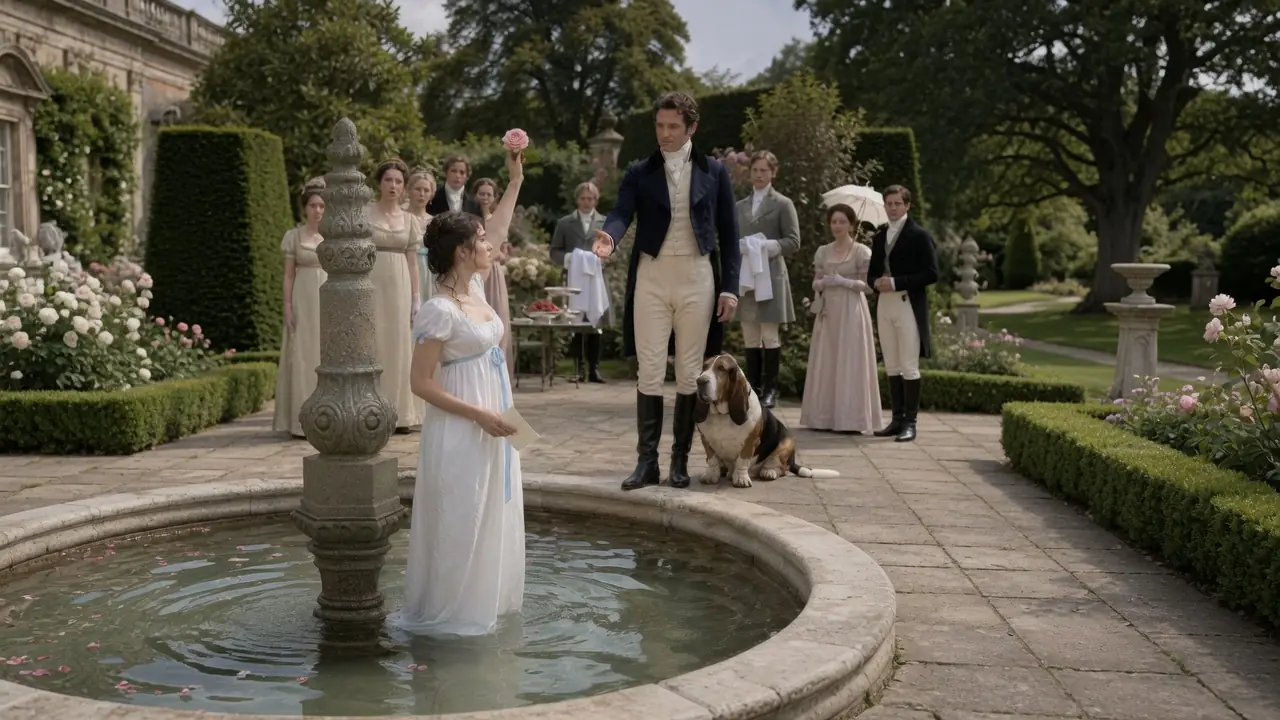
You will by now have heard that I fell into the Duke of Somerfield's fountain. I want it on record before any other account reaches you—and I have no doubt that other accounts are already traveling at considerable speed—that the fountain was not in its expected position. I have visited Somerfield Park twice before in my life. The fountain was, on both prior occasions, positioned a full twelve feet to the left of where it stood yesterday afternoon. I cannot explain how a stone fountain of some considerable weight and apparent permanence moves between visits, but I maintain that it does, and that this explanation is the correct one.
The Duke himself was present when it happened. Several witnesses have informed Aunt Cress that he did not laugh. I am told this with some emphasis, which I suspect means that he very nearly did. I am also told that the rose I was holding, which I had accepted from Lady Vickery’s garden tour approximately four minutes before the incident, survived in perfectly good condition—which is more than can be said for my pride or my second-best muslin.
The Duke's dog, a large and deeply philosophical Basset Hound of uncertain age and immovable opinions, sat down beside the fountain and watched the whole proceedings with an expression that I can only describe as professionally neutral. His name, I am told, is Hegel. This explains a great deal.
Your extensively damp and entirely blameless cousin,
Adelaide
***
It was the summer of 1814, and this letter was posted on a Tuesday. Clara Thornton received it on Thursday, which was two days after she had already received four separate accounts of the fountain incident from four separate correspondents, each more dramatic than the last. The letter, she thought, was by far the best version.
This is the story of what happened after a summer afternoon in a moving fountain, and a man who had not been surprised by anything in seven years. It is the story of a woman who read while walking, who could argue persuasively about cartography, and who made everyone in any given room feel as though the room had been waiting specifically for her. Six months between June and winter—a slow unraveling of everything a careful man had told himself about what he needed and did not need. And at the end of it, a distance that turned out to be far too long to keep.
The gathering at Somerfield Park on the fourteenth of June was, by every objective measure, a success. Lady Vickery had organized it with her customary precision. The weather had cooperated with unusual civility. The gardens were at their summer peak—walled roses and lavender hedges, and the particular deep green of an English lawn that has been rained on at exactly the right intervals. Thirty-two guests moved among the paths in their summer muslins and afternoon coats, admiring the herbaceous borders and accepting strawberries from footmen who had been stationed at intervals and had learned to maintain expressions of perfect equanimity regardless of what they witnessed.