Your Voice Makes Me Sick,' Mean Girl Says to Black Girl — Their Frozen When She Wins the Grammy
My dear Clara,
I write to you in haste from my room at Aunt Cress’s house, where I have spent the past hour wrapped in a wool blanket, drinking something hot that Aunt Cress insists is a restorative tonic, and I believe—on closer examination—is primarily brandy. 
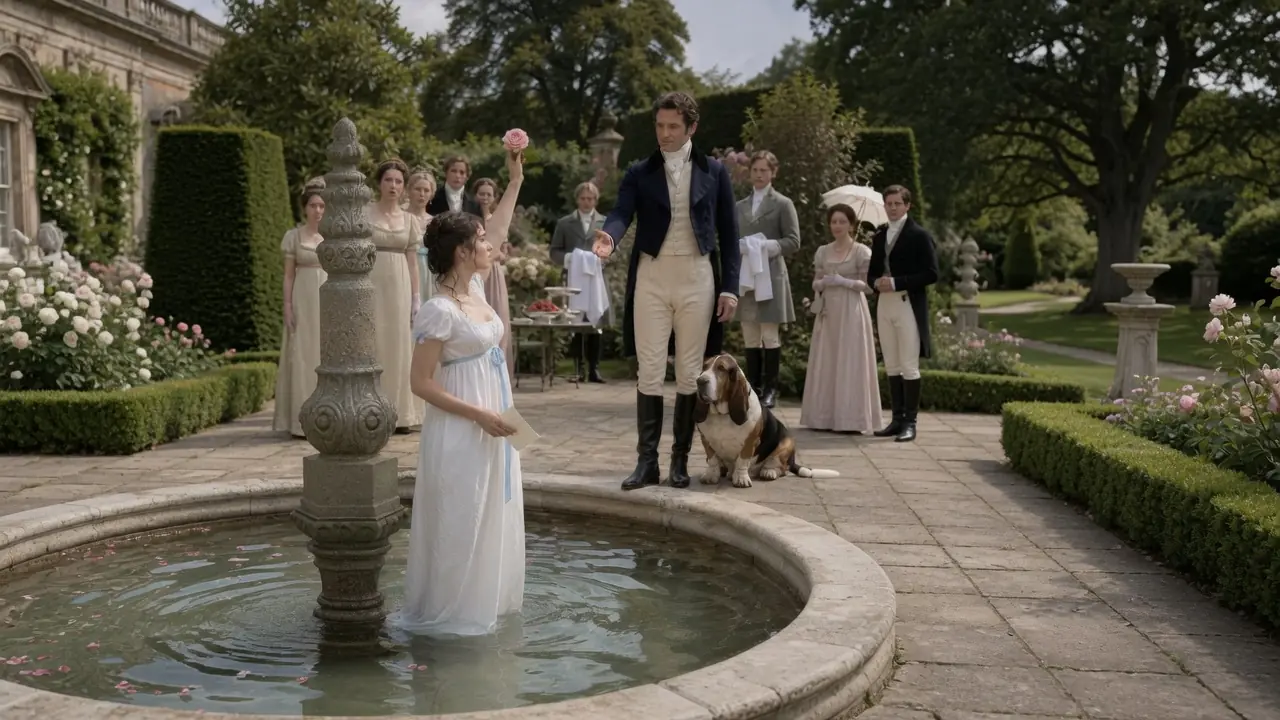
You will by now have heard that I fell into the Duke of Somerfield's fountain. I want it on record before any other account reaches you—and I have no doubt that other accounts are already traveling at considerable speed—that the fountain was not in its expected position. I have visited Somerfield Park twice before in my life. The fountain was, on both prior occasions, positioned a full twelve feet to the left of where it stood yesterday afternoon. I cannot explain how a stone fountain of some considerable weight and apparent permanence moves between visits, but I maintain that it does, and that this explanation is the correct one.
The Duke himself was present when it happened. Several witnesses have informed Aunt Cress that he did not laugh. I am told this with some emphasis, which I suspect means that he very nearly did. I am also told that the rose I was holding, which I had accepted from Lady Vickery’s garden tour approximately four minutes before the incident, survived in perfectly good condition—which is more than can be said for my pride or my second-best muslin.
The Duke's dog, a large and deeply philosophical Basset Hound of uncertain age and immovable opinions, sat down beside the fountain and watched the whole proceedings with an expression that I can only describe as professionally neutral. His name, I am told, is Hegel. This explains a great deal.
Your extensively damp and entirely blameless cousin,
Adelaide
***
It was the summer of 1814, and this letter was posted on a Tuesday. Clara Thornton received it on Thursday, which was two days after she had already received four separate accounts of the fountain incident from four separate correspondents, each more dramatic than the last. The letter, she thought, was by far the best version.
This is the story of what happened after a summer afternoon in a moving fountain, and a man who had not been surprised by anything in seven years. It is the story of a woman who read while walking, who could argue persuasively about cartography, and who made everyone in any given room feel as though the room had been waiting specifically for her. Six months between June and winter—a slow unraveling of everything a careful man had told himself about what he needed and did not need. And at the end of it, a distance that turned out to be far too long to keep.
The gathering at Somerfield Park on the fourteenth of June was, by every objective measure, a success. Lady Vickery had organized it with her customary precision. The weather had cooperated with unusual civility. The gardens were at their summer peak—walled roses and lavender hedges, and the particular deep green of an English lawn that has been rained on at exactly the right intervals. Thirty-two guests moved among the paths in their summer muslins and afternoon coats, admiring the herbaceous borders and accepting strawberries from footmen who had been stationed at intervals and had learned to maintain expressions of perfect equanimity regardless of what they witnessed.
Rafferty Kincaid, Duke of Somerfield, had been standing near the east wing with his steward for the past twenty minutes, discussing a drainage problem on the lower meadow. It was not, strictly speaking, the appropriate use of a garden party. Rafferty had attended the gathering because Lady Vickery was his nearest neighbor and had invited him seven times across three years without receiving a single acceptance. And Oldwin had said, with the particular quietness he deployed when he meant something strongly, that perhaps this year might be the year. Oldwin was sixty-one. He had been steward at Somerfield for twenty-two years. Rafferty had long ago learned that when Oldwin was very quiet about something, it was time to do it.
The lower meadow drainage remained unresolved. They were discussing the second culvert when Rafferty heard a sound—not a cry, nothing dramatic, more the specific noise of someone discovering very suddenly that a large volume of water was closer than expected.
He looked up. A young woman in white muslin was standing in the Somerfield fountain. Or rather, she had recently arrived in it, because she was still in the process of establishing her footing, one arm extended with a rose held carefully aloft as though this were the only item worth preserving. She was standing in approximately eighteen inches of water. She was looking at the fountain's central stone figure with the expression of someone who has just lost a very short argument with the built environment around her. Several guests had turned. A few moved forward. Most simply stared.
Rafferty walked over. It was not a decision, exactly; it was the straightforward application of being the person on whose grounds someone was standing in a fountain.
"Are you injured?" he said.
She looked at him. Her hair had come partly loose on one side, dark and damp against her cheek. Her eyes were honey-warm and entirely unafraid, which was the first thing he noticed because most people looked at him and then looked at the middle distance, performing a careful social neutrality. She looked at him as directly as one person can look at another.
"Not physically," she said.
"The basin has a submerged step," Rafferty said, "on the western approach. I have been meaning to have it marked."
She glanced down at the water around her ankles. She appeared to be conducting an internal review of the situation. Then she looked up at him again and said, "Is that the official explanation, or the charitable one?"
Rafferty looked at her for a moment. "Both, I think," he said.
"I was reading a letter," she said. "It was not exactly an explanation. It was simply the truth offered without defense."
"While walking?"
"While walking." She looked at the fountain's stone figure again. "It was an important letter."
Hegel had arrived by this point, having located an item of interest with the navigational certainty of a dog who regards most human activities as worth investigating. He sat down at the fountain's edge. He looked at the woman. He looked at Rafferty. He appeared to reach a conclusion of some kind and made no move to share it.
A footman had appeared with a large folded cloth. Oldwin materialized a step behind Rafferty with the professional expression of a man who has managed crises of varying descriptions for two decades and knows when to be useful without comment.
"I am Rafferty Kincaid," Rafferty said. "This is my fountain."
"Adelaide Thornton," she said. "I apologize for your fountain. It was the step. You are being very kind about it."
She accepted the footman's cloth with one hand, still holding the rose with the other. "The rose survived," she added. "That's something."
"It is," Rafferty agreed.
He offered his hand to assist her from the basin. She took it briefly, practically, and stepped out onto the path. She was three or four inches shorter than him, with water running from the hem of her gown, and a composure that was, he thought, either genuine or the most convincing performance of it he had ever encountered. It was genuine—that was the thing. She wasn't performing composure; she was simply not particularly frightened by being embarrassed. He hadn't met anyone like that in some time.
She handed the rose to Oldwin, who accepted it with the expression of a man who has been handed stranger things, and allowed herself to be guided toward the house by a quiet and efficient Lady Vickery. Before she turned to go, she looked back at Rafferty once, briefly, with an expression that might have been amusement or might have been gratitude, and then she was gone.
Hegel continued to sit by the fountain for another three minutes, looking at the path she had taken.
"The drainage," Oldwin said.
"Yes," Rafferty said, and they returned to the culvert.
But on the walk back through the gardens that evening, he found himself glancing at the fountain as he passed. The water was perfectly still. The stone figure stood as it always had. The rose had been left on the bench beside the path and had started gently to wilt.
Three weeks later, Rafferty accepted his second social invitation in seven years. It was a dinner at Mrs. Holbrook's house in the village—a small gathering, eight people, organized by a widow of excellent sense who had been an institution in the neighborhood for longer than Rafferty had been in the county. Oldwin had not said a word about it. Rafferty had said yes before he could think of a reason to say no, which was a departure from his established method. He told himself it was the drainage culvert. Mrs. Holbrook's late husband had been a man of property with strong opinions about groundwater management, and her records room was reputed to contain surveys going back to the 1750s. It was not, in any sense, a social call. It was research.
Adelaide Thornton was Mrs. Holbrook's niece, which he had not known until he arrived and found her standing in the hallway, arguing companionably with a very old and indifferent portrait of a man in a powdered wig.
"He looks exactly like my cousin Gerald," she said, not to anyone in particular.
"Gerald Thornton," said the older woman beside her, who was presumably Mrs. Holbrook, "is perfectly respectable and does not deserve to be compared to Admiral Stanhope."
"I said he looks like him. I made no comment on his character." She turned and saw Rafferty in the doorway, and something crossed her face—a brief, unguarded surprise, and then something else that she moved past so quickly he couldn't name it. "Your Grace."
"Miss Thornton," he said.
"You know each other?" said Mrs. Holbrook, whose eyes had the cheerful sharpness of a woman who has noticed everything and intends to notice more.
"We met at Lady Vickery's garden party," Rafferty said.
"He owns the fountain," Adelaide said pleasantly.
Mrs. Holbrook looked between them. "How delightful," she said.
The dinner was eight people around a table that sat ten comfortably, which meant there was room to breathe and room for conversation to go in unexpected directions. Rafferty was placed at Adelaide's left, separated by one guest—a pleasant, retired clergyman who talked primarily to the woman on his other side, which meant that across the space of an hour and three courses, he and Adelaide spoke six times. He counted. He did not mean to count.
The first time was over the soup, when she said something to the clergyman about the history of the Somerfield estate and was, to Rafferty's surprise, completely accurate in all particulars, including several that he had not known himself. The second was when he said across the clergyman, "Where did you read that?"
She looked over, apparently unsurprised that he had been listening. "The county history. Your great-grandfather's estate diary, which is in the records office in Ripon. I was there with my father when I was fourteen. He was very interested in old diaries."
"My great-grandfather's estate diary," Rafferty said. "He had extremely strong opinions about turnips."
"Entirely serious ones," Adelaide said.
The third, fourth, and fifth exchanges were about turnips, which was not a topic Rafferty had expected to discuss at a dinner party or indeed anywhere. And yet, he found that he was interested in what she said.
The sixth was at the end of dinner, when the guests were gathering for the remove to the drawing room. Adelaide had picked up a book that had been sitting on a side table near her chair. She had noticed it mid-dinner and had been glancing at it with the peripheral attention of someone who wants to look but is refraining, and she opened it to its first page with the expression of someone meeting an old acquaintance.
"Hume," she said, almost to herself. Then she looked up and found Rafferty still standing nearby, his coat already on, prepared to take his leave. She held up the book slightly, a small explanatory gesture. "Aunt Cress has every volume. She doesn't read them, but she buys everything."
"Do you?" he said. "Read them?"
"Yes." She closed the book and put it back. "Though I have learned to do so only while stationary." A pause, very brief. "On account of fountains."
Rafferty looked at her. She was not performing the joke. She was simply in possession of it, offering it the way someone hands you something through a doorway without particular ceremony.
"Good evening, Miss Thornton," he said.
"Good evening, Your Grace." She smiled at him—it was a quiet smile, not the wide, public kind. It was the kind that had been kept back and then let out by accident. "Thank you for the excellent drainage conversation."
He had not, in fact, mentioned the drainage.
He turned to go and heard, as he reached the hall, the sound of her saying something to her aunt that made Mrs. Holbrook laugh. He drove home in the dark with the windows of the carriage cracked open. The night air tasted of summer grass and the particular cleanness that comes before rain.
Hegel, who had been waiting by the front door of Somerfield, and who greeted Rafferty's returns from social engagements with a dignified reserve that suggested he had not been sleeping in the hall the whole time, raised his head and looked at him with an expression of professional inquiry.
"The soup was adequate," Rafferty said.
Hegel put his head back down. Rafferty went to his study and did not, for once, open the ledger.
The boundary dispute between Somerfield and the Vickery property had existed in one form or another for forty years. The question was a wall—specifically, which side of a crumbling stone wall was responsible for its maintenance and whose field it technically enclosed. It was the kind of dispute that produces not lawyers, but a great deal of correspondence between stewards and one family gathering on either side of the wall in early August to look at it with expressions of combined grievance. Oldwin had located survey maps from 1780. The Vickery steward had located survey maps from 1802. The two sets of maps disagreed politely about the wall's position by approximately six inches.
Adelaide Thornton appeared on the Somerfield side of the wall on a Thursday morning with a folder of documents under her arm and grass on her shoes, having apparently walked across three fields to get there.
"Miss Thornton," Rafferty said.
"I heard about the wall," she said. "Aunt Cress has the original parish enclosure records from 1780. She also has the transcript of the argument between your great-grandfather and Sir Henry Vickery’s grandfather, which is extremely entertaining, and which resolves the question of the wall entirely, if you're interested."
Rafferty looked at her. She looked back, waiting with the practical patience of someone who has arrived with useful information and is prepared to either hand it over or take it home.
"I am interested," he said.
They spread the documents on the wall itself, which was the most convenient flat surface available. Oldwin appeared and bent over the parish records with the reverence of a man encountering ancient truth. The Vickery steward, who had been called across from the other side, looked at the enclosure transcript and said, "Well," very quietly, which was everything.
It took an hour and a half to establish that the wall was conclusively on the Somerfield side by eight inches, which meant that Somerfield was responsible for its maintenance and always had been. This was not in itself a victory for Rafferty, but the dispute was over, which was worth more than the wall.
"Thank you," he said to Adelaide when Oldwin and the Vickery steward had gone to pace the boundary with the careful solemnity of men who have been given a task.
"My father kept everything," she said. She was still looking at the enclosure transcript, turning a page with the careful touch of someone who knows old paper. "He was a terrible farmer and a moderate clergyman, but he was an extraordinary keeper of records. He believed that everything mattered and that everything should be written down."
"He was a clergyman?"
"Rector of Thornton village for thirty years." A small pause. "He died in the winter of 1812. He had sixty-three years of his own journals and the complete records of the parish going back to 1640." She looked up. "I kept all of it."
Rafferty looked at her in the summer light, with the documents spread on the wall between them, and thought: *She is the kind of person who keeps things, who holds on to what other people let go.*
"The culvert problem," he said, "on the lower meadow. Your father's records wouldn't have anything on the drainage pattern in that field?"
Something shifted in her face—a very slight brightening, the way a room brightens when someone opens a door. "I would have to look," she said, "but probably, yes."
They walked back to the house together, not by arrangement, simply because they were both going in the same direction. The walk took twenty minutes across the Somerfield grounds, through the kitchen garden, past the walled orchard, and along the gravel path that ran beside the east wing. Adelaide looked at everything as they went—not rudely, she didn't stop or stare, but with a constant peripheral attention, the way a person walks through a place they are already reading.
"You've never been inside Somerfield," Rafferty said.
"I have not. Lady Vickery's garden party was in the grounds."
"You should see the library." He said it and then said nothing else, which was, he realized, an invitation delivered in the form of a statement of fact—which was either efficient or extremely inadequate. He was not sure which.
She looked at him briefly. "I would like that," she said, and did not make it into anything more than it was.
The library was six thousand volumes accumulated across four generations of Kincaids who had bought books the way other families bought land—compulsively and with the conviction that more was always better. It smelled of leather and old paper and the particular dusty warmth of a room that is genuinely used.
Adelaide stood in the doorway for a moment when she arrived the following Tuesday. She had come to return a map she had borrowed and found useful, and Rafferty had said, "Come and see the library." And she had come. And she looked at the room the way she had looked at the gardens, taking it in slowly.
"It's wonderful," she said, not performing delight, simply in possession of it.
"It is disorganized," Rafferty said, which was true. The shelving system had been started by his grandfather and completed by no one.
"It's marvelous when libraries are a little disordered. It means people use them." She moved to the nearest shelf and read the spines with one hand trailing. "Your grandfather had Vico," she said. "I've never seen a copy this old. He bought it in Naples, did he?" She turned it over in her hands with the careful attention she gave everything. "My father corresponded with a man who had met Vico's translator. He kept the letters." She paused. "I kept them."
"You keep everything," Rafferty said.
She looked at him. "Someone should." There was something in her voice that wasn't sorrow, exactly—something more settled than grief, more like a fact she had made peace with. "He kept everything because he thought the world was worth paying attention to. I keep it because he was right."
Rafferty looked at her—this woman who had fallen into his fountain while reading a letter, who had walked three fields to bring him a boundary transcript, who stood in his library holding a Neapolitan Vico like it was ordinary, which for her apparently it was—and thought: *I have been in this county for seven years, and I have not once paid attention to anything except the estate.* The thought was uncomfortable, which was unusual. Rafferty did not often feel uncomfortable.
Hegel appeared in the library doorway. He had, for reasons known only to himself, developed the habit of following Adelaide when she visited, and he had been managing this from approximately four feet of distance, attempting to appear as though proximity were coincidental. He sat down and looked at her with the full weight of his philosophical disposition.
"He likes you," Rafferty said.
"He has been following me at a very professional distance since the fountain," Adelaide said without looking up from the Vico. "He seems to be conducting a long-term assessment."
"He does that," Rafferty said. "He conducted a six-month assessment of the second footman before allowing himself to be fed by him."
"And what was the verdict?"
"Inconclusive. He tolerates the footman but has never fully committed."
She looked at Hegel. Hegel looked at her. Something passed between them that was, in Rafferty's observation, the specific communication of a dog deciding a thing. Hegel settled down on the library rug with the heaviness of a creature that has arrived at a conclusion and intends to stay.
It rained on the afternoon of the twenty-second of August with the sudden, comprehensive commitment that late English summers reserve for their worst displays. There were twelve people at the Haverstock property for what had begun as an outdoor gathering. There were not twelve good reasons for anyone to have planned an outdoor gathering in late August in Yorkshire, but the morning had been excellent, and the gazebo was large, and everyone had said it would probably be fine.
It was not fine. They came in from the rain in a wave—umbrellas useless, slippers ruined, at least one hat beyond recovery—and sorted themselves into the rooms of the Haverstock house with the cheerful resignation of people who have been defeated by weather and intend to make the best of it.
Rafferty and Adelaide reached the rose garden gazebo from different directions at approximately the same moment because it was the nearest structure to where they had each been standing. They arrived at it simultaneously, which produced a brief collision at the entrance that Adelaide navigated by stepping back, Rafferty by stepping sideways, and Hegel—who had been trotting behind Rafferty—by sitting down in the rain with the dignified exasperation of a creature above such things.
"Hegel," Rafferty said.
Hegel came in. He shook himself extensively.
The gazebo was approximately eight feet across. There was a stone bench, a table that had seen better seasons, and a view of the rose garden that would have been pleasant in other weather. Rain came at the roof in waves and ran in sheets off the edges. The garden had become, in the space of four minutes, a kind of small ornamental river. They stood at opposite edges of the bench and looked at the rain.
"This is my fault," Adelaide said.
"In what sense?"
"I told Mrs. Haverstock the weather looked promising this morning. I said the clouds were moving east. You are not, to my knowledge, responsible for the weather."
"No, but I was very confident about it. Which is worse." She sat down on the bench. "Confidence in uncertain things is a character flaw I am working on." She looked at the rain. "The work is slow."
Rafferty sat at the other end of the bench. Hegel positioned himself precisely between them and put his head on his front paws.
The rain was very loud on the roof. Inside it, there was a stillness—the kind that happens when two people are prevented from moving by something external and have to simply be where they are without the option of going somewhere else.
"Your father's journals," Rafferty said after a while, "do you read them sometimes?"
She turned the question over before she answered it, the way she turned pages carefully, with attention to what was underneath. "Not for information. Just for his voice. He wrote the way he talked, as though every subject was the most interesting one he had encountered, and he couldn't quite believe he was the one who got to think about it."
"I should like that," Rafferty said. He said it as a statement of fact, and then realized a half-second later that it might be taken as something else.
She looked at him. A small pause. Her eyes, he thought, were the precise color of amber glass with light behind it—not honey, exactly, but something slightly deeper. Something that changed with what she was looking at.
"I take that as considerable praise," she said.
"It was meant as an observation," he said, which was both true and inadequate.
"I know," she said, and then quietly, "Thank you."
The rain went on. Below them, the rose garden filled with water in the low places, and Hegel made a small sound in his sleep, and outside, someone called across the Haverstock lawn in the cheerful, carrying voice of a person who has found shelter and wants others to know it. Rafferty looked at the garden. Adelaide looked at the garden. Neither of them spoke for quite some time, and neither of them moved. And the rain did what rain sometimes does when it holds two people in the same place: it made the stillness mean something.
"Do you go to London often?" she asked after a while. It was the kind of question that could mean nothing at all.
"Less than I should," Rafferty said. "More than I want to."
"What do you want?"
He looked at her. She had asked it simply, not with the arch glance that such questions usually came accompanied by, not with any visible strategy. She was watching the garden and had asked a straightforward thing and appeared to expect a straightforward answer, which was unsettling because he was not accustomed to questions that expected the truth.
"To be left alone to run the estate," he said, which was the answer he had given for seven years, and which sounded, said aloud in this gazebo, in this rain, somewhat more like a defense than an ambition.
Adelaide nodded slowly, as though this were reasonable, as though she were filing it somewhere. "And are you," she said, "when you're left alone?"
"Am I what?"
"Left alone. I mean, is it as good as you expected it to be?"
A longer pause. The rain on the roof was steady and particular, the way rain sounds only when you are inside something small and the rest of the world is outside it. His boots on the stone floor, the smell of wet grass and roses, and the watered-down light of a gray Yorkshire afternoon.
"No," he said. It was the most accurate thing he had said in some time.
She turned and looked at him fully, and something in her face—not pity, nothing so condescending—was simply recognition: the way one person looks at another when they have found them saying something true.
"Good," she said. And then, as if correcting herself, "I mean, not good. I mean, it's easier if you know."
"Easier than what?"
"Than not knowing," she said. "Than being quite certain you are exactly as you want to be, and then finding without warning that you are considerably less certain." She turned back to the garden, her hands folded in her lap. "My father was a contented man. He always knew what he had. I sometimes think that knowing what you have, really knowing, is harder than it looks."
Rafferty looked at her hands in her lap. Her left hand had a faint ink stain at the side of the first finger, which he had noticed before. It was the mark of someone who writes frequently and does not always notice the pen. He said nothing. He was not certain what he could say that would not be inadequate. Outside, the rain softened slightly, not stopping, just considering it.
It was Aunt Cress who mentioned it in early September over breakfast. "I hear Somerfield is for London soon," she said, in the way she mentioned most things—conversationally, without apparent intention, which was the manner she had developed over sixty years of watching what people did with information.
"Is he?" Adelaide said.
"The Marchioness of Ashby's family," Aunt Cress said, turning a page of her letter. "The Ashby connection. A Miss Dunmore, I believe. Apparently, there has been some correspondence."
"That seems sensible," Adelaide said. She ate her toast. She drank her tea. She looked out the window at the garden, which was beginning to turn toward autumn—the flowers going over, the first yellow in the lime trees. Outside, the morning was clear and cool.
"She is said to be very accomplished," Aunt Cress said.
"Good," said Adelaide.
The conversation moved on. They talked about a letter from Clara, who had news of a neighbor's engagement, and about the linen cupboard, which needed reorganizing, and about whether the walk to the upper wood was worth attempting before the leaves turned or better left until after. Adelaide said nothing further about Miss Dunmore, or the Marchioness of Ashby's family, or London.
She spent the morning at her letters. She went for her walk after luncheon, which she always did, but she took the lane that ran east toward the village rather than the path that skirted the lower edge of the Somerfield grounds, which was the shorter route and the one she usually preferred. She did not think about this. She simply walked east through the village, past the church, and back around by the long way. When she returned, Aunt Cress was in the sitting room with her needlework and said nothing. This was, in Adelaide's experience, an unusual discipline for Aunt Cress, who generally said something.
*She is said to be very accomplished,* Aunt Cress had said at breakfast. Adelaide had said *good*. She had meant it. Of course it was good. Of course it was sensible. Of course a duke needed to marry well, and the Ashby connection was exactly the kind of thing his mother's correspondence had been designed to arrange. She understood all of this with perfect rationality.
She also understood that she had been walking the Somerfield path for two months because the Somerfield path was pleasant in September, because the library was interesting, and she had borrowed a map and needed to return it, and Hegel kept following her and needed returning too, and because there were drainage records she could be useful about. These were all true things.
There was also a third truth, which was less comfortable: she had been looking forward to the east gate every morning the way she looked forward to letters from Clara—with a particular alertness, a particular readiness, and the knowledge that the day would be different once she arrived there.
She did not go to the east gate on the morning of the seventh of September. She went the next morning instead, and the one after, and Rafferty was not there. Hegel sat with her at the wall for twenty minutes, as though this were his established practice, which apparently it was, and she walked home through the early autumn fields and told herself it was a very good arrangement for a summer in Yorkshire, and that she had never expected anything else.
At eleven o'clock that night, Aunt Cress passed the library on her way to bed and found the books arranged in complete alphabetical order by author's surname—which was not how she had arranged them, and which had clearly required several hours of sustained effort. There was a single lamp still burning on the table. Adelaide was in bed and appeared to be asleep. Aunt Cress looked at the books. She looked at the lamp. She turned it off very carefully and went upstairs.
He did not go to London. It was, in the end, a straightforward matter. The correspondence with the Ashby family had been his mother's doing, conducted entirely without his knowledge, and had been in progress for four months before he discovered it—at which point he wrote a very short and very clear letter to the Marchioness, and the thing was over. His mother wrote back at length. He did not respond at equivalent length.
Hegel had been missing on a Tuesday morning in October. Not missing, exactly, because Hegel was not a dog who went anywhere without deliberate intention, but absent from his usual locations, which meant he was somewhere specific. Rafferty found him at the east gate, sitting with the patient certainty of a dog who has somewhere to be and knows when to start.
Adelaide Thornton came up the lane from the direction of the village at ten o'clock, with her coat on and her hair bundled against the wind, carrying Hegel's lead in her hand. She stopped when she saw Rafferty at the gate.
"He found me on the lane," she said. "He follows me. I was bringing him back."
"He does that," Rafferty said.
"He's done it three times now," she said. "I should have brought him sooner."
"You could have sent a note."
Something crossed her face—an uncertainty quickly gone. "I did not want to be a bother."
"You are not a bother," Rafferty said. He meant it straightforwardly. It came out with more weight than he intended, the way things sometimes do when you mean them too simply. And then, because he was a man who filled silences with the nearest available practical matter, he said, "You have been here often enough coming and going, that the household has begun to expect it."
It was not a criticism. It was not an invitation, either. It was simply what was true, said without thought for how it would land. He saw the moment he said it that it had landed wrong.
Adelaide looked at him for a half-second, her eyes changing in that way they did, going from open to careful, and then she said, quite evenly, "I understand. I will take Hegel back another way in future." She held out the lead. "Good morning, Your Grace."
"Miss Thornton—"
"Thank you for allowing him off the grounds," she said pleasantly, which was worse than if she had been cold.
She handed him the lead, turned around, and walked back up the lane with the particular composure of someone who is not going to give you the satisfaction of seeing what you've done. Rafferty stood at the east gate with the lead in his hand and watched her go. Hegel sat down heavily and gave him a look.
"I know," Rafferty said.
Hegel gave him the look for a little while longer.
"I know," Rafferty said again.
November came in gray and cold, which it always did, and the Somerfield grounds went bare in stages—the lime trees first, then the oaks, then the kitchen garden stripped back to the root vegetables and the late brassicas that stood in rows like a diminished army. The days shortened; Rafferty worked. He was very productive in November. He completed the drainage project on the lower meadow, which involved two weeks of work with the estate's laborers and a solution that was, he acknowledged to Oldwin, nearly identical to what Adelaide had suggested based on her father's drainage records. He reviewed the winter accounts. He responded to four letters from his mother, which was four more than usual, all of them about the Ashby situation, which was over. He attended to all the things that required attending to.
He did not attend to the east gate. He went around it.
Hegel sat at the east gate every morning at approximately ten o'clock. He sat there for twenty minutes and then he came inside. He did not make any sound about it. He simply sat there as a matter of principle and then came in, went to his place by the library fire, and slept with the long composure of a creature who has stated his position and requires no further discussion.
Rafferty mentioned the drainage completion to Oldwin in the third week of November. They were in the estate office reviewing the ledger, and outside, it was beginning to snow.
"The culvert design," Rafferty said, "Miss Thornton's suggestion originally."
"It was," Oldwin said, not looking up. A pause. "She hasn't been in the neighborhood since October."
"No," Rafferty said.
"Mrs. Holbrook said she went back to Thornton, the family house. Her brother and his wife—her brother, Thomas Thornton, is in orders. Took the Thornton living when their father died. The house is his." Oldwin turned a page. "Mrs. Holbrook has the direction, I believe, if anyone needed it."
Rafferty said nothing. Oldwin very carefully did not say anything either, which was, Rafferty had worked with him long enough to know, the most articulate thing Oldwin could do.
He put down his pen. "What I said at the gate," he said.
Oldwin looked up.
"I said something at the gate in October," Rafferty said, "something I did not mean the way she heard it. I did not correct it." Oldwin waited. "I should have corrected it," Rafferty said.
Oldwin looked at him for a long moment with the expression of a man who has spent twenty-two years watching a careful, self-contained, very private person fail to say things that needed saying, and who has developed over those years an almost infinite capacity for not pointing this out.
"You should," Oldwin said.
Rafferty looked at the snow outside the window. It was coming down in proper flakes now, settling on the stone ledge of the estate office in a thin white line. Inside the room was the smell of coal and paper and the steady tick of the clock on the mantelpiece. He had been, for the past six weeks, extremely productive. He was also, he acknowledged to himself, sitting in his estate office in November, unable to explain why the lower meadow drainage felt like less of an accomplishment than it should, given that it was a genuinely well-executed piece of engineering.
He walked the estate that afternoon, which was something he did when the problem was internal. Estate work stopped being useful when the problem wasn't the estate. He walked the boundary wall, which was repaired now and unremarkable. He walked past the east gate. He walked through the kitchen garden, stripped and bare, and along the gravel path beside the east wing, which he had walked in August with Adelaide beside him, and which was in November very simply a gravel path.
He walked past the library windows, which were lit from inside, and looked in from the grounds for a moment— his own library, his own shelves, Hegel on the rug by the fire, six thousand books in considerable disorder. She had said it was marvelous when libraries were a little disordered. She had said it meant people used them.
He stood outside his own library window in November, in the cold, and thought: *She knew more about what I had here than I did.* That was the thing when he let himself look at it neatly. It was not just that he missed her visits—though he did, in the specific way you miss a habit you have not yet named—it was that Adelaide Thornton had come into his estate, and his library, and his argument about a boundary wall, and the rain in the Haverstock gazebo, and she had looked at everything, everything, with that concentrated, particular, fully present attention, as though all of it were interesting enough to deserve it. And in looking at it that way, she had made him look at it that way, too. He had been in this house for seven years. He had not, until June, thought much about whether he was in it or merely resident.
He went inside. He wrote to Mrs. Holbrook that evening. Mrs. Holbrook replied the next morning with the direction to Thornton Rectory and a brief additional note that read: "She takes her father's study in the afternoon if the weather is poor. It usually is."
It was, Rafferty thought, the most precise and useful intelligence he had received all year.
He drove to Thornton on the first clear day of December, which was the eighth. It was four hours by road in reasonable conditions; the road was reasonable. Rafferty had sent no letter ahead, which was a departure from his usual method. He always wrote ahead, he always arranged things, but a letter seemed wrong. A letter could be answered in writing, which meant she could answer it with courtesy and composure and without having to say what she actually thought, and he had understood over the past six weeks that composure was something Adelaide Thornton could deploy very effectively when she wished to. He did not want her to be composed. He wanted to be in the same room as her and say what he should have said in October.
Thornton Rectory was a modest house behind a church on the east side of the village—stone-built and sensible, with a kitchen garden that was put to bed for winter and a front path edged with a box hedge. The December light was failing by the time he arrived, pale and thin and already leaning toward evening.
He knocked. A girl of perhaps fourteen answered the door, looked at him with frank curiosity, and said, "Are you the Duke?"
"I am," Rafferty said.
"Adelaide is in the study," she said, and stood aside in the manner of someone who has been told to admit visitors and finds the Duke an acceptable variety. "I'll tell her."
"Thank you," Rafferty said.
He was shown into a hallway that smelled of the winter specific to old stone houses—slightly damp, cold smoke, the ghost of old cooking. A dog appeared from somewhere, sniffed his boot with professional attention, and went away again. From a room at the back of the house came the sound of a fire and someone moving among papers.
The girl came back. "She says to come in."
The study was small, book-lined, and extremely occupied—papers on every surface, a fire going well, three lamps lit against the early dark, and Adelaide standing at the far end behind a table covered in what appeared to be transcripts and parish records. She was wearing a plain wool dress the color of winter moss, and her hair was less carefully arranged than he had ever seen it, as though she had been working for some hours and had stopped noticing.
She looked up when he came in. Her face did not perform surprise. She looked at him, and something moved behind her eyes—not alarm, not delight, but something more complicated than either.
"Your Grace," she said.
"I came to correct something," Rafferty said.
She waited. He had rehearsed this in the carriage for four hours. He had several versions; all of them had seemed adequate in the carriage, and now, standing in her father's study with the lamplight and the fire and her watching him with those careful, honey-warm eyes, none of them seemed sufficient. He said the true thing.
"At the gate in October," he said, "I said that the household had come to expect your visits. I meant to say that I had come to expect them. There is a difference between the two, and I allowed you to hear the lesser version and did not stop you from leaving, which was... that was wrong." He paused. The fire settled. "I have thought about it every day since October. I have also," he said, "been unreasonably productive, which is how I manage things I am not managing." He looked at his hands briefly, then at her. "Hegel sits at the east gate every morning at ten o'clock. He does not do it for the estate's benefit."
Adelaide said nothing for a long moment. Rafferty had reached the limit of prepared things to say. He was standing in a small study in Thornton village in December, having driven four hours to correct a sentence, and he had corrected it, and now he was waiting for the rest of it, which was hers.
"You said the household expected it," she said finally.
"I did."
"And you meant that *you* expected it."
"Yes," he said. "And when I did not expect it anymore, it was considerably worse than the drainage culvert and the estate accounts combined. And those are not negligible things."
A beat.
"Miss Thornton, I am not practiced at any of this. I have been running an estate and managing obligations and being diligent about everything that required diligence for seven years. And it has... it has left me," he stopped, "unused," he said.
Something moved across her face quietly, like weather. "I know," she said. "I know that about you."
He looked at her. "Do you?"
"You are very careful," she said. "You speak precisely when you speak at all. You went to one garden party in three years because Oldwin was quiet about it, which is clearly your system for working out what you actually need to do." She came around the edge of the table. She was three feet from him now in the lamplight, with the fire behind her and her father's papers all around. "You found me in the fountain and said it was the step. You came to Mrs. Holbrook's dinner to look at drainage records. You said the library should be seen. You said nothing, and then corrected nothing, and then drove four hours in December." She paused.
"Yes," he said.
"You are extremely inefficient," Adelaide said, "for a man who manages an estate of that size."
"I am aware of this," Rafferty said.
"I was also," she said, "alphabetizing books at eleven o'clock at night because I couldn't think of anything better to do about it."
The fire made a small sound. Outside, darkness had arrived in full.
"I should like," Rafferty said, "to not be inefficient about this any further."
Adelaide looked at him. Her eyes were very bright in the lamplight, and her face had the look it had in the fountain—unafraid, just present, just there. "Then say what you mean," she said quietly.
"I mean that I would like you to come back to Somerfield," he said, "not to return the dog, not to look at boundary records, not for any reason that I have to construct afterward to explain why I have asked you to come. I mean... I mean that the library is considerably less interesting without you in it, which is something I did not expect to discover about a room I have spent twenty years in." He looked at her directly. "I mean that if you were willing to stay—not at Somerfield, I mean eventually... I mean if you were—"
"Rafferty," she said.
He stopped. She had used his name—not *Your Grace*, which she had used for six months with perfect consistency—his name, said simply, as though it were the most natural thing in the world, as though she had been keeping it for exactly this use.
"I know what you mean," she said.
A pause. The fire, the dark outside.
"Yes?" he said.
"Yes," said Adelaide. "Obviously, yes."
She was close enough now that he could see the small vertical line between her brows that appeared when she was thinking, and the way her eyes changed when she was trying not to smile, and the smile was winning.
"The fountain," she said, "was not in its expected position."
"I had it moved," he said.
She blinked. "I beg your pardon?"
"In September. Twelve feet to the left." He looked at her. "It's where it should have been."
Adelaide looked at him for a very long moment. Then she laughed—the real one, the unguarded one, the one that had startled Hegel into perfect behavior by the fountain in June. The small study in Thornton Rectory rang with it, warm and entirely honest. And Rafferty thought: *This is what I drove four hours for. This exact sound, in this exact room, from this particular person.*
He took her hand, which was warm and ink-stained at one finger from the morning's records work, and she looked at their hands together with the same attention she gave everything—fully, as though this, too, were worth paying attention to.
"I keep things," she said.
"I know," he said. "I'm counting on it."
They remained in her father's study for another hour, talking about the library, about the boundary records, about Hegel's campaigns, about nothing in particular. The girl who had answered the door looked in twice and was told each time that everything was perfectly fine, which she appeared to accept with the resigned wisdom of someone who has grown up around books and paperwork and the general unpredictability of adults.
Thomas Thornton, Adelaide's brother, came in at seven o'clock from his evening calls, found a duke in his study, and handled it with the admirable composure of a man who had been raised by a record-keeper and understood that things sometimes showed up unexpectedly. He invited Rafferty to dinner; Rafferty accepted. The dinner was simple, and the conversation was, for the first time in Rafferty's experience, comfortable in the specific way that means it will be possible to have this conversation for a long time.
He drove back to Somerfield in the dark, which took four hours, and thought for the entire four hours about approximately nothing important, which was the most pleasant thing he had experienced all year.
They were married in the spring at Thornton Church, which seemed correct—her father's church, her father's village, the register her father had kept for thirty years. The record in that register would be, Rafferty thought, exactly the kind of thing Adelaide would keep. She would keep it for a very long time.
Hegel was present at the wedding, having been included in the procession to the church on the grounds that his exclusion would have been philosophically unkind. He sat at the end of the family pew with the particular expression of a creature who has been conducting a long-term assessment and arrived at last at a satisfying conclusion. He had known since June. He had simply been waiting for the humans to reach the same finding in their own time—which they generally did, provided someone sat at the gate every morning and made the direction clear.
The people of Somerfield said afterward that the Duke was easier in himself after the winter—not softer, exactly, but more present, more in the room he was in. They noted that he left his study door open; that he laughed at things quietly once or twice in public; that his wife read while walking and had once walked into the topiary, which she maintained had moved; that she was usually right about things and said so without apology; and that she said what she thought, which was, according to the household, both exhausting and an improvement.
They noted that the Duke's Basset Hound had adopted her completely and could be found at her feet at any hour of the day or evening, conducting, presumably, the follow-up assessment. And that the fountain at Somerfield Park stood from that autumn onward twelve feet to the left of its original position, where it had always, in some important sense, belonged.
Your Voice Makes Me Sick,' Mean Girl Says to Black Girl — Their Frozen When She Wins the Grammy

The CEO Threw a Single Dad Mechanic $100 - Then Bet $10M He Couldn't Start Her Jet

"$500K If You Can Read, Meathead" Arrogant Prof Slid Ancient Greek to Black Janitor — Big Mistake

They Called The Black Girl A Circus Act — Then Her Final Dance Made The Whole Theater Stand Up

Saleswoman Dumped Mop Water on Shabby Black Man — Turns Out He Was the Undercover CEO of the Store

Left at the Altar With Nowhere to Go — A Lonely Cowboy Looked at Her and Said, "You're Mine to Protect"

My Father Said You Needed a Wife... She Whispered — And the Lonely Cowboy Said Yes

Lonely Cowboy Saw Her Selling Pies In Town — He Bought Them All And Said Now Bake Only For Me

Her Father Traded Her Away at 19 — But the Lonely Cowboy Treated Her Like a Treasure

The Poor Maid Married The Gardener Out Of Love — Unaware He Was The Duke In Search For Love

"Serve the Tea, Then Get Out of My Life," the Duke Barked — by Morning, He Was Begging Her to Return

She Closed The Garden Gate Behind Her — Unaware The Duke Had Followed Her There

Mail Order Bride Hid She Was a Nurse - Then an Epidemic Hit the Mining Town and Everyone Begged Her

The Duke Found Her Stuck In Creek Mud Laughing Hard — He Fell In Love Before He Pulled Her Free

They Believed the Widow Planted Orchids Against Her Cabin for Fancy — Until the Snowstorm Came

Cop Cuffs a Black Woman Over a "Stolen" Purse She Paid For — Not Knowing She Was the New Sheriff Now

He Gave Water to a Giant Sioux Woman - Next Day, 500 Warriors Surrounded His Farm

Manager Kicks Out Elderly Black Man Asking for a Test Drive — He Pales as Owner Says 'That's My Dad'

"Easy Money" An Arrogant Female Black Belt Challenges a Black Farmer Single Dad
Your Voice Makes Me Sick,' Mean Girl Says to Black Girl — Their Frozen When She Wins the Grammy

The CEO Threw a Single Dad Mechanic $100 - Then Bet $10M He Couldn't Start Her Jet

"$500K If You Can Read, Meathead" Arrogant Prof Slid Ancient Greek to Black Janitor — Big Mistake

They Called The Black Girl A Circus Act — Then Her Final Dance Made The Whole Theater Stand Up

Saleswoman Dumped Mop Water on Shabby Black Man — Turns Out He Was the Undercover CEO of the Store

Left at the Altar With Nowhere to Go — A Lonely Cowboy Looked at Her and Said, "You're Mine to Protect"

My Father Said You Needed a Wife... She Whispered — And the Lonely Cowboy Said Yes

Lonely Cowboy Saw Her Selling Pies In Town — He Bought Them All And Said Now Bake Only For Me

Her Father Traded Her Away at 19 — But the Lonely Cowboy Treated Her Like a Treasure

The Poor Maid Married The Gardener Out Of Love — Unaware He Was The Duke In Search For Love

"Serve the Tea, Then Get Out of My Life," the Duke Barked — by Morning, He Was Begging Her to Return

She Closed The Garden Gate Behind Her — Unaware The Duke Had Followed Her There

Mail Order Bride Hid She Was a Nurse - Then an Epidemic Hit the Mining Town and Everyone Begged Her

The Duke Found Her Stuck In Creek Mud Laughing Hard — He Fell In Love Before He Pulled Her Free

They Believed the Widow Planted Orchids Against Her Cabin for Fancy — Until the Snowstorm Came

Cop Cuffs a Black Woman Over a "Stolen" Purse She Paid For — Not Knowing She Was the New Sheriff Now

He Gave Water to a Giant Sioux Woman - Next Day, 500 Warriors Surrounded His Farm

Manager Kicks Out Elderly Black Man Asking for a Test Drive — He Pales as Owner Says 'That's My Dad'

"Easy Money" An Arrogant Female Black Belt Challenges a Black Farmer Single Dad