The first thing people noticed about Caleb Thornton wasn't the scar. It was the way he moved through town like he was already apologizing for being there—shoulders turned inward, eyes down, his hatbrim pulled low enough to cut the world in half. 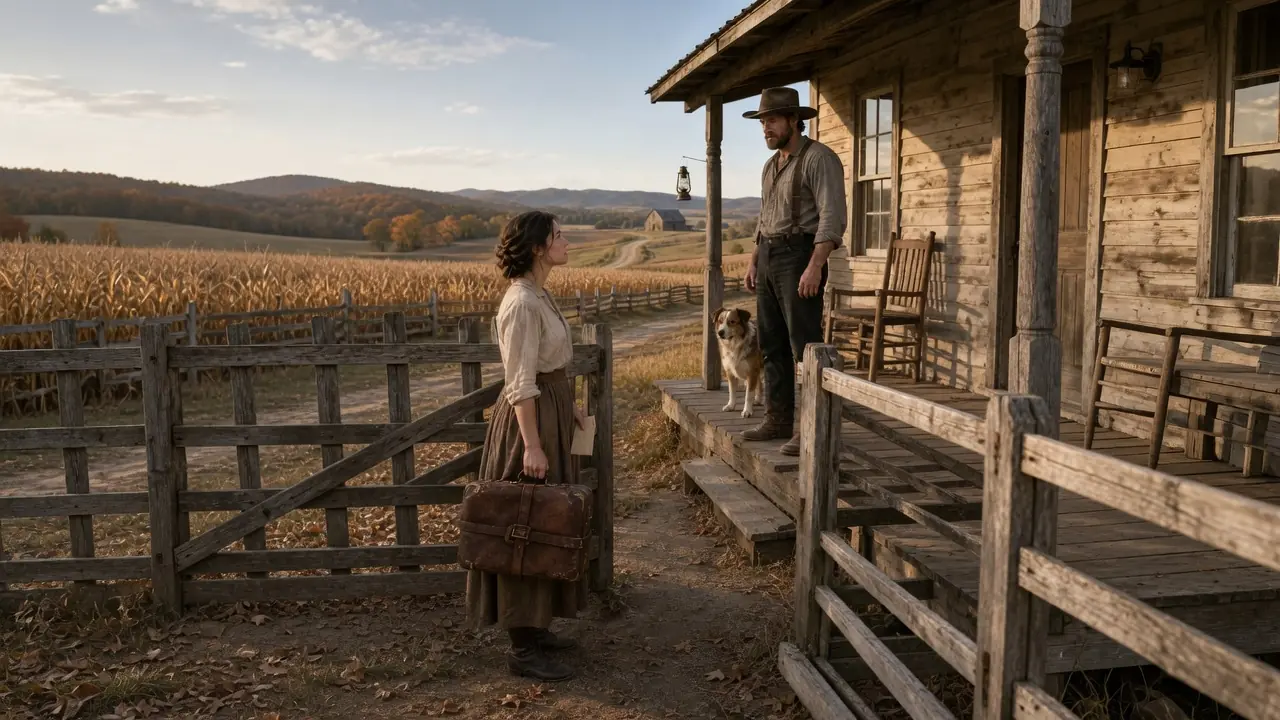
He bought his supplies fast, and he left faster. Nobody called after him to ask how the harvest was coming along, or whether he'd heard about the Dempsey boy who'd broken his leg falling off a roof on Birch Street. Nobody called after him at all. That was just how things were in Red Hollow.
The scar ran from the outer corner of his left eye down past his jaw—a thick, rope-like thing that had healed badly six years ago and never stopped looking raw, even now. A farming accident, that's what people said when they said anything at all. A thresher blade, a moment of terrible distraction, and a man who had walked into that morning looking one way and walked out looking like something that made women grab their children closer on the sidewalk.
He knew what he looked like; he wasn't stupid about it. What he hadn't expected, what nobody had warned him about, was how quickly people would decide that a changed face meant a changed soul—as if the blade had cut out something essential along with the flesh, as if disfigurement was evidence of some moral failing they'd suspected all along.
Within a year of the accident, the invitations to Sunday dinners stopped. The easy nods from men he'd worked alongside for a decade grew stiff and brief. A woman named Clara, who had been for a short, uncomplicated time something close to a sweetheart, wrote him a letter that was very kind and very final, and he'd burned it in the kitchen stove without reading it a second time. He'd learned not to need things he couldn't have.
The Thornton farm sat about four miles northwest of Red Hollow's main street, tucked into a shallow valley where a creek called Miller's Run cut through the land before disappearing into a stand of cottonwoods. It wasn't much to look at from the road: a two-story clapboard house that needed paint, a decent barn, sixty-odd acres of mixed cropland, and a kitchen garden that had gone mostly to weed since his mother passed away eight years back. But it was his, every inch of it, paid for in sweat and stubbornness, and two years of near starvation after his father's debts had come due all at once.
He'd almost lost it then. He had actually been sitting in the county assessor's office preparing to sign away the north pasture when a man named Gerald Harper had walked through the door, pulled up a chair uninvited, and told the assessor to hold off.
"I'll back the loan," Gerald had said, as easy as commenting on the weather. "Caleb Thornton's good for it."
Caleb had stared at him. He barely knew the man. Gerald Harper was a rancher from the east side of the valley—well-respected, comfortable without being rich, the kind of man who shook hands and meant it.
"You don't even know me," Caleb had said.
"I know your father raised you honest," Gerald had replied. "And I know an unfair situation when I see one."
That was it. No lecture, no terms beyond what the bank required, and no debt of gratitude demanded in return. Gerald Harper had simply done a thing because he thought it was right, and then he'd gone back to his own life, and Caleb had gone back to his. They'd exchanged maybe forty words total over the next several years—a tip of the hat here, a brief exchange about corn prices there—but Caleb had never forgotten it. You don't forget a man who pulls you back from the edge when he had every reason to keep walking.
By the autumn of 1889, the farm was holding—not thriving, but holding. The summer wheat had come in decent, the kitchen garden was still mostly weeds, and the barn needed a new section of roof before winter hit. Caleb did the work himself, dawn to dusk most days, with only a red cattle dog named Rust for company. Rust was eleven years old and half-blind in one eye. They suited each other.
The evenings were the hardest part, not because they were lonely, exactly. Caleb had made a kind of peace with solitude, the way a man makes peace with a bad knee—you don't stop walking, you just adjust. But there was something about autumn evenings specifically, the way the light went gold and long across the fields before it died, that had a weight to it he couldn't quite shake loose.
He'd been sitting on the porch with a cup of cooling coffee and a week-old newspaper he'd already read twice when he heard the sound of wheels on the dirt lane. He looked up. It was a rented buggy from the livery in town. He recognized the gray mare, a lazy animal named Duchess that the stable boy always overcharged for. The buggy came down the lane at a pace that suggested the driver wasn't entirely sure of the way—stopping and starting, once veering slightly left before correcting.
Caleb set down his coffee. Rust lifted his head from the porch boards, his one cloudy eye catching the last of the light. The buggy stopped in front of the gate, and a woman climbed down. She was maybe twenty-five or twenty-six, her dark hair pinned up but coming loose from a long day of traveling, wearing a dress that had been pressed carefully at some point hours ago and now showed every mile. She had a suitcase that appeared to be held shut by a leather belt buckled around its middle, which told him the latch was broken, which told him something about the state of things.
She stood at the gate and looked at the house, and then at him on the porch. Something flickered across her face—relief and dread at the same time, which was an expression Caleb recognized because he saw it in his own reflection occasionally.
She opened the gate. He stood up.
"You're Caleb Thornton," she said. It wasn't a question.
"I am." He came down the porch steps slowly, not wanting to spook her.
He was aware, as he always was with strangers, of the scar. He watched for the moment her eyes found it, watched them widen slightly before she caught herself and looked him square in the face, like she was making a deliberate decision about where to keep her gaze. He noted that most people didn't bother with the decision.
"I'm Lydia," she said. "Lydia Harper. Gerald Harper was my father."
Caleb went very still. "Was?"
"He passed six weeks ago." Her voice was steady, but there was something underneath it like old ice—the kind of steadiness you develop not because you aren't hurting, but because you've been hurting long enough that you've learned to talk through it. "Pneumonia. It came on fast."
Caleb took off his hat. It felt inadequate, but it was the only thing he had to offer at that moment. "I'm sorry. He was a good man. I owed him more than I could ever repay."
"He knew that," Lydia said. "He used to say you were one of the few people he'd backed in his life who never made him regret it."
They stood there for a moment in the cooling evening air. Rust limped down the porch steps to investigate the newcomer with his nose. Lydia looked down at the dog, and something in her face softened just slightly. She reached down and let him sniff her hand.
"He doesn't bite," Caleb said. "He barely walks. He's sweet."
She straightened up. "Mr. Thornton, I don't want to take up your evening. I've been traveling since before dawn, and I'm not at my best, so I'm going to say what I came to say plainly, and I hope you won't think worse of me for it."
"Say what you need to say."
She met his eyes, held them. "I have nowhere else to go."
***
He brought her inside. He wasn't sure why, exactly—reflex, maybe, or the memory of Gerald Harper walking through a door and pulling up a chair without being asked. Whatever it was, he held the front door open, and she walked through it carrying that beat-up suitcase. He put a kettle on the stove because it was the only hospitable thing he knew how to do on short notice.
The kitchen was clean—at least he kept it clean, one of his mother's insistences that had survived her. The rest of the house was functional but bare, in the way that happened when a man lived alone long enough and stopped noticing what was missing.
Lydia sat at the kitchen table and wrapped her hands around the cup of tea he set in front of her like it was the first warm thing she'd touched in days. Maybe it was.
"Tell me," he said. He pulled out the chair across from her and sat down.
She told him. After Gerald's death, the ranch had passed to Lydia as the only surviving child. Her mother had died when she was twelve, and her brother Thomas had gone east for work five years ago and hadn't written in two. The ranch should have been manageable; it wasn't large, but it was solid, and Gerald had been careful with money.
What Gerald hadn't been careful about was his foreman. A man named Dale Doss, whom Gerald had trusted for eleven years, had spent the last three of those years quietly siphoning money from the ranch accounts—small amounts at first, then larger ones, covered by falsified records that Gerald's failing eyesight and trusting nature hadn't caught.
When Lydia had discovered the discrepancy after her father's death, she'd gone to confront Doss. He'd turned it around on her, claimed she had authorized the transfers herself, produced paperwork with what looked like her signature, and gone to the county sheriff before she could. The accusations had moved fast, the way accusations always did in small communities. Broad embezzlement—a grieving daughter stealing from her own father's estate.
"It wasn't true," Lydia said. Her voice was still that same careful, steady pitch. "None of it was true. But once people hear a thing, especially about a woman alone..." She stopped, pressing her lips together. "The ranch hands quit. The neighbors stopped coming around. The bank froze the accounts pending investigation, and the lawyer my father used refused to take my case without a retainer I couldn't access."
"How did it resolve?" Caleb asked.
"It hasn't, not officially." She looked down at her tea. "The sheriff took Doss's word over mine. I had thirty days to vacate the property while the estate was held in review. That was three weeks ago."
"Where have you been staying?"
A pause. "A boarding house in Millfield, until four days ago when I couldn't make the rent."
Caleb was quiet for a moment. Outside, the wind had picked up, pushing against the kitchen window with a low, persistent sound.
"You said your father left a message," he said. "You wrote it in the letter you sent."
She'd sent him a letter two weeks ago—a brief, formal note saying she needed to speak with him about a matter concerning Gerald Harper's final wishes. He'd read it three times, trying to figure out what it could mean, and had come up with nothing useful.
Lydia reached into her coat pocket and produced an envelope, setting it on the table between them. "He wrote it himself," she said, "the week before he died, when he knew he was running out of time. He asked me to give it to you in person."
Caleb looked at the envelope. Gerald Harper's handwriting was on the front—just his name, *Caleb*, in the slightly shaky script of a man who'd been fighting illness when he wrote it. He picked it up and opened it. The letter inside was short; Gerald Harper had never been a man to use ten words when five would do.
*Caleb,*
*I don't have much time, and I won't waste it on preamble. Lydia is going to need help—real help, not the neighbor-checking-in kind. She's stronger than she looks and more stubborn than she ought to be, which means she won't ask easily. When she does, please listen. You are a good man, and I have always believed that. I'm asking you to remember it when it matters.*
*Gerald*
Caleb read it twice. Then he folded it carefully along its original creases and set it back on the table. He didn't say anything for a long moment. Lydia watched him with those careful eyes—not pushing, just waiting.
"He wrote that before any of this happened," Caleb said finally. "Before Doss, before the accusation... he just..." He paused. "He just knew you'd end up in trouble at some point, and he sent you here."
"He knew I was proud," Lydia said quietly, "and that I'd wait too long to ask for help on my own. He wanted to..." Her voice caught, just barely. She cleared her throat. "He wanted to make it easier, having someone already know they were supposed to help."
Caleb understood that more than he wanted to admit. "What is it you need?" he asked. "Specifically. Say it plain."
She looked at him steadily. And then Lydia Harper, who had been holding herself together with what appeared to be nothing more than sheer determination and an iron spine, said the words she'd clearly been rehearsing for two hundred miles.
"I need a legal situation that stabilizes mine. I need a permanent address for the court proceedings, a husband standing for the investigation, and..." She stopped, then started again. "I need someone who won't throw me out when it gets complicated. And it will get complicated."
"You're talking about marriage," Caleb said.
"A practical arrangement. I'm not asking for... I'm not suggesting anything beyond what's necessary. You would have full use of a second pair of hands on this farm, which, from what I can see, you could use. I can work. I'm not fragile; my father raised me on a ranch." She said it fast, the way people say things they've been afraid to say. "When the estate is resolved, if you want to dissolve it legally and quietly, we can do that, too. I'm not here to trap you into anything."
Caleb sat back in his chair. He looked at the woman across his kitchen table. She was exhausted—genuinely, bone-deep exhausted in a way that no amount of composure could fully hide. Her hands around the teacup had a slight tremor she was trying to control. Her eyes were clear and direct, and they had the particular quality of eyes that have cried a great deal recently and are currently under a strict prohibition from doing so again.
He thought about Gerald Harper pulling up a chair in the county assessor's office and saying, *I'll back this man because it's right.* He thought about sitting on this porch alone every evening for the next thirty years, watching the light go gold across fields he worked by himself. He thought about what it cost a person to walk up to a stranger's gate with a broken suitcase and say, *I have nowhere else to go.*
"You'd have to stay in the house," he said. "There's a spare room upstairs. I'll get the window fixed; the latch is broken and it lets in cold air."
Lydia stared at him. "You're... are you saying yes?"
"I'm saying the window latch is broken, and I'll fix it." He picked up his coffee cup, found it cold, and stood to put it in the wash basin. "There are things to sort out. The paperwork, the legal side of it. We'd have to go to the courthouse. It would have to be real on paper. I won't do something halfway and have it come apart on you later."
"I understand."
"I work early, before dawn most days. I don't expect you to match that unless you want to."
"I want to."
He turned around and looked at her. She was sitting straighter now, some of the exhaustion still there, but something else was underneath it—something that looked like a person who has been underwater for a long time and has just broken the surface.
"There's a room at the top of the stairs," he said, "second door on the left. Sheets are in the chest at the foot of the bed. It hasn't been aired out in a while."
"I don't care."
"Get some sleep." He moved toward the door, then stopped. "Miss Harper."
"Lydia."
"Lydia." He found the name unfamiliar in his mouth; he hadn't used a woman's first name in a long time. "Your father was a fair man. I can't be him. But I can be fair."
She nodded. Her chin was steady, but her eyes were bright. "That's all I'm asking."
He lay awake for two hours that night, listening to the old house settle around this new and improbable arrangement. What he'd done made almost no logical sense, and he was aware of that. A woman shows up at his gate with a dead man's letter, a broken suitcase, and a legal situation that sounded like it had thorns in every direction—and he'd said yes before he'd even thought it through properly. His neighbor, Bill Acres, would tell him he was out of his mind. The town would have an opinion about it within forty-eight hours, regardless of what the facts were.
But somewhere underneath the logic, something simpler was operating. A man who had done the right thing for no reason other than it was right had sent his daughter to Caleb's door. The least he could do was open it.
***
The courthouse in Red Hollow had a marriage registry office on the second floor that doubled as the property records department, which meant the clerk who processed their paperwork—a woman named Mrs. Gould with reading glasses and strong opinions—did so while also managing a stack of land surveys, making clear with every expression that she thought the whole thing was unusual.
They had arrived on a Tuesday. Caleb had put on his best coat, which was not a very good coat, and Lydia had worn the same dress as the night she'd arrived, but had managed somehow to make it look pressed again. The ceremony, such as it was, took eleven minutes. Mrs. Gould read the words, Caleb said what he was supposed to say, and Lydia said what she was supposed to say. They signed the register, and Mrs. Gould stamped it with a heavy brass stamp that said *County of Red Hollow* and handed them each a copy.
"Congratulations," Mrs. Gould said in a tone that conveyed no particular enthusiasm for the institution.
"Thank you," Lydia said politely.
Outside on the courthouse steps, they stood for a moment in the thin autumn sunlight. A wagon rolled past on the main street; a dog barked somewhere. Caleb looked at the document in his hand—a certificate of marriage, his name and hers, side by side in Mrs. Gould's precise hand.
"Well," he said.
"Well," Lydia said. "We should get back. The south fence needs repair before the temperature drops."
"I can help with the fence." He glanced at her sideways. "You know fence work?"
"My father's ranch ran four hundred head of cattle. I've mended more fence than you've probably seen."
He thought about that. "I'll get you a pair of work gloves. Your hands will thank you."
She almost smiled. It wasn't quite a smile, more like the preliminary motion of one, something that stopped just short, but he caught it. He looked away before it became something he was aware of noticing.
The town noticed within the week. Of course it did; Red Hollow was not a large town. It had two general stores, a land office, a saloon that tried to present itself as a hotel, a doctor who doubled as a dentist and tripled as a veterinarian when livestock were involved, three churches that disagreed about everything except the general inadvisability of the saloon, and approximately 460 people who all knew each other's business with varying degrees of accuracy. A scarred recluse farmer marrying a stranger woman under mysterious circumstances was approximately the most interesting thing that had happened since the bank had been robbed three years ago—and that only involved two people and a horse.
The first person to say anything to Caleb's face was his nearest neighbor, Bill Acres, who was a decent man but constitutionally incapable of minding his own business. He appeared at the farm gate on a Thursday morning with a lame excuse about borrowing a fence staple, which Caleb saw through immediately because Bill owned twice as many fence staples as Caleb did.
"Heard you got married," Bill said, leaning on the gate post.
"You heard correctly."
"Fast."
"Fast enough." Bill scratched his chin, looking at the house. Lydia was visible through the kitchen window, moving around, doing something with the stove. "She's staying then? Permanently?"
"She's my wife," Caleb said. "That's generally how it works."
"Don't get prickly. I'm asking because people are asking me, and I don't have answers. I'd rather give them something true than watch them make up something worse."
Caleb considered that; it was, in fact, a reasonable thing to say. "She's Gerald Harper's daughter," Caleb said. "She ran into bad luck after he passed. We knew each other through him. I had room, and she needed a start. That's the whole of it."
Bill looked at him a long moment. "She seems capable," he said finally. "Saw her repairing your kitchen garden fence this morning. She was using a level. She knows what she's doing."
"Good."
"You could use someone who knows what they're doing around here." Bill straightened up. "Just be careful, Caleb. You know how this town gets when it decides it has an opinion about something."
"I know," Caleb said. He did know. He just didn't know yet how bad that opinion was going to get.
Lydia took the farm in hand the way a person who has spent years watching someone else manage something badly finally gets to do it right. She didn't announce it, and she didn't ask permission; she simply began.
The kitchen garden was the first thing. It was October, late for most planting, but she ripped out the dead and overgrown, turned the soil, and put in winter crops—kale, leeks, late carrots—with the focused efficiency of someone who had been gardening since they could walk. She built a small cold frame from salvaged wood she found in the barn, covered it with old window glass Caleb had stacked in a corner and forgotten about, and explained to him very matter-of-factly that it would extend the growing season by six weeks.
He hadn't known that. He stood at the edge of the garden watching her work and thought, *She knows things I don't.* That was strange to feel about another person. He'd been managing alone so long that the possibility of someone knowing something he didn't had stopped occurring to him as a practical reality.
The house she tackled more carefully, room by room, asking before she changed anything. She found two broken chairs in the spare room and fixed them using a method involving boiled hide glue that he'd never seen but that worked. She tracked down the source of a persistent cold draft in the sitting room—a gap behind the baseboard that hadn't been sealed—and caulked it with a mixture she made herself. She was, he discovered, deeply and practically competent in a way that had nothing to do with presentation or performance. She just knew how to do things, and she did them.
What she couldn't fix was her own legal situation, which sat over the household like a low cloud. Twice a week, she wrote letters to the county circuit court, to a lawyer in the territorial capital she'd managed to contact through a newspaper advertisement—to anyone who might be in a position to act on her case. She wrote at the kitchen table in the evenings, her back straight and her handwriting precise and controlled. Occasionally, she'd stop and press her fingertips against her eyes—a gesture that lasted exactly three seconds before she put her hands back on the pen and continued.
Caleb, who had learned to read the small signals of a person who was managing, saw all of this and said nothing. The work was what she needed; purpose was what she needed. He understood that because it was what he'd needed six years ago when the accident had rearranged his world, and the only thing that had kept him from disappearing entirely into himself was the fact that the farm needed tending regardless of how he felt about anything.
One evening about three weeks in, he came inside from the barn to find supper already made. It was not the basic, functional meals he was used to eating standing over the stove, but something that had clearly taken time: stewed beef with root vegetables, fresh biscuits, and a pot of coffee that had been timed to be ready when he came in. He stood in the doorway for a moment, hat in hand, genuinely thrown.
"You didn't have to," he started.
"I wanted to," she said. She was already moving around the kitchen with the quiet ease of someone who'd found their territory. "Also, I found that you had three different kinds of dried beans in the cellar and absolutely nothing done with any of them, which is a waste. So, expect bean soup by the end of the week."
"I like bean soup."
"Good." She put a plate on the table. "Sit down before it gets cold."
He sat down. He ate. And for the first time in longer than he could accurately calculate, the house didn't feel like a place he was merely occupying. It felt like somewhere someone actually lived. He didn't know what to do with that feeling, so he just finished his supper, said it was good, which it was, and went to check on the barn.
Rust followed him with his uneven, arthritic gait, and for once the dog seemed less interested in the barn and more interested in looking back at the lit kitchen window.
"Don't make it complicated," Caleb told the dog. Rust sneezed.
***
The trouble arrived in the form of Margaret Blackwell, which was also more or less how trouble arrived in Red Hollow in general. Margaret Blackwell was forty-seven, widowed, and wealthy in the way that small-town wealthy people were wealthy—not actually rich by any large-world standard, but possessing enough land, enough bank influence, and enough social leverage that she functioned as a kind of informal authority over who was acceptable in Red Hollow and who was not.
She had over the years decided that Caleb was not. It wasn't personal, exactly, or rather, it was personal in the way that social cruelty is always personal while pretending to be about propriety. She had been the first to stop including him in community events after the accident, framing it as consideration for others' comfort. She had been the quiet voice that suggested over several years that a man that unsociable must be hiding something. She had, in ways that were never quite traceable, kept him at the edge of things. She had a gift for it.
When word of the marriage reached her via Mrs. Gould, who attended the same church, Margaret processed the information and began working with it immediately. The version she circulated had a particular shape: that Lydia Harper, a disgraced woman from the next county running from fraud accusations, had found Red Hollow's loneliest and most desperate man and attached herself to him for shelter and whatever money he could provide; that Caleb, poor, scarred, isolated thing, was too hungry for company to ask the questions he should have asked; that it wasn't a marriage at all, but a transaction, and one where he was being cheated.
She didn't say it all at once or in one place; she was smarter than that. She said pieces of it to different people in different rooms, always framed as concern, always with that particular gentleness that made the most cutting things sound like worry.
Caleb heard the version that had reached Bill Acres's third hand on a Saturday, standing at the feed store counter. He didn't say anything. He paid for his feed, went home, unhitched the horse, and spent a long time in the barn not doing anything in particular except being very still—in the way that he'd learned to be still when he was trying not to let something take hold of him.
When he came inside, Lydia was standing at the stove. She turned when she heard him and immediately said, "What happened?"
"Nothing," he said.
She looked at him with those direct eyes. "Caleb." He had not expected her to use his name like that, like she had a right to it, like they were people who used each other's names regularly and without formality. It caught him slightly off guard.
"There's talk in town," he said, "about us. About you."
Something shifted in her face—not fear, not quite, but recognition. "What kind of talk?"
He told her what he'd heard. He told it plain, without softening it, because she'd asked him to be fair and he thought fairness included not wrapping bad news in cotton. She listened with her arms crossed over her chest, and when he finished, she was quiet for a moment. Her jaw had gone tight.
"Margaret Blackwell," she said. "I've been hearing that name. The general store owner's wife mentioned her. She has influence in this town—more than she should, probably." Lydia uncrossed her arms, turned back to the stove, and adjusted something that didn't need adjusting. "What do you want to do about it?"
"I don't know yet," he said honestly. "I wanted you to know first."
She turned back to face him. "She's not wrong about the practical facts. I did need somewhere to go. You were... you are the arrangement that made that possible." Her voice was even, not defensive. "But she's wrong about the character of it, and she's wrong about you. I'm less concerned about me."
"I'm not," she said simply. "You've been made into someone's story before. I can see it in the way you move through town—someone else's idea of who you are, worn on your skin whether you chose it or not." She paused. "I won't let this woman do that to you again because of me."
Caleb looked at her. He thought, *She sees more than I'd realized.* He thought, *I should be more careful.*
"Get some sleep," he said. "We have the north fence tomorrow."
She nodded. She didn't push. But before she turned to go upstairs, she said very quietly, "I'm not going anywhere, Caleb. Whatever she says about this marriage, I'm not going anywhere."
He heard her go up the stairs. He sat down at the kitchen table, pressed his hands flat against the wood, and stared at the lamp flame for a long time. Outside, the wind was picking up. Over in the direction of the valley, the sky had gone the particular dark green color it went when something was building. *Weather's changing,* he thought. He didn't know yet how true that was going to be.
***
The days had a rhythm now that he hadn't expected and couldn't entirely explain. Before Lydia, his days had been structured by necessity—get up, work, eat, sleep, repeat. The structure had been enough because he hadn't had anything to compare it to. Now there was a second lamp lit in the mornings. There were voices instead of silence. There was the sound of someone else in the kitchen.
There was the small evidence of another person's presence scattered through the day: a book left face down on the sitting room table, a coffee cup washed and set to dry, Rust abandoning his usual corner for the rug by the kitchen fire where someone was more likely to pass by. He caught himself once pausing in the barn doorway just to listen to her in the garden, talking quietly to herself as she worked. It wasn't an actual conversation, just the running commentary some people did when they were working alone and didn't think anyone was listening—cataloging what needed doing, arguing with the soil, apparently carrying on a dispute with a particular carrot that wasn't cooperating. He turned away before she could catch him standing there doing nothing.
Three weeks became four, four became six. The farm looked better. There was no dramatic single moment of it, just the accumulation of small things done consistently, which is how anything actually improves. The kitchen garden was producing, the cold frame was working as she'd promised, and the interior of the house had lost its Museum of Abandonment quality and become something closer to functional. Even Rust had more energy, possibly because someone was now providing him with a consistent supply of kitchen scraps and the kind of quiet, regular attention that old animals particularly needed.
Something in Caleb, very slowly and very against his general inclination, had begun to unknot. He started explaining things as he did them—the particular way to handle the southfield drainage, which years had taught him was deceptive, or the temperament of the mare who pulled the plow and needed to be approached from a certain angle. He hadn't meant to turn it into teaching; it just happened. And Lydia listened with the particular quality of attention that people who genuinely want to learn have—not waiting to respond, but actually taking in information, asking follow-up questions that showed she'd been thinking.
"Why do you rotate this pasture every two seasons instead of three?" she asked one afternoon. "My father did three."
"Soil type," he said. "Your father was working different land. This valley clay wants more rest."
She thought about that. "Would it work the same on the East Acre?"
He had actually not fully thought through the East Acre in those terms. He told her so, and they stood there at the edge of the field in the October cold, having a genuine conversation about crop rotation—which was not the kind of conversation he had expected to be having with anyone ever in this life. She was, he realized, interesting. He found that mildly inconvenient.
The investigative letter arrived from the territorial capital on a Wednesday. Lydia was the one who brought in the mail—she'd taken over that task without announcement, the way she'd taken over most things. He heard her go very quiet at the kitchen table before he'd even come in from outside.
He came through the door and saw her sitting with the letter open in both hands, and her face had a look on it he hadn't seen before. It wasn't devastation, but something more complicated—like someone reading a map and finding that the road they needed was there after all, just longer than they'd hoped.
"The lawyer in the capital," she said. "He's taken the case."
Caleb pulled out a chair. "That's good news."
"It is." She set the letter down carefully. "He says the forged signature is the key. He thinks there's enough evidence in the document irregularities to open a counter-investigation into Doss." She paused. "He also says it will take time, maybe months, and that I'll need to appear before a circuit court judge, which means more travel, more..." She stopped.
"More uncertainty," Caleb said.
"Yes." She looked at the letter. "I know this was supposed to be temporary—the arrangement. I know, Caleb." She looked up.
"We said it would hold until it resolved," he said. "It hasn't resolved, so it holds." He paused. "Is that clear enough?"
Something in her face did something complicated. She looked back down at the letter. "Yes," she said. "Clear enough."
He got up and poured himself more coffee and did not look at her again for a while, because he was suddenly aware that the thing he'd told Rust not to make complicated had, in some manner he hadn't entirely authorized, already become somewhat complicated. The letter from the lawyer was pinned to the kitchen wall next to the farm's planting calendar. He found himself looking at both of them—the planting calendar with its careful annotations in his hand, and the letter beside it, slightly crooked, in hers. Two different kinds of growing season, both of them uncertain. Both of them, against all reasonable expectation, underway.
***
The rumor reached Lydia on a Friday through the entirely predictable channel of a woman who believed she was being kind by delivering it. Her name was Helen Pratt, the wife of the dry goods store owner—a pleasant enough woman with flour-dusted hands and a habit of saying difficult things in the softest possible voice, as if the gentleness of delivery changed the nature of the content.
Lydia had come in for lamp oil and thread, and Helen had leaned over the counter with that particular expression—brow slightly furrowed, voice dropped—that preceded bad news wrapped in sympathy.
"I just think you should know what's being said," Helen began. "Because I personally don't believe a word of it, and I think it's only fair."
"Tell me," Lydia said.
Helen told her. The version circulating through Red Hollow's social fabric, stitched together, Lydia understood immediately, by Margaret Blackwell, was this: that Lydia Harper had arrived in Red Hollow deliberately, not out of desperation, but out of calculation; that she had identified Caleb Thornton as a man too isolated and too starved for human contact to ask the right questions; that the marriage was a legal shield, nothing more, designed to complicate the fraud investigation back in the next county by muddying the waters around Lydia's residency and assets; and that Caleb, poor, lonely, scarred Caleb, was too gone on the attention of a woman in his house to see any of it.
Lydia stood at the dry goods counter and listened to all of it without changing her expression. She paid for the lamp oil and the thread. She said thank you to Helen Pratt, who seemed faintly disappointed that the reaction had been so contained. And then she walked out to the buggy and sat in it for a full three minutes without picking up the reins.
The anger was there; she knew how to locate it. It was a hot, pressurized thing sitting directly behind her sternum that she'd learned over the course of a very bad year to neither act on immediately nor swallow entirely. Both of those options caused damage. What you did was hold it, breathe through it, and figure out what it was actually telling you before you moved.
What it was telling her was that this wasn't going to stop on its own. Margaret Blackwell had made a calculation, the same way Lydia was making one right now. And Margaret's calculation was that Lydia would retreat—that she'd recognize the social weight aligned against her and make herself smaller, that she'd keep her head down and stay on the farm and let the story solidify around her the way stories did when nobody was around to contradict them.
She picked up the reins. She turned the buggy not toward home, but toward the center of town.
There was a community meeting that evening—a regular monthly gathering at the Grange Hall about water rights and the coming winter road conditions, the kind of event where most of the town showed up because it was also, practically speaking, the main social occasion of the month. Margaret Blackwell would be there. The Pratts would be there. Bill Acres, the banker, a man named Holt—most of the people who were currently holding an opinion about the Thornton marriage would be sitting in the same room. Lydia had been planning to skip it. She'd told Caleb she didn't think it was necessary. She was revising that position.
When she got back to the farm, Caleb was on the barn roof with a hammer and a mouthful of nails, resetting the shingles that had started to lift. He looked down when she pulled up, reading her face the way she'd noticed he read things quickly, without making a show of it.
"What happened?" he called down.
"I need you to come to the Grange meeting tonight," she said.
He took the nails out of his mouth. "I don't go to those."
"I know. Come anyway."
He looked at her for a moment. Then he looked back at the roof section he'd been working on. She could see him calculating—not whether she was serious, she thought, but whether he was going to let his own discomfort become her problem.
"What time?" he said.
"Seven."
He went back to the nails. "I'll be ready."
She brought the buggy into the barn and unhitched the horse and tried not to think too carefully about what she was planning to do, because she'd found that thinking too carefully about necessary things sometimes talked her out of them.
The Grange Hall was a wide, plain building on the east end of town, with oil lamps along the walls and rows of wooden chairs that scraped against the floorboards every time anyone shifted. It smelled of sawdust and pipe smoke, and the particular collective warmth of people gathered in an enclosed space in cold weather. By seven o'clock, it was nearly full—maybe eighty people, which for Red Hollow represented a substantial portion of the adult population.
Caleb walked in beside her, and the room did what rooms did, not dramatically. No one gasped or pointed; it was subtler than that—a wave of redirected attention, conversations fractionally pausing, glances that returned to the same point. She felt it more than she saw it, the way you felt a shift in current in water. She felt Caleb feel it, too. His shoulders had done a slight thing—a bracing, barely perceptible, the physical memory of being the thing people looked at.
She moved to a row of seats near the middle and sat down. He sat beside her, and she said quietly, without looking at him, "You don't have to do anything. Just be here."
"I'm here," he said, equally quiet.
The meeting opened with the water rights discussion, which was genuinely contentious and occupied the first forty minutes in a way that allowed the room to mostly forget about them. Lydia listened, asked one practical question about drainage timing that apparently surprised the meeting chair because he answered it seriously, and then looked at her like he was recalibrating something.
Margaret Blackwell was three rows ahead and to the left. She had come with two women from her social circle, the ones who formed the particular configuration that Lydia had observed in every community she'd ever lived in—a central woman with influence and two satellites who amplified it. Margaret was well-dressed in the way that communicated effort without appearing to, and she had not looked directly at Lydia once since they'd arrived, which was itself a kind of statement.
It was during the second agenda item, road maintenance funding, that Margaret made her move—not loudly, not even obviously to most of the room. She leaned toward the woman beside her and said something behind her hand, and the satellite woman's eyes cut sideways toward Lydia, and two other people nearby caught the gesture and leaned in slightly. It was exactly the kind of thing you couldn't confront directly without looking like you'd lost your composure over nothing, which was the point.
Lydia stood up. It was not because the agenda called for it, nor during a pause or an invitation. She simply stood, and the movement was direct enough that the meeting chair stopped mid-sentence.
"I'm sorry to interrupt," she said, and her voice came out steady, which she was grateful for. "I know this isn't on the agenda, but I've become aware that there are questions about my husband and me circulating through this community, and I'd rather address them directly than let them continue in corners."
The room had gone very quiet. Eighty people, and the only sound was the wind pressing against the Grange Hall's north wall. She didn't look at Margaret; she looked at the room.
"My name is Lydia Thornton. My father was Gerald Harper, whom some of you knew. He ranched the East Valley for twenty years and dealt honestly with every man and woman in this county. When he died, I inherited a situation that had been corrupted behind my back by a man my father trusted. I won't detail the legal particulars tonight because they are before a court. What I will say is that I came to Red Hollow with nothing, and that Caleb Thornton offered me a fair arrangement at a time when I needed one."
She paused. "That is the truth of our marriage—not strategic, not fraudulent. Two people making the best decision available to them with what they had." She let that sit for a moment. Then she said, "I don't expect this community to trust me on the basis of one speech. Trust is earned, and I understand that. But I would ask that people extend the same courtesy to my husband that any of you would want extended to yourselves, which is to say: wait for evidence before you decide what someone is."
She sat down. Beside her, Caleb had gone very still.
The meeting chair cleared his throat. "Well," he said. "Thank you, Mrs. Thornton." He looked at his agenda sheet. "Road maintenance funding. Holt, you had the floor."
The banker, Holt—a narrow-shouldered man with careful eyes—had been looking at Lydia with an expression that was difficult to read. He picked up his notes and continued. The meeting moved on.
After it ended, as people were filing out and conversations reassembled themselves, something happened that Lydia hadn't calculated for. Three people came up to speak to them—not many in the scale of a room of eighty, but three where she had expected none. A woman whose husband had known Gerald Harper, an older farmer who shook Caleb's hand and said simply, "Good to see you out, Caleb," and Helen Pratt, who appeared looking mortified in a way that suggested she'd processed the evening and arrived at some conclusions about her role in it.
"I shouldn't have..." Helen began.
"It's fine," Lydia said, because it was—in the sense that it was done, and fixable things were worth not dwelling on.
Margaret Blackwell left without speaking to either of them. She walked past, close enough that Lydia could have reached out and touched her sleeve, and she looked somewhere above and beyond them in a way that was its own kind of communication.
Outside, walking back to the buggy in the cold night air, Caleb was quiet for a long time. "You didn't tell me you were going to do that," he said finally.
"I didn't entirely know I was going to do it until I did it."
"That's..." He stopped, then started again. "You didn't have to make it about defending me."
"Yes, I did," she said simply. "Because it was about you. What she's been saying is about you as much as me."
He was quiet again. The town's lights were behind them now, the road going darker as they moved toward the farm lane. "People don't usually..." He stopped again. There was something in his voice she hadn't heard before—not quite discomfort, but something rawer than that. "No one has said anything like that about me. Not in a long time."
She didn't fill the silence. She'd learned that he needed space around certain things, that rushing in with words was the wrong instinct.
After a moment, he said, "Thank you."
"Don't thank me," she said. "Just help me get the cold frames covered before the temperature drops tonight. I think we're getting frost."
"We are," he said. "I could smell it coming this afternoon."
They drove the rest of the way in silence, but it was a different kind of silence than the ones they'd had in the early weeks—less careful, less managed. It was the kind of silence between people who have stood next to each other in a difficult room and come out the other side still standing.
***
The frost came hard that night, and the cold frames held. Lydia, checking them by lantern light the next morning, noted with satisfaction that every seedling underneath was intact. Caleb appeared at the garden's edge with two cups of coffee and handed one to her without comment. She took it. They stood there in the early gray light, breath misting, looking at the garden.
"The leeks are doing better than I expected," she said.
"Soil's good on that side. You should have been using it more."
"I know," he said. "I tend to underuse what I have."
She glanced at him sideways. She thought he might mean the soil; she wasn't entirely sure.
The weeks that followed had a different quality—not easier, exactly, but more settled. The public confrontation at the Grange Hall had shifted something in how the town engaged with them. It wasn't universal and it wasn't complete, but it was enough. There was an open door at the dry goods store, and nods on the street that hadn't been there before.
Bill Acres appeared one morning with his son to help reset a fence section that had come down in a windstorm, and he brought his wife, who had opinions about the kitchen garden that she shared freely. Lydia found, once she got past the delivery, that the advice was genuinely useful.
Margaret Blackwell was not done; they both knew that. But for the moment, her direct influence seemed to have contracted slightly, the way a fire does when it encounters ground that doesn't readily burn.
What nobody had warned them about was the particular difficulty of two people learning to share space. It wasn't the big things—the big things they navigated reasonably well: the work, the decisions about the farm, the legal correspondence that continued its slow progress through the mail. It was the small things that created friction, the daily texture of two people who had each built their lives around their own habits and rhythms discovering that the other person's habits were different and equally entrenched.
Caleb ran cold. He kept the house at a temperature that Lydia found appropriate for storing root vegetables and not for human habitation. When she increased the kitchen fire, he didn't complain, but she noticed him opening windows in rooms she wasn't currently occupying.
She was a reorganizer—not compulsively, but she thought about systems where things were kept, whether the location made sense, and how to reduce wasted steps in a daily routine. After three weeks, she reorganized the barn tool storage, and it was genuinely more efficient. Caleb said nothing for four days and then admitted it was better. She did not say, *I told you so,* because she was not an idiot, but she thought it quietly and with satisfaction.
He had a habit of starting conversations in the middle of his own thinking, providing a conclusion without the reasoning that led to it, which meant she was frequently expected to make sense of a statement with no context.
"The East Acre won't do," he said one evening at supper, cutting into the silence.
She had stared at him for a moment before realizing he was continuing a thought about crop rotation they'd discussed four days ago. "...because of the drainage issue?" she said.
He ate.
She had grown up in a house with a father who talked constantly, who narrated his thinking out loud like a running commentary, who filled rooms with words the way some people filled them with furniture. Caleb was the structural opposite. His silences were not hostile, she'd learned; he simply didn't say things until he'd already thought them through completely, which meant by the time he spoke, he was ready to be done with the subject and she was just arriving at it. They were working on it.
One evening in mid-November, she came downstairs to find him at the kitchen table with what appeared to be an accounting ledger spread out in front of him, and the look on his face was the one she'd privately categorized as the *load-bearing worry*—the expression that meant something was genuinely wrong and he was trying to solve it without mentioning it. She sat down across from him without being invited.
"What is it?" she said.
He looked at the ledger, then at her. He seemed to be running a brief internal debate about whether to minimize it. "The spring seed order," he said finally. "I'd planned to expand the wheat on the north field. I had the money set aside, but the roof repairs cost more than I'd calculated, and I'm about ninety dollars short of what I need to do it right."
Ninety dollars was not a small amount. Lydia was quiet for a moment, doing the math. "Show me the ledger," she said.
He hesitated—the instinctive old hesitation of a man who had managed alone for long enough that sharing his problems felt like exposure.
"Caleb," she said patiently, "show me the ledger."
He turned it toward her. She looked at it for a long time. She asked three questions: two about specific line items, and one about the pricing he'd gotten for last summer's wheat. He answered them.
"You're undercharging Holt's broker," she said. "You've been undercharging him for at least three seasons by my calculation."
"He's the only buyer local enough."
"He's not the only buyer in the county; he's just the closest one." She turned the ledger back toward him and pointed to a number. "Your wheat quality is better than average—the yield weight proves it. You should be getting six cents more per bushel. Over a season, that's more than ninety dollars."
He stared at the number. He stared at it for a long time. "I didn't know the county price was running that high."
"It's been running that for two seasons. I know because my father sold at the county rate; he taught me to check it."
Caleb sat back slowly. The expression on his face was not the defensive one she'd half expected, but something more honest—the slightly abashed look of a person who has just discovered they've been undervaluing something for years without realizing it. "You grew up learning this," he said.
"I grew up on a working ranch," she said. "My father believed a person who couldn't read the ledger had no business running the land." She paused. "He meant me as much as anyone."
"He was a smart man," Caleb said.
"He was." The word landed with its usual weight. She was better at carrying it than she'd been, but it still landed.
They sat for a moment in the kitchen's quiet. "We need to renegotiate with Holt's broker in the spring," she said, pulling the ledger back toward herself. "In the meantime, what's the minimum seed order that still makes the north field worth planting?"
They worked on it for an hour and a half at the kitchen table, the lamp burning down between them. At some point, Lydia made more coffee without breaking the conversation. At some point, Caleb made a suggestion about the East Acre soil amendment that she actually hadn't considered, and that was, she admitted, probably right. They argued briefly about whether it was worth planting the whole north section or only the viable portion, and neither of them convinced the other, and they ended up deciding on three-quarters as a compromise that satisfied neither of them fully—which she had come to understand was often what good decisions looked like.
By the time they finished, it was past ten o'clock, and the farm's plan for the following season was written in the margins of the ledger in two different handwriting styles—his narrow and precise, hers more angular and quick. Lydia was tired in the way she hadn't been tired in months, which was the productive kind, the kind that came from work that mattered.
"Go to sleep," Caleb said. He was gathering the ledger back into order. "I'm not tired."
He looked at her.
"I'm less tired than I was," she amended. "That's almost the same thing."
"It's not," he said. But there was something at the corner of his mouth that wasn't quite a smile—the same way her expression sometimes arrived at the edge of one and stopped. "Go to sleep."
She went. On the stairs, she paused and said without turning around, "Caleb, in the spring, when you go to renegotiate... let me come."
A pause. "Why?"
"Because I'm better at negotiating than you are."
Another pause, longer this time. "That's probably true," he said.
She went to bed. She lay there listening to the house settle in the cold, and to the sound of him downstairs putting away the ledger, checking the stove, and doing the last small tasks of the evening. She thought about how strange it was that a place could become familiar so quickly—that a house she'd walked into as a stranger two months ago felt like somewhere she'd been longer: the particular creak of the third stair, the way the wind hit the north window differently than the south one, the sound of Rust's arthritic footsteps as he made his last slow round of the ground floor.
She thought about Caleb at the kitchen table with the accounting ledger, the load-bearing worry on his face, and the way he'd turned it toward her after that brief debate with himself. That turning, that small, effortful act of letting someone in, was not a small thing for him; she understood that now. What she didn't examine too carefully was what it meant that she'd been glad he had. Some things were better understood slowly. She'd learned that much, at least, in a year that had stripped away everything she'd thought was stable and left her building from the ground up.
Outside, the prairie wind moved across the valley in long, cold sweeps, and the farm stood against it the way it had always stood—imperfectly, stubbornly enduring. Neither of them knew yet what was coming down from the north. But the storm was building, and it would arrive on its own schedule, indifferent to preparation, indifferent to plans, the way the worst things always did.
***
The signs had been building for three days before the storm actually arrived, and Caleb had read all of them correctly, yet he still wasn't ready for what it became.
The sky on the first day had gone that particular shade of pewter that wasn't quite gray, more yellow underneath, like something metallic had been dissolved into the clouds. The cattle were restless in a way that had nothing to do with feeding time. Rust spent an entire afternoon pressing himself against the inside of the back door, which he only did when the barometric pressure was doing something he didn't trust. The temperature dropped fourteen degrees between noon and sundown.
"Bad one coming," Caleb said at supper that evening.
"How bad?" Lydia asked.
"Bad enough." He looked at his plate. "We should move the chickens into the south section of the barn. The coop won't hold if the wind gets serious."
They'd spent that evening doing exactly that—relocating the chickens with the particular chaos that moving chickens always involved, securing the barn doors with additional iron brackets, checking the cold frames, and weighting the covers with boards. Lydia had wrapped the base of the cold frames with burlap without being asked, which was the right thing to do, and which he noticed.
The second day, the temperature kept falling. A neighbor three miles north sent word through his son, a boy of about twelve who rode out on a pony, that the storm front was running bigger than the almanac had predicted. His exact words, relayed by the boy, were, "Tell everyone to tie things down." They spent that day tying things down.
The third day, the sky went greenish-black by two o'clock in the afternoon, and Caleb stood on the porch looking at it with the feeling he always got before serious weather—not fear, exactly, more like the heightened attention of something very old in the back of his brain, the part that understood the prairie in a language older than words.
"Get inside," he told Lydia. "The mare's still in the east paddock. I'll get her. Get inside."
She didn't argue, which told him she'd looked at the sky and reached the same conclusion he had.
The storm hit at 3:20 p.m. It came from the northwest, as they always did, and it hit the valley like a wall moving sideways. It wasn't rain at first, just wind—the kind of wind that had actual mass to it, that pushed against you with the persistence of something that had a grievance. The temperature dropped another ten degrees in the first ten minutes. Then the rain arrived, horizontal and freezing, and behind it the first sleet, and the afternoon turned the color of nothing.
Caleb had gotten the mare inside and was latching the barn's main doors when the wind took the south-side hay cover—a tarpaulin he'd staked down with iron pins, which should have held and didn't. He saw it go up like a dark wing before the rain closed over it and it was gone.
The hay couldn't get wet. It was three weeks of cut and dried winter hay for the cattle, his entire supply until spring, and if it got soaked, it would mold and the cattle would have nothing. He pulled his coat tighter and went after it.
He found it wrapped around a fence post at the south pasture's far corner, which was a piece of luck he wouldn't have gambled on. He was unwrapping it from the post with his face turned down against the sleet when the fence line groaned.
He looked up. The cottonwood at the south pasture's edge was an old tree—forty years at least—and he'd known it was compromised because a section of the root base had rotted out over the summer. He'd meant to address it, had put it on the mental list of things to address, and hadn't yet gotten to it. It was moving in a way that trees weren't supposed to move—not bending with the wind, but swaying from the root. He had time to register this, and to think, *It's going to come down.*
Then he heard Lydia's voice behind him. He spun around.
She was there, twenty feet behind him at the edge of the pasture, because of course she was there, because she'd looked out and seen the tarpaulin go and she'd pulled on her coat and followed him out. She was holding a spare rope, and she had that expression that meant she'd come to help and hadn't anticipated being told to stay away.
He moved before he thought about it. "Lydia!"
The tree came down. It didn't happen all at once; it went in two stages, the way large things fell when they were reluctant to let go. First, the root system gave on the compromised side and the whole tree tilted, groaning. In the half-second that that tilting happened, Caleb was already crossing the distance between them at a dead run because the angle of the fall was wrong—because the crown of the tree was going to come down across the fence line, and she was standing right there, and she hadn't seen it yet. She was looking at him, not at the tree.
He hit her with his shoulder, both arms wrapping around her, and they went down together in the wet grass, mud, and sleet, rolling hard against the fence post. The tree came down across the fence line with a sound like a rifle shot multiplied by twenty. The outermost branches caught Caleb's left leg and right shoulder and dragged, and something hit the back of his head hard enough to white out his vision for a full three seconds.
Then, stillness. The wind kept screaming and the sleet kept falling, but in the immediate vicinity of the fence post and the fallen tree, there was a strange, local quiet—the eye of the immediate thing.
Caleb was on his hands and knees in the mud, head down, waiting for his vision to come back properly. His shoulder felt like something had tried to pull it out of its socket and reconsidered. His leg had a burning line across the calf that he understood was a branch wound, but couldn't yet assess.
"Caleb." Lydia's voice was right beside him. She had both hands on his arm. "Caleb, look at me."
He looked at her. She was mud-covered and soaked, and there was a cut on her chin from the fall—a small one, already beating blood that the rain was running thin and pink. She was looking at his face with an expression he hadn't seen on her before—something broken open. It wasn't the managed composure or the careful steadiness; it was something raw.
"I'm all right," he said.
"You're bleeding."
"So are you."
She made a sound that was almost a laugh and not quite. Her hands on his arm had gripped tighter without her, he suspected, being fully aware of it. "Can you stand?" she said.
"Yes." He stood. The leg protested but held. His shoulder was worse; there was something wrong with the rotation that he'd deal with later, after the cattle were checked and the barn was secured and all the things that needed doing were done. He'd been ignoring physical damage long enough that he had a system for it.
Lydia stood up beside him, and for a moment they were both just standing there in the storm, looking at the fallen tree, the flattened fence section, and the six inches of space between where she'd been standing and where the crown of it had landed. Six inches. He didn't say anything about the six inches; he didn't think he needed to.
"The cattle," he said. His voice came out slightly odd.
"The cattle," she agreed, equally odd.
They went. The next two hours were the focused, exhausting work of managing an angry storm and frightened animals simultaneously—checking the herd in the north pasture, moving three cows who'd gotten into a section of fence the wind had damaged, and getting the barn's water supply secured against the freeze.
Caleb's shoulder got progressively harder to use, which meant Lydia took over anything that required both arms above chest height, which she did without comment and without making it something he had to feel bad about. He held things one-handed and directed when necessary, trying not to move the shoulder in the ways that made it go white-hot.
By the time they got back to the house, it was nearly dark—though dark was mostly theoretical in a storm this heavy, because the visibility had been poor since three o'clock. They came through the back door into the kitchen and stood dripping on the floor. Both of them were shaking slightly, the combination of cold and adrenaline leaving the body at the same time, which always felt worse than either one separately.
Lydia went straight to the stove and started building up the fire with the efficiency of someone who'd already decided what needed to happen and was executing the plan. Caleb pulled off his coat, immediately regretted the movement his shoulder required to do it, and stood there with it half off until Lydia turned around, took one look at him, and came over to help him out of it without saying anything.
"Sit down," she said.
"I need to check—"
"You've checked everything. The animals are in. The barn is secured. Sit down."
He sat down. She brought a basin of warm water and a cloth. She looked at the back of his head, which had a lump on it that she probed with careful fingers, and which he tried not to react to because it hurt more than the shoulder, actually.
"I don't think it's serious," she said, "but I want to know if you feel sick or your vision goes strange."
"It won't."
"If it does," she said firmly, as if he hadn't spoken, "you tell me." She moved to his shoulder. She had her hands on either side of it, assessing, and he sat very still and watched her face, which was focused and intent and still had that small cut on her chin that had mostly stopped bleeding. "I don't think it's dislocated," she said. "Badly wrenched. It'll need rest and it'll hurt for a week." She paused. "Did you know this was already damaged?"
She had her thumb on a particular spot along the back of the shoulder joint, and the accurate location of that pressure told him she'd found the old injury—the one from four years ago when he'd gone off a horse in the dark. "There's old scar tissue here."
"I know," he said.
"You've been compensating for it for a while." She made a brief sound that communicated several things at once, none of them particularly charitable to his habit of working through old damage without addressing it.
She wrapped the shoulder with a strip of cloth from the medicine chest—firm enough to provide support, not so tight as to cut circulation—and she did it the way someone who'd done this kind of thing before did it: not uncertain, not tentative.
"Your father teach you that, too?" he asked.
"My father broke his collarbone when I was sixteen, and the doctor was two days' ride away," she said. "I learned because I had to."
She tied off the wrapping, sat back, and looked at him. They were very close. She was kneeling in front of him, and they were eye-to-eye, and the kitchen was dim and warm from the fire she'd built up. Outside, the storm was still going, the wind still working at the corners of the house. The cut on her chin was small, already darkening to a bruise around it.
"That needs cleaning," he said. He meant the cut. "I'll do it."
He reached for the cloth in the basin. His hands were steadier than they had any right to be. He dabbed at the cut with the damp cloth, careful, and she held very still with her chin tilted up slightly. The kitchen was very quiet under the storm's noise.
"You should have stayed inside," he said. "You should have told me the tree was compromised. I would have told you when I got around to it."
She exhaled through her nose. "Caleb, if you're going to have a partner in running this farm..." She stopped herself, letting the word land in the room. "If we're going to run this farm together," she said more carefully, "I need to know the actual state of things. All of it, not what's convenient to mention."
He looked at her. "All right," he said.
"The tree," she said. "What else?"
He thought about it honestly. "The east fence line has two posts that need replacing. The loft pulley is seized; I've been using the block manually. The water line to the stock tank runs shallow on the north side and freezes before the rest of them, which means I've been breaking ice by hand every morning since October."
She stared at him. "All winter?" she said flatly.
"It's not every morning. It only takes ten minutes, Lydia."
She pressed her hand briefly to her forehead. "We could have fixed that weeks ago. I would have helped."
"I didn't want to add to—"
"I'm your partner on this farm," she said, "not a guest, not a situation to be managed. I came here with nothing, and you let me in, and I am grateful for that. I will be grateful for that for the rest of my life. But I am not a charity case you're protecting from the hard parts. That's not what I came here to be." Her voice had gone quiet, in the way that was more serious than loud.
He didn't say anything for a moment. Outside, a loose board somewhere on the barn exterior was banging in the wind—a rhythmic, percussive sound that measured the silence between them.
"I know that," he said. "I know that's not what you came here to be."
"Then act like it."
"I'm trying," he said.
The way it came out—not defensive, but genuinely effortful, the admission of a man who had lived so long inside his own self-sufficiency that letting someone in was actual work he had to do consciously—made her expression shift. She looked at him for a long time in the firelight.
"I know you are," she said finally, quieter. "I know."
He became aware that his hand was still near her face from cleaning the cut. He lowered it, picked up the cloth, folded it, and set it on the basin's edge.
"The water line," he said. "I know how to reroute it. It'll take half a day. We can do it when the ground thaws."
"Good," she said. "And the fence posts. I can help with the fence posts."
"I know you can," he said. He said it simply, without condescension—a statement of actual fact that he meant. And something in her face registered that small difference between a man tolerating a woman's help and a man genuinely accounting for what she was capable of.
***
The storm ran itself out sometime around midnight. They both stayed up later than they should have—Lydia checking the cold frames by lantern light around ten o'clock and coming back in to report that two had shifted but none had broken; Caleb doing a final count of the cattle through the barn window because his shoulder wouldn't let him sleep anyway. They moved around each other in the kitchen, making tea and then not drinking much of it, both winding down from the particular high-alert state that a serious storm produced.
At some point, Rust, who had spent the entire storm pressed under the kitchen table, relocated to the rug in front of the fire. Lydia sat down on the floor next to him and put her hand on his side, and the old dog leaned into it with his eyes half-closed. Caleb came and sat in the chair beside the fire, which put him close enough to see the bruise on her chin properly for the first time in better light. It was going purple around the edges.
"Does it hurt?" he asked.
"Some." She kept her eyes on the fire. Her hand was still moving slowly on Rust's side, and the dog was making a sound that was almost but not quite a purr—an old dog's approximation of contentment. "Does your head hurt?"
"Some," he said.
She almost smiled, the preliminary motion of it. "We're a pair," she said.
He looked at her in the firelight—mud still in her hair, the bruise on her jaw, the small exhaustion of the evening sitting on her face without pretense, without the managed composure she usually wore in the world. She was just a person, tired, sitting on his floor next to his half-blind dog in the middle of the night after a bad storm.
He thought about the six inches. He thought about the moment he'd turned and seen her there at the edge of the pasture, and the way every other thought had stopped, and there had been only that one thought—a single, urgent, wordless thing that had moved him across the field before he'd made any conscious decision to move. He didn't know what to do with that. He'd been struggling with it since the moment the tree went down, when they were both in the mud, and she'd had both hands on his arm, and her face had been broken open in a way he'd never seen it before.
"Lydia," he said.
She looked up at him.
"Earlier," he started, and then he stopped, because what he was trying to say didn't have clean edges, didn't fit into the practical language he was most comfortable using.
"When the tree came down," she said quietly.
"Yes."
She looked back at the fire. Her hand had stilled on Rust's side. "I was frightened," she said simply, the way she said things when she decided to be honest instead of composed. "When I saw the tree going and you were running, I couldn't tell for a moment if you were going to reach me in time."
"I wasn't sure either," he said.
She looked back at him. "I've been telling myself," she said slowly, "that this is an arrangement, that the practical facts of it are the whole of it. That we're..." She stopped, pressed her lips together. "I've been telling myself that because I thought it was the sensible thing to hold on to. A clear boundary, a clear understanding, no complications."
"That's what I've been telling myself, too," he said.
Another pause. "It's not working very well," she said.
"No," he said. "It's not."
The fire popped and shifted in the grate. Rust sighed in that profound way that old dogs did, as if sighing on behalf of everyone in the room. Caleb sat with his elbows on his knees and looked at his hands—the calloused, scarred, working hands that had pulled her out of the path of a falling tree and that were now, he noticed, not entirely steady.
"I don't know how to do this," he said. "I want to be clear about that. It's been a long time since I let myself near anything that could be stopped."
"That could hurt you," she said.
"Yes."
She was quiet for a moment. "I married you three months ago for entirely practical reasons," she said, "and I told you it could dissolve quietly when the time came. I meant that; I wasn't lying."
"I know."
"But I'm not the same person I was when I said it." She looked at him directly, the way she always did when she was saying something she decided to say and was going to say it regardless of how it landed. "And I don't think you're the same person you were when you agreed to it."
He held her gaze. He didn't look away from it—not using the scar this time as a reason to avoid something, just accepting the plain fact of her eyes on his face and everything that was honest in them.
"No," he said. "I'm not."
She nodded like she'd been waiting for him to catch up to something she'd known for a little while. There was no triumph in it, no relief—just the acknowledgement of a thing that was true.
"I'm not asking you to—" she started.
"I know what you're not asking," he said. "You don't ask for things. It's a quality I've noticed."
"It's a quality that gets me in trouble."
"Sometimes," he agreed. "But right now, it's all right because... I'm..." He looked at the fire, then looked back at her. "I'm telling you myself. Whatever this is, I'm telling you I know what it is."
The wind outside had dropped to something manageable. The storm was ending the way prairie storms ended—not dramatically, but by degrees, the rage running out of it until there was only the cold night, the dripping eaves, and the particular silence that came after.
She reached over and put her hand on his—the one with the wrenched shoulder resting on his knee. It was not a dramatic gesture, not a declaration, just her hand, warm from the fire, placed on top of his with the same quiet certainty she brought to everything she did. He turned his hand over under hers.
They stayed like that for a while by the dying fire, while Rust snored softly between them, and the farmhouse settled into the stillness after the storm. Neither of them said much more; neither of them needed to.
There were still things to resolve: the legal case still grinding through its slow machinery, the farm still demanding its daily work, the town still carrying its opinions, and Margaret Blackwell still sitting somewhere in the back of everything like a splinter not yet worked out. The practical world hadn't paused for the storm, and it wouldn't pause now.
But something had shifted beneath all of it. Quietly, without ceremony, the way most true things shifted—not in a single dramatic moment, but in the accumulation of small ones: the ledger worked on by lamplight, the cold frames checked in the frost, the hand on the arm in the mud, the six inches. In the morning, there would be a fallen cottonwood to deal with, a fence line to repair, a lane full of storm debris, cattle to check, and a hundred tasks that needed doing before anything else. The work didn't stop, but Caleb Thornton sat by his own fire with Lydia Harper's hand in his, and for the first time in longer than he could accurately measure, the evening didn't have the weight it used to have.
The farm was still standing. So were they.
***
The letter from the bank arrived on a Monday, which was how Caleb would always remember it afterward—not for the day of the week particularly, but for the fact that he and Lydia had spent that Sunday evening at the kitchen table renegotiating the spring seed order and feeling for the first time in months like the ground under them was solid. Then Monday came, and the ground wasn't solid at all.
The letter was from a man named Aldrich Voss, who held the position of senior lending officer at the Red Hollow Territorial Bank and who had, in Caleb's experience, always conducted himself with the studied neutrality of someone paid to be neither friendly nor hostile. The letter was written in that same neutrality—precise and formal—which made the content worse rather than better.
It informed Caleb Thornton that his outstanding farm loan, the one he'd carried for six years, the one he'd never missed a payment on, the one that had been renegotiated once at fair terms and been current ever since, was being called in full. It was not being restructured or flagged for review; it was called in full repayment within sixty days, citing a clause Caleb had not thought about in years because he'd had no reason to think about it. It was a clause buried in the original loan agreement that allowed the bank to demand full payment upon any significant change in the borrower's personal or financial circumstances.
His marriage apparently qualified as a significant change in circumstances.
He read the letter twice at the kitchen table before Lydia came downstairs. She read it once, then set it down.
"Voss," she said.
"Yes."
"Has he done this before? Called loans on a technicality?"
"Not that I've heard." Caleb looked at the window. The morning was gray and flat, with no particular weather in it, which felt wrong for news this large. "He's been at that bank twelve years. He's always been careful, by the book."
"Someone leaned on him," Lydia said.
"Yes." She didn't say the name, and she didn't need to; they both knew which direction pressure in Red Hollow came from when it came with money behind it.
Sixty days. Caleb did the math he had already done three times since opening the envelope. The full loan balance was $420—a number he could not produce in sixty days through any combination of harvest sales, livestock, or savings without selling a substantial piece of the farm itself, which would collapse the operation he'd spent six years building back up. And once sold, he would never be able to buy it back at any price he could afford.
"There's an attorney," Lydia said. She was already moving to the shelf where she kept her correspondence organized—a system she'd built in the first month and which had proven several times over to be the kind of practical foresight that made Caleb feel both grateful and slightly ashamed that he'd never had anything similar. "The one handling my case in the capital. His name is Elias Marsh. He mentioned in his last letter that he had some familiarity with frontier banking law."
"A capital attorney costs more than I have to spend on legal fees."
"I know that," she said without looking up from the correspondence box. "Let me write to him anyway. I want to know whether this call-in is actually enforceable under the clause they've cited, or whether they're counting on you not knowing to challenge it."
Caleb looked at her. She found the letter she was looking for, looked up, and caught his expression. "What?"
"Nothing," he said. "Write to him."
She wrote that morning and sent it with the afternoon post. In the meantime, Caleb went to see Voss himself, because whatever was being done to him through the mail, he wanted to look the man in the face and take the measure of it.
The bank was on the main street, two doors down from the land office—a solid brick building that suggested stability, which Caleb thought was ironic under the circumstances. Voss received him in his office with the slightly pained expression of a man who had been hoping to avoid exactly this conversation. He was a thin man in his late Code forties with careful hands that he kept folded on his desk like he was consciously managing them. His office smelled of paper, pipe tobacco, and the particular dry warmth of a room kept too hot in cold weather.
"Thornton," he said. "I expected you'd come in."
"Did you?" Caleb sat down without being asked and put his hat on his knee. "Then let's skip the part where we pretend the letter is a surprise to both of us and talk about what it actually is."
Voss's carefully neutral expression flickered. "The clause is in your original agreement."
"I know what's in my agreement. I want to know who asked you to invoke it." Caleb kept his voice level. This was something he'd learned over years of being underestimated: that quiet was more effective than loud; that the men who shouted in banks accomplished less than the men who made bankers uncomfortable by staying very still and asking precise questions.
Voss looked at his folded hands. "The bank makes its own—"
"Voss." Caleb leaned forward slightly. "I have never missed a payment. Not once in six years. You know that because you've managed this account for four of those years. Something changed recently that made this loan suddenly worth calling, and we both know what it was and who it involved. I'm not asking you to violate a confidence. I'm asking you to look at me and tell me whether you believe this is right."
A long pause. Voss looked up. His expression had shifted, the professional neutrality cracking slightly at the edges to reveal something more human underneath—something that looked like a man who had done something he wasn't comfortable with and had been hoping not to have to sit across from the consequence of it.
"The clause is legitimate," Voss said carefully, "as written."
"As written," Caleb agreed, "and as deployed."
Another pause, shorter this time. "I'd encourage you," Voss said, "to review your loan agreement carefully. All of it, including the sections regarding grounds for challenge." He said it precisely, looking directly at Caleb, and then he looked back down at his desk in the manner of a man who had said as much as he was going to say and was indicating the conversation was over.
Caleb stood up. He put his hat on. "Thank you for your time," he said.
He walked out of the bank and stood on the main street in the thin winter light, understanding that Voss had just told him—in the language of a man operating at the edge of what his position allowed—that there were grounds to fight this and that he should find them.
He went home and told Lydia. She listened with her arms folded and her expression doing the thing it did when she was processing information quickly and not yet ready to speak. Then she went to the correspondence box again and pulled out Caleb's original loan agreement, which she had apparently located and filed at some point in the past weeks. He hadn't known she'd done that, hadn't known she'd gone through the farm's legal paperwork at all. His first instinct was a brief flash of the old defensive discomfort before he caught it and let it go, because she had been right to do it, and he needed to stop being surprised when she was right.
They went through the document together at the kitchen table. Lydia read the way she did everything—systematically, without rushing, asking questions when she needed to and not otherwise. Caleb read alongside her, the agreement more familiar to him in its general shape but less familiar in its specific language.
What emerged over the next two hours was a picture that was both worse and better than they'd started with—worse because the clause was real and facially applicable; better because two sections earlier in the document, there was language that conditioned the bank's right to invoke any clause on the borrower being in good standing, which Caleb was, and on there being a documented material increase in financial risk, which the bank had not demonstrated and could not demonstrate through the mere fact of a marriage that had, if anything, improved the farm's operational productivity.
"They'd need to show the risk went up," Lydia said, "not just that circumstances changed. The clause doesn't say changed circumstances alone; it says changed circumstances that materially affect the bank's security in the loan. Can they argue that?" She looked at the document.
"They can try."
"But our ledger for the past four months shows the farm is more productive than it was before I came, not less. The seed order is better positioned, the wheat negotiation is... well, we haven't executed that yet, but the plan is sound." She paused. "The argument against them is actually strong, Caleb. But it needs someone who speaks this language better than we do to make it formally."
"Marsh," he said.
"I'm going to write to him again today. I'll include copies of the relevant sections." She was already reaching for paper. "And I want to send a separate letter to the county circuit court clerk. My case—the Doss fraud case—has been moving. Marsh's last letter said the document examiner in the capital found irregularities consistent with forgery in three of the transfers. If that breaks open fully, it changes the financial picture for us considerably."
He watched her write. She wrote quickly, with precision, the way she did everything. He thought, not for the first time and with less resistance than he'd have had three months ago, that whatever Gerald Harper had understood about his daughter, he had not undersold it.
***
The reply from Marsh came faster than either of them had expected, which told them the lawyer had been paying attention. It arrived on a Thursday, four pages long, and its essential message was this: the call-in was legally shaky, challengeable on the grounds Lydia had identified, and Marsh was prepared to draft a formal response to the bank on Caleb's behalf.
He also noted that the investigation into Dale Doss had taken a significant turn. The county examiner had found evidence of Doss's forged documents extending beyond Lydia's case to at least two other property transactions in the area, which suggested a pattern of fraud that went well beyond one grieving daughter.
"It's bigger than I thought," Lydia said. She was reading the letter standing in the kitchen, not even sitting down. Her face had gone the way it went when something significant was happening and she was holding herself very still around it. "Marsh thinks Doss was working with someone—a partner who had access to county record filings, who could make the fraudulent transactions appear legitimate in the official record."
"Someone local," Caleb said. "Someone with influence in local institutions."
She looked up from the letter. "Someone who would benefit from the transactions going through without scrutiny." They looked at each other. "How much land did Margaret Blackwell acquire in the past four years?" Lydia said. It wasn't really a question.
Caleb thought about it, about the parcels he'd heard mentioned at Grange meetings. The expansion of Blackwell holdings that people had noted without examining closely, because Margaret Blackwell had money and money bought land, and that was simply how it went. "At least three parcels that I know of, maybe more."
"At below-market prices," Lydia said. "I'd bet on it."
"That's speculation."
"It is right now." She folded Marsh's letter carefully. "Marsh is looking at the county record filings. He says if the pattern holds, the connection to whoever enabled Doss becomes a legal matter, not just a rumor." She paused. "He also says we need to be careful. If this is what it looks like, the person who orchestrated it has already demonstrated they're willing to use institutional pressure as a weapon. And if they feel cornered..." She didn't finish the sentence. She didn't need to.
Three days later, Caleb woke at two o'clock in the morning to the smell of smoke. He was out of bed and at the window before he was fully awake, and what he saw through the glass made his stomach drop: an orange glow at the base of the barn's south wall. It wasn't a fire yet, but the beginning of one—the particular licking light that meant something had been set and was catching.
He was out the back door in thirty seconds, not fully dressed, not caring. He hit the barn with a bucket from the well and then another, and then he was screaming for Lydia, because one man with two hands and a well bucket was not enough, and he knew it.
She came out of the house with her coat thrown over her nightclothes. She took in the situation in one look and went directly for the secondary water barrel by the barn's east side that they'd kept filled since the storm. Between them, in the next twenty minutes, they put it out.
It wasn't a large fire. It had been set against the south wall at a spot where old, dry timber met a gap in the exterior siding. If Caleb had slept another thirty minutes, it would have been something neither of them could stop. As it was, the south wall had a charred section eight feet wide, and the hay inside that wall had scorched but not caught. The cattle were terrified; it took another hour to settle them.
When they finally came inside, both of them smelled like smoke, and the sky was going gray at the edges toward dawn. Lydia sat down at the kitchen table, pressed both hands flat on the wood, and just breathed for a moment.
"That wasn't an accident," she said.
"No," Caleb said.
"Who knew we'd gotten Marsh's letter? Who knew the Doss investigation was expanding?"
"Word moves in this town," Caleb said. He was looking at his hands. They were steady, which he was surprised by, because underneath the steadiness, something cold and hard had settled. It wasn't fear, exactly—something closer to the feeling of having been patient for a long time and arriving at the end of patience. Someone felt the walls moving in and decided to send a message.
"It's escalating," Lydia said.
"Yes."
"Then we escalate, too." She looked up at him. "We can't wait for Marsh to move through the courts at his own pace. If they're willing to burn the barn, the harvest is next, or the house." She stopped. "Caleb, if they destroy the harvest before we can sell it, the bank has its reason to make the loan call-in stick. We lose the argument and we lose the farm."
He knew she was right; he'd known it since he'd stood at the barn window watching the fire.
"The county sheriff is Holt's cousin," he said. "Filing a report with him gets buried."
"I know," Lydia finished, "but there's a circuit court deputy out of the county seat who isn't connected to local politics. Marsh mentioned him." She was already thinking ahead. He could see it—the same way she'd thought ahead at the Grange meeting, positioning several moves at once. "If we file an incident report directly with the circuit court office and attach it to the fraud case documentation, it becomes part of a federal record—harder to ignore, harder to make disappear."
"How long does that take?"
"With Marsh filing it formally, three or four days to get on the record." She met his eyes. "We need to protect the harvest until then."
"I can't watch the barn and the fields every night by myself."
"You won't have to."
He wasn't sure what she meant until the next morning, when she drove into town and came back an hour later with Bill Acres sitting in the buggy beside her. Behind them on horseback were two of Bill's farmhands and a man Caleb recognized as Owen Pratt—Helen's husband—who had never in Caleb's memory done anything that didn't benefit Owen Pratt directly, which meant Lydia had made some argument that had gotten through to him. She had also apparently stopped at the feed store and spoken to three other men who had dealings with Caleb Thornton over the years and who had their own reasons to dislike the way certain land transactions in the county had gone.
"She told us what's happening," Bill said, standing in Caleb's yard with his hands in his coat pockets. "The loan call, the fire, the connection to the land deals." He looked at Caleb directly. "I've had my own suspicions about two of those parcels—about where they went and why."
"This isn't your fight," Caleb said.
"No," Bill agreed, "but if they get away with it here, it doesn't stop here." He shrugged. "Also... I've been watching you get treated like you don't belong in this valley for six years, and I was too much of a coward to say anything useful about it." He left the rest of that sentence where it was.
Caleb looked at the group of men in his yard. He looked at Lydia, who was standing slightly to the side with the expression she wore when she'd done something she wasn't sure he'd sanction and was waiting to find out.
"The north field runs about a quarter-mile," Caleb said. "If we split into two groups..."
"Show us," Bill said.
They organized watch rotations that afternoon. Two men on the barn, two on the field edges, rotating every four hours through the night. Owen Pratt turned out to be, beneath the self-interest, a competent man who knew how to stay awake and quiet, which was all the situation required of him. Bill Acres stationed himself near the barn's south wall with a shotgun he described as his "opinion on fire-setting," and Caleb did not argue with the description.
The second night passed without incident. The third night, around midnight, two men came up the eastern field road on horses with no lanterns. They got within two hundred yards of the barn before Bill Acres stood up from behind the fence post he'd been sitting against and fired his shotgun once into the air, which was enough. The horses spooked, and the riders wheeled and ran.
Caleb, coming at a run from the north end, arrived in time to see them go and to get a look at one of the horses—a distinctive gray with a white sock on the left foreleg that he had seen before in the livery in town, in the paddock behind a property on the south end of Red Hollow that he knew belonged to a man who did occasional work for the Blackwell interests. He filed that information in the same place he filed everything he wasn't ready to use yet.
The circuit court order came through on the fourth day. Marsh had moved faster than his three-day estimate, possibly because the escalation from an arson attempt to repeated harassment had given him additional grounds. The incident report, the loan call documentation, the Doss fraud evidence, and a supplementary filing regarding suspicious land transactions were now formally before the circuit court, attached to a request for injunctive relief that temporarily blocked the bank's loan call-in pending judicial review.
Voss sent a brief note acknowledging receipt of the legal filing and stating that the bank's call-in was under internal review. Caleb read it twice and noted that Voss had signed it personally, which he took to mean the man was doing what he could within the narrow room he had to do it.
That same day, Marsh sent a telegraph—short, as telegraphs were by nature, but what it contained was not small.
*Document examiner confirmed. Three land transactions show same forged filing pattern as Harper case. Common point of entry county record office. Cross-referencing Blackwell acquisitions. Recommend you prepare for county hearing. Date to be set. Do not discuss publicly until notified.*
Caleb read it aloud to Lydia in the kitchen. She sat very still when he finished.
"She built it into the county records," Lydia said. "Not just Doss working alone... someone inside the institutional structure helping him file things that looked legitimate." She looked at the telegraph. "That's how she kept the bank compliant. That's how she had leverage over Voss—because if he looked too closely at certain transactions, he'd find his own institution's records implicated."
"And she's been using that," Caleb said, "for years, probably."
Lydia pressed her fingers together. "My father's land deal, when Doss was siphoning from the ranch... I always thought it was just theft, but if Doss had a partner with record access..." She stopped. "My father may have been a target specifically. His land, his position in the valley—someone may have been working toward acquiring Harper land for a long time."
Caleb thought about Gerald Harper walking into a county assessor's office to back a loan for a man he barely knew, about the kind of person who would inspire that kind of loyalty, and what kind of person would spend years quietly working to take everything he had. Something in his chest went tight and stayed that way.
"Whatever happens at the hearing," he said, "whatever they throw at us between now and then, we don't lose the harvest. We don't give them the financial argument for the loan call. We hold."
She looked at him. "We hold," she said.
***
The next two weeks were the hardest kind of waiting—the kind where you've done everything you can do and the outcome still depends on machinery larger than yourself grinding forward at its own pace. Marsh sent updates every three days.
The watch rotations continued on the farm, though after the second spooked rider, no further attempts were made on the property—either because whoever was directing them had gotten cautious or because the circuit court filing had introduced a level of risk that made direct action suddenly unappealing.
Margaret Blackwell was not seen at the dry goods store or the Grange. She was seen once by Helen Pratt going into the bank. Helen had sent word through the particular information network that small towns ran on that Blackwell had looked considerably less composed than usual.
The hearing date arrived in a letter from the circuit court clerk on the fifteenth of December—two weeks before the end of Caleb's original sixty-day window on the loan call. The hearing was set for the twenty-second, seven days away. They spent those seven days in the way people spent days before something large and uncertain: doing the ordinary work of the farm, eating meals together, talking about things that were not the hearing because they'd already said everything they could say about the hearing, checking the cold frames in the morning frost and finding the leeks still growing, reading Marsh's preparation notes in the evenings, and going to bed later than they should have because the evenings had become the time neither of them wanted to end quickly.
One evening, Caleb found Lydia at the kitchen table with her father's letter—the one Gerald Harper had written in the last week of his life—unfolded in front of her. She wasn't reading it; she was just looking at it the way you looked at things you'd already memorized. He sat down across from her.
"I keep thinking," she said without looking up, "that he knew. Not the specifics—he couldn't have known the specifics—but he knew something was unstable around him, and he knew I'd be in the middle of it. And he..." She stopped. "He sent me to the right place."
"He sent you to the only person he could think of who owed him something," Caleb said. "That's not the same as knowing what I'd do with it."
She looked up at him. "He knew what you'd do with it. That's why he sent me here." She paused. "He wrote that you were one of the few people he'd backed who never made him regret it. That's not a statement about debt; that's a statement about character."
Caleb looked at the letter. "I don't know that I've earned that."
"You took in a stranger with a broken suitcase," she said. "You went before a county court record on her behalf. You organized a watch rotation over your own fields to protect a harvest and a marriage that you had every practical reason to treat as temporary." She held his gaze. "You've earned it."
He didn't have an answer for that; he wasn't entirely sure he needed one.
Outside, the December cold pressed against the farmhouse with its steady, impersonal weight. Inside the kitchen, the lamp burned warm. In four days, they would walk into a county courtroom and lay everything out in front of people with the authority to end it one way or another. But right now, in this kitchen with the letter on the table between them and Rust doing his slow circuit of the room before settling for the night, Caleb Thornton understood that whatever happened in that courtroom, this farm had already become something different than it had been. Something worth fighting for wasn't just the land; he'd known that for a while now. He just hadn't said it out loud yet. And the evening was running late, and some things could wait one more night—not many more, but one.
***
The twenty-second of December came in cold and clear—the kind of winter morning where the sky was a hard, pale blue, every breath made a cloud, and the ground rang like iron under your boots. Caleb hitched the buggy before dawn because he needed something to do with his hands. Lydia came out of the house wearing her best dress under her winter coat, her hair pinned up more carefully than usual, and they drove into Red Hollow without saying much because there wasn't much left to say that hadn't already been said.
Elias Marsh was waiting for them outside the county building—a tall man in his fifties with a gray beard and the particular unhurried quality of a lawyer who had been in enough courtrooms to know that urgency performed in the wrong moment worked against you. He shook Caleb's hand and nodded at Lydia with the respect of a man who had read four months of her correspondence and understood whom he was dealing with.
"He'll have representation," Marsh said quietly, the three of them standing on the courthouse steps. "Blackwell retained a man from the capital. Good lawyer, expensive."
"Better than you?" Lydia asked.
Marsh considered this without offense. "Different kind of better. He's better at obfuscation; I'm better at clarity." He pulled open the courthouse door. "Today, clarity wins."
The hearing room was not large. It held maybe sixty people, and it was nearly full, which told Caleb that word had moved through Red Hollow completely ahead of any announcement. He recognized faces as he walked to the front: Bill Acres near the back, who gave him a brief nod; Helen Pratt, who had apparently decided that bearing witness was the least she could do; Owen Pratt beside her, which surprised Caleb slightly; and several of the men who had stood watch on the farm during those tense December nights—the feed store owner, the Grange meeting chair.
In the far left row, isolated by a margin of empty seats that people had apparently chosen not to fill around her, sat Margaret Blackwell. She was dressed formally, composed, and she was looking at a fixed point somewhere above the judge's bench with the expression of a person who had decided that if she didn't acknowledge what was happening, it might become something other than what it was. Her lawyer, the man from the capital, was a broad-shouldered figure named Carver, who arranged his papers with the deliberate unhurriedness of a man charging by the hour and comfortable with it.
The circuit court judge was a woman named the Honorable Clara Fitch, which Caleb had not expected, and which he noted seemed to recalibrate something in Carver's body language when she entered—a slight adjustment, the kind a man made when his assumptions about a room had been wrong. Judge Fitch was somewhere around sixty, with gray hair, reading glasses on a chain, and the kind of face that had heard a great many things and retained the ability to be unimpressed by most of them. She called the hearing to order, and it began.
Marsh had told them it might take all day; it took four hours. Carver opened for Blackwell's position with the argument Caleb had expected—that the bank's loan call was legitimate, that the marriage between Caleb Thornton and a woman under active fraud investigation represented a genuine change in financial risk, and that the various accusations being leveled at his client were the desperate maneuvers of people trying to deflect from their own legal jeopardy. He was good at it. Caleb sat and listened and felt the argument land in the room with a certain weight, and he watched Judge Fitch's face, which gave nothing away.
Marsh's opening was shorter. He laid out three things with the precision of a man who had decided that three things clearly stated were worth more than ten things muddied. First, the loan agreement's clause was contingent on a demonstrable increase in financial risk, which the bank could not demonstrate because the farm's productivity had increased, not decreased, in the period in question. Second, the timing of the loan call-in occurring within weeks of Lydia Thornton retaining capital counsel for the fraud case was not coincidental. Third, the fraud case itself had expanded through independent document examination to implicate a pattern of land acquisition that directly connected to interests represented in this courtroom. On that third point, he produced the document examiner's report—all forty-one pages of it.
Carver objected to its introduction on grounds of relevance.
Judge Fitch looked at him over her reading glasses. "Counselor, I'll determine relevance. Proceed, Mr. Marsh."
The document examiner's report, read into the record in the portions Marsh selected with surgical care, told a story that the hearing room heard in progressive silence: the forged transfers from the Harper estate; the identical filing pattern in three subsequent land transactions; the county record office entries that had facilitated those transactions appearing legitimate; and the timeline that placed those entries during specific periods when a particular individual had documented access to the filing office through her position on the county land advisory board.
Margaret Blackwell sat in her row and did not move. Carver attempted to interrupt twice and was told to wait his turn. When Marsh finished, Judge Fitch asked two questions of her own. The first was about the chain of custody of the document examiner's findings; the second was about the specific dates of the record office access logs, which Marsh produced from a second folder with the calm of a man who had expected exactly these questions.
Carver's response, when his turn came, had lost something—not the words, for the words were still arranged professionally, but the weight behind them. He challenged the document examiner's methodology, which was the right move legally and the wrong move practically, because the methodology was solid, and pushing on it only drew more attention to what it had found.
Lydia was called to testify. She sat in the witness chair, and she answered Marsh's questions in the direct, unhurried way she did everything. When Carver cross-examined her, she looked at him steadily and said what was true, without elaboration and without retreat. Once, when he attempted to characterize her arrival at Caleb's farm as predatory and calculated, she said, "My father asked me to go there. He believed Caleb Thornton was a good man. He was right. You can characterize that however you need to for your argument, but those are the facts."
The hearing room was very quiet after that. Caleb was called briefly about the farm's productivity records, the watch rotation, and the arson attempt. Marsh had coached him on brevity, and he kept to it. But when Judge Fitch asked him directly whether he believed the loan call-in had been made in good faith by the bank, he said, "No, Your Honor, I don't. And I think the bank's own lending officer knows it."
Voss, sitting in the third row where Caleb hadn't noticed him until that moment, looked at the floor.
Judge Fitch called a recess at noon. They sat in the hallway on a hard bench, and Marsh brought them coffee from somewhere. They drank it without tasting it. Lydia's knee was bouncing slightly, which was the only external sign she ever gave that something was costing her. Caleb put his hand on her knee; she stopped bouncing. She didn't say anything, and neither did he.
When the hearing resumed, Carver made one final argument about the separation of the fraud case from the loan matter—that even if his client's conduct regarding the land transactions was found to be irregular in a separate proceeding, it had no bearing on a straightforward banking dispute. Legally, it was his strongest point, and he knew it.
Marsh's response was two sentences. "The loan dispute and the fraud case share an origin point—the systematic undermining of the Thornton farm's financial stability by an interested party who stood to benefit from its failure. They are not separate matters; they are the same matter viewed from two angles."
Judge Fitch wrote something on her notepad. Then she ruled.
The loan call-in was suspended pending full judicial review of the fraud case and its connections to the land transactions, the bank to take no collection action against the Thornton farm during the review period. The fraud investigation against Lydia Thornton was formally closed, the evidence having demonstrated beyond reasonable doubt that the signatures on the contested transfers were forged. A referral was issued to the territorial attorney general's office regarding the pattern of land transaction irregularities and the individuals implicated in facilitating them. She said Margaret Blackwell's name once in the context of that referral, and she said it without particular emphasis, which was somehow more damning than any raised voice.
It was over in seven minutes. Carver gathered his papers without speaking to his client. Margaret Blackwell stood and walked out of the hearing room before the public gallery had fully registered what had happened. The particular set of her shoulders as she went, the rigidity of a person holding themselves together by sheer will, was the last Caleb ever saw of her in any professional or social context.
She sold her Red Hollow properties within six months and relocated to somewhere the territory's gossip network identified as her sister's home in another state. And if that felt like justice, it also felt smaller than Caleb had expected justice to feel, because it usually did. What he remembered walking out of that courthouse into the December cold with Lydia beside him was not the ruling, or Carver, or the look on Blackwell's face. What he remembered was Marsh shaking both their hands on the courthouse steps and saying simply, "Well done," and meaning it for both of them equally.
Bill Acres was waiting at the bottom of the steps. He fell into step beside Caleb and didn't say anything elaborate, because Bill wasn't an elaborate man. He said, "Come by for supper sometime this week. My wife's been cooking for an army since Tuesday in case there was something to celebrate." He paused. "There's something to celebrate."
Caleb looked at him. "Yeah," he said, "there is."
The drive home was quiet in the way that the drive-in had been quiet, but entirely different in character. On the way in, the quiet had been the tight, coiled silence of people carrying something heavy toward an uncertain destination. On the way home, it was the quiet of people who had set something down. Lydia sat beside him with her hands folded in her lap and her eyes on the road, and at some point she exhaled—a long, slow breath, the kind that had been held for months—and didn't say anything. He didn't say anything either, and the mare picked her own pace on the familiar road back to the farm.
The cold frames were intact when they got home. The cattle were where they should be. Rust met them at the gate, moving with his arthritic dignity, and looked at them both with his one good eye as if he'd expected nothing less.
That evening, Caleb built up the fire in the sitting room, which he almost never used, and they sat in it together.
Lydia said, "The spring seed order. What about it?"
"We should increase the north field allocation now that the loan pressure is off." She was staring at the fire with the particular expression that meant she was doing math in her head. "If the wheat price holds at the county rate and we plant the full section—"
"Lydia," he said. She looked at him. "The seed order can wait until tomorrow."
She looked at him for a moment, then something in her face relaxed—genuinely, the last held tension of the day finally releasing. "All right," she said.
They sat in silence for a while—not the managed silence of the early weeks, but the comfortable, unself-conscious kind that took time to build, and that neither of them had entirely noticed building until it was already there.
"My father would have liked today," she said eventually, her tone not sad, just honest, the way she said most things.
"He'd have had opinions about Marsh's closing argument," Caleb said.
She almost laughed. "He would have said it needed one more sentence. He'd have been wrong. He usually was about specifics," she said. "He was better at the big things." She paused. "He was right about you."
Caleb was quiet for a moment, looking at the fire. "I wasn't sure I'd be," he said. "When you first came to the door... I wasn't sure I had what it took to be what he thought I was."
"Neither was I," Lydia said. "About myself, I mean. I came here because I had nowhere else, not because I thought I was capable of building something." She paused. "I didn't know I still had that in me."
He understood that more than she probably knew. He understood the way a person could lose confidence in their own capacity for building things—not through a single catastrophic failure, but through the slow accumulation of hard years, and isolation, and the daily evidence that the world had decided you were less than you were. You stopped expecting yourself to amount to anything. You started keeping your hopes small enough not to hurt when they didn't work out.
And then sometimes, if you were lucky in the way that had nothing to do with luck and everything to do with the right person showing up at the right time, you found out you'd been wrong about yourself.
He reached over and took her hand. She turned it over and held his, and they stayed that way by the fire until it burned down low, and Rust had long since settled into sleep, and the farmhouse was quiet around them. He had something to say. He'd been working toward saying it for a while—not drafting it, not the way Lydia drafted letters with their careful precision, but carrying it around with him. It was the kind of thing you carried around because you kept finding it wasn't quite the right moment for it, and then finding that the moments kept passing, and understanding at some point that you were using the wrong moment as an excuse for not being brave enough.
"I know this started as a practical arrangement," he said.
She looked at him. "Caleb—"
"Let me finish." He kept his eyes on the fire; it was easier. "I know what you said at the beginning, and I know what I said, and I know we both meant it at the time. And then things changed, and I've been not saying what those changes meant because I didn't know how to say it, and because it seemed like..." He stopped, tried again. "I was afraid that what I felt was more than what this was. That I'd made it into something in my head that you didn't."
"Caleb," she said again, quieter.
He looked at her.
"I love you," she said simply, without preamble, without the careful framing she usually gave to important things—just the words plain in the firelight. "I don't say it to complicate anything or to change what we've been figuring out. I say it because it's true, and I've been carrying it around long enough that it's getting heavy."
He looked at her for a long moment. "I love you, too," he said. "I have been for a while. I just didn't know what to do about it."
"I know," she said. "You're not very good at saying things you feel."
"I'm aware of that."
"You're getting better," she said.
He almost smiled—the full version of it, not the preliminary motion. "I'm working on it."
She squeezed his hand. He squeezed back.
Outside, the December wind moved across the valley, cold and clean, and the farm stood in it the way it had always stood—not perfectly, not easily, but present, solid, and rooted in the ground it had been built on.
***
That was January. By March, the loan matter had been formally resolved through the judicial review, the bank issuing a written acknowledgement that the call-in had been without sufficient documented basis. The terms returned to what they had been, the account current, and no penalties attached. Voss delivered the paperwork himself, which Caleb took as the man's version of an apology, and which he accepted in that spirit without making anything more of it.
The territorial attorney general's office opened a formal investigation into the land transaction irregularities in April. Dale Doss, finding himself facing charges that had grown considerably beyond the original fraud accusations, cooperated with investigators in exchange for a reduced sentence and provided testimony that filled in the remaining gaps. Three people were ultimately charged: two were county functionaries whose access to the record office had been the lynchpin of the whole scheme, and the third was someone adjacent to the Blackwell interests whose name had appeared, after enough investigation, at the center of the financial arrangements.
Margaret Blackwell herself was never directly charged. The structure of the scheme had been built carefully enough to keep her name at one remove from the documented transactions. Whether this was justice or its absence was a question that different people in Red Hollow answered differently, and Caleb found that he could live with the ambiguity in a way he couldn't have six months earlier, which he thought probably said something about where he'd arrived.
The spring planning went in on the full north field allocation—wheat, at county-negotiated rates—and the East Acre got its soil amendment and was put into rotation for the first time in four years. Lydia renegotiated the broker arrangement in person, as she'd promised. The broker, apparently not accustomed to a farmer's wife who had read his pricing structure in detail and arrived with documentation, agreed to the revised rate after approximately fifteen minutes of discussion. Caleb, standing slightly behind her, thought it was one of the more efficient negotiations he'd witnessed.
On the drive back from that meeting, he said, "You were right. You're better at negotiating than I am."
"I know," she said. She was looking out at the passing fields with that small, not-quite-smile that he had come to recognize as the real version of happiness on her—not the performed kind, but the quiet kind, the kind that didn't need an audience. "You're better at growing things."
"We're a pair," he said. He'd borrowed the phrase from her, and she knew it.
"We are," she said.
The garden that summer was the best the farm had produced in years—not because of any single decision, but because of the combination of things: the soil amendment, the cold frames, the winter planning, and the particular attention that two people working toward the same thing brought to a piece of land they both cared about. The leeks Lydia had planted in October came up in spring, thick and healthy. The kitchen garden ran out to twice its original size. Even Rust seemed to have opinions about the tomatoes, stationing himself near that corner of the garden with a territorial air that suggested he considered himself their protector.
Neighbors who had kept their distance began appearing—not all at once, not dramatically, but the way things changed in small communities, gradually, through the small transactions of proximity. Helen Pratt asked Lydia about the cold frame construction, and Lydia spent an afternoon showing her. Two farmers who had worked with Bill Acres came by to look at the East Acre rotation and stayed for coffee and an argument about soil amendment timing that everyone involved seemed to enjoy.
The Grange meeting, when they attended it in September, felt different. It wasn't because anyone made a speech about it, but because Caleb sat in the middle of the room instead of the edge, and nobody treated that as remarkable. He still had the scar; that hadn't changed and wasn't going to. What had changed was something harder to name—the way he moved through the world, maybe, or the way the world seemed to move around him. He didn't know if the town had changed or if he had, and he suspected it was some combination of both, which was usually how those things worked.
Lydia had said once, early on, that someone else's idea of who you were could be worn on your skin whether you chose it or not. He thought about that sometimes—about the long years of wearing other people's smallness of him without fully knowing that was what he was doing. He'd stopped wearing it, or started wearing something else; he wasn't sure which, only that the weight was different.
It was late August when Lydia told him. She told him at the kitchen table, which was where the important things in their life seemed to happen: the ledger work, the planning, the letters, and the conversations that mattered. She said it plainly, because she did everything plainly, looking at him across the table with those direct eyes.
"I'm expecting."
He put down his coffee cup. He looked at her. She was watching his face with the careful attention she brought to things she was uncertain about—reading him, waiting.
"You're sure?" he said.
"I'm sure."
He sat with that for a moment. The kitchen was the same kitchen it had always been—the same table, the same lamp, the same view through the window of the yard, the barn, and the fields beyond—and also completely different, in the way that certain pieces of information rearranged everything around them without moving anything physically.
He got up from his chair, went around the table, and held her—not dramatically, not with the kind of gesture that belonged in a different story, just his arms around her and her head against his shoulder, the two of them standing in the kitchen in the August morning light. She put her hands against his back and held on.
"Are you all right?" she said, muffled against his shirt.
"Yes," he said. "Are you?"
"Yes." A pause. "Scared."
"Me, too," he said. "That's probably right."
She made a sound that was a small, tired laugh. "Your father would have had opinions."
"Your father would have had more. He would have cried," she said. "He cried at everything important. He thought it was embarrassing and he did it anyway."
Caleb thought about Gerald Harper walking into an assessor's office to back a loan for a stranger. He thought about the particular kind of person who did things like that, who moved through the world trusting that decency was worth the expenditure even when it cost you, even when it wasn't repaid. He thought about a man who raised a daughter with the same instinct, bone-deep, so that when she found herself at the bottom with nowhere to go, the first thing she thought to do wasn't to quit, but to knock on someone's door. He thought about what it meant to be trusted with someone else's most essential thing—not a farm, not a legal battle, but a person's willingness to believe the world could be better than it had shown itself to be. He thought he was still, some days, working out how to deserve it.
But that was the work, wasn't it? Not arriving at deserving it, but the continuous, daily practice of trying—the fence posts, the ledger, the honest conversations, the cold frames, and the hand held in the firelight. The showing up, the staying.
He'd been wrong for a long time about what a life was supposed to look like. He thought it was supposed to be something you built once and then maintained; he understood now that it was something you built continuously with whoever was willing to build alongside you. The building was the point, not the finished structure, which was always temporary anyway, always one storm away from needing repair.
The fields outside were gold in the August light. The harvest was coming—a good one, better than the year before, which had been better than the year before that. The barn stood solid on its repaired south wall. The cold frames waited in the garden for October. Rust was sleeping in his corner, ancient and content, and the house was full in a way it had not been full in a very long time.
None of it was perfect. Caleb's shoulder still ached in cold weather. Lydia still reorganized things without announcing it, and he still started conversations from their conclusions. There were nights when the farm's financial reality pressed hard against what they wanted to do, mornings when things broke that they didn't have easy money to fix, and days when they disagreed with the particular stubbornness of two strong-willed people who had each spent years trusting only themselves.
But there was this kitchen and this table, and the person across it, who had come to his door with a broken suitcase and a dead man's letter, and who had turned out to be, against all reasonable calculation, exactly what the farm needed—exactly what he needed.
The frontier had given them hard years first, the way the frontier always did. It didn't make promises, didn't smooth the path, and didn't reward anything except endurance and the willingness to stay. But it gave eventually to those who stayed. It had given them this: a farm that was finally, fully a home. It was a family built from the ground up by two people who had lost enough to know what not to waste, and a future that neither of them could have found alone. It could only have been built together, in the long, imperfect, necessary way that anything real was built.
That was enough. More than enough. It was everything.