Dakota Territory, 1875. David Graham found her dying by his creek. A Sioux woman, tall as a lodgepole pine, fevered and broken. He gave her water, expecting nothing.
The next morning, 500 warriors ringed his farm like a noose made of flesh and steel, and not one of them moved: not attacking, not leaving, just watching. And he had no idea why. The Dakota Territory in August of 1875 was a land that killed without mercy.
Heat shimmered off the plains like water that would never come. David Graham wiped sweat from his forehead and walked toward the creek that ran through his property, the only reason this patch of earth near the Cheyenne River was worth farming at all. The wheat stood thin and gold in the fields behind him.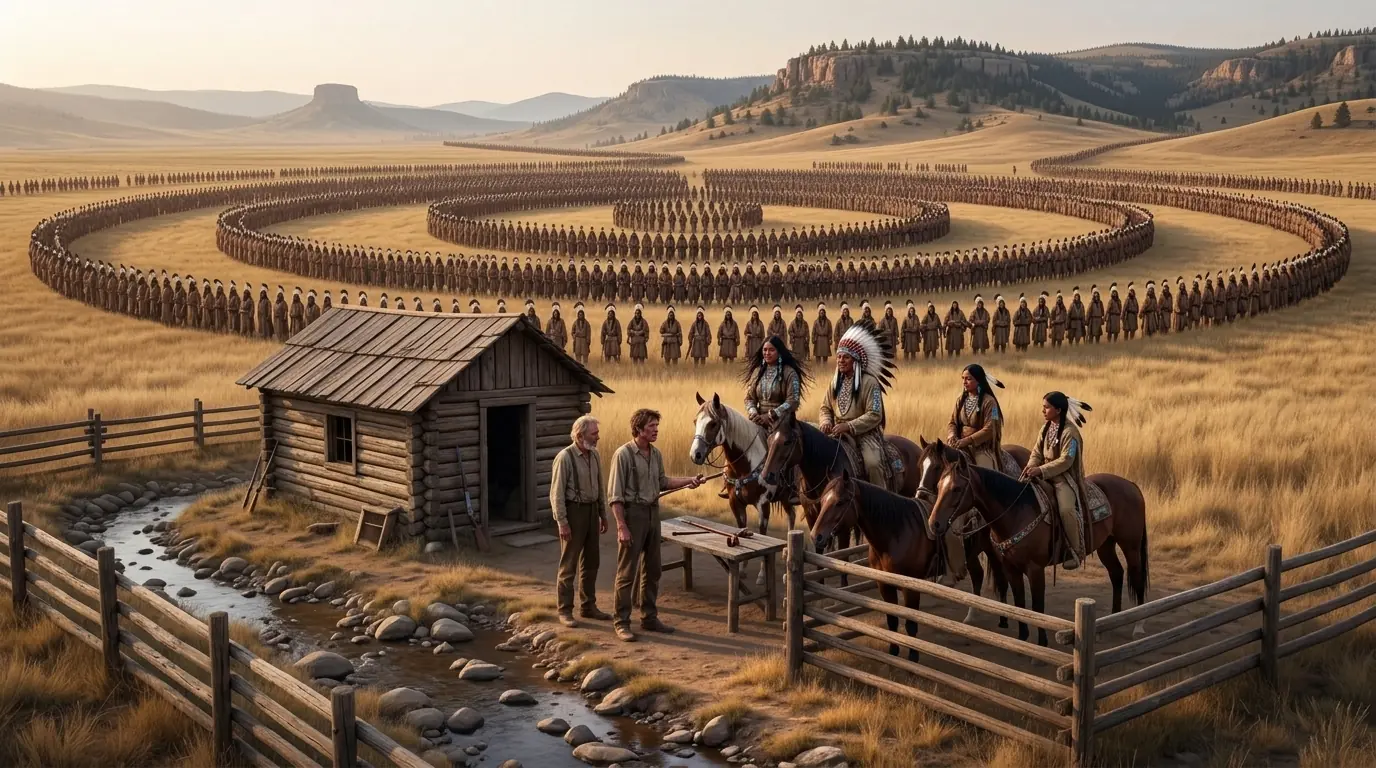
Not much of a harvest, but enough to get through another winter alone. He had been alone for three years now since cholera took Sarah and left him with nothing but 60 acres and a silence so deep it felt like drowning. He had chosen this isolation deliberately. No neighbors asking questions, no townspeople offering sympathy that felt like pity.
Just the land, the work, and the kind of quiet that let a man forget he was supposed to be part of something larger. The creek ran low this time of year, barely a trickle between rocks. David knelt to check the flow when he saw her. A woman collapsed in the tall grass 20 feet upstream, massive, even lying down.
Her deerskin dress was dark with sweat and blood. A gash across her temple had bled down the side of her face and dried black in the heat. Her lips were cracked white like sunbaked clay. Sioux, the beadwork on her dress made that clear.
David’s first instinct was to back away slowly, leave her there, pretend he’d never seen her. The territory was a powder keg, and helping an injured Sioux woman was the kind of thing that got white settlers killed, or worse, branded as sympathizers and driven out by their own people. But her chest rose and fell, barely. She was alive.
He thought of Sarah, how she’d always said a man’s character was measured by what he did when no one was watching. God knew no one was watching out here. David uncorked his canteen and knelt beside the woman. He lifted her head, careful with the wound, and poured water between her cracked lips.
She drank like the earth drinks rain, desperate, instinctive, necessary. Once, twice, three times. Her eyes opened, brown and fierce, even in weakness. They fixed on his face, studying him with an intensity that made his breath catch.
Not gratitude, not fear, just awareness, like she was memorizing every detail. Then her eyes closed again, unconscious. David looked at the woman, at the blood, at the miles of empty land surrounding him. He made his choice.
David carried her to the barn. She was heavy, solid muscle and bone, taller than any woman he’d ever seen. He laid her on clean hay in the corner stall, and brought water, clean rags, a blanket. Through the afternoon and into the night, he tended her fever, pressing cool cloths to her forehead, cleaning the wound as best he could.
She never fully woke, just murmured words in a language he didn’t understand. At dawn, she opened her eyes, sat up slowly, testing her strength. When she stood, David had to tilt his head back slightly to meet her gaze. She had to be six and a half feet tall, maybe more.
A lodgepole pine of a woman, Sarah would have said. He offered her his canteen and a cloth sack with bread and dried meat. She took both, studied his face one more time with those fierce brown eyes, then turned and walked out of the barn. No words, no acknowledgement, just that same measuring stare, like she’d decided something about him he wasn’t privy to.
David watched her disappear into the hills west of his property, swallowed by heat shimmer and distance. He told himself that was the end of it, went back to his work. But that night the horses were restless. He could hear them in the corral, shifting weight, blowing hard through their nostrils.
Once the bay mare let out a sharp whinny that cut through the dark like a warning. David sat up in bed, listening. Nothing followed, just wind and the distant call of something hunting in the hills. He lay back down, staring at the rough ceiling beams.
Tomorrow he’d check the north fence line. Tomorrow everything would go back to normal. He was still telling himself that when the sun rose. David stepped outside at first light, suspenders over his shoulders, squinting against the glare, the valley stretched out before him, scrub grass and rock formations dotting the landscape under a pale blue sky.
And then he saw them shadows on the ridgeline. But shadows didn’t sit on horseback. Shadows didn’t watch. He counted 10, then 20, then stopped counting.
They were just there surrounding his farm like a noose pulled tight. David’s hand moved toward the doorframe where his rifle leaned, then stopped. What good was one rifle against an army? David stepped into the yard, boots crunching on hard-packed dirt.
The horses in the corral were pressed against the far fence, heads high, nostrils flared. They could smell it. danger thick in the air like smoke. He scanned the ridges again, trying to understand what he was seeing.
This wasn’t a raid. Raiders moved fast, struck hard, disappeared. This was something else. This was deliberate, organized, a message written in flesh and steel.
But what message? His throat tightened. He thought about the woman, the water, the way she’d looked at him before walking into the hills. Movement caught his eye.
A single rider broke from the group on the northern ridge and began descending the slope. Slow, controlled, the horse picked its way down the rocky incline with precision that came from a rider born in the saddle. Behind him, a second rider appeared. Her. Even from this distance, her height was unmistakable.
She sat straight-backed on a painted horse, no longer fevered and broken, but dressed in clean deerskin, decorated with intricate beadwork. A necklace of turquoise and silver caught the morning light. They rode down together. The older warrior’s face was lined with years of sun and wind, and something harder, command.
He wore a war bonnet, eagle feathers marking him as a chief. Authority radiated from him like heat from stone. They stopped 50 feet from where David stood. The chief dismounted first, movements deliberate, almost ceremonial.
He walked forward 10 paces, stopped, waiting. David forced himself to breathe. This was a test. Had to be.
If they wanted him dead, he’d already be dead. They’d had all night. He stepped forward, matching the distance, 10 paces. then stopped. They stood facing each other across 50 feet of dusty ground.
The chief’s eyes were black and unreadable. Gray streaked his long hair. He carried no weapon in his hands, but a knife hung at his belt, and a rifle was strapped to his horse. David kept his hands visible at his sides.
The silence stretched out, thick and suffocating. Then the chief raised his hand and pointed, not at David, at the well. David’s stomach dropped. The chief lowered his hand and made a gesture, pouring water, drinking.
The meaning was clear. David nodded slowly. Yes, he’d given water to someone. The chief’s expression didn’t change, but something shifted in his posture.
He turned his head and called out in his own language, sharp, commanding. The woman rode forward, stopping 10 feet away, close enough that David could see her face clearly. She looked at him with that same measuring gaze. Then she spoke.
Her English was halting, but clear. You give water. It wasn’t a question. It was a statement, an acknowledgement. David nodded. Yes.
You not know who. Again, not a question. No, David said. You were hurt.
You needed help. Something flickered in her eyes, Surprise maybe, or respect. She turned to the old warrior and spoke rapidly in their language. He listened without expression, then responded with a single word.
The woman turned back to David. My father says you are brave or a fool. David’s throat went dry. Father, the old warrior was her father, which meant he was a chief, which meant this woman wasn’t just any Sioux.
She was the daughter of the man who commanded hundreds of warriors. I didn’t know, David said quietly. That is why you live, she replied. Her tone was flat, factual.
A man who knows tries to get a reward. You give water because a thirsty person needs water. That is different. The chief spoke again longer this time.
The woman listened then translated. My father is Mapia Luta, war captain under Red Cloud. I am Anape, his daughter. I did a test, walking alone four days.
No food, no water. Prove strong. Prove ready for my path. She paused. I fall, hit head, lost my way. Your water saved my life.
David felt the weight of 500 pairs of eyes on him. I’m glad you’re all right, he said. Anape tilted her head slightly, studying him. You are not afraid?
I’m terrified, David admitted. But shooting or running won’t change anything, so I’m standing here. For the first time, something almost like amusement touched her face. She spoke to her father again.
He nodded once, then his expression hardened. When he spoke, his voice carried authority that needed no translation. Anape’s face grew serious. We watch eight days.
See if you speak truth or lie. See if you run to Fort Pierre. See if you tell bluecoats where we are. See if you are a good man or just white man.
How long have you been watching? David asked. Since I left yesterday. My father follow me. See where I go.
See who helped. When I told him you gave water, asked nothing, and let me go free. He decide to test. David’s chest tightened.
They’d been out there all night watching while he slept. could have killed him a dozen times over. What happens if I fail? he asked. Anape’s expression didn’t change. You die.
Your farm burns. No one remember your name. And if I pass? She glanced at her father, then back at David.
We see first you must pass. The chief spoke one more time. Brief final. My father say, Most white men run to soldiers bring army. You run, you die, you stay, you wait, maybe you live.
Choice is yours. With that, they mounted their horses and rode back up the slope. The warriors on the ridges didn’t move. They settled into their positions like they had all the time in the world.
David stood alone in his yard as the sun climbed higher. He was a prisoner in his own home, and he had no idea if he’d survive the next eight days. The first three days blurred together like heat shimmer on the plains. David worked his farm because there was nothing else to do.
He fed the animals, checked the wheat, mended a section of fence that had come loose in the wind. Every action felt deliberate, performative, like he was an actor on a stage he hadn’t auditioned for. And they watched, always watching. At dawn, warriors lined the eastern ridges, silhouettes against the rising sun.
At noon, smoke rose from camps on the northern bluffs where they cooked meals and rested horses. At dusk, fires dotted the hillsides like scattered stars close enough that David could smell burning wood carried on the wind. They rotated positions. Fresh warriors replacing tired ones.
A system organized, efficient. This wasn’t improvised. This was military discipline applied to a test he still didn’t fully understand. Sleep became impossible.
David lay in bed with his rifle across his chest, staring at darkness, listening to every sound. The creek of the barn door, wind rattling the shutters, his horses shifting in the corral, nervous and alert even in the dead of night. On the fourth morning, he found something by his front door. A bundle wrapped in deerskin tied with sinew.
Inside, strips of dried buffalo meat, dark and leathery. A clay jar filled with water sealed with beeswax. No note, no explanation. David crouched in his doorway, turning the jar in his hands.
Were they feeding him out of respect or keeping him alive long enough to complete their test? The meat was good, rich and salty. He ate it slowly, chewing each piece until it softened, watching the ridge lines for movement. On the fifth day, Anape rode down alone.
She didn’t dismount, just sat on her painted horse 20 feet from his porch, studying him with those fierce brown eyes that saw too much. You could run, she said. Her English was better now, more confident at night. Take horse. Try escape. David set down the bucket he’d been carrying.
Am I trying?, he said. No thanks. Something shifted in her expression. Not quite approval, more like recognition. You smart, she said.
Most men choose pride over life. You choose life with honor. That is different. She rode away without another word, leaving David standing in his yard, wondering if he’d just pass some invisible test within the larger test.
Day six arrived with brutal heat. David talked to his horses just to hear a voice, even if it was his own. The isolation was wearing on him in ways he hadn’t expected. He had chosen solitude after Sarah died.
craved it even. But this was different. This was being alone while surrounded, watched, judged. He began to understand.
The test wasn’t about fear. It was about character, about who he was when consequences loomed large enough to crush him. Day seven dawned clear and bright. One day left, David allowed himself to think he might actually survive.
Then he heard the bugles. The dust cloud appeared first, and the sound of hooves hardened fast. 40 soldiers riding in formation. Guidance snapping in the wind. U. S.
cavalry from Fort Pierre. Blue uniforms dark with sweat. Rifles across their saddles. They rode straight into David’s yard like they owned it.
The officer leading them was tall and lean with a face carved from stone and eyes that had seen too much killing. Captain Josiah Kellogg. David had seen him once in Deadwood buying supplies. the kind of man who gave orders expecting them to be followed without question.
Kellogg raised his fist. The column halted, horses blowing hard, foam on their bits. Graham, Kellogg said. Not a greeting. An accusation.
David stood on his porch, hands visible, rifle leaning against the door frame six feet away. Too far to reach, close enough to be a statement. Captain, David said. A younger officer, barely old enough to shave, rode forward.
Lieutenant Burch, his insignia said. He pointed at the ground. Tracks everywhere, sir. Unshot horses. Dozens of them. Maybe hundreds.
Kellogg’s jaw tightened. He turned his gaze back to David. You’ve been harboring hostiles, Graham. That’s treason. I gave water to an injured woman, David said. That’s all.
An Indian woman. Lieutenant Burch spat the words like they tasted rotten. You brought a savage into your home. David didn’t answer.
Didn’t need to. A scout rode up from the barn holding something. Beaded moccasins. Small enough to be a child’s ornate enough to be ceremonial. Found these near the stall, Captain. Fresh.
They’ve been here recently. Kellogg dismounted, walked toward David with the deliberate steps a man used to violence. He pulled a folded map from his coat and shook it open. Where did they go, Graham?
North to the Black Hills. West to the Badlands. David met his eyes. I don’t know. You’re lying.
Kellogg’s voice dropped low. Dangerous. You know exactly where they are. Tell me now or I’ll have you arrested for treason and hang you before sunset. The truth sat in David’s throat like a stone.
He knew exactly where they were. Still surrounding the farm, hidden in a wheat field behind the barn in the tree line. Watching this exact moment. One word would send these soldiers riding into an ambush.
40 men versus 500 warriors on terrain they knew like breathing. Slaughter. I gave water to a dying person, David said quietly. That’s all I know. The scout’s voice cut through the tension.
Captain, fresh tracks leading to the northern bluffs. They’re close right now. Kellogg’s face went hard. He started to give the order.
David spoke first. I know that 500 warriors have been watching this farm for seven days, he said. Without firing a single shot. That tells me their intentions. Kellogg froze.
500 at least. The captain’s face went pale. He turned, scanning the ridges with new eyes. That’s when the war cries started from every direction at once.
North, south, east, west. The sound rolled across the valley like thunder and warriors rose from hiding from the wheat field from behind rocks from the tree line. Dozens of them, no, hundreds all armed, all watching. Kellogg’s hand went to his sidearm, then stopped.
The mathematics were simple and brutal. 40 men versus 500 warriors on their own terrain. Mount up. Kellogg’s voice cracked like a whip. Now move. The cavalry wheeled their horses.
formation breaking into controlled panic. As they thundered past, Kellogg leaned from his saddle, face twisted with rage. You just chose your side, Graham. You’re a dead man.
Then they were gone, dust rising behind them like a funeral shroud. David stood alone in his yard as the dust settled. The warriors remained visible on every ridge for one hour. A reminder, a statement.
Then they faded back into the land like smoke. The test was over. Evening came with long shadows. Chief Mapia Luta rode down from the northern ridge with Anape and three tribal elders.
They dismounted and walked straight to David’s cabin. No hesitation, no request for permission. David opened the door and stepped aside. They entered in silence.
The chief’s presence filled the small space, making the rough wooden walls feel temporary, insignificant. He stood in the center of the room, eyes moving across the simple furniture, the cold fireplace, the photograph of Sarah on the mantle. Then he spoke, long sentences in Lakota, his voice carrying the weight of judgment. Anape translated, You pass test.
You did not tell the bluecoats. You risk everything for honor. The chief unwrapped a bundle he’d been carrying. Inside, a pipe carved from red catlinite.
intricate designs running along its stem. Beside it, a beaded vest marked with geometric patterns in blue and white and yellow. His band’s colors. You wear these. Anape continued.
Every Sioux warrior will know you. No one will harm you. No raiding party will take from you. You are with Chasa Oana, híŋhaŋ tiospaye man.
David stared at the objects. Sacred items. A declaration. Anape’s tone shifted. But white men see these. They know you choose us over them.
They call you traitor. Indian lover. Maybe they will kill you. The chief spoke again. Shorter this time. Final.
You cannot walk two paths. Anape said, Must choose. We offer protection but cost you everything white men give. You become alone among your people.
David thought of Sarah’s grave out past the wheat field. The settlers in Deadwood who already viewed him with suspicion. Captain Kellogg’s rage still echoing in the air, but he also remembered Anape’s cracked lips. The moment he poured water, 500 warriors choosing observation over violence.
My wife said, A man’s character is what he does when no one’s watching, David said quietly. But I’ve had 500 watching me for a week. Reckon I showed what I am. He picked up the beaded vest.
Put on the weight of it settled across his shoulders like a new skin. He took the pipe. Sacred, irreversible. I choose to live like a human being, he said, If that makes me an enemy to my own people, maybe I was on the wrong side all along. Chief Mapia Luta stepped forward, placed his hand on David’s shoulder.
The grip was brief, powerful. He spoke one English word. Learned from traders over decades of conflict and negotiation. Brother, the elders nodded.
One by one, they filed out into the darkening evening. Anape was last. She paused at the door, looking back at David in his new vest, the pipe held carefully in both hands. You very brave, she said.
We’re very stupid. Maybe both, David replied. She almost smiled. Then she was gone, riding up into the hills with her father and the elders.
The warriors followed, disappearing into the landscape like they’d never been there at all. David stood alone in his doorway, wearing colors that would mark him as a traitor to everyone he’d ever known. He’d crossed a line he could never uncross. And he’d done it with his eyes open.
David gave water to a stranger and lost everything his people offered, but gained something rarer than acceptance. Three weeks later, David was in the wheat field when he heard the horses. He straightened, hand moving instinctively to the rifle leaning against the fence post. Then he saw who it was.
Two young Sioux warriors, maybe 18 or 19 years old, leading a pack horse with an elk carcass tied across its back. They rode to the edge of his property, stopped. One of them gestured at the elk, then at David. No words, just the offering.
David nodded his thanks. They turned and rode away. It had been happening twice a week now. Elk, deer once, always fresh, always left without conversation.
David butchered what he could use, smoked the rest. His small root cellar was fuller than it had been in three years. The beaded vest hung on a peg inside his cabin, but he wore it whenever he worked outside. a signal, a declaration.
The sacred pipe stayed wrapped in deerskin, brought out only when Anape visited. She came every few days now, sometimes with news from her father, sometimes just to help with heavy work, splitting logs, repairing the barn roof, hauling water. She taught him Lakota words while they worked. Simple things: water, sky, wheat, horse, brother, your farm safe, she said one afternoon, handing him a wooden bucket.
Other homesteads hit last week. Three burned. Families run to Fort Pierre. David had heard. Word traveled even to isolated farms carried by wind and rumor and the occasional trader passing through who’d still do business with him.
The raids are getting worse. Desperate, the Sioux were being pushed into smaller and smaller territories. Hunting grounds carved up by fences and settlements. Why mine?
David asked, though he knew the answer. Anape pointed at the vest hanging inside his cabin, visible through the open door. You wear our colors. You are protected.
My father’s word is law among the bands that ride here. David had started to understand, really understand. This land had been theirs. Taken by treaties written on paper they couldn’t read.
Enforced by soldiers they couldn’t defeat. Every fence was a violation. Every homestead was theft. He wasn’t innocent just because he’d been kind once.
But he was trying to be better than blind. Word is spreading, Anape said, her tone shifting. In white settlements. They talk about Indian lover near Cheyenne River.
Dangerous men talk in Deadwood. Men who lose family to Sioux. They look for someone to blame. David drove the axe into the chopping block.
I made my choice. I’ll stand by it. Choice and dying are not always different things. Anapee said quietly.
That afternoon, David was stacking firewood when he saw it. Dust rising from the south. Multiple riders moving fast. Not cavalry this time. Something worse.
Twelve riders came hard and fast, spreading out as they entered his yard. Prospectors, ranchers, settlers, the kind of men whose faces have been carved hard by loss and anger. They wore trail dust like armor and carried rifles like extensions of their arms. The man leading them was older, maybe 50, with a beard gone gray and eyes that had stopped seeing anything but revenge.
Jud Holcombb, David recognized him from Deadwood. His son had died in a Sioux raid two years back. Killed trying to defend a wagon train near Slim Buttes. Holcombb’s eyes locked onto the beaded vest visible through David’s open cabin door.
His jaw clenched so hard David could hear teeth grinding. We heard about you, Graham. Holcombb’s voice was gravel and broken glass. Heard you’re wearing Indian colors.
Heard you let a war party walk right past our cavalry. David stood his ground. I didn’t let anyone do anything. I made a choice not to start a massacre.
A younger man, barely 20, lean and wired with rage, spat in the dirt. My brother died at Slim Buttes. Those warriors you protected might have killed him. You’re a traitor to your race. Pritchard.
David remembered the name from conversations in town. The kid’s brother had been a soldier. Holcombb reached behind his saddle and pulled out a coiled rope. A noose already tied at one end, the knot thick and efficient.
He let it hang from his fist like a promise. One chance, Holcombb said. Take off that vest. Denounce the Sioux.
Come back with us. Face proper justice or hang right here. David’s hands stayed at his sides. Steady. This is my land.
My wife’s buried here. I’m not apologizing for showing human decency to another human being. Then you’ll hang from that cottonwood. Holcombb pointed at the tree near the well.
Die wearing their color since you love them so much. The vigilantes dismounted, slow, deliberate, boots hitting dirt with finality. They spread out, hands on weapons, forming a loose circle. David didn’t run, didn’t beg, just stood there, hand resting on a sacred pipe at his belt.
The war cry cut through the tension like a blade through silk. Warriors rose from the wheat field where they’d been lying flat. 30 of them painted for war, rifles aimed in ae among them, standing tall, her face hard as stone. More warriors appeared on the barn roof.
In a tree line behind the well, the vigilantes horses screamed and reared, sensing the trap they’d ridden into. Anapee rode forward, stopping her horse between David and Holcombb. Her rifle lay across her saddle, casual but ready. You leave, she said.
Now where you die here. Holcombb’s hand shook on his rifle. Rage fighting survival instinct. This doesn’t concern you.
He saved my life. Anape’s voice carried no emotion, just fact. Now I save his. That is how honor works.
David stepped forward, stood beside her horse, looking directly at Holcombb. Nobody dies today. You want justice for your son? I understand. But killing me won’t bring him back.
This fight just creates more widows, more orphans. The mathematics were brutal and simple. 12 men surrounded by 50 warriors. Maybe more hidden.
The vigilantes could see it in each other’s faces. The moment they pulled triggers, they’d all die. Holcombb’s face twisted. You’re a traitor, Graham.
His voice cracked. Not anger anymore. Despair. Maybe I am, David said quietly. But I’m a living traitor on my own land.
You want to hang me, you go through them first. You know how that ends. The standoff stretched. Wind moved through the wheat.
Someone’s horse stamped nervously. Hulk spat in the dirt. Pronounced judgment like he was speaking at a funeral. You’re dead to us.
Dead to every white settlement from here to Fort Pierre. Don’t come to Deadwood, Rapid City, anywhere. You’re alone. I know, David said. They mounted up, left a rope coiled in the dirt like a shed skin, rode out slowly, dignity barely intact, knowing they’d come to kill, and left empty-handed.
The warriors remained visible until the dust settled on the horizon. Anape turned to David. You should have let us kill them. They will come back.
Maybe, David said. But not today. Maybe enough people choosing not to kill means eventual peace. Anapee studied him like he was a puzzle with missing pieces.
You are a very strange white man. Autumn came to Dakota Territory with the smell of snow in the air. David harvested the last of his wheat alone. Working methodically, the beaded vest under his coat for warmth, the sacred pipe visible on his belt where he always kept it now.
The isolation was complete. No settler would trade with him. The general store in Deadwood had turned him away at gunpoint. Letters he’d sent to his brother in Missouri came back unopened.
Marked returned as sender traitor. His name was spoken with contempt in every white settlement from Fort Pierre to Rapid City, but his farm stood untouched while others burned. When a section of fence collapsed in early October, he woke to find it repaired. Posts reset deep and solid.
Sioux warriors had come in the night, fixed it without being asked, and disappeared before dawn. When the first heavy snow threatened the remaining wheat, Anape arrived with a dozen helpers. They worked fast and efficient, bringing in the harvest in half the time it would have taken David alone. They shared a meal afterward, dried venison, cornbread David had made, strong coffee.
The warriors spoke in Lakota, and David understood enough now to follow the conversation. stories about hunting, about the old days, about land that was supposed to be theirs forever. The cost of his choice was visible everywhere. Empty spaces where friendships used to be.
Silence where conversation should have filled the air. Letters that would never be answered. But the reward was quieter, deeper. He slept peacefully now.
No guilt gnawing at him in the dark. No shame when he looked at Sarah’s grave. He had chosen principle over prejudice. and whatever loneliness followed was a price he could pay.
The first real snow fell on a gray November afternoon. Heavy, relentless, covering the world in white. David sat on his porch, watching it come down, covering the wheat field Sarah had loved, smoothing out the rough edges of the land. Hoofbeats approached through the snow.
Anape rode up alone, dismounted, walked to the porch steps. My father asked, You have regret? David thought about it. really thought Sarah’s grave under new snow.
The wheat safely stored. The beaded vest that marked him as other to his own people. The pipe that meant he’d chosen a different path. No regrets, he said.
I did what was right. I’d do it again. White men think you traitor. Sioux think you are strange.
Where do you belong? David pointed at his farm at the land stretching toward the Black Hills in the distance. All of it covered in clean white snow. Right here where I’ve always belonged.
Anape nodded slowly. My father says sometimes the bravest warrior is one who fights without a weapon. You fight with water and kindness. That is harder than fighting with a rifle.
She mounted her horse and rode off into the falling snow. Disappearing into the white landscape like a memory fading. David went back to his chores. Splitting wood, feeding animals, simple, honest work.
The valley stretched silent under white sky. No armies watching, no vigilantes hunting, just land and peace earned through choice. He stood in his wheat field as snow accumulated on his shoulders. The beaded vest was visible beneath his open coat.
The sacred pipe hung at his belt. He was utterly alone among white society, but he was at peace with himself. It wasn’t the life he’d planned when Sarah was alive, but it was an honest one. And in Dakota Territory consumed by violence and fear, honesty was worth more than belonging.
David gave water to a dying woman and it cost him everything except his soul.