In the spring of 1883, people throughout Greenville, Maine, watched a widow do something that made no sense. Vera Aldous was planting orchids against her cabin. Not near the cabin, against it. The roots went into the soil only inches from the foundation logs, forming a deliberate unbroken ring around the entire structure.
North wall, east wall, south wall, every side. At first, most people assumed she was filling the silence left behind by a dead husband with something living and bright. That was the kind of thing widows sometimes did when a house grew too quiet. But the planting continued.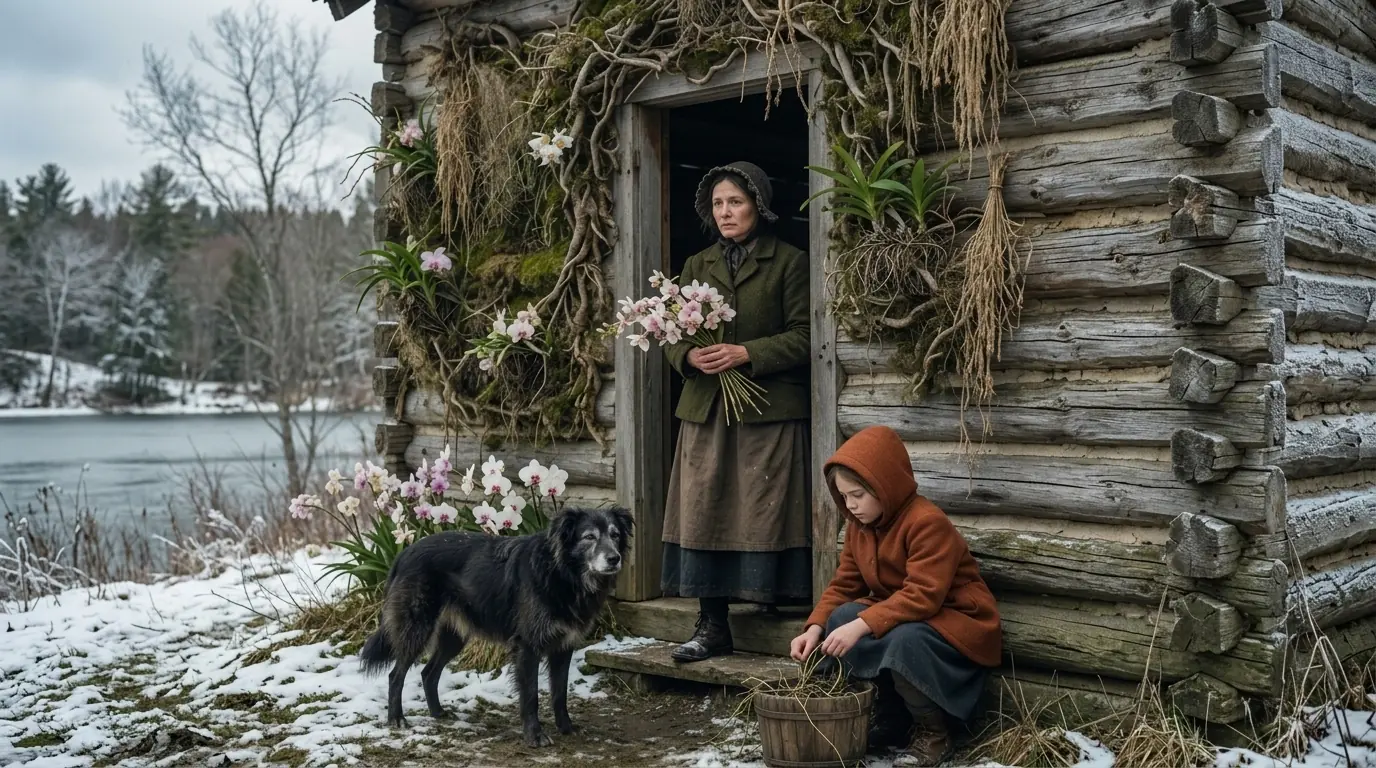
Her 8-year-old daughter, Nell, followed close behind each morning carrying a small wooden bucket packed with native orchid root cuttings harvested from the bog edges at the south end of Moosehead Lake. An old black dog named Soot stretched across the porch steps watching them both with the slow patience of something that had seen everything. By the end of the first week, the entire perimeter of the Aldous cabin sat embedded with young orchid roots, each one pressed carefully into the dirt at almost identical depth. That was when people began paying real attention.
Fletcher Crowe noticed first. The timber hauler had passed the Aldous property three days running, and each time the widow was in the same position, moving without hurry and without explanation. On the fourth morning, he stopped his team at the fence line. What are the orchids for?
Vera pressed one more root into the soil before she looked up. For the cabin, she said. Nothing else. Fletcher stared at the logs, then at the flowers, then back at Vera. The answer explained nothing at all.
But in a town this size, nothing was already enough to set people talking. The talk reached the logging camp before it reached the church. By the second week of May, Vera Aldous and her orchids had become the most discussed subject in Greenville. The conversations varied by location.
At Oakes Brothers Supply, where Bernard Oakes kept the winter credit accounts and kept a mental register of every household standing, the matter was treated as evidence of poor judgment. Bernard had extended credit to the Aldous family the previous winter when the timber work dried up. He took a personal interest in how the widow chose to spend her daylight hours. Decorating, he said to a group of men waiting on a lumber order.
The woman is decorating while her wood pile sits half empty. The remark drew agreement from several directions. Arthur Drum was among those who heard it. Drum had spent 15 years building and repairing structures across the Maine interior, from Moosehead south to Skowhegan.
He had replaced rotted sills, reset foundations, and rebuilt wall sections that bad decisions had destroyed over a single winter. When a man had spent that much time correcting other people’s mistakes, he developed opinions quickly. When he heard about the orchid ring, his first response was the one most experienced men default to when they see something unfamiliar being done with confidence. He rode out to look.
The stems sat close, very close, pressed tight against the logs with the soil packed firmly around each root. He said nothing that afternoon, but he told Gordon Fenn later that week that the widow was going to regret every inch of it before the first snow fell. Gordon Fenn owned the property to the north of the Aldous land, a modest farm with a small herd and a barn that survived three brutal Maine winters by what he privately considered to be the narrowest of margins. He had watched the planting from a distance and reached the same general conclusion as Drum, but he had also noticed something the carpenter had not.
Every morning, without exception, Vera was out before full light. Whatever she was doing, she was doing it the way people did things when they were following a plan rather than acting on feeling. Gordon kept that observation to himself. The orchids kept growing.
Very little was known about Vera Aldous before she arrived in Greenville. She had come north six years earlier with her husband Edmund Aldous, a quiet man who worked timber in the winter and kept a small garden in the summer and said almost nothing to anyone beyond what the work required. Edmund died in January of 1881. He had gone out in a whiteout to check on a sick animal and had not returned.
Search parties found him two days later, half a mile from the barn. The frost had finished what the storm had started. After that, Vera stayed. She worked the property alone, took in mending during the slow months, and raised Nell with the same economy of movement she applied to everything else.
She asked very little from the community. She gave it no particular reason to think about her. Until the orchids. The idea had not begun in Maine.
Years before she married Edmund, when she was still young and working in a household near Bangor, she had spent a summer with Edmund’s grandmother, a Finnish woman named Aino, who had come to Maine as part of a small settlement that pushed north of Millinocket in the 1860s. Aino worked with her hands the way other people breathed, without pausing to think about it, without stopping to explain it. She spoke about plants the way experienced farmers spoke about soil, as something with practical character, not merely color. One summer evening, while they were working together along the outer wall of Aino’s cabin, the old woman paused and pressed her palm flat against the logs.
Cold finds the outside first, she said. Give it something else to find before it reaches the wood. At the time, Vera filed the words away with the other things old women said, sayings that sounded like folklore when you were young and had not yet seen a winter that tested everything you believed you knew. She had seen several since.
Standing in Greenville in the spring of 1883, with the wind off Moosehead still carrying a sharp edge even in May, she understood precisely what Aino had been describing. Not decoration, not custom, but a system, one that had already survived more Maine winters than most people in Greenville had birthdays. Outside, Nell carried another bucket to the south wall. Soot followed at his own pace.
The orchids kept going in. By midsummer, the orchids had grown. What had begun as a modest ring of pressed roots in May had become something that stopped wagons on the Greenville road. Native bog orchids were not known for dramatic height, but Vera had selected her cuttings with care.
She had worked with several species, pink lady’s slippers from the bog margins, white bog orchids from the shadowed edge of the spruce stand, and the results were unlike anything the valley had seen planted against a working cabin. The plants grew dense and upright along every wall, their stems crowding together in a long living border that reached past Nell’s shoulder by mid-July. People found it difficult not to stare. Bernard Oakes made a formal inspection on a Tuesday in late July.
He rode up the property road, surveyed the bloom for a long moment, then turned to the man riding beside him, a mill foreman named Dex Rigby, and said something that both of them found considerably funnier than it was. She grew herself a garden fence, Dex. Rigby laughed. A few men nearby caught the edge of it and assumed they were sharing something worth repeating, so they repeated it. By afternoon, someone at the sawmill had given it a name, the orchid widow’s fence.
By evening, the name had permanently attached itself to the Aldous property, and Vera heard it the following morning on her way to the lake. She heard it, so did Nell. Neither reacted. The summer wore on the way Maine summers do, arriving late, burning bright, and ending before anyone was prepared. The days shortened without asking permission.
The orchid stems hardened as the season advanced, their softness replaced by something rigid and fibrous. August brought the first cool mornings, the kind that took until noon to shake off, and the older men who sat outside the trading post began watching the northern sky in the way they always did when their joints started delivering information their eyes hadn’t confirmed yet. Inside the Aldous cabin, meanwhile, a new habit had appeared. A small ledger sat on the table near the window.
Every week Vera recorded entries in a neat careful hand. Morning temperature, evening temperature, how much firewood the stove had consumed, how often the fire had needed tending in the night. Simple columns of simple figures. Most people in Greenville did not measure winter.
They endured it. The idea of writing numbers in a book while the cold pressed against your walls struck most men as roughly useless as arguing with the weather itself. But the ledger kept filling page after page, week after week. September arrived in Greenville the way it always did without asking permission.
One morning the ferns were still green. By the following week they were copper and brown at the edges and carrying that particular smell the Maine woods produce just before the first freeze. A smell of damp earth and ending. The orchid plants shifted, too.
Their flowers had long since dropped. What remained standing against the cabin walls were dry stiff stems. Their color drained from green to pale gold to something close to straw hardening day by day in the cooling air. For most families in the valley the season meant pulling in.
Firewood stacked and restacked. Root cellars sealed against the freeze. Windows re-chinked where last winter had quietly opened gaps too small to see until the cold found them. For Vera Aldous, a different kind of work was only beginning.
She harvested part of the seed crop first, pressing dried flower heads carefully into paper envelopes and storing them inside a tin box on the highest shelf of the cabin. The seeds had a purpose. What remained standing against the walls had an entirely different one. Over the following weeks, something strange began happening to the Aldous cabin.
It started to disappear. Dried orchid stalks were bundled into groups and secured with lengths of cord. The thicker stems went against the logs first, pressed flat and tied at regular intervals with the kind of deliberate repeated knots that only come from someone who has rehearsed the plan long before starting it. Smaller stalks filled the gaps between them.
Dried seed pods were woven horizontally, like stitching running through a heavy coat. Where cord alone could not hold the structure steady, Nell gripped sections in place while Vera secured them. The two of them worked in the efficient quiet of people who had spent enough time together to share a task without speaking it aloud. Soot moved from station to station around the cabin as though conducting his own inspection.
By mid-October, the north wall had almost ceased to exist as a visible thing. A dense, layered skin of dried plant matter had swallowed it entirely. The color had gone silver and pale gray in places where the material had dried out fully. From the road, the cabin no longer quite looked like a cabin.
It looked like something in the process of becoming part of the forest pressing in around it. Gordon Fenn noticed from his barn door one evening. He stood watching the last light fall across the wrapped structure for a long time. He still wasn’t certain it made sense, but he was becoming less certain about the part where it didn’t.
The trouble arrived on a Thursday in mid-October, as trouble often did, quietly and from the direction nobody was watching. Nell was working along the base of the eastern wall when she stopped, set her armload of stalks down, and called for her mother without raising her voice. Mice. A small nest had established itself in the first layer of dried material tucked into a warm, dark space between two bundles of orchid stems about 18 inches from the ground. The discovery was not entirely unexpected.
Mice were a permanent feature of Maine winters, and enclosed dry spaces with organic material were precisely what they sought before the hard freeze arrived. What made this one significant was the timing. The outer layer was not even finished, and the inhabitants had already arrived. Arthur Drum heard about it before nightfall.
He rode out the following afternoon, arriving while Vera was already pulling sections of the outer layer apart to expose and clear the nesting areas. Hours of completed work were coming undone in the flat, cold October light. Drum watched for a moment before he spoke. I told you, he said.
Vera kept working. The carpenter dismounted, rested one hand on the saddle horn, and looked over the exposed wall. He had built structures throughout the Maine interior for 15 years, and spoke about wood the way surgeons spoke about bone. He understood failure.
He genuinely believed, based on everything he had seen rot and collapse in this country, that what Vera was doing would hold moisture against the foundation logs, provide permanent cover for rodents, and achieve nothing useful before spring undid it all. He meant every word of it. That was what made him difficult to dismiss. Moisture gets in and stays in, he said.
Rot follows, then the mice make it permanent. Vera pulled the last compromised bundle free. She studied the exposed section for a moment, then she walked to the barn and returned carrying two armloads of dried sweetgrass and spruce boughs gathered from the high ridge above the lake. She packed them into the vulnerable sections with attention focused on the foundation gaps where rodents preferred to travel.
The result came quickly. Within a week, signs of nesting were difficult to locate. A week after that, they were gone entirely. Drum heard about that, too.
He said nothing, but he rode past the cabin twice the following week without stopping to look, which was in its own way a kind of attention. The wrapping resumed. Every replaced section was built more carefully than the one removed. Several came back stronger than before the damage.
By the first week of November, the Aldous cabin had completed its transformation. What stood on the South Road of Greenville was no longer recognizable as an ordinary Maine homestead from any reasonable distance. The orchid skin covered the structure from foundation to eaves, running between 30 and 36 inches thick in most places. The dried material had been packed firmly enough to hold through ordinary weather, but loosely enough to preserve the thousands of small air pockets distributed throughout its mass.
That was the detail the neighbors had missed entirely when they stood at the fence line shaking their heads all summer. Vera had not been building a solid wall. Solid material conducted cold. Still, trapped air resisted it.
Every stem, every dried seed pod, every layered piece of dead plant matter was part of a system designed to intercept the wind before the wind reached the wood. Only the chimney stood fully exposed. The door had a narrow passage. Two small windows remained barely visible behind the outer layers.
Everything else had been swallowed. That was when Silas Merl came. Merl was not easy to place in the social order of Greenville. He kept to himself on a tract of land above the lake that nobody else had wanted.
And he spent more time watching the sky than most men spent doing anything useful, or so the common opinion had it. He was not a preacher or a doctor. He was simply a man who had paid close, sustained attention to Maine weather for 40 years, and who had been right often enough that people listened even when they would have preferred not to. He arrived without announcement on a gray November morning, dismounted at the gate, and walked a slow, unhurried circle around the entire structure.
He pressed his palm flat against the outer layer in several places, testing thickness. He examined the bindings at the corners. He looked at the way the material sat away from the logs beneath, creating a narrow gap of still air between the orchid skin and the wood. He did not laugh.
He did not ask his question as a joke. Who showed you this? My husband’s grandmother, Vera said. She was Finnish, from up north of Millinocket.
Merl nodded once. He stood a moment longer, his gaze moving toward the tree line above the north shore of the lake. The sky above the spruce ridge had the particular color of a storm that was not yet a storm, flat and low and holding its shape with unusual patience. He climbed back into the saddle without another word.
He did not look back. But a man who had read Maine winters for 40 years had just walked the orchid wall’s full perimeter without laughing, and that silence in Greenville in November of 1883 carried a weight that took a while to settle. December 7, 1883 began with a silence that every long-time Maine resident knew better than to trust. Moosehead Lake was flat and dark.
The air carried a smell of iron. The sound that usually lived in the upper spruce canopy, the constant low conversation of wind through the branches, was entirely absent. The forest was holding its breath. By late morning, a pale flat gray had sealed the northern sky and was pressing south without hurry.
By noon, the temperature had dropped 24 degrees in fewer than four hours. By mid-afternoon, the blizzard had arrived. It came out of the north with the kind of force that did not announce itself incrementally. It appeared at full strength as though assembled somewhere beyond the mountains and released all at once.
Wind drove at 60 mph through the Greenville Valley. Gusts pushed well past 70. Snow did not fall. It drove sideways across the open country in white sheets so dense that the far end of a barn became invisible from its own doorway.
Fence lines disappeared first, then the road, then the lake entirely swallowed by white. Fletcher Crowe lost two outbuilding doors within the first hour. A section of Bernard Oak’s supply roof peeled back against its own timbers with a sound like a rifle shot. Livestock yards across the valley turned to shapes in the white, and men who went out for firewood returned with frost on their eyelashes and a new understanding of what they were up against.
At Gordon Fenn’s cabin, the night became a sustained battle. The wind found weaknesses that three previous winters had left undisturbed. It pushed through a gap where the door frame had settled. It entered through old chinking on the north wall that summer heat had shrunk past usefulness.
By midnight, frost had formed along the interior face of the north logs. Thin white lines appeared first, spreading. Gordon fed the stove without pause. The thermometer reached 42 degrees and held there, refusing to move further.
His wood reserve shrank at a rate that made him count the remaining hours until dawn and compare them carefully to the logs stacked against the wall. Three hundred yards south, a different accounting was in progress. The blizzard struck the orchid wall at its full force. Outside, the sound was enormous.
Inside the Aldous cabin, it arrived reduced, stripped of its sharpest edges, as though the storm were occurring just beyond a heavy curtain rather than directly against the structure itself. Soot lay beside the stove with one ear folded over his face. Nell sat at the table in the lamplight turning pages without urgency. The thermometer read 61 degrees.
The stove operated at its ordinary pace. No additional wood was required. No adjustments were needed. Vera opened the ledger and made another entry.
Temperature, wood consumed, time. The same columns she had been filling since summer. The storm released Greenville on the morning of December 9. The silence that followed was the particular kind that arrives after two days of sustained noise, disorienting in its completeness, as though the world needed a moment to remember what quiet sounded like.
Drifts were shoulder-high in places. The road had ceased to exist as a recognizable thing. The trees along the lake edge were encased in ice on every branch, and the sound of them shifting in the aftermath breeze carried across the valley like the slow cracking of glass. Gordon Fenn spent 40 minutes digging his front door free from the drift packed solidly against the outside.
When it finally opened, the world beyond it was white in every direction. His wood pile was nearly exhausted. His livestock had survived, barely. Three sections of fence had simply vanished.
New cracks ran along the north wall of his cabin where old chinking had surrendered under sustained pressure. He was alive. Everything else fell into the category of damage that would take the rest of the winter to assess and the spring to repair. After seeing to the animals, something made him walk south down the road.
He told himself afterward that he expected to find wreckage. The orchid wall had looked fragile from the fence line all summer. Two full days of 70-mph wind should have scattered it from one end of the property to the other. That was the logical outcome, and Gordon Fenn considered himself a logical man.
The Aldous cabin came into view through the tree line. He stopped walking. The structure was still wrapped. The outer surface had taken punishment.
Stalks had stripped away near the upper sections. Ice had locked the remaining material into something rigid, almost geological. From where he stood, it looked less like a building than a mound rising from the white valley floor. But from the chimney, a thin ribbon of smoke rose into the pale winter sky.
Not the heavy, desperate smoke of a stove burning everything available to hold back the cold. Steady smoke, quiet, sufficient. Gordon reached the door and knocked. Warm air reached him before Vera had it fully open.
Inside, Nell was eating. Soot slept beside the stove without a care in the world. The thermometer read 59 degrees, the wood pile showed two ordinary days of use. The ledger lay open on the table, the same neat columns, the same steady handwriting as calm at the end of the blizzard as it had been the morning before the first flake fell.
Gordon looked at the thermometer, then the wood pile, then the ledger, then Vera. She handed it to him without a word. He followed the numbers through both days of the storm. His own household had burned nearly twice the fuel and held more than 20 degrees less warmth throughout the worst hours.
The record sat in ink, line by line, requiring no interpretation, no argument, no voice. He set the ledger down. I was wrong, he said. He did not say it loudly.
He did not need to. That spring, Gordon Fenn planted orchids against his own cabin walls. He did not explain himself to anyone. He simply did it.
The following summer, three other families followed. The year after that, there were six. The practice spread the way most genuinely useful things spread across frontier country, not through persuasion, but through unmistakable evidence that it worked. Arthur Drum never admitted his concerns had been entirely wrong.
Several of them had not. Instead, the carpenter studied the system the way good craftsmen study anything that holds under pressure. He developed better methods for securing the bundles, improved the spacing, refined the approach to airflow. The work improved.
His name quietly became associated with it. Bernard Oakes stopped making jokes on the subject, which was often what happened in Greenville when an idea stopped being a source of amusement and started being something people depended on to survive the winter. Silas Merl said nothing more. He had said enough on that gray November morning when he walked the perimeter and asked one question and listened to the answer without laughing.
Edmund Aldous’s coat still hung behind the door. Nobody moved it. Outside, every summer brought orchids. Not as decoration, never as decoration, as memory, as method, as the quiet enduring record of a woman who understood something her neighbors couldn’t see until winter arrived and made it visible to everyone.
The strongest protection is not always the one that looks the strongest. Sometimes wisdom arrives wrapped in something most people walk past without a second glance. Sometimes it looks like a field of flowers pressed against a cabin wall. And sometimes the only opinion that truly matters is the seasons.