She stepped off the chartered King Air like the tarmac owed her an apology. Designer boots, pressed coat, the kind of woman who had never waited for anything in her life. She looked around, cracked asphalt, a hand-painted sign, a hangar that had seen better decades, and her expression didn’t even bother forming into surprise, just contempt, fully assembled. A man was crouched beside an old helicopter at the far end of the tarmac, shirt dark with grease, not looking up.
She turned to her assistant and said it loud enough to carry, Someone should tell him scrapyards pay by the pound. The man stood slowly, turned around, said absolutely nothing. She hadn’t looked at the sign yet. She was still standing on his land.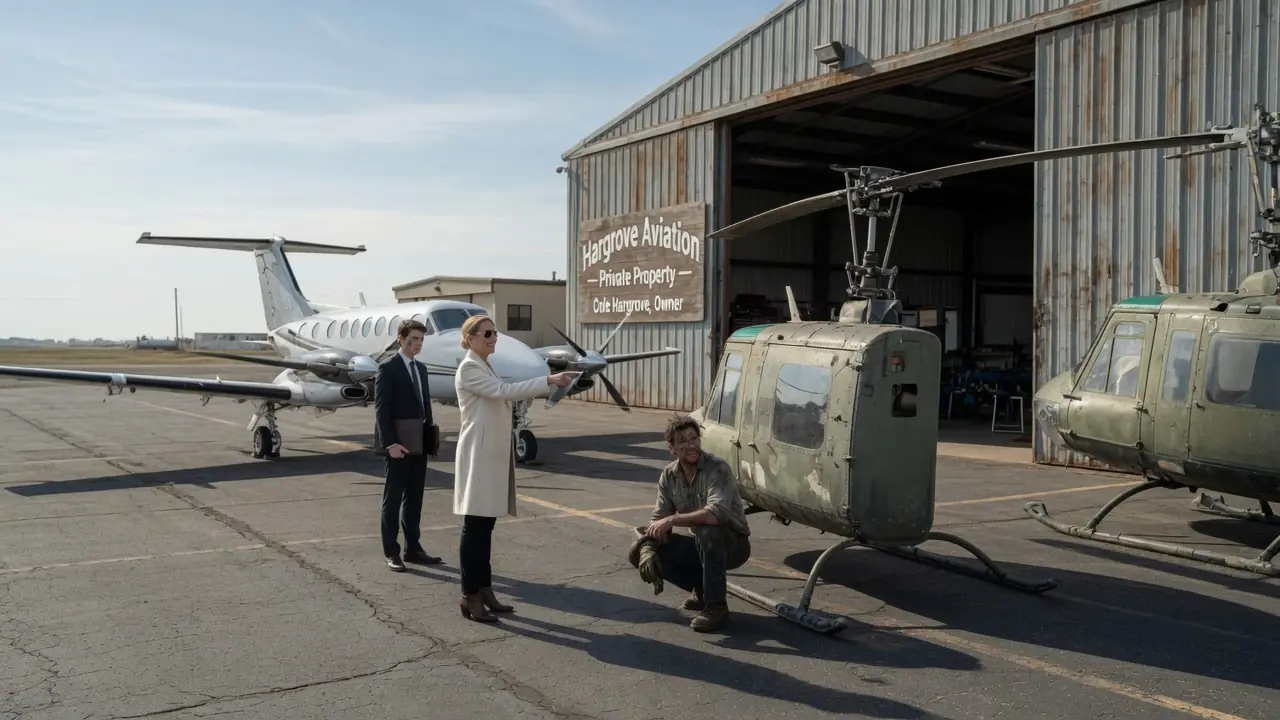
Hargrove Aviation had never been much to look at, and Cole Hargrove had long since stopped seeing that as a deficit. 40 acres of Virginia ground spread from the main hangar in every direction: south to the fuel depot, north to the small observation tower his father had built in 1974, east, where the grass grew thick against the chain-link fence, and the deer came quietly at dusk, west, where a gravel access road met the county highway at a rusted iron gate. The runway ran 1,200 meters from one tree line to the other, cracked in a few places, but structurally sound. Cole walked the full length of it every spring, eyes down, weight shifting forward through his heels to feel for soft spots in the substrate.
His father had taught him that. He had been 14 the first time he did it beside the old man, neither of them speaking, both of them looking at the ground the way you looked at something that mattered. The main hangar was wide enough for three aircraft side by side, and held the particular smell of a working facility, oil and metal, and the dry warmth that collected under corrugated steel in June. The smaller secondary hangar behind it stored tools and a parts inventory that Ruth Chen updated every Tuesday morning before anyone else arrived.
The observation tower at the north corner was the oldest structure on the property built from pressure-treated lumber that had weathered to silver over 50 years. Cole pressed a thumbnail into the grain each fall. Not soft, not yet. It wasn’t beautiful.
It was entirely his. No bank held any portion of it. No investor had a percentage. No creditor had a claim.
When the county sent the annual tax assessment, Cole paid it the week it arrived and filed the receipt in the green folder in the second drawer of the desk. He had never been late. He had no intention of being. Cole had spent nine years at Lockheed Martin in Marietta, Georgia doing the work he had trained for at Georgia Tech.
Structural load analysis on regional aircraft propulsion systems, runway tolerance consulting for private airfields across the Mid-Atlantic corridor. He had been genuinely good at it in the specific way that people are good at work they find worth thinking about. He had also believed, as most people believe at 32, that a career and a marriage and a child could all be held at once without any of them becoming smaller. When Claire was diagnosed, the belief rearranged itself.
When she died 26 months later, with Sawyer asleep down the hall and the night nurse in the kitchen making coffee that no one wanted, Cole sat in the driveway for close to an hour before he went inside. In the morning, he called his manager and then he called his father and then he started packing boxes. Sawyer had been 5 years old. He had his father’s dark eyes and his mother’s habit of asking questions that were much harder to answer than they sounded.
He slept for most of the drive north, woke up when they crossed into Virginia and asked how far they still had to go. Cole told him, not far. That had been four years ago. Sawyer was nine now and the airfield was the only home he remembered clearly.
And Cole considered that more than sufficient. Dana Whitfield walked into the terminal building and stopped two steps inside the door. She had expected not luxury, she would have said if someone had asked, but the functional minimum of any commercial facility receiving a business client: climate control, a reception desk, a person employed to handle the initial exchange. What she found was a wooden desk worn smooth from decades of use, a ceiling fan rotating at a pace that suggested it was doing its best, and a woman in her late 50s seated behind two monitors with a stack of binders that reached her collarbone.
I need to speak with whoever has authority to execute a lease agreement, Dana said. Ruth Chen looked up from the screen without hurry. She had been at this desk for 2two years and had seen many people come through the door carrying exactly the kind of compressed efficiency that Dana was radiating. In her experience, it either softened over time or it didn’t, and either way the paperwork got processed.
She nodded toward the south-facing window. Through the glass, Dana could see the man from the tarmac crouching near the hangar entrance with a boy of about nine beside him. The boy was pointing at something on the engine housing, explaining with the authority of someone who had formed a complete theory on the subject. The man listened, said something, and the boy laughed.
Cole came in seven minutes later without pausing to change his shirt or offer an explanation for his appearance. He sat down across from Dana, reached behind him to the shelf, and placed a folder on the desk between them. The lease agreement inside ran 12 pages. She opened it and began to read, and what she found was a document drafted by someone who understood what they were doing.
The liability clauses were correctly layered, the maintenance obligations were written with technical specificity that matched the regulatory framework. The payment terms were structured in a way that reflected real legal thinking rather than a form pulled from the internet. Did your attorney prepare this? she asked. I did, Cole said.
She looked up. He was watching her with no particular investment in what she thought about that answer, not proud, not waiting for credit, not braced for disbelief, just looking at her in the calm, matter-of-fact way of a person who had long since stopped managing other people’s expectations. She turned back to the document and kept reading. The door opened and Sawyer appeared with a can of cold water tucked under each arm.
He placed one in front of Dana without asking whether she wanted it, put the other on his father’s side of the desk, and was gone at the same speed he’d entered, pulling the door shut behind him. Dana looked at the can, then at Cole. She had prepared before arriving a clear approach to this meeting, what she intended to establish in what sequence and at what pace. It was good preparation.
None of it was available to her right now and she couldn’t precisely identify why. The documentation review was Dana’s standard protocol before executing any long-term facility lease, which was accurate and also not the complete truth. She wanted to understand what she was actually dealing with. The agreement she had read the previous day had not settled that question the way she’d expected it to.
It had, in fact, opened a different one. Cole placed a bound folder on the desk. Dana opened it. The FAA Part 139 certification was current, renewed the prior November with a compliance inspection that recorded zero deficiencies across all assessed categories.
She read that page twice. Behind it were fuel supply agreements with two national carriers, both active. The insurance documentation showed $12 million in liability coverage. The property survey full copy attached, confirmed 40 unencumbered acres, no liens, no easements, no outstanding claims of any kind.
She slowed when she reached the runway inspection logs. Quarterly entries, three years back, each one signed by Cole and countersigned by an independent FAA licensed inspector. She was in the middle of the third year when a loose sheet slipped from between sections and landed face up on the desk. She picked it up.
It was a degree certificate from the Georgia Institute of Technology. Bachelor of Science, Aerospace Engineering. The name in the center was Cole Thomas Hargrove. Below the name, in the formal italic reserved for academic distinction, Magna Cum Laude.
Clipped to the back was a consulting agreement on Federal Aviation Administration letterhead, retained for technical assessment services, runway design standards for privately operated airfields, United Atlantic Region. Cole’s signature was at the bottom. The date was nine years prior. Dana held both documents.
She looked at them for a long moment. Then she looked at Cole. He didn’t explain. He didn’t shift in his chair or offer the small conversational signals that people offer when they want to be acknowledged for something.
He held her gaze with the level patience of a man who had been looked past many times and had made a considered decision about whose job it was to correct that. Why aren’t you listed in the National Private Airfield Registry? she asked. Because I choose who I work with, he said. She sat with that for a moment.
The answer was simple in the way that things are simple when the person saying them has already resolved every complication behind it. The door opened and Sawyer came in with a sandwich on a paper plate, which he set in front of his father with a satisfied directness of someone completing a mission, then turned to Dana. Do you know how to fly? he asked. No transition, no context. Dana blinked.
Then she laughed short and unguarded, nothing like the controlled half-smiles she’d been producing since she landed. Something in her face shifted that she hadn’t planned for. Cole pushed the contract across the desk to her with his signature already on the bottom line. 48 hours, he said.
After that, I have another party interested in the slot. She looked at his signature. The handwriting was economical and unhurried, the handwriting of someone who signed things they meant. She knew, with the particular clarity of 1three years in business, that he wasn’t issuing a warning.
She also knew, with a different kind of clarity, that she wanted to sign right now and that she didn’t fully understand why and that both of those things were unusual enough to pay attention to. Greg Parsons arrived at 4:30 that afternoon without calling first, which was how he operated when he wanted to establish that certain conventions applied to other people. He brought two men from the county development office, which was also how he operated, never alone when an audience could be assembled. He had been chairman of the Fredericksburg Commerce Council for 11 years and had facilitated six significant land transactions in that time.
Two of them had involved owners who initially declined. He had a particular patience for the gap between a first refusal and a final one. He and Cole greeted each other without warmth and without hostility, the particular civil greeting of two people who knew each other through a dispute that had not yet been resolved. Greg laid out the offer.
He named a figure approximately 30% below what the land was worth with an active FAA certification and an operating commercial lease attached to it, a calculation Cole had worked through himself when the approach first came three months prior. Greg cited community development priorities. He referenced a planning committee timeline. He described a window of favorable conditions that would not remain open indefinitely.
His voice carried the reasonable warmth of a man who had convinced himself he was doing someone a service. Cole said he appreciated Greg making the trip out. Greg said the city had genuine interest in seeing the corridor developed responsibly. Cole said he would be in touch. Greg paused.
In his experience, the substrate of a refusal was usually one of three things: fear, pride, or financial pressure, and all three could be worked with given the right approach and enough time. What he was reading from Cole had none of those textures. It was quieter. It didn’t seem to need anything from Greg’s assessment of it, which was the kind of response that Greg found genuinely difficult to navigate.
Dana was in the car with the window down, waiting while her pilot finished the refiling paperwork inside the terminal. She heard all of it. She watched Cole from across the tarmac, no lean, no shift in his weight, no sidelong glance toward the terminal building for support, or toward the car to check if anyone was watching. He stood exactly as he’d stood that morning, exactly as he’d stood when she’d first seen him rise from beside the helicopter, present and settled like a man who had made his decisions before anyone arrived.
Greg glanced toward the King Air and noticed the Whitfield Logistics tail livery. His expression rearranged itself slightly. She’s negotiating a lease with you? he said. Cole didn’t answer.
Greg noted that fact and filed it. Dana stepped out of the car. She hadn’t decided to. She crossed the tarmac and came to stand a few feet from Cole.
Is there a problem with the property? she asked. Cole looked at her steadily. No, he said. There’s a problem with the people who want it.
Greg and his associates left shortly after. Dana went back into the terminal and picked up the lease agreement from the desk where she’d left it. She sat down and read it from the beginning, not flagging provisions, not mapping risk, reading it the way you read something when you’ve stopped looking for reasons to doubt it and started trying to understand the person who constructed it. Dana was at the gate before Cole the next morning, which had not been part of the plan.
She told Marcus she needed to go over the addendum language before the 9:00 call. That was true as far as it went. Cole’s truck came in at 8:10 with Sawyer in the passenger seat talking with both hands about something that apparently required both hands to explain properly. Cole parked, came around to open the door, and both of them stopped when they saw her standing at the gate with a coffee that had gone cold in the early morning air.
Sawyer climbed down and looked at her with the unfiltered directness of a 9-year-old who had not yet learned to cushion an observation. You came early because you haven’t decided yet, he said. Dana opened her mouth. She closed it.
He was right, more precisely right than anything she had assembled lying awake in the hotel room with the lease document on the nightstand and the numbers running in every direction except toward a conclusion she trusted. Cole put his hand on his son’s shoulder, one touch, quiet and unambiguous. Sawyer picked up his backpack and climbed back into the truck without pushing further. Cole drove him to school and was back in 20 minutes.
Dana was standing at the runway threshold looking south toward the tree line, not calculating anything, just looking at the grass and the asphalt and the pale sky above the pines. A red-tailed hawk was working a thermal above the trees, circling with the effortless patience of something that did not need to hurry. Cole came to stand beside her, not close, just near, in the easy way of someone who understood the difference between company and intrusion. They watched the hawk for a moment without speaking.
Tell me about the helicopter, she said. He looked toward the bell in the open hangar entrance. My father bought it in ’89, he said, flew it for 16 years. Last flight was the month before he died.
The pause that followed had its own weight, not grief or not only grief, but the weight of carrying something over a long distance. I’ve been putting it back together since I came home. He walked her to it. He explained the new rotor assembly, the bearing specifications he’d sourced and installed himself, the blade pitch tolerances he’d set against the original manufacturer documentation, cross-referenced with current FAA guidance on restored aircraft.
He spoke technically and precisely without translating anything down. She asked a question about the cyclic control linkage. He stopped. He looked at her with a different quality of attention, not surprised exactly, but revised. The way your reading of someone revises when they say something that doesn’t fit the earlier version.
He handed her a single page addendum before she left. Priority slot access during morning peak windows. Locked rate for 18 months. Sign before five, he said.
I hold it for Whitfield. She took the page. She didn’t sign it. Not because she had doubts about the terms.
She wasn’t ready to be done being here, and she knew it, and she didn’t examine that knowledge very closely. Greg Parsonss was not a man who revised his plans based on a single refusal. He had built a career on the understanding that most resistance was temporary, a surface condition, not a structural one, and that the right application of pressure, delivered through the right channel at the right moment, could move most things. The calculation was straightforward.
If Whitfield Logistics executed a long-term commercial lease at Hargrove Aviation, the fair market value of the property increased significantly, and the city’s development corridor acquisition became vastly more complicated. He needed to slow Dana’s decision. The petition he’d filed, an emergency compliance review request, routed through a cooperative council member as a public safety inquiry, was his mechanism, thin but functional. He had moved things with thinner instruments.
He found Dana at her hotel that evening without having called. He sat across from her at the lobby bar with the easy manner of someone stopping by rather than someone who had tracked her location through the Commerce Council’s liaison at the county development office, which was actually how he’d known where to find her. He expressed concern. He spoke about the general challenges of small private airfield operations, about maintenance cycles and the gap between what paperwork reflected and what a thorough inspection might uncover.
He mentioned Cole’s pattern of refusing serious investors three or four years. Greg said, shaking his head with the gentle regret of someone who had watched a good man make avoidable mistakes. He said all of it warmly because Greg said everything warmly. Dana said the most recent FAA compliance inspection had found zero deficiencies.
Greg said that was the last inspection and let the implication develop on its own. She thanked him for stopping by. He left. She called Marcus and asked for a complete public records pull on Hargrove Aviation’s financial standing. No bank debt, no outstanding liens, no litigation of any kind.
FAA records clean going back to the original certification date. At the bottom of Marcus’s summary, flagged with an asterisk, three years prior, a regional logistics holding company had approached Cole with an unsolicited acquisition offer priced at 40% above the current appraised value of the property. Cole had declined. No counteroffer, no follow-up communication.
Dana set the phone on the desk and looked at that number for a while. 40% above market. She had been doing this long enough to understand what that figure meant, that Cole had looked at a number designed to move anyone who could be moved and had looked at something else instead, something the number couldn’t reach. She didn’t know yet what that something was.
She was beginning to understand it was worth knowing. She drove to the airfield without having consciously decided to. The sun had been below the tree line for an hour. Through the fence, she could see the work light in the hangar and Cole’s silhouette bent over the bell’s engine housing.
The irregular knock of a wrench against metal carried out across the dark tarmac in the still air. She parked at the gate and turned off the engine and rolled down the window and sat there listening to that sound, not going in, not leaving, staying longer than made any practical sense. Dana arrived before 7:00 the next morning. Ruth was at her desk with the coffee already made, which Dana had begun to understand was simply how Ruth was.
Why won’t he sell? Dana asked. She sat across from Ruth without preamble. They’d moved past preamble somewhere in the previous three days. Ruth was quiet for long enough that the ceiling fan completed several full rotations.
It was not the quiet of someone who didn’t know the answer. It was the quiet of someone deciding whether this was the moment to give it. He could have sold the week after Claire died. Ruth said at last.
A cousin had offered a clean price. Fair, no complications. Cole could have walked away with enough to go anywhere, start over anywhere, do anything. She straightened a stack of papers that was already straight.
He could have taken the FAA advisory panel position. They asked twice. Washington, compensated. The kind of appointment that people in his field work toward for a decade. She paused. He stayed because Sawyer was born in the house at the end of this road and because his father built this place the way you build something you intend to outlast yourself.
And because, Ruth stopped, and when she finished the sentence, she said it simply, with no particular emphasis, this was the one place left where he still knew who he was. Dana looked at the runway through the south window. The morning light was making long shadows across the old asphalt. Ruth reached into the bottom drawer of her desk and placed a manila envelope on the surface between them.
It had been handled enough times that the clasp had worn a groove in the flap. Dana opened it. Inside was a letter on Federal Aviation Administration letterhead dated 22 months prior. It was a formal invitation carefully worded, specific in its terms, to join the National Advisory Panel on private airfield infrastructure development, a compensated position.
Quarterly sessions in Washington. The kind of appointment that came once, if it came. In the upper right corner of the letter, written in blue ballpoint pen in handwriting that was unhurried and a little compressed, Cole had left a note. Sawyer needs me here. No period.
No further explanation. Four words written like a grocery list. Dana read the note twice. She set the letter on the desk and looked at the surface in front of her for a while.
You came to lease a runway, Ruth said. Her voice was level and without performance. I thought you should know whose runway it is. The door opened, and Cole stepped in.
He saw the envelope on the desk. He read the room in the time it takes to draw a breath. He didn’t say anything to Ruth. He pulled out the chair across from Dana and sat down.
Have you made a decision? he asked. She looked at him. Then she picked up the pen and signed the contract. She set the pen down.
In the quiet that followed, something had been settled that none of the pages on the desk could contain and both of them were aware of it. Greg Parsonss’ petition arrived at the council chamber on a Wednesday, filed through a member who owed him a favor from a zoning variance two years prior and had no particular opinion about the details. It was formatted as a public safety inquiry, a request for emergency compliance review of Hargrove Aviation’s operating license, citing community concerns about maintenance standards and flight safety. The factual basis was sparse.
Greg had moved things with sparse filings before, when the surrounding pressure was correctly applied. Two regional FAA inspectors arrived Thursday morning in a gray government sedan and parked near the terminal without having called ahead, which was standard for compliance reviews. Greg took a position outside the fence far enough from the gate to maintain distance if questioned about his involvement, close enough to see what happened. Cole had not received advanced notice.
He didn’t require it. The documentation cabinet in the corner of the terminal office had been organized for several years in a way that reflected not anxiety but simple preparation. the preparation of someone who understood the regulatory environment he operated in and had decided calmly and without drama to be ready for it at all times. He opened the cabinet and began to hand over materials in sequence.
Maintenance logs current and three years back, quarterly runway inspection records, fuel handling certifications, the most recent instrument calibration report, the insurance binder, the environmental compliance documentation. All of it organized, all of it beyond the minimum that was required. The inspectors worked through the materials methodically. Cole sat across from them and answered questions when they asked them and said nothing that wasn’t asked.
Dana was in the office. She had come to finalize the cargo scheduling addendum and had found that she couldn’t leave once the gray sedan pulled in. She stood near the window and watched. One of the inspectors, an older man with reading glasses resting on his forehead, turned to the back section of the certification history binder and stopped.
He looked up at Cole over the top of the glasses. He gave a single nod, the nod that passes between two people who know each other from a context that doesn’t require explanation in this one. Cole nodded back. Neither of them said anything further about it.
Two hours and 11 minutes after they’d arrived, the senior inspector signed the compliance confirmation and pushed it across the desk. Clean record, she said. No deficiencies. Greg watched both inspectors shake Cole’s hand from beyond the fence. He watched Cole walk them to their car and stand there while they drove away.
Then Greg pushed the gate open and crossed the tarmac. This doesn’t change the zoning question, Greg said. His voice held its control the way a man holds something he knows is slipping. The city has legal authority.
Cole walked past him to the center of the open tarmac and stopped, turning in the sun. Private land, he said. His voice was even and unhurried. Each word carrying its own weight. Debt-free title.
Active long-term commercial lease. Legally executed. My attorney will be glad to explain what that means for your reclassification timeline. It was more words than Cole had said in Greg’s presence across all their combined encounters. There was nothing in them that needed reinforcing.
Greg looked past Cole at Dana, who had come to stand behind him and to his left. She hadn’t moved there on purpose. She was just there and Greg understood what that meant. He walked back to his car and left.
The first Whitfield Logistics cargo flight landed on a Tuesday morning in late June. A Cessna Caravan on a medical supply run out of Richmond touched down clean at 7:42 and rolled to a stop at the secondary tie-down area. Ruth logged it in the operations ledger with one brief notation and capped her pen. Sawyer, who had been on summer break for three days and had by this point established what he considered unambiguous residency at the airfield, was at the fence with his notebook, recording the tail number and landing time with the gravity of someone who understood that records were how things were remembered.
Cole had finished the Bell’s final airworthiness check the previous Thursday. He’d done the first engine run-up alone that Friday morning before Sawyer woke, sitting in the cockpit with the hangar doors open and the sound moving out across the empty field. When he cut the engine and listened to what came after, he sat there for a few minutes without moving. Then he climbed down and washed his hands and started the Tuesday checklist.
He ran the rotor again on Tuesday morning with Sawyer watching from the tarmac. The blades turned up slowly, found their speed, and stabilized into a sound that filled the whole airfield, not the clean mechanical whine of modern turbines, but something older and more physical, a sound with texture and weight that came from a machine that had been worked on by hands over a long period of time. Sawyer pressed both palms over his ears and grinned until it looked like it cost him something. Dana heard it from the parking area.
She had driven out to sign the cargo scheduling addendum in person, a task that could have been completed by email and that she had told herself required an in-person visit for reasons of professional thoroughness. When the rotor sound reached her, she stopped walking in the middle of the parking area and stood there listening. It wasn’t a sound she associated with the airports she moved through, the managed, optimized acoustics of commercial facilities. This was different, older, rougher, more honest in some way she didn’t try to name right away.
She walked toward it instead of toward the terminal. Cole saw her from the cockpit and left the engine running. Sawyer came across the tarmac toward her with his notebook under one arm and his face flushed from the morning sun. Do you want to sit in it? he said.
Dad can let you sit in the front. Cole came down from the helicopter. He’d heard Sawyer. He stood a few feet from Dana, didn’t repeat the invitation, didn’t withdraw it, just stood there with the rotor turning overhead and the engine warm in the morning air, looking at her, waiting in the particular way he had of waiting that didn’t feel like waiting at all.
Dana looked at the helicopter. She looked at Cole. She looked at Sawyer, who was watching her with the uncomplicated patience of a child who had not yet learned to protect himself against the possibility of no. For the first time in longer than she could locate precisely, she didn’t know what she wanted.
She stood in that not knowing, and it did not feel like a problem. It felt, in a way she couldn’t have prepared for, like something she hadn’t known she’d been missing. Dana didn’t go back to the hotel when Ruth left for the evening. She had finished reading the addendum by half past 7:00, and she was still at the desk at quarter to 9:00 with the pages in front of her and the terminal quiet and the ceiling fan turning in its slow deliberate circles above her.
Cole came back for his truck keys at quarter to 9:00. He saw the light through the window. He came in. He didn’t ask why she was there.
He went to the back counter and made two cups of coffee from the machine that had occupied that corner for as long as anyone could remember, and he carried both across the room and set one in front of her without ceremony and took the chair across the desk. They sat with the coffee in the quiet of the empty terminal. Outside, the runway was dark. The tree line held its shape against a sky that still carried a narrow band of deep blue at the top.
Can I ask you something? Dana said. He waited. Do you ever regret it? The FAA position? Staying here?
He looked at the window. The silence that followed wasn’t empty. It was the silence of someone thinking carefully before they answered, which was, she had noticed, how Cole did most things worth doing. Once, he said. First winter.
Sawyer was six. I woke up at 3:00 in the morning and I sat in the kitchen and I could not construct a single argument for any choice I’d made. He turned his cup slowly on the desk. He heard me get up.
He came and sat across from me in his pajamas and asked why planes didn’t fly at night. So, I started explaining visual flight rules, instrument ratings, weather minimums, the whole thing, and somewhere in the middle of that I realized I’d stopped thinking about what I’d been thinking about. He was quiet for a moment. He asked me later that year why I didn’t fly anymore.
I told him I did, just at a different altitude. Dana looked at the desk. Then she looked at him, and whatever she didn’t say was clear enough in the way she said it that he received it, and she saw him receive it, and neither of them spoke about it. He looked away for a moment, giving the space around it room to exist.
He stood first. It’s late, he said. She nodded. They went to the door at the same moment, unhurrying. They stood in the doorway for a beat that lasted past its practical purpose.
And then they went to their separate cars across the dark parking lot. Both of them walking more slowly than they had any reason to. Three weeks on, the operation was running. The Tuesday and Thursday morning cargo flights came in on schedule.
Ruth had added a second column to the ledger, and Sawyer had memorized both tail numbers. And greeted the aircraft by name when they appeared on the approach. The airfield had settled into the rhythm of something that had been decided and was now simply being lived. Dana drove out on a Thursday morning with a folder on the passenger seat that she had decided not to bring until she was already 10 minutes down the road.
Inside was a partnership proposal. She’d spent four days drafting with her attorney, not a lease extension, not a rate renegotiation, but a joint development agreement. Whitfield Logistics and Hargrove Aviation. Equal cost sharing on a runway extension.
An instrument approach upgrade for the corridor north through Culpeper County. Revenue projections for three years. Legal structure carefully built to account for what each party was actually contributing. She carried it into the terminal, holding it the way you hold something you haven’t fully decided to hand over.
Cole took it and read it without rushing. He went through the financial projections and the infrastructure specifications and the legal structure with the same methodical attention he brought to everything. He looked up once through the south window where Sawyer was at the fence explaining something to Ruth with both arms extended gesturing at the wing of the Caravan as it taxied in very serious about making his point. Cole set the folder down. He stood.
Come with me, he said. He drove her around the perimeter of the property in the old truck, the full 40 acres slowly enough to see it, the fence line and the back boundary and the north corner where the observation tower stood with its silver lumber and solid joints. He showed her the drainage channel his father had cut by hand along the east edge in the dry summer of 1981, a project that had taken three weeks and that his father had considered important enough to complete himself. He showed her the south gate iron rusted through at the lower hinge, paint long since stripped by weather, the gate his father had opened every morning of his working life at this place.
Cole had never repainted it. He had thought about it. He hadn’t. He didn’t explain why he was showing her any of it. She didn’t ask.
When they came back around, he parked and they walked inside. Dana signed the proposal. Cole signed beneath her name. Ruth produced a pen from somewhere without being asked and witnessed both signatures because she had been watching this particular story develop over three weeks and she knew when a document needed a witness.
Sawyer came in from outside with grass stains on his knees and looked at the papers on the desk. Did something happen? he asked. Business, Ruth said. He turned to Dana.
Are you going to come here a lot now? Dana looked at Cole. Cole looked through the window at the runway at the Bell sitting in front of the open hangar in the afternoon light, its new paint still bright along each blade, the rotor blades at rest. He didn’t answer Sawyer’s question.
Neither did she, not in words. The Bell sat in the afternoon sun with its rotor still, the new paint holding the light evenly along each blade. The field held the particular quiet of a working place between operations, not empty, just resting. Ruth’s operations ledger had two columns now.
Sawyer’s notebook was half full of tail numbers and landing times, and small careful drawings of aircraft from angles that interested him. The south gate at the perimeter road still stood rusted and solid, opened and closed by different hands than before, but no less certain. Two people had stood on either side of a desk and signed something, and neither said anything about what had quietly begun between them, not because there was nothing to say, but because they didn’t need to, and that was the only reason either of them could fully trust that it was real. Neither of them had been looking for it.
That was the part that couldn’t be planned or engineered or negotiated into existence. It was what happened in the space between two people who had each decided, separately and long before they met, to stop pretending that things were other than what they were. They had stood still long enough in a place that was honest, and the rest had followed.