"Excuse me, officer. My neighbor's hearing starts in five minutes. May I go in?"
"Wait outside, old man."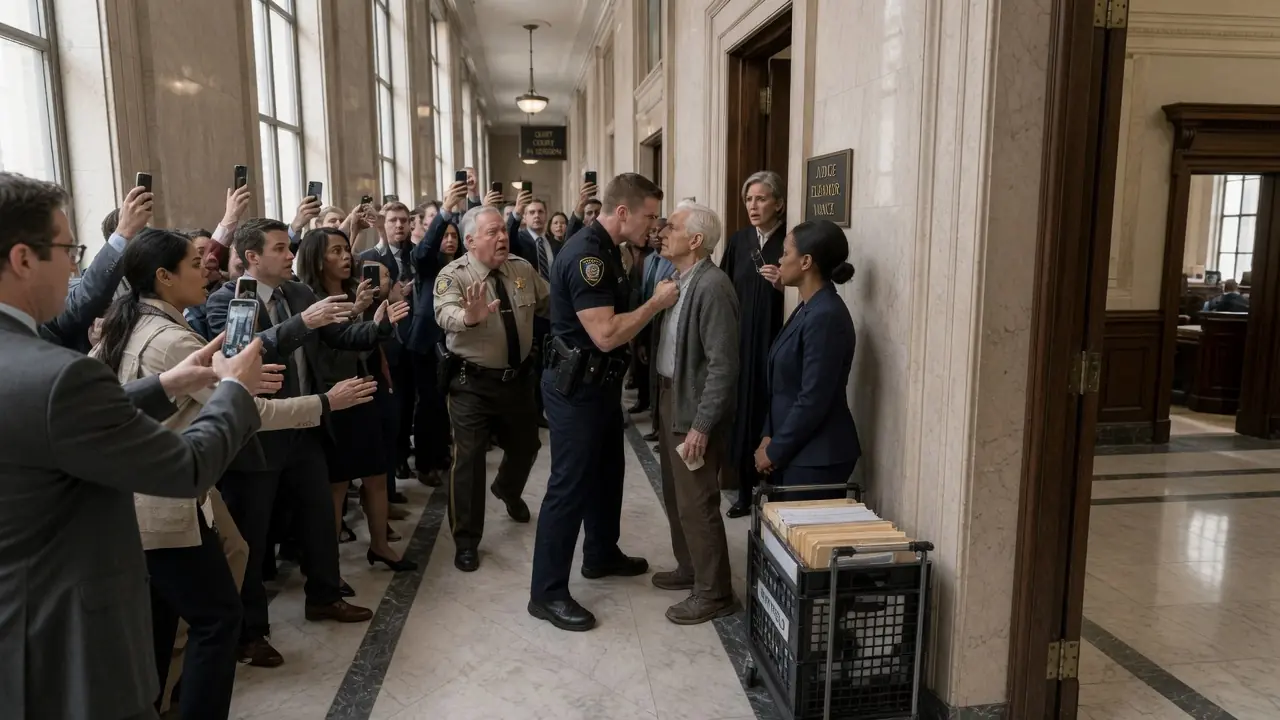
"I beg your pardon?"
"You heard me. Court is for people who matter. Not shuffling grandpas in thrift store sweaters."
"Sir, the gallery is open to the public. I only want to sit in the back."
"And I only want you gone. What is this? A diary?"
"Please be careful with that notebook. It was a gift from my wife."
"Now it's mine. Call it evidence of loitering."
"Son, do you know whose courtroom this is?"
"Yeah. Mine. I keep the trash out of it. Move before I find a reason to cuff you."
"Then I'll wait. I'm very good at waiting."
"Whatever, old man. Just stay out of my courtroom."
The hallway laughed with Officer Voss, not knowing the quiet man he mocked had run this entire court for twenty years.
---
The next morning, courtroom four filled before 9:00. Fairmont County still loved a trial. Word had spread that a local teenager faced three years for assaulting a police officer, and the gallery benches creaked under the weight of curiosity.
Miles Keller stood at the door again. This time, it was not Voss who met him. It was a heavy-set bailiff with silver hair and a careful limp—a man named Gus Halloran. Gus studied the old man's face for a long moment. Something flickered behind his eyes, half a memory trying to surface.
"Gallery is open, sir," Gus said quietly. "Back row has space."
"Thank you kindly."
"Do I know you from somewhere?"
"I have one of those faces," Miles said, and walked in.
He took the last seat in the last row, folded his hands, and watched the machinery of justice begin to move. He knew this room. He knew the sticky hinge on the jury door. He knew the water stain above the clerk's desk shaped like the state of Florida. Twenty years leaves fingerprints on a man's memory, and the man leaves fingerprints on a room.
At the defense table sat Elijah Brooks, 19, in a borrowed suit one size too big. His mother had ironed it twice that morning. His hands stayed flat on the table, exactly the way his lawyer had told him. He looked like a boy trying very hard to seem small.
Assistant District Attorney Scott Calloway rose first. He was tall, polished, the kind of lawyer who rehearsed his pauses. "Your honor, the evidence will show that on the night of March 12th, the defendant attacked Officer Derek Voss during a routine stop. This was not a misunderstanding. This was an assault on a man who wears a badge so the rest of us can sleep at night."
Judge Eleanor Vance listened from the bench with a stillness that gave nothing away. She was in her 50s, sharp-eyed, famous for patience and infamous for the end of it.
Then the state called Officer Derek Voss. He walked to the stand like a man accepting an award—pressed uniform, fresh haircut. He smiled at the jury before he even sat down, and half of them smiled back. People want to believe the uniform. That is the whole point of one.
"Routine patrol on Carver Street. Around 9:15, I observed the defendant acting suspicious near the hardware store. Pacing. Checking windows. I initiated contact, polite and professional. He got aggressive immediately, shouting, swearing. When I attempted to detain him, he struck me in the chest and resisted. I used the minimum force necessary to bring him under control."
The story rolled out smooth as poured concrete. Every sentence landed in order. Every detail arrived on time, dressed and rehearsed. The jury leaned in. A woman in the second row shook her head at Elijah as if she already knew the verdict.
In the back row, Miles Keller did not move. But inside his mind, a single phrase had snagged like a thread on a nail. *Around 9:15.*
The charging documents had been read aloud during arraignment, and Miles had been listening from the hallway. The original incident report logged the stop at 9:40. Twenty-five minutes did not just vanish from a trained officer's memory. Sloppy men forget details; lying men rearrange them. The story was perfect. That was the problem. Lies rehearse. Truth remembers.
Callaway kept going, feeding his witness easy questions, and Voss kept hitting them like batting practice. The teenager swung first. The officer feared for his safety. The arrest was textbook. Somewhere in the third retelling, the strike to the chest became a strike at his face.
Nobody else seemed to notice the wound migrating. Miles noticed. He had spent two decades watching testimony from a higher chair than anyone in this room. He knew the rhythm of a memorized script. Real memory wanders; it backtracks, corrects itself, stumbles into honesty. Voss never stumbled once. His story had no loose threads because someone had already cut them all off.
"And the defendant's notebook claim," Calloway said almost casually, "he alleges you confiscated personal property in the courthouse yesterday."
"I removed a potential security item from an unidentified loiterer," Voss said. "Standard procedure."
In the back row, the unidentified loiterer allowed himself one slow blink.
Gus Halloran turned from his post by the wall and looked at Miles again, longer this time. His brow folded as if he were doing arithmetic with very old numbers. Miles met his eyes, calm as Sunday, and the bailiff turned away with the question still sitting on his face.
The defense had its turn. Nora Whitfield stood up, and the difference between the two tables became painful to watch. She was young and smart and drowning—80 open cases will do that. Her cross-examination was earnest and toothless.
"Did you identify yourself?"
"Yes."
"Did you feel threatened?"
"Of course."
Each answer closed a door she did not know how to reopen. "No further questions," she said finally, and the words sounded like surrender.
But the state had one more witness, and this is where the concrete cracked. Officer Tyler Brennan had been Voss's partner for two years. He took the stand the way a man steps onto thin ice, testing each word before putting weight on it. He confirmed the stop. He confirmed the arrest.
Then, Calloway asked him to describe the moment the defendant struck Officer Voss.
Brennan paused. It was a small pause—two seconds, maybe three. But silence has a different texture when it is hiding something, and the whole room felt the temperature change.
"It happened fast," Brennan said. "There was a struggle. I was focused on calling it in."
"You were three feet away," Calloway said, smiling thinly. "Did you see the defendant strike your partner?"
"Like I said, it was fast."
Callaway moved on quickly, the way lawyers do when the floor creaks. The jury barely registered it. Juries hear words; old judges hear the spaces between them.
Miles unfolded his hands and looked at Elijah Brooks, who had stopped breathing through the entire exchange. The boy's mother gripped the bench in front of her. One row over, a man whispered that the kid would take a plea by Friday. Everyone always does.
---
The court recessed at noon. The gallery emptied past Miles in a river of chatter and cheap cologne. Voss came down the aisle last, escorting his own grin, and slowed when he reached the back row.
"Still here, old man? Hope you enjoyed the show."
"Very educational," Miles said.
"Stick around for the verdict. Kid swings at a cop, kid learns what consequences feel like."
"And what do they feel like, Officer?"
Voss laughed, tapped the badge on his chest twice, and walked out swinging his keys around one finger.
Miles sat alone in the empty courtroom for a moment longer. He looked at the bench where Eleanor Vance had sat. He looked at the witness chair, still warm from a man whose story had no wrinkles. Then he took out a pen, smoothed a courthouse visitor pamphlet against his knee, and wrote four words in the margin in small, steady letters: *9:15 / 9:40.*
Some men collect grievances; judges collect discrepancies. By sundown, that little gap of 25 minutes would have company.
---
The second floor hallway smelled like floor wax and old paper, as it had for forty years. Miles found Elijah's mother on a wooden bench outside the vending alcove, folding and unfolding a tissue that had given up an hour ago.
"Mrs. Brooks?"
She looked up. "You're Mr. Keller, from Hartwell Street. Elijah cuts your grass. He used to cut it for my wife when she was sick. Never once let her pay him."
Miles sat down beside her. "That boy carried her trash cans to the curb every Tuesday for two years. I have not forgotten."
Her eyes filled. "They're going to take him from me. That lawyer is trying, but she's got a stack of folders thick as a Bible. And that officer talks so smooth."
"Smooth is not the same as true," Miles said. "Polished floors are the ones you slip on."
Down the hall, Nora Whitfield stood over a rolling crate of case files, eating a granola bar in three bites while reading two documents at once. Miles approached the way you approach a startled animal—slow and sideways.
"Counselor, you have a minute?"
"I really don't, sir."
"Then I'll only use half of it. Three questions." He held up one finger. "Did you receive the full body cam footage or a clip the department selected for you?"
Nora stopped chewing.
"Two." A second finger. "Does the time stamp on Officer Voss's incident report match the time he testified to this morning? Because I heard 9:15 from the stand and arraignment said 9:40."
The granola bar lowered slowly.
"Three. Has anyone pulled the dispatch log to see when the stop was actually called in? Dispatch does not rehearse. Dispatch just records."
The hallway noise went on around them, but Nora Whitfield had gone very still. She looked at the old man in the worn gray sweater, at his thrift store shoes, at his patient brown eyes, and recalculated everything.
"Who are you?" she asked.
"A neighbor of the defendant."
"Neighbors don't ask about dispatch logs."
"Curious neighbors do." He smiled. "Ask for the full footage, counselor. Ask for the body cam. Then ask him again. One of them will change its story, and it will not be the camera."
Before she could answer, a familiar voice cut down the corridor like a thrown bottle. "You have got to be kidding me."
Officer Voss came toward them with his thumbs hooked in his duty belt. "Still here, old man? This is a courthouse, not a senior center. Bingo's at the church on fifth."
A couple of clerks laughed. Somebody's phone came up, hungry for content.
"He's with the defense," Nora said.
Voss looked Miles up and down from white hair to worn soles. "What is he, your expert witness? Expert in what? Early bird specials?"
More laughter. Miles let it pass over him like weather.
"You should drink water, son," he said mildly. "All that talking this morning. A dry throat makes a man misremember his timestamps."
Something moved behind Voss's grin—just a flicker, fast as a fish under ice. Then the grin repaired itself. "Whatever. Court's back in twenty. Enjoy the show, Grandpa."
He shouldered past, close enough to make the old man rock half a step, and the moment was gone.
Nora watched Voss go. "He took your notebook yesterday. Elijah told me. You should file a complaint. It's on his desk in the patrol annex. Third drawer, with the other things he takes from people. They always keep trophies."
Miles straightened his sweater. "File nothing yet. Complaints warn a man. Evidence convicts him."
She wanted to ask how a retired nobody knew about the third drawer in the patrol annex. The bell for session rang before she could.
---
The gallery refilled. Miles paused at the stone bench outside courtroom four—the one with the chipped corner—and rested his hand on it the way you rest a hand on an old dog.
Three thousand mornings he had sat on that bench. He used to come down from chambers at dawn with Ruth's coffee in a thermos and a draft ruling on his knee. The marble took the words better than the desk did. That bench had heard him reason through sentencing decisions that kept him awake. It had heard him talk himself out of anger more than once, because anger writes bad law.
Ruth had given him the brown notebook the morning of his swearing-in. *"For the rulings you make outside the courtroom,"* she had written inside the cover. He had filled twenty notebooks since. Hers was the one that mattered, and it was sitting in a bully's trophy drawer. He went in and took his seat in the back row.
The afternoon session was procedural sand—stipulations, scheduling, the slow grinding of the docket. But two small things happened, and Miles caught them both, because catching small things had been his profession.
The first happened at the bench. Judge Eleanor Vance was scanning the gallery during a sidebar when her eyes crossed the back row. They stopped. They came back. For two full seconds, Eleanor Vance looked at the old man in the gray sweater, and her pen went quiet against her legal pad. Twenty years is a long time, and a face can age, but some faces you studied too closely for too many years to ever fully lose. She blinked, wrote something, and the moment closed like water over a stone.
The second thing happened at the prosecution table. A clerk brought Calloway a folder. Callaway opened it, read for a moment, and his eyes flicked once toward Voss, seated in the second row in his pressed uniform. It was a brief look, and it was not a friendly one. Prosecutors can smell a problem witness the way sailors smell weather, and somewhere in that folder, a wind had shifted.
Court adjourned at 4:30. Tomorrow, the state would rest and the defense would begin with almost nothing in its hands.
Almost.
On the courthouse steps, Nora caught up with Miles, her crate wheels clattering behind her. "I filed the request," she said, breathless. "Full body cam footage, original metadata, and the dispatch log. The clerk said first thing tomorrow." She hesitated. "If you're wrong about this, I just spent capital I don't have. And if I'm right, then Officer Voss lied under oath, and somebody edited the record to cover it." She said it quietly, like the words might be illegal to say out loud. "People like me don't beat people like him, Mr. Keller. I've watched it go the other way too many times."
Miles looked back at the courthouse. The evening sun lit the limestone gold, and the carved words above the doors threw long shadows: *Equal Justice Under Law.* He had spent twenty years under that sentence. He intended to spend one more day.
"You won't be beating him alone," he said.
---
The house on Hartwell Street kept its lights low. Miles liked it that way. Since Ruth passed three winters ago, the quiet had become a kind of company. He hung his sweater on the hook by the door and stood a moment in front of the photograph in the hallway—Ruth, on the courthouse steps, laughing, one hand holding her hat against the wind on the day of his retirement ceremony. She had leaned over that afternoon and whispered that he was finally hers full-time.
Eight months later, the doctors found the shadow on the scan. It was Elijah Brooks who mowed their lawn that whole last summer. Fifteen years old, pushing a second-hand mower in August heat, refusing every folded bill Ruth tried to press into his hand. When the ambulance came the final time, the boy stood at the curb holding his cap, and he cried like family. Miles owed no speeches to anyone. He owed that boy a debt.
He made coffee at 9:00 in the evening, which Ruth would have vetoed, and carried it to the small study. The desk held a reading lamp, a county directory, and the laptop his granddaughter had set up two Christmases ago. He typed slowly with two fingers, but with absolute precision. Court records are public; most people never learn how public. Miles pulled the docket index and searched the name: *Derek Voss, badge number 8312, arresting officer.*
The screen filled. He read for two hours, the way he used to read briefs, with a pencil and total stillness. *Resisting arrest, assault on an officer, resisting, resisting.* Six cases in four years. Every defendant young, every defendant from the East Side. Every case resting entirely on the officer's word. Four had pleaded out—plea deals leave no transcripts worth reading—but two had gone far enough to generate filed reports, and Miles read those twice.
Then he saw it, and his pencil stopped moving.
*“The subject became combative and struck me in the chest with a closed fist, at which point I employed department-approved control techniques.”*
Word for word, identical. The same sentence in the same order in a report from three years ago and a report from fourteen months ago. Two different nights, two different young men, one sentence photocopied from memory. Honest reports differ because honest nights differ. Only fiction repeats itself cleanly.
"There you are," Miles said softly to the empty study.
He checked the clock: 20 past 11:00. Court resumed at 9:00 sharp. Whatever he was going to build, he had to build it before morning. And a retired man with a library card could only reach so far. Certified copies, sealed dockets, personnel complaint indexes—those doors needed keys, and he had surrendered his keys with his robe.
But twenty years is a long time to run a building, and a man like that does not leave empty-handed. He leaves with something better than keys. He leaves with people.
Miles picked up the telephone—the old corded one Ruth had refused to throw away—and dialed the number he still knew by heart. It rang twice.
"Hello?"
"Margie, it's Miles."
A pause, then a sound between a laugh and a gasp. "Judge Keller? Lord above, three years and not a postcard."
"I know. I'm sorry. Grief makes poor correspondents." He turned the pencil over in his fingers. "Margie, are you still clerk of records?"
"Senior clerk now. Why do I feel like you're about to ruin my evening?"
"Based on your memory, you know me." He looked at the names on the screen—six young men, six case numbers. "I need certified copies of six case files by morning. Arrest reports, plea records, and every citizen complaint ever filed against badge number 8312. I need the originals matched against what was entered into evidence."
The line went quiet. Margie Doyle had spent thirty years around courtrooms; she could hear the shape of a thing before it was named. "This is about the Brooks trial, isn't it? Courtroom four."
"It is."
"That officer testified today. Word in the building is the kid's done for."
"The word is wrong."
Another pause, then briskly, the sound of a drawer opening. "Certified copies by eight. I'll bring them myself." She stopped. "Welcome back, Your Honor."
Miles set down the phone and looked at Ruth's photograph through the study door. A season of silence had just ended with one phone call. 11:00 found him still working. He never noticed midnight at all.
---
Margie Doyle arrived at 7:50 in a raincoat the color of strong tea, pulling a document box on a luggage cart. She found Nora Whitfield at a corner table in the courthouse cafeteria, and she set the box down like an offering.
"Certified copies, six case files, complaint index, and one extra item nobody asked me for." Margie tapped a thin folder on top. "The hardware store on Carver Street got robbed two years ago. After that, the owner mounted a camera over his door. The county served him a preservation notice this morning at 6:00. He was very cooperative. Apparently, he doesn't care for Officer Voss either."
Nora opened the folder, read the single page inside, and felt her heartbeat change gears. "Who are you people?" she whispered.
"I'm a records clerk." Margie smiled. "The gentleman in the gray sweater... you'll have to ask him yourself."
---
At 9:00 sharp, courtroom four came to order. The state rested. And Nora Whitfield, who had walked in yesterday like an apology, stood up like a different woman.
"Your Honor, before the defense begins, we move to admit the complete body cam recording from Officer Voss's unit, together with its original metadata. We received the file from the county evidence server this morning."
Callaway rose. "Objection. The relevant portions are already in evidence."
"The relevant portions," Nora said, "are exactly what we intend to establish."
Judge Vance considered for a moment, then nodded. "I'll allow it. Proceed."
The screen on the side wall flickered to life. The footage began in the patrol car—dashboard lights, the radio murmuring. Then the picture jumped. One moment the cruiser was rolling past a laundromat; the next moment, Elijah Brooks was already on the ground, wrists behind him, shouting that he had done nothing.
Nora let the silence sit. Then she turned to the jury. "The county's own logs show this camera records continuously. Yet the file in evidence skips from 9:36 to 9:41. Four minutes are missing—the four minutes that matter." She lifted a page. "And here is the metadata. The original file was accessed and exported again at two minutes past 11:00 that same night from workstation 12 in the patrol annex—the workstation assigned to Officer Derek Voss."
The gallery made a sound like a kettle starting. Vance's gavel came down once. Voss was recalled to the stand. The pressed uniform was the same, but the man inside it had changed sizes overnight. He kept his chin up, but his thumb kept finding his belt, looking for something to hook onto.
"Officer Voss," Nora said, "why was the file exported from your workstation at 11:02 p.m.?"
"I don't handle the servers. The system glitches all the time. Ask the techs."
"We did. The county technician certified there was no system fault that night. Export requires a logged user. The logged user was you."
"Then somebody used my login." He smiled at the jury, asking them to stay with him. Fewer of them smiled back this time. "Look, I wrote my report. The camera does what it does. I told you what happened out there."
"You did," Nora said. "You testified the stop occurred around 9:15. The dispatch log, which we are now admitting, shows you called the stop in at 9:38. Dispatch does not glitch either, officer. Which time would you like the jury to believe?"
"It was dark. Times blur."
"Times blur," Nora repeated slowly, letting each word find a seat in the jury box. "An analytical perspective shows your written report from that night says 9:40. So your memory was sharp until this trial began, and then it moved twenty-five minutes in the direction that helped you."
Callaway did not object. He sat very still with the expression of a man doing math he did not enjoy.
In the back row, Miles Keller watched the young lawyer work and allowed himself a small, private satisfaction. The questions were hers now; she had stopped reading them off the page an hour ago.
Then came Brennan. Voss's partner walked to the stand like a man walking a tightrope. He had heard the morning's testimony from the hallway; everyone could see he had heard it. The thin ice from yesterday had cracks in it now, spreading.
"Officer Brennan," Nora said gently. "Yesterday you testified that the defendant struck your partner. Today you've seen the missing four minutes and the altered export. I'll ask you once more, and I remind you that you are under oath: Did you see Elijah Brooks strike Officer Voss?"
The pause was longer this time—five seconds, six. Brennan looked at the rail in front of him. He did not look at Voss, and that was the loudest thing he had ever done.
"I did not see that," he said finally. "I was at the car. When I turned around, the kid was already going down."
"Did your partner appear injured?"
"No, ma'am."
"Did you ask him what happened?"
Brennan's jaw worked. "He told me what to write."
The kettle sound rose again, and this time the gavel had to fall twice. Elijah's mother had both hands over her mouth. Voss sat in the second row with his neck going red above his collar, a man watching his own concrete crack in public. But Nora was not finished.
"Your Honor, the defense has one more exhibit: security footage from the hardware store at the corner of Carver Street, recorded the night of the arrest, produced this morning under subpoena with the owner's affidavit."
"Objection," Callaway said, but his heart had left the word before it landed.
"Overruled."
The screen lit again—a high angle over a shop door, the streetlight shining down. The timestamp running in the corner read *9:37*. And there was Elijah Brooks walking, earbuds in, a paper bag in one hand. There was the cruiser sliding to the curb. There was Voss getting out, pointing, shouting something the camera could not hear. And there was Elijah Brooks setting the bag down and raising both hands.
Both hands. Open. Empty. Shoulder-high for three full seconds.
Nobody in courtroom four breathed. The boy on the screen stood perfectly still, palms out, and the officer crossed the distance and shoved him violently into the wall of the hardware store. Then a knee, and the ground, and the wrists, and the shouting.
At no point, at no frame, did the boy swing. The camera across the street had no badge to protect; it just told the truth at thirty frames per second.
Someone in the gallery began to cry. It was not Elijah's mother; it was a stranger, an older woman in the third row, and somehow that was worse. Elijah himself stared at the screen like a drowning man watching a life raft arrive. Nineteen years old, three years of his life on the table, saved by a shopkeeper's seventy-dollar camera.
Judge Vance watched the screen until the clip ended. Then she took off her glasses, folded them, and looked at the prosecution table for a long, terrible moment. "Mr. Calloway, I'm going to call a recess. I suggest you use it to confer with your office." Her voice could have frosted the windows. "Court stands in recess until 1:00."
The gavel fell. The room exhaled, and as the gallery rose around him, buzzing like a struck hive, Miles Keller sat quietly in the back row and looked at Derek Voss across the emptying benches. The officer was already looking at him. Nobody laughed in that hallway now.
---
The recess hallway was crowded, and Derek Voss came through it like a storm front looking for a coastline. He found Miles Keller by the window, drinking water from a paper cone.
"You." The word arrived before he did. "I don't know what you did, old man, but I know you did it. The records request, the camera... that little lawyer suddenly asking questions she's not smart enough to ask."
"She was always smart enough," Miles said. "She was only short on time."
"You think this is funny?" Voss stepped in close, his voice dropping into something uglier. "I'm one radio call from arresting you for interfering with a police matter. You're nobody. You're a bag of old clothes that wandered into my courthouse. I want you out of this building, or I swear I will drag you out in front of everybody."
Phones were rising around the hallway now—the same hungry lenses from yesterday, smelling a different meal.
"Go ahead, son," Miles said quietly. "Touch me. Add one more case file to the stack."
Voss's hand actually moved—two inches, maybe three, toward the old man's collar. And that was when a voice cut across the hallway, flat and hard as a dropped beam.
"Officer, step away from him. Now."
Gus Halloran was crossing the corridor, his limp completely forgotten, and his face had gone pale in the way faces do when forty years of memory finally finish their arithmetic. He stopped in front of Miles, and the old bailiff did something no one in that hallway could decode: he straightened his back, tucked his thumbs to the seams of his trousers, and stood rigidly at attention.
"Good morning, Your Honor," Gus said. "It took me two days. I'm ashamed of myself."
The hallway went dead still. Voss blinked. "What did you call him?"
"Eleven years I worked his courtroom." Gus did not look at Voss; he could not seem to stop looking at Miles. "I carried his calendar. I saw him every morning at that stone bench. Your Honor... we thought you'd left the state."
"I left the third floor, Gus," Miles said gently. "It's not the same thing."
A door opened down the hall. Judge Eleanor Vance stepped out of chambers, her robe unzipped over street clothes, reading glasses still in one hand. Someone must have called her, or maybe twenty years of instinct had. She took five steps into the corridor, saw the old man by the window, and stopped as if the floor had ended.
"It is you," she said. "I sat sidebar this morning telling myself I was imagining it." She crossed the hallway, and a sitting judge of the county circuit, in front of clerks and lawyers and one paralyzed police officer, inclined her head. "Chief Judge Keller, you hired me as your clerk in my first year out of law school. You taught me how to read a witness." Her voice caught, then leveled. "I sit in your courtroom, Your Honor, every day."
The words went through the corridor like current through water. *Chief Judge Keller.* The name on the brass plate outside courtroom four for two decades. The portrait hanging on the third-floor landing—the one with the gray robe and the steady eyes—the one Derek Voss had walked past every single morning without once looking up.
Three thousand mornings on that bench. The man who had run this entire courthouse for twenty years, sorted into the trash by a patrolman who never read the walls.
The hallway phones caught everything. They caught Voss's face doing something complicated—arrogance trying to hold a structure that was liquefying under it. They caught the half-step backward. They caught the swallow.
"Sir," Voss said. The word came out cracked—a syllable he had never once offered this man. "Sir, I didn't... nobody told me you were..."
"You're standing in his courtroom, Officer," Gus said. "You've been standing in it all week."
Voss looked from the bailiff to the judge to the old man in the gray sweater, and you could watch the arithmetic land. The loiterer he had shoved, the grandpa he had mocked on camera, the bag of old clothes. He had spent two days building his own gallows, one plank at a time.
Miles folded the paper cone, dropped it neatly in the bin, and met the officer's eyes. "Wait outside," he said.
---
At 1:00, courtroom four was standing room only. Word travels fast in a small county, and faster in a courthouse with phones. Judge Vance took the bench and paused before calling the session to order. Her eyes found the back row, where the old man sat in the same gray sweater.
"The court notes the presence of the Honorable Miles Keller, retired chief judge of this circuit." Her voice was formal, but something warm ran underneath it. "Your Honor, there is a seat available at the front, should you prefer it."
"The back row has been very educational, Judge," Miles said, "but thank you. I'll come forward."
He walked up the aisle he had walked ten thousand times—once in a robe, now in a cardigan—and the gallery watched him pass in absolute silence. He took the observer's chair beside the clerk's desk, twenty feet from the witness stand, close enough for Voss to feel it.
Nora rose, and this time she carried Margie's certified files. "Officer Voss, you remain under oath. I want to read you a sentence." She lifted the first report. *"The subject became combative and struck me in the chest with a closed fist, at which point I employed department-approved control techniques."* She looked up. "Did you write that?"
"Sounds like standard report language."
"It does sound standard." She lifted a second report. "Because you also wrote it three years ago, about a different man, on a different street—word for word. Twenty-six words in identical order." She raised a third report. "And fourteen months ago—word for word." She picked up the remaining documents. "A fourth. And here. And here. Six reports. One copied sentence. Zero coincidences."
The jury was leaning forward now, all twelve of them.
"Officers use templates," Voss said, his voice flat. "Everybody knows that. Templates describe procedure."
"This sentence describes an event," Nora countered. "Six different young men, officer, and every single one of them swung at your chest the exact same way? In the exact same words? Memory wanders. Fiction repeats. Who taught you that sentence? Or did you compose it yourself?"
"I'm not answering that."
"You just did," Nora said quietly. "Nothing further on the reports." She turned to her final notes. "One last question. You testified this morning that times blur. Yet two days ago, you told this jury '9:15' with complete confidence. Today, the dispatch log says 9:38. When you change a time by twenty-five minutes, officer, the camera gap you created stops looking like a glitch. It starts looking like a plan."
"Objection," Callaway said, half-rising out of habit more than hope.
"Withdrawn," Nora said.
The jury heard it anyway. Vance's gavel hovered but did not fall; some sentences deserve their echo.
Voss left the stand a completely different size than he had entered courtroom four two days earlier. He walked past the observer's chair on the way to his seat, and for one moment, his eyes met the old man's. Miles did not gloat. He simply looked at him the way he had looked at a thousand defendants—with a terrible, patient sadness. Somehow, that was worse than anger. Voss sat down and stared blankly at his own hands.
At the back of the courtroom, the doors opened without sound. Chief Patricia Lawson stood against the rear wall. She had not been announced; she had come alone in full uniform, arms folded, her face carved from quarry stone. She watched her officer for a long moment. Twenty years of a careful career sat in that stare, weighing thirty seconds of a terrible decision.
Callaway rose slowly. "Your Honor, in light of today's evidence, the state requests a brief conference with defense counsel."
The conference took eleven minutes. The gallery counted every one of them. When the lawyers returned, Calloway stood with the posture of a man performing surgery on his own case.
"Your Honor, the state moves to dismiss the charge of assault on a law enforcement officer." A collective breath ran through the room. "The state is also referring the matter of Officer Voss's testimony and the evidence file to the District Attorney's office for review."
"Noted," Vance said, "and granted. We will hear closing arguments on the remaining count tomorrow at 9:00." Her gaze moved to Voss, then to the chief by the back wall. "I expect everyone who testified this week to be present."
The gavel came down clean. Voss stood and found his own chief watching him, and learned what cold really was. Tomorrow, there would be a verdict. Tonight, somewhere in the patrol annex, a third drawer was waiting to be opened.
---
The verdict came on a Thursday morning under a sky the color of clean paper. Nora Whitfield's closing argument took nine minutes. She did not shout; she had learned somewhere in the last three days that the loudest thing in a courtroom is a fact.
"Three days ago, the state told you a story," she said to the jury. "A dangerous young man, a brave officer, minimum force. You believed it because the man telling it wore a uniform. And we are raised to trust the uniform. So was Elijah Brooks. He trusted it enough to put both hands in the air." She let that breathe.
"The camera showed you what happened to him anyway. Four minutes were cut from the record. A time was moved. A partner was told what to write. None of that was an accident. You cannot call it a mistake when it has a pattern, and you have seen six copies of the pattern." She rested one hand on Elijah's shoulder. "This young man spent his summers mowing a dying woman's lawn for free. He has never raised a fist at anyone. The state has already abandoned half of this case. We are asking you to finish the job. Send him home."
Callaway's closing was four sentences. There is no dignity in defending a building already on fire.
Before instructions, Judge Vance looked toward the observer's chair. "The court recognizes Judge Keller. Your Honor, you have watched these proceedings from the first morning. If you wish to address the court as a friend of the bench, the bench would be honored."
Miles rose slowly. He did not approach the jury box; he stood beside his chair, hands folded, and spoke as if the room were small and the hour were late.
"Thank you, Judge. I'll be brief. Brevity is the only gift age gives a speaker." A soft ripple of laughter broke out—the first in three days. "I spent twenty years on that bench. In all that time, I learned one thing worth repeating: A badge is borrowed. Character is owned. We loan a young man a piece of metal and the power that comes with it, and the loan has one condition: the truth. Not courage, although we hope for it. Not kindness, although it helps. The truth. The moment an officer lies under oath, the badge stops being his. He just hasn't returned it yet."
He looked at the jury—twelve tired, serious faces.
"I did not come here as a judge. I came as a neighbor, because a boy who was kind to my late wife needed one person in the room who knew how to listen. Every courtroom should have one. Most don't. That is not the jury's fault; it is everyone's unfinished work. Thank you for your attention these three days. Whatever you decide, decide it on the record. The record is finally honest."
He sat down. Nobody moved for a moment, and then Vance instructed the jury, and they withdrew.
They were gone forty minutes. When the foreman stood and said the words, "Not guilty," the sound that came out of Elijah's mother was not a cheer. It was older than that—something between a sob and a hymn, the sound of a heavy weight hitting the floor after being carried too far. Elijah folded over the defense table like a puppet with the strings finally released. Nora put both arms around him—lawyer last, human first.
The gavel fell for the final time, and courtroom four emptied into the marble hallway. And that was where the last accounting happened.
Chief Patricia Lawson was waiting by the stone bench with two Internal Affairs officers, her face promising nothing good. Voss saw her and stopped walking.
"Officer Voss." Her voice carried down the corridor, flat and public, and she did not lower it. "Effective immediately, you are suspended without pay pending termination and criminal referral. Evidence tampering, perjury, falsification of records. The District Attorney has the file." She held out one hand, palm up. "Badge and weapon."
The hallway went dead silent. The same hallway, the same phones—all of them up now. Voss looked at the chief's open hand. His fingers went to his chest, to the piece of metal he had tapped twice while laughing at an old man, and they fumbled with the clip twice, three times, before it came free. He set the badge in her palm, then the holster, the belt suddenly loose around a man who had been wearing borrowed weight for years.
"And the notebook," Lawson said. "I'm told you keep things in a drawer."
It arrived in an evidence bag twenty minutes later—brown leather, worn corners. Lawson carried it across the hallway herself and placed it in the old man's hands. "Judge Keller, on behalf of the department, I apologize. The rest of my apology will take about a year of work. You'll see it, not hear it."
"That's the right kind," Miles said.
His thumbs moved over the cover, finding the soft, worn place where Ruth's hand used to rest. Her writing waited inside, faithful as ever: *For the rulings you make outside the courtroom.*
He looked up at Derek Voss, unarmed, unbadged, escorted toward the doors he had guarded like a kingdom.
"Wait outside," the old man said softly.
And this time, the man did.
---
Six months later, Derek Voss stood in a different courtroom, at a different table, and learned what the view was like from the other side. Evidence tampering and perjury—the jury took less than a day. The judge who sentenced him was not Eleanor Vance, and that was deliberate, because Fairmont County did everything by the book now. He served his time in a facility two counties away, where nobody cared what he used to wear to work.
His six old cases were reopened one by one. Two convictions were vacated by spring; one young man came home to a daughter who had learned to walk while he was gone. The department kept Chief Lawson's promise. Every body cam in the county now uploads automatically to an independent server, untouchable from any workstation, and the policy has a name. Officers call it the Keller Protocol. Most of the new recruits have no idea who Keller is; the old ones make sure they learn.
Officer Brennan kept his job—barely—and traded his badge for a desk and a second chance. He teaches the body cam rules to rookies now, delivering the lessons like a man paying off a debt.
Elijah Brooks enrolled at the community college in the fall, studying pre-law. On his application, where it asked why, he wrote one sentence: *Someone showed up for me, and I want to be someone who shows up.* Nora Whitfield wrote his recommendation letter. She has a new job, too—senior counsel at the public defender's office, carrying a crate that rolls a little lighter these days.
And every Tuesday morning, if you come to the Fairmont County Courthouse early, you will find an old man in a gray sweater on the stone bench outside courtroom four. Young lawyers bring him coffee and impossible cases. He listens more than he talks. When he does talk, they write it down.
The brown notebook stays in his lap, the leather gone soft at the corners from two pairs of hands. On the newest page, in small, steady letters, there is a name: *Elijah Brooks, fall semester.* Below it, a line from the notebook's first owner, copied forward so it will not be forgotten:
*For the rulings you make outside the courtroom.*