"Oh, hell no. Not today."
Diane Hartwell looked up from her computer terminal, her features instantly tightening into a look of profound disgust, as if she had just stepped in something rotten. "Who let this in? Security doesn't work here anymore? I have a 10:00 a.m. scheduled with Carol."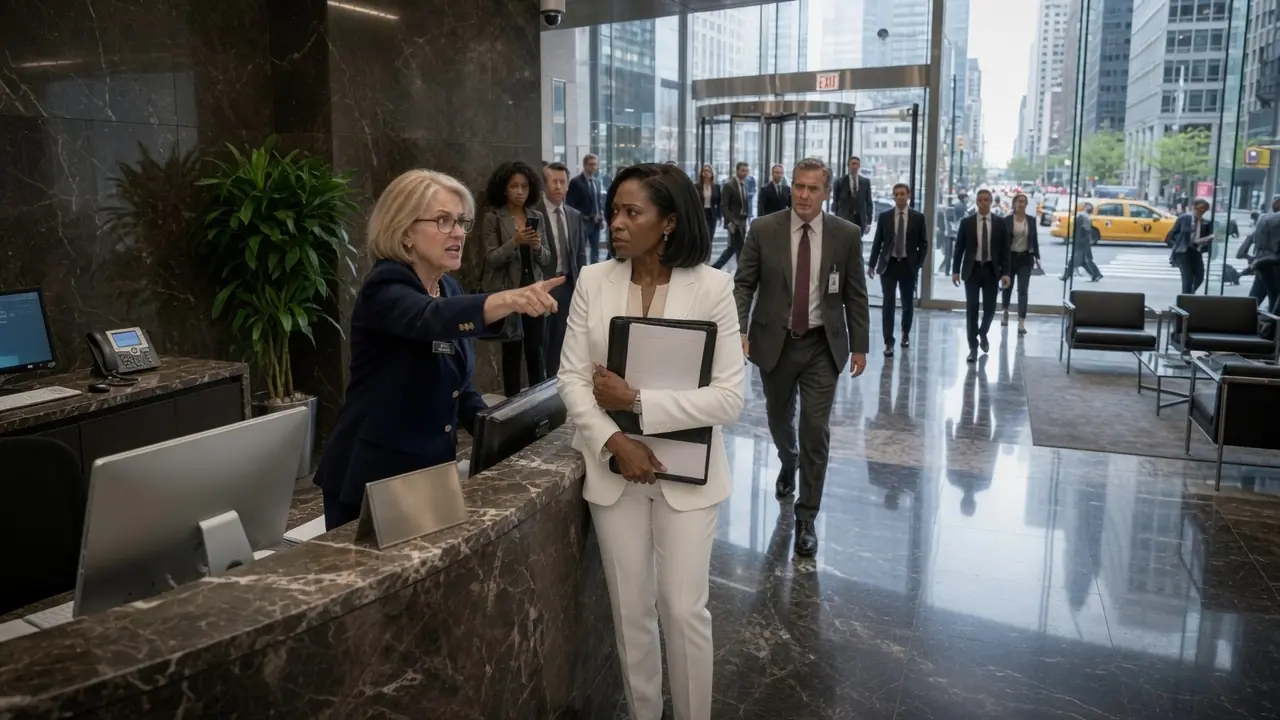
"You have nothing," Diane stood straight up, bracing her hands on the counter. "Look at you. You look like you crawled straight out of a shelter and followed someone through the revolving door."
"The contract, girl, stop," Diane let out a sharp, cruel laugh, her finger pointing aggressively toward the glass revolving doors. "Out. Now. Before I call the police and tell them a confused woman just dirtied her way in off the street."
Olivia Monroe didn't move an inch. Her eyes remained perfectly soft, her leather portfolio pressed firmly to her chest. What Diane didn't know—what nobody in that vast, marble lobby knew yet—was exactly who was standing on the other side of that reception desk. And by the end of this day, every single person in this forty-story tower would never forget her name.
---
To understand why what occurred in that lobby mattered so much, you need to understand who Olivia Monroe actually was—not the narrative Diane had constructed in her head, but who she was in reality.
Tuesday, 6:14 a.m., Chicago's South Side. The city was still cast in shades of gray at that hour, the streetlights still humming. The L train rattled somewhere in the distance—steel on steel, that familiar Chicago soundtrack that never quite leaves your bones even after you've made it out. Olivia was already at her desk, drinking black coffee with no sugar, a yellow legal pad spread out before her covered in tight, precise cursive. Every line was perfectly straight, even without ruled paper.
Her COO, Nathan Briggs, always joked that her handwriting looked like it had been to law school. She never laughed at that joke—not because it lacked wit, but because she had actually been to law school, and business school, and had spent the first three years following graduation getting systematically passed over for promotions by men who had graduated below her rank.
That was a long time ago. On the wall behind her desk hung a single framed photograph—not a diploma, and not an industry award, but a photograph of a Black man in a hard hat standing on a half-finished bridge somewhere in rural Illinois, pointing up at a massive steel beam as if he were introducing it to the sky. Her father. Raymond Monroe had spent thirty-one years as a structural engineer for the state, never making more than $74,000 a year, building bridges that thousands of citizens drove across every single day without ever knowing his name. He died of a sudden heart attack at sixty-seven, exactly two years before Olivia landed her first major commercial contract. She thought about his legacy every single morning.
Meridian Edge Consulting had started in the second bedroom of a small two-bedroom apartment in Bronzeville. There were no venture investors, no family wealth, and no safety net of any kind—just Olivia, a laptop, a commercial printer that jammed every third page, and a reputation she was building from scratch, one phone call at a time. That was eleven years ago.
Today, Meridian Edge employed thirty-four full-time professionals, with offices in Chicago, Atlanta, and Houston, and a client roster that included three Fortune 500 companies whose infrastructure strategies had been quietly, fundamentally reshaped by Olivia's work—even if her name rarely appeared in the press releases. She preferred the work to do the speaking, and lately, it had been speaking exceptionally loudly.
At 7:30 a.m., Nathan called her line. "The final numbers look completely clean, Olivia. Legal signed off last night. Both physical copies are ready."
"I know," she said, already auditing the columns, checking every single line the way her father used to verify load calculations—slowly, twice, looking for the tiny error everyone else assumed was fine.
"Are you nervous?" Nathan asked.
"No."
"Liar."
She almost smiled. "I'll be at the tower at 9:45. Carol's team confirmed it twice yesterday. You're pre-cleared—VIP notation on the visitor log, direct elevator access. It's already done."
"Good."
She hung up, looked at the photograph of her father for a final second, closed the pad, and stood up. Her suit was entirely deliberate—charcoal gray, single-button, with highly structured shoulders. She wore no jewelry beyond small gold studs and her father's old Seiko watch, which still bore a cracked crystal she refused to have fixed. She liked the crack; it reminded her that things could be damaged and still keep perfect time.
She looked at her reflection in the mirror for exactly three seconds—not out of vanity, but out of discipline, the way a pilot checks instruments before takeoff. Then she secured her leather portfolio. Inside rested both signed copies of the contract, her business license, her firm's state registration, and three official emails from Apex's finance department verifying that the $50,000 retainer had already been wired to Meridian Edge's account. She carried those documents everywhere now. It wasn't paranoia; she had learned across eleven years of entering rooms that weren't built for her that preparation wasn't just good business practice—it was armor.
---
And that's when the first domino fell.
Diane Hartwell had been sitting behind that reception desk for eleven years. She knew this lobby the way a landlord knows a property—every blind spot, every camera angle, every face that belonged, and every face that didn't. She operated on a strict tracking system: a half-second scan from top to bottom, like a machine running a security checklist. Olivia received the scan the microsecond she cleared the revolving door.
Two white men in tailored suits pushed through right behind her. Diane didn't even glance at their badges, simply lifting two fingers from her keyboard in a practiced wave, and they walked straight through toward the elevator banks without breaking stride. Olivia watched the transaction, filed it away, and said absolutely nothing.
She approached the counter, setting her leather portfolio down on the marble surface with a quiet, deliberate click, and smiled. "Good morning. Olivia Monroe, Meridian Edge Consulting. I have a 10:00 a.m. scheduled with Carol Whitfield on the twenty-second floor."
Diane looked down at her screen and began typing. The clicking of her keyboard was exceptionally slow, almost theatrical—the kind of slow that isn't about data accuracy, but about forcing a person to wait. "I'm not seeing anything under that name."
"It should be there," Olivia said, her tone level. "My office verified the appointment three days ago. There should also be a pre-clearance notation for VIP access and a direct elevator route."
More typing followed. Diane tilted her head slightly—the characteristic gesture of someone who has already decided the answer and is just performing the search for appearances. "Nope. Nothing here."
"Can you spell it back to me, please?" Olivia kept her voice even. "M-O-N-R-O-E. First name, Olivia."
Diane typed again, then paused, squinting at the pixels. "I'm showing a Monroe, but the system says the meeting was rescheduled."
"It wasn't rescheduled. I spoke directly with Carol's personal assistant yesterday afternoon at 4:30 p.m."
"Well, the system says what the system says," Diane leaned back in her ergonomic chair, folding her hands flat on the desk with the utter calm of someone who holds all the leverage in a transactional space and knows it. "Maybe there was a miscommunication on your end. It happens."
*On your end.* Not on theirs. On hers.
Olivia opened her portfolio and slid a printed document across the marble. It was the formal meeting confirmation email—printed, time-stamped at 4:47 p.m. the previous afternoon, bearing the official Apex Consolidated letterhead and the digital signature of Carol Whitfield's assistant.
Diane glanced at the paper but didn't bother to pick it up. "I can't verify third-party emails. You'd need an internal confirmation from our primary system."
"That email was generated from an internal Apex domain, ma'am."
"Listen, girl," Diane's voice dropped half a register—not turning quieter, but significantly harder. "I don't make the building security rules. If you're not clearing the system, I can't grant you lobby access. What I can do is suggest you wait outside on the sidewalk while I reach out to the relevant department during a shift break. There's a waiting area right there, but it's full."
Olivia glanced toward the row of leather chairs along the wall. It was currently occupied by three other visitors—all white, all sitting comfortably with their smartphones and coffee cups, not a single one having been asked to produce an email verification. Diane followed Olivia's gaze, looked back, and didn't blink.
"Those individuals have been fully verified. You haven't. So, I'm asking you to step outside onto the pavement until this gets sorted out."
The lobby hummed around them—elevator chimes, expensive dress shoes clicking on marble, and the distant murmur of a security guard on a radio line. It was a normal Tuesday morning, completely indifferent to the exclusion occurring at the desk.
"I'm going to stay right here, thank you," Olivia said.
Something broke in Diane's expression—not open anger, but the intense irritation of an administrator whose authority has been questioned by someone she deemed below the baseline. She picked up her desk line, punched a button, and waited. "Gregory? It's Diane at front reception. I need you down at the desk immediately. Yes, now, please."
She set the receiver down and turned back to her monitor, typing rapidly, acting as if Olivia had already ceased to exist in the physical space. Olivia stood perfectly still at the counter, her hands resting flat on the marble, her portfolio open. She didn't check her phone, she didn't shift her weight, and she flatly refused to give Diane the satisfaction of watching her fidget.
Three minutes passed.
---
Gregory Saunders arrived from the secure side corridor. He was a compact man in his mid-fifties, the kind of corporate middle manager who had constructed his entire identity around his security access badge and his right to say no to people. He was already wearing his resolution face before he'd taken three steps across the marble—his chin thrust forward, his shoulders squared, walking with the heavy stride of a man arriving to handle an anomaly.
He looked at Diane, then looked at Olivia. He did not look at the leather portfolio on the counter, he did not look at the printed confirmation email, and he did not ask Olivia's name.
"What's the issue here?" he demanded.
Diane spoke first, her tone sharp. "This woman is claiming she has a 10:00 a.m. appointment on twenty-two, but she's not clearing our visitor system and she's flatly refusing to wait outside on the sidewalk as requested."
Gregory turned his head toward Olivia. "Ma'am, if you're not showing up on our internal visitor logs, I cannot authorize lobby access. That is strict building policy."
"My name is Olivia Monroe," she said, her voice dropping into a professional cadence. "I am the CEO of Meridian Edge Consulting. I hold a signed master service agreement with Apex Consolidated inside this portfolio, a meeting confirmation from your Senior VP's office, and a pre-clearance notation that should be visible on your terminal under VIP access."
Gregory delivered a slow nod—the empty nod of a bureaucrat who has already stopped processing data. "I understand all that, ma'am, but without system verification, my hands are completely tied. What I'd suggest—"
"Have you checked the visitor pre-clearance log?" Olivia cut in levelly.
A small pause cleared the air. "Diane handles the visitor management files."
"Has Diane checked the pre-clearance log? Not the generic appointment calendar—the VIP registry."
Gregory looked down at Diane. Diane looked down at her screen. A sudden flicker of something passed across her features—not quite guilt, but the micro-expression of an administrator realizing she had skipped a primary step, but possessing absolutely no intention of admitting the oversight to the room.
"The system shows no confirmed appointment," Diane said, refusing to lift her eyes from the glass.
Olivia reached into her portfolio. This time, she didn't slide the document across the marble; she placed it flat on the counter, directly in Gregory's line of sight. It was the contract—the full master service agreement between Apex Consolidated Group and Meridian Edge Consulting. Forty-three pages, bearing both parties' signatures on the cover page and the Apex corporate seal embossed in gold foil at the top.
Gregory looked down at the seal, looked up at Olivia's face, and then looked back down at the signatures. "That doesn't verify your identity, ma'am."
The words landed in the lobby like a heavy object dropped from a height. A man standing nearby—white, mid-thirties, with a visitor badge clipped to his lapel—slowed his pace toward the elevator banks. He didn't stop entirely, just slowed down, the way people do when something in the air signals a public reckoning.
"What identification would you like to see?" Olivia asked.
"We require internal system verification from our databases, not paper documents you've brought with you from the street."
"You're telling me that a signed legal contract between your corporation and my firm, bearing your own CEO's signature, doesn't constitute sufficient identification to clear this desk?"
"I'm telling you that I cannot override building security protocol based on personal documents," Gregory said, straightening his posture. "Now, I've been very patient with you, but I need you to either wait outside on the pavement or I am going to have to call security to escort you off the premises."
"Call them."
Gregory blinked. That wasn't the response his script was expecting. People usually backed down at the mention of uniform security—they shifted their feet, apologized, and gathered their belongings. Olivia simply stared at him.
"Call them," she repeated, her voice quiet and completely steady, as if she were inviting him to execute the single worst decision of his professional life and was genuinely willing to wait while he completed the error.
---
Gregory called security. Two uniform guards arrived within ninety seconds—young, professional, and alert. They assessed the scene with the careful neutrality of employees who understood that something about this dynamic was entirely off.
And that's when Gregory made the move that would cost him his entire livelihood. He leaned slightly across the counter toward Olivia—close enough that the gesture felt completely deliberate, and dropped his voice into a patronizing whisper. "Look, I don't know where you obtained those papers, girl, but we've had situations before. People attempting to gain unauthorized access under false pretenses. I'm not accusing you of a crime; I'm just doing my job."
*False pretenses.*
The man with the visitor badge fully stopped walking now, turning his body toward the desk. A young Black woman near the elevator bank, carrying a laptop bag, pulled her smartphone out of her pocket and held it loosely at her side, the lens angled subtly upward.
Olivia looked at Gregory for a long moment. Then, she reached into her portfolio one more time, slowly, methodically. She placed three additional documents flat on the marble counter, one at a time: her Illinois CEO certification, Meridian Edge's corporate state business registration, and a banking wire confirmation.
She tapped the wire confirmation once with her index finger. It showed Apex Consolidated's corporate finance department, three weeks prior, transferring a $50,000 good-faith retainer directly to Meridian Edge Consulting's commercial account.
"False pretenses," she said. It wasn't a question, and it wasn't a heated accusation; she simply returned the words to the man who had deployed them, laying them flat next to $50,000 worth of federal financial proof.
The young woman near the elevator column pressed the record button.
Gregory stared down at the wire transfer routing numbers for three full seconds. You could see the calculations happening behind his eyes—the exact microsecond where a smarter manager would have stopped the engine, picked up the desk line, called the twenty-second floor, and tried to salvage his career with a handshake and a profound apology. The off-ramp was wide open. He didn't take it.
"These could easily be fabricated," he said quietly, almost to himself, but the words carried clearly to everyone within ten feet. "Anyone can print a document off a home terminal."
Olivia didn't react—no flinch, no sharp intake of breath, nothing. Just those steady eyes fixed on his face. "Are you telling me, sir, that you believe a wire transfer confirmation generated from your own corporation's financial department, bearing your CFO's digital signature and your internal corporate account number, is a fabrication?"
"I'm saying I cannot verify the data on the spot."
"Then call your finance department."
"That's... that's not how this process works."
"Then call Carol Whitfield directly. Her direct office line is listed on the contract cover page right in front of you."
Gregory's jaw tightened into a rigid line. "Ma'am, I do not take operational instructions from visitors."
That word again: *visitors*. Like she was someone who had wandered in off Michigan Avenue to sit in the warmth of the lobby. Like the multi-million-dollar contract, the state certification, and the federal wire transfer sitting on his counter didn't possess any physical reality.
The two security guards remained stationary. The older guard—a man in his late40s who had worked enough corporate assignments to recognize a disaster when it materialized—shifted his weight and glanced down at the counter. His eyes tracked across the wire confirmation document, and something in his expression shifted. It was subtle, but it was there. Gregory was too revved up on his own authority to notice. He turned to the guards.
"Please escort her to the street exit."
The older guard didn't move immediately. "Sir... did you want to make a quick call upstairs first? Just to verify the log?"
"I said escort her out, now!"
A heavy beat of silence cleared the lobby. Then the guards stepped forward—not with open physical aggression, their palms open and professional, but they stepped into Olivia's personal space.
And the lobby, which had been pretending very hard to mind its own business, completely stopped performing. Heads turned across the floor; a woman on an active call let her voice trail off mid-sentence; and the man with the visitor badge took two steps closer to the desk, not away. The young woman with the smartphone held it steady, capturing every angle.
Olivia raised one hand, her palm open, her voice flat. "Do not touch my body, please."
The guards stopped dead.
She turned her head back to face Gregory. Her voice remained at the exact same volume it had been since she cleared the revolving door—not louder, not harder, just completely precise.
"I want to be exceptionally clear about what is occurring right now. I arrived at this building at 9:46 a.m. for a scheduled appointment. My name is registered on your visitor pre-clearance log under VIP access. I have presented a signed legal contract, a meeting confirmation generated from your senior vice president's office, my state CEO certification, my firm's business registration, and a verified wire transfer from your own finance department. You have not checked the pre-clearance files, you have not called the twenty-second floor, and you have not requested my identification in any standard format. What you have executed is a security call, and you have used the phrase 'false pretenses' toward a Black woman standing in your lobby with more documentation than most firms bring to a closing."
---
The lobby went entirely quiet. Gregory's face had turned a particular shade of blotchy red that had absolutely nothing to do with the room's temperature.
"You're creating a disruption, ma'am," he muttered.
"I am standing perfectly still."
"You're agitating the situation."
"Gregory," the older security guard said under his breath. He just said his name, nothing else, but the warning tone carried an immense weight. Gregory ignored him. He pulled out his own phone terminal, typing rapidly to call Walt, the director of building security—his next escalation up the corporate chain. He was doubling down instead of stepping back, the way people do when they've made a catastrophic error and don't know how to stop making it worse.
Diane had gone completely still behind her monitor, staring at the glass with the intense focus of an employee who desperately wished she were anywhere else on Earth.
Walt arrived four minutes later. He was a broad, gray-haired veteran who had spent twenty years in commercial high-rise security and had developed a highly refined instinct for situations that were about to become exceptionally expensive for a corporation. He walked in from the side corridor, took one long look at the scene—the documents spread across the marble counter, the two guards standing awkwardly, the lobby full of prominent citizens who had stopped walking—and his entire face shifted.
He walked to the counter, reviewed the spread, picked up the wire confirmation sheet, and read the routing text properly. He set it down gently, turned his body toward Gregory, and spoke quietly. "Did you call the office upstairs before you dialed my line, Gregory?"
Gregory straightened his posture. "Diane handled the initial system verification."
Walt turned his head to look at the receptionist. "Did you call the twenty-second floor, Diane?"
A pause cleared the air, lasting exactly one second too long. "I sent an email."
Walt stared at her. "You sent an email?"
"To the general inquiries inbox."
*To the general inquiries inbox.* Walt set the wire confirmation back down on the marble with excessive care—the exact way you set an object down when what you actually want to do is hurl it through a window. "For a VIP pre-cleared executive appointment?"
Diane's mouth opened, then closed again.
Walt turned his back on her, looked at Gregory, and said absolutely nothing. He didn't need to; his expression articulated the entire end of their employment.
Gregory, finally understanding that the ground beneath his boots had shifted catastrophically, attempted the only survival move he had left in his script. He turned back to Olivia, his features morphing into a managed, corporate apology face—the kind of look that contains no real apology at all. "Ms. Monroe... look, if there's been a slight miscommunication here, I want to—"
"There was no miscommunication," Olivia's voice was quiet, steady, and cut through his performance. "You made a systematic series of choices, sir. Each one of them was a definitive choice."
But Gregory wasn't finished making bad ones. He stepped an inch closer to her, dropping his pitch to make it sound like a private executive conversation while the entire floor listened. "Look, I've been doing this job for fourteen years, ma'am. I know how to read a corporate situation. And the situation I'm reading right now..." He glanced down at the ledger, then back at her face. "...is someone who walked into this lobby with a very compelling story and a lot of very convenient paperwork. We've had individuals attempt this before. Access fraud. It's significantly more common than you think in the loop."
*Access fraud.*
The older security guard closed his eyes briefly, shaking his head. The businessman with the visitor badge let out a short, sharp sound—the involuntary noise a person makes when they witness an act of stupidity so absolute it defies belief.
Olivia looked at Gregory for a long moment—the kind of stare that requires no adjectives because words would only diminish the weight of his exposure. Then, she reached into her portfolio one final time and laid the last document flat on the desk. She played it slowly, the way you play a card you've been holding for a very long time.
It was a printed email chain—fourteen independent messages detailing six weeks of pre-contract logistics negotiations between Meridian Edge and Apex Consolidated, including two specific messages from Gregory Saunders himself, carbon-copied on the arrival metrics. His name was clearly stamped in the sender field; his corporate signature sat at the bottom of every reply.
She placed it directly in front of his eyes. "You were carbon-copied on six of these logistical threads, sir," she said.
Gregory looked down at his own name. The color drained from his face so completely and so quickly that the transformation was almost cinematic. His own words, his own corporate signature, staring straight back at him from a document he had completely forgotten existed.
The lobby held a silence that felt almost physical—the dense kind that presses against your ears and makes you aware of the building's infrastructure hum. Walt picked up the thread, read the first two lines, and set it back down.
"Gregory," Walt said very quietly. "Stop talking."
Gregory stopped talking. Diane pushed her chair back three inches from the counter, as if creating distance between herself and the ledger could somehow separate her name from the wreckage. It wouldn't.
---
Then, Olivia's phone rang. The sound cut through the marble lobby like a stone thrown through glass. She checked the screen, looked at Gregory's gray face, and then answered the line, pressing the speaker button right there on the counter.
*"Olivia?"* The voice was clear, crisp, and authoritative—Carol Whitfield, Senior Vice President of Apex Consolidated. *"It's Carol. We're all set up in the boardroom on twenty-two. Are you downstairs in the lobby?"*
Every single citizen in that space heard the audio.
"Yes, Carol," Olivia said into the microphone. "I've been downstairs for about fourteen minutes. Your receptionist and your office manager are currently attempting to have security remove me from the building."
An absolute dead silence cleared the line. Then: *"I'm sorry. What did you just say?"*
Gregory looked like he was standing in front of a firing squad.
*"I am coming down right now,"* Carol said. Her voice had transformed completely, the corporate control masking a freezing, final fury—the exact tone of a senior executive who has analyzed the full dimensions of a structural disaster and is already three steps into managing the liability. *"Gregory, do not articulate another single syllable to this woman."*
The line stayed open, the static clicking over the speaker. The digital numbers above the elevator bank began their countdown.
**22**
**21**
**20**
Olivia stood perfectly still at the counter—composed, elegant, every single document exactly where she had placed it.
**19**
**18**
**17**
Gregory was staring fixedly at the floor tile. Diane was frozen at her monitor. Walt kept his eyes locked on the manager, and the young woman by the column adjusted her camera angle one final time, ensuring she had a clean, unblurred shot of the contract, the wire transfer, and the managers.
**12**
**11**
**10**
The lobby held its collective breath. The heavy bronze doors of the express elevator slid open.
---
Carol Whitfield stepped out, and the entire atmosphere of the lobby shifted—the distinct way a room shifts when real, uncompromised authority enters the space. There was no shouting, no dramatic performance, just a sudden change in pressure that everyone felt simultaneously. She was fifty-three, sharp-featured, with silver hair cut close—a veteran of twenty-two years at Apex Consolidated who had survived four independent CEOs, two economic recessions, and one hostile takeover attempt, exiting each crisis with more corporate leverage than she had going in.
She wore absolutely no expression on her face as she crossed the marble, which was significantly more alarming than if she had arrived screaming. Her eyes targeted Olivia first, then the documents spread across the counter, then Gregory, then Diane, and finally back to Gregory. Three seconds total.
"Olivia," her voice was warm and completely controlled. "I am so deeply sorry for this. Please." She gestured toward the open elevator cab. "Come upstairs."
Olivia collected her documents slowly—every single sheet returning to the leather portfolio in exact chronological order, methodically, without a trace of haste or a performance of relief. She closed the brass latch with a quiet snap. Then she paused, looking at Gregory. She didn't say a word; she just delivered a long, level, four-second look. It was the look of a woman who has been keeping records for three years and has just watched every single entry in those files become relevant on the same morning. Gregory couldn't meet her eyes.
Olivia walked into the elevator. Carol stepped in beside her, and the doors closed. The lobby finally exhaled.
---
The twenty-second floor was all floor-to-ceiling windows, with the Chicago skyline spread out below them, silver and enormous in the late morning light. The boardroom held a long mahogany table, with two water glasses already poured and a fountain pen laid out at each seat.
Nathan Briggs was already standing near the glass, his phone held in his hand, wearing the exact expression Olivia recognized—the specific look he got when a complication had occurred and he was analyzing how to break the data to her. He turned the screen toward her before she had even set her portfolio down on the wood.
It was a forty-seven-second video clip captured from the elevator column—clear, steady, and perfectly framed. It displayed the reception counter, the contract layout, Gregory leaning across the marble with his hushed voice, and the security guards flanking her. Through every second of the footage, Olivia remained completely stationary, her hands empty and visible, her portfolio held against her chest.
The social media account that had uploaded the clip held exactly twelve followers. The video already showed 180,000 views. It had been online for twenty-one minutes.
Carol watched the playback over Olivia's shoulder, the line of her jaw tightening once. She turned immediately to her corporate legal team. "Get Gerald on the phone this second."
But here is what the viral video didn't display—what nobody in that ground-floor lobby understood yet. This morning wasn't an isolated incident of discrimination; it was the visible, undeniable surface of an audit trail that had been building for thirty-six months.
Olivia opened her portfolio, reached past the Apex contract, and removed a separate document. It was a personal log—twelve pages, single-spaced, printed in black ink. She laid it flat on the mahogany table in front of Carol.
"This constitutes the fourth time," Olivia stated factually.
Carol looked down at the ledger entries.
"The first occurred in March, three years ago, at a state municipal building in Dallas," Olivia said, her voice dropping into a calm, legal rhythm. "I was on site for a preliminary consultation with the infrastructure board. The facility manager told me the meeting had been canceled and ordered me to vacate the corridor. I displayed the verification email; he stated that digital records could easily be altered. I left the building, sitting in my vehicle in the parking garage while I called Nathan to report the exclusion. The meeting had not been canceled."
She turned the page of the log.
"The second occurred fourteen months later in Houston, at a different energy firm. A receptionist instructed me that the freight elevator at the rear dock was the correct entrance for 'contractors and service vendors.' I was on site that morning to present a $400 million infrastructure proposal."
Carol remained completely motionless.
"The third occurred eight months ago, at a tower on Wacker Drive, exactly six blocks from this desk. A lobby supervisor claimed the conference room I had reserved had been double-booked and offered me a basement storage room with a plastic folding table as our alternative. He did not offer that alternative to the two white male executives who arrived for the exact same presentation ten minutes after my boots cleared the rug."
Olivia turned to the final page of the ledger. "Each independent time it occurred, I documented the metrics: the names, the exact timestamps, the specific phrases deployed, and the witnesses present. I consulted an employment attorney following the third incident on Wacker. He informed me that, taken individually, each situation could be explained away as an administrative oversight or a misunderstanding. He told me I would require a documented pattern that was completely impossible for a board to dismiss." She closed the leather binder. "I kept waiting. Today is that day."
Carol secured the log, her expression shifting completely. She picked up her office line and made two immediate calls—one to Gerald in corporate legal, and one to Apex's CEO directly. Both conversations lasted less than a minute, and both concluded with the exact same data line from Carol: "Clear my afternoon ledger completely."
---
Forty stories below, Michigan Avenue moved through its Tuesday morning, entirely indifferent. And inside the ground-floor lobby, Gregory Saunders' phone terminal began to ring with an internal extension.
He was still standing near the marble counter with Walt, locked in the dense silence of two employees who have completely run out of scripts. The lobby had mostly returned to its baseline rhythm—badges scanning, glass doors sliding—but the normalcy felt paper-thin, like a single coat of paint over a structural crack.
He picked up the line: Human Resources, fourth floor. Fifty seconds later, he hung up the receiver and stood completely still, his arms flat at his sides. "I have to report upstairs," he told the director. Walt simply nodded once, refusing to say a word.
Diane received her call four minutes later. She took the extension at her desk, her hand cupped tightly around the plastic receiver as if privacy were still an option in that space. It wasn't. She listened to the audio, nodded twice, set the phone down, and stared at the dark monitor for a long moment before slowly pushing her chair back and standing up. She reached beneath the counter to secure her handbag, her fingers shaking with the fine, subtle tremor of a person whose body has processed the termination before her brain has fully aligned the data.
The human resources department pulled them into separate review rooms, isolating their accounts before the legal team arrived. Gregory went first. The HR director placed a printed copy of the visitor pre-clearance log flat on the table between them, one single line highlighted in bright yellow ink: **OLIVIA MONROE – VIP ACCESS – CEO LEVEL – DIRECT ELEVATOR ROUTE – ENTERED THREE DAYS PRIOR.**
"Were you aware of this explicit notation when you executed the security call, Gregory?"
Gregory stammered, claiming he had relied entirely on Diane's initial system assessment.
"Why did you accept a receptionist's verbal assessment without independent verification for a client of this scale?" the director asked, her pen hovering. "Does your standard procedure include deploying the phrase 'false pretenses' toward a verified executive who has displayed five separate forms of legal proof?"
"I was protecting the parameters of the building," he muttered.
The director set her pen down flat. "The video has crossed four million views, Gregory. It has been shared by three national news syndicates in the last forty minutes. Ms. Monroe's legal counsel has already initiated contact with our corporate department. And you were carbon-copied on six independent emails in the pre-negotiation logistics chain, meaning you possessed direct, prior written knowledge of exactly who she was. Is there anything else you want to add to the record?"
Gregory looked down at the yellow ink. He had nothing left in his script.
Diane's intake session was significantly worse. The email she claimed to have sent upstairs was pulled from the server archives within minutes. It hadn't gone to Carol Whitfield's office or to any administrator with executive clearance; it had been routed straight to a generic, unmonitored "Inquiries" inbox—the digital equivalent of a suggestion box.
The compliance officer displayed the sent log, then displayed the pre-clearance log, and finally laid out a third document: an internal acknowledgment form signed by Diane's own hand eight months prior, confirming she had completed Apex's mandatory compliance training on equitable access protocols and the discriminatory denial of entry.
Diane stared down at her signature. "I didn't think..." she whispered.
"That is the core metric of the infraction, Diane," the officer said flatly.
By 2:15 p.m., both managers had been placed on immediate, non-compensated administrative leave. Their corporate access badges were deactivated at exactly 2:22 p.m.—a precise timestamp that would later appear in multiple national articles as a detail the public found deeply satisfying. At 2:30 p.m., Apex's chief executive issued an internal corporate memo acknowledging a catastrophic failure of both protocol and basic human dignity. An employee photographed the text on her terminal and posted it online by 3:00 p.m.
The viral video crossed 1.2 million views before the evening shift cleared. The comments section had stopped being surprised and had transitioned into an organized, tactical anger. Surprise fades; anger structures. And across town, a senior investigative reporter named Stacy Drummond was already on the line with her network producer, stating the data that meant the story was about to blow the walls out: "I know exactly who Olivia Monroe is."
---
Stacy Drummond's investigative segment aired at 6:42 p.m. on the national evening news. She had executed her research with absolute speed—four hours of verified calls, court records pulled, and infrastructure data compressed into a segment that ran four minutes and seventeen seconds, an extraordinary length for an evening broadcast.
The framing was entirely factual, avoiding emotional sensationalism, laying the data points end to end until the weight was undeniable: a Black woman, CEO and founder of Meridian Edge Consulting—a firm holding $340 million in active infrastructure contracts—arrived at a scheduled appointment carrying a signed $2.3 billion master service agreement, was ordered to wait on the concrete sidewalk, was accused of fraud by a middle manager, was flanked by guards, and stood perfectly still for fourteen minutes while the lens recorded her dignity.
The video played twice during the broadcast. Stacy concluded the segment with a single direct line to the camera: "Ms. Monroe has not yet issued a public statement. Her legal counsel has."
Attorney Warren Cole held a formal press conference the following morning on the steps of the federal courthouse on Dearborn Street. He was measured, precise, and completely thorough. He filed a civil complaint against Apex Consolidated Group, Gregory Saunders, and Diane Hartwell individually. The complaint was forty-one pages long, transforming Olivia's twelve-page personal log into legal counts, with every entry supported by time-stamped exhibits.
He read a single paragraph aloud to the press pool, detailing the Dallas parking garage incident—the isolation, the exclusion, and the phone call to Nathan where her voice didn't shake. A reporter in the front row lowered her notepad, her hand over her mouth.
"My client maintained meticulous records for three years," Warren Cole told the microphones. "She did not execute this log because she was seeking a lawsuit. She executed it because she understood that without hard documentation, her lived experience would be explained away as an oversight every single time. She was right. And today, the paperwork speaks for itself."
The filing was a matter of public record by 10:00 a.m. By noon, the PDF had been downloaded 34,000 times from the court terminal. The State Civil Rights Commission opened a parallel structural investigation into Apex Consolidated's institutional compliance patterns—subpoenaing five years of lobby logs, incident reports, and internal employee reviews.
Buried in a 2021 archive file, investigators located a notation indicating that the Michigan Avenue building had received three prior informal complaints regarding inconsistent visitor treatment at the front desk. None had been formally investigated by Gregory Saunders' office; all three complainants had been professionals of color, and the files had been quietly archived and forgotten. They were no longer forgotten.
Two additional Apex employees came forward to counsel within the week—a facilities coordinator named Brenda and a junior financial analyst named James. Both had separately experienced lobby misdirection, freight elevator instructions, and extended credential delays that their white colleagues never encountered. Neither had reported the track formally. Both stated the exact same metric when asked why: "I didn't think anyone on the board would believe my word against the badge."
They believed them now. Their sworn statements were integrated into the commission's master file, expanding the lawsuit from a single front-desk incident into a documented, multi-year pattern of discriminatory exclusion.
---
The formal depositions began six weeks later. Gregory's session lasted three hours. When asked by Warren Cole whether he had reviewed the VIP log before instructing the guards to execute the removal, he stated he had relied entirely on the receptionist's computer data.
"Why did you accept her verbal assessment without independent verification for a client holding a billion-dollar account?" Cole asked, his voice cutting through the deposition room. "Does your standard procedure include deploying the phrase 'false pretenses' toward an executive who has presented five independent forms of corporate proof?"
"I was protecting the parameters of the building," Gregory repeated his script.
"Has that exact standard procedure ever been deployed toward a white executive carrying a portfolio?"
"I cannot speak to hypotheticals."
Warren Cole placed the email chain flat on the table, pointing to the CC field displaying Gregory's internal address. "Is your own signature a hypothetical, sir?"
Gregory's defense attorney immediately requested a five-minute recess.
Diane's deposition was shorter, but completely closed the gate. Her signed compliance form from eight months prior entered the record. When asked what specific metrics she recalled from her mandatory equitable access training, she stated she recalled the module being mostly about tenant parking validation procedures. The legal tracking verified the module was forty-five minutes long; parking validation had been covered in the final three minutes. The remaining forty-two minutes had been explicitly about the parameters she violated on Tuesday morning.
Apex Consolidated settled the civil suit before the case ever reached a jury trial. The financial metrics were sealed by federal court order, but investigative tracking confirmed the settlement was an eight-figure sum.
The non-monetary terms were completely public: a mandatory, independent third-party audit of all fourteen Apex commercial facilities nationwide, an externally administered compliance training track that was non-optional for all building personnel, and a formal, public letter of apology signed directly by the chief executive officer. It wasn't a PR release; it was a signed letter published in full page prints across major papers. The third paragraph read: *“What Ms. Monroe experienced in our lobby was not a miscommunication or an administrative oversight. It was a failure of institutional culture, and that failure belongs entirely to our name.”*
Judge Patricia Lawson, finalizing the regulatory proceeding, issued a formal judicial finding that would alter the parameters of future civil rights litigation in the circuit:
> *"The pattern of conduct documented here constitutes a systematic failure, not an isolated human error. The detailed ledger preserved by the plaintiff over three years represents exactly the kind of evidence that institutional metrics are designed—whether consciously or not—to prevent from reaching the record. That this data exists at all is a testament to an extraordinary persistence in the face of repeated institutional dismissal. Systemic failures require systemic remedies. This court will ensure they are applied."*
Gregory Saunders never returned from his administrative leave; his contract was formally terminated thirty-one days after the video went online. He filed an internal wrongful termination grievance against the firm; it was summarily dismissed by the board. Diane Hartwell was terminated the exact same week, her personnel file carrying a permanent finding of discriminatory conduct—the first such finding in her eleven years behind the counter.
---
Six months after that Tuesday morning, Meridian Edge Consulting signed two additional Fortune 100 contracts. The firm's national profile had tripled—not because of the viral clip or the news segments, but because the consulting work had always been exceptional, and the market had finally been given a definitive reason to look at the ledger.
A major business magazine featured Olivia on their January cover. She wore the exact same charcoal blazer, the same gold studs, and her father's cracked Seiko watch was clearly visible on her wrist in the portrait. The headline read: **The CEO Who Kept Receipts.** She didn't select the phrasing, but she didn't object to the print either; it was accurate.
The $2.3 billion Apex contract proceeded exactly as planned. The infrastructure engineering began on schedule, and Meridian Edge delivered the Phase 1 load reports six days ahead of the contract deadline. None of the evening news channels covered that part—the quiet, unglamorous, extraordinary competence that had been present before the video, before the filing, and before the cameras turned up on Michigan Avenue. It had always been there.
Nathan framed the magazine cover and hung it in the Meridian Edge reception area, right next to the photograph of Raymond Monroe pointing at his bridge. Olivia told him the display was excessive; he left it on the wall anyway.
The young woman who captured the video was never publicly identified. She never granted an interview, never claimed credit for the shares, and never posted again from the anonymous account she had used that morning—an account that held twelve followers when she pressed record and was completely deactivated three days later.
Olivia mentioned her once during her single public statement following the settlement: "I want to thank the individual who captured those fourteen minutes in the lobby. I don't know your name, but you saw an act of exclusion occurring, and you chose not to look away from the counter. That baseline integrity matters more than I can say." She stepped back from the podium, and that was all she said about the matter. Some things don't require any more words than that.
Apex Consolidated completed their mandatory third-party audit across all fourteen corporate facilities. The final report was two hundred pages of uncomfortable reading, but the firm implemented every structural change on a verified, public timeline. It was a rare case of an elite institution choosing genuine accountability over simply waiting for the national news cycle to clear the deck. It didn't fix the entire loop, but it fixed something real. And something documented and verified is always better than something promised and forgotten.
Brenda and James both received formal, written letters from the executive board acknowledging that their prior experiences in the buildings had been real, had been wrong, and had not been their fault. It was a small detail on paper; it wasn't a small thing at all to their metrics.
Olivia gave one single interview eight months after the settlement—a quiet forty-minute podcast session. Near the conclusion, the host asked her what she thought about every morning when she looked at the photograph of her father on the wall.
"He built structures that lasted," she said, her voice dropping into that calm, unhurried baritone that had outlasted the lobby. "Bridges that thousands of people depend on every single day without ever knowing his name. He never required the public credit; he just required the work to stand on its own feet. I think about that metric a lot. Build things that stand. Maintain your records. And never let anyone tell you the room wasn't built for your presence." She paused, letting the statement rest. "Sometimes, you have to be the one who builds the room yourself."