"I'll donate another million if anyone can make the ice queen dance."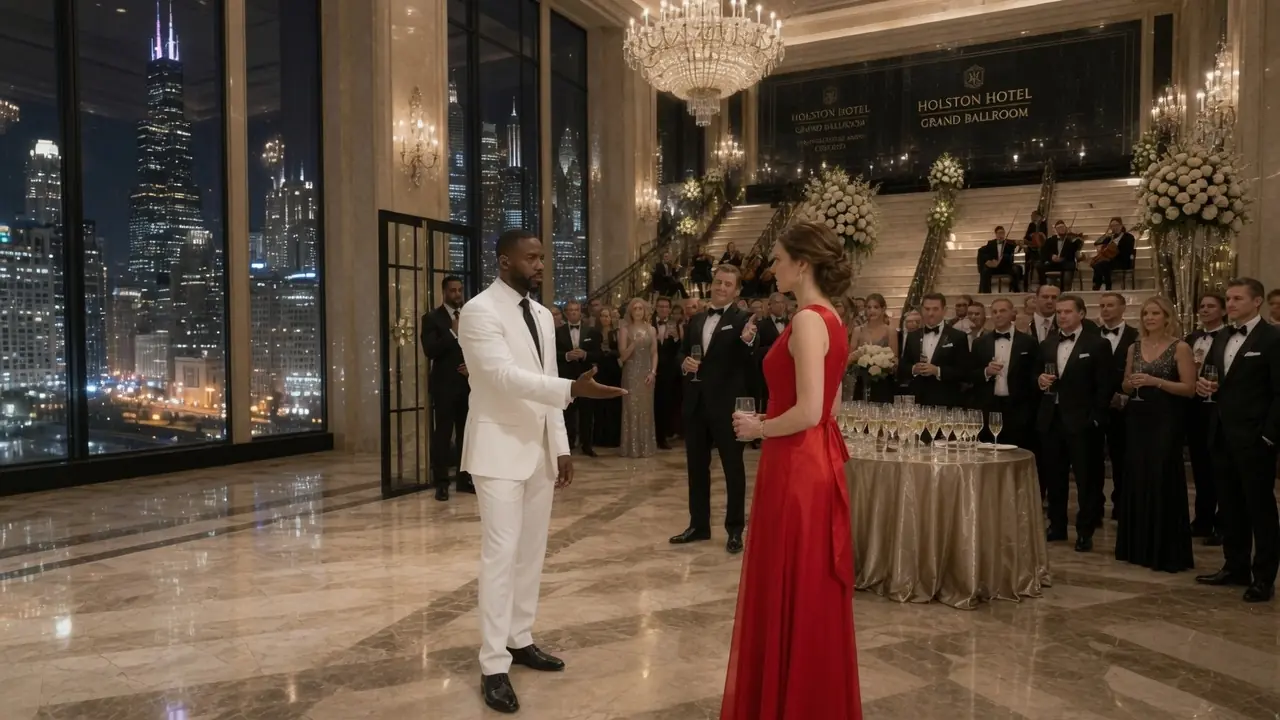
Preston Vale, heir to a banking fortune and loud enough to make sure the cameras noticed him, leaned toward his circle near the champagne table. He said the words with a smile sharp enough to cut silk. A few people laughed—not loudly, just enough to hurt.
Evelyn Whitmore heard it. Her face did not change. Her chin stayed lifted. Her eyes stayed forward. But Calvin saw the smallest thing happen: her thumb pressed against the rim of her sparkling water glass until the skin blanched. A young woman near Preston raised her phone, pretending to adjust her bracelet while angling the camera toward Evelyn. Another man smirked and stepped back, already enjoying a humiliation that had not happened yet.
The Whitmore Medical Trust Gala had taken over the Grand Ballroom of the Holston Hotel in downtown Chicago, fifty-two floors above the city, where the windows caught every light along Lakeshore Drive and turned the night into something expensive. Crystal chandeliers burned overhead. A string quartet played near the marble staircase. Men in black tuxedos spoke in low voices beside women wearing diamonds that could have paid off a neighborhood mortgage. Everything smelled like white roses, polished wood, and old money pretending to be new kindness.
At the center of it all stood Evelyn Whitmore, the woman whose name was printed on the invitations in silver ink. At thirty-six, she was a billionaire and chairwoman of the Whitmore Medical Trust—a woman people praised in public, feared in private, and never approached unless they had rehearsed every word twice. She wore a midnight blue gown that moved like water when she walked, but she had not moved in nearly ten minutes. She stood near the edge of the dance floor, completely alone.
Across the ballroom, Calvin Hayes watched from beside the east entrance, one hand resting lightly over the small radio clipped to his jacket. His security suit was clean, pressed, and plain, designed to disappear into the walls. At forty-two, Calvin had learned how to stand in rooms where nobody really saw him. He knew where every exit was. He knew which guests were drinking too fast, which reporters were pretending not to record, and which rich men laughed too loudly when they felt small.
But what held his attention was the way Evelyn's fingers tightened around her glass every time someone looked at her and turned away. Her shoulders stayed high, like armor no tailor could soften. Calvin had seen that look before—not on billionaires, but on widows at hospital elevators, on fathers outside courtrooms, on children waiting at school doors after every other parent had arrived. It was the look of someone trying very hard not to need anybody.
Calvin looked at the room, then at Evelyn, then at the polished dance floor opening like a spotlight no one had the courage to enter. His coworker, a younger guard named Ellis, noticed his expression and muttered, "Don't even think about it."
Calvin did not answer.
Ellis leaned closer, his voice low. "That woman can end your job with one sentence."
Calvin's eyes stayed on Evelyn. "Maybe," he said quietly. "Then maybe somebody should give her one moment where she doesn't have to be a headline."
He unclipped the radio from his jacket, set it on the service table, and stepped away from the wall.
The first few people barely noticed. Then one woman stopped speaking mid-sentence. A waiter slowed with a tray of drinks. Preston's smile widened as if the joke had just become entertainment. Calvin walked with no hurry and no performance, his old black dress shoes crossing the marble border of the ballroom. He was not dressed like a donor; he did not carry a title anyone cared about. He was a Black single father working security at a gala where one silent mistake could cost him rent, health insurance, and the after-school program his daughter, Norah, loved. Still, his back stayed straight, his hands stayed visible, and his face stayed calm.
When he reached Evelyn Whitmore, the quartet seemed to soften by instinct. Conversations thinned; forks paused above plates. Evelyn turned her head slowly, her pale eyes landing first on his jacket, then his name badge, then his face. Calvin stopped at a respectful distance, not too close, not too far, and gave the smallest nod.
"Miss Whitmore," he said, his voice low enough that only the nearest circle could hear. "Would you allow me one dance?"
The ballroom fell into the kind of silence that does not arrive empty. It arrives carrying every judgment in the room. Evelyn stared at him. For one second, she looked less angry than surprised, as if he had spoken to the woman beneath the name before asking permission from the billionaire above it.
Then her gaze sharpened again. "Do you know what happens to men who embarrass me, Mr. Hayes?"
Calvin did not smile. "Yes, ma'am," he said. "That's why I won't."
For a moment, nobody moved. Even the quartet seemed to hover between notes, waiting for Evelyn Whitmore to decide whether Calvin Hayes had just made a brave mistake or an unforgivable one. She studied him the way people in her world studied contracts, looking for the hidden cost. His suit was plain. His shoes were polished but old at the edges. His hands were steady, held where she could see them—not reaching, not assuming.
That was the first thing that unsettled her. Men in ballrooms usually took before they asked. They took attention, space, credit, air. Calvin Hayes had walked into the center of the room and somehow brought quiet with him. Evelyn glanced past him at Preston Vale, who was still smiling with that lazy confidence of a man born behind locked gates, and she realized those gates were built to keep others out.
Everyone wanted her to freeze the guard out. That would be familiar. That would be easy. The ice queen refusing the security guard—another sharp little story for people who mistook cruelty for strength. But Calvin did not look like he had come to win a dare. He looked like he had noticed something everyone else had chosen to ignore.
Evelyn lowered her glass onto the nearest tray without looking away from him. "One dance," she said.
Her voice was calm, but the room felt the change like a window cracking open in winter.
Calvin gave a single nod. "One dance, ma'am."
He offered his hand, palm open, still waiting. Not a demand, not a performance—a choice. Evelyn looked down at it. There were faint lines across his knuckles, the small marks of a man who fixed things himself because calling someone cost money. She thought of all the manicured hands that had reached for hers over the years—hands attached to men who wanted access, headlines, leverage, or her last name. This one waited as if her *yes* actually mattered.
---
A murmur moved through the ballroom and died just as quickly. Calvin turned toward the dance floor, careful with the distance between them, and Evelyn followed. The quartet found its rhythm again, a slow waltz rising under the chandeliers.
Calvin did not pull her close. He did not try to impress the room. His right hand settled at a respectful place near her shoulder blade—light enough that she could step away at any second, certain enough that she did not have to. That balance surprised her.
The first step came small, then another. Evelyn expected awkwardness, a stumble, a reason to end this before the photographers had anything useful. Instead, Calvin moved like someone who understood patience as a language. He led without pushing, turned without showing off, and gave her room to breathe inside the music. Her gown shifted across the floor, midnight blue against white marble, and for the first time that evening, people stopped pretending not to stare. Preston's smile faded by half. A woman near the staircase whispered, "Who is he?" No one answered, because no one had a category ready for him.
Calvin heard none of it, or acted like he did not. His eyes stayed level—not fixed on her beauty, not lowered in fear, but present. Evelyn hated how rare that felt.
"You have done this before," she said quietly.
"A little," Calvin replied. That was not an answer; it was a closed door with warm light under it. She should have left it alone, but she did not.
"Ballroom lessons?"
Calvin's mouth softened, not quite a smile. "Hospital hallways, mostly. My wife had a long recovery after an accident years ago." His voice was low enough to belong only to the music. "Doctors told her movement would help. She hated therapy rooms. So, we danced in the hallway outside room 412 every evening after visiting hours."
Evelyn looked at him, then really looked. There was no attempt to make the story sadder than it was. No reaching for sympathy—just fact, just memory held with clean hands. "Is she here tonight?"
Calvin's gaze shifted for the briefest second toward the windows, toward the city lights beyond the glass. "No, ma'am. She passed six years ago."
Evelyn's breath caught—not loudly, not dramatically, but enough for her own body to betray her. Calvin did not rush to comfort her; he gave her the dignity of silence.
The music carried them another turn. Outside, Chicago glittered as if grief could not reach the fifty-second floor. Inside, Evelyn felt something in her armor loosen and immediately wanted it back. "I am sorry," she said.
Calvin nodded once. "So am I." Then, after a beat, he added, "But my daughter says I still dance like I am being graded, so I keep practicing."
The smallest sound escaped Evelyn before she could stop it—not quite a laugh, too brief to become evidence, but Calvin heard it. She knew he heard it because his expression warmed without changing shape. Across the room, the silence deepened. Not because a billionaire was dancing, but because the man leading her was not trying to rise above anyone. He was simply refusing to let her be left alone in public shame. And somehow, that made him taller than every powerful man watching.
The waltz carried them past the center of the floor where the chandelier light fell in clean white circles, making every movement impossible to hide. Evelyn felt the room trying to understand what it was seeing. That was what rooms like this did: they measured, they labeled, they priced. A security guard dancing with the most powerful woman in the building should have looked like a mistake. Somehow, Calvin made it look like the only honest thing happening there. He did not smile for the cameras. He did not search the faces around them for approval. He moved with the steady concentration of a father crossing a dark room while trying not to wake a sleeping child—careful, quiet, certain.
Evelyn had spent years mistaking certainty for control. But this was different. Control tightened; certainty steadied. There was a mercy in that difference, and she did not know what to do with it.
Near the champagne table, Preston Vale lifted his glass again, irritated now that the joke had not landed. "Careful, Evelyn," he called, just loud enough for half the ballroom to hear. "The help might start thinking he belongs here."
A few people gave nervous laughs—the kind that came from fear, not humor. Evelyn's spine stiffened so quickly Calvin felt it through the frame of the dance. Her eyes went cold again. The old armor snapped back into place, but Calvin did not turn toward Preston. He did not raise his voice. He simply guided Evelyn through the next step, smooth as breath, and said softly, "Do not let small men decide how tall you stand."
Evelyn missed half a beat—just enough for her heel to catch at the seam where the temporary dance floor met the marble border. It was a tiny mistake. In another room, it would have meant nothing. In this one, hungry eyes would have turned it into weakness before morning.
Calvin felt the shift before she fell out of rhythm. His hand firmed—barely, not grabbing, not rescuing for show—just adjusting the turn so her weight returned to center. From the outside, it looked intentional, elegant—a graceful pause built into the music. No one saw the stumble except Evelyn and Calvin. That was the part that changed her face. He had protected her dignity without announcing that he had done it.
The dance continued, but something in the room changed. The whispers stopped. Phones lowered. Even Preston looked uncertain, because mockery needed an audience, and the audience had begun to feel ashamed of itself.
Evelyn looked at Calvin as they passed beneath the chandelier. "Why did you do that?" she asked.
His eyes stayed gentle, focused somewhere over her shoulder in the old, formal way. "Do what, ma'am?"
"You know what."
Calvin was quiet for two steps. Then he said, "My daughter is nine. Her name is Norah. When she was little, she would fall during dance practice and look around to see if anyone laughed before she decided whether to cry." Evelyn said nothing. Calvin's voice stayed even. "I learned to make the next move big enough that she could pretend the fall was part of it."
The words settled into Evelyn slowly. Not as a lesson, not as advice, but more like a door opening inside a house she thought she had locked years ago. She looked across the ballroom at the people who had feared her, wanted from her, judged her, envied her, and photographed her, but rarely protected anything human in her. They were silent now—not stunned by money, not impressed by status, but stopped by the sight of a man who could have used the moment to make himself visible, yet had used it to shield someone else.
The music softened toward its final measure. Calvin guided her through one last turn, then released her hand with the same care he had shown when offering his own. There was no lingering touch, no victory, no claim—just respect.
For a second, applause did not come. The room stood suspended, caught between what it had expected and what it had witnessed. Then, an older woman near the charity board began clapping slowly. Someone else joined, then another. The sound spread—polite at first, then warmer, though Calvin seemed almost uncomfortable with it. Evelyn knew applause; she had received it from investors, surgeons, senators, and entire auditoriums of people who wanted something. This sounded different. This sounded like a room trying to apologize without having the courage to use words.
Calvin stepped back and gave her a small nod. "Thank you for trusting me with the floor, ma'am."
Evelyn looked at him, and for once, the perfect sentence did not come. She had built an empire on knowing what to say, when to pause, where to cut, and how to win. But this man had handed her back a piece of herself in front of five hundred strangers, and all her language felt too polished to touch it.
---
Before she could answer, Preston appeared at the edge of the dance floor, still smiling, but his expression had thinned. "Well, that was charming," he said. Then he turned to Calvin, pulled a folded check from his jacket pocket, and held it between two fingers. "Name your price, Mr. Hayes. I would like the next miracle."
The check stayed in Preston Vale's hand, bright white under the chandelier light, as if paper could purchase what character had just given for free. Calvin looked at it for a long second, then at the man holding it. He did not move closer. He did not laugh. He did not make a speech. That was what made the silence worse for Preston. Men like him knew how to fight noise; they did not know what to do with calm.
"I appreciate the offer, sir," Calvin said, his voice even. "But I am not selling what your money never taught you."
The ballroom went still again, sharper this time. Somewhere near the back, a glass touched a table with a soft click that sounded too loud. Preston's smile stayed on his face, but it lost its comfort. "Excuse me?"
Calvin folded his hands in front of him the way security guards did when they were trying not to become part of the problem. "You asked for a miracle, sir. I cannot help with that. I only asked a woman to dance."
Evelyn turned her head toward him. *A woman.* Not the Whitmore name. Not the foundation chair. Not the billionaire in the blue gown. Just a woman. The word landed gently, and somehow that made it heavier.
Preston gave a short laugh and glanced around, looking for people to rescue him with their amusement. No one did. That may have been the first time all evening he understood the danger of a room deciding not to follow him. He tucked the check back into his jacket with slow, stiff fingers. "How noble," he said. "Very touching. But let us not pretend this is not convenient. A man in your position gets noticed by a woman in hers, and suddenly dignity becomes a strategy."
Calvin's face did not change, but Evelyn saw the line of his jaw settle. Not harden—settle. It was as if he had heard worse in grocery stores, in school offices, and in hotel lobbies, and had learned not to give strangers the satisfaction of making him feel smaller.
Before Calvin could answer, Evelyn stepped forward. Her voice was soft when she spoke, which made every donor in the ballroom lean in. "Mr. Vale," she said, "you pledged two million dollars tonight for the Children's Surgical Wing."
Preston blinked, caught by the turn. "Of course."
Evelyn nodded. "Then you understand how important it is that the people funding it possess a basic respect for the families who will walk through those doors."
The color rose in Preston's face. "Evelyn, I was joking."
"No," she said. "You were comfortable. The difference is expensive."
A hush moved through the room like a curtain being drawn. Evelyn turned slightly—not enough to make it theatrical, just enough for the nearest board members to understand she was no longer speaking socially. "The Whitmore Medical Trust will return your pledge by morning. We will not attach children's names to money that arrives with contempt still on it."
Preston stared at her. Several people did. Returning two million dollars in a ballroom full of donors was not a gesture; it was a message with a receipt.
Calvin looked at Evelyn then, truly startled for the first time. She did not look back at him. Her eyes stayed on Preston, but something in her posture had changed. The armor was still there, but now it was being used differently—not to keep everyone out, but to draw a line around someone else.
Preston gave a thin nod, the kind men gave when they had lost and needed to pretend they had simply chosen to leave. "As you wish," he said. He turned toward the bar, but the room did not follow him.
Power had shifted—not loudly, not legally, not through a title, but through the quiet discovery that fear was no longer the strongest thing in the ballroom.
Evelyn exhaled once, very slowly. Then she faced Calvin. For a moment, neither of them spoke. The quartet had stopped playing. The city glittered beyond the windows. Five hundred people stood around them, pretending not to watch.
Calvin broke the silence first. "That was a costly correction, ma'am."
Evelyn's expression softened by one degree. "So was letting it pass."
He nodded because he understood that kind of math—not the math of foundations and pledge sheets, but the other kind: the private cost of swallowing something ugly because the rent was due, because the child was waiting, because survival often asked decent people to stay quiet.
Evelyn looked down at his name badge again. *Calvin Hayes, Security.* The badge suddenly seemed too small for what she had witnessed. "Do you always speak to donors that way?" she asked.
"Only when they are not my donors."
Her mouth almost curved. "Almost. And do you always ask unreachable women to dance?"
Calvin glanced toward the service table where his radio sat, then toward the side exit where staff moved like shadows. "No, ma'am. Most nights I just check doors and make sure nobody parks in the fire lane."
A faint sound escaped her, warmer than before. This time, more people heard it. Evelyn Whitmore had laughed—not brightly, not openly, but enough to make the room remember she was capable of it. Calvin lowered his eyes with quiet courtesy, as if protecting even that small sound from becoming another thing people took from her.
---
Then his phone vibrated in his pocket. He ignored it at first, but it vibrated again. Evelyn noticed.
"You should answer," she said.
Calvin hesitated. "It is probably my daughter."
"Then you definitely should answer."
He stepped back, turned slightly away from the room, and checked the screen. Three missed calls from Norah. One voice message. His face changed before he could stop it—not with fear or panic, but with the tired tenderness of a father pulled back to the only world that mattered.
Evelyn saw it, and for the first time all night, she wondered what kind of man could stand inside a million-dollar gala and still look like home was somewhere else. Calvin did not play the message in the ballroom. He simply looked at the screen, pressed the phone against his palm, and slipped it back into his pocket with the careful restraint of a man who had learned that worry could wait until he was alone.
Evelyn noticed anyway. She noticed the way his shoulders shifted—not collapsing, just remembering weight. She noticed how quickly the gala returned to its polite breathing once the drama had passed, as if people could file away discomfort as long as dessert was still being served.
A board member approached her with a cautious smile and a folder tucked under one arm. "Evelyn, the children's wing announcement is in twelve minutes. The mayor's office would like a photograph near the donor wall."
Evelyn looked at the donor wall, where names in gold lettering covered a white backdrop like a shrine to generosity. Some gave because they cared; some gave because tax season existed; some gave because cameras loved clean suits and oversized checks. Tonight, she could no longer tell which was worse—the pretending, or how long she had accepted it.
Calvin had stepped back toward the edge of the floor, already returning himself to invisibility. That bothered her more than Preston's insult. He had entered the center of the room only to give her back her own dignity, and now he was walking away as if the world had no obligation to remember him.
"Mr. Hayes," she said.
He stopped at once, not startled, but attentive. "Yes, ma'am."
The board member looked between them, confused. Evelyn ignored him. "Your daughter... is everything all right?"
Calvin's eyes moved briefly to the room, measuring privacy. "She is with Mrs. Alvarez upstairs in staff housing until my shift ends. She knows not to call unless she needs me."
Evelyn heard what he did not say. Children did not call three times over nothing. "Then go."
Calvin shook his head slightly. "I am on duty until midnight."
"There are other guards."
"Not for my post."
Evelyn's gaze sharpened. "Mr. Hayes, I employ the hotel security contractor tonight. If I say your post is covered, your post is covered."
He looked at her, and for the first time, there was a boundary in his calm. "With respect, ma'am, I do not leave work because rich people make exceptions."
Evelyn blinked. Around them, the air tightened again, but quieter now, more private.
Calvin continued, his voice low. "Exceptions have a way of turning into favors. Favors turn into stories. Stories turn into people saying, 'He only got through the door because somebody felt generous.' I cannot bring that home to my daughter."
The sentence hit harder than any accusation. Evelyn had heard men brag about pride all her life; this was not pride. This was architecture—a man building walls around his child's future with nothing but discipline and tired hands.
The board member cleared his throat. "Evelyn, we really do need to stay on schedule."
She lifted one finger without looking at him, and he fell silent. "Calvin," she said, softer now. "May I ask your daughter's name?"
"Norah. Nine years old, fourth grade. She says she is going to be either an astronomer, a pastry chef, or president, depending on the homework load."
Evelyn almost smiled. Then the phone in Calvin's pocket vibrated again. This time, the sound seemed to pass straight through him. He took it out, looked at the screen, and answered quietly. "Norah."
He turned away, but Evelyn still saw his face change. It was fatherhood in its purest form—the whole world reduced to one child's voice.
"I am here, baby. Slow down. Tell me where you are." His eyes closed for half a second. "Okay. Stay with Mrs. Alvarez. Do not come downstairs. I am coming up."
He ended the call and looked at Evelyn. "I need five minutes."
She did not ask what happened. Something about his expression told her that questions would only slow down love. "Go," she said.
Calvin nodded once and moved toward the service corridor.
Evelyn should have turned back to the board, the cameras, and the mayor's aide waiting near the donor wall. Instead, she watched him leave. Then she handed her glass to the nearest waiter. "Cancel the photograph," she said.
The board member stared. "Cancel it?"
Evelyn was already walking toward the same corridor. "Tell them the children's wing can wait twelve minutes for a father."
---
The service hallway was nothing like the ballroom. There were no chandeliers and no roses—just beige walls, humming fluorescent lights, folded linens, and the distant clatter of catering trays. Evelyn's heels sounded too sharp there, too expensive, like they did not belong. Calvin was twenty feet ahead, moving fast but not running, one hand on the stair rail because the staff elevator was too slow. Evelyn followed without announcing herself.
On the next floor, a small sitting room had been set aside for staff families during long events. Mrs. Alvarez, a gray-haired housekeeper in a black uniform, stood near the doorway with a worried face. Inside, Norah Hayes sat on a sofa with a glittery backpack clutched to her chest, trying very hard not to cry. The moment she saw Calvin, she stood up.
"Daddy, I did not mean to call so much."
Calvin crossed the room and knelt in front of her, lowering himself until his eyes were level with hers. "Calling me was the right thing, always."
Norah's lip trembled. "The other kids were watching videos from downstairs. They said you were dancing with the ice lady because you wanted her money."
Calvin went very still. Evelyn stopped at the doorway, unseen for one more second.
Norah looked down at her sneakers. "I told them you do not do that. I told them my dad does not use people."
Calvin took a slow breath. "That is right."
Then she whispered, "But one boy said, 'People like us only get invited upstairs when somebody needs a story.'"
The room became painfully quiet. Evelyn felt the words land in a place no board meeting had ever reached.
Calvin gently took his daughter's hands. "Listen to me, star girl. We do not let confused people name us. Not downstairs. Not upstairs. Not anywhere."
Norah nodded, but her eyes were wet. Calvin brushed one tear from her cheek with his thumb. "I danced because someone was being laughed at. And nobody should stand alone while people make a joke out of their hurt."
Norah looked past him then and saw Evelyn in the doorway. Her eyes widened. Calvin turned.
Evelyn stood there without her armor fully assembled, one hand resting lightly against the door frame.
Norah whispered, "Are you the lady from the dance floor?"
Evelyn stepped in slowly, as if entering a room where money had no authority. "Yes," she said. "And your father told you the truth."
Evelyn had spoken to senators, surgeons, governors, and men who believed the world tilted when they entered a room. But standing in front of a nine-year-old girl with wet eyes made every polished sentence she owned feel useless.
Norah held her glittery backpack tighter against her chest. Calvin rose slowly but stayed beside his daughter—close enough for her to feel him, far enough not to speak for her. That was the first thing Evelyn noticed: he did not turn Norah into evidence. He did not use her tears to defend himself. He simply stood there, steady as a door left open in a storm.
Mrs. Alvarez looked from Calvin to Evelyn, nervous about the invisible line that separated staff from guests, workers from donors, and people who cleaned rooms from people who named buildings. Evelyn felt that line in the beige walls, in the folded linens, and in the way everyone waited for her to decide what kind of woman she would be outside the ballroom.
Norah wiped her cheek with the back of her hand and said, "Are you mad at my dad?"
Evelyn took a breath. "No, I am not mad at your father. He helped me tonight."
Norah studied her with the direct suspicion only children and wounded people have. "Then why did they laugh?"
Calvin's hand shifted once at his side, but he stayed silent. Evelyn looked down at her blue gown—at the fabric that had seemed elegant under chandeliers and now seemed almost foolish under fluorescent lights.
"Because some people laugh when they do not understand kindness," she said, "and some laugh because it is easier than admitting they were wrong."
Norah's face softened, but not fully. "Did you laugh?"
The question was small and carried no accusation. That made it harder. Evelyn could have said no; technically, she would have been telling the truth. But truth without honesty was just another expensive lie. She looked at Calvin, then back at Norah.
"I have laughed at people before," she said quietly. "Maybe not tonight. Maybe not out loud. But I have stood in rooms and let people feel invisible because it was convenient for me."
Calvin's eyes lifted to hers—not sharply, not approvingly, just present.
Norah hugged her backpack a little less tightly. "My dad says invisible people still have names."
Evelyn nodded. "Your dad is right."
Norah looked at Calvin then, and some of the fear left her shoulders. Evelyn felt something shift inside her—a small, private collapse no one would applaud. Downstairs, five hundred guests were waiting for her to announce a hospital wing. Instead, one child had just explained the part her foundation had forgotten.
Calvin checked his watch. "I should get Norah settled and return to my post."
Evelyn turned to him. "You do not have to return tonight."
His expression closed by a fraction. "Ma'am..." She heard the warning in that single word—not anger, but a boundary.
She corrected herself before pride could ruin the moment. "I did not mean as a favor. I mean the hotel can reassign coverage. You have done your job."
Calvin glanced toward Norah. "I have done part of it."
Evelyn understood. The other part was standing in the room with a glittery backpack and a trembling lower lip.
Norah looked up. "Daddy, you can go back. I am okay now."
Calvin crouched again. "Being okay is not something you have to perform for me."
Norah blinked fast, then leaned into him. He wrapped one arm around her with the care of someone holding the most valuable thing he would ever own. Evelyn looked away, not because the moment was inappropriate, but because it felt too honest to stare at.
Mrs. Alvarez cleared her throat softly. "Miss Whitmore, they are calling for you downstairs."
Evelyn almost laughed at the timing. The whole building wanted her back in the costume of importance. She looked at Norah. "Would you and your father come downstairs with me?"
Calvin stood up. "I do not think that is wise."
"Neither do I," Evelyn said. "That is why I think it matters."
The room went quiet. Norah looked between them. "Why?"
Evelyn knelt carefully, her gown folding around her like spilled midnight. Calvin's eyebrows lifted slightly, but he said nothing. Evelyn met Norah's eyes at her level.
"Because people downstairs heard a story about your father that was not true. I cannot control what every person says after tonight, but I can decide what I allow to stand in my name."
Norah considered this, serious as a judge. "Will there be cake?"
For the first time, Evelyn smiled without guarding it. "There is a very large cake."
Norah looked at Calvin. "Daddy?"
Calvin looked at his daughter for a long moment, then at Evelyn. "You understand what you are asking?"
Evelyn rose. "Yes. I am asking you not to disappear just because the room expected you to."
Calvin studied her. The hum of the fluorescent lights filled the silence. Finally, he reached for Norah's backpack and slung it over one shoulder. Norah took his hand. Evelyn stepped aside, letting them leave first. It was a small thing, almost nothing, but Mrs. Alvarez saw it. Calvin saw it. Norah saw it. And when they walked toward the service stairs together, Evelyn Whitmore followed—not leading with her name this time, but walking behind the father and daughter who had just shown her the difference between charity and respect.
---
The service stairwell opened behind the ballroom, where the music had returned, but the air had not. Conversations moved in careful pieces. Smiles looked repaired rather than natural. The donor wall still glowed under soft lights, waiting for Evelyn Whitmore to stand before it and accept applause for a future wing that children had not yet walked through.
But when Evelyn entered from the side corridor, she did not come alone. Calvin Hayes walked beside Norah, his daughter's small hand folded inside his, her glittery backpack hanging from his shoulder like the most honest accessory in the building.
For two seconds, the gala did not know what to do with them. Then, it looked.
Norah slowed down immediately. Calvin felt it through her hand and gave her fingers one gentle squeeze. "You are all right, star girl," he whispered. "Lift your chin."
She lifted her chin, trying to borrow his calm. Evelyn saw it and felt something ache quietly behind her ribs. She had spent half her life teaching rooms to fear her; Calvin had spent one hallway teaching a child how to stand inside one.
The mayor's aide hurried forward with a frozen smile. "Miss Whitmore, we are ready for the announcement. The photographers are set."
Evelyn looked toward the small stage near the donor wall, then toward Calvin. He had already begun to step back, guiding Norah toward the edge of the room where staff families were meant to be invisible.
"Mr. Hayes," she said, not loudly, but clearly enough that the nearest guests turned.
Calvin paused. "Yes, ma'am?"
Evelyn held out her hand—not for a dance this time, but toward the front of the room. "Please join me."
Calvin's expression remained respectful, but she saw the refusal forming. Before he could speak, she added, "Miss Whitmore, I appreciate it, but my daughter and I are not part of the program."
Evelyn nodded once. "That is the problem."
The room quieted in layers. Norah looked up at her father. Calvin looked at Evelyn for a long, unreadable moment. Then he leaned down to Norah. "Your choice, baby."
Norah swallowed and asked, "Will people stare?"
Calvin's answer came without hesitation. "Some will." Then he added, "That does not mean they own where you stand."
Norah took one breath, then another, and nodded. They walked to the stage together.
The applause that followed was confused at first, because people often clap when they are unsure whether silence will expose them. Evelyn stepped behind the microphone. The prepared remarks waited on the clear podium—three pages of polished language about innovation, access, pediatric care, and legacy. She looked at them, then turned the pages face down. A ripple moved through the board members.
Evelyn looked out at the crowd. "Twelve minutes ago," she said, "I was supposed to stand here and thank the most important people in this room." Her eyes moved briefly to Calvin and Norah. "I realized I had been wrong about who those people were."
No one breathed too loudly.
"This foundation was built to serve families who walk into hospitals carrying fear, exhaustion, bills, and hope in the same two hands. Tonight, one of those fathers reminded me that dignity is not something we give to people after they prove themselves. It is something we owe them before we know their names."
Calvin lowered his gaze. Norah stared at Evelyn, wide-eyed. Preston stood near the bar with his face turned partly away, but even he did not leave.
"I have spent years putting my name on buildings," Evelyn continued, "but names on buildings do not comfort children. People do. Teachers do. Security guards do. Fathers who leave ballrooms because their daughters called do."
A woman near the charity board pressed her hand to her mouth. Mrs. Alvarez, standing in the service doorway, blinked quickly and looked down.
Evelyn's voice softened, but it carried farther than before. "So tonight, before we announce another wing, we are creating a family support fund attached to it. Not for photographs, not for plaques—for transportation, meals, overnight stays, counseling, and childcare. The things wealthy people call details because they have never had to choose between gas and medicine."
The room changed then—not with shock, but with recognition. Some guests looked uncomfortable, others looked ashamed, and a few looked relieved, as if someone had finally said the thing their own lives had taught them.
Quietly, Evelyn turned toward Calvin. "Mr. Hayes, I will not ask you to stand here as a symbol. That would be another way of taking from you. But I would like to ask your permission to name the first community advisory seat after your late wife's hallway dance program, if that is something your family would allow."
Calvin looked up slowly, the words reaching him before he was ready for them. Norah squeezed his hand. "Daddy," she whispered, "Mom would like that."
Calvin closed his eyes for one second. When he opened them, they shone, but his voice stayed steady. "Her name was Elise."
Evelyn nodded. "Then we will call it the Elise Hayes Family Care Seat. Not because she belonged to this foundation, but because love like that belongs wherever families are trying to heal."
The applause came differently this time—not loud at first, but real first, then full. Calvin stood still, one hand holding Norah's, the other curled lightly around the backpack strap on his shoulder. He did not look victorious; he looked humbled by the weight of being seen correctly.
Evelyn stepped away from the microphone and let the applause pass around them without touching what was sacred. For the first time all evening, the ballroom was not silent because it was judging; it was silent beneath the applause because it had finally learned how to listen.
---
After the announcement, the gala did not return to what it had been. It tried. The quartet played again. Servers moved between tables with trays of coffee and miniature desserts. Board members adjusted their smiles and pretended the evening had always been meant to bend this way. But something invisible had been rearranged.
People looked at Calvin differently now, and he was not sure he liked it. Some looks were respectful, some were curious, and a few were the same old hunger wearing a kinder face. He had spent too many years being unseen to trust sudden visibility. Norah, however, trusted cake. She sat at a small, round table near the side of the ballroom with a slice of chocolate layer cake in front of her, swinging her feet above the carpet while Mrs. Alvarez fussed over a napkin tucked beneath the plate. Calvin stood nearby, one eye on his daughter, the other on the room.
Evelyn noticed that, too. Even after the applause, even after his late wife's name had crossed the microphone and entered the foundation's records, even after people who would not have greeted him an hour ago now whispered his name with careful admiration, he remained a father first. Everything else stood in line behind that.
Evelyn stepped beside him, holding two cups of coffee. She offered one. "Black, no sugar," she said.
Calvin accepted it, surprised despite himself. "How did you know?"
"You look like a man who does not ask coffee to lie."
That almost made him smile. They stood in a quiet pocket near the donor wall—close enough to hear the party, far enough not to belong to it. Norah laughed softly as Mrs. Alvarez pretended to mistake her fork for a microphone. Evelyn watched the child, then looked down at her own cup.
"I should apologize," she said.
Calvin did not rush to fill the space. "For what?"
"For many things." She glanced at him. "For assuming I understood people because I funded programs for them. For letting rooms like this teach me whose discomfort mattered. For almost letting them laugh at you because correcting them would have cost me less than admitting I had benefited from the same silence."
Calvin looked toward the ballroom floor, where the place they had danced now held two elderly donors moving slowly to the music. "My mother used to say an apology is only the receipt," he said. "The repair is the purchase."
Evelyn nodded, as if writing it somewhere inside herself. "Your mother sounds wise."
"She is. She lives in Milwaukee now. Calls every Sunday after church to remind me I am not as grown as I think."
Evelyn's mouth warmed. "Mothers have a way of doing that."
Calvin heard the slight change in her voice and understood there was a closed door there, too. He did not push it. That restraint unsettled Evelyn more than questions would have. Most people tried to enter her pain as if curiosity were a key; Calvin simply stood outside it with respect.
Across the room, Preston Vale moved toward the exit with two men from his circle, no longer laughing. A photographer raised a camera toward him, but Preston lifted a hand and turned away. Evelyn saw him leave and felt no triumph, only fatigue. There had been a time when humiliating a man like Preston would have satisfied her for days; now it felt like sweeping glass after someone else broke the window.
Calvin followed her gaze. "Returning that pledge will make people talk."
"People already talk."
"Yes, ma'am. But now they may say something useful."
That did make her smile, small and real. Then her expression settled again. "I would like you to come to the foundation office tomorrow."
Calvin's face became careful. Evelyn expected that now.
"Not for a favor," she added. "Not for publicity, not for a photograph with Norah." His eyes sharpened at his daughter's name, and she was glad they had. "For a conversation," she said. "About the family support fund. About what families actually need when hospitals become their whole world."
Calvin looked at the coffee in his hand, then at Norah, who was now explaining something serious to Mrs. Alvarez with frosting on her chin. "I am not a consultant," he said.
"No," she waited. "You are a father who knows the shape of waiting rooms. That matters more."
The words sat between them, quiet but not soft. Calvin had been offered things before, usually low things dressed as opportunities—extra cash to look the other way, a better shift in exchange for silence, or compliments that felt like someone testing the price of his pride. This did not feel like that, but caution had kept food on his table more than trust ever had. Evelyn seemed to sense it.
"I will pay you for your time at a professional rate," she said. "A contract, clear terms, no fad, no stories. No one touches your daughter's name without your permission."
Calvin looked at her then—really looked at the blue gown, the tired eyes, the woman trying to learn a language her money had never required her to speak.
"Tomorrow," he said finally. "I work from 3:00 in the afternoon until 11:00 at night."
"Morning, then. After school drop-off. 7:45."
Calvin nodded. "7:45."
Norah looked over and called, "Daddy! Miss Evelyn said the cake has raspberry in it, but I forgive her because it is still good."
Calvin looked at Evelyn with one eyebrow raised. "Miss Evelyn?"
Evelyn lifted her cup. "Your daughter negotiated the title herself."
Calvin shook his head softly, and for the first time that night, he smiled fully, changing his whole face. Evelyn saw the man the ballroom had missed—not a symbol, not a story, not a miracle, just a tired father with old grief, strong manners, and a smile he did not spend carelessly. The sight stayed with her longer than the applause.
---
By the time the gala ended, the ballroom looked almost ordinary again. Chairs had shifted. Coffee cups sat half-empty on white linen. The donor wall still glowed softly, but its gold lettering no longer seemed like the center of the room.
Calvin carried Norah's backpack over one shoulder while she walked beside him, sleepy now, one small hand tucked into his. Evelyn stood near the hotel entrance with her coat over one arm, watching guests step into waiting cars as if the night had not changed them. Some thanked her, some avoided her eyes. A few stopped to shake Calvin's hand, and he accepted each gesture with the same quiet courtesy—never too eager, never cold.
When his ride-share pulled up outside, Norah turned back and waved at Evelyn. "Good night, Miss Evelyn. Thank you for the weird raspberry cake."
Evelyn smiled. "Good night, Norah. I will ask for chocolate next time."
Norah approved with a serious nod, then climbed into the back seat. Calvin paused with one hand on the car door. "7:45," he said.
Evelyn nodded. "7:45."
For a moment, the city moved around them—tires hissing against damp pavement, wind slipping between the hotel columns, lake air touching the edges of her gown. Evelyn wanted to say something large enough for what had happened, but Calvin had a way of making large words unnecessary, so she simply said, "Thank you for not letting them decide who I was tonight."
Calvin looked at her, tired, his eyes gentle beneath the hotel lights. "Thank you for deciding differently before the night was over."
Then he got into the car beside his daughter, and the vehicle pulled away from the curb. Evelyn stood there until the taillights disappeared into Chicago traffic.
The next morning at 7:42, Calvin arrived at the Whitmore Medical Trust office in his plain navy jacket, Norah's school drop-off receipt still folded in his pocket. Evelyn was already waiting in the lobby. Not upstairs, not behind glass, not surrounded by assistants—just standing near the front desk with two coffees in her hands. One black, no sugar.
Calvin stopped for half a second when he saw her. She offered the cup. He accepted it. Neither of them mentioned the ballroom first. They walked toward the conference room together, past framed photographs of buildings Evelyn had funded and families she had never met. This time she looked at every face. This time Calvin noticed, and somewhere between the elevator doors and the quiet morning light, the foundation began to become less of a monument and more of a promise.