"Who let this black dog into my boardroom?" Gregory Crane said it loud. Twelve board members heard every syllable.
Damon Ingram, the only black face in the room, kept his composure. "That algorithm saves this company $200 million a year."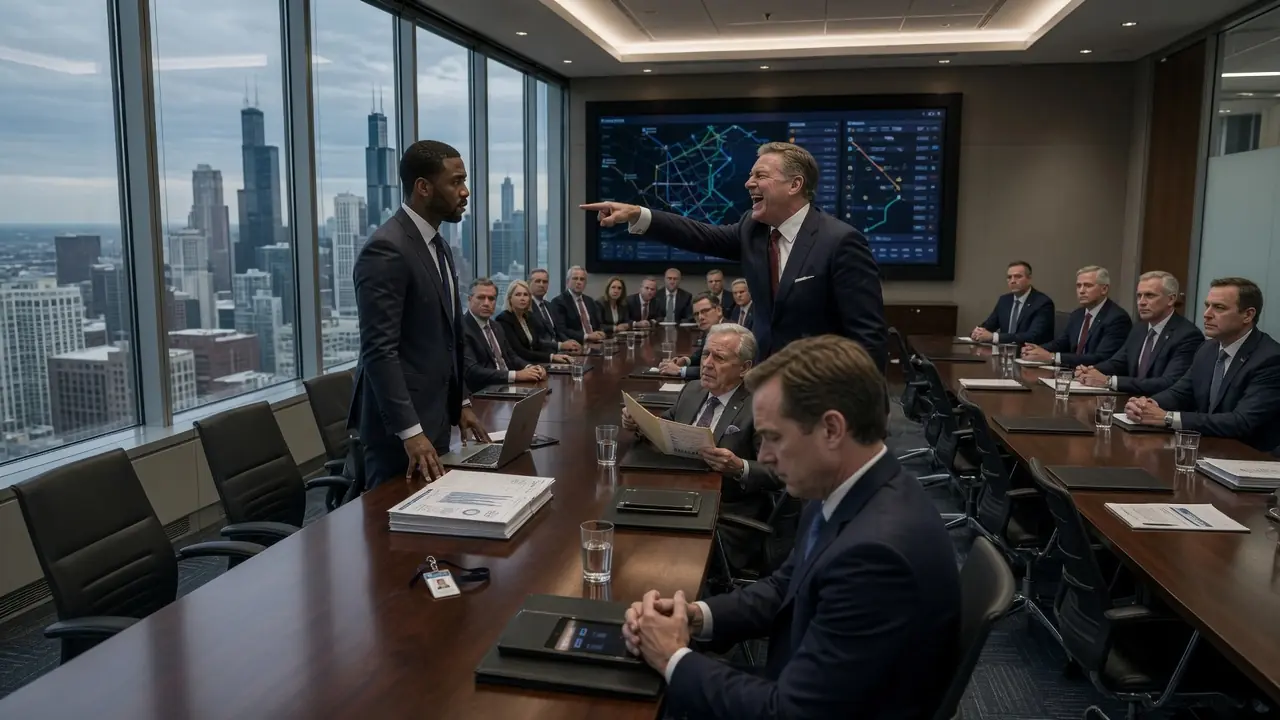
Gregory snorted. "An idea? From you? Stupid idea. Stupid pitch. Dogs don't have ideas. That's all you are."
"You'll regret this, Mr. Crane."
Gregory laughed. "A broke black nobody threatening me? You're fired. Get out."
No job. No savings. No connections. Just a fired black single dad with a crayon drawing and an idea his CEO called stupid. But that idea didn't die. It followed him home, and what it became next, Gregory Crane never saw coming.
***
Damon drove home with the windows down because the AC in his twelve-year-old Honda had been broken since last summer. The Chicago air was thick and warm. His laptop sat on the passenger seat. His phone buzzed twice, but he didn't check it.
Nora was already asleep when he got home. Lorraine was sitting at the kitchen table, reading glasses on, her Bible open in front of her. She looked up the moment he walked in and knew. Mothers always know.
"What happened, baby?"
Damon set his laptop on the counter. "They let me go, Mom."
Lorraine took off her glasses. She didn't ask why. She didn't ask what he did wrong. She just said, "Sit down. I'll heat up a plate."
He sat at the kitchen table—the same table where he'd spent hundreds of late nights writing code after Nora went to bed, the same table where Celeste used to sit across from him, grading papers while he coded, both of them too stubborn to go to sleep first. That table held more history than any boardroom.
His phone buzzed again. This time he looked. It was an email from Whitfield and Crane HR.
> **Subject:** Position eliminated effective immediately. Two weeks severance. Return your badge by Friday.
That was it. Three years of work reduced to four sentences. He set the phone face down on the table and stared at the wall.
Later that night, after Lorraine fell asleep on the couch, Damon walked into Nora's room. She was curled up under her purple blanket, one arm around a stuffed bear. On her nightstand, under a cup of crayons, sat the original drawing—the one she'd made the night he first told her about his algorithm. It showed a stick-figure Damon on a stage, stars everywhere, with big, wobbly letters at the top: *Daddy's big idea.*
She'd said that night, grinning with a missing front tooth, "When you show them, Daddy, they'll clap."
***
The next morning at Whitfield and Crane, Gregory Crane walked into the building whistling. His assistant handed him two things: a latte and a quarterly churn report. Client losses were up 15%. The routing system was hemorrhaging money—exactly the problem Damon's algorithm was designed to fix.
In the hallway, Howard Whitfield, the seventy-one-year-old founder's grandson whose role was mostly ceremonial, stopped Gregory by the elevator. Howard had a manila folder in his hand. "Gregory, that young man's presentation yesterday... I read his full deck after the meeting."
Gregory sipped his latte. "Howard, I handled it."
"The numbers were compelling. The efficiency models were—"
"Howard." Gregory put his hand on the old man's shoulder. "Trust me. That kind of guy doesn't build things. He copies things. I did us a favor."
Howard frowned. He opened his mouth, then closed it, turned around, and walked back to his office. That was the first crack. Small, barely visible, but it was there.
Three days passed, then five, then ten. Damon applied to nine companies—software firms, logistics startups, tech consultancies. He tailored every resume. He followed up twice.
Nothing. Not a single callback. Not even a rejection. Just silence.
He didn't know it yet, but Gregory's HR team had quietly blackballed him. A few phone calls, a few whispered words: *Difficult to manage. Performance issues. Not a team player.* That's all it takes to erase a man in this industry. No paper trail. No proof. Just doors closing one by one.
By the second week, Damon was sitting at the kitchen table at two in the morning, staring at his laptop screen. His savings account showed $11,243. Rent was due in nine days. Nora needed new shoes for school. The Honda needed an oil change he couldn't afford.
Lorraine found him like that—hunched over, eyes red, the cursor blinking on a blank job application. She sat down across from him. She didn't say, "It'll be okay." She didn't quote scripture. She just looked at the laptop screen, then at him, and said, "You still got that thing? That program you built?"
"It's an algorithm, Mom."
"I don't care what it's called. Is it good?"
Damon paused. He rubbed his eyes. "I think it could change how every shipping company in the country operates."
Lorraine leaned forward. "Then stop begging people to hire you, baby. Hire yourself."
She said it the way she said everything—like it was obvious, like she'd been waiting for him to catch up. Lorraine Ingram had spent thirty-one years mopping hospital floors, and in that time she'd learned one thing most CEOs never do: dignity isn't something anybody can give you or take away. You either carry it or you don't.
Damon looked at her for a long time, then he looked at his laptop. The algorithm was still there. Every line of code had been written on his own time, on his own machine, saved to his own drive. It belonged to him. All of it.
He closed the job application tab, opened a blank document, and typed three words at the top: *Bridgepoint Systems Inc.*
That night, he walked into Nora's room and pinned her crayon drawing above his laptop on the kitchen table. It stayed there through every late night, every doubt, every moment he almost quit. Eleven thousand dollars, a kitchen table, a crayon drawing, and an algorithm that one man called the stupidest idea he'd ever heard—that was all Damon Ingram had.
But somewhere on the fourteenth floor of Whitfield and Crane, the routing system was bleeding money, and Gregory Crane had just thrown away the only man who knew how to stop it.
***
Six weeks. That's how long Damon lived on four hours of sleep a night. Every evening the routine was the same: dinner with Nora, homework, bath, story, lights out by 8:00. Then Damon would sit down at that kitchen table and code until his vision blurred. Lorraine stayed over most nights, sleeping on the couch, waking up at 5:00 to make breakfast before Nora's school bus came.
The prototype came together piece by piece. Not in a gleaming tech lab, not in some venture-backed office with cold brew on tap, but on a second-hand laptop at a kitchen table with a wobbly leg, in a two-bedroom apartment on the south side of Chicago where the radiator made a banging sound every thirty minutes.
But the algorithm worked. It more than worked. Damon ran simulations on public shipping data, port schedules, freight routes, fuel costs, and warehouse turnover. Every simulation showed the same thing: a 30 to 40% efficiency gain across the board. The math was undeniable.
The problem was math doesn't pay rent. His savings were down to $6,800.
He found a startup pitch competition in Chicago—one of those events where fifty founders get five minutes each in front of a panel of investors. The entry fee was $250. He almost didn't register. That money was Nora's new shoes and two weeks of groceries.
Lorraine saw him staring at the registration page. "What's that?"
"A pitch competition. Investors watch you present and decide if they want to fund you."
"How much to get in?"
"Two hundred and fifty."
Lorraine pulled her purse off the back of the chair, took out three hundred-dollar bills, and set them on the table. "I was saving that for new curtains. The curtains can wait."
***
The competition was held in a converted warehouse in the West Loop. Thirty founders, exposed brick, open bar. Damon walked in wearing his only interview shirt, the same one he'd worn to the boardroom. He was the only black man in the room.
Most of the other founders pitched like they were performing—big voices, big gestures, words like *disruptive* and *revolutionary* flying around like confetti. One guy used the phrase *paradigm shift* three times in four minutes.
When Damon's turn came, he didn't perform. He walked to the front, opened his laptop, and talked numbers. Quietly. No flash, no buzzwords—just the algorithm, the data, the savings. He spoke for four minutes and thirty seconds. Most of the judges looked bored before he hit minute two.
But one didn't. Elaine Woodson sat in the far left chair. Sixty-one years old, silver hair pulled back, reading glasses on a chain around her neck. She'd built a $900 million venture fund from nothing, and she'd sat through ten thousand pitches in her career. She could smell a real idea the way a chef smells a good kitchen before they even taste the food. She leaned forward at minute three. By minute four, she'd stopped writing notes. She was just listening.
After the event, while the other founders networked at the bar, Damon packed up his laptop. He was heading for the door when a voice stopped him.
"Your pitch was terrible."
He turned. Elaine Woodson was standing three feet behind him, arms crossed.
"Excuse me?" Damon asked.
"Your pitch—terrible. Monotone, no energy, no story. You presented like you were reading a tax return." She paused. "But your idea is extraordinary. The most original logistics model I've seen in fifteen years. Can we talk?"
They met the next afternoon at Elaine's office on Michigan Avenue, on the thirty-second floor. It was the kind of office where everything is white and gray, and the coffee comes in cups that cost more than Damon's shoes.
Elaine grilled him for two hours straight. She pulled apart every assumption, challenged every data point, and asked him why no one had built this before. Damon answered every question with no exaggeration and no performing. When he didn't know something, he said so. When she pushed too hard on a technical point, he pushed back with data.
Finally, she leaned back and asked the question she'd been circling. "Why did you leave Whitfield and Crane?"
Damon was quiet for a moment. "I didn't leave. I was fired. In front of the entire board. The CEO called my idea stupid. Then he called me worse than that."
"Worse how?"
"He called me a dog, Mrs. Woodson. Because of the color of my skin."
Elaine held his gaze for a long time. Then she opened a drawer and pulled out a term sheet for $2 million in seed funding. She slid it across the desk.
Damon picked it up and read every line, every clause, and every footnote. Elaine watched him, expecting the reaction she always got—shaky hands, a grateful nod, a signature before the ink was dry.
Instead, Damon set the paper down, pulled a pen from his pocket, and circled three clauses. "These don't work for me."
Elaine blinked. "Excuse me?"
"Clause four gives you controlling interest at Series A. Clause nine lets you replace me as CEO with board approval. Clause fourteen restricts hiring to your network referrals only." He slid the paper back. "I need three things, and they're not negotiable."
"A man with $6,000 in the bank is giving me conditions?"
"Yes, ma'am." He held up one finger. "First, I keep majority ownership. This is my idea, my code, my risk. I'm not giving control to anyone." He raised a second finger. "Second, the company hires from underserved communities first—not as charity, but built right into the charter. The people no one gives a chance to get the first shot." He raised a third finger. "Third, you advise. You don't control. I don't need another boss telling me what I can and can't build. I need a partner."
Elaine stared at him. In thirty years of venture capital, she had never, not once, had a founder with nothing negotiate like a man who had everything. Most people in Damon's position would have signed anything, taken any deal, begged for the money, and figured out the terms later.
But Damon wasn't most people. Lorraine Ingram didn't raise a beggar. She raised a man who knew his worth, even when the world told him he had none.
Elaine took off her reading glasses. "You've got nerve, Mr. Ingram."
"I've got a daughter, Mrs. Woodson. And I promised her mother I'd build something that matters. I don't break promises."
Elaine looked at him for a long moment. Then she picked up her pen, crossed out the three clauses, initialed the changes, and signed at the bottom. "Deal."
***
Two weeks later, a certified letter arrived at Damon's apartment. The return address read: *Whitfield and Crane Technologies, Legal Division.* It was a cease and desist. Gregory Crane was claiming Damon's algorithm was proprietary company technology, developed on company time and company property.
Damon read it standing at the kitchen counter while Nora sat at the table doing homework. She looked up when she saw his face change. "Daddy, is someone being mean to you again?"
Damon folded the letter, put it in the drawer, looked at his daughter, and said, "Just somebody who forgot the difference between stealing and building, baby."
That night, after Nora went to sleep, Damon sat at his laptop and opened every file, every commit log, and every timestamp. Every line of code had been written between 10:00 p.m. and 3:00 a.m. All of it was on his personal machine, saved to his personal GitHub account. The evidence was clean. The work was his.
Gregory Crane had just fired a shot across his bow, but he'd aimed it at a man who had already survived the worst thing life could throw at him—losing Celeste. A cease and desist letter from a man in a glass tower didn't even register. Gregory wanted a fight, but he didn't know it yet: he'd just picked one with the wrong man, at the wrong time, over the wrong idea.
***
Bridgepoint Systems was born in a rented office above a barber shop in Brownsville. Four hundred square feet, two folding tables, three second-hand monitors Damon bought off Facebook Marketplace for $80 each, and a coffee maker that took six minutes to brew one pot. And on the wall, taped at eye level with a piece of Scotch tape, hung Nora's crayon drawing—*Daddy's big idea*—the stick figure with stars around his head, watching over everything.
Damon didn't hire from Stanford. He didn't recruit from Google. He walked into a community coding bootcamp on the South Side, the kind of place where twenty-year-olds who couldn't afford college taught themselves Python from YouTube videos. He sat in the back row for an entire class without saying a word.
When it was over, he approached three students. The first was a twenty-three-year-old woman named Keisha Grant. No degree, no connections, she'd been teaching herself code for two years while working the night shift at a gas station. The second was a kid named Andre Simmons, nineteen, who'd been in and out of the foster system since he was six and had built a delivery tracking app on a cracked laptop. The third was a quiet, focused man named Terrence Bell, twenty-eight, an Army vet with two tours and a gift for data architecture that he'd never been given a chance to use.
Damon told them the same thing: "I can't pay you much right now, but I can promise you this. You'll never be invisible in my company. Your name will be on the work. Your voice will be in the room. And nobody will ever call your ideas stupid."
All three said yes before he finished the sentence.
The first two months were brutal. They worked twelve-hour days, six days a week. The office was too hot in the afternoons and too cold at night. The Wi-Fi dropped twice a day. Damon covered payroll from Elaine's seed money and didn't pay himself for the first ninety days.
But something was happening in that little room above the barber shop—something Gregory Crane would never understand. These four people, thrown away by every system that was supposed to lift them up, were building something real. Something beautiful. Not because they had resources, but because they had each other.
Keisha debugged routing models faster than anyone Damon had ever seen. Andre built a user interface so clean and intuitive that Elaine's own tech team couldn't believe a nineteen-year-old designed it. Terrence restructured the entire data pipeline in three weeks—a job that would have taken a corporate team three months.
And every morning when someone walked in and sat down at those folding tables, they looked up at the crayon drawing on the wall. It became a ritual, an inside joke, a mission statement. Andre started calling it "the boardroom" because that drawing was the only board of directors Bridgepoint would ever need.
***
Elaine visited the office for the first time in late October. She stood in the doorway for a full ten seconds, looking at the folding tables, the tangled extension cords, and the coffee maker held together with duct tape. She didn't say anything, but her face said everything.
She sat down with Damon in the back corner, which was really just two chairs next to a stack of printer paper, and went through the numbers: revenue projections, burn rate, and the hiring pipeline. Then she stopped at one line.
"You hired a woman with no college degree as your lead engineer?"
"Keisha Grant. She's the best coder in this room, including me," Damon said.
"Damon, I'm trying to help you build a company that investors will take seriously. No degree, no portfolio, no track record."
"Elaine." Damon leaned forward. "You funded the algorithm. Fund the philosophy, too. The whole point of Bridgepoint is that talent doesn't come with a diploma. If you don't believe that, we have a bigger problem than Keisha's resume."
Elaine went quiet. She looked out the window. When she turned back, there was something different in her eyes—softer, older.
"My son's name was Connor," she said. "He was twenty-six when he died. Overdose. I was in a board meeting when the hospital called. I didn't pick up because I was closing a deal." She paused. "I built a $900 million fund, Damon, and I would trade every cent of it to hear his voice again."
Damon didn't offer empty sympathy; he didn't say, "I'm sorry." He knew those words were useless when the wound was that deep. He just said quietly, "Then help me build something where people matter more than portfolios."
Elaine looked at the crayon drawing on the wall, looked at Keisha and Andre and Terrence working at their folding tables, and looked at a company that had nothing except the one thing her billion-dollar fund had always lacked: a soul.
"Okay," she said. "Okay."
That was the day Elaine Woodson stopped being just an investor and started being family.
***
Three weeks later, Damon almost destroyed everything.
It was a Thursday. Bridgepoint had just landed its first pilot program; a regional shipping company in Indiana wanted to test the algorithm on their fleet of two hundred trucks. The deadline was tight, and Damon was working around the clock. He forgot to eat. He forgot to call. And he forgot that Thursday was November 14th—Nora's ninth birthday.
Lorraine called him at 6:00 in the evening. He picked up and heard the heavy silence before she spoke, that particular silence only a mother uses when she's furious but too dignified to yell.
"Damon James Ingram, your daughter has been sitting at this table in her birthday dress for two hours. The candles on the cake have melted down to nothing. You want to tell me where you are?"
His stomach dropped. He looked at the clock, looked at his screen, and looked at the crayon drawing on the wall. "I'm on my way."
He drove home twenty miles over the speed limit. When he walked in, Nora was still sitting at the table in her purple dress and a paper crown she'd made herself. Nine candles were melted to stubs on a lopsided chocolate cake Lorraine had baked from scratch.
Nora looked up at him, and she didn't cry. That was worse. Crying would have meant she was surprised. She wasn't surprised; she was used to it.
Lorraine pulled him into the hallway, her voice a sharp whisper. "Celeste didn't die so you could become a ghost in your own daughter's life. That little girl in there—she's not your second priority. She's your only priority. The company can wait. Childhood doesn't."
Damon felt those words hit him like a wall because Lorraine wasn't wrong. He'd spent so long trying to build a legacy for Nora that he'd started missing the actual life he was building it for.
The next morning, he canceled every meeting and took Nora to the Shedd Aquarium. They spent five hours looking at jellyfish and penguins and a sea turtle Nora named Mr. Pancake. They ate hot dogs on the lakefront. She laughed so hard at a seagull stealing someone's french fries that she got the hiccups.
On the drive home, she pulled out a crayon and a napkin from the glove box and drew something. When she was done, she held it up. It was the Bridgepoint logo—a bridge with a sunrise drawn in purple and orange crayon.
"This one's for your office wall, too, Daddy."
He put it right next to the original drawing the next morning. Keisha saw it and smiled. Andre took a picture. Terrence said, "We got a new board member."
***
The pilot launched in December. Within ninety days, the Indiana shipping company saved $8.2 million—not projected, not modeled, but actual, verified bottom-line savings. The CEO called Damon personally. "I've been in logistics for thirty years. I've never seen anything like this."
Word spread. Three more companies signed by February, five more by March, and twelve more by June. Revenue was doubling every month. Elaine's $2 million investment was already worth fifty times what she'd put in.
The tech press started calling. A reporter from *Crain's Chicago Business* wrote a massive feature. The headline ran across the top of the business section in bold letters:
> **The Idea One CEO Called Stupid Is Saving the Shipping Industry Millions**
The article mentioned Whitfield and Crane by name. It mentioned the boardroom. It mentioned the firing. It didn't use the word *dog*, but anyone who'd been in that room knew exactly what had been said.
Damon didn't send the article to Gregory. He didn't need to. At 7:42 that morning, in his corner office on the fourteenth floor, Gregory Crane opened the *Crain's Chicago Business* website with his morning coffee. He read the headline. He read the name. He set down his cup, and for the first time in his life, his hand was shaking.
While Gregory's hand trembled, three floors below him, his engineers were staring at a screen full of failing code—a knockoff of Damon's algorithm that Gregory had secretly ordered them to build. And it was about to blow up in the worst possible way.
***
The lawsuit landed on a Tuesday morning. Damon was at the Brownsville office, standing behind Keisha's chair reviewing a new routing model when Tessa Moore called. Tessa was Bridgepoint's attorney, a thirty-two-year-old Harvard Law graduate Elaine had connected them with. Sharp, fearless, she was the kind of lawyer who read contracts the way a sniper reads a map—every detail, every angle, every possible kill shot.
"Damon, sit down."
"I'm already standing. Just tell me, Tessa."
"Whitfield and Crane filed a $50 million lawsuit against Bridgepoint Systems this morning. Intellectual property theft. They're claiming your algorithm was developed using proprietary company tools, on company time, with company data. They want full ownership of the codebase, all revenue to date, and an injunction to shut down your operations immediately."
Damon closed his eyes. Keisha looked up. Andre stopped typing. Terrence set down his coffee. The room went entirely quiet.
"Fifty million," Damon muttered.
"That's not the worst part," Tessa said. "They've also filed an emergency motion to freeze your accounts. If the judge grants it, you can't make payroll next week."
Damon looked at the crayon drawing on the wall, the stick figure with the stars. He could hear Nora's voice in his head: *When you show them, Daddy, they'll clap.* Nobody was clapping right now.
"What do we do, Tessa?"
"We fight. But you need to understand something. Gregory Crane didn't file this lawsuit to win. He filed it to bury you. The discovery process alone will take months. They'll drown you in paperwork, depositions, and subpoenas. They have a legal team of thirty. You have me. This is a war of attrition, and he's betting you can't afford to survive it."
Gregory wasn't just fighting in the courtroom; he was fighting in the press. Within forty-eight hours of the lawsuit filing, anonymous sources close to Whitfield and Crane started talking to tech reporters. The narrative was surgical: Damon Ingram was a disgruntled former employee. He'd been fired for performance issues. The algorithm was built on company infrastructure, and he'd stolen proprietary data on his way out the door.
None of it was true, but all of it was effective. The story hit three major tech blogs in the same week with headlines Damon couldn't escape:
* *Bridgepoint Founder Accused of Stealing Former Employer's Technology*
* *Whitfield and Crane Files $50 Million Suit Against Ex-Employee's Startup*
* *Questions Surround the Origins of Bridgepoint's Core Algorithm*
Two client contracts were paused pending the lawsuit. A third client called Elaine directly. "We love the product, but we can't be associated with a company under IP litigation. Call us when it's resolved."
Damon's face was on tech blogs right next to the word *theft*. The same face Gregory Crane had called a dog. The same face that had walked out of that boardroom with nothing but a crayon drawing. And now the world was being told that face belonged to a thief.
***
Nora came home from school on a Friday afternoon. She set her backpack on the floor, sat at the kitchen table, and didn't start her homework. She just sat there. Lorraine noticed first.
"What's wrong, baby girl?"
"A boy at school said Daddy stole something. He said his mom read it on the internet."
Lorraine's jaw tightened. She looked at Damon.
Damon knelt down in front of his daughter. "Nora, look at me. I didn't steal anything. I built something. There's a difference. And sometimes, when you build something good, people who didn't build it try to take it from you. That's what's happening right now."
"But why?"
"Because they're scared, baby. Scared people do mean things."
Nora thought about that for a second. Then she said, "When I build my Lego castle and somebody knocks it down, I just build it again. Bigger."
Damon pulled her into his arms and held on until she squirmed away to get a snack.
***
The legal fight was suffocating. Gregory's legal team buried Tessa in discovery requests—fourteen thousand documents, six depositions, motions to compel, motions to dismiss counterclaims, motions on top of motions. Every week brought a new filing, and every filing meant another bill Bridgepoint could barely afford to pay.
Tessa fought back with precision. She pulled every commit log from Damon's personal GitHub account, verifying every timestamp and file path. The code had been written night after night between 10:00 p.m. and 3:00 a.m. on a personal laptop using personal software licenses, entirely connected to Damon's home Wi-Fi network. Not a single byte had ever touched a Whitfield and Crane server. The evidence wasn't just clean; it was airtight.
But evidence doesn't matter when you can't afford to present it. Gregory's strategy wasn't about facts; it was about exhaustion. Bleed the startup dry, force a settlement, and take the algorithm for pennies on the dollar. He'd done it before to smaller companies. It always worked.
It was working now. By month three of litigation, Bridgepoint's legal costs had hit $400,000. Elaine covered most of it, but even she had limits. The team took a collective pay cut. Andre started sleeping at the office to save on rent. Keisha picked up freelance work on weekends to cover her bills. Nobody complained. Nobody left.
Damon sat alone in the office at 2:00 in the morning on a Wednesday. The screens were dark. The coffee was cold. The crayon drawing hung on the wall in front of him, barely visible in the amber glow of a streetlight through the window. He stared at it for a long time.
He thought about Celeste. He thought about the night she died—the phone call, the hospital hallway, the doctor's heavy face. He thought about Nora asking why Daddy was crying.
He almost quit. Right there. Two o'clock in the morning, alone in a room above a barber shop. He almost picked up his phone to call Tessa and say, *Settle. Give Gregory whatever he wants. Just make it stop.*
Then the door opened. Lorraine walked in carrying a thermos of coffee and a Tupperware container of beef stew. She didn't ask why he was sitting in the dark. She didn't ask if he was okay. She set the food down, pulled up a chair, sat right next to him, and said one word.
"Eat."
He ate, and she sat with him. They didn't talk; they didn't need to. Sometimes the most powerful thing a person can do for you is just refuse to let you be alone.
When he finished, Lorraine looked up at the drawing on the wall. "You remember when Nora made that?"
"The night I told her about the algorithm," Damon murmured.
"She didn't understand a word you said. You know that, right? She just saw her daddy's face light up when he talked about it. That's why she drew the stars." Lorraine paused, her voice softening. "That little girl didn't draw stars because she understood your idea, Damon. She drew them because she understood you."
He didn't quit. He went back to work the next morning, and the morning after that, and the morning after that.
***
Three weeks later, the case broke wide open.
Curtis Tate had been silent for fourteen months. He'd been in that boardroom the day Gregory humiliated Damon. He'd sat in his chair and said nothing while a good man was called a dog and thrown out like garbage. He'd gone home that night, sat in his driveway for twenty minutes, and told himself it wasn't his problem.
But it was. It had been eating him alive.
Curtis was a mid-level engineer at Whitfield and Crane—solid, reliable, the kind of guy who kept his head down and did his job. But after Damon was fired, Curtis watched Gregory's team do something that made his stomach turn. They pulled Damon's presentation files from the company server—the exact slides he'd uploaded for the board meeting—and began reverse engineering the algorithm. Not improving it, not adapting it, but copying it line by line, concept by concept. Gregory called it "internal development," but everybody in engineering knew exactly what it was.
The knockoff algorithm launched six months later under the name *Crane Route*. It was sold to a massive national client, a freight company running twelve thousand trucks across thirty-eight states.
Within ninety days, Crane Route failed catastrophically. Routing errors cascaded through the system, sending trucks to the wrong warehouses and delaying vital shipments by weeks. The client lost $30 million in a single quarter. They promptly terminated the contract and threatened a massive lawsuit of their own. Gregory buried the failure, blamed the core engineering team, fired two junior developers as scapegoats, and never mentioned Damon's name.
Curtis watched all of it, and something inside him finally snapped.
On a rainy Sunday evening, Curtis sat in his car parked quietly outside Tessa Moore's office building. The engine was off, and a black USB drive sat heavy in his palm. On it were 247 internal emails: Gregory explicitly ordering the reverse engineering, Gregory approving the Crane Route launch despite urgent engineering warnings, Gregory instructing HR to blackball Damon at every company in the industry, and Gregory telling his CFO to "make the problem go away" when the client threatened legal action.
Curtis's hands were shaking.