The dog hit the fence so hard the chain link sang like a struck bell. Every man in that yard took a step back. Every man except the one who had just released the latch, and he was already moving sideways, putting distance between himself and whatever was on the other side of that gate. Nobody said anything. They didn't have to. 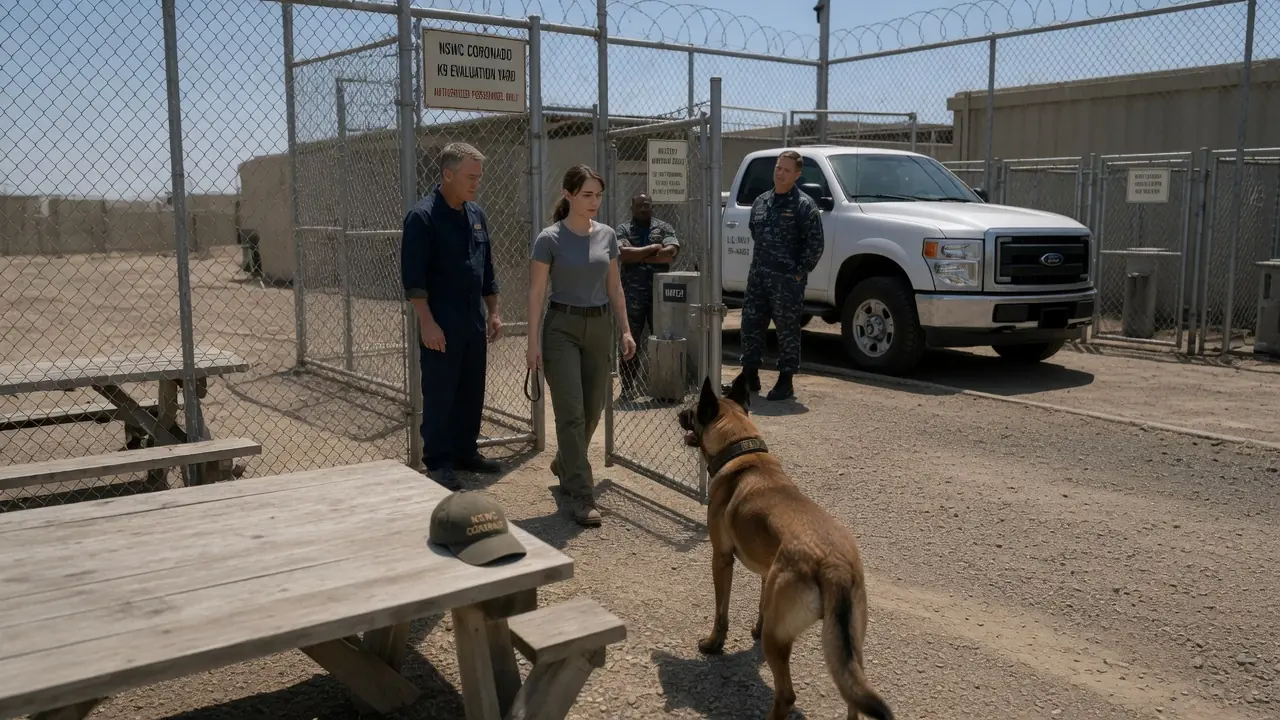
Rex had been at the naval special warfare compound for 11 days. In that time, he had torn through two bite sleeves, put one handler in the medical bay with a dislocated shoulder, and refused every command from every certified K-9 trainer the unit had brought in. He wasn't aggressive in the unfocused way of an abused dog. He was precise, deliberate. He aimed for control points—wrists, forearms, shoulders—and had simply stopped caring who was on the receiving end.
The official assessment submitted by the base veterinarian the previous Thursday used the word "compromised." The unofficial assessment passed between handlers over coffee was simpler: Rex was done.
His original handler, a special warfare operator named Sergeant First Class Darren Cole, had been killed eight weeks earlier during a reconnaissance mission outside of Kandahar. No family, no next of kin on file beyond an estranged sister in Baton Rouge who hadn't responded to the notification letter. Rex had been flown back to the States, processed through the working dog program's intake protocol, and assigned to the compound's evaluation yard while the brass figured out what to do with him. What they were currently figuring out, based on the paperwork on Chief Warrant Officer Glenn Maddox's desk, was whether to retire him to a civilian family—assuming any family would take him—or to have him humanely euthanized before he put someone in the hospital. The decision had a deadline: Friday.
Maddox was standing at the far end of the yard when the truck came through the main gate. He didn't turn around at first. He was watching Rex pace the length of the holding pen—back and forth, back and forth. It was the same circuit he'd been running since 6:00 that morning. The dog's movements were tight and controlled. There was no panic in them, no confusion, just something that looked, if Maddox was being honest with himself, like barely contained fury.
The truck door opened; boots hit gravel. He turned.
She was younger than he'd expected. That was the first thing. Mid-20s, maybe. Dark hair pulled back under a ball cap, no insignia. She was wearing a gray contractor's shirt tucked into cargo pants, and she was carrying a soft-sided duffel over one shoulder and a battered leather case in the other hand—the kind old veterinarians used to carry on farm calls. She wasn't hurrying. She looked like someone who'd done this before and had learned that hurrying didn't help.
Behind her, climbing out of the passenger seat, was a naval officer Maddox didn't recognize. Commander's insignia. He crossed the yard and offered his hand.
"Warrant Officer Maddox. Out of Pendleton. This is Jenna Carr. She's been contracted by the program to do an independent behavioral assessment."
Maddox looked at the woman. She'd stopped a few feet away from the holding pen and was watching Rex without moving. The dog had paused his pacing. He was watching her back.
"She's a contractor, civilian specialist. She trained with Darren Cole's unit in Germany three years ago. She helped condition Rex from the start."
Maddox looked at her again. *She trained with...* Yes. He didn't say what he was thinking. He'd learned over the course of a long career to be careful about what he said out loud when women were standing close enough to hear, but he thought it: *She's twenty-something years old, and she's here to assess a dog that put one of my best handlers in a sling.*
"11 days."
She turned then. Not at Maddox, at Commander Aldrich. "11 days in a holding pen."
"It was the safest—"
"I understand what it was." She looked back at Rex. "How much exercise is he getting?"
"Two handlers walk him, leashed, twice a day."
"Two handlers. After what happened with Petty Officer Henderson, we weren't comfortable with..."
"I'd like to see his feeding records and his sleep patterns from the last two weeks," she said, setting the leather case down on the picnic table near the fence. "And I'd like someone to open that gate."
There was a pause, not a short one. Senior Chief Petty Officer Langston Webb, who had been standing near the water station with his arms folded since Maddox arrived, pushed off the wall and walked over. He was a big man—not in the way that was for show, but in the way that came from decades of functional use. He'd trained K-9 teams for six years. He'd also been in the yard the day Rex had gone after Henderson, and he hadn't forgotten it.
"Ma'am," he said, and the word had a specific texture to it that wasn't quite respectful. "With due respect, that dog has gone after every handler on this base. He is not—"
"I'm not a handler," Jenna said. "Open the gate."
"You heard her, Senior Chief." Commander Aldrich's voice was quiet, flat. "Open the gate."
Webb looked at Maddox. Maddox gave a short nod.
Nobody moved toward the gate. Finally, one of the younger operators, a kid named Petty Officer Decker, who'd been trying to look invisible near the supply shed, walked over and lifted the latch. The gate swung inward.
Rex didn't move.
Jenna Carr set her cap on the picnic table. She unzipped the duffel and removed a small item that none of the men could immediately identify—a length of braided cord with a specific knot pattern, the kind used in training reinforcement sequencing. She held it loosely in her left hand, not as a tool, just as something for her hands to do.
And she stepped through the gate.
Nobody breathed. Rex watched her cross the first three feet of the pen. His ears were forward, not the aggressive forward angle he used when he was about to strike. Something else, something more like listening. She stopped, crouched down so she wasn't above him, looked at the ground to the left of his face—not at his eyes—and then she said something quietly that none of the men outside the fence could hear clearly. Two words, maybe three.
Rex sat down.
Webb made a sound that wasn't quite a word. Maddox said nothing. He was watching the dog.
Rex had not sat on command in 11 days. He had not sat on command for any of the three certified trainers who had attempted it. He had not sat on command for the base veterinarian or the behavioral specialist flown in from Lackland Air Force Base, a man with 22 years in the military working dog program.
He sat for her.
Jenna Carr moved closer. She didn't reach for him immediately. She sat down in the dirt of the pen, cross-legged, about three feet from the dog, and she stayed there. Rex watched her. After a moment, his ears shifted back slightly, not to a submissive angle, but to something softer—listening still, processing.
From outside the fence, Senior Chief Webb said under his breath, "What is she doing?" It wasn't a question.
She sat with Rex for 40 minutes. The men stood outside the fence for the first fifteen, then began drifting to various points around the yard, caught between trying to look like they weren't watching and not being able to stop watching. Commander Aldrich leaned against the truck with his arms folded and said nothing.
At the 40-minute mark, Jenna Carr stood up, walked to the gate, let herself out, and latched it behind her. Rex lay down in the center of the pen. He put his head on his paws. He looked like a different dog.
Maddox walked over to her. "What did you say to him?"
She picked up her cap from the picnic table. "I'll need to see those feeding records."
"I asked you a question."
She looked at him then. Her eyes were dark and steady, and she had the specific kind of patience that wasn't gentle—the kind that came from having already made a decision and waiting for everyone else to catch up to it.
"He's not broken," she said. "He's grieving. There's a difference, and it matters. And if you'd understood it two weeks ago, you wouldn't be scheduling a Friday appointment with the vet."
Maddox felt the heat move up the back of his neck. "With respect, Miss Carr, that dog has put people on the ground."
"Yes, because he's a 90 lb Belgian Malinois who was trained to respond to a specific handler. That handler is dead, and you've been sending strangers into his space and expecting him to pretend otherwise." She zipped the duffel closed. "He's not broken. He's waiting."
"Waiting for what?"
She slung the bag over her shoulder. "Someone he trusts."
Webb came over from the side of the yard. He had his arms folded, and the expression on his face was the one that men in his position sometimes wore when they were trying to decide whether to be angry or to listen. "How long did you work with Darren Cole?" he asked.
"Two and a half years. Germany, then two rotations overseas. I was part of the conditioning team that trained Rex from 12 weeks old."
There was a silent, *You're the one who...* Webb stopped. "Cole used to talk about a trainer. Called her the dog whisperer." The inflection on the nickname was complicated—half skeptical, half something else.
"He called me a pain in the ass," Jenna said. "Which I was. But I knew how to build a working dog, and he knew how to work one." She looked at the pen. Rex was still lying down. "He trusted me. So Rex trusts me. It's not magic. It's just what it is."
"He's been cleared for euthanasia," Maddox said.
"The evaluation is wrong." She turned to face him fully. "Cancel it."
"I don't have the authority to."
"Commander Aldrich does." She looked at Aldrich.
He gave a slow nod. The nod of a man who had already decided something before he drove onto this base.
Maddox looked between the two of them. There was a dynamic here he hadn't fully understood until this moment. This wasn't an independent assessment. This was a directive dressed up as an assessment. And Jenna Carr hadn't been sent here to evaluate Rex. She'd been sent here to get him back.
"Three days," she said. "Give me three days with him. Full access. No interference. Then you can reassess whatever you want."
Maddox looked at the dog in the pen. Then he looked at her. "If he goes for you..."
"He won't."
"If he does—"
"He won't." She picked up the leather case. "But if it would make you feel better, you can post someone at the fence."
She was already walking back toward the pen.
---
The next three days were the kind of thing that Petty Officer Decker—who ended up as the unofficial designated watcher because he was the most junior person in the unit, and therefore had the least ability to pretend he had something else to do—would spend the next several years trying to describe accurately to people who asked.
He would tell them it was boring. That was the first thing. People expected drama, and what they got was a woman sitting in a dirty yard with a dog for several hours at a time, doing very little that was visually interesting. She brought different items each day—textures, scents, a specific kind of rubber toy that Rex had been conditioned with during early training. She spoke quietly and consistently, and never raised her voice. She ran him through obedience sequences in a specific order that matched, as nearly as Decker could tell from the training logs he'd pulled, the original protocol Darren Cole had used.
On the first day, Rex responded to her presence with the controlled weariness he'd shown since arriving. He tolerated her. He ate the food she offered from her hand. He didn't bite anyone.
On the second day, he followed her—not on leash, not on command. He simply got up from where he'd been lying and walked alongside her as she crossed the pen. And when she stopped, he stopped. And when she turned, he turned. And when she sat down, he put his head in her lap. Decker, who was 23 years old and had joined the Navy because he thought it would make him harder, had to look away.
On the third morning, Maddox came out to the yard earlier than usual. He stood at the fence and watched Jenna run Rex through a full operational sequence: directional commands, search patterns, controlled aggression, recall. Not a demonstration, not a show for the brass. She ran it efficiently and quietly, the way someone runs a thing they've done hundreds of times, calling out commands in the two-word German shorthand that military working dogs are trained to. And Rex executed every one flawlessly, without hesitation, like a dog who had never been in any kind of distress at all.
Maddox watched this for approximately six minutes before he understood that he had been wrong. Not a little wrong—comprehensively wrong in the specific way that people are wrong when they mistake grief for damage and absence for failure.
He'd seen it in people. He'd seen operators come back from deployments where they'd lost someone and move through the world at reduced capacity, and some of them had been reassigned or discharged because their performance metrics told a story that the metrics couldn't actually explain. And he'd looked at those numbers and made assessments, and some of them, he knew this—had always known this—had not been right. He'd applied the same logic to the dog. He'd read the veterinarian's assessment, the behavioral specialist's report, and the incident documentation from Henderson's injury, and he had constructed a picture of Rex as a broken asset—an animal that had passed beyond the point of usefulness, a liability. He hadn't looked at the dog and seen a dog who was waiting.
He put both hands on the fence and watched Rex bring back a training dummy from 30 yards out and place it precisely at Jenna Carr's feet. She said something quiet. Rex's tail moved.
Webb appeared at his shoulder. "She's going to want to take him."
"I know."
"She doesn't have the authority to."
"She doesn't need it. Aldrich does. And Aldrich is going to sign off."
Maddox watched Rex sit at Jenna's left heel, perfectly positioned, perfectly still. "He's operational."
"He's operational with her," Webb said.
"Yes."
There was a pause. "That's not standard protocol," Webb said. "She's a civilian contractor. She can't deploy with a—"
"I'm aware of the protocol, Senior Chief."
Another pause. Longer. "He's a hell of a dog," Webb said finally.
"He is."
Jenna Carr came back through the gate at 10:43. Rex walked at her left side, off leash, close enough that his shoulder brushed her leg with every other step. She stopped in front of Maddox. He looked at the dog. Rex looked back at him with the particular calm attention of an animal that has been correctly understood and correctly handled, prepared because of that to extend a provisional tolerance to everyone else in the vicinity.
"He's not going back in the holding pen," Jenna said.
"No," Maddox agreed. "He's not."
She looked at him more carefully. Something shifted in her expression—not softness exactly, more like the recalibration that happens when someone has been braced for an argument and the argument doesn't come.
"The paperwork for his reassignment, I'll sign it today."
She nodded, looking down at Rex. He was still watching Maddox with that calm, assessing gaze.
"He remembers the people who were decent to him," she said. "And he remembers the people who weren't."
Maddox thought about this. He thought about Henderson. He thought about the three certified trainers who had come into Rex's pen with choke leads and correction protocols, and the assumption that the dog's problem was a problem of compliance rather than a problem of loss.
"Is that a warning?" he asked.
Jenna Carr picked up the leather case. "It's just something worth knowing."
She walked toward the truck. Rex moved with her, stride for stride, unhurried.
Webb watched them go. He had his hands in his pockets, and the expression on his face had migrated somewhere past skepticism and past acknowledgement, and arrived eventually at something that might have been simple and uncomplicated respect.
"She knew that dog," he said, not to anyone in particular.
"She raised that dog," Maddox said.
Decker was still standing near the supply shed. He was 23 years old, and he'd spent three days watching a woman sit in a dirty yard and bring a dog back from whatever the edge was that the dog had been standing on. He thought about what that took—the patience of it, the knowledge of it, the absolute certainty required to walk through a gate that every certified professional on the base had been treating as the entrance to something dangerous and unmanageable, and to walk through it without hesitation because you knew something the professionals didn't know.
He thought about the moment on day two, late afternoon, when Rex had stood up from where he'd been lying and simply walked alongside her. No command, no leash—just a dog who had decided, based on information only the dog possessed, that this person was trustworthy.
There were things Decker was beginning to understand that no certification program taught. There were things that existed only in the specific history between two beings, built over years of daily proximity and trust, and the particular kind of knowledge that came from paying close attention to something you cared about.
Jenna Carr had that. She'd had it before she'd walked through the gate, before she'd spoken those two or three words that sat Rex down like a switch had been thrown. She'd carried it with her the whole time—in the leather case, in the braided cord, in the quiet two-word German commands that matched exactly what Rex had been hearing since he was 12 weeks old in a training facility in Baumholder. She hadn't showed up to prove something. She hadn't walked through that gate to win an argument or demonstrate competence or show up the certified professionals who'd failed. She'd walked through that gate because Rex was on the other side of it, and she knew him, and he knew her, and 11 days in a holding pen and eight weeks of grief had not changed that, and she had known it wouldn't before she'd gotten out of the truck.
The truck backed out through the compound gate. Rex was visible through the rear window for a moment, a dark shape in the back seat, ears forward, watching the compound recede. Then they were gone.
Maddox stood in the empty yard for a while. The holding pen was open, the gate latched back against the fence. The dirt inside was marked with the patterns of the last three days—the specific worn track where Jenna had walked her sequences, the spot near the center where Rex had lain with his head on her lap.
He thought about the Friday appointment that was no longer happening. He thought about the paperwork he was going to have to file—the behavioral reassessment, the handler reassignment, the revision to the original evaluation that had used the word "compromised." He thought about Darren Cole, who had worked with a civilian trainer in Germany for two and a half years and apparently called her a pain in the ass, which seemed, in retrospect, like exactly the kind of thing Cole would have said about someone he completely trusted.
He thought about what she had said, standing in the dirt of the yard with Rex's head on her lap: *He's not broken. He's grieving. There's a difference, and it matters.*
There was a difference. It did matter. He'd been in this work long enough to know that the difference mattered with people, too, and that the systems built to assess performance and capability were not always built to recognize it. That there were operators who came back from the places they'd been and moved through the world at reduced capacity—not because they were broken, but because they were waiting for the right context, the right team, the right voice saying the right words in the right sequence. Some of them got that; some of them didn't.
Rex had gotten it.
Maddox walked back toward the main building. Behind him, the yard was empty and quiet, the gate to the holding pen open and swinging slightly in the morning wind.
Senior Chief Webb fell in alongside him. "You know she's going to want to run him on an actual operation," Webb said.
"Probably."
"She can't deploy. She's a contractor."
"She can go where the contract takes her."
Webb thought about this. "That's a gray area."
"A lot of things are." Maddox pushed open the door to the main building. "Get me the reassignment forms. I want them on Aldrich's desk by noon."
Webb nodded. Then, as Maddox moved down the hallway, he said, almost to himself, "She walked through that gate like she already knew how it was going to end."
Maddox stopped, looked back. "She did know," he said. "That was the whole point."
He went to his desk and pulled up the assessment file on his computer. At the top of the form, in the field labeled *Evaluation*, someone had typed: *Recommended for retirement or euthanasia. Asset compromised.*
He deleted the line. He thought for a moment. Then he typed: *Evaluation revised. Subjected to behavioral reassessment. Asset fully operational. Handler reassignment.*
He looked at the words for a moment. Then he added one more line below the official language in the notes field that the brass rarely read:
*The dog was never broken. We just didn't know who he was waiting for.*
He saved the file and went to find the forms.