The flatbed's reverse beep cut through the pre-dawn quiet as Elijah eased the truck into the yard. In the passenger seat, his six-year-old daughter Maya slept with her cheek pressed against the window. 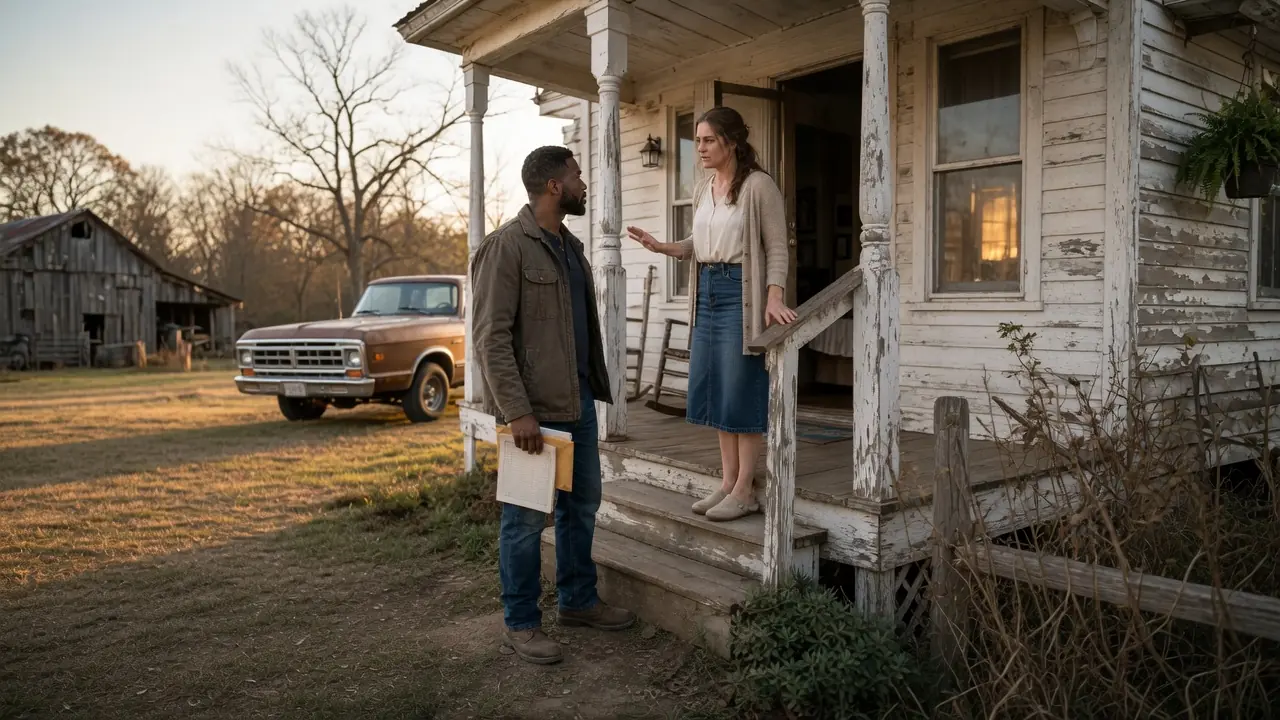
He never made it to the ramp. A loader tractor rolled out from the barn and stopped dead in front of the trailer hitch, its bucket lowered, the engine idling like a warning.
The woman behind the wheel climbed down and walked straight toward him. "If you take that baler today," she said, "this farm is dead before the month's out. Give me thirty days. I'll pay you every dollar, principal and interest both."
Elijah looked at the rusted red baler sitting behind the shed. His baler. The one her husband had borrowed and never paid for. He looked at his sleeping daughter, then he looked back at the woman.
The yard smelled like cut grass and diesel. Elijah stepped out of the truck and left the door cracked so he could still hear Maya breathing. He had driven forty minutes in the dark to get here. He had the rental agreement folded in his back pocket, Dale Roark's signature at the bottom—three months old, two payments behind. The baler was his. The law was clear.
He had told himself the whole drive out that this would be simple. Then Tessa Roark had rolled a loader tractor out of her barn and put it between him and his equipment. She was standing a few feet away now, arms crossed, but not in the way people cross their arms when they are being defensive. It was the posture of someone holding themselves together. Her work boots were caked with dry mud. There was a streak of grease along her left forearm that she hadn't bothered to clean off. Whatever she had been doing before he arrived, she hadn't stopped long enough to wash her hands.
"Your husband signed that rental agreement," Elijah said, keeping his voice level. "He's two months behind. I've called four times."
"I know," Tessa said. "I'm not here to argue about Dale."
"Then move the tractor."
She didn't move. Instead, she reached into the front pocket of her canvas jacket and pulled out a small notebook with a yellow cover, its edges worn soft from handling. She held it out toward him.
Elijah didn't take it right away. He looked at it the way you look at something when you already suspect it is going to complicate your morning.
"The South Field has forty acres of hay ready to cut," Tessa said. "If it doesn't come off this week, it's going to rain and I'll lose the whole crop. That baler is the only equipment on this property that can do the job." She kept the notebook extended. "Everything's in there. What the hay is worth at the co-op, what I owe the feed dealer, what I owe you. I've laid it out by the numbers."
Elijah took the notebook. He opened it under the thin gray light coming up over the tree line. The handwriting was dense and careful—columns of figures, dates, names of buyers. The hay yield estimate was conservative, not inflated. The payment schedule she had written out showed his full rental debt cleared in three installments, the last one before the end of the month, with a modest percentage added on top. She hadn't written her husband's name anywhere in it.
"Dale doesn't know I'm out here," Tessa said. "I'm not asking you to renegotiate with him. I'm asking you to make a new contract with me, separate. My signature, my liability."
Elijah closed the notebook and looked back at his truck. Maya had shifted in her sleep, her small face now turned toward the windshield. She hadn't woken up. She was still in that deep, unguarded sleep that only children manage—the kind that assumes the world will stay safe while they are under. That was the thing about being her father. She assumed, and he had to be worth the assumption.
He thought about what was in his account—not much. The baler was old, but it had resale value if he moved it fast. A guy in the next county had already expressed interest. That money would cover Maya's school fees through the fall and leave something over for the water pump on his own property that had been threatening to give out since spring. The math was straightforward: take the equipment, sell it, move on.
"Why didn't you call me before it got to this?" he asked.
"Because I didn't know how far behind Dale was until two weeks ago," Tessa said. "He handles the accounts."
"Handled."
Something shifted in the way she said the second word—not grief exactly, but the particular flatness of a person who has already done their grieving and come out the other side into something harder and more useful. "I went through the books myself after he left for his brother's place. That's when I found your invoices."
Elijah folded the notebook and held it out to her. She took it.
"If I sign a new contract with you," he said, "Dale can still come back and contest it. He's still the named leaseholder on the property."
"The hay operation runs under a separate agricultural account," Tessa said. "I have co-signatory rights on anything related to seasonal crop management. A lawyer in town looked it over last week. It'll hold."
She had already talked to a lawyer. He hadn't expected that.
Elijah walked to the front of his truck. He pressed his hand flat against the hood—it was still warm from the drive—and looked out at the field beyond the fence line. The hay was there, dense and pale in the early light, heavy enough that the stems were starting to bend under their own weight. You could see it needed to come off. Any farmer would see it.
He opened the driver's side door, reached into the glove box, and pulled out his own folded documents: the original rental agreement and a blank contract form he kept out of habit. He carried them to the hood of the truck and spread them flat.
"I'll need a co-op receipt as security," he said. "If the sale falls through or comes in under projection, the baler comes back to me within forty-eight hours. No argument, no negotiation."
"Agreed," Tessa said.
"And Dale's name comes off everything going forward. I'm not chasing two people."
"His name was never going to be on this one."
Elijah picked up a pen from the dash and laid it between them on the hood.
Inside the truck, Maya stirred. She pushed herself upright in the passenger seat, blinking at the windshield with the slow confusion of a child trying to remember where she was. She looked out at her father standing in the gray morning light, at the woman across from him, at the yellow notebook sitting on the hood between them. She didn't say anything; she just watched.
Elijah noticed. He always noticed when she was watching. He picked up the pen and signed his name at the bottom of the new contract, then he turned it toward Tessa. She signed without hesitation.
Neither of them said anything after that. Elijah folded his copy and put it in his jacket pocket. Tessa took hers and slid it into the yellow notebook. The loader tractor was still sitting where she had parked it, but it no longer felt like a blockade. It was just a machine in a yard.
Elijah walked back to the driver's side door. Before he got in, he looked once more at the field, at the hay that needed to come off, at the work that was waiting. He hadn't signed because he trusted Tessa Roark. He had signed because the numbers in that yellow notebook told the truth, and in his experience, people who told the truth with their numbers were usually willing to back them up with their labor. He would find out soon enough if he was right.
There is a particular kind of courage that doesn't announce itself. It doesn't feel like bravery when you're in it; it just feels like choosing not to let an old wound make the decision for you.
Maya had fallen back asleep by the time Elijah turned the truck around and headed down the gravel drive. He kept the radio off and drove in the quiet, one hand on the wheel, the contract folded in his pocket. Thirty days. He had given her thirty days. He told himself it was because the math made sense. He almost believed it.
***
Elijah came back the next morning with his tools in the truck bed and Maya in the passenger seat with a coloring book she had already half finished.
The first three days were just work. The South Field's irrigation line had a split joint that was bleeding water into the soil two hundred feet from where it was supposed to be delivering it. Elijah found it by walking the line on foot, watching for the soft ground. He dug it out, cut the damaged section, and replaced it with fittings he had in his toolbox.
Tessa was in the adjacent paddock when he finished, rounding up two heifers that had pushed through a weak section of fence during the night. She didn't ask him to help with the cattle. He didn't offer. They each had their work, and they did it.
Maya sat on a hay bale near the barn with her coloring book open across her knees. By midmorning, she had abandoned the book entirely and was watching a barn cat stalk something along the fence line with the focused patience that only cats and six-year-olds can sustain.
In the afternoons, Elijah ran the baler. The machine was old, but he knew its rhythm—the way it hesitated on the third gear shift, the particular sound it made when a bale was forming clean versus when the tension was off. Tessa drove the rake ahead of him, laying the windrows straight. She had clearly done this before. She didn't need to be told where to turn or how wide to leave the rows. They worked until the light failed, and then they stopped.
On the fourth day, a belt on the baler snapped clean during the second pass of the morning. Elijah shut the machine down, assessed the damage, and told Tessa he needed to drive into town for a replacement.
"Chuck's Hardware carries agricultural belts," Tessa said. "It's the only place within thirty miles."
Elijah loaded Maya into the truck and drove the twelve miles to town. Chuck's Hardware occupied a wide corner lot on the main street, the kind of store that had been there long enough to feel like it owned the block. The bell above the door rang when Elijah pushed it open. Maya walked in beside him, her hand in his.
The man behind the counter—Chuck himself—was heavy-set, somewhere in his sixties, with the particular look of someone who had spent decades deciding without much effort who belonged in a room and who didn't. He watched Elijah move down the aisle without saying anything. When Elijah brought the belt to the counter and set it down, the man rang it up slowly.
"You're the one been out at the Roark place," Chuck said. It wasn't a question.
"That's right," Elijah said.
"Dale's been gone what, couple weeks now?" Chuck's eyes moved briefly to Maya, then back to Elijah. "Funny time for a man to start making himself at home out there."
The store was quiet. Two other customers near the back had gone still. Elijah looked at the total on the register screen. He pulled out the exact amount in cash, set it on the counter, and picked up the belt.
"Thank you," he said, and turned toward the door.
Maya had to take two steps for every one of his to keep up. When they got outside, she tugged his hand. "Why did he say that?" she asked. "About you being at that lady's farm?"
Elijah opened the passenger door and lifted her up to the seat. He buckled her in before he answered.
"Because he doesn't know anything about us," Elijah said. "So, he filled in the blank with something ugly. That's his problem, not ours."
Maya considered this with the seriousness she gave to most things. "Did it make you mad?"
"Yes," Elijah said.
"But you didn't yell."
"No."
"Why not?"
He looked at her for a moment—at her face so open and waiting, taking in everything he did as though she were writing it down somewhere she would never lose it.
"Because yelling would have given him something to talk about," Elijah said. "Walking out gave him nothing."
He closed her door and got in the driver's side. He sat for a few seconds with his hands on the wheel before he started the engine. What he had said to Maya was true, but it was also incomplete. The fuller truth was that he had felt the familiar heat move through him in that store—the kind of anger that comes not from surprise, but from recognition, from knowing exactly what was being said and why. And he had made a choice. Not because he was afraid, but because his daughter was standing next to him, and he was not willing to let a man like that write the lesson she took home.
He drove back to the farm and replaced the belt himself.
***
They were about nine days into the arrangement when Tessa called him just after seven in the evening. Her voice was controlled, the way voices get when a person is holding something together that wants to fall apart.
"Dale changed the deposit account," she said. "At the co-op. He went in two days ago and updated the banking information. All the proceeds from this delivery are going to route to his personal account."
Elijah set down the wrench he'd been holding. He was in his own garage doing maintenance on the service truck. The fluorescent light above him hummed. "You're sure?" he said.
"I called the co-op this afternoon to confirm the delivery logistics. The woman on the phone read me the account number to verify. It wasn't mine."
Elijah looked at the wall above his workbench, at the contract he had folded and pinned there three days after signing it because he liked to be able to see the terms of anything he had agreed to. His name, Tessa's name, the payment schedule, the co-op receipt clause. If the money routed to Dale's account, it was gone. Dale would use it before anyone could file a claim. Tessa would lose her operating cash, the feed dealer would pull her credit, and the farm would start coming apart at the seams. Elijah would lose his rental payment, all of it, and have nothing to show for two weeks of work except a repaired irrigation line and a replaced belt.
He thought about Maya's school fees. He thought about the water pump. Then he thought about the fact that he had looked at Tessa's numbers and signed his name.
"We need to go to the bank tomorrow morning," he said, "before the delivery processes."
"The delivery is scheduled for ten," Tessa said.
"Then we go at eight."
Elijah picked Tessa up at 7:45. Maya was in the backseat with her coloring book, newly restocked with a fresh set of markers Elijah had bought the evening before without quite admitting to himself why.
The First Agricultural Bank of Crestfield sat on the same Main Street as Chuck's Hardware, three blocks west. Elijah pulled into the lot and cut the engine. Before they got out, Tessa turned to look at him from the passenger seat. She had the yellow notebook with her, and on top of it, a manila folder he hadn't seen before.
"Dale is already here," she said, looking at a gray pickup parked near the entrance. "That's his truck."
In a town this size, word moved fast. Someone at the co-op, a neighbor on the road—it didn't take much. Dale had known they were coming.
Elijah looked at the truck, then he looked at the bank's front door. "Then let's go," he said.
Inside, the bank smelled like recycled air and carpet cleaner. Dale Roark was standing near the service desk, talking to one of the tellers in the low, easy tone of a man who believed his comfort in a room was evidence of his right to be there. He was broad-shouldered and sunburned, somewhere in his mid-forties, wearing a collared shirt that was too clean for someone who had supposedly been at his brother's place.
He saw Elijah come through the door, and his expression shifted not to surprise, but to something more calculated. "Well," Dale said loudly enough for the room to hear. "Didn't expect company."
Tessa walked past him toward the service desk without responding. Dale watched her go, then looked at Elijah with the particular smile of a man who thinks he has already won.
"I appreciate you keeping an eye on things out at the property," Dale said, "while I've been away."
Elijah didn't answer. He followed Tessa to the desk.
The branch manager who came to meet them introduced himself as Gerald, a careful man who kept his hands folded on his desk and his voice carefully neutral. Gerald explained that the account update Dale had submitted was procedurally valid. Dale's name was on the operating account as the primary holder; the change had been processed through proper channels. Dale, seated across the desk to the side, said nothing further. He didn't need to. He let the manager's words do the work.
Tessa opened the manila folder. Inside was a document Elijah hadn't seen before—a notarized power of attorney, three years old, granting Tessa full authority over financial decisions related to seasonal agricultural operations on the Roark property. Dale had signed it himself back when he had needed her co-signature to secure an expansion loan. The authority was specific and legally binding. It covered exactly the kind of co-op transaction Dale had just tried to redirect.
Gerald took the document. He read it carefully, then read it again.
Dale's expression did not change immediately. It changed slowly, the way ice changes from solid to something that still looks solid but has lost its integrity.
Gerald excused himself to consult with the bank's compliance officer. He was gone for eleven minutes. Elijah knew because he watched the clock on the wall above the manager's desk.
While they waited, Dale looked at Tessa. Then he looked at Elijah. Then he said it—the thing that had been building behind his eyes since they walked through the door.
"You should have kept him sweet until we worked things out," Dale said to Tessa. His voice dropped low, but not low enough. "That's how you handle it. You keep them close until you don't need them anymore."
The room went still. Maya, sitting on the chair beside Elijah with her coloring book open in her lap, looked up.
Elijah felt the heat come again—the same heat from Chuck's store, but deeper this time, more personal. Dale hadn't just implied something ugly; he had said it in front of his daughter. He had said it as though Maya weren't there, or as though it didn't matter that she was.
Elijah looked at his daughter. She was looking back at him with dark, steady eyes. He thought, *She is going to remember this room. She is going to remember what her father did next.*
He turned to Gerald's empty chair and waited.
When the branch manager returned, he set the power of attorney on the desk between them. "Given the scope of the authority documented here," Gerald said, "we're going to place a hold on the account update pending a formal review. The delivery proceeds will be held in escrow until the matter is resolved through the appropriate process. That's the most I can do today without a court order."
Dale pushed his chair back. "That's my account, Mr. Gerald."
Gerald's voice didn't rise. "The hold is in place. You're welcome to consult legal counsel."
Dale stood. He straightened his collar, looked once more at Elijah with an expression that had curdled past anger into something closer to contempt, and walked out. The door closed behind him.
Tessa let out a breath that she seemed to have been holding since they walked in. Elijah picked up Maya's marker from the floor where it had rolled and handed it back to her. She took it and went back to her page without comment, but she leaned slightly against his arm as she colored—the small, deliberate weight of a child who has decided to stay close.
Some men build their authority by controlling what others can access: money, land, information, the right to be believed in a room. What Dale couldn't understand was that Tessa had never needed his permission to be competent; she had only ever needed him to stop getting in the way. And what he had said in that bank, meant to humiliate two people in front of witnesses, had done nothing except confirm for everyone present exactly who he was. The dirt doesn't stick unless you bend down to pick it up.
***
The escrow hold bought them four days. Tessa spent those four days doing what she had apparently been doing for years without anyone noticing: keeping records.
She pulled every document she had from the filing cabinet in the farm office—co-op receipts going back three seasons, equipment maintenance logs, the original agricultural loan paperwork with Dale's signature alongside hers, bank statements showing which deposits she had made and which withdrawals she hadn't authorized. She organized everything into a sequence that told a clear story without requiring any interpretation.
Elijah came by on the second day to finish the last section of the South Field. The hay was all off by mid-afternoon. He cleaned the baler down and parked it back behind the shed where it had started. Then he sat on the tailgate of his truck, drank water from a bottle, and looked at the field. It was flat and clean and pale gold in the late light. A good cut. The kind of work you could look at and feel settled by.
Tessa came out of the barn and stood beside the fence, looking at the same field. She didn't say anything for a moment. Neither did he.
"Gerald called," she said finally. "The compliance review came back. The power of attorney holds. They're going to reverse the account update and release the escrow."
Elijah nodded.
"It'll process Tuesday," Tessa said. "I'll have the first payment to you by end of day."
"I know you will," Elijah said. He meant it plainly, the way you mean something when you've stopped needing to convince yourself of it.
On Tuesday morning, Elijah's phone buzzed on the kitchen counter while he was making breakfast. He looked at the screen. The transfer had come through—the full first installment, exact to the number Tessa had written in the yellow notebook, with the agreed percentage added on top. He set the phone face down on the counter and finished making Maya's eggs.
She came padding into the kitchen in her socks, her hair still flattened from sleep, and climbed into her chair with the automatic confidence of a child in her own home. She ate without being asked and talked about a dream she'd had involving a horse that could open doors. Elijah listened and responded in the right places, and felt, underneath the ordinary texture of the morning, something that had been tight in his chest for several weeks begin to loosen.
After breakfast, he told Maya to put her shoes on.
"Where are we going?" she asked.
"To buy you shoes," he said.
She looked down at her feet, at the sneakers she'd been wearing since spring, the left one starting to separate at the toe. She looked back up at him with an expression of complete seriousness. "These ones are fine," she said.
"They're not fine. You start first grade in three weeks."
She considered this with the gravity it apparently deserved. "Can they be purple?"
"They can be whatever color you want," Elijah said.
They drove into town and found purple sneakers at the second store they tried. Maya wore them out of the shop, lifting her feet higher than necessary with each step to make sure the color caught the light.
The equipment auction was that Thursday. Tessa had arranged it through the county agricultural extension office—a small sale of surplus machinery to cover the outstanding balance with the feed dealer. Dale had bought three pieces of equipment on credit in the previous eighteen months without telling Tessa, and those debts were hers to clear now, whether she had agreed to them or not. The auction would handle most of it.
Elijah drove out that morning, not because Tessa had asked him to, but because he had a practical reason. One of the items up for sale was a hydraulic attachment that was compatible with his service truck, and he was interested in the price. He bought the attachment.
Tessa settled the feed dealer debt by noon. Dale did not appear. Elijah had half expected him to show up with something to say, some final attempt to reclaim the narrative of the morning, but Dale's gray pickup was nowhere in the lot, and nobody who came to the auction mentioned him. By the time the last item sold, his absence had settled into the day like a fact everyone had already accepted.
Later, Elijah heard from a man who worked at the co-op that Dale had collected some personal belongings from the property while Tessa was in town one afternoon and hadn't come back. No announcement. No confrontation. Just the specific, quiet exit of someone who has run out of ground to stand on.
Elijah gave Tessa the space she needed after that. It wasn't a calculated decision; it was just the right thing, and he knew it without having to think through it. She had a divorce to start, a farm to stabilize, and a lot of decisions to make that had nothing to do with him. He sent her the maintenance schedule for the baler by text, answered her questions when she had them, and let the distance between visits stretch naturally.
The second payment came on time. The third came four days early.
On the morning the third payment arrived, Elijah was in his garage doing an oil change on the service truck when his phone lit up. He looked at the transfer confirmation, then at the balance figure, and did the arithmetic in his head. The water pump could be replaced before the first frost. Maya's school fees were covered through the spring. There was enough left over to put something back. He cleaned his hands on a shop rag and stood in the open garage door for a while, looking at the road.
***
Three weeks after the auction, Elijah drove out to the Roark farm on a Tuesday morning. He brought two coffees from the gas station on the county road—the kind that came in foam cups with lids that didn't quite seal, so you had to hold them level. He had a folded paper in his jacket pocket: a basic maintenance schedule for the baler, written out clearly with seasonal checkpoints and the specific belt size to keep on hand. He hadn't called ahead.
Maya was out of the truck before he'd fully stopped, running across the yard toward three puppies that were tumbling over each other near the barn door. Tessa had mentioned the litter a week ago in passing, and Maya had filed that information in the part of her memory reserved for things that mattered.
Tessa came out of the barn when she heard the truck. She was in her work clothes, the same canvas jacket from the first morning, but cleaner now. She looked at the two cups in his hands.
"I didn't know you were coming," she said.
"I was in the area," Elijah said, which was not entirely true. He held out one of the coffees. She took it.
He pulled the maintenance schedule from his pocket and unfolded it against the side of the truck. "The baler's going to need the main drive belt checked before you use it again in the fall. I wrote down the part number. Chuck's carries it, or you can order direct from the manufacturer. I put the contact at the bottom."
Tessa looked at the paper. "You didn't have to do this."
"I know," Elijah said.
Across the yard, Maya had sat down in the dirt and was allowing one of the puppies to climb into her lap. She was laughing—the full, uncomplicated laugh of a child who has no reason not to be happy—and the sound of it moved across the yard in the morning air.
Tessa watched her. Something in her expression settled, the way a field looks after the last of the season's work is done—not empty, but finished, ready.
"She's a good kid," Tessa said.
"She is," Elijah said. "She doesn't miss much."
Tessa looked at him then, and he understood that she knew what he meant. Maya had been in that bank. She had sat in that chair with her coloring book and felt the weight of what adults were capable of, and watched her father hold himself together and do the right thing without making a performance of it. She had leaned against his arm when it was over. Children remember the rooms they were in. They remember what the people they loved did when things were hard.
Elijah drank his coffee. The sun was coming up over the east tree line, spreading flat and golden across the cut field—clean stubble as far as the fence, the kind of ground that had been worked and would be ready again when the season turned.
"I have another property starting in October," he said. "Larger operation. I'm going to need the baler for most of the fall."
"That's fine," Tessa said. "I'll work around your schedule."
"I'll give you dates in advance."
"I'd appreciate that."
They stood side by side against the truck and drank their coffee while Maya negotiated with the puppies in the dirt. Nobody felt the need to fill the quiet. It was the kind of quiet that comes after a lot of noise—not empty, but earned.
The strongest agreements aren't built on grand declarations. They're built on the small, repeated choice to be straight with each other about money, about time, about what you need and what you're willing to give. That kind of trust doesn't arrive all at once. It accumulates the way good soil does, one honest season at a time.
Elijah finished his coffee, folded the foam cup, and put it in his jacket pocket. He said he'd send the fall schedule by the end of the week. Tessa said that worked for her.
He called Maya back to the truck. She came reluctantly, turning around twice to look at the puppies, and then climbed into the passenger seat and pressed her face against the window as they pulled out of the yard.
"Can we come back?" she asked.
"Probably," Elijah said.
She accepted this with the pragmatic satisfaction of a child who knows that "probably" from her father almost always means yes.
He turned onto the county road and drove south, the cut field visible in the rearview mirror until the tree line took it.