"Hands on the car now."
Gloria Holloway turned slowly. "Officer, this is my car. My keys are right here."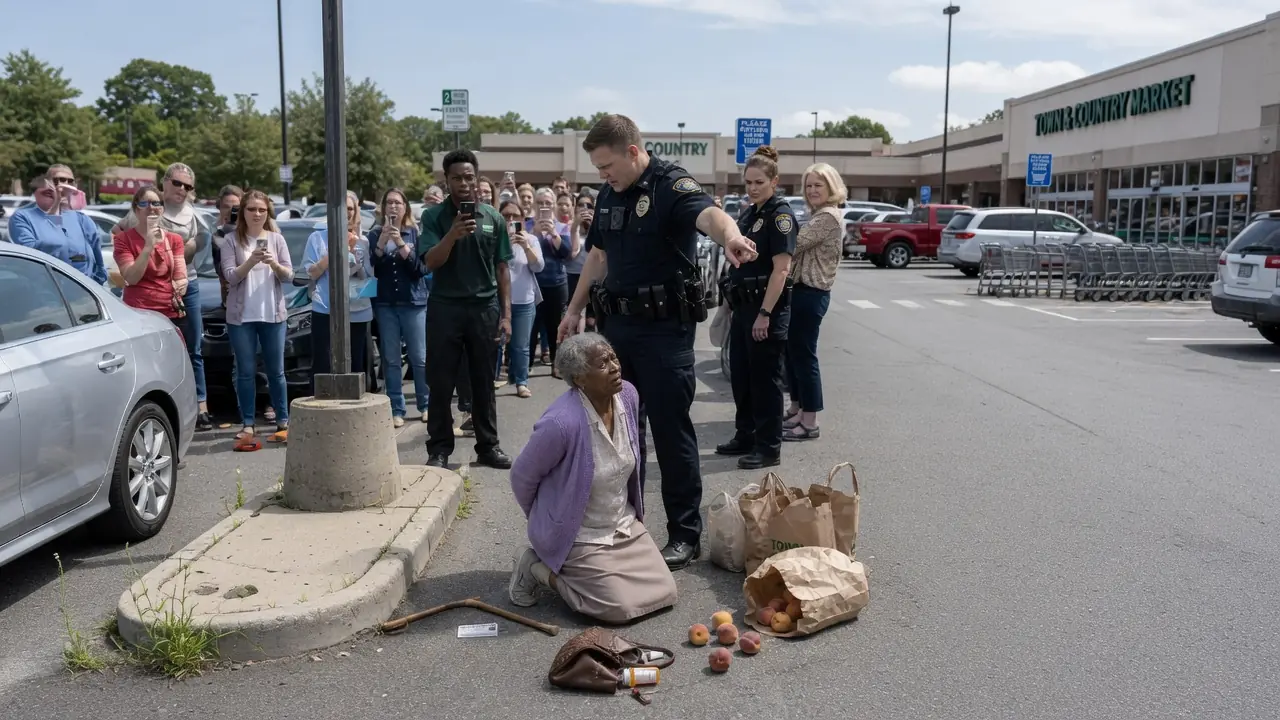
"People like you don't drive cars like this."
"Please. I left the hospital this morning."
"I said, 'Hands on the hood now!'"
Phones rose all around them, a dozen glowing screens recording the encounter. Nobody stepped forward. Somewhere in the loose semi-circle, someone laughed. Gloria felt the Mercedes key bite sharply into her closed fist.
Three hours earlier, the morning had been gentle. Gloria Holloway had signed her discharge papers at Fairmont County Hospital, where a nurse wheeled her to the exit. The surgeon's parting words had been clear and repeated: Rest. Walk slowly. No stress on the heart.
Following the advice, she had driven herself to the Greenfield Market for one small thing—fresh peaches, her late husband's favorite. Tomorrow would have been their wedding anniversary. Parking the silver Mercedes had taken her two careful minutes. Leaving it gleaming under the noon sun, she had walked inside, leaning heavily on her cane the whole way.
Across the parking lot, a woman watched from a parked SUV. Karen Whitfield lived four houses down from Gloria and had never once said hello. She had complained about Gloria's garden; she had complained about Gloria's visitors. Now, staring at the elderly Black woman climbing out of a luxury vehicle, something ugly turned over in her chest. She lifted her phone and dialed 911.
"Yes, I'd like to report a theft in progress," Karen's voice was calm, rehearsed. "There's a Black woman breaking into a Mercedes at Greenfield Market. She doesn't belong with a car like that. She might be armed. Please hurry."
Every word was a lie. Gloria's key was in her purse and the title was in her name, but the dispatcher heard the word "armed" and the call instantly changed shape.
Two miles away, Officer Travis Boyd took the radio transmission. At 29 years old with three years on the force, he was hungry to matter. A possible armed auto theft was the most important thing that had come across his radar all week. He flipped on his emergency lights and accelerated, not slowing down to ask questions. In his mind, the suspect was already guilty.
He had a description: Black, female, older. He had a crime: grand theft auto. He had a stage, and an audience would soon gather with their phones waiting in their pockets. What he did not have was a single piece of the truth. He did not know the woman's full name, he did not know about the fresh stitches over her heart, and he did not know that this woman, if pushed far enough, would make a single phone call—a call to a number that could end his career in a single afternoon.
The patrol car came in fast, its tires shrieking against the asphalt. Boyd stopped at an angle, the driver's door flying open before the engine even settled. He stepped out with one hand already resting on his holster, his jaw set like a man arriving at a war zone.
Gloria had just reached her vehicle, carrying two bags of groceries with a small paper sack of peaches balanced on top. She heard the siren and turned, confused, squinting into the sunlight.
"Step away from the vehicle!" Boyd commanded. "Hands where I can see them!"
She blinked. "Officer, is something wrong?"
"I said step away from the vehicle now!"
"This is my car. I was only loading my groceries."
"Ma'am, I won't tell you again."
"All right," she said softly. "All right, I'm not doing anything."
Boyd circled her, his eyes hard. He looked at the polished silver Mercedes, then at her, then back at the car. An old Black woman in a faded cardigan and orthopedic shoes. In his mind, the two simply did not belong together, and that gap in his own perception was all the evidence he thought he needed.
"Whose car is this?"
"Mine. I've owned it three years."
"Right," Boyd let out a short, cynical laugh. "And I'm the mayor."
A few shoppers had slowed near the store entrance. One of them lifted a phone, then another. Within moments, the lot was filling with quiet witnesses. Not one of them moved closer. They formed a loose half-circle, the way people gather around an accident—close enough to see, far enough to stay clean.
"Officer," Gloria tried again, her voice straining for patience. "My registration is in my purse. My key is in my purse. If you would only let me show you."
"Don't reach for anything!"
"I only want to show you—"
"I said don't reach!"
She froze. Her hand hovered near the strap of her bag, then dropped heavily to her side. The peaches sat in their paper sack between them, bright and absurd.
Boyd keyed his shoulder radio without taking his eyes off her. "Dispatch, I've got the suspect on scene. Older female matches the description. Vehicle present, possibly armed. Standing by."
"Suspect?" Gloria repeated the word, and it landed strange in her ears. "Armed? Son, I'm 68 years old. I came from the hospital this morning. The only thing in that bag is peaches and my heart medicine."
"I'm not your son." The words came sharp, and the action behind them was sharper still. Boyd stepped closer and kicked her cane.
The wood clattered across the pavement and spun underneath the car parked beside hers, far out of reach. Gloria swayed. Without the cane, her balance was a fragile thing. She caught herself against the warm hood of the Mercedes, breathing through a sudden flash of pain that bloomed across her chest and radiated down her left arm.
"Please," she whispered. "I had heart surgery six days ago. I cannot stand long."
"Hands on the hood. Spread your feet."
"Officer, I am telling you the God's honest truth."
"Everybody says that."
A young man near the shopping carts took a tentative step forward. He wore a delivery uniform and had kind, worried eyes. "Hey man, she's old. Just check her ID. It'll take you ten seconds."
Boyd turned his head slowly. "Stay back or you're next. Mind your business."
The young man stopped. He didn't leave, but he didn't come closer either. Instead, he lifted his phone higher, and the small red dot of a live stream began to blink. A counter beside it started to climb: forty viewers, then a hundred, then more.
Gloria placed her hands flat on the hood, the hot metal burning her palms. She bowed her head as a strand of gray hair fell loose across her face. "My name is on the title," she said to the car, to herself, to anyone who would listen. "Gloria Holloway. Look it up. Please, just run the plate. It will tell you everything."
Boyd didn't run the plate. He pulled the handcuffs from his utility belt. The mechanical ratchet sound cut through the parking lot—that hard click recognized from a hundred internet videos. The crowd leaned in; the phones steadied.
"You're being detained for suspected vehicle theft," Boyd said. "Hands behind your back."
"I have stitches. Please, not behind my back."
He took her wrist anyway, pulling it down and back hard, the motion bending her forward over the hood. Gloria gasped, a small, high sound of pure pain escaping her.
"Please," she cried. "Please, you're hurting me."
"Stop resisting!"
"I'm not resisting... I can't move that fast."
"Stop resisting!" Boyd barked it loudly for the crowd, for the cameras. It was a phrase meant to rewrite the scene, ensuring anyone watching the footage later would wonder, just for a second, if she actually had been fighting back.
She had not. The first cuff snapped closed. He reached for her second wrist and dragged it back to meet the first. The steel bit deeply into the thin skin over the bone, and a bright bead of blood welled up against the metal. Gloria made no more sounds. She simply closed her eyes.
A second patrol car eased into the lot. Officer Lisa Bennett stepped out. Younger and quieter, she took in the scene with a sudden flicker of unease—an elderly woman bent over a hood, blood on her wrist, and a cane lying abandoned. Bennett opened her mouth, but she glanced at Boyd's rigid expression and stayed silent. She took up a position near the crowd, hands on her belt, becoming one more person who watched.
Gloria's purse had slipped off her shoulder during the struggle, hitting the pavement and spilling its contents. A lipstick rolled away; a pill bottle from the hospital pharmacy skittered out. And there, in plain view, face up on the asphalt, lay the laminated registration card: *Gloria Holloway*, matching the make of the car, the plate, and her address.
The young man with the phone saw it first. "Yo, her name's right there! The papers are right there, man! You don't even have to look hard!"
Boyd glanced down. He saw it, too. For one long second, he had a choice. He could pick up the card, read it, and accept the cold drop in the stomach that comes when a person realizes they have made a terrible mistake. He could begin, however clumsily, to make it right.
Instead, he nudged the card aside with the toe of his boot, sliding it into the shadow beneath the car next to her cane. "That doesn't prove anything," Boyd said aloud. "Could be stolen, too. People steal the paperwork right along with the car."
A murmur moved through the crowd. Some of it was discomfort, but some of it was a sickening amusement. Someone laughed—a bright, careless sound that turned the incident into an afternoon show.
Gloria felt that laugh more than she felt the steel around her wrists. She had marched in 1968 as a girl of ten, holding her mother's hand. She had been turned away from lunch counters. She had buried a husband and raised a son alone on the wages of a woman who cleaned office buildings after dark, mopping marble floors in towers she could never afford to live near. She had spent six decades proving over and over, through a thousand small humiliations, that she was a person who belonged. And here, in a sunny parking lot with peaches spilled at her feet, a stranger had decided in ninety seconds that none of it counted.
"You think a woman like me can't own a car like this?" she said quietly.
Boyd snorted. "I think this car costs more than you'll see in your whole life."
"You don't know my life."
"I know your type."
"My type?" She turned the words over. "And what type is that?"
He didn't answer. He took her by the arm and turned her around to face the crowd, displaying her like a catch. The phones drank it in: an old woman in handcuffs, blood at her wrist, swaying without her cane, her chest heaving with the effort of staying upright.
"Walk," he ordered.
She tried, but her knees buckled. "I can't," she breathed. "My heart, please. I need to sit down."
"You can sit in the car. Walk."
"I'm going to fall."
She did fall. Her legs gave out beneath her, and because her hands were bound behind her back, she could not break her descent. She went down onto the asphalt, hitting her knees hard. The impact jolted through her fragile frame, tearing a sharp cry from her throat that echoed off the storefront glass.
Boyd, instead of helping her up, looked at the crowd and shook his head in disappointment. "Classic," he muttered. "They always do this. Fake an injury, make a scene, play to the cameras." He crouched near her ear, his voice dropping below where the phone microphones could reach. "Get up. Nobody here believes you."
But the cameras caught enough. They caught a 68-year-old woman on her knees. They caught the blood, the spilled pills, the abandoned cane, and the registration card glowing white in the shadows. They caught the peaches, scattered and bruised, rolling one by one toward the storm drain. What they did not catch was the truth of who she was. Not yet.
Near the SUV at the edge of the lot, Karen Whitfield watched with her arms folded, the smallest smile touching the corner of her mouth. She had not expected it to work this well; she had only wanted the old woman gone. She did not yet understand what she had set in motion, or how completely it would turn back on her.
A woman near the front of the crowd pressed a hand to her mouth. "Someone should do something," she whispered to her friend. But she did not move an inch. Everyone was waiting for someone else, and so no one became the someone.
Gloria knelt on the pavement, breathing in and out, as the surgeon's voice echoed in her mind: *No stress on the heart.* She almost laughed. She thought about her son, the boy she had raised on those midnight cleaning wages. She thought about the promise she had made to herself thirty years ago, knees aching on a cold office floor, that her child would grow up into a world a little fairer than the one she had been handed. She had believed it. Most days, she still did.
"Officer," she said, and her voice was steadier now than it had any right to be. "I would like to make my phone call."
Boyd laughed. "You'll get your call at the station."
"No," she said. "I'd like to make it now. One call. That is all I am asking of you."
Something in her tone made a few people glance up from their screens. It was not the voice of a guilty woman, nor even a frightened one anymore. It was calm, certain—the voice of someone who knew exactly which number she would dial and exactly what would happen when the other end picked up.
Boyd didn't hear it. He hauled her to her feet and steered her toward the patrol car, already rehearsing the arrest report in his head. He had no idea that the most important call of his career was currently ringing on the top floor of the county building, behind a door marked with a prestigious title and a badge.
Boyd opened the rear door of the cruiser and pushed Gloria inside. "Watch your head," he said carelessly, folding her into the back seat and shutting the door.
The car had been baking in the sun all morning. The air inside was thick, suffocating, pressing against her chest like a physical weight. "Please," she gasped through the glass. "It's too hot in here. My heart... I need air."
Boyd turned his back, treating the matter as closed.
The delivery man with the kind eyes moved along the edge of the lot, keeping his phone trained on him. "I got all of it," he called out. "Half to the officer and half to the thousands of strangers watching this live stream. Everybody saw. The papers were right there. You kicked them under the car."
"Turn that off," Boyd snapped.
"It's a public lot. I don't have to turn it off."
"Turn it off or I'll find a reason to take it."
The young man's jaw tightened, his hand shaking. He lowered the phone an inch, but he thought of the old woman trapped in the back seat and lifted it again. It was the bravest thing in that parking lot, and it was still only a phone held by a man too far away to stop anything.
The crowd had begun to thin. Whatever they had come to see, they had seen it. A few drifted back toward the store, while others kept filming with a restless boredom—the look of people who knew something was wrong but had decided it wasn't their problem. That was the cruelest part of the moment: not the one cruel man, but the forty quiet ones.
Inside the car, the heat climbed rapidly. Sweat broke across Gloria's forehead and ran into her eyes. The pain in her chest was no longer a passing flash; it had settled into a slow, terrifying tightening. Her breath came shorter, and the edges of her vision went soft and gray.
"Officer," she called out weakly, tapping her forehead against the glass. "Officer, please. I think something is wrong... my chest."
Boyd glanced back through the window. Seeing a gray-faced woman slumped against the seat, he saw only what he had already decided to see: a performance. "She's fine," he said to Bennett. "They always do this. The second the cuffs go on, suddenly they're dying. It's a script. I've seen it twenty times."
Bennett looked through the glass. She had not been on the force long enough to see it twenty times. What she saw did not look like a script; it looked like an old woman in genuine medical distress. "Travis," she said quietly. "She doesn't look good. Her color's off. We should at least—"
"Bennett." Boyd said her name like a slammed door. "I've got seniority on this scene. Stand down."
And she did. That was the thing she would think about for a long time afterward, lying awake at night. She had felt the wrongness sitting cold in her stomach, but when the moment came to act, she had folded her hands and stood down because a louder man told her to. Her silence joined all the other silences in that lot, building a wall around Gloria Holloway.
Gloria pressed her cheek against the hot window and closed her eyes. She did not pray for rescue from the strangers outside. Instead, she remembered who she was. She was Gloria Holloway. She had a name, even if this man refused to read it. She had a son who loved her. And she had a ten-digit number memorized better than her own birthday—the number of the one person in this county who could walk into any room and be instantly obeyed.
She opened her eyes. "I want my phone call," she said, her voice dropping all drama and becoming chillingly clear. "I know my rights. I am owed one phone call and I want it now. I may not make it to the station. If you will not let me call, then every person here is watching you deny medical help to a woman having a heart attack. Look at the cameras, son. Look at how many of them there are."
For the first time, Boyd hesitated. It wasn't mercy; it was arithmetic. The phones were still up, and the live stream counter had passed 11,000 viewers.
Bennett seized the hesitation. She crossed to the car before Boyd could stop her, pulled the door open, and crouched down to Gloria's level. Up close, the older woman's distress was undeniable. "Ma'am," Bennett said gently, "is there someone we should call? Family? A lawyer?"
Gloria turned her head, her eyes steady. "Yes," she whispered. "There is."
"What's the number?"
Gloria recited the ten digits, slow and certain. Bennett dialed it into her own phone and pressed call, holding the speaker to the old woman's ear. Behind them, Boyd scoffed. "Who's she calling? Her social worker?"
The line rang once. The delivery man stepped closer, his phone still recording, sensing the shift in the air. The line rang twice, then three times, before connecting. A man's voice answered—warm, busy, the voice of someone with a hundred things to do.
"Holloway."
Gloria closed her eyes, and for the first time all day, her voice broke. "Nathan... baby, it's your mother. I need you to come."
Bennett's face transformed instantly. Everyone on the force knew that name. It was on the letterhead of every official memo; it was on the door of the top-floor office. It was the name they said with straightened backs and lowered voices.
*Holloway.*
Bennett turned slowly toward Boyd, the phone still pressed to the old woman's ear, the color completely draining from her face. "Travis," she said softly, her voice trembling. "Travis... what's her last name?"
Boyd wasn't listening. He was watching the far end of the parking lot, where the afternoon light had suddenly erupted into a flashing wall of blue and red. Not one patrol car, but three vehicles were turning in off the main road, moving fast and in tight formation—the way a convoy moves when the most important official in the county is inside.
The three vehicles skidded to a halt in a tight arc, effectively blocking the parking lot exit. Doors flew open. Officers stepped out, but they did not move like men responding to a routine theft. They moved like an executive escort, fanning out, clearing space, their eyes sweeping the scene for one person only.
From the lead vehicle, a man emerged. He was tall, broad-shouldered, wearing a pressed uniform with silver stars gleaming on the collar. He wore no expression—only the rigid, focused calm of a man who has been told something he refuses to believe until he sees it with his own eyes.
The crowd parted for him without being asked. He scanned the lot once: the spilled groceries, the cane under the vehicle, the patrol car with its back door open. And then he saw her.
For one second, Chief Nathan Holloway did not move at all. His face, usually an immovable wall, came apart slowly. He saw the blood on his mother's wrist. He saw the gray pallor of her skin. He saw the handcuffs.
"Mom!"
The word came out of him cracked and small, a raw sound no one expected from a man of his stature. Then he was running. He crossed the parking lot in a few long strides, dropping straight down onto both knees on the hot asphalt beside the open cruiser door. He took her face in his hands as if she were made of spun glass.
"Mom. Mom, I'm here. I'm here. Look at me."
"Nathan," she breathed weakly. "You came."
"Of course I came," his voice shook violently. "Who did this? Who put these on you?"
He didn't wait for an answer. He reached behind her back, found the steel cuffs, and his hands stopped. They were too tight. They had cut her. A man does not forget the moment he sees his mother bleeding from a wound someone chose to give her.
"Key," he said. His voice had changed entirely. It was flat, cold, and it carried across the silent lot like a drawn blade. "Whose prisoner is this? I want the key now."
Nobody moved.
"The key," he said again.
Officer Bennett fumbled at her utility belt, crossed over, and unlocked the cuffs with trembling hands. As the steel came away from Gloria's wrists, the deep, bleeding indentations were exposed. Nathan caught her hands gently in his own, and the crowd captured the exact moment the chief of county police pressed his mother's wounded wrists to his lips.
The parking lot had gone utterly silent. The thousands watching the live stream had gone silent, too—the comment feed slowing, stopping, then filling with a collective, dawning horror.
Boyd stood frozen ten feet away, his mind working frantically and arriving nowhere good. He had run the suspect through every assumption he owned, and not one had prepared him for this. He opened his mouth. "Sir... I... I was responding to a call. An armed theft. I didn't—"
Nathan rose to his feet. He did it slowly, a deliberate movement that was far worse than any sudden outburst. He turned and looked at Officer Travis Boyd. For a long moment, he simply looked at him the way a man looks at something he is trying to comprehend.
"Her name," Nathan said quietly, "is Gloria Holloway."
Boyd swallowed hard. "Sir—"
"She raised me by herself in a one-bedroom apartment on Crescent Street," Nathan continued. "Do you know how she did that?"
Boyd said nothing.
"She cleaned offices at night. After working a day job, she mopped the marble lobbies of downtown buildings so that I could have shoes that fit and books for school. She came home at two in the morning with her back bent and her hands cracked, and she never once let me see her cry."
The crowd held its collective breath.
"That car," Nathan went on, his voice tightening, "the one you decided she couldn't possibly own... I bought it for her. Two years ago, the first thing I did when I made chief was put my mother in a car nobody could ever look down on. I told her, 'You spent forty years invisible to people like that. Never again.'" He looked down at the Mercedes, and at the registration card still lying in the shadow beneath it. "Never again. That's what I told her. And today, she couldn't even buy peaches without a man deciding she was a criminal because of the color of her skin and the price of her vehicle."
"Sir, the description matched... the call said an older Black female. That was the description. It was all I had."
"And it was enough for you," Nathan's eyes locked onto him. "You didn't run the plate. You didn't read the registration lying at your feet. A citizen tells me you kicked it under the car."
Boyd's face had gone the color of chalk.
"There is a live stream running," Nathan said, gesturing broadly. "Thousands of people are watching, and there are body cameras—yours and Officer Bennett's. In about an hour, I am going to watch every single second of what happened here. Every word you said to my mother. And I think you already know what I'm going to see."
It was then that Gloria spoke from the seat. "Nathan."
He turned at once, dropping back to his knees beside her, the police chief vanishing and the son returning in the space of a single word.
"Don't," she said softly. "Don't let me see you become him. Help me up first. My peaches are all over the ground."
A sound went through the crowd—half a laugh, half a sob. Nathan let out a long breath, the tension in his shoulders loosening slightly. He slid an arm beneath hers and lifted her slowly, carefully taking all of her weight.
"Somebody get her cane," he ordered. "And call the paramedics. She had heart surgery six days ago, and she's been kneeling on this pavement in the sun."
Three officers moved instantly. The delivery man with the kind eyes darted forward, retrieved the cane from under the vehicle, and pressed it into Gloria's hand. "Here, ma'am. I got it."
She looked at him, really looked at him, and gently squeezed his arm. "You're the one who kept talking," she said. "When everyone else went quiet, I heard you. Thank you, baby."
The young man's eyes filled with tears, and he nodded, unable to speak.
Nathan caught the exchange. He turned to the crowd, to all the lifted phones. "This young man," he said, pointing to the delivery driver, "was the only person in this parking lot who said something. Dozens of you watched. He spoke. Remember that the next time you tell yourself there was nothing you could do."
Then he turned back to Boyd, his voice dropping to a calm, measured tone that was the most frightening thing of all. "Officer Boyd, hand your weapon and your badge to Officer Bennett. You are relieved of duty, effective immediately, pending a full investigation into excessive force, unlawful detention, and the assault of a 68-year-old woman recovering from major surgery."
Boyd's hands shook violently as he unclipped his badge. "Sir, please... I have a family. I made a mistake. A terrible mistake."
Nathan held his gaze. "My mother made a mistake once. She trusted that if she worked hard enough and lived honestly enough, the world would see her as a person. You're the proof of what that mistake costs."
Nathan took the badge, holding the metal for a moment in his palm—the small object that had given one man the power to put an old woman on her knees.
Far at the edge of the lot, Karen Whitfield was backing toward her SUV, hoping no one would remember who had initiated the call.
"Don't let that woman leave," Nathan said without raising his voice, pointing toward the gray SUV. "The one who placed the call. I'd like to know exactly what she told dispatch about a neighbor she's never spoken to in her life."
Two officers moved quickly toward Karen, whose defiant posture collapsed into tears.
In the center of the lot, Gloria Holloway stood on her own two feet at last, leaning on her cane and her son. The sun was warm on her face as she looked out at the crowd that had watched her fall, saying nothing. She was not smiling, but she was standing.
The paramedics arrived within four minutes. They eased Gloria onto a gurney despite her protests, wrapping her bleeding wrist and clipping a monitor to her finger. The metrics were concerning; her blood pressure had spiked and her heart rate was dangerously ragged.
"How long was she restrained like this?" the lead medic asked, examining the deep cuff marks.
"Twenty minutes," Bennett said quietly. "Maybe more."
The medic looked at Boyd, saying nothing. He didn't have to.
Nathan stayed at his mother's side, holding her hand, before turning back to the parking lot. He held up the registration card he had retrieved from the asphalt. "Officer Boyd, before the medics take my mother, I want you to hear something while these cameras are still rolling. Not because I'm chief, but because everyone here deserves to understand. This was on the ground, face up. Her name, her plate, her address. It took me three seconds to read it. You stood over it for twenty minutes and called it a fake. Why?"
Boyd's mouth worked soundlessly. "I... the call said armed theft. I was following the call."
"The call?" Nathan turned as the officers walked Karen Whitfield forward. She had her arms crossed tight over her chest, her chin lifted defensively. "You told dispatch she was armed," Nathan said to her. "Was she armed?"
"I... I thought she might be."
"You told dispatch she was breaking into the car. Did you see her break into anything?"
Karen's mouth opened and closed.
"She lives four doors down from you," Nathan continued, reading from a note an officer had handed him. "You filed three complaints against her in two years about her garden and her guests. And today, you watched a woman you've resented for years get out of a nicer car than yours, and you picked up the phone and lied to the police about a weapon."
"I didn't... it wasn't like that."
"Filing a false police report is a crime," Nathan said flatly. "Especially one that claims a weapon. Especially one that puts an elderly woman in handcuffs. You'll be giving a full statement at the station, and the recording of your 911 call will be part of the record."
Karen's posture collapsed entirely, and she began to cry—the frightened weeping of someone who had never expected to face a single consequence for her actions.
Nathan turned back to Boyd, his voice losing its formal edge and becoming deeply personal. "Internal Affairs will review every second of footage from this lot. You'll be investigated for excessive force, unlawful detention, and denial of medical care. That's the law being the law—the same law you swore to serve."
"Sir, please," Boyd's voice cracked. "I've got two kids. This is going to end me."
"You keep saying that," Nathan studied him. "You said it to me, but you never once said it to her. You never said 'I'm sorry' to the woman bleeding on the ground. You're sorry now, but you're sorry because of what it costs you, not because of what you did. And that is the entire problem, son."
The word "son" hung heavily in the air, turning Boyd's own dismissive language back on him. Boyd's shoulders dropped, and his defenses fell apart. He looked for the first time at the gurney, at the old woman lying with a bandage on her wrist and an oxygen line under her nose.
"Ma'am," he said, his voice barely audible. "I'm... I'm sorry."
Gloria turned her head on the gurney. The crowd went perfectly still to hear her. There was no hatred in her face, which made her words carry an immense weight.
"I believe that you're frightened," she said slowly. "I don't think you're sorry yet. Sorry takes longer. Sorry is something you do, not something you say in a parking lot when the cameras are on. But I hope you get there. I truly do. Because a man who never gets there does this again to someone who doesn't have a son with a badge."
The sentence landed heavily on the crowd. Gloria Holloway had been saved in the end by a phone number, by the fact that her son happened to hold power. Every person watching understood the chilling reality she was pointing at: How many Glorias did not have that number? How many were carried away in the back of a hot car while people filmed and no one intervened?
Nathan nodded slowly, as if receiving an assignment. "You're right, Mom. And I'm going to do something about it."
The medics lifted the gurney. Gloria reached out and caught her son's sleeve. "The peaches," she said.
He managed a slight smile through the tightness in his throat. "I'll get your peaches, Mom."
As they wheeled her toward the ambulance, the chief of county police bent down in the middle of the parking lot and gathered up the spilled, bruised fruits one by one, placing them back into the paper sack and carrying them after his mother like the most vital pieces of evidence in the world.
---
Gloria spent three days in the hospital. Her heart had been pushed dangerously hard, but it held; she was far tougher than her medical chart suggested.
The video spread rapidly across the internet, viewed millions of times by the second day. News crews parked outside the county building, and the public demands for accountability were loud and immediate.
Nathan came to her bedside on the third evening, sitting in the plastic chair beside her. "They want me to throw the book at him," he said quietly. "I could do it easily. After what he did to you, no one would blink."
Gloria was quiet for a long time. "And what would that fix?" she finally asked.
"It would feel like justice."
"Feeling like justice and being justice aren't always the same thing," she said, taking his hand. "If you destroy that one man, the next officer watches it on the news and learns one lesson: don't get caught with the wrong old woman. That's all. He won't learn not to do it; he'll just learn not to do it to someone who matters."
Nathan looked at her. "Then what do you want?"
She told him. She did not ask for financial compensation, nor did she ask for Boyd's complete ruin, though the officer would face the legal system on his own merits and lose his job through the proper channels. What she asked for was larger, harder, and slower than revenge.
She demanded the implementation of the "Holloway Standard"—a policy ensuring mandatory body cameras that could not be deactivated during a stop, a required verification step checking registration and ID before any detention could proceed, and a community review board composed of ordinary citizens to examine footage and demand answers.
Cole Hartman, the delivery driver who had refused to stop filming, was the first civilian appointed to that board. Travis Boyd was not sent to prison in the end, pleading to lesser charges, but he lost his law enforcement certification and could never wear a badge again.
Before his case closed, Gloria requested to meet him. They sat across a table in a quiet room with no cameras. She did not lecture him. Instead, she told him about Crescent Street, the marble floors, the shoes that fit, and the son who grew up to be a man people listened to. She told him she had been ten years old, holding her mother's hand, the first time a man in a uniform looked at her like she was a problem to be removed.
"I've been afraid of that look my whole life," she told him. "You gave it to me in a parking lot when I was 68. I am too old to be afraid anymore, so I'm going to tell you the truth instead. You weren't born seeing me that way. Somebody taught you, and anything taught can be unlearned if you have the courage to sit in the discomfort of it."
Boyd wept—not the frightened crying of the parking lot, but something quieter and slower. It looked, finally, like the beginning of a real apology.
Gloria stood, gathered her cane, and paused at the doorway. "My anniversary was the day you arrested me," she said, almost smiling. "I never did get those peaches home. My son brings me new ones every week now. Funny, the things that come out of a terrible day. Take care of yourself, Mr. Boyd."
She walked out on her own two feet.
A year later, Gloria Holloway stood at the front of a training room, speaking at a podium. Every new officer in the county hears her story on their first day, delivered in her own voice. She shows them the photograph of the registration card lying in the shadow beneath the car and asks one simple question: "What would you have done?"
The Holloway Standard has since been adopted by four neighboring counties. Karen Whitfield completed her community sentence and moved away. Travis Boyd writes to Gloria twice a year, and she writes back.
She still drives the silver Mercedes, and she still buys peaches every week, and she is never questioned for it again.