They thought she was just a woman walking her dog on a Thursday afternoon in October. That was their first mistake. 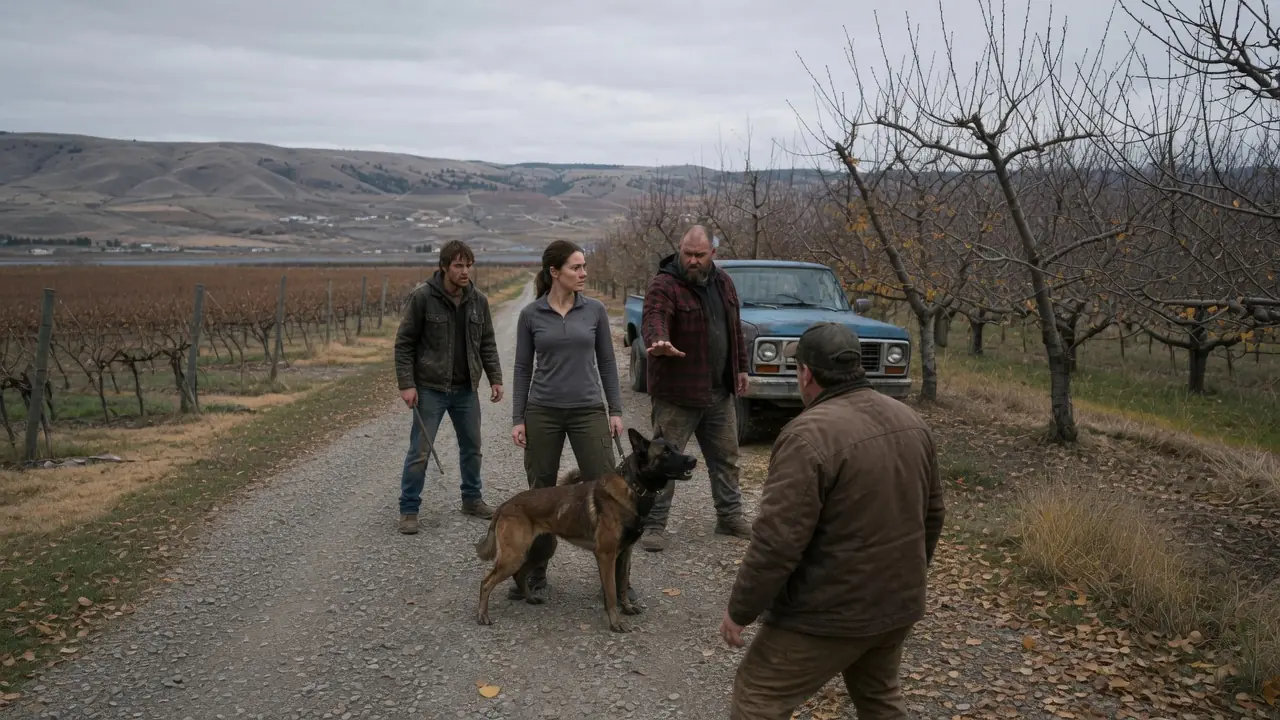
The Okanagan Valley in late autumn carries a particular kind of quiet that people from the cities never quite understand. The tourists are long gone by then. The vineyards are stripped bare, and the back roads between Oliver and Osoyoos are mostly empty, except for the occasional pickup truck hauling a last load of equipment to storage.
Juniper Holt had chosen to live out here precisely because of that quiet. She had earned it. She had paid for it in ways that didn't show up on any record civilian eyes would ever be permitted to read.
Juniper was 31 years old. She had the kind of face that made people think she was younger—fine features, pale freckled skin, and dark hair she kept pulled back in a simple elastic. She was 5'6", lean in the way that came from discipline rather than effort, and she moved with a steadiness that most people registered as calm without understanding what it actually was. She had been a JTF2 operator for six years before a compound injury, sustained during an extraction in a country she was not officially in, ended her operational career. She had come back to the Okanagan, bought five acres with a small house and a gravel road that turned to mud in March, and she had quietly disappeared from the world that had shaped her.
The dog's name was Talon. He was a four-year-old Belgian Malinois, 73 pounds, with a brindle coat and amber eyes that missed nothing. Talon had been her partner on her last two deployments. When Juniper was medically separated from JTF2, she had submitted the paperwork to adopt him herself—a process that had taken 11 months, two appeals, and one very tense phone call with a colonel in Ottawa. He slept at the foot of her bed. He ate before she did. She would have walked through fire for him; he had already walked through worse for her.
On the afternoon of October 14th, they were doing their usual route down the gravel road, turning right onto the old orchard service road that ran parallel to the highway through the tree line, out toward the bench overlooking the valley. Juniper wore trail runners, dark green cargo pants, and a plain gray quarter-zip. No insignia, no indication of anything except that she was a woman in her early 30s who liked long walks with a very serious-looking dog.
Talon moved beside her left knee with the alert, grounded focus of an animal who had been trained to read environments the way other dogs read smells. Every few minutes he would glance up at her, checking in, confirming the world was still ordered. She would give him a small nod. He would look forward again.
They had been walking for about 40 minutes when Juniper registered the truck. It was parked at the far end of the service road where the orchard met the tree line—an old blue Silverado with one headlight cracked and a tailgate that didn't sit flush. She had passed this stretch hundreds of times, and she had never seen that truck parked there. She noted it without adjusting her pace. She kept her eyes forward.
Talon had already seen it. She felt the subtle shift in his gait, that barely perceptible tightening, the way his head came up a degree, and his tail dropped slightly below level. He was reading something she hadn't fully processed yet. She trusted that reading implicitly.
There were three of them. They came out from the tree line on the right side of the road, moving with the particular swagger of men who have done something like this before and found it easy.
Juniper stopped—not because she was startled, but because stopping was the tactically correct response.
Talon sat. She hadn't given the command. He had made that decision himself, and the fact that he sat rather than stood told her he was already in pre-engagement assessment. His eyes were locked on the man with the rebar.
"Nice dog," the big one said. He wasn't looking at Juniper; he was looking at Talon.
"Thank you," Juniper said. Her voice was completely level.
Inside her, something old and precise had come fully awake—something that didn't have a name in civilian language. A mode, a way of being that she had spent years learning how to switch on, and years after that learning how not to need.
"What kind is it?" the big one said, still watching Talon.
"Belgian Malinois."
"Yeah?" He took a step forward. Not a casual step. A deliberate one. The kind that was meant to be noticed. "Military dog?"
"He was."
The big one smiled. It didn't reach his eyes. "Bet he's worth something, then."
Juniper felt the geometry of the situation finalize itself in her mind. Three men, staged and spread. The rebar one on her left, the quiet one trying to drift behind her right flank, the big one keeping her attention up front. The Silverado at the tree line was likely the extraction vehicle. This wasn't random. They had been on this road before, probably more than once, watching the routine, timing the isolation. Whoever these men were, they were organized enough to plan, but stupid enough to think that organization was sufficient.
"We're going to need you to hand over the leash," the big one said. He said it the way a man says something he has said before and found effective. "And your wallet, and your phone."
"No," Juniper said.
The word landed in the air between them like a stone dropped in still water. The big one blinked. He hadn't expected that word. People usually didn't say no to him in that tone, or any tone. Most people, when confronted by three large men on an empty road, went either to panic or to pleading. Juniper had gone to neither. She was standing exactly as she had been standing before they emerged from the trees—weight balanced, hands loose at her sides, eyes moving in a controlled pattern across all three of them.
"Lady," the rebar one said, stepping forward slightly. "You don't really understand the situation you're in."
"I understand it fine," Juniper said. She looked at him directly. "Put the rebar down."
He actually laughed, a short, disbelieving laugh.
"Put it down," she said again, still in the same tone. Not louder, not harder, just absolutely certain. "Whatever you think is going to happen here, I'm telling you now before it does: this is your last good chance to change the outcome."
The big one looked at the rebar one, and something passed between them that was somewhere between amusement and irritation. Then the big one looked back at Juniper, and his expression changed into something colder.
"Take the dog," he said—not to Juniper, but to the one behind her.
That was the moment.
Talon moved before Juniper had fully processed the instruction. Not toward her, not away. He pivoted on his hindquarters and placed himself between her and the man behind her in a movement so fluid and instantaneous that the man actually stumbled backward. Talon didn't lunge. He didn't bark. He simply positioned himself and held—hackles fully raised, lips pulled back just enough to show what he was working with, his amber eyes fixed with an intensity that had nothing recreational in it. That was 73 pounds of purpose, trained by professionals, and the man behind Juniper suddenly looked very young.
Juniper was already moving. She had spent six years learning to close distance on armed subjects in conditions that made this open road feel like a training exercise. The rebar one had roughly a 40-centimeter weapon in a one-handed grip, his elbow elevated. His grip was loose, the way it always was with people who carried things as props rather than tools. He swung when she came into range.
She wasn't where he swung. She had stepped inside the arc before the arc was completed, her left hand trapping his forearm at the wrist, her right elbow meeting his jaw in a short, definitive strike. He went down sideways. The rebar hit the gravel, and she kicked it off the road without looking.
The big one came fast, faster than she'd expected, and she felt the displacement of air. She turned into it rather than away, taking the grab on her shoulder and converting it into a redirect that used his forward momentum to roll him off balance and into the gravel on his hands and knees. He was big; he was not technically skilled.
She took one knee to his back to keep him down and said calmly, precisely, "Talon, halt!"
The man behind her had not moved. Talon's posture had made certain of that.
Juniper stood up and looked at the three of them—the one on his knees in the gravel, the rebar one sitting against the ditch holding his jaw, and the young one pressed against the tree line with Talon still locked on him.
"Stay down," she said to the big one. He stayed down.
She had her phone out. She was already dialing. What she told the RCMP dispatcher when they answered was brief and exact: the coordinates of the location, the number of subjects, a description of each, the presence of the vehicle, and a request for immediate attendance.
The dispatcher asked if she was injured. She said no. The dispatcher asked if the subjects were injured. She said one had a possible jaw fracture and one was on his knees in involuntary compliance. The dispatcher did not ask her how she was managing three men by herself on a rural road, which was professionally appropriate.
While they waited, the big one tried twice to get up. Both times, Juniper said, "Stay down," in the same tone she had said everything else, and both times he complied. By the second time, something in his face had shifted. The calculation was happening behind his eyes—the slow, grinding reassessment of everything he had assumed about the situation and the person at the center of it.
She could see the moment it finished. "Who are you?" he said, not aggressive, genuinely asking.
"Someone who asked you nicely," she said.
Talon sat beside her, watching the young one against the tree line with the patience of an animal who could hold that attention for as long as it was required. His breathing was steady. His posture was immaculate. There was a scar along his left flank, barely visible beneath the brindle coat—a thin white line from a piece of shrapnel in Kandahar three years ago, on a night Juniper did not think about anymore. He had kept working. He had kept protecting. He had never, in four years of partnership, let her down.
She put her hand on his head. He leaned into it by exactly five degrees. She left her hand there.
The RCMP arrived 11 minutes later. Two cruisers, lights but no sirens, came down the service road from the highway end. The first officer out was a constable named Whitmore—young, with the efficient movement of someone who had been on enough calls to stop thinking about what he might find and just respond to what he did.
He took in the scene: three men on the ground or against the tree line, one woman standing with a large dog. He looked at Juniper with an expression that was not quite surprise and not quite confusion, but somewhere between them.
"You the one who called it in?" he asked.
"Yes," she said.
"You okay?"
"Fine."
He looked at the man with the jaw. He looked at the one still on his knees in the gravel. He looked at the young one against the tree line, who was now looking at Talon the way a person looks at something they deeply wish they had not provoked.
"They were armed?" Whitmore said.
"Rebar, about 40 centimeters. It's in the ditch, two meters from the road."
Whitmore nodded and said something into his radio. His partner had already begun the approach on the subjects. Standard protocol, easy geometry. Three men who had made a series of very poor decisions, and were now disinclined to make more of them.
Whitmore looked at Juniper again, and she could see the question forming, the one that always came. She answered it before he asked it.
"JTF2, separated, current civilian." She paused. "And yes, the dog was operational."
Whitmore looked at Talon. Talon looked back at him with the same expression he used for most people—attentive, measured, professionally unimpressed.
"Understood," Whitmore said. He wrote something in his notebook. Then he looked up. "We've actually been watching this area. There's been a series of robberies in the rural sections between here and Osoyoos, targeting people walking or cycling on the back roads. Probably six incidents over the past month."
Juniper thought about the Silverado. The way they had been staged, the way the big one had said *hand over the leash* like he had said it before. "They know the routes," she said.
"That's what we figured," Whitmore said. "They've been patient about it, waiting for isolated targets." He looked at her again with an expression that was starting to settle into something like professional respect. "They picked the wrong one tonight."
"Most days I'm here by 4:30," Juniper said. "Same road, same direction. If they were watching, they'd know that."
Whitmore nodded slowly, writing.
The second constable had all three men cuffed and seated on the gravel beside the Silverado. From the cab of the truck, visible through the driver's side window, Whitmore's partner was photographing something. Juniper could see cable ties—zip ties, the heavy-duty kind—in a bundle on the passenger seat, a backpack, and what looked like a second length of rebar behind the seat.
They had come prepared. Whatever they had intended to do with an isolated woman and a dog on a back road in rural BC, they had come prepared for it to take longer than a few seconds. That particular understanding settled into Juniper like something cold and exact.
She had dealt with that understanding before in operational contexts, on behalf of people who never knew she had been there. She was not new to the reality of what human beings were willing to prepare for. But standing on a gravel road in the valley where she had grown up, seeing the zip ties in that cab, the feeling was different—more personal, more specific.
Talon pressed his shoulder against her left leg. She looked down at him. He was watching her. Not the men, not the trucks, not the officers—just her. The way he always did when the operational phase had ended and the next phase, the coming-back-from-it phase, was beginning.
She had never been able to explain to anyone who hadn't experienced it how much that meant. The dog didn't need an explanation of what had happened. He didn't need her to be fine or to process it on anyone else's schedule. He just stayed there—steady, warm, present, his amber eyes patient and full of something that wasn't quite human, but was in its way complete.
She rubbed the top of his head. He made a small sound low in his chest and leaned harder.
"Good boy," she said quietly. "Good boy, Talon."
Whitmore took a statement. It was thorough, professional, and took about 25 minutes. She described the approach, the positions, the verbal exchange, the moment of escalation, and what she had done. She described it the way she had been trained to describe things—accurate, sequential, without interpretation. When she was done, Whitmore read it back to her, and she confirmed each element. Then he asked if she'd be willing to come to the detachment in Oliver the following morning to give a formal statement, and she said yes. He gave her his card; she gave him her number. He shook her hand.
As the cruisers were preparing to leave—the three men loaded into the back of the second unit, the Silverado being photographed for the impound report—Whitmore came back over to her.
"I want to ask you something," he said.
"Okay."
"That moment when the big one told them to take the dog." He paused, choosing the words. "Most people, even trained people, there's a half-second, a hesitation. You didn't have that."
Juniper was quiet for a moment. She looked at Talon, who was watching the cruisers with mild professional interest. "He was already moving," she said finally. "He'd already made his assessment. I just caught up to him."
Whitmore nodded as if that explained something for him. Maybe it did.
---
After the cruisers were gone, the road was quiet again. The last light was going out of the western sky over the ridge—that particular Okanagan dusk that turned the air a deep gold for about seven minutes before it went purple and then dark. The vineyards on the bench above the valley were just visible as rows of bare vines in the fading light, and the temperature had already dropped three degrees in the ten minutes since the sun went behind the ridge.
Juniper stood in the middle of the service road and breathed. Talon sat beside her and looked out at the valley with what she had long since decided was appreciation, because she didn't have a better word for whatever it was he was doing when he looked at open spaces with that particular quality of stillness.
She thought about the zip ties in the cab. She thought about six incidents on back roads in the past month—six people who had been on that road at the wrong time and had not had what she had. She thought about what that meant, and then she filed it carefully in the place where she kept things she couldn't change, which had gotten quite organized over the years.
Then she looked at Talon and said, "Come on."
He stood up immediately, exhibiting that perfect readiness, and they walked back the way they had come—down the service road, and up the gravel road toward the house, the last of the light behind them, their two shadows long and close together on the pale ground.
The house was exactly as she had left it. The porch light was on. Talon went up the steps first, the way he always did, and waited by the door while she unlocked it.
Inside, she fed him before she did anything else—before she took off her jacket, before she turned on any other lights. She watched him eat with the easy focus he gave to everything, efficient and content, and she thought about what Whitmore had said: *They picked the wrong one tonight.*
She had heard things like that before, meant as a compliment, expressed as a kind of relief on her behalf. She understood the sentiment. She never quite knew how to explain that luck had nothing to do with it. What it actually was was preparation, and training, and six years of being asked to do things that most people would correctly identify as terrifying, so that eventually the terrifying things lost their power to override the thinking. You could thank luck if you wanted. But luck was a story you told to make something comprehensible. What actually happened was something quieter, less dramatic, and much harder to acquire.
Talon finished eating. He drank from his water bowl. He looked at her.
She crouched down and looked back at him, holding his face in both hands, and he allowed this with the dignified tolerance he gave to her smaller sentimentalities. The scar on his flank caught the kitchen light. She had been told by the vet who treated him after Kandahar that he had not made a sound when it happened, that he had kept working.
"I know," she said. She wasn't sure what she was responding to exactly, just the fact of him—the fact of his continued presence in her kitchen, warm and real and whole.
He licked her chin once briskly, as if that was a sufficient acknowledgement, and then turned, walked into the living room, and took his position on the rug in front of the fireplace.
Juniper stood up. She turned on the fireplace. She made tea. She sat in the chair beside the fire with her mug, her dog beside her. Outside, the October dark was settled and total over the valley. The house was warm, and everything that needed to be handled had been handled.
In Oliver at the RCMP detachment, a duty sergeant was running the identities of three men who had made the decision to approach a woman on a back road in the Okanagan on a Thursday afternoon, and discovered rather abruptly that some women on back roads have particular histories. The sergeant would learn in the course of that search that all three men had prior records—robbery, assault, one weapons charge—and that the series of incidents along the South Okanagan rural routes had been escalating in both frequency and the level of planning involved. Connecting the current arrest to the prior incidents would take the detachment's investigators another four days, but the connection would hold. The charges that eventually resulted were substantial.
None of that was Juniper's problem to carry anymore. Her problem, if you could call it that, was the dog asleep on the rug beside the fire, one ear twitching occasionally in whatever operational territory he patrolled in his dreams.
She watched him for a while, then she finished her tea. Then she said to the warm, quiet room, "Good work today."
And Talon's tail moved twice against the rug—once for each word, slow and certain, the way it always did when he knew he had done exactly what he was there to do.