An October pasture stretched out like a sheet of beaten brass gold. Wade Holloway cut the engine on the John Deere tractor his father had bought back in '72. On the far side of the fence, three black Range Rovers ground to a halt, kicking up dust. A woman stepped out of the lead vehicle and looked straight at him.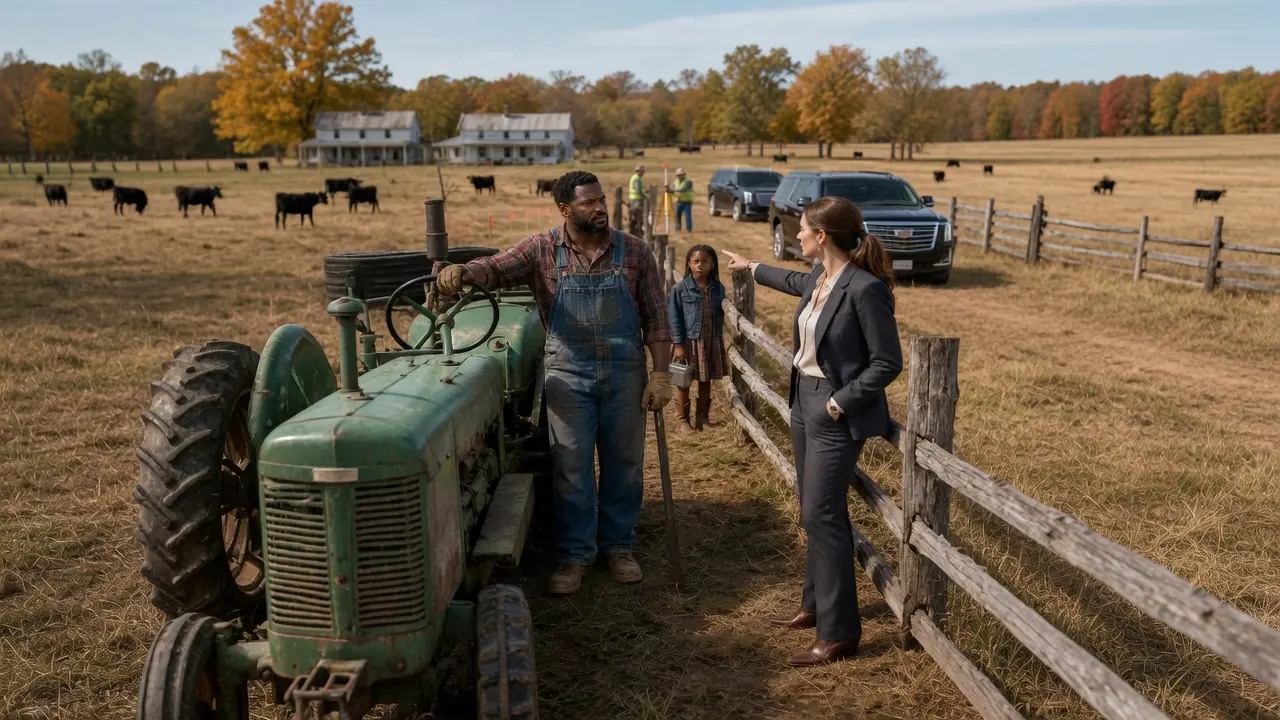
"Hey, flannel," she called out. "You the help out here? Listen carefully. That rust bucket of yours is trespassing on my future parking lot. Ride it home to whatever trailer you crawled out of and tell your boss the grown-ups are here now."
Five seconds of silence followed.
In Dallas, Garrett Pike signed the survey order on Comanche Springs.
The next morning was bright and cold—the kind of Texas autumn that smells of dry mesquite and wood smoke. The Dusty Bell Diner sat on the corner of Main and Pecan in Cedar Hollow, its windows fogged from the griddle and its booths half full of men in feed caps.
A bell rang over the door. Adeline Voss walked in with the air of someone who had never in her life been told to wait for a table. She took the booth by the window, set down a paper cup of city-driven coffee, and opened her laptop. The county appraiser was already late, but she did not seem to care. Her phone rang, and she answered before the second ring.
"Closing Vista Larga inside ninety days," her voice was Dallas warm and Dallas impatient at once, the kind of voice trained to take up the whole room. "Yes, I have it on the calendar. Tell Boyd if he wants the easement language tightened, he can fly down himself."
At the far end of the counter, a man in a flannel shirt was cutting pancakes for a small girl with a brown braid. He did not look up. He did not need to; he recognized the voice.
The second call came in three minutes later. "Garrett Pike," Adeline said.
Wade could hear the chairman's voice faintly leaking from the receiver—low, silken, and demanding.
"The neighboring parcel matters, Adeline. Talk to the holdout. Charm him if you must. Offer eight figures if it gets us moving. We need that water easement clean before the bond rating comes through."
Adeline rolled her eyes at her own coffee. "Garrett, it's a hick with a tractor. He'll sign for two million and a handshake. I'll have it on your desk by Friday."
Ivy looked up from her breakfast. "Daddy, why's that lady talk so loud?"
Wade kept his eyes on the plate, cutting another piece of pancake into a smaller portion. "Some people use loud to cover small, sweetheart."
Adeline ended the call. She stretched her shoulders, glanced around the diner, and her eyes caught his. A flicker. One second of recognition passed between them. Her mouth did not change shape, but the tips of her ears went the faintest shade of pink.
She stood up, walked over, and stopped beside his booth as though she had simply decided to. "Mr.—"
Wade did not offer his name. He took a sip of coffee and looked at her over the rim of the cup.
Adeline pivoted into her professional smile—the one she had paid a coach in Dallas $8,000 to perfect. "I'd like to discuss your property line at some point. Convenient for you?"
Wade set the cup down. "Property line's been there since 1887, ma'am. Hasn't moved."
She placed a business card on the table—cream stock, dark blue ink, no graphic—and walked out without looking back. Ivy reached over, picked up the card, turned it upside down, and squinted at it as if she might learn something from the wrong side. Wade slid it into the pocket of his flannel without reading it.
That night, he stood on the cedar porch of the white frame house, watching the surveyor's headlights sweep slow, methodical patterns through the pasture beyond the creek. A single light appeared from the Vista Larga side, then two, then four.
At 8:00 the next morning, Marisol Reyes picked up her office phone in her two-room law practice above the Cedar Hollow Hardware Store. Adeline was on the line and already mid-sentence.
"I need a list of holdout landowners adjacent to Vista Larga. Anyone whose signature might be required for easement adjustment. I want it within the hour."
Marisol reached for her notepad with one hand and her coffee with the other. She gave three names, speaking slowly on each one. None of them was Wade Holloway.
"What about the parcel to the east of Vista Larga?" Adeline pressed. "The one with the old white house and the John Deere. I drove past it yesterday. Who owns that?"
Marisol set her coffee down. "That parcel is privately held. The owner doesn't take meetings."
She hung up before Adeline could push further, then sat at her desk for a full minute staring at the wall. After a moment, she opened the bottom drawer of her filing cabinet. Inside, behind a row of plain manila folders, sat a bound leather binder: Hartley Cattle Co. Deed history, 1887–present. She put her hand flat on the cover. She did not open it. She drew her hand back.
Three miles east, behind the horse barn, Wade climbed the wooden stairs to a loft he had built himself the spring after Eleanor died. The walls were lined with what looked, at a glance, like a normal rancher's keepsakes. They were not. There was a framed bachelor's degree in agricultural economics from Texas A&M, dean's list; a black-and-white photograph of his great-grandfather receiving a deed from a Texas land office clerk in 1887; and a current hydrology survey color-coded by aquifer zone with Comanche Springs marked at its center.
The blue line of the flow ran east across Hartley Cattle Company land before it reached anywhere else. Fourteen thousand acres of Vista Larga depended entirely on water that could not be legally moved without his signature. Without Wade's name on a single page, not one drop crossed the fence.
He picked up the phone and called Marquette & Boyd in Austin. "Theo, pull the easement files. Every page Voss Meridian has filed on the Vista Larga deal in the last six months."
That afternoon, Adeline drove up the long gravel drive of Hartley in her Range Rover. She brought a bottle of Napa Cabernet that had cost her $400 in a Dallas wine shop, carrying it carefully with both hands.
Wade met her on the porch. He took the bottle, set it on the kitchen counter, and then poured her a glass of well water from the pitcher in the icebox. "Water here's older than the wine, ma'am. Try it first."
She drank. Her expression shifted—the water was clean, faintly mineral, and sweet on the back of the tongue. "Where does this come from?"
"Comanche Springs. Three miles that way. Been running since before the state of Texas existed."
A door creaked open. Ivy came in leading Biscuit, the old palomino mare, by her halter. She stopped when she saw the visitor in the kitchen. Adeline, who had never knelt to a child in her life, set her glass down and lowered herself onto one knee.
"Hi, I'm Adeline. Who's your friend?"
"This is Biscuit," Ivy said. "She's old."
"So am I," Adeline replied softly. "Sometimes."
Wade watched them, staying silent.
When Adeline left, she paused at the open door of her vehicle. "Mr. Holloway, what would it take for you to sign an easement?"
"To know what you intend to do with the water."
He went back inside, and the door closed.
That night, the file from Austin arrived by courier in a sealed accordion folder. Wade carried it up to the loft and turned the pages slowly, one at a time, until he reached the page Theo had marked with a yellow tab. It was a scanned internal memo dated September 14th. The signature at the bottom belonged to Garrett Pike.
The subject was the engineered diversion of the Comanche Springs flow toward an Austin metropolitan water contract—a contract that, by the third page, was worth millions over fifteen years and would draw the spring completely dry inside of seven.
Wade folded the memo. He looked at the clock on the wall and spoke softly to the empty room. "Eleanor would have burned this place down before letting him have it."
At 6:00 the next morning, the surveyors crossed the fence.
Wade was already up. He had been awake since 4:30, the way he had been every day since Eleanor died, sitting on the porch with a cup of black coffee while the sky behind the live oaks turned from charcoal to peach. He saw the first white flag go into the dirt on his side of the property line, then the second.
He set his coffee down. He walked out, calm and unhurried, his boots stirring up small puffs of caliche dust. He stopped twenty feet from the survey foreman. "Gentlemen, you're on Hartley land. I'll need you to pack up and step back across that fence."
The foreman immediately called Adeline. She arrived in twenty minutes flat, a blazer over her silk shell, wearing new cowboy boots that had not yet learned the shape of her feet.
"Mr. Holloway, my crew has authorization from the Vista Larga sellers," she stated. "If your fence line is in dispute, I suggest you take it up with the county."
Wade said nothing for a beat. Then he took out his phone and dialed. "Sheriff Bender, Wade Holloway. I've got six men trespassing on my property, and I'd appreciate a deputy when you've got the time."
Sheriff Tom Bender pulled up twelve minutes later in a county cruiser the color of dried mud. He stepped out, settled his hat, and walked straight past Adeline to where Wade was standing. "Morning, Mr. Holloway, sir. What have we got?"
Adeline noted the "sir." She filed it away.
The sheriff turned to the surveyors, his voice level but absolute. Within ten minutes, the crew had pulled their flags, loaded their equipment back into two pickup trucks, and rolled back across the fence onto Vista Larga land.
Adeline stood in the middle of the dirt road in a blazer that suddenly felt like the wrong piece of armor for the country she was standing in. After the crew left, she did not get back in her car. She walked over to the fence and put both hands flat on the top rail.
Wade joined her, his pace slow. "Why does the sheriff call you sir?" she asked quietly.
"Because his mother was my third-grade teacher. That's how it works out here."
Adeline did not answer. From the porch, Ivy waved a small hand, offering a small smile. Adeline waved back before she even thought about it. She drove back to the motel in Cedar Hollow in total silence.
In Room 12, she opened her laptop and, for the first time, typed the query into the county database herself: Hartley Cattle Co., Mesa Blanca County.
The screen populated: Acreage: 14,237. Last appraisal: $118,400,000. Sole owner: Wade A. Holloway.
She read the screen three times. The words from her first afternoon—future parking lot—repeated themselves in her own head, and she despised the sound of them. Her phone began to ring. It was Garrett Pike. She let it ring out, turning the phone face down on the bedspread.
That same evening, Marisol drove up the long gravel road to Hartley with the leather binder under her arm. She and Wade sat on the porch in the blue twilight. She set the binder on the table between them.
"Wade, Pike's already filed paperwork through a shell entity to claim an adverse easement against the eastern flow channel. He's not going to ask you nicely anymore. He's going to try to take it through the courts and the legislature both." Marisol hesitated, her face tight. "And he's holding something over my son. Daniel just made associate at a firm in Dallas, and Pike sits on their advisory board. I can't be your lawyer of record on this one, Wade. I'm sorry."
Wade nodded once, completely understanding. "You don't need to be. You just needed to come tell me. That's enough."
Three days later, Adeline came back to Hartley a third time. She did not bring a bottle, a tri-folded contract, a tablet, or an assistant. Instead, she carried a manila folder she had spent the previous evening reading line by line in her motel room—her own company's draft of the Vista Larga purchase agreement, the version carrying her signature on page 41.
She had read it quickly in the airport before signing it three months ago. Last night, she had read it slowly, and she had discovered on page 28 the clause that quietly granted Voss Meridian the right to redirect the surface flow from Comanche Springs after closing. She had signed it without understanding what she was truly signing away.
Wade was at the kitchen table when she walked in. He poured a cup of coffee for her without asking.
"If I told you the deal as written would dry up your land within five years," she said, "would you believe me?"
Wade slid the cup toward her. "I'd believe you were starting to see it."
She sat down, setting her purse on the floor, leaving her laptop behind. Ivy padded in barefoot from the front room, holding a sugar cookie wrapped carefully in a napkin, and held it out to her. Adeline took it in both hands like it was something precious that might break.
"Thank you, Ivy."
"You're welcome, Miss Adeline."
After the coffee, Wade stood up, took down a barn jacket from the peg by the door, and held the screen door open for her. "Come on. I want to show you something."
They walked the long way around the south pasture, past the windmill that still pumped though no one needed it to, and past the pecan grove Eleanor had planted the year Ivy was born. At the top of the rise behind the barn, beneath a single live oak older than any property deed, was a piece of granite the size of a saddle. It was low, gray, with no inscription except a name and two dates. A clay pot of bluebonnet seedlings sat at its foot.
"My wife knew this land better than I do," Wade said softly. "She used to say, 'Land doesn't belong to anyone, Wade. People belong to the land.' Pike doesn't understand that. I don't think you did, either, until this week."
Adeline looked down at the grass, letting the silence stretch out before trying to answer. "I was raised in a high-rise, Mr. Holloway. My father sold leverage. He went broke twice. He taught me that land was just a slow-moving stock."
"And now?"
"Now, I'm not sure what I was taught was right."
They walked back together in silence. At the side of the barn, Ivy was brushing Biscuit's flank with both hands, talking to the mare in a soft, running stream of absolute nonsense. Adeline stopped at the fence and watched. Wade stopped just behind her, watching her watch his daughter. The immense distance between them—measured in steps, in air, and in years of being entirely different kinds of people—shortened by one. Neither of them spoke, and neither of them moved away.
The Voss Meridian boardroom in Dallas was on the 43rd floor—all glass, steel, and oiled walnut, with a sweeping view of downtown that had once made Adeline feel she had finally arrived. That morning, sitting in her usual seat at Garrett Pike's right hand, the view looked entirely insignificant.
Garrett opened the meeting by announcing a compressed timeline: thirty days to close Vista Larga instead of ninety. He wanted the spring diversion application filed with the Texas Water Development Board before—and he smiled when he said it—any noisy neighbors could get litigious.
Adeline kept her face perfectly still. "Garrett, the easement isn't clean. The Hartley parcel controls the upstream flow. We need their signature, or the deal collapses in due diligence."
Garrett's smile did not waver. "Adeline, Hartley is a sentimental man with a child and a dead wife. He'll sign for the right number."
"And if he doesn't?"
"We have other ways." He stood up, walking around the table. As he passed her chair, he laid a hand briefly on her shoulder. "The grown-ups are handling it now."
Adeline did not move. She knew that exact sentence. She had used it. She had used it in this very boardroom on a junior analyst eight months ago; she had used it to a contractor in Cedar Hollow only three days prior. She had used it because Garrett had used it on her four years ago during her first week on the job, and she had absorbed it the way a child absorbs the cadence of a parent's contempt.
She sat completely still until the rest of the board meeting concluded. Then, she walked to the executive restroom, stood in front of the mirror for a long time without turning the water on, and took her phone out.
She dialed Marisol Reyes. "Off the record... what kind of man is Wade Holloway?"
There was a pause of exactly three seconds over the line. "The kind you don't try to fool twice."
Adeline put the phone back in her bag.
That night, she drove south. She did not call her assistant, and she did not pack a bag. She drove three hours through the pitch black, the Dallas tower lights falling away behind her, and pulled up at the perimeter gate of Hartley Cattle Company at 1:00 in the morning.
Wade was still awake, working in the tack room to repair the cinch on Ivy's saddle for the morning ride. He saw the headlights through the window, walked out, opened the heavy gate, and waited.
She got out of her car, leaving her keys in the ignition. "I'm not here as a buyer, Mr. Holloway."
He looked at her for a long second, then pushed the gate wider. "Then come on in, Miss Voss."
As she stepped onto the gravel driveway, her phone vibrated in her hand. It was an unknown number. She glanced down to find an incoming image file—a photograph of a young man in a graduation cap and gown, the Texas A&M Law School logo clear behind him. Beneath the image were six words: Ask your friend Reyes to stay out of this. - GP
She read it, her hand closing tightly around the device. She did not show Wade; she did not need to. He saw the sudden shift in her expression, but he did not pry. He only tipped his head toward the porch steps.
They sat there together until the sky turned gray.
In the morning, they drove together to Cedar Hollow Feed & Tack—a long, low building on the south edge of town with a wooden bin of bulk oats by the door and a hand-lettered sign that read: No Credit. No Exceptions. Sorry, Grandma.
Hollis Vance had owned the store for 46 years. He was 78, lean as a fence post, and had not missed a workday since his wife's funeral in 2004. He looked up when the bell jangled, grinning at Wade, before looking past him at Adeline. His eyes were slow and assessing.
"This the Dallas lady I've been hearing about?"
"That's her," Wade said.
Hollis wiped his hands on the canvas apron at his waist, speaking directly to Adeline with no edge, but no soft cushion either. "Miss, your chairman came through here in '19. Same shoes, different face. Tried to buy out your boy, Wade. Wade said no. Pike said he'd find another way."
Adeline did not flinch, holding his gaze. "Mr. Vance, do you know what kind of way he meant?"
Hollis smiled very slightly and gestured for them to follow him into the back room, which smelled heavily of leather oil and old paper. He crossed to a tall green safe that had been bought used from a defunct bank in San Saba back in 1961. He spun the dial, opened the heavy door, and reached past a stack of old ledger records to pull out a brown envelope, soft at the corners.
Inside was a photocopy of a meeting transcript dated June 11th, 2019. The parties listed were Garrett Pike, then a senior partner at a Dallas acquisition firm, and the deputy commissioner of the Texas General Land Office. The subject was a contingency plan to be activated only if the Hartley parcel could not be acquired through private negotiation: To pursue an eminent domain taking on behalf of a public-private water infrastructure consortium.
The transcript carried both signatures, the official date stamp, and the small embossed seal of the deputy commissioner's office. The original file had vanished entirely from the state archive in 2020.
"This was the only copy. My nephew worked in that office," Hollis said quietly. "Made a copy of the file before they cleaned out the cabinet. He passed away the year after, but he left it to me. I've been waiting seven years to give this to somebody who'd use it right."
He handed the envelope to Wade. Wade handed it directly to Adeline. Her fingers closed around the paper, trembling faintly before she steadied them.
This was it. With Adeline's internal testimony as corroboration, this document was enough to void the entire Vista Larga purchase agreement, terminate Garrett Pike from the board, and open a federal conspiracy investigation that would last for years.
On the drive back to Hartley, Adeline did not speak. Wade drove the 1998 Ford F-250 with one wrist resting casually on the steering wheel. At the second cattle guard, he eased the truck to a stop, letting the engine idle.
"Miss Voss, you can give that paper back to Hollis right now and pretend you never saw it. Drive back to Dallas, sign the deal, and nobody would ever blame you."
She looked down at the envelope on her lap. "I'd blame me."
Wade nodded once, putting the truck back into gear. "Then we go to Austin on Monday."
It was the first time in three weeks of conversations that he had used the word we. Adeline registered it, but she did not remark on it. She turned her face to the side window, watching the live oaks run past in long, uneven rows.
When they pulled into the Hartley drive, Ivy came running from the barn in her small boots, her braids swinging. She didn't slow down, wrapping her arms around Adeline's waist in a single, complete hug before letting go. "You're back!"
"I'm back," Adeline said, her voice entirely devoid of the cadence she used on the 43rd floor.
Wade watched from the porch, sliding his hands into his pockets, staying there a long moment before stepping down to meet them.
Monday morning was cold and clear. Wade drove the F-250 south on Highway 281 with Adeline in the passenger seat, the brown envelope and a thicker manila folder of her own corporate materials packed inside a leather briefcase wedged between them. Ivy was safely at the Reyes house in Cedar Hollow, where Marisol had promised pancakes and a slow morning brushing the neighbor's pony.
Somewhere south of Marble Falls, they began to talk. They had spent weeks within a few miles of each other, but they had not yet truly conversed.
"My father went broke twice," Adeline said, looking out at the river running parallel to the highway. "Once when I was nine, and once when I was fifteen. He raised me on a single phrase: Never love anything that can't appreciate and value you. He meant it as a kindness."
Wade kept his eyes firmly on the road. "My wife wrote her senior thesis on Comanche Springs—range ecology, fall semester of '92. That was how we met. I was a junior, she was a senior. She asked me if I knew anything about my own water flow, and I said no, and she said, 'Well, that's a shame.' I told her, 'Maybe you could teach me.'"
Adeline smiled at the windshield. "She'd have liked you, Wade."
"Not at first," he noted, "but eventually."
It was the first smile of the trip that didn't have anything to sell.
They reached Austin a little past noon. Theo Marchetti was waiting in his corner office on the 18th floor of a stone-faced building two blocks off Congress Avenue, his shirt sleeves already rolled up. He read through the contents of the Hollis envelope without speaking a word. Ninety seconds passed. He set it down flat on his desk blotter.
"Wade, this is enough. This is more than enough. We file Wednesday morning."
Adeline cleared her throat. "Mr. Marchetti, if I voluntarily resign from Voss Meridian today and turn over these internal digital documents as a cooperating witness... can we file Tuesday morning instead?"
Theo looked at Wade. Wade looked at Adeline. Adeline looked steadily at the bookshelf behind Theo's head, not flinching.
"Tuesday morning it is," Theo said.
That night, they took separate rooms on the eighth floor of a hotel on West 6th Street. At 10:00, Wade knocked on the door of Room 812. When Adeline opened it, he held out a green glass quart bottle of water, hand-corked, with condensation already pooling on the glass.
"Helps you sleep. Eleanor used to swear by it."
She took it, holding it with both hands. "Why are you doing this with me, Wade? You could have ruined Pike without my help."
Wade thought about it for a beat. "Because you turned around. Most people don't."
He closed the door. She stood in the middle of the room with the bottle in her hands for nearly a minute, then poured a glass, drinking it slowly while sitting on the edge of the bed. She did not check her phone, and she did not open her laptop. When the glass was empty, she lay down on top of the comforter fully dressed and slept through the night.
In Dallas, Garrett Pike was currently on his fourth consecutive call to her phone. None of them was answered.
At 7:00 a.m. Tuesday, Adeline knocked on the door of Room 810. She was wearing the same blazer as the day before, holding the empty glass bottle by its neck. "I'm ready."
The clerk's office of the Travis County Civil District Court opened at 9:00. Theo Marchetti was the first attorney through the door, filing three major documents simultaneously.
The first was a massive civil complaint on behalf of Wade A. Holloway and Hartley Cattle Company against Voss Meridian Land Holdings, the chairman of its board Garrett Pike individually, and a list of seventeen co-defendants, alleging conspiracy to commit fraud, attempted abuse of eminent domain proceedings, and willful violation of Texas surface and groundwater law. The second was Adeline Voss's comprehensive sworn affidavit as a cooperating witness. The third was a sealed packet of internal corporate emails proving Garrett Pike had personally authored the buried diversion clause, knowing exactly what damage it would cause.
The filings were public record by 10:00. By noon, the Dallas Business Journal had broken the story. By 1:00 p.m., Voss Meridian had lost 41% of its market capitalization.
The board convened an emergency session at 2:00. They voted seven-to-one to remove Garrett Pike effective immediately; Garrett cast the lone dissenting vote against himself. At 4:00, the Dallas field office of the FBI opened a formal federal fraud and conspiracy file.
Wade and Adeline walked out of the courthouse together into the slanted afternoon light. They crossed Congress Avenue and walked four blocks to a small coffee shop with a pressed-tin ceiling, sitting at a table by the window.
Adeline placed her hand flat on the wood. Wade placed his hand a few centimeters away from hers. Neither hand moved.
"What happens to you now?" Wade asked.
"I don't know. The board may keep me to manage the fallout, they may not. Either way, I'm not going back to that office the same person I was."
Wade looked out at the street traffic. "There's room at Hartley if you need a place to think for a while. The spare cedar cabin's been empty for a few years."
She turned her face toward him. "Wade... that's not nothing, what you just said."
"I know."
On the long drive back to Cedar Hollow, her phone rang. It was a number she recognized—the board's outside general counsel. She put it on speaker and listened. They were offering her the interim chairman seat. They were doubling her base salary, asking her to guide Voss Meridian through the federal cleanup and out the other side.
"I'll think about it," she said, and ended the call.
Wade glanced sideways at her. "You're considering it?"
She looked out at the dark, rolling line of the Hill Country to the west. "I'm considering whether I want to spend the next ten years undoing what Garrett built, or whether I want to do something I haven't done yet."
Wade did not ask her what that something was. He didn't need to; he kept driving.
For two weeks, Adeline stayed in the cabin behind the main house at Hartley. The cabin was small—one room and a wood stove, featuring a tin roof Eleanor's sister had repainted green back in 2020, and a porch with two cane-bottomed chairs. Adeline wore plain denim she had bought at the local feed store and the leather cowboy boots Wade had quietly placed by her door on her second morning. They carried real Texas mud by the end of the first week.
She drank coffee on the main house porch every morning with Wade and Ivy. On a Thursday afternoon, Ivy decided to teach her how to tie a real cowboy knot—the kind that holds a halter rope securely to a fence post but pulls entirely free with a single tug.
"Two loops, Miss Adeline, then through the back," Ivy instructed. "Like a real knot, not a city knot."
Adeline let out a clear, open laugh—a sound she did not remember ever making before. Her head tipped back against the porch post. Wade watched her from the kitchen window, his coffee mug in hand, and he did not look away.
She formally declined the corporate chairman's seat the following Monday. In its place, she announced the founding of the Voss Meridian Land Trust—a non-profit conservation foundation chartered under Texas law for the sole purpose of protecting family ranches from corporate acquisition and aquifer-draining development. The initial capital of $40 million was drawn entirely from her federal whistleblower award, her personal savings, and the liquidation of her luxury Dallas penthouse.
The grand jury indicted Garrett Pike on the 23rd of October on four federal counts of fraud and conspiracy. He was remanded to home confinement pending his trial, and his Vista Larga shell entity collapsed inside of a week.
Hollis Vance was called as a material witness. He wore his old Stetson and a tie his late wife had picked out for him forty years before, answering the prosecution's questions in short, plain sentences. When he stepped down from the stand, Wade was waiting for him in the marble hallway. Hollis put a heavy hand on Wade's shoulder. "Eleanor would have been proud, son."
Wade nodded, unable to get any words out past the tightness in his throat.
Marisol Reyes finally opened the leather binder she had kept hidden in the bottom drawer of her filing cabinet for seven years. Inside, behind the deed history of the county, was a single folded sheet of cream stationery carrying Eleanor's handwriting—a codicil to the estate will written six months before the accident. Marisol drove out to Hartley on a Friday evening and put it directly into Wade's hands.
He sat down at the kitchen table to read the script. There was a line in it he had never seen before: “If I'm not there, Wade, find someone who can stand on this land without trying to own it.”
Wade read it twice, folded the paper carefully, and put it in the pocket of his flannel shirt. He walked out onto the porch. Adeline was sitting on the top step with Ivy beside her, patiently teaching her how to find the first winter stars of December.
By the first week of December, Vista Larga had been officially acquired by the Voss Meridian Land Trust for $89 million—well below the inflated sale price Garrett Pike had once chased, but enough to fully satisfy the sellers' note and the lenders. The entire acreage was placed under a perpetual conservation easement. Comanche Springs received state-level protective designation; no industrial diversion would ever be drilled into the aquifer. The Austin metropolitan water contract was permanently reassigned to a desalination project on the coast, where it should have been from the very beginning.
Adeline moved out of the green cedar cabin the second week of December and into a small rented house on the south end of Cedar Hollow—close to Hartley, but not on it. The house had a bright yellow front door and a porch that faced east, and she liked it. She was not ready yet for what lay between the cabin and the main house. Wade understood, and he did not push. When she came over for supper on Wednesdays, he simply set a third plate at the table.
On a clear afternoon a few days before Christmas, Wade walked the fence line between Hartley and Vista Larga with a coil of new wire over one shoulder and a heavy fence post driver in his hand. The sky was the high, cold blue that only comes to Texas in December. It was the exact stretch of fence where Adeline had stood three months earlier in her city heels and tailored blazer, calling his pasture her future parking lot.
She came down the dirt road on foot, wearing her boots, carrying two paper cups of hot coffee from the Dusty Bell. She handed him one, and they worked together without speaking for almost an hour. She held the wire taut against the cedar posts while he drove them deeper into the hard caliche earth. Her hands carried calluses now—small ones on the fleshy part of her thumbs from the physical labor of the last few weeks.
When the final post was securely set, they straightened up together and looked west across the pasture toward the rise where Comanche Springs ran cold, clear, and older than the state of Texas.
"Wade," she said softly, "I don't know what this is yet."
He set the post driver down in the dirt, looking at her for a long moment—the way a man looks at weather he is trying to read. "Doesn't have to be anything yet, Adeline. Land doesn't rush."
She nodded once, not looking away.
A small thudding of boots came up behind them. Ivy was leading Biscuit by the halter, her braid swinging and her cheeks pink from the winter cold. She walked straight between them, slipping her right hand into Adeline's left, and her left hand into Wade's right, turning the three of them gently to face the spring.
The water was still moving. It had always been moving. It would keep moving long after all three of them, long after the fence, the wire, and whatever names anyone chose to write on any legal deed.
Wade felt his daughter's small fingers tight around his own. He felt, on Ivy's other side, the woman who had stood on this exact line in September and tried to take it from him, now standing on it with him in the same boots, in the same cold, looking at the same water.
He did not let go. Neither did Adeline. Some fences mark where land ends; others mark where it begins.