The garden gate at Renfield Hall had a small, tired creak—the kind that only a servant or a girl who did not matter would notice—and Iris Pharaoh had learned every sound that house could make. She had spent three years listening for the ones that meant trouble, and the ones that meant she was, for a little while, safe. 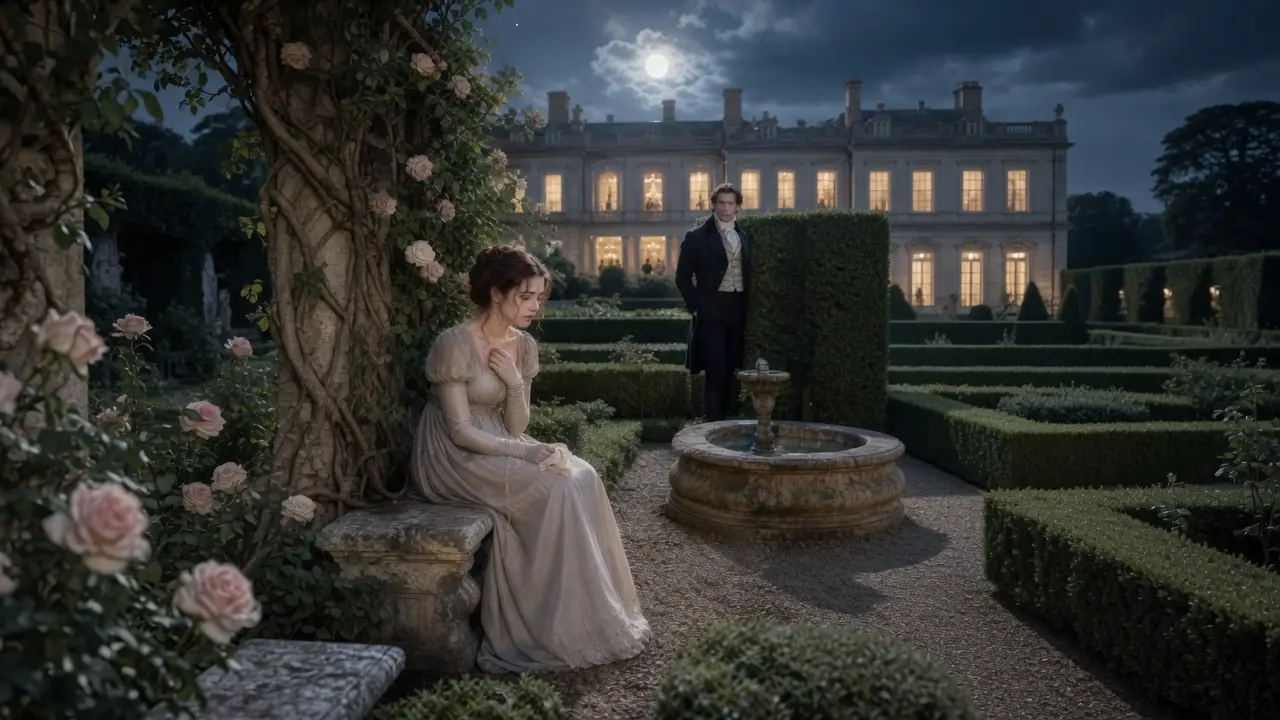
Tonight, she pulled the gate shut behind her with both hands, softly, the way she closed doors when she did not wish to be found, and she did not look back to see whether anyone had watched her go. She did not think anyone would. That was the shape of her life at Renfield: unwatched, unremarked, present the way a chair by the wall is present—useful when needed and otherwise invisible.
Inside, the ballroom still glittered. She could hear it even here, muffled through stone and hedge—the violins pulling laughter out of people who had never once had to wonder whether their gowns were three seasons old. She had worn her gray silk tonight because it was the only one that did not show its mending in candlelight, and she had told herself, walking down the stairs an hour ago, that gray was elegant, that gray was quiet, that gray did not need to apologize for itself.
Lady Camden had disagreed loudly enough for six people to hear. Iris pressed her fingers to her collarbone now in the dark, as though she could still feel the words landing there.
"Miss Pharaoh does try so hard with so little to try with, doesn't she?"
Laughter followed—light, cruel, and utterly without malice in the speaker's own mind, because to Lady Camden it had not been an unkindness at all, merely an observation, the sort one might make about weather or a poorly bred dog. Iris had smiled. She always smiled. It was the only defense she had ever been permitted to keep.
The garden at this hour belonged to no one, and that was precisely why she loved it. Boxwood hedges cut the moonlight into long, silver strips. A stone bench sat half-swallowed by climbing roses gone slightly wild, and beyond it, a fountain that no longer ran murmured only with the wind moving through dead water. Iris walked to the bench and did not sit so much as fold—the way a girl folds when she has been holding herself upright for hours and finally believes no one is looking.
She did not hear the second set of footsteps.
Julian Ashford, Duke of Renfield, had not intended to follow anyone into his own garden. He had intended, in fact, to escape his own ballroom for exactly as long as it took to remember why he continued to host these gatherings at all, and he had gone out through the west door precisely because it was the door least likely to be used by guests who wished to be seen using doors. He had not expected the gray figure ahead of him on the gravel path, moving quickly, quietly, like something trying not to disturb the dark.
He knew who she was. Of course he knew. A man does not host a house party for a fortnight without cataloging, however idly, the women in it—the daughters paraded like prize mares, the mothers watching him with the particular hunger of women calculating acreage, and somewhere at the edges, always at the edges, the poor cousin who poured tea and fetched shawls, and was thanked the way one thanks furniture for being sturdy.
He had noticed her before tonight. He was a man who noticed things. It was, in fact, the whole of his reputation: cold, watchful, difficult to charm—because charm required a man to be looking at the surface of things, and Julian had never in his life managed to look only at the surface.
He had noticed that Miss Pharaoh refilled Lady Camden's wine glass before Lady Camden asked; that she remembered which Dowager took her tea without sugar, and which insisted upon two lumps though she pretended to abstain; that she laughed at other people's jokes with her whole face, and never once told one of her own. He had noticed three days ago that she had given her own dinner roll to a hunting dog that had slipped in through the kitchen door and been near to strangled with hunger, and that she had done it without an audience, without any expectation of praise, simply because the animal was hungry and she had bread.
He had not meant to follow her tonight. And yet here he was at the edge of the hedge, close enough to see her shoulders shaking, and something in him—something old and unpracticed, a muscle he had not used since he was a boy who still believed the world could be gentled by wanting it to be—refused to walk away.
"I am so very tired," she said to nothing. To the roses, her voice broke slightly on *tired*, as though the word itself weighed more than she could carry. "I am tired of being grateful. I am tired of being useful. I should like only once to be wanted for no reason at all."
Julian did not move. He barely breathed.
"I know I have no right to want that," she went on, quieter now, almost amused at her own foolishness—the way people are cruel to themselves when they think no one else will hear it, so no one will contradict them. "I have a roof and a bed and Aunt Eugenia's charity, and I ought to be thankful every hour of every day. And I am, I am." Her hands twisted in her lap. "I only wondered tonight, watching her laugh at me, what it might feel like to be looked at... as though I were worth looking at. Not managed, not tolerated—looked at."
She laughed, then made a small, broken sound and wiped her face quickly with the back of her glove, as though even her own tears were an indulgence she could not afford to keep.
Julian stood very still in the dark and felt something in his chest crack open like ice in a spring thaw—sudden, total, and impossible to stop. He did not step forward. Some instinct older than manners told him that to reveal himself now, to let her know that her private grief had been witnessed—that the very thing she feared, being seen in her worst and most unguarded moment, had already happened without her consent—would be its own cruelty, however gently done.
So he retreated, step by careful step, back along the gravel until the hedge swallowed him whole, and only then did he let himself breathe. He returned to his own ballroom, a changed man, though no one there could have told the difference. He danced the required dances. He exchanged the required pleasantries. He watched Lady Camden across the room with new and quiet dislike, and he watched more than once for a gray silk gown that did not reappear that night at all.
Iris did not come down to breakfast the next morning. She told her aunt she had a headache, which was not strictly a lie, though the ache lived somewhere lower than her temples. She spent the morning mending a torn hem in the small sitting room set aside for companions and unmarried relations of no particular consequence—the room with the north light and the worn carpet—and she told herself that last night's foolishness, speaking her heart aloud to an empty garden as though the world owed her an answer, had been a private weakness, indulged and finished, never to be repeated.
She did not know, could not have known, that the Duke of Renfield had begun from that morning forward to watch her with an attention so careful it left no visible trace.
It began in small things: the dinner roll. The very next evening, a footman set before her a plate with a portion of pheasant slightly larger than the others, and when she glanced up in mild confusion, no one at the table seemed to have noticed at all, least of all the Duke, who was deep in conversation with Lord Camden about drainage and did not so much as glance her way. She thought nothing of it; kitchens made mistakes.
Then it was the fire. She had mentioned once in passing to her aunt that the small sitting room grew unbearably cold by late afternoon, and three days later a housemaid appeared with an armful of wood and built the fire high without being asked twice. She continued to do so every day after, though no order had been given that Iris could trace to any source.
Then it was the book she had admired aloud to no one in particular—a volume of poetry left open on a table in the library. Cowper, a poet she had loved since girlhood, before poverty had made loving things feel like a luxury she could not afford. Two days later the book was gone from the table. She assumed it had been reshelved and thought no more of it until she returned to her small room that evening and found it lying upon her pillow, a single dried violet pressed between the pages at her favorite verse.
She stood holding it for a long time, her heart beating in a strange, unfamiliar rhythm, before she made herself set it down. It could not mean what some foolish part of her wished it to mean. Gifts like this did not arrive for girls like her without a reason attached, and she had lived long enough among the wealthy to know that reasons were rarely kind ones. Someone was playing at something. She resolved to be careful. She did not yet let herself imagine it was the Duke. That thought was too large, too dangerous—the kind of hope that, once permitted entry, does terrible damage on its way back out.
It was Lady Camden who first planted the suspicion, though she did not mean to be kind about it.
"You have caught His Grace's eye, I think," she said one afternoon, in the tone of a woman remarking upon an unfortunate stain on a carpet.
They sat together in the drawing room with several other ladies, embroidery frames balanced on their knees, and Lady Camden did not look up from her stitching as she spoke.
"He watches you at dinner. I noticed it Tuesday and again Thursday. Quite peculiar, given that you have nothing whatsoever to recommend you beyond good posture."
The other ladies laughed—the easy laughter of people amused by someone else's discomfort. And Iris felt her face go hot.
"I am certain you are mistaken," she said, and made her voice light, because lightness was armor and she had worn it long enough to know exactly how to put it on.
"Perhaps." Lady Camden's needle moved in and out, unhurried. "Though I confess I cannot imagine what he would want with you. A duke does not marry a companion, my dear, whatever novels may tell young women these days. He may find you a diverting curiosity for a fortnight. He will not find you a duchess."
The words landed exactly where they were meant to land, and Iris bent her head over her own embroidery so that no one would see how deeply the needle had gone in.
She did not know that Julian stood just beyond the drawing room door, having come to deliver a message to his aunt, and had heard every word. He did not enter the room. He stood in the corridor for a long moment, his jaw tight, and felt an anger so foreign to his usual temperate self that it frightened him slightly. Not at Iris—never at Iris—but at a world so casually, thoughtlessly cruel to a woman whose only offense was having been born to less money than the women around her.
He began from that day to be more careful in his attentions, not less consistent in his intentions. He understood now what he had perhaps always understood without naming it: that any interest he showed Iris Pharaoh openly would be turned into a weapon against her before it could ever become a comfort. So he continued in silence. He continued in small, unclaimed kindnesses. He waited, though waiting had never come naturally to a man used to simply taking what he decided he wanted, because he understood dimly, instinctively, that this was not a woman to be taken. This was a woman who had spent her whole life being managed, arranged, decided for, and the last thing he would ever do was become one more person who decided things about her without her consent. He would let her come to trust the kindness before he ever let her know its source.
It was another week before they spoke—truly spoke. Not the brief, exchanged courtesies of a host and a guest's poor relation, but a conversation in which she looked at him and he looked at her, and neither one performed for an audience, because for once there was none.
She had gone to the library at dusk, when she believed the house occupied elsewhere with cards and gossip, seeking the quiet the way she always sought it, like a creature returning to its den. She did not expect to find the Duke there already, standing at the tall windows with his hands clasped behind his back, looking out at a garden going gray with evening.
"Forgive me," she said at once, already retreating. "I did not know you were here, Your Grace. I shall come back another—"
"Stay," he said. And something in his voice—not a command, but a request, oddly gentle for a man whose voice she had only ever heard pitched for dinner tables and drawing rooms—made her pause with her hand still on the door.
"I only wished for a book," she said.
"Then take one." He gestured faintly at the shelves. "I promise not to report the theft."
It was such a small joke, so unlike the cool reserve she had come to expect of him, that she almost smiled before she caught herself. "You are teasing me, Your Grace, a little."
He turned from the window then and studied her with an attention that made her want, absurdly, to smooth her hair, check her hem, do something with her hands. "Does that trouble you?"
"I am not accustomed to it," she admitted before she could stop herself. "Being the subject of anyone's notice, let alone their teasing."
Something crossed his face then, quick and gone—something that looked almost like grief on behalf of another person, and she did not understand it. Not yet.
"That," he said quietly, "seems to me a very great oversight on the part of everyone who has ever known you."
She did not know what to say to that. It was too large a kindness, too specifically aimed, and she had learned to be suspicious of kindness that arrived without an obvious motive. "You are very good to say so, Your Grace, but I think you mistake politeness for—"
"I do not mistake anything," he said. And there was something almost fierce beneath the quiet of it. "I have never once in my life said a thing I did not mean simply to be agreeable, Miss Pharaoh. I find agreeableness tedious. I would rather be silent than false."
She looked at him properly then, for the first time perhaps in three weeks of sharing a house, and saw not the cold and watchful Duke of drawing room gossip, but a man standing very still, as though holding something carefully so it would not break.
"Then I thank you," she said softly, "for whatever kindness prompted the fire in my sitting room, and the roll at dinner, and the book that found its way to my pillow with a flower pressed inside it. I did not know how to thank a source I could not identify. I am glad, I think, to finally have a name to put to my gratitude."
His breath caught just slightly, and she saw it, and understood in that instant that she had guessed correctly, and that he had not meant for her to know so soon.
"I did not do it for gratitude," he said.
"Then why?"
He was quiet a long moment, weighing something, and when he spoke again, his voice had gone very low, very careful—the voice of a man laying down something precious and uncertain of how it would be received.
"Because eleven nights ago, I followed you into the garden without meaning to, and I heard you say that you wished only once to be looked at as though you were worth looking at. And I have not been able to stop looking at you since."
The room went very still. Iris felt the blood leave her face and then rush back into it all at once—a wave of heat and horror and something else beneath the horror, something she did not yet have a name for.
"You heard that?" she whispered.
"I did."
"You heard all of it? My—" She could not finish.
The memory of that night rose up in her: every foolish, unguarded word she had spoken to what she believed was an empty garden, and she felt suddenly, violently exposed, as though he had seen her, not merely undressed, but flayed. Every private ache was laid bare for a man she barely knew.
"Iris." It was the first time he had used her given name, and it landed on her like a hand at the small of her back, steadying her when she had not known she was falling. "I did not stay to hear it. I left the moment I understood what I was intruding upon. I have told no one. I will tell no one. I have thought of nothing else in a fortnight. Not because I pity you—God, not because I pity you—but because I have never in my life heard anyone say a truer thing about themselves, and I could not bear that you had spoken it into the dark, believing no one worth speaking to would ever hear it."
"You should not have told me you heard," she said. And her voice shook now, anger and shame tangled together so tightly she could not separate them. "You should have let me keep that. It was mine. It was the one thing in this house that was only mine, and you have taken it. The same as everyone always—"
"I have taken nothing," he said, and stepped closer, though he did not touch her, seeming almost afraid to. "I have given you back the truth of it, which is that someone heard you and did not think less of you for it. Someone heard you and thought you the bravest, most honest creature in this entire house full of people performing happiness they do not feel. You are not my pity, Iris. I never once pitied you. I have simply finally told you the truth because I think you have had entirely too many people in your life who found it easier to lie."
She stood there shaking, caught between the urge to flee and the terrible, dangerous urge to stay. And for a long moment, neither of them spoke, the library dark around them, the last of the daylight gone violet at the windows.
"I do not know what you want from me," she said finally, very quietly.
"I do not want anything from you," he said. "I want something for you. I want you to walk through a room and know that at least one person in it sees you plainly, entirely, and finds you worth the seeing. That is all. I am not asking you for anything tonight. I only wished at last to stop lying to you about the fires and the books and the roll at dinner. I find I am tired of being a secret."
He left her there in the darkening library with a heart that would not settle and a mind that could not stop turning his words over and over, like a stone worn smooth by handling. She did not sleep that night. She lay awake reconstructing every kindness of the past fortnight and finding in each one a new and terrible tenderness she had not let herself see before—because seeing it would have meant hoping, and hoping had never once been safe for a girl in her position. But something had shifted quietly, irreversibly, and she could not now pretend it had not.
The days that followed were not simple. Julian did not press her, did not seek her out with any obviousness that might draw the notice of a house full of people already inclined to gossip. But something had changed in the way he looked at her across a dinner table—something the sharper-eyed guests began slowly to notice.
Lady Camden noticed first, and she said nothing kind about it.
"You would do well," she told Iris one morning, cornering her in the corridor with the particular relish of a woman who has found a new subject to needle, "to remember your place before you embarrass yourself further. Men like the Duke amuse themselves with women like you for exactly as long as it entertains them, and then they marry women like me. It has always been so. It will always be so. I would hate for you to make a spectacle of yourself, hoping otherwise."
"I have hoped for nothing, Lady Camden," Iris said with more composure than she felt.
"Good." Lady Camden smiled, not unkindly exactly, but with the flat certainty of someone who believed she was doing a service. "Hope is a luxury for women with dowries, my dear. The rest of us must be practical."
Iris walked away from that conversation with her spine very straight and her hands trembling at her sides, and she told herself sternly that Lady Camden was right—that hope was a dangerous indulgence, that whatever tenderness had passed between herself and the Duke in the library was a moment out of time, and must not be permitted to grow into anything larger. She began deliberately to avoid him.
It was not difficult. A great house offered a hundred small corridors down which a woman determined not to be found could disappear. She took her meals early or late. She walked in the mornings before the household woke. She told herself this was wisdom, and some nights lying awake, she almost believed it.
Julian noticed the retreat immediately and understood it, though it cost him something to watch her fold back into herself—to see the brief, unguarded warmth of that evening in the library close over again like water after a stone sinks. He did not chase her. He had learned enough of her already to know that chasing would only confirm every fear Lady Camden and a lifetime of careless relations had planted in her—that she was a curiosity to be pursued and then discarded, a diversion rather than a choice.
Instead, he waited and watched, and let the small kindnesses continue without comment, trusting with a patience that surprised even himself that a woman who had survived this long on her own dignity would not be won by pressure. She would be won, if she could be won at all, by evidence, by consistency, by a man who did not vanish the moment the difficulty of loving her became apparent.
The turning point, when it came, arrived in the cruelest possible form.
It was the last grand evening of the house party—a ball meant to close the fortnight with sufficient splendor to be discussed in London drawing rooms for months afterward—and Iris had hoped, foolishly she told herself even as she hoped it, to pass through the evening unremarked, as she had passed through every evening of her adult life. She did not succeed.
It began with her gown. She wore again the gray silk because it was the only gown she owned fit for a ballroom, mended so carefully at the hem that only she knew where the tear had been, and she had told herself, dressing that evening, that she did not care what anyone thought of it. She had not accounted for Lady Camden's determination to make certain she cared.
"The gray again," Lady Camden said loudly enough for the cluster of guests around her to hear as Iris crossed the ballroom floor. "How resourceful of you, Miss Pharaoh, to make a single gown do the work of an entire wardrobe. I confess I could not manage it myself. But then, I have never had to."
Laughter followed—the easy, cruel laughter of people who had never once gone without. And Iris felt it land in her chest like something physical, a blow she had absorbed so many times before that she knew exactly how to keep her face still around it, how to let the sting settle somewhere private where it would not show.
"I find gray suits me," she said, and her voice, to her own faint surprise, did not shake.
"It suits your circumstances, certainly." Lady Camden's smile did not reach her eyes. "One does what one can with what one is given. I only wonder that you continue to attend these gatherings at all, when you must know how little you have to offer them. It seems, if you will forgive my candor, rather a painful sort of pretending."
The room had gone quiet enough now that other guests had turned to watch, drawn by the particular electricity of public humiliation, and Iris felt the old familiar instinct rise in her—to smile, to demur, to make herself smaller so the moment would pass more quickly, the way she had made herself smaller a hundred times before. She opened her mouth to do exactly that.
And then she heard from just behind her a voice she knew now better than she had any right to know it—low, and utterly without warmth for anyone but her.
"Lady Camden."
The ballroom seemed to still all at once. Julian Ashford, Duke of Renfield, crossed the last few steps between himself and the two women with the unhurried, absolute authority of a man who had never once in his life needed to raise his voice to command a room's attention.
"I confess I have listened to that particular observation with growing astonishment," he said, and though his tone remained perfectly even, perfectly civil, there was something beneath it that made Lady Camden's smile falter for the first time all evening. "You wonder that Miss Pharaoh continues to attend gatherings at which she has, in your estimation, so little to offer. I wonder myself that a woman who has spent an entire fortnight failing to notice the single most honest, most graceful, most quietly courageous person in this house continues to believe herself qualified to judge anyone's worth at all."
A murmur went through the room, quick and startled.
"Your Grace," Lady Camden began, some color returning to her face. "I meant no—"
"You meant precisely what you said, Lady Camden," Julian replied. "Which is, I think, the trouble. You have said it so many times in so many drawing rooms that you have forgotten it might land somewhere and do damage. It has landed. It has done damage. I watched it happen just now, and I find I have grown entirely tired of watching it happen."
He turned then fully toward Iris, and something in his face—open now, unguarded in a way she had never once seen it in three weeks of careful watching—made her breath catch in her throat.
"Miss Pharaoh wears gray," he said quietly now, though the whole room strained to hear it, "because gray is the only gown she owns that does not show where she has mended it herself, alone at night by a single candle, so that no one would ever know how much she has gone without. I know this because I have watched her for three weeks do more with less than anyone else in this house has ever had to manage, and do it with a grace not one of you has ever been required to summon. I have watched her give her own dinner to a starving dog. I have watched her comfort women who have never once returned the kindness. I have watched her endure precisely this more times than I care to count, and smile through it because smiling was the only power anyone ever left her to keep."
He paused. The room was utterly silent now, every eye fixed upon them, and Iris stood very still, her heart pounding so hard she thought, *Surely everyone must hear it.*
"I do not offer this observation to embarrass anyone further," Julian said. "I offer it because I find I can no longer stand by and watch a woman I admire beyond any other person of my acquaintance be diminished for the crime of having less money than the people diminishing her. Miss Pharaoh has more dignity in the mending of a single hem than most of this room possesses in the whole of its inheritance."
He turned back to her then, and something in his expression gentled entirely, becoming private even in that public room, as though for a moment the two of them stood entirely alone.
"I do not care what gown you wear, Iris," he said, quietly enough now that it was almost only for her. "I have never once cared. I care that you stop believing yourself unworthy of being looked at, because I have been looking at you for weeks, and I have never once seen anything but a woman worth an entire lifetime's attention."
Iris felt tears rise, hot and sudden, and fought them with everything she had, because she would not, could not cry in front of this room—not now, not when she had finally been given something that felt like the opposite of pity.
"Your Grace," she managed. "You need not—"
"I need to," he said simply. "I have needed to for a fortnight. I am done waiting for a more convenient moment because I have watched what waiting costs you, and I will not add my own silence to the list of things this house has cost you."
The ballroom remained frozen, guests exchanging glances too startled even for whispers, and Lady Camden stood pale, furious, and entirely without a response.
For perhaps the first time in her adult life, Iris looked at Julian—at this man who had followed her into a garden by accident and stayed in every way that mattered ever since—and felt something inside her that had been clenched tight for years, since her parents died and left her at the mercy of relations who tolerated rather than loved her, finally begin cautiously to loosen.
"I do not know what to say," she whispered.
"Say nothing tonight," Julian said gently. "Say it to me tomorrow, when this room is not watching, and you can decide freely, without an audience, whether you want what I am offering. I will not have you choose me because you were cornered into it in front of witnesses. I want you to choose me because you want to, and only that."
He bowed then, with perfect formal courtesy, as though he had not just upended the entire architecture of the evening, and withdrew—leaving Iris standing in the center of a ballroom that had gone, for the first time in her life, entirely, astonishingly silent on her behalf.
***
She did not sleep again that night, though this time it was not grief that kept her waking, but something far more dangerous and far more welcome: the slow, careful unfurling of a hope she had spent years refusing herself. She thought of every kindness she had folded away and dismissed—the fire, the roll, the violet pressed in Cowper's verses—and understood at last that none of it had been accident or pity, but the long, patient courtship of a man who did not know how else to say, "I see you," without first proving it.
She thought, too, of her parents, gone now nine years, and of the small, cold room in her aunt's house where she had first learned to make herself quiet enough not to be a burden. She wondered what her mother would have said, watching a duke defend her daughter's dignity in front of half the county, and found, to her own surprise, that the thought did not bring the old grief, but something gentler, something almost like relief—as though a debt long carried had finally, unexpectedly been paid.
She found him the next morning in the same walled garden where it had all begun, standing near the dead fountain in the pale early light, as though he had known somehow that she would come there first.
"You followed me into a garden once without meaning to," she said, coming to stand before him, her hands clasped tightly to keep them from shaking. "I find I have followed you into one quite deliberately."
Something in his face broke open at that—a relief and hope so plainly visible that she felt her own throat tighten in response.
"Iris, I have spent my whole life—"
"I have spent my whole life," she said, before he could continue, because she needed to say it now, needed him to understand exactly what he was asking for, "being grateful for scraps. Being told that wanting more than scraps was a kind of vanity I could not afford. I do not know how to be loved, Your Grace. I have never once been given the practice."
"Then let me teach you," he said, closing the distance between them, "the same patient way I would teach myself anything worth knowing. I am not offering you scraps, Iris. I am offering you the whole of what I have: my name, my house, my attention, for the rest of however many years we are given. I fell in love with you the night I heard you speak the truest thing I have ever heard spoken, and I have not for one single day since managed to stop."
"Lady Camden was right about one thing," Iris said, though a smile had begun, unstoppable, at the corner of her mouth. "I have no dowry. I have nothing at all to bring you."
"You have brought me the only thing I have ever actually wanted," Julian said, "which is to be looked at by someone whose good opinion I actually value, and found worth loving regardless of what I have. I think, Miss Pharaoh, we may have that particular deficiency in common."
She laughed then—a real laugh, startled out of her by the sheer, unexpected tenderness of it—and he reached for her hands and held them as though they were something precious he had been waiting a lifetime to be permitted to hold.
"Marry me," he said simply, without any of the elaborate formality such a moment was supposed to require, because he had learned in three weeks of watching her that Iris Pharaoh did not need grand gestures nearly so much as she needed honesty plainly given. "Not because I pity you, not because I wish to rescue you. Marry me because I have followed you into gardens twice now and I find I have no intention of stopping, and I would very much rather do it as your husband than as a duke who watches from the hedges."
"Yes," Iris said before he had even finished the word, arriving with a certainty that surprised her—warm, whole, and entirely without doubt. "Yes, Julian, I will marry you."
He kissed her then, gently, carefully, as though she were something he intended to spend the rest of his life learning how to hold well. And the dead fountain beside them, forgotten and dry for years, seemed for a moment almost to catch the morning light and hold it, as though even stone remembered what it was to be looked at again, and found worth the looking.
***
Word of the engagement moved through Renfield Hall faster than any servant could have carried it, and the reaction, predictably, split the household in two.
The kinder guests—and there were more of them than Iris had ever let herself notice, so accustomed had she become to counting only the cruelty—offered warm, unguarded congratulations, several of the older women confessing quietly that they had watched the Duke's attention shift weeks ago and had wondered when he would finally act on it. Her aunt Eugenia wept, astonishing everyone, including herself, and admitted haltingly that she had never known how to love a poor relation without it feeling like charity, and that she was ashamed of how little warmth she had managed to offer a girl who had asked for so very little in return.
Lady Camden, for her part, departed Renfield two days early, citing a sudden family obligation that no one in the house quite believed, and was not missed.
The wedding, when it came, was neither large nor small, but it was, by every account that mattered, entirely happy. Iris wore for her wedding a gown of pale blue silk that had never once been mended, chosen not because gray no longer suited her, but because Julian had asked quietly whether she might allow herself, just this once, to be given something new without earning it first. She had cried a little, accepting it, and he had understood exactly why and said nothing at all, only held her until the tears passed.
They settled into a life together that neither of them had quite dared to imagine possible: Julian, who had spent so many years watching from a careful distance, learning at last what it was to love openly, without restraint; Iris, who had spent so many years making herself smaller, learning slowly, patiently, that she was permitted to take up space in a room, in a marriage, in a life, and be loved for it rather than in spite of it.
On quiet evenings, they often returned to the walled garden, to the bench beneath the wild roses, and sat together as the fountain—repaired at Julian's quiet order within a month of their wedding so that it ran now with clear water—caught the last light of every sunset and murmured softly beside them.
"Do you regret it?" Iris asked him once, months into their marriage, her head resting against his shoulder in the fading light. "Following me that night. You might have gone the other way. You might never have heard any of it."
Julian was quiet a moment, his hand finding hers in the dusk, his thumb moving gently over her knuckles.
"I have thought of that," he admitted, "how very nearly it did not happen. I had almost turned back toward the house before I saw you on the path." He turned his head, pressed a kiss to her hair, and she felt even now, months later, the same small catch of breath she had felt that first evening in the library when he had finally told her the truth of what he had heard. "But I did not turn back. And I have come to believe, Iris, that some part of me knew, even then, before I understood any of it, that I was walking toward the only thing in my life I would ever be glad to have followed."
The fountain caught the last of the sun and turned it briefly to gold, and Iris closed her eyes and let herself at last, entirely and without reservation, be happy. Not grateful, not merely relieved, but happy, fully and simply, in the particular way of someone who has finally, after a lifetime of being overlooked, been found, and chosen, and kept.
She had closed a garden gate behind her once, believing herself entirely alone in the world. She did not know that night that she would never again have reason to believe it.