The saloon went silent as coins slammed onto the card table. Outside, Savannah Reed gripped a worn canvas bag so tightly her knuckles turned pale. A horse stamped against the hitching rail. Somewhere behind her, a bottle shattered. Then the lonely cowboy stepped through the swinging doors, looked directly at her, and said six quiet words nobody expected to hear:
"You're free to leave whenever you choose."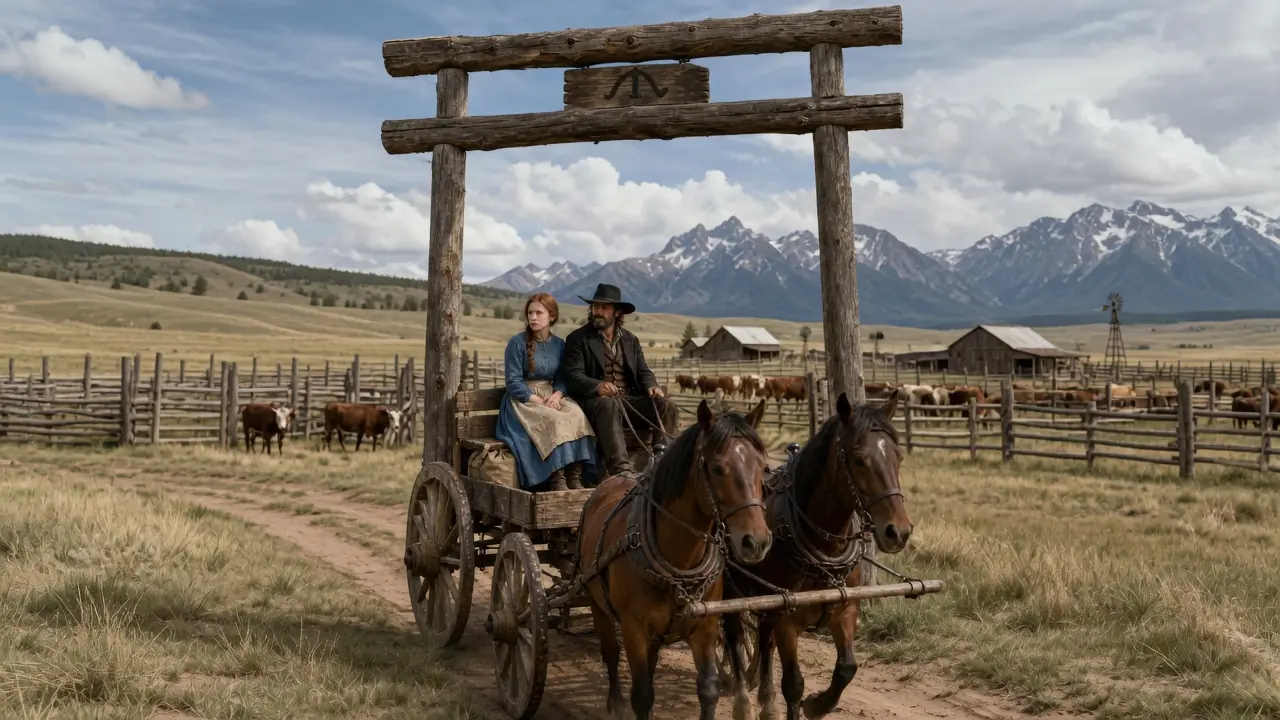
The heat sat heavy over Elk Ridge that evening. Dust drifted across the main street every time a wagon rolled through town. Horses stood tied beneath the hitching rails with their heads low, flicking flies from their flanks. The smell of leather, tobacco, and spilled whiskey hung in the air.
Inside the saloon, laughter burst from a card table near the back wall. Harold Reed was losing again. A stack of coins that had once been his was now spread across the table in front of three other men. His shirt collar hung open. His face was red from drink. A bottle rested near his elbow.
"That's the last of it, Harold," one ranch hand said.
Harold stared at the cards. Then he laughed—not because anything was funny, but because he had nothing left.
Outside, Savannah Reed stepped onto the boardwalk carrying a crate of supplies from the general store. Sweat darkened the collar of her faded blue dress. The late afternoon sun caught the edges of her braided hair. She paused near the saloon window when she heard her father's voice rise above the others.
"I can pay."
More laughter. With the crate still in her hands, she stood motionless.
"Pay with what?" someone asked.
Harold leaned back in his chair. "My girl."
The laughter stopped. Savannah felt the weight of the crate grow heavier. Inside, chairs creaked. A few men looked away; others waited. Harold took another drink.
"She's nineteen. Reads better than most folks in this town. Keeps books. Works harder than any ranch hand I ever hired."
His words drifted through the open window as if he were describing a mule or a wagon—anything except a daughter.
Across the room, one man said nothing: Cole Walker. He sat alone near the wall with a black coffee growing cold beside him. He was forty-two years old, widowed, and known throughout the valley for speaking only when he had something worth saying.
Harold pointed a finger toward him. "You still need help at that ranch, Walker?"
Harold kept talking, words spilling out faster than reason. "Take her. She'll earn every cent."
No one laughed now; the silence felt worse. Then came the sound of coins. A leather pouch landed on the table. Cole stood. The money inside was enough to cover the debt. Every eye followed him.
Harold blinked twice, then grinned. "Knew you'd see sense."
Cole's expression never changed. He placed his hat on his head and walked toward the door.
Outside, Savannah had already set the crate down. She stood waiting—not because she wanted to, but because there was nowhere else to go.
By sunset, she packed everything she owned into a worn canvas bag: two dresses, a comb, and her mother's Bible. Nothing more. The town watched from porches and storefronts as she stepped into the fading light.
Cole stood beside his wagon. The horses shifted impatiently. Savannah stopped a few feet away. Neither spoke for a moment. Then Cole removed his gloves and tucked them into his belt.
"Miss Reed." His voice was low, respectful, and different from the voices she'd heard all afternoon.
She lifted her eyes. "I suppose I'm ready."
Cole looked at her for a long second, then shook his head, delivering those six quiet words. Savannah frowned.
"The debt belongs to your father," he said, "not to you."
The words settled between them—simple, quiet, yet somehow larger than anything spoken that day. Across the street, two men exchanged confused looks. A woman standing outside the bakery lowered her hand from her mouth. No one had expected that, not even Savannah. For the first time since hearing her father speak inside that saloon, she felt air reach her lungs.
Cole climbed into the wagon. "You got family elsewhere?"
She shook her head. "No, sir."
He nodded once. "Then you're welcome at Broken Pine Ranch until you decide what comes next."
Nothing more. No conditions, no demands—just a place.
As darkness gathered over Elk Ridge, the wagon rolled north. The town disappeared behind them. An hour later, beneath the fading glow of a lantern hanging from the wagon seat, Savannah opened her canvas bag. Something slipped from between the pages of her mother's Bible: a folded paper, yellowed around the edges. She unfolded it carefully as the wagon wheels continued turning. Her eyes moved across the page.
It was a legal notice concerning past-due claims and property disputes. And one name was repeated more than once: Cole Walker. Someone had been trying to seize Broken Pine Ranch for months.
Savannah folded the paper again. Cole kept his attention on the road ahead. The mountains stood dark against the stars. She said nothing, and the wagon carried them deeper into the Colorado night.
***
The mountains rose black against a sky crowded with stars. The road narrowed as it followed a creek swollen by snowmelt from higher country. Somewhere in the darkness, water moved over stone.
Cole Walker drove without hurry. Now and then he checked the horses; now and then he adjusted the lantern hanging beside the wagon seat. He asked no questions, and Savannah was grateful for that.
Near midnight, they stopped beside a stand of pine trees. Cole watered the horses, spread a blanket near the wagon, and handed her a tin cup of coffee he warmed over a small fire. The coffee was strong enough to wake the dead. Savannah drank every drop.
Cole sat across from her on a fallen log. The fire crackled softly between them. Neither spoke much. The silence felt different from the silence back in Elk Ridge. Back there, silence usually meant judgment; this silence felt more like space.
By sunrise, they were moving again. Broken Pine Ranch appeared shortly before noon. Savannah saw the entrance gate first: weathered pine posts with a faded ranch brand burned into the wood. Beyond it stretched rolling pasture, cattle grazing among patches of yellow grass, and farther back, a cluster of buildings beneath the shadow of the mountains.
The ranch wasn't grand. It was tired. The paint on the main house had faded, one section of fence leaned noticeably, and the windmill turned with a faint squeak. Everything worked, but nothing seemed loved.
Cole guided the wagon into the yard. Three children appeared almost immediately. A tall boy emerged from the barn carrying a shovel. A smaller boy came running from behind the chicken coop. A little girl stood quietly on the porch steps. Nobody smiled.
Cole climbed down first. "Ethan."
The oldest nodded. His eyes moved immediately to Savannah—careful, suspicious.
Luke was different. His curiosity arrived before his manners, and he stared openly.
The little girl remained silent, one hand resting against the porch railing.
"Maggie," Cole said gently.
The girl lowered her eyes. Savannah noticed that—the way she seemed to disappear whenever attention found her.
Cole carried Savannah's canvas bag toward a small cabin near the edge of the property. It sat beneath two pine trees—simple, clean, a place built for function. He opened the door. Inside stood a narrow bed, a washstand, a small wedge of a stove, and a single window facing the mountains.
"You can stay here."
Savannah looked around. "You don't mind?"
"No."
"You don't know me."
Cole leaned against the doorframe. "No," he said, "but I know enough."
For a moment, neither moved. Then he placed her bag beside the bed. "If you need anything, the house is there."
With that, he left. No conditions, no expectations—just a key resting on the table. Savannah stared at it for a long moment. Nobody had ever handed her a key before.
The first week settled into a rhythm. Mornings began before sunrise: coffee, feed buckets, dust, wind, the sounds of ranch life.
Luke appeared almost constantly. He followed Savannah while she gathered eggs, followed her while she swept the cabin, and followed her while she checked the vegetable garden behind the house. One afternoon, he finally asked, "Do you know how to read books without moving your lips?"
Savannah smiled despite herself. "Most days."
His eyes widened. That answer alone earned another hour of questions.
Ethan remained distant—polite when necessary, cold when possible. Maggie barely spoke at all. Sometimes Savannah caught the little girl watching from a doorway; the moment she noticed, Maggie would disappear again. The house itself felt strangely quiet. Meals were quick. Chairs scraped across the floor, plates emptied, and everyone vanished. Nobody lingered, nobody told stories, and nobody laughed.
One evening, Savannah noticed a ranch horse limping badly near the corral—a deep strain in the front leg. The nearest veterinarian was two days away. She spent nearly an hour cleaning the leg, wrapping it carefully with strips torn from an old flour sack, and cooling the swelling with creek water. Cole watched from a distance, but he never interrupted.
The next morning, the horse moved easier. Luke announced the news at breakfast as though the animal had won a race. Even Ethan looked surprised. It was the first crack in the ice—small, but real.
Days later, rain arrived. It wasn't much, just enough to drive everyone indoors. Savannah spent the afternoon helping organize receipts and supply invoices piled in a cabinet near the kitchen. At first, she intended only to sort them, but the numbers began catching her eye. Feed orders, delivery receipts, payment records—the amounts didn't match. Not once, not twice, but repeatedly.
Her brow tightened. She carried the stack to the window. Outside, Cole and Ethan repaired a gate. Inside, Savannah spread papers across the table. The discrepancy stretched back months, long before she arrived. Money was disappearing—a lot of it. Someone had been stealing from Broken Pine Ranch carefully, patiently.
She sorted invoice after invoice, comparing signatures, dates, and amounts. Her finger tapped against the window glass. The house remained quiet. Then her eyes stopped on a familiar name, a signature repeated again and again: the ranch manager. It was the man Cole trusted more than anyone outside his family.
Savannah slowly lowered the paper. And for the first time since arriving at Broken Pine Ranch, she understood that something far more dangerous than loneliness was hiding there.
The rain stopped sometime before dawn. By breakfast, the clouds had drifted east toward the mountains. Cole sat at the table with a cup of black coffee and a plate of biscuits. Ethan was already pulling on his work gloves. Luke was talking about a hawk he had seen near the creek. Maggie sat quietly beside the window.
Savannah watched them while folding the invoices back into neat stacks. The signature remained fresh in her mind. She almost said something—almost—but she didn't yet know enough. A suspicion wasn't proof, and Cole Walker looked like a man who trusted carefully, the sort of trust that took years to earn and only seconds to break.
The ranch manager, Vernon Pike, arrived later that morning. He rode in through the front gate on a gray gelding. He was in his mid-fifties, with broad shoulders and an easy smile—the kind of man nobody questioned. Cole greeted him warmly. They spoke about cattle prices, fencing repairs, and winter feed. Savannah stood near the barn holding a bucket of oats. Vernon tipped his hat politely. Nothing about him looked dishonest, and that troubled her even more.
Over the following weeks, she paid attention quietly, not obviously. A missing receipt here, an altered number there, several deliveries that never seemed to arrive—each trail led back to Vernon. And automotive details aside, beyond Vernon, another name appeared repeatedly: Roy Baxter, the owner of Baxter Ridge Ranch. Cole never spoke much about him. The few times his name came up, a shadow crossed the conversation like a storm cloud passing over sunlight.
Autumn settled into Elk Ridge Valley. Aspen trees turned gold, and morning frost glittered across fence rails. The Walker children slowly changed. Luke still followed Savannah everywhere, but now he carried books with him. Most evenings they sat on the porch steps while she helped him sound out words from an old reader. His face lit up whenever he got one right.
Maggie changed more slowly. One afternoon, Savannah found her sitting beside a pen full of orphaned lambs. The little girl was humming softly—a sound no one else seemed to notice. Savannah sat beside her. Neither spoke. After several minutes, Maggie reached down and handed her a bottle for feeding one of the lambs. It wasn't much, but it was trust—the first true gift the child had offered anyone.
Even Ethan began to soften. The change came gradually: a gate repaired before she asked, a water bucket carried without complaint, a quiet thank you when she stitched a tear in his work shirt. It was nothing dramatic, just small things, the kind that mattered.
Then October arrived, and with it came trouble.
The weather turned overnight. One day the valley sat beneath clear blue skies; the next, dark clouds gathered beyond the mountains. Old ranchers noticed first—men who had spent their lives reading the sky. By noon, the wind carried snow. By evening, the storm had become something far worse.
Cole stared toward the western ridges from the barn doorway. "We need to bring the cattle down."
No one argued. The roundup began before sunrise. Riders disappeared into blowing snow as visibility shrank by the hour. Savannah stayed behind, helping secure livestock and prepare supplies. By afternoon, the first riders returned, then the second group, then the third.
Cole counted faces once, twice, a third time. His expression changed. "Ethan?"
Nobody answered. The wind howled across the yard. One rider removed his hat. "He got separated near Timber Pass."
The words landed hard. Cole moved immediately: saddle, rifle scabbard, winter coat—no wasted motion. Savannah grabbed her own coat.
Cole turned sharply. "No."
"He won't survive alone."
Neither of them blinked. For a moment, the storm screamed around them. Then Cole handed her an extra pair of gloves. Ten minutes later, they rode into the white wilderness together.
The mountains vanished behind curtains of snow. The world narrowed to horse ears and drifting shadows. Hours passed. The cold bit through wool and leather alike. Several times they nearly lost the trail. Then, shortly before dark, they found Ethan's horse, alone, tied beside an abandoned trapping cabin.
The door opened before they reached it. Ethan stood inside—cold, exhausted, but alive. For a moment, nobody moved. Then Cole crossed the room in two long strides and pulled his son into a fierce embrace. Ethan looked surprised by it; so did Cole.
The storm trapped them there overnight. Snow piled against the cabin walls, and the small fire struggled against the cold as hours passed in silence, broken only by the wind. At some point, Ethan fell asleep beneath a blanket. Cole stared into the flames.
"My wife died in winter." The words came unexpectedly. Savannah looked up. Cole rarely spoke about himself. "Fever," he said quietly. "One week she was laughing in the kitchen; the next she was gone."
The fire crackled softly. Outside, snow battered the roof. After a long silence, Savannah spoke. "My mother passed when I was twelve."
Cole nodded. Neither offered comfort; neither needed to. Sometimes understanding was enough.
Across the room, Ethan's eyes opened. He remained silent, listening, learning. For the first time, he heard the truth: Savannah had never tried to replace anyone. She carried losses of her own.
Morning finally came, and the storm weakened. They rode home through fresh snow sparkling beneath pale sunlight. Broken Pine Ranch appeared just before noon, and then Cole's horse stopped.
Smoke drifted upward from the valley—dark, heavy, and wrong. Every rider in the group saw it at the same moment: the barn. Someone had set the barn on fire.
By the time Cole and the others reached the yard, the worst of the flames had already been beaten down. Neighbors stood in the snow with buckets. Smoke rolled from the blackened roof, water dripped from charred beams, and the smell of wet ash hung in the cold air.
Savannah slid from her horse before it fully stopped. Luke ran toward her, his face pale. "We saved most of the horses."
She knelt and brushed soot from his coat sleeve. "That's what matters."
Cole moved through the wreckage without speaking. A man handed him a shovel; another offered condolences. He accepted both with a nod, nothing more.
The next few weeks were hard. Feed stores had been damaged, tools were ruined, and several expensive saddles had been lost. Money became tight—very tight. At night, after the children slept, ledger books covered the kitchen table. Cole sat beneath the oil lamp studying numbers, and Savannah sat across from him. Sometimes neither spoke for an hour—only pages turning, pencils scratching, and coffee cooling in tin cups.
One evening, she finally placed several documents in front of him. "I think you should see these."
Cole looked up. She showed him the altered invoices, missing deliveries, false totals, and forged entries. The same signature appeared again and again: Vernon Pike, Cole's long-time ranch manager, the man who had worked beside him for nearly ten years.
Cole stared at the papers. His expression remained calm, but the silence afterward felt heavier than any anger.
Two days later, more evidence surfaced. Receipts linked Vernon to Roy Baxter—feed contracts, private payments, and land negotiations. It was enough to paint a clear picture. Roy had not been waiting for Broken Pine Ranch to fail; he had been helping it fail.
Winter gave way to early spring. Snow retreated from the lower hills, and mud replaced ice. The annual cattle auction arrived with the first warm weather. People came from every ranch within fifty miles—merchants, drovers, church families, bankers, farmers. Everyone gathered beneath the large auction pavilion near Elk Ridge.
Savannah almost stayed behind, but Cole insisted. "You belong there same as anyone." She said nothing, yet those words stayed with her all morning.
The crowd filled quickly, conversations echoing beneath the wooden rafters as the smell of horses, dust, and coffee drifted through the air. Then Roy Baxter arrived, wearing an expensive coat and polished boots, carrying the smile of a man who enjoyed an audience. For a while, he remained across the room, watching, waiting. Then, just before the main bidding began, his voice carried through the crowd.
"Funny thing about Broken Pine." The conversation slowed, and heads turned. Roy smiled. "You never know what you'll find there. Lost cattle, missing money, stray ranch hands..." He paused. Then his eyes landed on Savannah. "...or girls whose fathers traded them away."
The room went quiet. Savannah felt dozens of eyes shift toward her. Nobody moved, nobody spoke.
Roy continued. "Heard she arrived carrying everything she owned in one little bag."
A few nervous laughs broke out. Someone looked away; someone else whispered. The old shame returned without warning—not because Roy's words were true, but because so many people were willing to enjoy them. For one long moment, Savannah stood alone.
Then a chair scraped against the floor. Ethan stepped beside her. He didn't say anything; he simply stood there. A second later, Luke appeared on her other side. Maggie slipped her small hand into Savannah's.
The laughter faded, and Roy's smile weakened. Then Cole Walker stood slowly, quietly. Every conversation stopped. He faced the crowd—not Roy, the crowd.
"The best thing that ever happened to this ranch walked here with one canvas bag and nothing else."
Nobody interrupted. Cole continued. "She saved horses I would have lost." He looked toward several ranchers. "Balanced books I didn't know were being stolen from."
More silence.
"She taught my son to read better." Luke lowered his eyes. "She helped my daughter find her voice again." Maggie's grip tightened. "And she stood by my family when most people would have walked away."
The room had gone completely still. Even Roy簡 hố stopped smiling. Cole's gaze settled on Savannah for only a second before returning to the crowd.
"You can believe whatever story you like," his voice remained calm, "but I know the truth."
Nobody laughed now; nobody whispered. The humiliation Roy had planned never arrived. Instead, the room filled with something else: respect—slowly, reluctantly, but undeniably. Roy Baxter turned away first, and that alone told everyone who had won.
The ride home was quiet. The children eventually fell asleep in the wagon, and stars appeared above the mountains. Cole drove while Savannah watched the darkness beyond the road. When they reached Broken Pine Ranch, everyone went inside.
Hours later, long after the lamps had been extinguished, Savannah sat alone in her cabin. The canvas bag rested beside her bed—the same bag she had carried from Elk Ridge, the same bag people still remembered. She stared at it for a long time. Then she began folding her clothes carefully, neatly, without making a sound.
By midnight, a letter sat on the small table. And before dawn, Savannah had already made her decision: she would leave before anyone could suffer because of her.
A pale spring moon hung overhead. A faint light still glowed inside the main house, where the kitchen stove held the last of yesterday's warmth. Savannah stood quietly inside her cabin. The canvas bag rested on the bed, holding everything she owned. She folded one final dress, placed her mother's Bible inside, then sat at the small table.
The letter took longer. Several times she stopped writing; several times she stared out the window toward the dark outline of the ranch house. At last, she folded the page and addressed it simply: *Cole.*
By the time the first gray hint of dawn touched the eastern horizon, she was gone.
The trail leading north still held traces of frost when Cole stepped onto the porch later that morning. Something felt wrong immediately. The yard was too quiet. Luke wasn't chasing chickens, Maggie wasn't feeding the lambs, and even the wind seemed to hesitate. Then he noticed the cabin door standing slightly open. A few minutes later, he stood alone inside.
The canvas bag was gone. The room felt empty in a way furniture could never explain. On the table lay the folded letter. Cole picked it up slowly, carefully, as though the paper itself might break.
The words were simple. She thanked him—for the cabin, for the key, for treating her like a person when nobody else had, and for giving her a place where she had finally felt safe. At the bottom, she wrote: *You deserved peace before I arrived. You deserve it after I'm gone.*
Cole lowered the letter. Outside, a horse whinnied; somewhere, a gate creaked. For a long moment, he remained completely still. Then he folded the page, placed it inside his coat pocket, and finally admitted something he had been avoiding for months. He wasn't afraid of losing the ranch, he wasn't afraid of Roy Baxter, and he wasn't even afraid of starting over. He was afraid of losing Savannah.
Within an hour, he had saddled his horse. Ethan watched from the barn doorway. "You going after her?"
Cole tightened a strap. "Yes."
Ethan nodded once. "About time."
The ride took him deep into the foothills north of Elk Ridge, where snow still lingered beneath the pine trees and creeks rushed with spring runoff. The mountains stood blue beneath a clear sky.
Meanwhile, news spread through town. Roy Baxter's schemes had finally come to light, Vernon Pike had disappeared, and Broken Pine Ranch was recovering. That news reached another man as well: Harold Reed.
He arrived in Elk Ridge three days later. Dust covered his coat, and whiskey stained his breath. The years had not been kind, but greed remained healthy. By noon, he stood outside the general store demanding information. By evening, he had found Savannah.
Mrs. Clara Whitmore's small schoolhouse sat near the church. Savannah had been helping repair books and organize supplies while deciding what came next. Harold stumbled into the yard.
"There she is."
The old shame tried to return, but something had changed. She no longer felt nineteen; she no longer felt trapped. Harold pointed toward her.
"Everything you've got is because of me. I gave you that life."
Several townspeople stopped walking; others turned to watch. Savannah stared at him. The wind stirred loose pages hanging on the schoolhouse clothesline, and children's handwriting fluttered in the sunlight. For a moment, nobody spoke. Then she stepped forward—not angry, not afraid, simply certain.
"You gave me away because you couldn't see my worth." The words landed quietly, more powerfully than shouting ever could. She looked toward the mountains, toward the ranch she had left, then back at her father. "They saw it before I did."
Harold opened his mouth, then closed it again for the first time in years. He had no answer. The crowd remained silent. Eventually, he turned away, a smaller man than the one who had arrived, and nobody stopped him.
As the last of the spectators drifted away, Mrs. Clara Whitmore emerged from the schoolhouse carrying a wooden box. "I've been waiting a long time to give you these."
Inside lay a bundle of letters tied with a faded blue ribbon. Savannah recognized the handwriting immediately: her mother's. Her hands trembled slightly as she unfolded the first page. The letters spoke of dreams—a small ranch, children running through mountain grass, a home beneath Colorado skies, freedom, belonging, and a place of her own.
Savannah read until tears blurred the words—not tears of sorrow, but something quieter, something deeper. All this time, she had been building the very life her mother once imagined.
A horse approached from down the road. She looked up. Cole.
Neither moved at first. The distance between them seemed both very long and very short. Finally, he stepped down from the saddle. "I read your letter."
She smiled faintly. "I was hoping you would."
He reached into his coat and pulled out the folded pages. "You forgot something."
She shook her head. "No."
The breeze shifted, and a church bell rang somewhere in town. Cole looked at her for a long moment, then spoke with the same honesty that had first separated him from every other man in Elk Ridge.
"Home doesn't feel much like home without you there."
The silence afterward felt warm, like sunlight after winter.
Months later, beneath a clear Colorado sky, a small wedding took place beside a river bordered by cottonwoods—nothing grand, nothing extravagant, only family, only people who belonged there. Ethan stood beside his father. Luke carried the rings with the seriousness of a judge. Maggie read a short Bible verse in a steady voice that would have been impossible a year earlier. Mrs. Clara cried openly, and nobody teased her for it.
Years passed, and Broken Pine Ranch prospered. The laughter returned, the kitchen stayed full, and the front porch lights burned late into summer evenings. Above the fireplace hung the worn canvas bag Savannah had carried the day she left Elk Ridge. Beneath it rested a small wooden plaque:
*The day she arrived, we thought we saved her. Years later, we realized she saved us.*
One evening, as the sun settled behind the Colorado mountains, Savannah and Cole stood together on the porch. Below them, cattle moved slowly through the golden pasture, and the wind carried the scent of pine and fresh earth. The ranch glowed warm against the coming dusk.
For the first time in her life, Savannah Reed was not someone's burden, she was not someone's debt, and she was not something to be traded away. She was home.