The rain was hammering the runway when billionaire CEO Vivien Cross stepped down from her frozen private jet, pointed at the oil-stained mechanic standing beneath the wing, and threw a $100 bill at his boots like he was nothing more than a beggar in coveralls. Around them, executives, pilots, engineers, and airport staff fell silent. Callum Vance did not bend to pick it up. He only stood there with grease on his hands, exhaustion in his eyes, and a hospital bracelet from his little boy still tucked inside his pocket.
Vivien’s $80 million jet had refused to start minutes before the most important flight of her career, and her elite engineering team had already failed in front of everyone. But when Callum quietly said he knew what was wrong, she laughed loud enough for the whole hangar to hear. Then she made the insult even worse. She bet $10 million that this single dad mechanic could not start her aircraft in 30 minutes.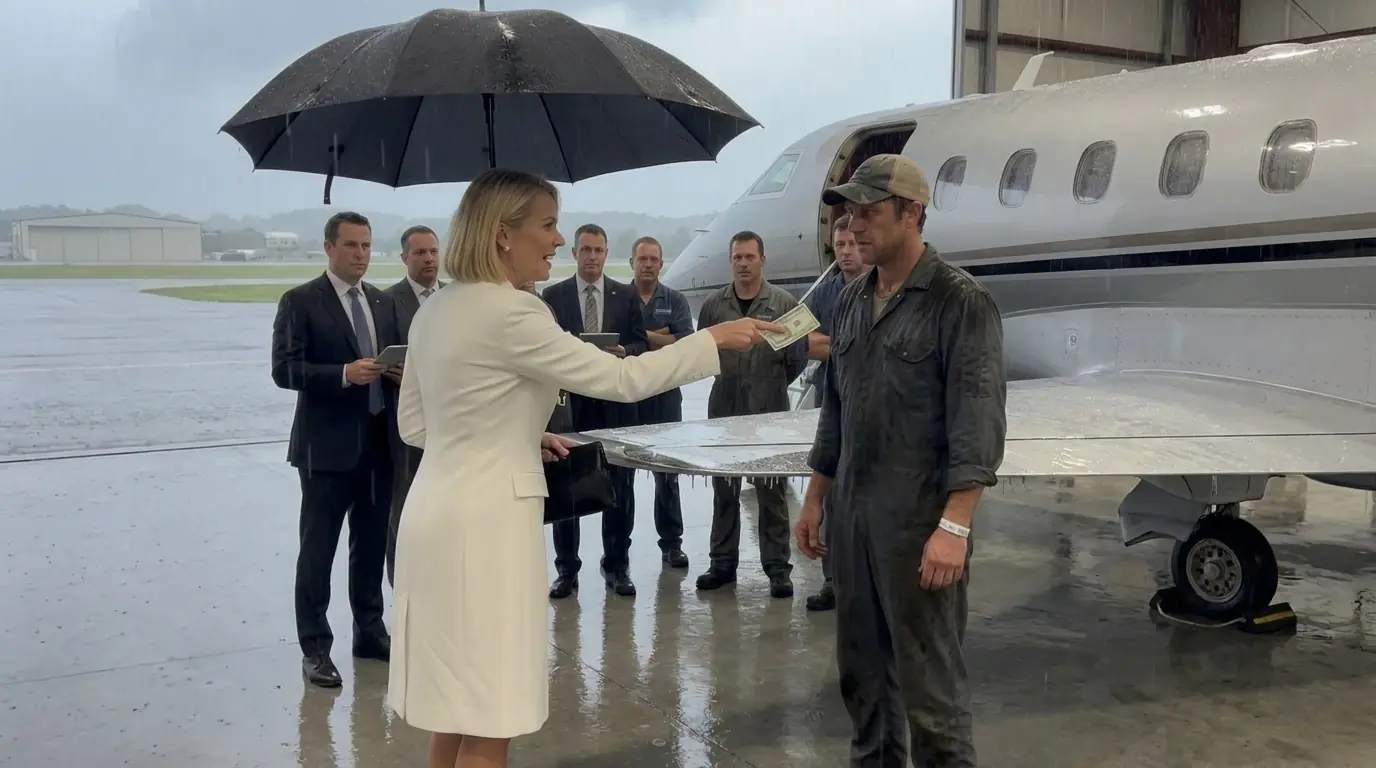
If he failed, he would have to pick up the $100 and admit he was just a desperate man pretending to be useful. No one knew that Callum had once worked on engines no civilian engineer had ever touched. No one knew that his wife’s death had driven him away from the life that once made him famous. And Vivien had no idea that the man she had just humiliated might be the only person standing between her and a deadly secret buried inside her own jet.
As the countdown began, Callum looked at the plane, then at the phone message saying his son needed emergency treatment, and finally at the woman who thought money could measure a man’s worth. So, what happened when the mechanic everyone underestimated placed his hand on the engine and heard something no one else could? Before anyone at Sterling Field ever saw billionaire CEO Vivien Cross throw a $100 bill at his boots, Callum Vance had already learned how quietly a man could break without making a sound. He was 39 years old, a single father and airport mechanic, and the kind of man people passed every day without truly seeing.
At 4:30 each morning, while the city still slept beneath a bruised gray sky, Callum would rise from the thin mattress in his small apartment on the east side of Dayton, Ohio. Careful not to wake his 8-year-old son, Eli, who slept in the next room with a plastic dinosaur tucked under one arm and an inhaler resting on the bedside table like a silent warning. The apartment was clean but tired, with patched walls, secondhand furniture, and a refrigerator covered in Eli’s drawings of airplanes, rockets, and one crooked sketch of a smiling woman with golden hair and angel wings. That drawing hurt Callum every time he saw it because Eli had labeled it in uneven blue crayon, Mom watching us fly.
Hannah Vance had been gone for three years, but grief still lived in the rooms like another person sitting quietly at the kitchen table, standing beside the bathroom mirror, waiting in the empty half of Callum’s bed. She had died from a sudden heart complication after years of pretending she was stronger than she was, and Callum had never forgiven himself for not noticing how much pain she had hidden behind her smile. Since then, every hour of his life had narrowed into one purpose. Keep Eli safe.
Keep Eli breathing. Keep Eli believing the world was still kind, even when Callum himself was no longer sure it was. He worked nights and mornings at Sterling Field, a private airport where billionaires, celebrities, politicians, and corporate kings flew in and out on jets polished brighter than the cars parked outside his apartment building. His official title was senior line mechanic, though most of the wealthy passengers never bothered to learn the difference between a mechanic, a technician, or the man who kept their aircraft from becoming coffins in the sky.
To them, Callum was part of the background. Another oil-stained uniform beneath the wing. Another pair of rough hands tightening bolts before they stepped aboard with leather luggage and expensive watches. But Callum never complained.
He had long ago stopped expecting respect from people who thought money gave them altitude above everyone else. He arrived before dawn, checked fuel pressure, inspected hydraulic lines, listened for irregular vibrations, cleaned tools, filled reports, and took extra shifts whenever Ray Coleman, the maintenance supervisor, offered them. He ate vending machine crackers for lunch so Eli could have fresh fruit. He wore boots with soles worn almost smooth because the money for new ones always became medicine, rent, groceries, or another bill from Dayton Children’s Hospital.
His hands were always cracked from cold metal and chemical cleaner, but he still washed them carefully before touching Eli’s face every night. Eli was small for his age, bright-eyed, pale from too many hospital rooms, and stubborn in the way sick children sometimes became when they had spent too much time watching adults whisper. He had severe asthma complicated by a rare immune condition that turned every winter into a battlefield. A simple cough could become an emergency.
A missed medication could become a night of sirens. His doctors had recommended a specialized treatment program in Cincinnati, something that might stabilize him for years. Maybe give him a childhood not measured by oxygen levels and pharmacy refills. But the cost was brutal even after insurance.
Callum had stared at the estimate until the numbers blurred. $28,000 upfront, more after that. He had laughed once, not because it was funny, but because the alternative was screaming. He had sold Hannah’s old car, pawned his wedding watch, canceled his own dental appointment, skipped meals, and taken weekend repair jobs at a cargo hangar where the heating barely worked.
Still, the balance barely moved. Some nights after Eli fell asleep, Callum sat alone at the kitchen table with bills spread before him, like accusations, pressing his thumb against the bridge of his nose while the apartment hummed around him. He never let Eli see those moments. In front of his son, he was steady.
I’ll handle the rest. Eli believed him, and that belief was both Callum’s greatest blessing and his heaviest burden. On the morning everything changed. Callum had already been awake for 19 hours.
The night before, Eli had suffered an attack that left him gasping on the bathroom floor, while Callum knelt beside him, counting breaths, holding the nebulizer mask to his face, whispering Hannah’s old lullaby with a voice that shook despite his effort to keep it calm. At the hospital, Eli had recovered enough to joke weakly with a nurse, but the doctor pulled Callum into the hallway and said the words he had been dreading: the treatment could not wait much longer. Eli’s lungs were under too much strain. There were assistance programs, paperwork, waiting lists, appeals, but waiting was becoming dangerous.
Callum nodded, thanked the doctor, and stood in the elevator afterward with his son’s overnight bag in one hand and his own heart collapsing somewhere behind his ribs. By the time he dropped Eli at Mrs. Alvarez’s apartment upstairs, dawn had not yet broken. Mrs. Alvarez, a retired schoolteacher with silver hair and the sharp kindness of someone who had survived her own losses, took Eli in without question. Go, she told Callum, seeing the exhaustion in his face.
I’ll make him soup. You make the money. Callum wanted to smile, but all he managed was a tired nod. Eli, wrapped in a blanket on the couch, lifted one small hand. Dad.
Callum turned back immediately. Yeah, buddy. Eli hesitated, then asked, Are you scared? The question hit harder than any bill, any insult, any sleepless night. Callum crossed the room, crouched in front of him, and brushed a strand of hair from his forehead.
Sometimes, he admitted softly because Hannah had always told him never to lie about feelings, only about the size of monsters. But being scared doesn’t mean we stop. Eli studied him with those serious blue-gray eyes that looked too much like Hannah’s. Mom didn’t stop. Callum swallowed.
No, she didn’t. So, we don’t either. Callum pressed his lips to his son’s forehead and held them there a second longer than usual. That’s right. Then he left before Eli could see the tears he refused to shed.
Sterling Field looked like another world when Callum arrived. Wide runways glowing under sheets of rain, hangars lit with white security lamps, private jets lined in perfect silence, like sleeping beasts owned by people who never wondered what things cost. The air smelled of jet fuel, wet concrete, and storm electricity. Callum pulled up in his old pickup, its heater broken, and its dashboard held together with tape and sat for a moment before getting out.
In the cracked rearview mirror, he saw a man older than 39 with dark hair threaded by early gray, a trimmed beard, tired eyes, and a face shaped by work weather and worry. He looked at the hospital bracelet still wrapped around his wrist from Eli’s emergency visit, and started to take it off, then stopped. For some reason, he left it there. Maybe as a reminder, maybe as punishment.
Maybe because he wanted the day to know exactly why he had shown up. Inside hangar three, Ray Coleman glanced up from a clipboard and frowned. You look like hell, Vance. Callum reached for his toolbox.
Good morning to you, too. Eli? Ray asked, his voice lowering. Callum did not answer right away, and that was answer enough.
Ray exhaled, rubbed the back of his neck, then said, I can put someone else on the south ramp. You should go home. Callum shook his head. Home doesn’t pay Cincinnati.
Ray’s expression hardened with sympathy, the kind Callum hated because it made him feel closer to falling apart. There’s an extra shift tonight if you want it, but I don’t like asking. I’ll take it. You haven’t even heard the hours.
I’ll take it, Callum repeated. Ray looked at him for a long moment, then nodded. He knew better than to argue with a father, counting time in medical invoices. The morning dragged on in cold, wet labor.
Callum inspected a charter jet with a faulty auxiliary power unit, replaced a cracked fuel sensor on a Gulfstream, and helped a younger mechanic named Owen trace an electrical fault that three diagnostic scans had missed. Owen was 26, eager, and always amazed by how Callum could identify problems by sound alone. How do you do that? Owen asked as Callum leaned beneath an access panel, listening to a faint clicking pattern inside the housing.
Machines talk, Callum said. Most people just interrupt them. Owen laughed, thinking it was a joke, but Ray standing nearby did not. He had seen enough to know Callum Vance was no ordinary mechanic.
There were rumors, of course. Men like Callum always attracted rumors because silence left space for invention. Some said he had worked for the military. Some said he had once designed engines.
Some said he had been fired from a major aerospace program after a test flight went wrong. Callum never confirmed or denied any of it. He did his work, signed his forms, picked up his paycheck, and went home to his boy. At noon, while the rain grew heavier and thunder rolled low over the runway, Callum stepped into the breakroom and opened a lunch container.
Mrs. Alvarez had packed for him without asking. Two turkey sandwiches, an apple, and a folded note from Eli. Don’t forget to eat, Dad. Underneath the words was a drawing of Callum wearing a cape while fixing an airplane.
Callum stared at it until his vision blurred. He was not a hero. Heroes had savings accounts, clean uniforms, answers. Heroes did not dodge calls from billing departments or count coins at gas stations.
Heroes did not stand in pharmacy aisles choosing which prescription could wait three more days. But Eli saw him that way. And because Eli saw him that way, Callum forced himself to take a bite. Even though grief and fear had closed his throat.
His phone buzzed before he finished the first sandwich. The screen showed Dayton Children’s Hospital. For two seconds, he could not move. Then he answered.
The woman on the line spoke gently, which made it worse. Eli’s specialist had reviewed the latest results. They wanted to move up his admission. There were forms to complete, deposits to arrange, financial counseling options to discuss.
Callum gripped the edge of the table until his knuckles went white. How soon? he asked. The answer left a hollow ringing in his ears. Forty-eight hours. They needed a decision in 48 hours.
He thanked her with the automatic politeness of a man whose life was being dismantled by kind voices, ended the call, and stared at the wall. Around him, mechanics came and went. Coffee machines hissed. Rain beat against the window, and somewhere outside a jet engine roared to life for someone rich enough to leave whenever they pleased.
Callum sat perfectly still. Then he folded Eli’s drawing, placed it carefully in his chest pocket, and went back to work. That was what he did. That was what survival had made of him.
He did not have the luxury of collapsing. He did not have the luxury of pride. Pride did not pay hospital deposits. Anger did not open treatment slots.
Despair did not help a little boy breathe. So Callum swallowed everything sharp inside him and returned to the ramp where the storm had turned the concrete silver and the wind pushed rain sideways across the hangars. By midafternoon, the private terminal had begun to stir with unusual tension. Black SUVs rolled through the security gate one after another.
Men in dark suits moved quickly beneath umbrellas. A catering truck arrived, then a fuel truck, then two executives from Cross Global Aerospace wearing badges that made the younger mechanic stand straighter. Ray muttered something under his breath when he saw them. Big money coming in.
Owen looked toward the terminal. Who? Ray checked his clipboard. Vivien Cross. Even Owen knew the name. Everyone did.
Vivien Cross, billionaire, CEO, aerospace queen, magazine-cover genius. The woman who had taken her father’s company and turned it into one of the most powerful private aviation empires in America. Her newest aircraft, the Crosswing V900, was scheduled to depart Sterling Field within the hour for a high-stakes meeting in New York. Callum barely reacted.
Names like that floated above men like him. They belong to television screens, business pages, and private terminals with marble floors. He had a hydraulic leak to inspect on bay 4 and a son who needed a miracle by Friday. But as he crossed the ramp with his toolbox in one hand, he saw the Crosswing V900 for the first time.
Sleek silver, impossibly elegant, it sat beneath the storm light like a blade. Executives clustered near the stairs. Engineers moved around it with tablets, their faces tight. The aircraft was beautiful, but something about it sounded wrong.
Not loud, not obvious, just a strained, uneven whine beneath the auxiliary system. A pulse too thin, too irregular, like a heartbeat trying to hide a failure. Callum slowed without meaning to. His head turned slightly. He listened.
For a moment, the rain, the engines, the shouting ground crew, and the distant thunder all faded behind that one sound. A memory moved through him. Another hangar, another prototype, another warning tone, ignored by men too important to listen. His chest tightened.
Then a sharp voice cut across the ramp, cold enough to slice through the storm. Why is my aircraft still on the ground? Callum looked up and saw Vivien Cross step from beneath a black umbrella, tall, immaculate, and furious, her white coat untouched by the oil and rain world around her. Everyone near the jet seemed to shrink beneath her gaze.
Callum lowered his eyes, adjusted his grip on the toolbox, and reminded himself that this was not his problem. His problem was Eli. His problem was 48 hours. His problem was getting through one more shift, one more bill, one more day without letting fear show on his face.
But then the Crosswing’s auxiliary unit gave another faint broken pulse and Callum stopped walking completely. He knew that sound. He wished he did not. And as Vivien Cross turned toward the maintenance crew with impatience burning in her eyes, Callum Vance stood in the rain.
A tired father with grease on his sleeves and his son’s hospital bracelet on his wrist. Knowing that whatever was wrong with that jet, it was not simple. It was not safe, and it was about to drag him into the kind of storm he had spent years trying to avoid. Vivien Cross did not notice Callum Vance at first, and when she finally did, it was with the kind of glance powerful people reserved for stains on marble floors.
She stood beneath the wide mouth of Hangar 3, while rain hissed across the runway behind her, dressed in a white tailored coat that probably cost more than Callum made in a month. Her dark hair pulled back perfectly, her diamond earrings catching the cold fluorescent light every time she turned her head. Around her, executives from Cross Global Aerospace moved with nervous obedience, checking phones, whispering into headsets, and trying to pretend the impossible was not happening. The Crosswing V900, Vivien’s personal jet, and the crown jewel of her company’s private fleet would not start.
Its cockpit displays were alive. Its systems had power. Its fuel readings were clean. And yet the aircraft remained stubbornly dead, refusing to give the smooth ignition sequence everyone expected.
Three senior engineers in expensive weatherproof jackets had already crawled through the diagnostics twice. A software specialist from Cross Global’s mobile response team kept tapping angrily at a tablet. The pilot stood near the stairs with his jaw tight. Every minute lost placed Vivien’s multi-billion-dollar New York acquisition meeting at risk.
and everyone in the hangar could feel the pressure building around her like heat before an explosion. Callum had only meant to pass by. His shift was supposed to keep him on the south ramp, far from private corporate dramas, far from people who barked orders at men wearing name patches. But the sound coming from the auxiliary power unit had caught him again, that thin, uneven mechanical pulse buried beneath the rain.
And before he could stop himself, he had stepped closer to the aircraft’s left side, eyes narrowing as he listened. Owen noticed first. Callum, the young mechanic, whispered, Don’t. But Callum’s attention was already on the jet, on the faint cycling delay between the fuel control module and the starter sequence on something that felt less like a failure and more like a warning.
They’re looking in the wrong place, he said quietly. Unfortunately, not quietly enough. One of Vivien’s engineers turned irritated. Excuse me. Callum looked up, suddenly aware of the expensive suits, the polished shoes, the security men, the pilots, the assistants, and Vivien Cross herself, staring at him as if he had walked into a room where he did not belong.
Rain dripped from the brim of his cap. His coveralls were stained with grease. His boots were muddy and the hospital bracelet around his wrist stood out pale against his weathered skin. He knew exactly what he looked like to them, tired, poor, invisible until inconvenient.
I said you may be looking in the wrong place, Callum replied, keeping his voice calm. That sound isn’t a dead starter. It’s a protection lockout. Something upstream is telling the system not to fire.
The software specialist gave a short laugh, sharp and dismissive. And you got that from standing in the rain. A few executives smiled. Someone near the catering cart muttered.
Airport mechanic thinks he’s NASA. Callum ignored them. He had ignored worse. He had learned years ago that pride was expensive and he could no longer afford expensive things.
But Vivien stepped forward then, her eyes traveling over him from his soaked cap to the toolbox in his hand and her mouth curved with disbelief. Who is this? she asked, not to Callum, but to Ray Coleman, as though Callum were equipment being explained. Ray’s face tightened.
Callum Vance, senior mechanic, one of the best men I’ve got. Vivien’s gaze did not soften. Your best man is covered in oil and listening to my aircraft like it’s a sea shell. A ripple of laughter moved through the gathered staff.
Callum felt it strike him, not because he cared what they thought of his uniform, but because he suddenly imagined Eli seeing this, imagined his little boy watching strangers laugh at the hands that packed his lunch, held his nebulizer, fixed his toys, and signed hospital forms with shaking fingers. Still, Callum said nothing. Vivien seemed to mistake his restraint for weakness. She turned fully toward him and said, Do you understand what this aircraft is?
Callum looked at the V900. Yes, ma’am. Do you understand that my own engineers designed its operating system? I understand they’re still trying to start it. The hangar went so quiet that the rain became loud.
Ray closed his eyes for half a second. Owen stared at the floor. Vivien’s expression hardened, not with shock, but with the insult of being answered honestly by someone she had already decided was beneath her. Slowly, she reached into the leather clutch held by her assistant.
Pulled out a crisp $100 bill and walked toward Callum. Men like you always think proximity is expertise, she said, her voice low enough to sound controlled, but loud enough for everyone to hear. You stand near expensive things all day and after a while you start believing you understand them. Callum’s jaw flexed once.
I’m just telling you what I hear. What you hear? she repeated almost amused. Then before anyone could stop her, Vivien flicked the $100 bill down at his boots.
It landed on the wet concrete darkening as the rainwater spread through it. Gasps moved through the maintenance crew. One of the executives looked away embarrassed but not brave enough to speak. The Cross Global engineers stared with thin smiles, relieved that someone else had become the target of her anger.
Ray took one step forward. Ms. Cross. That’s enough. Vivien did not look at him. Her eyes stayed on Callum. Pick it up, she said.
Consider it payment for your performance. Callum looked down at the bill. $100. It could buy Eli’s medication for a few days. It could fill the truck.
It could cover groceries. In another place, under another hand, it might have meant relief. But thrown at his feet in front of an audience, it was not money. It was a leash.
It was a verdict. It was every unpaid worker, every exhausted parent, every quiet man in a dirty uniform being told his dignity had a price. Callum did not bend. He only lifted his eyes back to Vivien and said, My son needs money more than anyone in this hangar knows.
But he doesn’t need me to bring home shame. The words landed harder than he expected. For one brief second, something flickered in Vivien’s face. Something almost human but pride crushed it instantly.
Fine, she said. Then let’s make this interesting. She turned to the crowd, raising her voice with the theatrical confidence of someone who had never doubted that a room belonged to her. This mechanic believes he knows more than my engineers.
He believes he can diagnose an aircraft he has never flown, never designed, and certainly never owned. More people gathered near the hangar entrance now. Ground crew assistants, pilots from neighboring bays, security officers, even terminal staff drawn by the spectacle. Callum felt their eyes collecting on him, turning him from a man into a show.
Vivien pointed at the silent jet. Thirty minutes, she declared. If Mr. Vance can start my aircraft in 30 minutes, I will personally pay him $10 million. The hangar erupted in whispers.
Owen’s mouth fell open. Ray stared at her as if she had lost her mind. Callum remained still, though his heart slammed once against his ribs. $10 million. Eli’s treatment. A home without collection calls.
A future bought back from the edge. Vivien stepped closer, lowering her voice just enough to make the cruelty feel intimate. But if he fails, he picks up that $100, gets on his knees, and admits in front of everyone that he is exactly what he looks like, a desperate mechanic pretending to be useful. The laughter this time was quieter, uglier, because even the people enjoying the spectacle understood that a line had been crossed.
Callum looked at the bill again, then at the aircraft, then at the phone in his pocket where the hospital’s deadline waited like a ticking bomb. He wanted to walk away. Every tired bone in his body begged him to walk away. dignity. Hannah’s memory. Eli’s belief in him, all of it, told him not to dance for rich people’s entertainment.
But then the jet gave another faint, broken pulse, and Callum heard danger beneath the insult. This was no longer only about pride. This aircraft was trying not to start for a reason. If they forced it, someone could die.
He looked back at Vivien Cross, the woman who had turned his poverty into a performance, and spoke so calmly that the room leaned in to hear him. I’ll take your 30 minutes, he said. But when it starts, you don’t just pay me. You apologize to every mechanic in this hangar.
Vivien smiled coldly, certain she had already won. Start the clock. Callum did not argue with Vivien, did not answer the laughter, and did not waste a single second defending himself to people who had already decided what a man in dirty coveralls was worth. He simply set his toolbox down beside the Crosswing V900, removed his soaked cap, and listened.
The hangar clock began counting down every second, turning the silence heavier. Vivien stood with her arms crossed, certain she was watching a desperate mechanic humiliate himself. while her engineers exchanged amused glances behind their tablets. But Callum moved differently from them.
He did not attack the control panel first. He walked around the jet, slowly touched the access seams, studied the fuel vent temperature, then crouched beneath the auxiliary housing, and placed two fingers against the metal skin. The starter isn’t dead, he said. The aircraft is protecting itself.
One engineer scoffed. But Callum had already opened the panel and found what they had missed. A corrupted pressure calibration in the secondary fuel control unit, forcing the system into silent lockout before ignition. If they had overridden it, the engine could have surged hot on startup.
The laughter faded. Callum asked Owen for a manual bypass sequence no one had used in years, then recited the old procedure from memory step by step faster than Vivien’s senior engineer could search it. A young technician suddenly whispered that Callum Vance’s name appeared in an archived aerospace database, former former Air Force propulsion specialist and consultant on early adaptive jet systems recipient of a classified engineering commendation. Vivien’s face changed.
The poor mechanic she had mocked was not guessing. He was remembering a world she had never known. With three minutes left, Callum reset the calibration, killed the false lockout, and signaled the pilot. For one breath, nothing happened.
Then the jet shuddered, the systems aligned, and the engines roared to life with a clean, powerful thunder that filled the hangar. No one cheered. No one laughed. Across the entire airport, people simply stared at Callum Vance in stunned silence, realizing the man they had treated like a joke had just done what millions of dollars in arrogance could not.
The roar of the Crosswing V900 should have been the end of the humiliation. But for Callum Vance, it was only the beginning of the truth. As the engine settled into a smooth, controlled rhythm, he did not smile, did not celebrate, and did not reach for the $10 million everyone now knew he had won. Instead, he kept staring at the diagnostic screen with a darkness in his eyes that made Ray Coleman step closer.
Callum? Ray asked quietly.. Callum did not answer at first. His fingers moved across the panel, pulling up the hidden maintenance history buried beneath layers of corporate security.
The room was still full of people, but the mood had changed completely. The same engineers who had laughed at him now watched like students afraid to breathe. Vivien Cross stood near the aircraft stairs, pale beneath her perfect makeup, no longer looking like a woman in control of the world. Callum finally turned the screen toward her.
Your jet didn’t fail because of weather, he said. It locked itself down because someone altered the fuel pressure thresholds after the last software update. The safety system caught what your own people tried to hide. Vivien’s eyes moved over the logs, then froze on one access name, Marcus DeWitt, her chief operations officer and most trusted executive.
The hangar filled with a stunned murmur. Marcus, who had been standing behind the board members with his phone in hand, immediately stepped forward and called it impossible, but his voice cracked before the lie even finished leaving his mouth. Callum opened another file, then another, revealing deleted warnings, falsified inspection reports, and internal memos showing that Cross Global Aerospace had been rushing the V900 fleet into service despite a known calibration flaw. If Callum had not recognized the sound if he had allowed Vivien’s engineers to force the startup, her flight to New York could have ended in fire before it ever reached the clouds.
Vivien stared at Marcus as if seeing him for the first time. The man she had trusted with her company had gambled with lives to protect a stock price, while the mechanic she had degraded had risked his pride to protect people who had mocked him. Security took Marcus away before he could reach the exit. Lawyers began making calls.
Executives whispered in panic, but Vivien heard almost none of it. Her gaze fell to the wet $100 bill still lying near Callum’s boots, and shame finally broke through the armor she had worn for years. She walked to him slowly, picked up the bill herself, and held it in her trembling hand. Mr. Vance, she said, her voice no longer sharp, no longer commanding.
I was wrong. The entire hangar went silent again. But this silence was different. It was not disbelief.
It was witness. Vivien looked at the mechanics standing behind Callum. Men and women with tired eyes, dirty sleeves, and hands that kept wealthy strangers alive every day without applause. I was wrong about him, she continued.
and I was wrong about all of you. I treated experience like it was worth less than a title. I treated honest work like it was invisible. I am sorry.
Callum studied her for a long moment. He could have crushed her with anger. He could have made her kneel the way she had tried to make him kneel. But he thought of Eli, of Hannah, of the kind of man his son still believed he was.
Respect means more when it comes before you need saving, he said quietly. Vivien nodded, accepting the wound because she had earned it. True to her word, she paid him the $10 million. But Callum did not use it to become someone else.
He paid for Eli’s treatment first. He cleared the hospital debt that had haunted every corner of his life. He bought a small house with a backyard where Eli could breathe fresh air and draw airplanes under the sun. Then he used much of the remaining money to create the Hannah Vance Aviation Safety Fund, a program for mechanics, single parents, and young technicians who had talent but no access to opportunity.
Months later, Eli walked out of the Cincinnati Treatment Center stronger, laughing as he ran into his father’s arms without coughing. Callum held him so tightly that even Vivien, watching from a respectful distance, had to turn away to hide her tears. Cross Global changed, too. Vivien fired corrupt executives, grounded the V900 fleet until every aircraft was inspected and gave frontline mechanics a permanent seat in safety decisions.
She no longer entered hangars like a queen passing through servants. She listened. She learned names. She shook rough hands with both of hers. And Callum, once the invisible man in oil-stained coveralls, became the director of a new aviation safety division, not because money had rescued him, but because truth had finally been forced to bow to experience.
On the first day Eli was well enough to visit Sterling Field. He stood beside the runway and watched his father inspect a jet beneath a bright morning sky. Dad? he asked. Are you famous now?
Callum smiled, wiping grease from his hands. No, buddy. I’m just useful. Vivien, standing nearby, heard him and shook her head softly. No, she said. You’re the reason some of us are still here. Callum looked at the sky, then at his son’s healthy smile, and for the first time in years, the weight in his chest felt lighter. He had not won because he was richer, louder, or more powerful. He had won because he endured, because he listened, because he loved his son more than he feared being humiliated, and because in a world obsessed with price, he proved that a good man’s worth could never be measured in dollars.