“Get off the floor.”
The sentence cut through Studio One before the music even stopped.
Zara Ellison froze with one hand on the barre, sweat running down the side of her face, her chest rising hard beneath a faded gray practice top she had washed so many times the fabric had gone thin at the seams. Her ballet shoes were old, the satin rubbed dull at the toes, the ribbons tied neatly but fraying near the ankles.
Across the studio, Brielle Vance stood in front of the mirror with her arms folded.
Brielle was nineteen, pale, copper-haired, perfect in the way expensive training can make a person look effortless. Her black leotard fit like it had been sewn directly onto her body. Her posture was elegant even when she was being cruel, which somehow made the cruelty worse.
Zara did not move.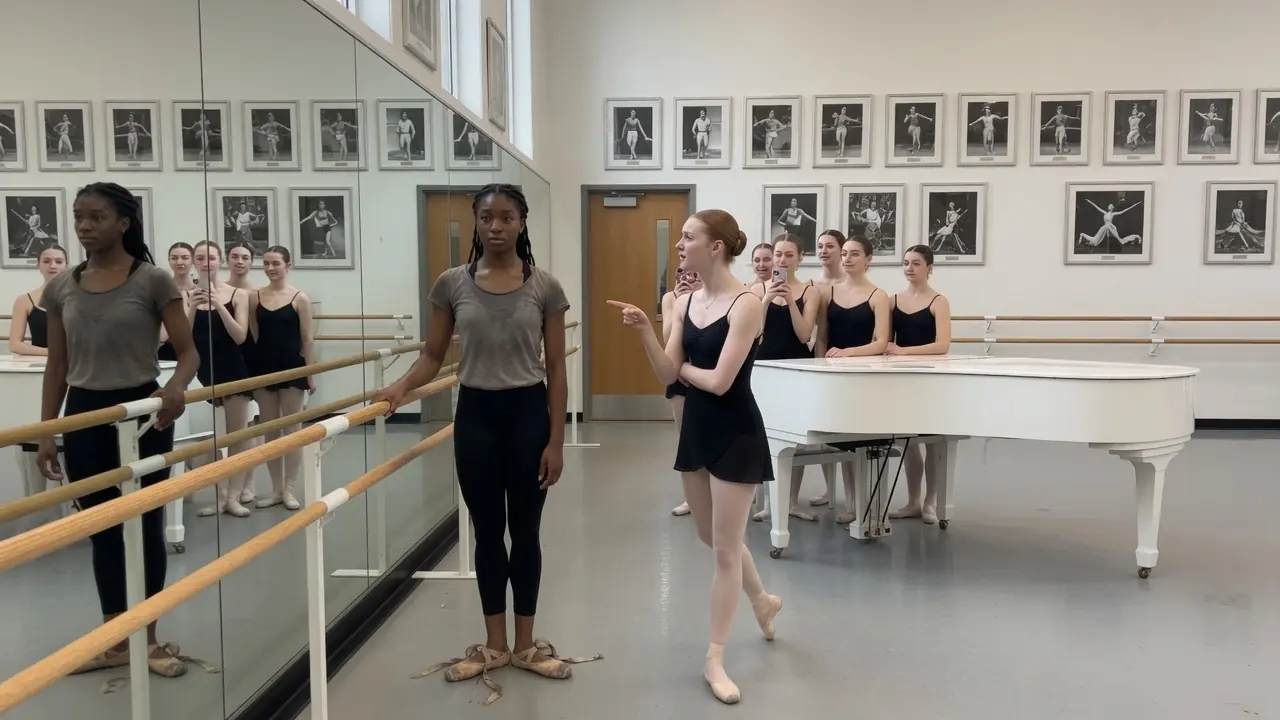
Brielle’s mouth curved.
“I said get off the floor,” she repeated. “This studio is for competitors, not circus acts.”
A few girls behind her laughed.
Not all of them.
Enough.
Zara looked around the room at the polished floor, the wall of mirrors, the high ceiling, the white grand piano in the corner, and the framed photos of champions lining the back wall. Every face in those photos seemed to have the same long neck, same slim arms, same expensive stillness.
None of them looked like her.
None of them looked like they had learned ballet in a converted laundromat under a flickering light while traffic rattled the windows.
“My name is on the rehearsal list,” Zara said.
Her voice was calm.
Too calm.
Brielle stepped closer, her eyes moving over Zara’s body with slow, deliberate contempt.
“Your name can be on the moon,” she said. “That doesn’t mean you belong there.”
The room went quiet.
Zara gripped the barre tighter.
The metal was cold under her palm.
Brielle smiled like she could smell the hurt and wanted more of it.
“Look at you,” she said. “Sweating through a thrift-store outfit, breathing like you just chased a bus. You stomp when you turn. You wobble when you land. You’re not a ballerina.”
She leaned closer.
“You’re a carnival horse in ribbons.”
That was when someone took out a phone.
Zara saw the red recording dot in the mirror.
Brielle saw her see it.
And kept going.
“You should go back to whatever basement you crawled out of before you embarrass yourself in front of people who actually trained.”
Laughter moved through the studio like a match dropped into dry grass.
Zara said nothing.
She bent down, picked up her dance bag, and pressed one hand against the worn pair of ballet shoes inside. They had belonged to her grandmother. The ribbons were old, the soles softened by decades of memory, and inside the left shoe, written in faded ink, were six words Zara had read a thousand times.
Make them hear your feet.
That night, the clip went viral.
Brielle’s friend posted it with the caption: When the basement girl thinks she’s Swan Lake.
By morning, two million people had watched Zara Ellison stand silent while Brielle Vance called her a carnival horse. By noon, strangers had turned her stumble into memes. They placed circus music over her rehearsal. They edited horse sounds over her landing. They zoomed in on her sweating face and wrote captions about cheap shoes, cheap training, cheap dreams.
The internet laughed because the internet is always hungry, and humiliation is fast food.
But the world had not yet seen Zara dance.
Not really.
And that was the mistake everyone made.
Zara Ellison had been dancing since before she knew the word discipline.
She grew up in South Arlen, a working-class neighborhood in the fictional city of Briarwick, a place built from brick churches, corner markets, bus stops, and apartment buildings with window units humming through hot summers. South Arlen was not pretty in the way brochures understand beauty. It had cracked sidewalks, tired storefronts, and alleys where streetlights died and stayed dead for months.
But music lived there.
It came from church choirs on Sunday mornings, car stereos at gas stations, teenagers drumming on buckets outside the laundromat, and old men playing saxophone near the bus terminal because they said silence made a neighborhood feel abandoned.
Zara’s first studio was not a studio at all.
It was the back room of Ellison Wash & Fold, the laundromat her grandmother owned for thirty-one years.
The front room had twenty machines, eight dryers, a change machine that broke every winter, and a bulletin board covered in lost-cat flyers, tutoring ads, church fish fry announcements, and handwritten notes from neighbors looking for work. The back room had once stored detergent, extra hoses, and broken folding tables.
Mabel Ellison turned it into a dance space with stubbornness and borrowed tools.
She laid plywood over the concrete floor. She painted the walls pale yellow because she said children should not practice in rooms that looked like storage. She bolted a metal pipe into the studs for a barre and hung a secondhand mirror she bought from a closed beauty salon.
The mirror had a crack in one corner.
Mabel refused to replace it.
“A perfect mirror makes lazy dancers,” she used to say. “A cracked one teaches you to look harder.”
Mabel Ellison had once been a dancer herself.
Not famous.
Not rich.
Not protected.
But good.
In her twenties, she danced with the Briarwick Civic Ballet, the first Black woman in that company to perform a featured solo during the winter season. She had strong feet, a fierce back, and a line so clean that one critic wrote she moved as if gravity had signed a private agreement with her.
Then came the injury.
Not dramatic to anyone but her.
A wet stage.
A bad landing.
A knee that folded wrong beneath her body while the music kept playing.
The company moved on within a season. That is what institutions do. They write sympathy in programs, send flowers, then replace the body that can no longer perform. Mabel came home to South Arlen with one ruined knee, two boxes of shoes, and a silence where applause used to be.
She bought the laundromat with insurance money and a loan nobody expected her to repay.
Then she started teaching.
First one child.
Then three.
Then half the neighborhood.
Zara was five when Mabel placed her at the barre for the first time.
“Stand tall,” Mabel said.
“I am tall.”
“You are short with opinions. Stand tall.”
By seven, Zara could hold a clean first position longer than most ten-year-olds. By nine, she could remember combinations after seeing them once. By twelve, she was waking up before school to drill tendus while dryers spun in the next room and customers folded towels on the other side of the wall.
Ballet taught her order.
The neighborhood taught her rhythm.
At night, after Mabel locked the laundromat and her knee stiffened from standing too long, Zara stayed in the back room with one cheap speaker and an old phone. She watched street dance battles, krump sessions, popping tutorials, footwork competitions, and dancers who moved like their bodies were arguing with history.
She taught herself in secret.
Not because Mabel would forbid it.
Because Zara wanted to build something before showing her grandmother.
She wanted to take Mabel’s ballet and South Arlen’s rhythm and make them meet without apology.
By sixteen, Zara could spin from a classical pirouette into a floor freeze. She could begin a delicate adagio and break it mid-line with a chest pop so sharp it looked like the music had struck her body. She could make one arm speak ballet and the other answer in street dance, then pull both back into the same breath.
She did not know what to call it.
So she called it home.
The poster appeared on a rainy Wednesday.
Zara found it taped to the window of a bakery near Grant Street Station while walking back from a shift at the laundromat. The paper was glossy, bright, and expensive. A dancer in white stood beneath gold lights, one leg lifted behind her in a perfect arabesque.
Ravenhill Grand Dance Championship.
Hosted by Vance Conservatory of Performing Arts.
Grand prize: full scholarship to Northbridge School of Dance.
Open category. Ages eighteen to twenty-five. All styles welcome.
Zara stood in the rain reading those words until her hoodie darkened around her shoulders.
All styles welcome.
She knew enough not to trust that sentence completely.
Institutions loved to say all while meaning some.
Still, she took a photo of the poster and showed Mabel that night.
Her grandmother sat behind the laundromat counter, counting quarters into paper rolls, reading glasses low on her nose. Outside, rain ran down the windows and turned the streetlights soft.
Mabel looked at the photo.
Then at Zara.
“You thinking about entering?”
“I don’t know.”
“That means yes but scared.”
Zara rolled her eyes.
Mabel pointed one roll of quarters at her.
“Do not roll those eyes at me unless they are paying rent.”
Zara smiled despite herself.
“I don’t have the entry fee.”
Mabel reached under the counter and pulled out an old cookie tin.
Inside were folded bills, loose coins, and a small envelope marked Heat Bill in Mabel’s careful handwriting.
Zara shook her head immediately.
“No.”
“Yes.”
“Grandma, that’s bill money.”
“It is money.”
“For bills.”
“For a future bill I would like to see paid by your gift.”
Zara looked away.
“I might lose.”
Mabel closed the tin.
“Baby, losing is ordinary. Not trying because somebody built a room to make you feel small? That’s the thing that follows you.”
The next morning, Zara registered.
Vance Conservatory sat on the west hill of Briarwick like it had been placed there by someone who wanted the rest of the city to look upward. The building was glass, stone, and money. White columns framed the entrance. A fountain moved silently in the front courtyard. Inside, the lobby smelled like lilies, polished wood, and air-conditioning that never broke.
Zara walked in wearing clean jeans, a black jacket, and sneakers she had wiped down twice before leaving home.
Her dance bag hung from one shoulder.
Inside it were Mabel’s old shoes wrapped in a scarf.
The receptionist looked up.
Her smile was professional until she saw Zara properly.
Then it became careful.
“Can I help you?”
“I’m here to confirm my registration for the championship.”
The receptionist blinked.
“The dance championship?”
Zara looked at the poster on the desk.
“Yes.”
A pause.
Small.
Sharp.
“Name?”
“Zara Ellison.”
The woman typed.
Found it.
Looked slightly surprised.
“You are registered. Orientation is Studio Four. Down the hall, second left.”
“Thank you.”
Zara walked down the hallway past glass studio doors, framed medals, alumni portraits, and donors’ names carved into brushed silver plaques. Through one door she saw a class of dancers moving in perfect unison, all black leotards and pink tights, every body long and controlled.
One girl glanced at Zara through the glass.
Then whispered something.
The others turned.
Zara kept walking.
Studio Four was mostly empty when she arrived. She checked in, received a contestant number, and asked about rehearsal times. Everything was polite, organized, and cold.
On her way out, she passed Studio One.
That was where Brielle Vance first saw her.
Brielle was rehearsing a contemporary solo near the mirror, her copper hair in a perfect bun, her feet bare, her body slicing through the music with professional precision. Four girls sat along the wall watching her like she was something rare.
Brielle caught Zara’s reflection in the mirror and stopped.
“Can I help you?” she asked.
Zara had heard the phrase three times that morning.
This version had teeth.
“Just finding my way out.”
Brielle’s eyes moved from Zara’s sneakers to her bag.
“The community outreach entrance is on the other side.”
One of the girls covered her mouth.
Another laughed openly.
Zara looked at Brielle.
“Good to know.”
She did not give them anything else.
Not anger.
Not embarrassment.
Not the satisfaction of seeing the blade go in.
She walked out of the conservatory, down the stone steps, through the courtyard, and back toward the bus stop where the wind was free and nobody pretended not to stare.
The open rehearsal happened ten days before the competition.
All contestants were allowed to use the main studio from nine to noon. The email called it a supportive shared space. The moment Zara entered, she knew support had assigned seating.
Vance students took the center.
Everyone else found corners.
Zara chose a spot near the far barre. She set her bag against the wall and started warming up slowly, quietly, one movement at a time. Ankles first. Feet. Hips. Spine. Breath.
She could feel people looking.
She had learned not to look back too quickly.
Brielle arrived twenty minutes late.
Of course she did.
The room adjusted around her as if her entrance was weather. She wore a black wrap skirt, red lipstick, and a thin gold necklace with a small letter B at her throat. Her four friends followed with water bottles, phones, and the soft cruelty of girls who had never been punished for laughing at someone in the right room.
Brielle took the center.
No one challenged her.
For thirty minutes, the rehearsal moved in fragments: dancers marking routines, music cutting in and out, bodies claiming space, teachers walking through with clipboards. Zara waited until a patch near the mirror opened. She stepped in, lifted her arms, and began the first section of her solo.
It was classical.
Slow.
Intentional.
She wanted the room to underestimate the beginning.
Her arms moved through first position, then fifth. Her leg unfolded into développé. She let her body breathe into the line, not forcing height, not chasing applause, just listening for the floor.
Then her foot slipped slightly on a patch where someone had spilled water.
It was nothing.
A half-second correction.
Most dancers would have ignored it.
Brielle did not.
“Oh,” she said loudly. “This is going to be fun.”
The music stopped.
Zara lowered her leg.
Brielle walked toward her, smiling.
“Don’t stop,” she said. “We were all enjoying the… attempt.”
Zara breathed once.
“Move.”
The word surprised the room.
Brielle tilted her head.
“What did you say?”
“I said move. I’m rehearsing.”
That should have been enough.
But girls like Brielle did not become Brielle by allowing boundaries to remain standing.
She stepped closer.
“You are rehearsing? That’s what you call that?”
Her friend Tessa lifted her phone.
Brielle noticed.
Good.
“Because from here, it looked like a circus horse trying to copy ballet from a shampoo commercial.”
Laughter.
Zara felt heat rise in her face.
She did not let it reach her eyes.
Brielle looked around the room, performing now.
“I’m serious. Are we doing open category or petting zoo this year?”
More laughter.
Someone whispered, “Stop,” but too quietly to matter.
Brielle leaned in.
“You do not belong on this floor. You do not belong in this building. And when you walk onto that stage, everyone is going to know Vance Conservatory made a mistake letting you through the door.”
Zara looked at the phone.
Then at Brielle.
“Are you done?”
Brielle blinked.
The question robbed her of rhythm.
Zara picked up her bag.
“I asked because I know people like you need an audience to finish.”
Then she walked back to her corner, sat down, and waited until rehearsal ended.
She did not leave.
That mattered.
The video hit the internet that night.
Tessa posted it with dramatic zooms, circus music, and little animated horse stickers. The edited clip showed Zara slipping, then Brielle’s insult, then the room laughing. It did not show the water on the floor. It did not show Zara asking calmly if she was done. It did not show the two full minutes of rehearsal before the stumble where Zara’s line was clean enough to make two instructors glance at each other.
Truth rarely travels first.
Mockery does.
By morning, #CircusBallerina was trending in Briarwick. By lunch, it reached national dance accounts. People remixed the clip. They made reaction videos. They wrote comments that sounded clever only because cruelty often mistakes rhythm for intelligence.
Someone tell her ballet has weight limits.
This is why open category was a mistake.
She dances like her shoes have unpaid bills.
Zara turned off her phone.
Then turned it back on.
Then turned it off again.
At three in the afternoon, she walked into the laundromat back room and found Mabel waiting beside the barre.
Her grandmother had seen everything.
Zara could tell from her face.
“Say it,” Mabel said.
Zara stood near the door.
“Say what?”
“Whatever ugly thing you have been telling yourself since breakfast.”
Zara looked at the plywood floor.
“Maybe they’re right.”
Mabel’s cane struck the floor once.
Sharp.
“No.”
The word filled the room.
Zara looked up.
“You didn’t even let me finish.”
“Because I heard that lie coming from the hallway.”
Mabel limped to the old cabinet by the mirror. She opened the bottom drawer, reached beneath folded towels, and pulled out a pair of pale satin ballet shoes wrapped in a blue scarf.
Her own shoes.
The final pair she had worn before her knee ended everything.
She handed them to Zara.
“They called me too heavy once,” Mabel said.
Zara looked down.
“What?”
“Too strong. Too dark. Too muscular. Too much hip. Too much shoulder. Too much everything they did not know how to praise. Then the same people used my power when they needed a role that required fire.”
She tapped the shoe.
“Open the left one.”
Zara turned it over.
Inside, written in faded blue ink, were the words she knew by heart.
Make them hear your feet.
“I wrote that the night before my last performance,” Mabel said. “I thought I had years left. I had one more night.”
Her voice tightened.
“I lost my stage to injury. You are not losing yours to a girl with a phone.”
Zara pressed the shoes against her chest.
For the first time that day, her eyes burned.
“What if they laugh again?”
Mabel looked at her.
“Then make them run out of laughter before you run out of truth.”
So Zara trained.
Not normally.
Not carefully.
Like a person rebuilding herself from insult.
Every morning before sunrise, she was in the back room while dryers thumped on the other side of the wall. Mabel sat in her folding chair with a stopwatch, cane across her lap, coffee cooling near her feet.
“Again.”
Zara turned.
“Again.”
She landed.
“Again.”
She fell.
“Again.”
She rose.
The ballet came first because Mabel believed foundation mattered even when rebellion was the goal. Zara drilled turnout, balance, extension, breath, softness in the hands, strength in the back. Mabel corrected everything.
“Your elbow is lazy.”
“My elbow is tired.”
“Your elbow has not paid rent either.”
Zara groaned.
Then did it again.
At night, after the laundromat closed and Mabel went upstairs to rest her knee, Zara returned. She turned off the overhead lights and let the streetlamp paint the floor gold through the front window. Then she put on the other music.
Bass.
Snare.
Strings.
A beat that sounded like concrete and heartbeat.
She broke the ballet apart and stitched it into what she knew from South Arlen: popping, locking, floorwork, footwork, body control, the sharp honesty of street movement. She fused it carefully, refusing to make either style serve as decoration for the other.
Ballet gave the piece its spine.
Street dance gave it its blood.
One night, she did not hear the door open.
She was halfway through the routine when the lights snapped on.
Zara stumbled to a stop.
Mabel stood in the doorway, cane in one hand, night scarf tied around her hair, eyes wide.
For one terrible second, Zara felt like a child caught stealing.
“How long?” Mabel asked.
Zara swallowed.
“Since I was fourteen.”
“Five years?”
“Yes.”
“Five years in my back room and you didn’t tell me?”
“I wanted it to be good first.”
Mabel looked at the floor.
At the speaker.
At Zara’s shoes.
Then at Zara.
“From the top.”
Zara blinked.
“What?”
“Do it again. If you’ve been hiding a whole language in my laundromat, I’d like to hear the sentence.”
So Zara danced it.
All of it.
The classical opening. The fracture. The beat. The spiral into floorwork. The rise back into pointe. The final sequence where her grandmother’s old phrase became something wider than either of them had planned.
When it ended, Mabel did not speak for almost a full minute.
Then she limped to the cabinet again.
From the top shelf, she pulled an old folder tied with brown string.
Inside were choreography notes from forty years ago.
Mabel’s unfinished solo.
The one she had never performed.
The pages were yellowed, corners soft, pencil marks smudged, but the structure was there. A piece about restraint turning into release. A piece about a dancer trapped in tradition and finding her own timing inside it.
“I wrote this before the injury,” Mabel said. “Never got to finish it.”
Zara touched the paper gently.
“It looks like what I’ve been trying to make.”
“No,” Mabel said. “Yours is bigger. Mine was asking permission from the old world. Yours is not.”
They spent the next four nights rebuilding the solo together.
Mabel gave Zara the emotional architecture.
Zara gave it the body.
The routine became a conversation between generations. Mabel’s ballet, disciplined and wounded. Zara’s street dance, sharp and alive. South Arlen and Vance Conservatory. A laundromat and a grand stage. A cracked mirror and gold lights.
On the fifth night, someone knocked.
Zara opened the back door and found Lacey Monroe standing in the alley.
Lacey was one of Brielle’s friends, a tall white girl with pale hair and nervous hands. She had been in the studio when the video was filmed. She had laughed once, then stopped, but the first laugh still counted.
“I’m sorry,” Lacey said.
Zara said nothing.
“I should have said something. I didn’t.”
“No. You didn’t.”
Lacey looked past her into the room.
“I saw another clip. Someone posted you dancing through the window.”
Zara stiffened.
“I didn’t post anything.”
“I know. But it made me realize Brielle cut the video. She made it look like you were bad.”
Zara’s voice stayed flat.
“You needed a second video to know that?”
Lacey flinched.
She deserved it.
“Yes,” she whispered. “I guess I did.”
Mabel’s cane tapped behind Zara.
“Child, if you came to apologize, apologize standing up. Shame doesn’t need choreography.”
Lacey straightened.
“I am sorry. And I can help. Brielle’s father is trying to get you disqualified.”
Zara’s stomach dropped.
“What?”
“Conrad Vance. He chairs the competition board. Brielle heard about the garage clip going viral. She is scared.”
That sentence felt strange.
Brielle Vance, scared.
A week earlier, Zara would not have believed it.
Now she understood.
Cruel people are often terrified of losing the mirror that makes them look bigger.
“What is he doing?” Mabel asked.
Lacey reached into her bag and pulled out printed screenshots.
“Section 9.2. Unauthorized rehearsal media featuring competition material. He wants to say your garage clip violates the rules.”
Zara stared at the papers.
“That clip was filmed without my permission.”
“I know.”
“And Brielle’s friend posted the first video.”
“I know.”
Lacey’s eyes filled.
“And Brielle has posted rehearsal clips every week for two months.”
Mabel reached for the screenshots.
“Then we stop asking permission.”
The disqualification letter arrived the next morning.
It was polite.
That made it worse.
Dear Ms. Ellison,
Following review of competition protocol, the Ravenhill Grand Dance Championship committee has determined your participation violates section 9.2 regarding unauthorized publication of rehearsal materials. Your registration is revoked effective immediately. Entry fees are non-refundable.
We wish you the best in your future artistic pursuits.
Zara sat at the laundromat counter with the letter in front of her, hearing washing machines churn behind her like the world was continuing without shame.
Mabel read it once.
Then twice.
Then she called Tyrell Knox.
Tyrell was Zara’s oldest friend, a mechanic, dancer, and the person most likely to solve emotional problems with editing software. He had filmed one short clip of Zara training days earlier, but unlike the strangers who had recorded her humiliation, he had filmed her with love.
He arrived twenty minutes later with his laptop under one arm.
Mabel placed the disqualification letter on the counter.
Tyrell read it.
Then smiled.
That smile made Zara nervous.
“What are you doing?” she asked.
“Letting the internet finish what it started.”
He edited fast.
Not sloppy.
Fast like someone who had been waiting for the right reason.
The video opened with Brielle’s insult.
Circus horse.
Laughter.
The phone recording.
Then it cut to Zara training in the laundromat back room. Mabel counting with her cane. The old shoes. The cracked mirror. Zara spinning from ballet into street work with such controlled force that the insult looked smaller every second.
At the end, he added the disqualification letter.
Then the screenshots Lacey had brought.
Then one line in white text on black.
They laughed when she danced badly. Now they’re afraid she’ll dance well.
He posted it at 6:00 p.m.
By 7:00, it had 50,000 views.
By midnight, half a million.
By morning, #LetZaraDance was everywhere.
Former students of Vance Conservatory began speaking out. One wrote about being benched after refusing private coaching from a Vance-approved instructor. Another said judges had always known Brielle’s scores were inflated. A former receptionist admitted scholarship applicants from low-income neighborhoods were quietly discouraged from finishing registration.
Conrad Vance released a statement calling the accusations misleading.
Nobody believed him.
The competition board called an emergency meeting.
The head judge, Odessa Grant, demanded full review.
Odessa was sixty-eight, Black, famous in dance circles, and feared by anyone who thought money could dance on their behalf. She had choreographed for national companies, taught in four countries, and once told a donor that his check was generous but his opinion remained unnecessary.
She reviewed the rules.
Then the videos.
Then Brielle’s public rehearsal posts.
Then the emails.
Because Lacey had more than screenshots.
She had forwarded messages between Conrad Vance and committee director Paul Renner.
Handle Ellison before she turns the event into a circus.
Use 9.2.
Clean and quiet.
Odessa placed the printouts on the conference table.
Conrad Vance tried to speak.
Odessa lifted one hand.
“No.”
Just one word.
The room obeyed.
“If section 9.2 removes Zara Ellison,” Odessa said, “then it removes Brielle Vance, six other Vance students, and nearly half the finalist pool. Would you like equal enforcement?”
No one answered.
“I thought not.”
The vote was unanimous.
Zara was reinstated.
Paul Renner resigned before lunch.
Conrad Vance was removed from all judging influence pending investigation.
Brielle said nothing publicly.
That silence was the first honest thing she had done.
Three days before the competition, Mabel fell.
It happened in the back room during rehearsal.
Not while dancing. Not dramatically. She stood to correct Zara’s wrist position, took one step, and her bad knee gave out beneath her. Her cane slipped. Her shoulder hit the mirror. The crack in the corner split wider with a sharp sound that made Zara’s heart stop.
Mabel went down hard.
“Grandma!”
“I’m fine,” Mabel snapped immediately.
But her face had gone gray.
Her hands shook.
She was not fine.
At Briarwick Mercy Hospital, the doctor used words like severe degeneration and surgical evaluation and mobility support. Mabel listened with the bored expression of a woman who had been told by men in coats what her body could not do for forty years and had stopped being impressed.
When Zara arrived from the waiting room, Mabel was sitting up in bed, leg braced, IV taped to her hand.
“You are dancing,” Mabel said before Zara spoke.
“Grandma—”
“No.”
“You’re in the hospital.”
“And you are in a competition.”
“I can withdraw.”
“You can also throw yourself into traffic. Both are bad decisions.”
Zara closed her eyes.
Tears pressed hot behind them.
“I don’t want to do it without you.”
Mabel’s face softened then.
Only then.
“Baby, you are never doing it without me. Every count you know came through my bones before it reached yours.”
Zara took her hand.
Mabel squeezed.
Weakly.
Enough.
“You dance for the laundromat. You dance for South Arlen. You dance for every girl who learned something beautiful in a place the world called ugly.”
Her voice lowered.
“And you dance for yourself. Not for revenge. Revenge runs out of music.”
Zara bent over Mabel’s hand and cried into the hospital blanket.
Mabel let her.
For one minute.
Then she said, “That’s enough. Tears dehydrate dancers.”
The championship sold out.
Ravenhill Grand Theater held twenty-three hundred people beneath a ceiling painted like a night sky. Gold trim framed the balconies. Heavy red curtains hung on either side of a stage wide enough to make Zara’s laundromat back room feel like a shoebox.
The livestream reached eighty thousand viewers before the first dancer began.
By the time Brielle Vance took the stage, it had doubled.
Brielle danced ninth.
Her solo was perfect.
That was the truth.
She was not untalented. That would have made the story simpler, but life rarely grants that convenience. Brielle was technically brilliant, clean in her turns, exact in her extensions, controlled through every transition. Her costume shimmered under the lights. Her music swelled. She ended in a flawless arabesque that drew a standing ovation from half the orchestra section.
Her score appeared.
9.41.
A championship score.
The kind that usually ended the night.
Brielle walked offstage smiling, but her smile was tight.
She knew Zara was last.
Zara stood in the wings wearing a simple black leotard, hair braided down her back, Mabel’s ballet shoes tied around her feet. No glitter. No stones. No costume built to distract from the movement.
Just her.
Lacey stood near the curtain.
“I’m sorry,” she whispered again.
Zara looked at her.
“I heard you the first time.”
“Does that mean—”
“It means don’t waste it.”
Lacey nodded.
Then the announcer spoke.
“Final contestant, Zara Ellison.”
The theater dimmed.
A single spotlight found center stage.
Zara walked into it.
For one second, as she stood there with her head down, she heard the video in her mind.
Circus horse.
Basement girl.
You don’t belong.
Then she heard Mabel’s cane.
Tap.
Tap.
Tap.
The music began with one violin.
Soft.
Lonely.
It sounded like a memory walking barefoot across a cold floor.
Zara lifted her arms.
The first minute was pure ballet.
Not imitation.
Not proof.
Truth.
Her body moved with quiet precision, every line held just long enough to speak before becoming the next. She did not dance like she wanted permission. She danced like she was showing the room the foundation they had mistaken for absence.
A hush fell over the theater.
Even the phones stopped shifting.
Then the beat entered.
Low.
Steady.
Unavoidable.
Zara’s body changed.
A pirouette broke mid-turn into a hard pop through her shoulders. Her arms, which had just floated in classical softness, snapped into sharp angles. She dropped to the floor, swept one leg under her body, spun once on her shoulder, and rose into a clean arabesque as if the floor itself had lifted her.
The audience gasped.
Not politely.
Together.
She kept going.
Ballet and street dance no longer alternated.
They fused.
A grand jeté landed in a controlled slide. A delicate port de bras fractured into locking. A slow backbend rolled into floorwork and returned upright without losing the musical line. Her feet spoke Mabel’s language. Her spine answered in South Arlen’s.
On the hospital bed eleven blocks away, Mabel watched on a nurse’s tablet.
Her bad leg was braced.
Her hand gripped the rail.
The nurse beside her whispered, “Is that your granddaughter?”
Mabel did not look away from the screen.
“That is my answer.”
Back at the theater, Zara entered the final sequence.
Twelve turns.
That was the risk.
Mabel had warned her it could ruin the ending if she missed the center.
Zara took the first turn clean.
Then the second.
Third.
Fourth.
The beat climbed.
Fifth.
Sixth.
The violin returned over the bass, two worlds rising together.
Seventh.
Eighth.
The stage lights burned white.
Ninth.
Tenth.
A murmur moved through the crowd, then died because nobody wanted to interrupt the impossible.
Eleventh.
Zara spotted the front row.
Odessa Grant had removed her glasses.
Twelfth.
Zara stopped dead center, feet grounded, arms wide, chest lifted, head thrown back as if she had caught the whole ceiling in her ribs.
Silence.
One second.
Two.
Then the theater broke open.
People stood before they understood they had moved. Applause exploded from every side. Someone shouted her name. Then another person. Then dozens. The sound rose so hard Zara felt it through the stage.
In the wings, Brielle stood motionless.
Her face was blank.
Not hateful.
Not even angry.
Just stripped of the one belief that had carried her entire life: that the stage belonged to her because it always had.
The judges took less than two minutes.
Scores appeared on the screen.
9.86.
The theater erupted again.
Odessa Grant stood at the microphone.
“I have judged this championship for thirteen years,” she said. “Tonight, I watched a dancer refuse to choose between where she came from and where she was told she should go.”
She turned to Zara.
“That is not a gimmick. That is not fusion for decoration. That is lineage.”
Zara’s throat tightened.
Odessa lifted an envelope.
“On behalf of Northbridge School of Dance, I am honored to award Zara Ellison the grand scholarship.”
Zara accepted the trophy with both hands.
It was heavier than she expected.
So was being seen.
Afterward, Brielle found her in the hallway.
No audience.
No phone.
No friends behind her.
Her hair had loosened from its bun, and mascara had smudged faintly beneath one eye. She looked younger than Zara expected. Smaller, somehow, without the room bending toward her.
“I was cruel,” Brielle said.
Zara leaned against the wall, trophy at her feet.
“Yes.”
“I was scared.”
“Yes.”
Brielle looked up.
“That doesn’t excuse it.”
“No.”
For a moment, neither spoke.
Then Brielle said, “My whole life, I thought being the best meant no one could question whether I deserved to be here. Then you walked in and you didn’t ask anyone to believe you. You just kept showing up.”
Zara studied her.
“I don’t forgive you tonight.”
Brielle nodded.
“I know.”
“But I hope someday you dance because you love it, not because you need everyone else to lose.”
Brielle’s face crumpled slightly.
She nodded once, then walked away.
Three days later, Conrad Vance stepped down from the conservatory board. The academy announced an independent review of competition practices, scholarship access, and internal favoritism. The words sounded polished, corporate, safe.
But the building changed.
Not enough.
Not immediately.
But cracks had opened.
And sometimes cracks are where air enters first.
Mabel came home from the hospital the following week.
Zara had moved the trophy to the laundromat counter beside the change machine.
Mabel ignored it.
She looked at the back room.
The mirror was still cracked wider from the fall.
Zara had wanted to replace it.
Mabel said no.
“Now it tells the truth better.”
That summer, Zara used part of the prize money to renovate the back room without removing its soul. New sprung flooring over the old plywood. Better lights. A stronger barre. A sound system that did not need to be slapped twice before working.
The mirror stayed.
Crack and all.
On the first Saturday of the Ellison Free Dance Program, nine children arrived.
By the next month, there were twenty-seven.
Some wore ballet shoes.
Some wore sneakers.
One little boy came in rain boots because that was what he had. Mabel told him boots were not ideal but confidence was welcome, and he danced the whole class with squeaking feet and perfect seriousness.
Zara taught ballet first.
Then rhythm.
Then how to let the body tell the truth without apologizing for its accent.
Mabel sat in her folding chair by the mirror, cane across her lap, calling corrections like commandments.
“Back straight.”
“Feet alive.”
“Do not throw your arms like laundry.”
Sometimes, when a child found the movement exactly, Mabel tapped her cane twice.
Tap.
Tap.
Everyone learned what it meant.
On the wall above the barre, Zara framed Mabel’s old ballet shoes.
Pale satin.
Yellowed ribbons.
Soft soles.
Inside the left shoe, the faded words remained.
Make them hear your feet.
Under the frame, a small brass plate read:
Mabel Ellison danced here first.
Zara Ellison made them listen.
Years later, people would tell the story as if it began with a viral insult.
They would say a rich girl called a Black dancer a circus horse, and the girl came back and won the championship. They would say it was a revenge story, which was easier to understand and easier to sell.
But Zara knew the truth.
The story began in a laundromat back room with plywood floors and a cracked mirror.
It began with a grandmother who lost a stage but refused to lose the language.
It began with a little girl learning first position while dryers shook the wall.
It began every time someone said you don’t belong and a dancer answered by staying.
The internet had laughed.
The academy had doubted.
The powerful had tried to close the door quietly.
But Zara Ellison did not need their permission to become real.
She only needed a floor.
A rhythm.
An old pair of shoes.
And enough courage to make the world hear her feet.