She was polishing the silver for his wedding, not as a guest, but as a servant.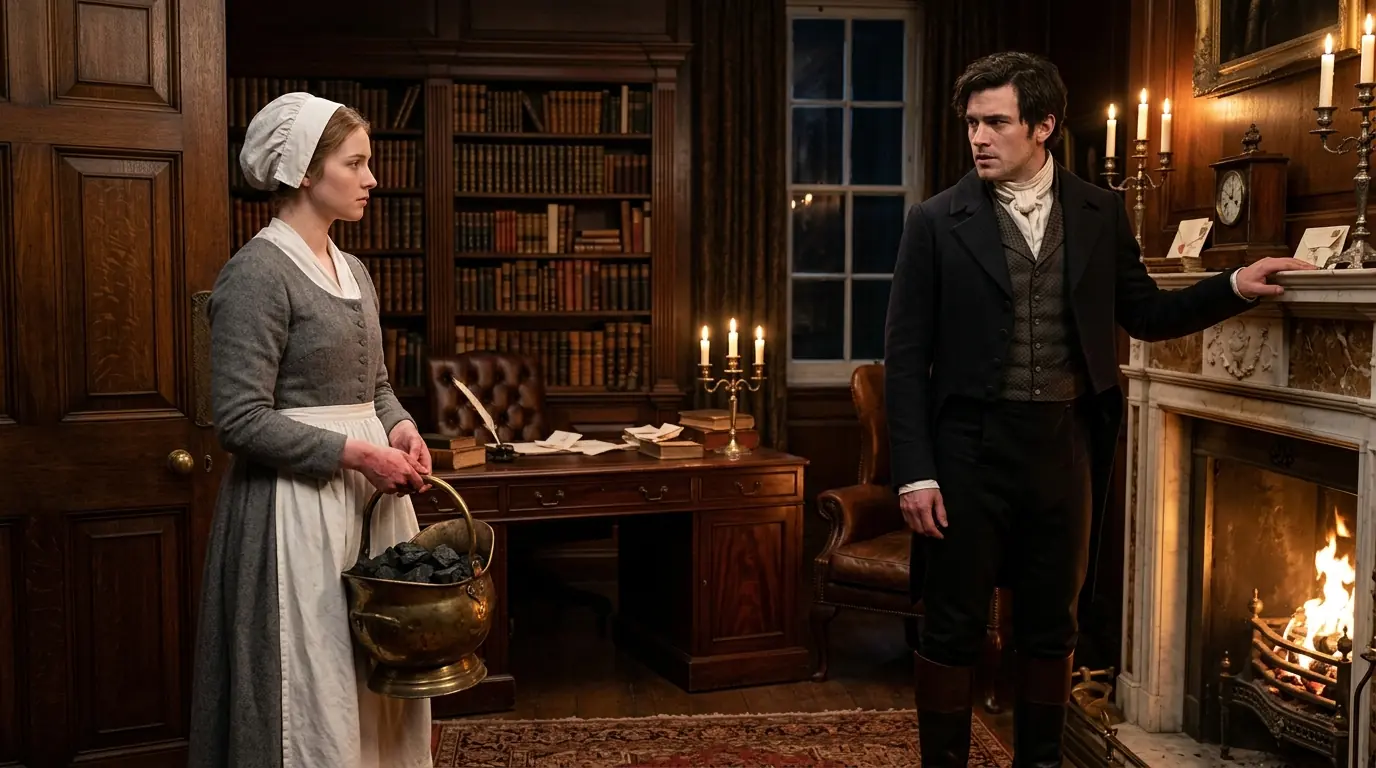
Eleanor Hart had loved Thomas Ashkam since she was six years old—since he had pushed her on the swing behind the vicarage and promised with a missing front tooth, "I'll marry you when I'm a duke."
At twenty-two, he was a duke: the Duke of Ashkam. And tomorrow he was marrying Lady Amelia Vane in the very hall where Eleanor now knelt, cloth in hand, making the candlesticks shine for another woman's vows.
The housekeeper's voice cut through the silence: "Girl, the bride's gloves. Take them to her, and curtsy properly this time."
Eleanor stood. In her apron pocket, her fingers brushed something small and sharp: a wooden bird, a robin, whittled by a boy's hand sixteen years ago. She had kept it every day since. He had forgotten it completely.
Or had he?
We begin not in a ballroom, but in mud.
Eleanor Hart is the vicar's daughter in the village of Ashkam: not poor, not rich, invisible in the way good, clever girls of modest birth always are. Thomas Ashkam is eight—the second son, wild, freckled, not yet a duke, not yet cold. His older brother, William, is the heir, perfect and distant. Thomas is the spare who is allowed to play.
And he plays with Eleanor.
"Again!" she squealed.
"I'll push you to the clouds!" Thomas declared, his voice full of importance. "Hold tight, Eleanor Bird!"
He called her Eleanor Bird because she was small and quick and always humming.
That afternoon, Thomas had spent an hour in his father's woodshed with a stolen penknife. He presented it to her, solemn as a knight offering a sword: a little wooden robin, clumsy, one wing larger than the other.
"For you. So you don't forget me when I go to school."
"I could never forget you," she whispered. And she meant it with the terrifying completeness only a six-year-old can manage.
He, with the gravity of an eight-year-old boy who has recently learned about dukes and destiny, took her hands. "When I am a duke, I will marry you. I promise. Swear it on the robin."
"I swear it," she said.
He did not become a duke for another twelve years. But she swore it every day after.
Their childhood unfolded in three quick, luminous memories:
Aged ten and twelve: he teaches her to read Latin behind the stables because the governess says girls don't need it, their heads bent together over a book.
Aged thirteen and fifteen: her father's funeral. Thomas is now at Eton. He rides two days straight to stand at the back of the church. He says nothing; he just presses the robin—which she had left on his pillow when he departed—back into her palm and squeezes.
Aged fifteen and seventeen: the night before he leaves for Oxford, his brother William dies of fever. Thomas becomes the heir overnight. He finds her by the swing, now too small for her.
"Everything will be different now, Eleanor," he says, not meeting her eyes. "I have to be different."
She thinks he means distance. She is right.
Her father, the vicar, dies. Her mother follows a year later. The new vicar has his own family. Eleanor, at eighteen, has no dowry, no home.
The Duchess, Thomas's mother, offers her a place at the hall—not as a guest, not as the vicarage girl who was like a sister, but as a housemaid; upper housemaid for her literacy. Eleanor accepts because it means being under the same roof as Thomas.
Thomas, now twenty, now Marquess, now cold with grief and duty, says nothing when he sees her in the gray dress. He just looks at her for a long second, too long, then bows as if she is a stranger.
"Miss Hart."
She curtsies. "My lord."
The robin stays in her pocket, always.
Three years pass in service. Eleanor is invisible. She makes fires, mends linen, and watches the boy she loved become a man she barely knows. The old, stern Duke of Ashkam dies. Thomas at twenty-three becomes Duke. He is in London for a year. Letters come; the house prepares.
Then the news: the Duke is returning, and he is engaged.
Lady Amelia Vane: daughter of an earl, twenty, golden, accomplished, kind in the way beautiful girls with everything are kind—which is to say, not unkind, but never having to try.
The entire house erupts: seamstresses, florists, confectioners. Eleanor finds out while airing the state bedroom—their bedroom. The bedsheets she is smoothing will be for him and another woman.
Mrs. Agatha, the housekeeper who loves Eleanor like a daughter, finds her frozen. "Child, you must ask to be moved to the kitchens. Or the dower house. I can arrange it. You need not see this."
Eleanor folds the sheet with perfect precision. Her voice does not shake; that is her dignity. "No, Mrs. Agatha, I will serve. If I can love him since childhood, I can have the grace to serve his wedding. I will not give anyone the satisfaction of seeing me run."
The Duke arrives at dusk: carriages, trunks, barking dogs. Eleanor stands in the line of servants in the great hall, head bowed. He enters—taller, broader, in black. A duke now, truly; his face is handsome and unreadable. His eyes sweep the line. They pass over her, then snap back. He stops.
For three seconds, the hall is silent. Lady Amelia on his arm notices: "Thomas?"
He recovers. "Nothing." But his voice is tight.
Later that night, Eleanor is sent to bring fresh coal to his study. She knocks, enters. He is alone, staring into the fire, cravat undone. He looks exhausted, not happy.
"Eleanor."
"Your Grace."
He looks at her gray dress, her hands red from lye. Something flickers in his face: pain, shame. "You... you remained."
"Where else would I go, Your Grace?"
He opens his mouth, closes it. Formality crashes down like a portcullis. "That will be all."