The room went quiet so quickly that Ava Monroe could hear the soft mechanical hum of the cameras mounted beneath the ceiling.
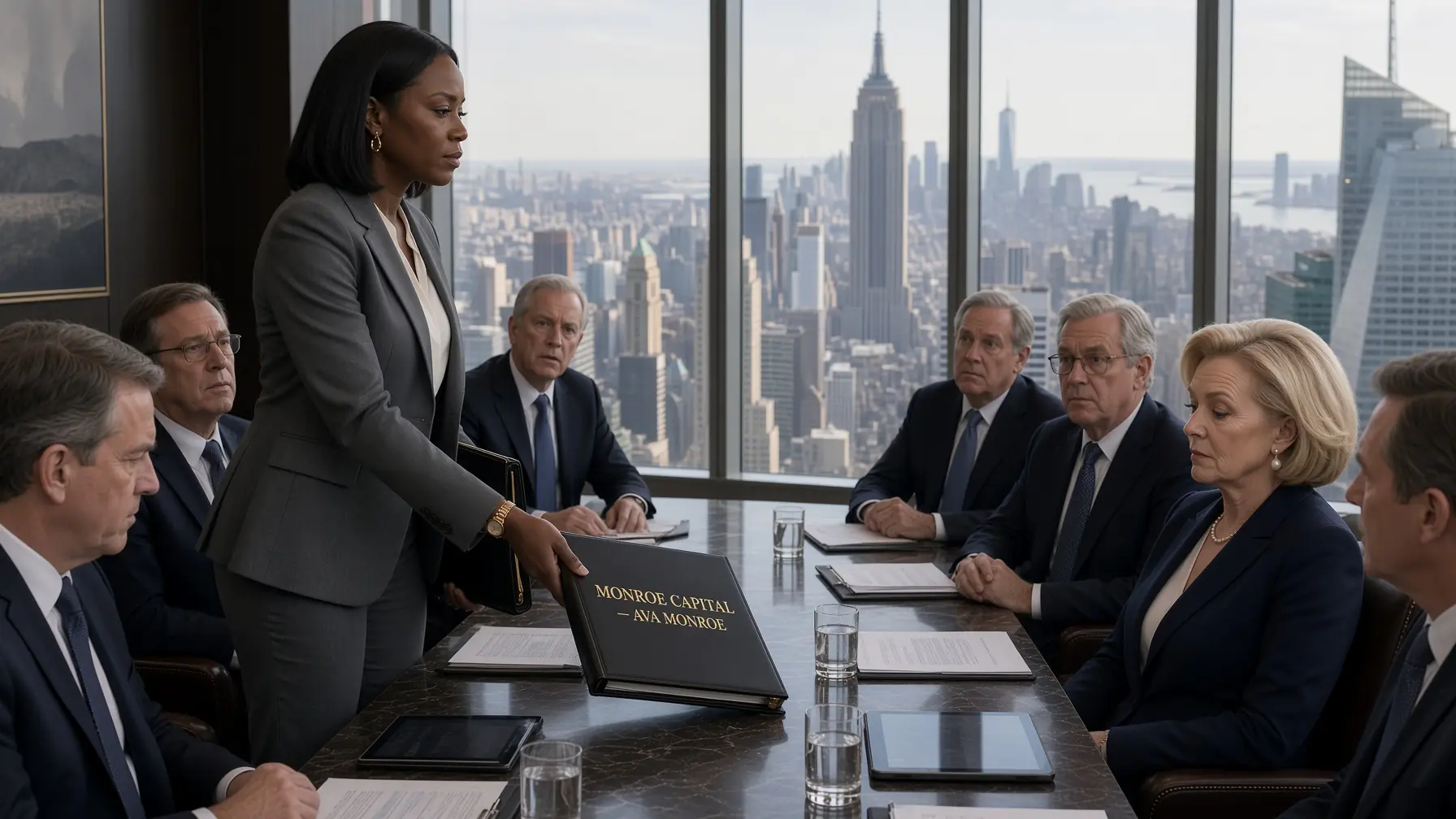
Her hand remained extended across the polished conference table.
Victoria Sloan looked at it.
Then at Ava.
Then she leaned back in her chair and raised one palm between them as if stopping a waiter from pouring more wine.
“We don’t shake hands with people like you.”
For perhaps two seconds, nobody moved.
The boardroom occupied the forty-seventh floor of Langston Tower in Manhattan, wrapped almost completely in glass. Twelve directors sat around a table large enough to seat twenty. Beyond them, the city stretched beneath a pale February sky, every building reduced by altitude to something quiet and manageable.
Inside the room, nothing felt manageable.
Ava slowly lowered her hand.
One director coughed into his fist.
Another shifted in his chair.
Someone near the far end gave a nervous laugh—the kind people produce when they cannot tell whether they have just witnessed a joke, an insult, or something they will later wish they had objected to.
Victoria smiled.
She had intended the remark to land.
That much was obvious.
Ava looked at her for one heartbeat longer than necessary.
“Understood,” she said.
Then she sat.
There was no shouting.
No demand for an apology.
No dramatic announcement of who she was.
Everyone in the room already knew exactly who Ava Monroe was.
That was what made the moment worse.
At forty-six, Ava was the founder and chief executive officer of Monroe Capital Partners, a privately held investment firm that had grown from a six-person advisory shop into one of the most disciplined infrastructure and industrial investment groups in the country. Monroe did not buy flashy consumer brands. It bought logistics companies, specialized manufacturers, freight operators, water systems, warehouse portfolios, and businesses most people noticed only when they failed.
Ava had built the firm slowly.
No inherited fortune.
No mysterious billionaire mentor.
No overnight technology windfall.
Her first major deal had been a distressed regional cold-storage company in Ohio. Her second involved a rail-servicing business everyone else dismissed as too old and too operationally complicated. She made money because she read what other people skipped: maintenance liabilities, labor contracts, customer concentration, equipment replacement schedules, environmental exposure, and management incentives.
Her staff joked that Ava could find a million-dollar problem hiding behind a two-line footnote.
She disliked the joke because it was usually true.
That Tuesday morning, Monroe Capital was not visiting Sloan Industrial Holdings as a supplicant.
It was leading the financing package for the largest transaction in either company’s history.
Sloan Industrial, a publicly traded manufacturing and distribution conglomerate, wanted to acquire Hartwell Systems, a family-controlled industrial automation company with operations in twenty-two states. The purchase price was just over $5.1 billion.
Sloan could not fund that acquisition from cash.
It needed debt.
It needed institutional equity.
And it needed a lead investor willing to anchor the transaction strongly enough that banks and minority participants would follow.
Monroe Capital had committed up to $2.4 billion of equity and preferred capital, subject to final closing conditions.
That distinction mattered.
The money was not sitting in Victoria Sloan’s checking account.
It had not yet been transferred.
Monroe had signed a binding commitment agreement, but the funding remained conditioned on representations, governance requirements, compliance certifications, and completion of the final transaction documents.
If Monroe withdrew lawfully, Sloan would not “lose” $2.4 billion it already possessed.
It would lose the cornerstone of its financing structure.
And without that cornerstone, other parts of the transaction could collapse with it.
Victoria knew that.
So did every lawyer in the building.
Yet for months, she had behaved as though Monroe needed the deal more than Sloan did.
The handshake made that belief visible.
Ava opened the leather folder in front of her and placed her pen across the page.
Victoria adjusted a stack of documents.
“Now that we’re clear on protocol,” she said, “perhaps we can finally finish this.”
Nobody laughed that time.
The investor-relations cameras continued recording.
The meeting was being transmitted on a restricted livestream to major lenders, participating investors, outside counsel, and several Hartwell family representatives because the transaction involved multiple parties in different cities. It was not a public broadcast, but it was far from private.
Ava knew that.
Victoria either had forgotten or had decided it did not matter.
The chief financial officer, Martin Kell, cleared his throat.
“We’re on page sixty-eight of the integration model.”
Victoria nodded.
“Good. Let’s continue.”
Martin brought up the next slide.
Projected cost synergies.
Shared distribution centers.
Procurement savings.
Head-count efficiencies.
Technology consolidation.
Ava listened for three minutes before raising one finger.
“Your Year Two distribution savings are still assuming the Hartwell Tennessee facility closes by the end of Q3.”
Martin nodded cautiously.
“That is the operating assumption.”
“It shouldn’t be.”
Victoria leaned back.
“Here we go.”
Ava ignored her.
“Hartwell’s primary automotive customer has a continuity clause requiring twelve months’ notice before any manufacturing relocation affecting their supply schedule. Your model shows eight.”
Martin looked toward Sloan’s general counsel.
The lawyer opened a binder.
Victoria said, “We have already discussed that.”
“No,” Ava replied. “We discussed management’s expectation that the customer would waive it.”
“They will.”
“Do you have the waiver?”
Victoria’s expression hardened.
“No.”
“Then it is not a savings yet.”
One director at the far end nodded almost imperceptibly.
Victoria noticed.
“You are becoming very attached to hypotheticals, Ms. Monroe.”
“I’m attached to obligations already signed by the company we’re buying.”
“It is called integration. Contracts get renegotiated.”
“Sometimes.”
“Exactly.”
Ava looked at Martin.
“Please leave the twelve-month case in the downside model.”
Martin nodded.
Victoria cut in.
“Remove it from the presentation.”
Ava turned toward her.
“Why?”
“Because this is the board case.”
“This is the financing case.”
Victoria smiled.
“There’s the difference between us.”
Ava waited.
“You finance businesses,” Victoria said. “We run them.”
The sentence sounded almost reasonable.
That was Victoria’s skill.
The insult at the beginning had been unusually direct. Most of her contempt arrived wrapped in language that could be explained later.
Ava closed her pen.
“I finance businesses by understanding whether the people running them are telling me the truth.”
The room went still again.
Victoria smiled without warmth.
“That sounded emotional.”
“No.”
“I think it did.”
Ava looked around the table.
“Does anyone else think asking whether a customer waiver exists is emotional?”
Nobody answered.
Victoria’s smile faded.
For the next hour, she interrupted Ava five times.
When Ava’s senior analyst, Priya Shah, challenged an inventory assumption, Victoria asked whether Monroe had “sent the junior team” because Ava was afraid to defend the model herself.
When Monroe’s general counsel, David Rosen, raised a change-of-control issue in an environmental indemnity, Victoria said lawyers always found problems because “being useful would end the billing.”
When Ava corrected a depreciation schedule, Victoria laughed and told the room, “This is what happens when spreadsheet people discover machinery.”
Ava had spent her first eight years in finance evaluating heavy manufacturing.
She did not correct her.
She wrote the sentence down.
At 11:14, Victoria leaned toward her and said, “You’ll eventually learn that this industry doesn’t reward emotional ambition.”
Ava lifted her eyes.
“Which ambition?”
Victoria made a small gesture toward the room.
“This. All of it.”
Monroe’s chief investment officer, Thomas Greene, shifted beside Ava.
He had worked with her for fourteen years.
He knew the warning signs.
Ava became quieter when she was angry.
Not louder.
She turned one page in her notebook.
“Thank you.”
Victoria seemed almost disappointed.
The meeting continued.
At 11:38, Martin requested a fifteen-minute recess so the finance teams could reconcile two leverage schedules.
Ava stood.
David Rosen followed her into the hallway.
Thomas came next.
They walked past the elevators into a small breakout room Sloan had assigned to Monroe’s team.
The door closed.
Thomas spoke first.
“We’re done.”
Ava removed her glasses.
“Maybe.”
“Maybe?”
David set his binder on the table.
“We need to separate three things.”
Thomas looked at him.
“David.”
“The insult, the deal, and our legal right to terminate.”
“She said it on camera.”
“I know.”
“She said ‘people like you.’”
“I was sitting there.”
Thomas pointed toward the boardroom.
“What else do you need?”
David turned toward Ava.
“Do you want the answer as a friend or counsel?”
“Counsel.”
“Then I need twenty minutes.”
Ava nodded.
Thomas stared at her.
“You’re actually considering staying?”
“I’m considering what we signed.”
Thomas dropped into a chair.
Ava continued.
“If I walk because I’m angry and the termination right doesn’t cover this, Sloan sues Monroe for breaching a $2.4 billion commitment.”
“Let them.”
“No.”
Thomas looked at her.
“No?”
“I don’t pay lawyers eight figures to defend decisions I could have checked in twenty minutes.”
David almost smiled.
“That is why I work here.”
Ava opened the commitment agreement on her tablet.
Clause 8.3 sat near the end of the seventy-eight-page document.
It did not say:
If someone insults Ava Monroe, Monroe Capital may cancel everything immediately.
Contracts were rarely that convenient.
The section dealt with material representations and conduct before closing. Sloan had represented that senior management and directors would comply with applicable anti-discrimination law, company ethics policies, and negotiated transaction conduct standards. Monroe also retained a termination right if a documented act by senior leadership created a material governance or reputational event reasonably expected to impair financing participation, regulatory approval, or the closing process.
The language existed because Monroe had discovered an undisclosed harassment investigation during a different transaction four years earlier.
Victoria’s attorneys had fought it.
Then accepted it after Monroe refused to remove the provision.
The question was whether one humiliating remark, even on camera, crossed the threshold.
David called outside deal counsel.