By eleven thirty on Saturday morning, the lemonade was finally cold enough.
Twelve-year-old Malik Carter stood behind a folding wooden table beneath the largest maple tree on Hawthorne Lane and stared critically at the glass pitcher as though he were inspecting a laboratory experiment.
“More ice,” he decided.
His nine-year-old sister, Nia Carter, groaned.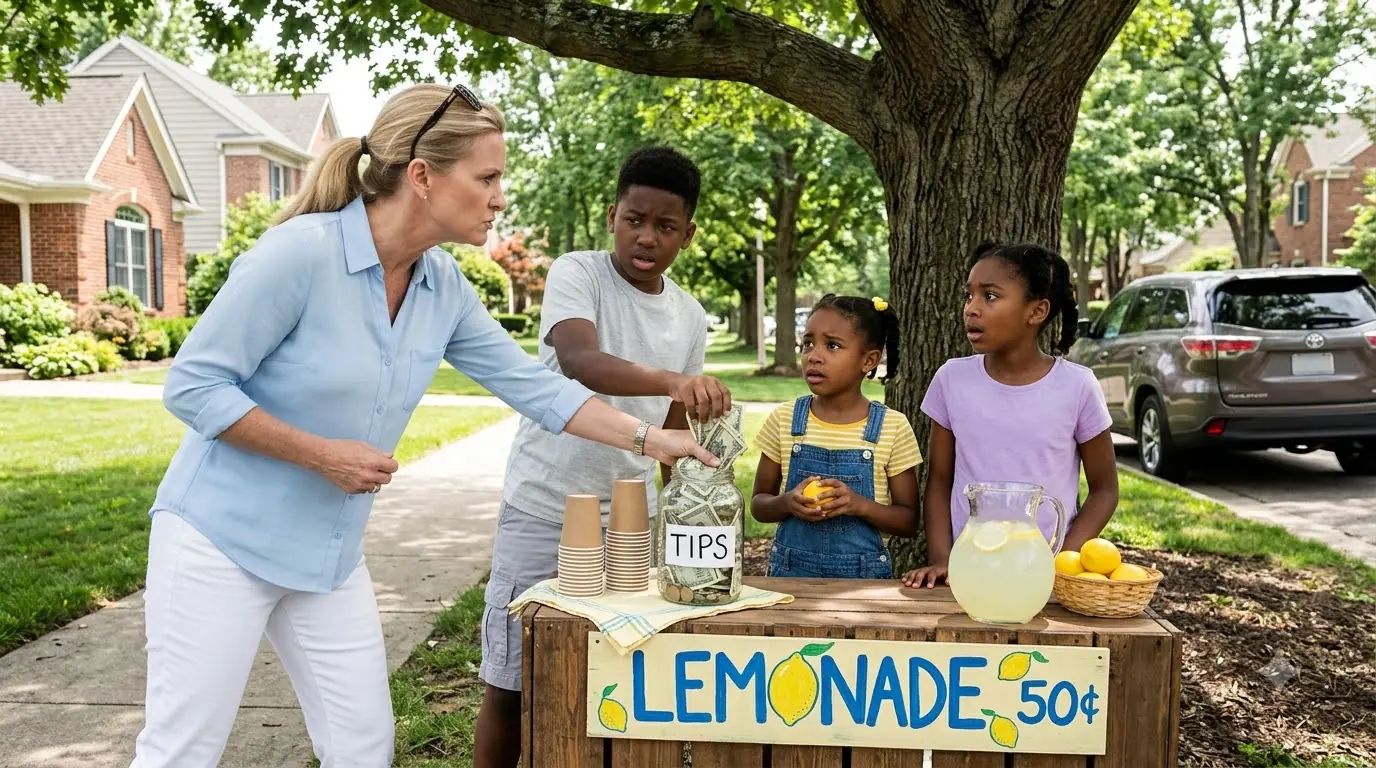
“You said that three minutes ago.”
“It melted.”
“It’s summer.”
“That’s why it needs more ice.”
Nia rolled her eyes and reached for the plastic cooler beside her feet.
Their cousin Aaliyah Brooks, ten years old, sat on a small lawn chair behind the table making final adjustments to the hand-painted sign they had spent most of Friday evening creating.
LEMONADE
$1.00
THANK YOU!
The letters were uneven.
The yellow paint around the word LEMONADE had smeared near the bottom.
Aaliyah loved it anyway.
She leaned back, held the sign at arm’s length, and said, “It looks professional.”
Malik glanced at it.
“The E is crooked.”
“That makes it handmade.”
“That makes it crooked.”
Nia dropped another handful of ice into the pitcher.
“You two argue too much.”
The three children were standing at the edge of the Carter family’s front yard in a quiet suburban neighborhood outside Raleigh, North Carolina.
Their table was positioned well inside the property line.
Behind them stood the Carter house, a pale-gray two-story home with a small porch, white trim, and a basketball hoop above the garage.
Across the street were similar houses with trimmed lawns, flower beds, and wide sidewalks running beneath mature trees.
It was the sort of neighborhood where people waved while walking dogs and knew which children belonged to which families.
Malik and Nia had lived there for six years.
Aaliyah lived two streets away.
The lemonade stand was not some sudden business idea.
It had a purpose.
Three months earlier, a severe storm had damaged part of the playground at Lincoln Elementary School.
The school's parent association had already raised most of what was needed to replace a damaged shade structure, but students had begun creating their own small fundraisers.
Malik had suggested lemonade.
Nia had suggested bracelets.
Aaliyah had pointed out that none of them knew how to make bracelets.
So lemonade won.
Their mother, Maya Carter, had helped them buy lemons, sugar, paper cups, and ice.
She had also explained something Malik found irritating.
“You’re probably not going to make much money.”
“We could,” Malik had replied.
“You could.”
“So why say we won’t?”
“Because the important part is doing it, not imagining you’re building a lemonade empire.”
Malik had thought about that.
“Can it become a small lemonade corporation?”
Maya had laughed.
“Start with Saturday.”
Now Saturday had arrived.
By eleven forty-five, they had sold seven cups.
Mrs. Jensen from across the street bought one and put five dollars into the jar.
Mr. Alvarez, who walked his dog every morning, bought two.
A delivery driver purchased one without even drinking it.
He handed Malik a dollar, accepted the cup, then left it unopened in his truck.
Nia watched him drive away.
“He didn’t drink it.”
Malik shrugged.
“He paid.”
“That’s weird.”
Aaliyah leaned closer.
“Maybe he doesn’t like lemonade.”
“Then why buy lemonade?”
“Because we’re raising money.”
Nia considered that.
“Oh.”
The clear glass jar beside the pitcher now contained fourteen dollars.
Every time someone paid, Malik carefully wrote the amount in a small notebook.
His mother had insisted.
“If you say the playground fund got fifty dollars,” she told him, “you should be able to show where fifty dollars came from.”
Malik had inherited his mother's obsession with receipts and numbers.
At twelve, he already kept his birthday money in envelopes labeled by purpose.
SAVE.
SPEND.
EMERGENCY.
His sister thought this was ridiculous.
Malik considered it responsible.
At eleven fifty-eight, a silver SUV slowed in front of the Carter house.
Nobody at the stand noticed.
The SUV continued another thirty yards and pulled into a driveway.
The driver was Karen Whitmore.
Karen was fifty-four, white, with carefully styled blonde hair, thin-framed sunglasses resting on top of her head, and the clipped posture of someone who rarely entered a room without deciding where everyone else should stand.
She wore a pale-blue button-up blouse tucked into white trousers with a narrow tan belt.
She carried a large black handbag on one shoulder.
Karen did not live directly beside the Carter family.
Her house was around the corner on Bedford Court.
But she walked Hawthorne Lane frequently.
She described herself as someone who “kept an eye on the neighborhood.”
Nobody had appointed her to do this.
Karen did not consider appointment necessary.
She had lived in the development for seventeen years.
She had served briefly on the neighborhood landscape committee.
She had organized two holiday decorating contests.
She knew the phone number for code enforcement.
She knew which day yard waste was collected.
She knew who had painted a mailbox the wrong shade of black four years earlier.
In Karen's mind, knowledge gradually became responsibility.
Responsibility gradually became authority.
And authority gradually became something she believed she possessed simply because nobody had formally stopped her from acting as though she did.
When Karen stepped out of her SUV, she noticed the lemonade table.
She stopped.
Three children stood behind it.
A pitcher.
Cups.
A sign.
Money jar.
Karen stared for several seconds.
Then she turned toward her house.
She took three steps.
Stopped again.
Looked back.
Her expression tightened.
She crossed the street.
Malik saw her first.
He recognized her.
Everyone did.
“Hi, Mrs. Whitmore,” he said.
Karen did not smile.
“What is this?”
Malik glanced at the sign.
“Lemonade.”
Karen looked at him as though he had intentionally misunderstood.
“I can see that. What are you doing?”
“We’re selling it for the school playground.”
Aaliyah raised the sign slightly.
Karen barely glanced at it.
“Who gave you permission?”
Malik frowned.
“My mom.”
“Your mother doesn't control neighborhood commerce.”
Nia looked at Malik.
Aaliyah lowered the sign.
Malik tried to remain polite.
“We’re on our lawn.”
Karen looked down at the table legs.
They were more than six feet inside the grass.
“That doesn't mean you can run a business.”
“It’s a lemonade stand.”
“A business is a business.”
Malik did not know how to answer that.
He had never thought of himself as a businessman until that moment.
Nia whispered, “Maybe ask if she wants a cup.”
Malik almost laughed.
Karen heard her.
“No, I do not want a cup.”
The children became quiet.
Across the street, a sprinkler clicked over a lawn.
Somewhere farther down Hawthorne Lane, a lawn mower started.
Karen stepped closer to the table.
“How much money have you taken?”
Malik's expression changed.
“Taken?”
“Collected.”
“Fourteen dollars.”
Karen looked toward the glass jar.
There were several dollar bills and one five-dollar bill inside.
“You need to shut this down.”
Malik shook his head.
“My mom said we could do it until two.”
Karen took out her phone.
“Your mother is wrong.”
Nia's face tightened.
Malik noticed.
He did not like adults speaking about his mother that way.
Still, he kept his voice steady.
“Can we call her?”
Karen looked at him.
“What?”
“She’s inside. We can call her.”
Karen's eyes moved toward the Carter house.
For the first time, something shifted in her confidence.
She had apparently assumed the children were alone.
But instead of accepting Malik's suggestion, Karen said, “I already know what the rules are.”
Malik pointed toward the front door.
“My mom is right there.”
“That doesn't change anything.”
Then Karen did something Malik would replay in his mind many times afterward.
She reached across the table.
At first, he thought she was taking a cup.
Her hand passed the stack of paper cups.
Passed the lemons.
Closed around the rim of the glass jar.
Malik instinctively grabbed the opposite side.
“Hey.”
Karen pulled.