Emily Carter hated the leg-extension machine.
Not because it was difficult.
Difficulty she understood.
She had spent most of her life believing discomfort could be solved by working harder, running farther, or refusing to admit something hurt.
The problem with the leg-extension machine was that it reminded her how little she could currently do.
Eight weeks earlier, Emily had been running a local half-marathon when her right foot landed badly near the final turn.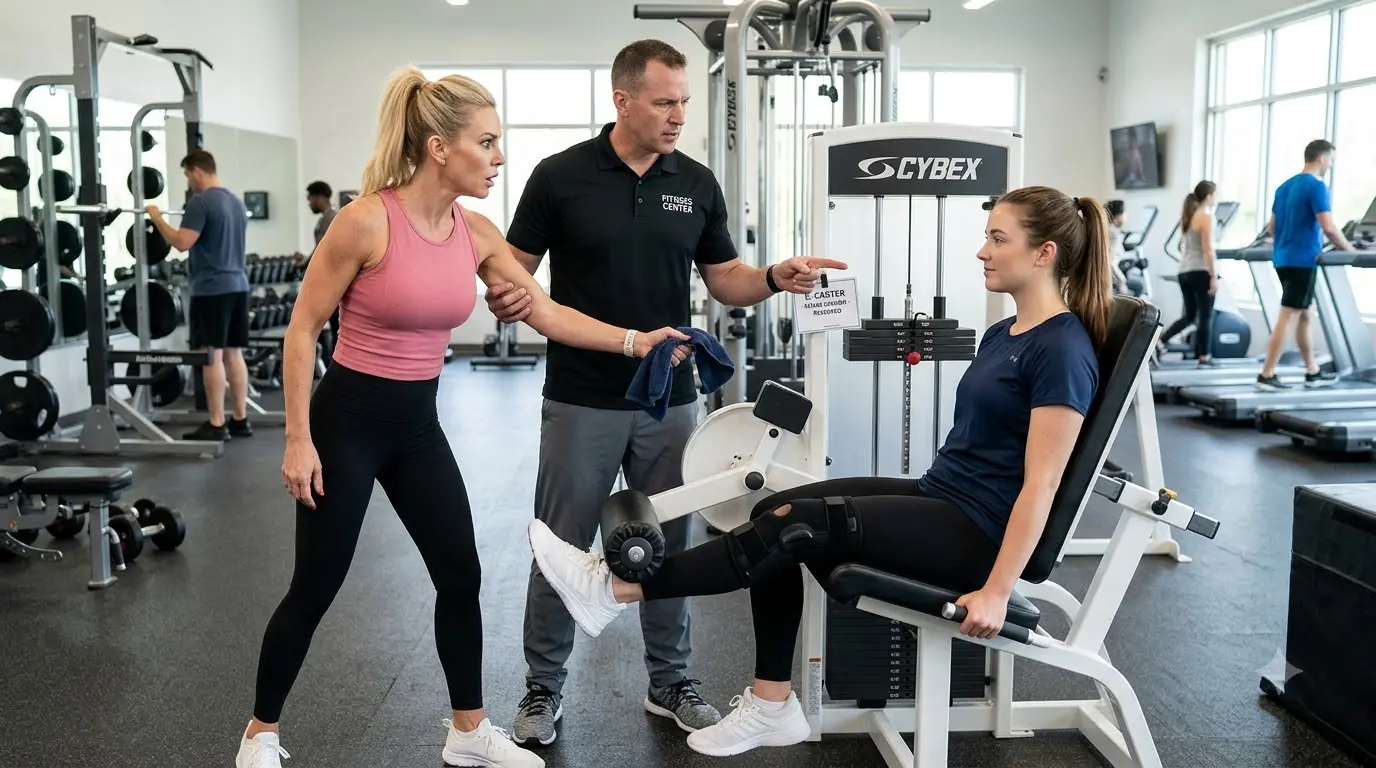
There was no dramatic collision.
No spectacular fall.
Her shoe caught the edge of uneven pavement, her knee twisted, and she heard a sound inside her body that she immediately knew was wrong.
She finished the fall sitting on the roadside with both hands around her knee.
The race continued around her.
For several seconds, she could not move.
An MRI two days later confirmed a torn anterior cruciate ligament and additional cartilage damage.
Surgery followed.
Then swelling.
Then crutches.
Then sleepless nights.
Then rehabilitation.
The surgeon had warned her recovery would test patience more than strength.
Emily did not understand that at first.
Now she did.
At twenty-two, she had been accustomed to trusting her body without thinking about it.
She ran.
Hiked.
Played recreational soccer.
Worked long shifts as a veterinary technician.
Carried heavy bags of dog food for elderly clients who could not lift them.
She had never appreciated the miracle of bending a knee until bending it became a scheduled exercise.
That Tuesday afternoon, Emily sat inside Desert Peak Fitness in Scottsdale, Arizona, staring at a tiny weight pin set lower than she would once have considered worth touching.
Ten pounds.
The rehabilitation plan taped to her clipboard instructed:
LEG EXTENSION — LOW RESISTANCE — CONTROLLED RANGE — 3 SETS OF 10
Emily tightened her grip on the machine handles.
Her right knee was wrapped in a black stabilizing brace.
The visible surgical scars had faded from angry red to pink.
Her physical therapist had cleared her to begin light independent sessions between appointments, but only under strict limits.
No explosive movement.
No heavy loading.
No deep squats.
No ego.
That last instruction had not been written down.
Her physical therapist, Maya Patel, had simply looked at her and said:
“Emily, I know athletes like you.”
“I’m not really an athlete.”
“You tried negotiating with me over whether jogging counts as running.”
Emily had smiled.
Maya had not.
“No ego.”
So Emily followed the program.
Slowly.
Painfully.
Faithfully.
Her right leg extended.
Paused.
Returned.
One.
Again.
Two.
At seven repetitions, the quadriceps began trembling.
Emily stopped.
Breathed.
Then continued.
Eight.
Nine.
Ten.
She lowered the padded bar carefully.
Rest.
According to the timer on her phone, she had been at the station for eleven minutes.
Her reserved rehabilitation slot was twenty minutes.
The gym had partnered with North Valley Sports Rehabilitation six months earlier.
Three machines near the back corner could be reserved for medically supervised recovery during limited daytime periods.
A small laminated card clipped to Emily’s machine read:
REHABILITATION RESERVATION — 2:00 PM TO 2:20 PM
Most members ignored it.
A few asked what happened to her knee.
One elderly man recovering from hip surgery had given her a thumbs-up earlier.
“Keep going.”
Emily had smiled.
“I’m trying.”
At 2:13 p.m., Vanessa Whitmore entered the training area.
Emily noticed her immediately.
Most people did.
Vanessa was forty-three, fit, blonde, immaculately dressed even for a workout.
Her high ponytail barely moved.
Pink fitted training top.
Black leggings.
White shoes that looked too clean for a gym floor.
Wireless earbuds.
Smartwatch.
Designer water bottle.
She walked with the confidence of a person who assumed every space should reorganize itself around her arrival.
Emily had seen her several times.
They had never spoken.
Vanessa trained almost every afternoon with a personal trainer named Cole.
That day Cole was absent.
Vanessa walked directly to the leg-extension machine beside Emily.
Occupied.
She looked toward another machine.
Occupied too.
Then at Emily.
Emily was resting between sets.
Vanessa waited perhaps five seconds.
Then removed one earbud.
“Are you using this?”
Emily glanced around.
She was sitting on it.
“Yes.”
“How many sets?”
“One left.”
Vanessa looked at Emily’s phone timer.
“You’ve been sitting there.”
“I’m resting between rehab sets.”
Vanessa looked down at the brace.
“Oh.”
Emily expected the conversation to end.
Instead Vanessa stayed.
Emily began her final set.
One repetition.
Two.
Vanessa shifted impatiently.
Three.
She exhaled loudly.
Four.
Emily tried ignoring her.
Five.
Vanessa stepped closer.
“Can you speed that up?”
Emily stopped.
“Sorry?”
“You’re barely using any weight.”
Emily looked at the ten-pound stack.
“I’m recovering from surgery.”
“I can see that.”
Vanessa gestured toward the machine.
“But people are waiting.”
Emily looked around.
Nobody else was waiting.
“You’re waiting.”
“Yes.”
Emily nodded.
“I have about five minutes left in my reservation.”
Vanessa laughed.
“Reservation?”
Emily pointed toward the laminated card.
Vanessa leaned down and read it.
Then straightened.
“That doesn’t mean you get to sit here doing nothing.”
Emily felt heat rise into her face.
She disliked confrontation.
Especially now.
Being injured had already made her feel strangely exposed.
The brace invited questions.
The slower movements invited looks.
She had spent weeks needing help carrying groceries and climbing stairs.
She did not want another stranger reminding her that she was taking up space without performing impressively enough.
“I’m following my physical therapist’s program.”
Vanessa rolled her eyes.
“Then go to physical therapy.”
“This gym partners with my clinic.”
“I pay almost two hundred dollars a month to use this equipment.”
Emily blinked.
“So do I.”
“Not the same membership.”
Emily did not know what that meant.
She tried returning to the exercise.
Six.
Vanessa reached down and snatched the small white towel Emily had placed over the machine handle.
Emily stopped.
“What are you doing?”
Vanessa tossed the towel onto a nearby bench.
“Making it clear you’re done.”
Emily stared at her.
“No, I’m not.”
“You’ve been on this machine forever.”
“Thirteen minutes.”
“I watched you sit for half of that.”
“Because I have to rest.”
Vanessa stepped closer.
“Then rest somewhere else.”
Emily’s pulse quickened.
Her right knee began trembling, partly from fatigue and partly from anger.
She slowly lowered the padded bar.
“I still have one set.”
“Do it later.”
“No.”
Vanessa looked surprised.
Emily was surprised too.
“No?”
“No.”
Vanessa folded her arms.
“I asked nicely.”
Emily looked at the towel on the bench.
“You threw my towel.”
“I moved it.”
“You told me to leave.”
“Because you’re wasting the machine.”
Emily swallowed.
“I’m recovering from ACL surgery.”
Vanessa shrugged.
“And?”
The word hit harder than Emily expected.
And?
For eight weeks, her entire life had revolved around that knee.
Surgery.
Pain.
Medication.
Lost work hours.
Rehabilitation bills.
Fear that she would never run the way she used to.
And to Vanessa, it was simply an inconvenience delaying her workout.
Emily took a breath.
“And my therapist reserved this machine.”
Vanessa looked toward the front desk.
“Fine.”
Emily thought perhaps she was leaving.
Instead Vanessa walked behind the seat and placed one hand on the adjustment lever.
Emily immediately grabbed the side handle.
“What are you doing?”
“I’m resetting it.”
“I’m still sitting here.”
“Then stand up.”
“No.”
Vanessa pulled the lever slightly.
The seat shifted.
Emily’s right foot slipped.
A sharp sting shot through her knee.
She gasped.
“Stop!”
Several people looked over.
A man doing cable rows removed one earbud.
Vanessa released the lever.
“You’re being dramatic.”
Emily stared at her.
“That hurt.”
“I barely touched anything.”
“My knee was under load!”
“Then maybe you shouldn’t be using gym equipment.”
Emily’s mouth opened.
Nothing came out.
A young woman on a treadmill slowed down.
An older man near the dumbbells turned.
Vanessa noticed the attention.
Instead of backing down, she seemed energized by it.
She pointed toward Emily.
“This is ridiculous. People come here to train, not occupy machines while checking their phones.”
“I’m timing my rest.”
“You’ve said that.”
“Because you keep accusing me of sitting around.”
Vanessa reached for the machine handle again.
Emily put her hand over it.
“Don’t touch it.”
“Move your hand.”
“No.”
“Get off.”
“No.”
Vanessa’s expression hardened.
“Do you know how long I’ve been a member here?”
Emily stared.
“No.”
“Seven years.”
“Okay.”
“I’m premium tier.”
Emily almost laughed from disbelief.
“What does that have to do with my knee?”
“It means I’m not going to stand here while somebody who barely exercises blocks equipment.”
That one hurt differently.
Before the injury, Emily had run thirty miles a week.
She knew that should not matter.
A beginner deserved equipment as much as an athlete.