The frost came early that year, sharp enough to whiten the grass by the tea garden wall before the sun had cleared the hedge. It settled on the iron chairs and the porcelain left out overnight. And it carried with it the smell of wood smoke from the kitchens three streets away, and wet stone, and the particular sweetness of orange pekoe steeping too long in a pot no one had come to drink.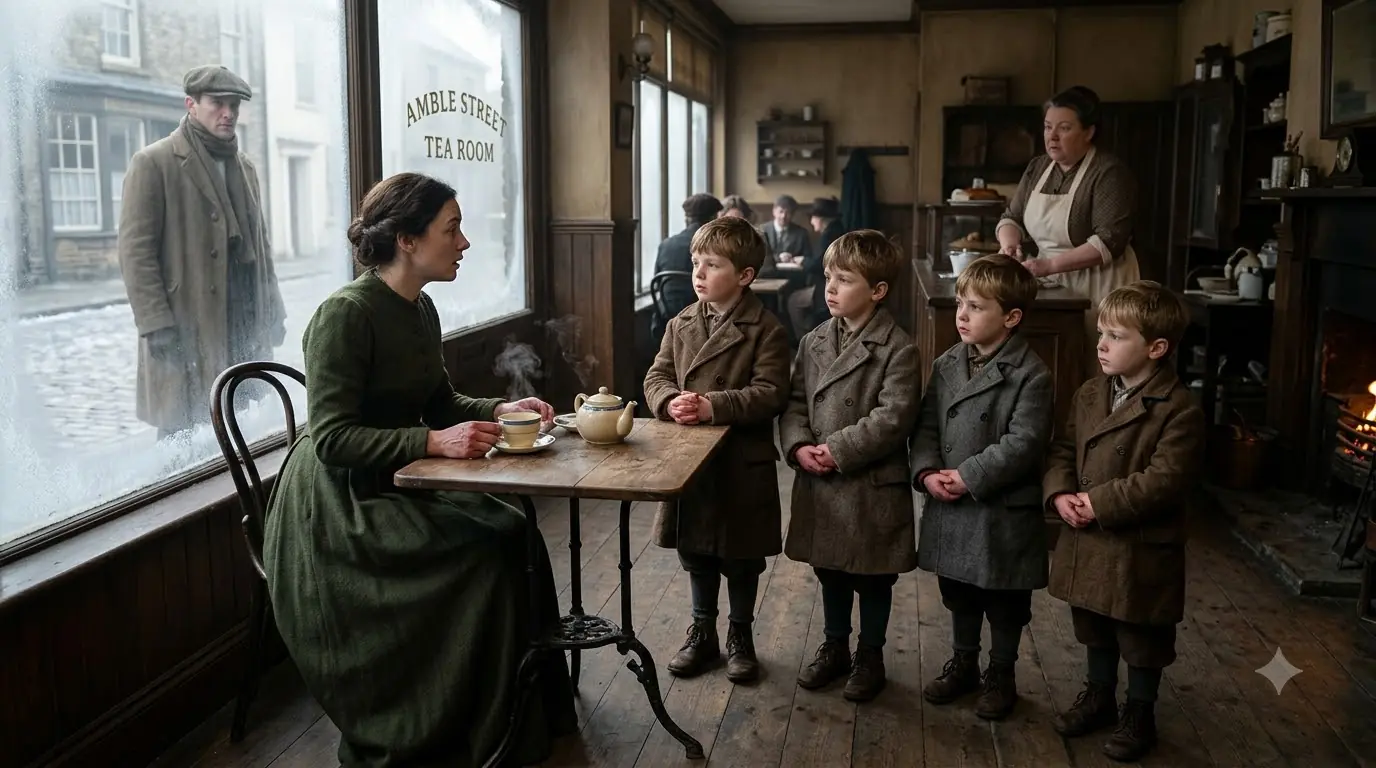
Eleanor Vance was the kind of woman an innkeeper forgot the moment her coin was counted: not pretty enough to be remembered, not poor enough to be pitied outright—though she was that, too. She was seven-and-twenty, and she had buried her father in the spring. And she took her tea alone at the corner table of the Amble Street Tea Room because it was the one hour of the day that belonged to no one else.
She mended linen for three houses on the square. Her hands were red at the knuckles from the work, and steady because she had trained them to be steady. She did not know that morning that four small boys were about to change everything she believed about being unseen.
The boys came in like a held breath let go all at once: four of them, identical down to the cowlick above the left ear, no taller than a hall table, dressed in good wool coats that had been buttoned by someone in a hurry. The eldest, by some accident of birth order, pushed the door. The others followed in a clump, the way ducklings follow water.
The tea room's proprietress, a stout woman named Mrs. Cole, came out from behind her counter with her hands already fluttering, already reaching for words like, "Who say you, and where is your—?"
But the boys did not answer her. They had found Eleanor's table.
They stood in a row before her: four small faces arranged in identical solemnity, and the tallest one spoke first in the flat, grave voice of a child reciting something rehearsed on the walk over:
"Pretend you're our mother."
Eleanor set her cup down. She did not laugh, though it was the kind of thing that invited laughing. She looked at the boy who had spoken, and then at his brothers, one by one, the way she might look at four lambs that had wandered through a fence.
"I am not your mother," she said.
"We know," the second boy said. "That is why we are asking you to pretend."
"Just for today," the third one said.
The fourth said nothing. He only watched her, the way children watch adults when they are deciding whether the adult can be trusted with something important.
Mrs. Cole was still fluttering, saying she would fetch someone, she would send for the constable; these children did not belong to anyone in the square, and did the miss know them, and ought she to call for the coachman waiting outside?
Eleanor did not answer her, either. She was looking at the boys' hands: cold, all eight of them, red at the fingertips the way her own were red, though for a different reason, and none of them wearing gloves.
"Where is your governess?" Eleanor said.
"Cross," the eldest said. This seemed to be a name or a description or both.
"And your father?"
At this, the row of small faces went very still—the particular stillness of children who have learned that a question has an answer too large for them to hand over whole.
"Away," the eldest said finally. "He is always away."
"And today," the third one added, "is the day mothers come. At the school gate. All the other boys have one. We do not have one to bring."
It was such a plain thing to say that it took Eleanor a moment to feel the whole weight of it land. Not a want for affection, not exactly—a want for the ordinary machinery of belonging that every other child got without asking: a woman standing at a gate, someone whose presence proved something.
She did not tell them this was foolish. She did not tell them to run along and find whoever had lost them. She looked at the tea going cold in her cup, and at the four boys shivering in their good coats, and she made a decision the way she made most decisions: without any fuss at all.
"Sit down," she said. "You are letting in the frost."
They sat, all four crowded onto the bench meant for two, shoulder to shoulder. And Mrs. Cole brought a second pot without being asked, and Eleanor poured milk into four cups before she poured any tea into them at all, because she remembered from some corner of her own childhood that scalded tongues were the true tragedy of any nursery.
She did not know then that the man standing just beyond the fogged window glass, in a coat too plain for who he was, had been looking for these four boys for the better part of an hour with a fear he would not have named aloud to any living soul.
She did not know that he had stopped in the doorway of the tea room, one hand still on the frame, and gone entirely still at the sight of a stranger pouring milk before tea for children who were not hers—asking nothing, expecting nothing, already halfway to mending what the morning had broken.
She did not know that this was the single truest thing he had seen anyone do in a year, and that he intended to find out exactly who she was.