The lobby of the Grand View was built to impress. Marble floors, gold trim, staff trained to smile at the right people and look through everyone else.
On a Tuesday evening in October, a man named Caleb Ward stood at the front entrance with his 6-year-old daughter at his side and a stranger in a wheelchair beside him.
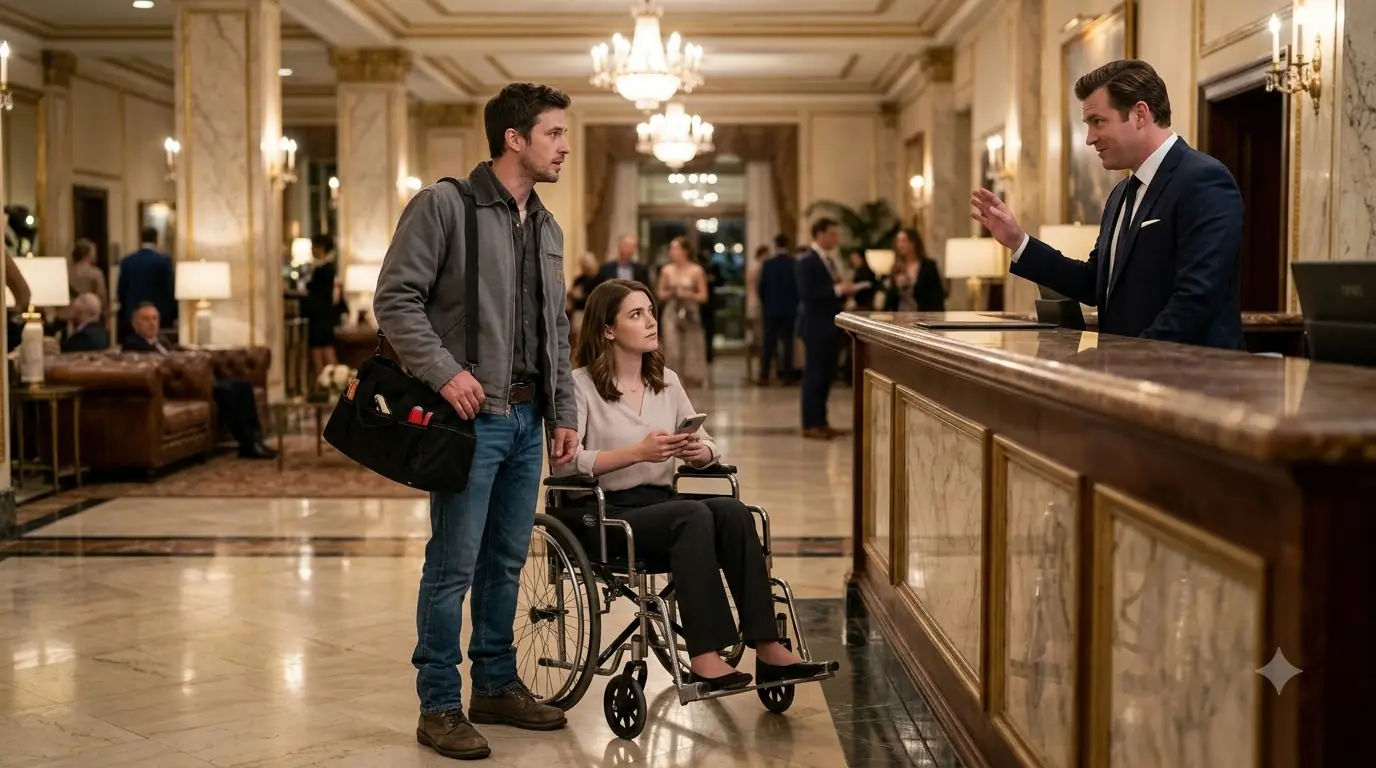
The receptionist had just told that stranger there were no suitable rooms available.
The shift manager had made it worse. The crowd had started to stare. Nobody in that building knew that the woman in the wheelchair owned every square foot of it.
Caleb Ward was 27 years old and looked younger than that in the right light, older than that in the wrong kind. He had the kind of face that didn't broadcast much, a straight jaw, tired eyes that moved too quickly for someone who appeared to be doing nothing, hands that always found something useful to do when the rest of him went still. He wore a gray jacket over a work shirt, jeans that had been cleaned that morning, and a pair of boots that had seen every kind of floor a hotel could produce. He carried a black canvas tools bag over one shoulder. Nothing remarkable about it. Nothing that suggested anything in particular about the man who carried it.
He had not planned to be at the Grand View that evening. He had come to retrieve the bag, which he had left behind the week before following a consultation on the East Wing's ventilation system. Freelance work, the kind he had been taking since leaving his last full-time position 14 months earlier. The consultation had paid enough to cover 2 weeks of groceries and Sophie's art supplies. That was the math his life ran on now, small numbers, specific purposes, nothing wasted.
Before the freelance work, before the apartment that was exactly the right size for two people who had decided which things mattered and which did not, Caleb Ward had been a systems engineer for the same hotel group that managed four properties in the city. He had been good at it, genuinely good. The kind of good that gets noticed and then resented by the people who notice it. The position had ended badly, the way positions in large organizations sometimes do. Internal politics, a disagreement over deferred maintenance that management had not wanted documented in writing, and a decision to let the person who had done the documenting find somewhere else to document things.
He had not fought it. He had taken Sophie, packed the things that mattered, and left. That was 14 months ago. He did not miss the salary. He missed the systems, the satisfaction of a building that ran correctly, the specific pleasure of finding a fault and fixing it before it became something worse. That part he had kept.
Sophie Ward was 6 years old and shaped like a question mark when she was nervous, shoulders drawn in, chin tucked, eyes tracking everything above her as though the world were a ceiling she wasn't entirely sure would hold. She had her father's dark hair and her late mother's way of gripping things too tightly when she felt uncertain. That evening she was gripping Caleb's hand with both of hers, her small fingers laced through his, her weight pressed against his leg as though she were trying to reduce her own outline. She had asked to come along because she didn't like being left with the neighbor, and Caleb had said yes because he almost always said yes to her when he could.
It was supposed to be a 10-minute errand. In, retrieve the bag, out. That was the plan. Sophie had brought a small notebook and a pencil in case she got bored, which she had tucked into the front pocket of her jacket. She had not needed them yet. The lobby of the Grand View had provided sufficient material.
Charlotte Bennett was 26 years old and almost no one in that building had ever seen her face. She had acquired the Grand View Hotel 18 months earlier through a holding company with a name that meant nothing to anyone who wasn't paying careful attention to the right documents in the right places. The acquisition had been clean, precise, and entirely invisible to the staff and management of the property she now owned. She had spent those 18 months watching from a distance, reviewing quarterly reports, reading staff complaint logs, monitoring the gap between the service her brand promised and the service her brand actually delivered. The gap had been widening.
She had seen it in the numbers first, then in the details behind the numbers, the complaint categories that kept recurring. The maintenance deferrals that had been authorized and then forgotten, the pattern of reviews that described a hotel whose surfaces were impeccable and whose substance had been quietly hollowing out for years. She had been considering her next move for 3 months. That evening, she had decided to stop considering.
She arrived in a hired car, dressed plainly: dark slacks, a simple blouse, no jewelry that announced anything. She sat in a manual wheelchair, the practical kind that said nothing about wealth, and she had asked her driver to drop her at the main entrance rather than the side access lane marked with the blue symbol near the service delivery bay. She wanted to see what happened at the front door. She wanted to see what the Grand View looked like from the outside of its own assumptions.
She had a reservation. She had made it herself. Under her own name. Through the public booking system 2 days earlier.
Room 412. Accessible accommodation confirmed. She had the confirmation on her phone and had not planned to need it. She had been wrong about that.
What she encountered at the front desk was a young man named Marcus who looked at her reservation, looked at her, and then looked at his screen for a long time before informing her there had been a system error. The accessible room had been reassigned. There were no other suitable options available at this time. He delivered this with the smooth efficiency of someone who had produced similar news before and found it entirely unremarkable, a small inconvenience resolved by simply redirecting the problem elsewhere.
Dylan Carter appeared before Charlotte had finished processing what she had been told. Dylan was the shift manager, 35, broad-shouldered, with a voice he kept calibrated just below commanding, as though restraint itself were a form of authority. He inserted himself between Marcus and Charlotte with the practiced ease of someone accustomed to managing inconvenient situations before they became visible ones. He suggested, with careful courtesy, that the hotel's standard accommodations were not designed to meet every guest's specific requirements.
He suggested there were other properties nearby that might be better suited. He said the word suited the way people say designed for when they mean lower. He smiled throughout, which was somehow the worst part of it.
Charlotte said nothing. She watched him. She had a way of watching people that didn't reveal itself as watching. Her eyes stayed still. Her expression didn't shift, and the quality of her attention was invisible to anyone who wasn't specifically looking for it. She had developed this over years of being underestimated and had found it consistently useful.
The lobby was busy. A Tuesday evening in October, conference season, three events running simultaneously in the east and west ballrooms. Guests moved through in clusters, business travelers, couples, a large group wearing matching lanyards from some corporate gathering that had taken over the mezzanine level since mid-afternoon. Nobody was paying particular attention to the front desk until the temperature around it changed.
A child's voice cut through the ambient noise with the clarity that only a child's voice can manage in a quiet moment. "Daddy," Sophie said, pulling at Caleb's hand. "Why won't they let her in?"
Caleb had been watching from 10 feet away, tools bag already in hand, already calculating the distance to the exit. He had registered the exchange the moment Dylan Carter appeared. The shape of it was familiar, and he had understood what it was in roughly 4 seconds. He had stood still for another 30, talking himself out of involvement.
He was not supposed to be here. He had a daughter at his side and a freelance income that depended on not acquiring enemies in the buildings where he worked. He had learned what happened when maintenance contractors offered opinions in hotel lobbies. It never resolved cleanly. It always cost something.
"Give me just a second," he told Sophie. He crossed the distance to the desk without hurrying. "Excuse me," Caleb said, not loudly, just clearly.
Dylan turned. The look he gave Caleb lasted about 2 seconds and accomplished a complete assessment. The jacket, the boots, the child, the unremarkable entirety of the man in front of him.
"Sir, we're currently assisting a guest."
"You're not assisting anyone," Caleb said. "You're turning someone away. There's a difference."
The particular silence that followed a sentence like that, the silence of people recalibrating what they thought was about to happen, settled briefly over the desk. Marcus had gone very still. Charlotte's eyes moved slowly to the man who had just spoken.
Dylan reset his posture. His voice dropped into the register of someone who had decided this conversation would conclude on his terms. "I don't believe you understand the full situation," he said. "This is a private matter between a hotel and its guest. And I'd ask you not to insert yourself."
"She has a confirmed reservation," Caleb said. "Accessible room. You just told her there isn't one. That's not a private matter, that's a violation of the Americans with Disabilities Act. Do you want me to be specific about which sections?"
Dylan stared at him. "Who are you?"
"Nobody relevant," Caleb said. "What's relevant is that you publicly denied accommodation to a disabled guest who had a valid reservation. That's the part that matters here."
Charlotte had not moved, but the quality of her attention had shifted. It was now directed at Caleb the way it had been directed at Dylan, except that with Caleb it had acquired something different, something more considered. Sophie appeared at Caleb's side, both hands finding his again, pressing her weight against his leg. She looked up at Dylan Carter the way children look at things that confuse them by being wrong with a directness that carried no judgement but required no softening either.
Dylan lowered his voice in a way meant to feel like accommodation. "Sir, this hotel serves a specific clientele with specific expectations. Our accessible accommodations have real physical limitations and it isn't always possible to meet every guest's particular requirements. If you and this woman have concerns, the appropriate channels are available through the hotel's guest relations team. Not the front desk."
"The appropriate channel," Caleb said, "is the front desk you're currently standing at. That's what the appropriate channel looks like before it becomes a formal complaint and then a lawsuit."