A single dad janitor was asked to play piano as a joke. But what he played made even the CEO tear up.
"Careful with that cloth," Jack said softly, his voice barely above a whisper. "This one has history in its bones."
He wasn't speaking to anyone in particular, just to himself, and maybe to the Steinway grand piano under his hands, which gleamed like black glass beneath the warm lights of Lexington Hall.
Jack Hollis — janitor, 39, single dad, war veteran, and invisible man in a suit-and-tie world — moved like a shadow through the hushed grandeur of the hall.
The gala was still hours away, but already the air buzzed with invisible electricity. Staff bustled in quiet corners, clinking glasses, adjusting table linens. The floral team was arranging absurdly expensive white orchids. A violinist tested acoustics.
And in the center of it all stood Jack, gently buffing the curved edge of the Steinway with a worn microfiber cloth as if he were handling something sacred.
He paused — not because he was finished, but because he wasn't ready to move on.
His palm rested lightly on the wood, his eyes far away.
"You're talking to furniture again, Jack?" came a small voice behind him.
He turned and smiled.
Lena, his 8-year-old daughter, peeked in through the side curtain, cradling her sketchbook to her chest like it held state secrets. Blonde hair in a loose braid, oversized hoodie, and sneakers with worn soles.
She wasn't supposed to be here, technically, but Jack had made an exception. She'd been quiet all day. And when Lena went too quiet, Jack paid attention.
"Furniture?" he said. "That's not furniture. That's a cathedral with 88 steps to heaven."
Lena giggled softly and sat cross-legged just beyond the light. Her pencil scratched across the page.
Jack returned to his work. With one hand, he polished the last corner of the piano. With the other, he traced a memory.
He'd once sat at a piano like this — before life turned into bills, overtime, and emergency room visits. Before Lena's mother slipped away on a hospital bed. Before grief became background noise.
"Mr. Hollis."
A sharp voice snapped from across the stage.
Jack looked up.
A woman in a dark blazer, clipboard in hand, stood near the entrance, frowning.
"Could you please be quick with that? Miss Kingsley will be arriving soon, and everything needs to look immaculate."
Jack nodded without speaking. He never did in moments like these. He understood his place.
But as he bent down to gather his cleaning supplies, another voice sliced through the air — this one laced with theatrical disdain.
"My God, he's caressing it like it's his long-lost lover."
The voice belonged to a tall man descending from the VIP balcony. Late 50s, silver hair, Italian shoes — the kind of man who wore smugness like cologne.
Langston Gray, music critic for the Times and patronizing connoisseur of “real talent.”
A few staff nearby chuckled nervously.
Jack didn't look up. He gathered his cloths and brushes slowly, methodically, folding them with too much care.
Langston continued, undeterred.
"It's always adorable when the help gets romantic with the decor. What's next? Vacuuming the carpet with tears in his eyes?"
More laughter — louder this time.
Jack said nothing.
But Lena had stopped drawing.
Her eyes flicked to her father. She knew that look — his jaw just slightly clenched, the quiet stillness that meant a storm was gathering inside.
He picked up his bucket and turned to walk off stage.
"Wait," Langston called out, grinning. "Tell me something, janitor. Do you even know what this is? This instrument you're so reverent with?"
Jack finally turned.
He looked at Langston — not angry, not offended — just calm, steady.
"Yes," he said. "It's a Steinway Model D, nine feet long, 12,000 moving parts. The soundboard is made from Sitka spruce, grown slow and high for resonance. The rims are made of 17 layers of hard rock maple. The keys — originally ivory — now composite. It costs more than your Mercedes and holds more stories than your column ever will."
Silence fell like a dropped curtain.
Langston blinked.
Jack didn't wait for a reply. He turned and walked toward the wings.
Lena stood quietly, wide-eyed.
He knelt beside her.
"You okay?" he asked.
She nodded.
Jack reached into his shirt pocket and pulled out a tiny music note charm. He placed it in her palm.
"What's this for?" she whispered.
"For remembering," he said. "That music isn't always played out loud."
She clutched it tight.
Just then, the grand double doors opened.
A wave of voices flooded in. Lights were adjusted. Ushers scurried.
The evening's star guests arrived — donors, celebrities — and above all, Celia Kingsley.
She entered the hall not like a performer, but like someone used to owning rooms just by walking into them.
Tailored black jumpsuit, sharp eyes, controlled poise — a woman who had built empires, dissolved boardrooms, and been called both genius and tyrant in the same breath.
She scanned the stage, eyes landing briefly on the piano… then the lingering haze of silence.
"Everything ready?" she asked her assistant.
"Yes, Miss Kingsley. Final polish just completed."
She approached the Steinway, running her fingers over the wood.
Then, with a glance toward the wings, she caught sight of Jack.
Their eyes met — just for a second.
She said nothing.
But her gaze lingered one breath too long before turning away.
Jack stood still, Lena beside him.
The gala was about to begin.
And no one — not even the woman who owned the stage — knew that the most unforgettable performance of the night wouldn't come from the program.
It would come from the shadows.
From calloused fingers.
From a father with music buried under layers of dust… waiting to rise again.
“How long do you need to make people forget you're human?”
Celia Kingsley asked the question in her mind as she looked around Lexington Hall from the wings. The answer she'd learned was approximately seven seconds. Just enough time to step into a spotlight, smile like you mean it, and pretend the silence in your own chest was elegance, not emptiness.
The orchestra tuned softly beneath the murmur of guests arriving. Strings, breath, woodwinds, all aligned to serve the illusion that this night was about harmony, beauty, order. Not business. Not control.
But for Celia, everything was business. Even music.
She adjusted the diamond clasp on her cuff and nodded at the event manager.
“Tell the quartet to begin on my signal,” she said. “And make sure the Langston piece is displayed on every donor's seat. I want them reading his praise before the appetizers.”
The assistant scurried away.
Celia turned back toward the piano, the Steinway that was center stage, literally and metaphorically.
It was flawless now, polished to a mirror finish. Not a single fingerprint on the lid. She could see her own reflection in the curve of the wood.
She hated mirrors.
Voices rose behind her, guests finding their seats, laughing, clinking glasses.
Somewhere in the movement, she noticed the janitor again, the one from earlier.
He wasn't looking at her. He was helping a young girl find her seat off to the side. His daughter, probably.
He bent down and brushed her shoulder with a gentleness that didn't match his rough hands.
Celia hesitated.
Something about the way he stood, shoulders slightly hunched like he was used to shrinking into the background, but still carried a quiet kind of strength, stuck in her mind longer than it should have.
“Miss Kingsley.”
Langston Gray appeared beside her, sipping a drink, eyes sharp behind thick designer frames.
“Lovely turnout tonight. Impeccable, as always.”
She nodded.
“And your review, strategically early as always?”
“Well, some of us still understand how timing works in the arts,” he said, “and how to separate polish from passion. Unlike our overly sentimental janitor earlier.”
Celia's gaze flicked toward Langston's drink, then back to his smug face.
“You know, Langston,” she said smoothly, “sometimes the people closest to the floor hear what no one else does.”
He blinked. “I'm sorry?”
“Nothing.” She smiled tightly. “Just a passing thought.”
He chuckled, missing the edge entirely.
Backstage, Jack was tucking Lena's coat onto the storage shelf, carefully smoothing out the wrinkles.
“You sure you want to stay through the whole concert?” he asked, voice soft.
Lena nodded. “I want to hear the piano when it's not just us.”
Jack tilted his head. “It's never just us when we play, kiddo.”
She looked up. “What do you mean?”
He paused.
“It's like this,” he said, searching for the words. “When you play music, real music, it remembers people, places, things you lost, things you hoped for. It's never just fingers on keys. It's everything you've ever felt trying to climb out.”
Lena didn't answer, but she reached into her sketchbook and tore out the page she'd been drawing.
It was the Steinway. And him.
Jack took it, his throat tightening. The details were stunning. The way the stage lights hit the piano. The curve of his shoulder leaning toward the keys.
“You see more than most people,” he said.
“You hear more than most people,” she whispered.
As the gala progressed, the MC took the stage. The lights dimmed. The air shifted.
Celia stood just behind the curtains, listening to the speech being delivered in her name.
“And of course, none of this would be possible without the vision and generosity of Miss Celia Kingsley, whose dedication to music education has brought us all together tonight.”
Applause.
Celia stepped forward.
Spotlight. Smile. Breathe.
“Thank you,” she began, voice even and clear. “This hall has always been a place for extraordinary sound. But tonight, we are not just celebrating the notes we hear. We are celebrating the people who make them possible.”
She paused, eyes scanning the crowd.
“Talent,” she continued, “doesn't always come with pedigree. It doesn't announce itself in the right clothes or the right accent or the right address. Sometimes, it hides, waiting for a moment to be seen.”
Her eyes landed, just for a heartbeat, on Jack sitting in the shadows.
Then she moved on.
“Tonight's proceeds will go toward providing instruments and instruction to public schools across the state. Because brilliance belongs everywhere, not just here.”
Thunderous applause. Standing ovation.
But Jack, he didn't stand. He just sat there, a quiet statue in the glow of a moment not meant for him.
Backstage after the second performance, Jack stood near the corridor exit, waiting for Lena. She had gone to the restroom with a volunteer.
Langston passed him again, clearly two drinks deeper than before.
“You know,” he slurred slightly, “you've got a lot of nerve putting on that poetic act earlier.”
Jack didn't respond.
Langston leaned in.
“You think touching a piano gives you insight? That it gives you worth?”
Jack turned slowly, calm, unshaken.
“No,” he said. “I think being able to walk past one without ever hearing it, that's what takes something away from you.”
Langston blinked.
For the first time, he didn't have a comeback.
Jack walked away.
Back in the audience, Celia sat down beside the Steinway during intermission, alone.
Her fingers hovered over the keys, not pressing, just remembering.
Long ago, before mergers and IPOs, she'd played Bach in competitions. Her mother had cut every rose bush in the garden the day she lost a state final.
She never touched a piano again after that.
Until now.
She pressed one note. C-sharp. Pure and ringing.
She closed her eyes.
Outside, Lena returned to find Jack waiting. She slipped her small hand into his calloused one.
“Are you sad?” she asked.
Jack shook his head.
“No, sweet pea. I'm just remembering how loud silence can be.”
The scent of fresh varnish and lilies hung thick in the air as the hall began to fill with velvet and perfume.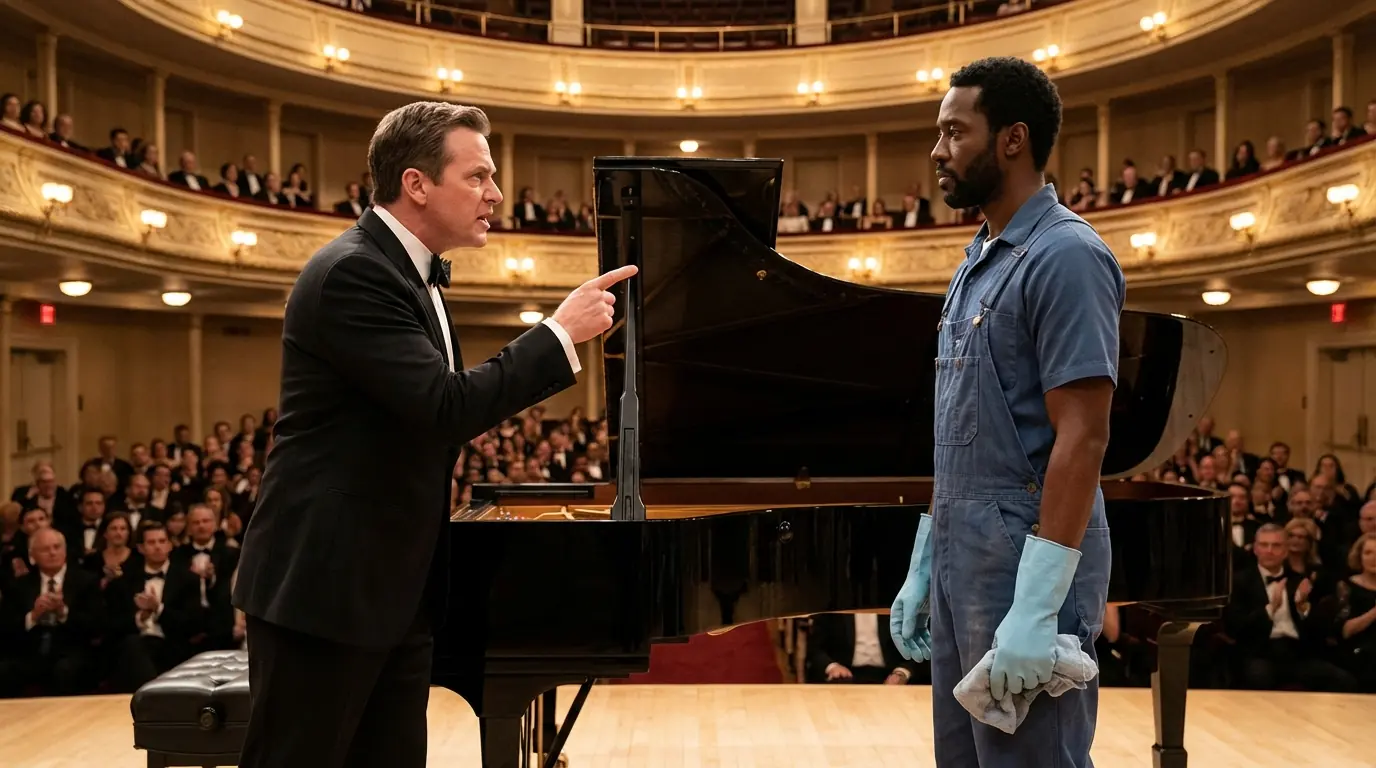
High heels clicked across marble, laughter rang beneath chandeliers, and the chandeliers themselves shimmered like they had been waiting all year for this one perfect night.
Jack stood at the edge of the stage, a small cloth folded neatly in his hand.
The gala hadn't started yet, but the VIPs were drifting in early, those who loved being seen more than seeing.
Celia was mingling with donors near the back, her posture poised, her smile effortless.
He turned back to the Steinway.
It was already clean. He knew that.
But he didn't touch the piano out of necessity. He touched it like someone visiting a gravestone. Tender, familiar, sacred.
His thumb moved along the wood grain, and for a moment he forgot the lights, the crowd, the ridiculous tuxedo someone had hung over a spotlight as a joke.
He remembered his wife's voice.
“You always play like the keys owe you an apology,” she used to tease.
He had loved that.
And then, just as his fingertips paused over middle C, a loud voice pierced the quiet of the stage.
“Well, well, if it isn't Beethoven with a mop.”
There was laughter, scattered, unsure.
Jack straightened, cloth still in hand.
Langston Gray stood near the orchestra pit, holding a champagne flute like it was a scepter.
He had his jacket slung over one shoulder and a knowing smirk on his lips.
Jack didn't move.
“Tell me,” Langston said, taking a step closer, his voice now loud enough to draw more attention. “Do you prefer Brahms when you buff the pedals, or is Chopin your go-to when scrubbing stains?”
More laughter now, fuller, some polite, some mean.
Jack's eyes flicked toward Lena, seated near the back of the hall. She was watching him, small hands wrapped tightly around her sketchbook.
He looked back at the piano, then at Langston.
“I'm just doing my job,” Jack said quietly.
Langston scoffed.
“Oh, come now. That's not what I saw earlier. You were looking at it like it whispered secrets. Or maybe you thought it had whisper of yours.”
A few people chuckled. A few didn't.
Celia, standing off to the side with a glass of red in hand, turned slightly, her expression unreadable.
Jack breathed in. He could feel something swell in his chest. Anger. Shame. Memory. It was hard to tell them apart anymore.
He took a step forward, his boots echoing gently against the polished stage floor.
Then he spoke, not loud, but with weight.
“You ever see a soldier pick up a rifle he hasn't touched in years?” he asked.
Langston frowned, caught off guard.
“First thing he does,” Jack continued, voice steady, “he checks it, wipes it down. He doesn't load it, doesn't fire it, just holds it, because sometimes what you used to carry still carries something in you.”
The hall went silent.
Jack gently placed the cloth into the bucket, stood tall, and turned to leave the stage.
But Langston, not done yet, called out with a mocking cheer.
“Maybe you should play something tonight, janitor. I mean, if the piano means that much, give us a little tune. Twinkle, Twinkle, perhaps.”
A few snorts. Nervous giggles.
Jack paused midstep, and in that pause, something sharp shifted in the air.
Celia moved.
She didn't say a word, just stepped forward and placed her wine glass down on the edge of the stage.
A few people turned toward her instinctively.
She met Jack's eyes, calm, focused.
She didn't look amused or embarrassed or superior.
She looked thoughtful.
Jack gave a small nod, more to himself than anyone else, and walked off the stage with quiet dignity.
In the corridor backstage, Lena approached him, clutching her sketch pad.
“Why do people laugh when something's not funny?” she asked, her voice almost a whisper.
Jack knelt down to her level.
“Because,” he said, “sometimes they're afraid of what they don't understand. And sometimes they're afraid of remembering what they gave up.”
She stared at him.
“Did you give it up?”
Jack hesitated.
“I didn't have a choice,” he said. “But maybe I didn't fight hard enough to keep it.”
He ruffled her hair gently.
“I'm okay,” he added, more for her than for himself.
Lena didn't reply. She just leaned her forehead against his chest and stayed there a moment longer than usual.
Back in the hall, Langston retook his seat, still chuckling quietly.
Celia stood near the edge of the aisle, arms crossed, her gaze resting once more on the Steinway.
She remembered her own mother's voice.
Winning isn't about playing better. It's about playing so they don't question your worth.
And yet, there was something about the janitor.
His words weren't just clever. They were true.
There was an ache behind them that she recognized in her own mirror.
She walked up to the piano. Slowly.
She let her fingers drift over the keys, not playing, just feeling the texture, the temperature, the quiet hum beneath the wood.
She pressed a soft note, F.
It rang clean and bright.
And for the first time in years, Celia Kingsley felt like the instrument was listening back.
Jack stood in the service hallway, hands pressed against the cool tiles as if the building itself might steady him.
Outside, applause rolled through the grand hall like thunder across a valley. The second performance had ended. Laughter returned. Champagne flowed.
The air was filled with celebration.
But inside him, only silence.
Not the comforting kind. The kind that presses in on your ribs and whispers, “You don't belong here.”
He should leave.
Just grab Lena, clock out early, and disappear the way ghosts are supposed to.
He'd done it a hundred times in other rooms, other lives.
Being invisible was a survival skill.
Maybe even a talent.
“Dad.”
Lena's voice was soft, but it carried.
He turned.
She stood at the end of the hallway, small and still, holding his old leather-bound notebook — the one he used to jot musical ideas in. Now worn from years of disuse.
He hadn't seen her take it.
Hadn't even realized she knew where he kept it.
“I found this in your locker,” she said. “I thought maybe you forgot what was in it.”
Jack walked slowly toward her, gently taking the notebook in his hands.
The cover was cracked. The edges curled.
But when he opened it, the music stared back at him.
Bars of melody. Half-finished phrases.
One page marked: Lena’s Theme — unfinished.
He blinked hard.
“Where did you learn to be this brave?” he asked.
Lena shrugged.
“From you. Except when you forget you are.”
He knelt down beside her.
“I don't want you to see me like this,” he said. “I don't want you to remember tonight for the wrong reasons.”
She tilted her head.
“I won't remember what they said. I'll remember that you stood there proud, like you knew something they didn't.”
Her words hit him harder than Langston's ever could.
And then she added, almost shyly:
“You still love the piano, don't you?”
He didn't answer right away.
He looked down at the notebook in his hand.
Then back at her.
“I love it,” he said finally. “The way some people love someone they lost. Quietly. From across the street. Never getting too close.”
Lena thought about that.
Then, with more courage than her years should allow, she said:
“Maybe it's time to cross the street.”
Back in the hall, Celia sipped from a fresh glass of wine, watching as Langston recounted his “piano comedy” to a circle of eager socialites.
She wasn't listening.
Her mind kept drifting back to the janitor's eyes.
Not humiliated.
Not wounded.
Just… anchored.
Like a tree refusing to bend, no matter how strong the wind.
She admired that.
Even envied it.
She stepped away from the crowd and walked to the edge of the stage.
The lights above were soft now, set for ambiance between sets.
A technician adjusted cables nearby.
She looked again at the piano.
And this time, she sat.
Only for a moment.
She lifted the fallboard, laid her fingers gently on the keys, and played a single chord.
A minor.
It rang through the empty stage like a secret told to no one.
“Didn't expect to see you try that,” a voice said behind her.
Celia turned.
Jack stood just offstage, arms crossed, Lena beside him.
Celia smiled faintly.
“Still fits like an old coat, doesn't it?”
Jack stepped forward.
“Funny thing about coats,” he said. “You forget how warm they are until someone hands them back.”
They stood there, in a moment that balanced between small talk and something deeper.
“You didn't have to step in earlier,” he said, his voice low. “But you did.”
Celia glanced at Lena, then back to him.
“She was watching,” she said. “And so was I.”
Jack nodded.
“Then let me ask you something.”
She raised an eyebrow.
“Why does someone like you…” He gestured to the room, the gowns, the acclaim. “…still sit alone at a piano?”
Her expression didn't change, but her eyes softened.
“Because applause is loud,” she said. “But it never drowns out regret.”
Jack swallowed hard.
“I used to think music was something I left behind,” he said. “Turns out it's just been waiting in the quiet.”
They stood silently, the piano between them.
Then Lena broke it.
“Dad,” she said, tugging his sleeve. “Do you think you could show me the piece you used to play for mom? The one you said was too sad for now.”
Jack looked at her.
Then at Celia.
“Maybe,” he murmured. “It's sad because I never played it all the way through.”
Celia stood up slowly.
She gestured toward the bench.
“Then finish it,” she said, voice gentle but firm. “You don't owe anyone a show. Just finish it… for her.”
She nodded toward Lena.
Jack hesitated.
Then he moved.
He took a breath.
Lowered himself onto the bench.
Adjusted the seat like instinct.
And let his fingers hover over the keys.
For a moment — nothing.
Then—
Music.
Not flawless.
Not rehearsed.
But honest.
A lullaby wrapped in pain and hope.
Full of pauses that spoke louder than the notes themselves.
Celia watched, something old and aching unfolding in her chest.
Lena sat cross-legged nearby, still, eyes wide.
And when Jack lifted his hands off the final chord, the note hung in the air like a held breath that finally, gently exhaled.
The final note hadn’t fully faded when the sound of applause broke through the stillness.
Not polite.
Not scattered.
Real.
Celia turned sharply.
A small group of guests had gathered at the edge of the stage, drawn in by something they couldn’t quite explain. Conversations had stopped. Glasses were left half-raised.
And in the center of it all stood Langston Gray.
But this time, he wasn’t laughing.
His expression was tight. Calculating.
“What exactly is this?” he said, stepping forward slowly, his voice cutting through the moment. “An unscheduled performance?”
Jack rose from the bench, instinctively placing himself slightly in front of Lena.
“No,” he said calmly. “Just a moment.”
Langston let out a short, humorless laugh.
“A moment?” He glanced around at the watching guests. “This is a curated event, not an open mic night. There’s a program. Standards. Expectations.”
Celia stepped beside Jack.
“And who defines those?” she asked, her tone cool but steady.
Langston didn’t hesitate.
“I do,” he said. “Or have you forgotten who shapes the narrative in this room?”
A murmur rippled through the crowd.
Celia’s jaw tightened slightly, but she didn’t look away.
“No,” she said quietly. “I remember exactly who you are.”
The tension thickened.
Langston’s gaze shifted back to Jack.
“Let’s not pretend,” he continued, voice rising just enough to reclaim attention. “This is charming, sure. A janitor with a hidden talent. Very… cinematic. But talent without discipline, without training, without pedigree—”
“Without permission?” Jack interrupted.
The interruption landed like a dropped glass.
Langston’s eyes narrowed.
“Be careful,” he said. “You’re confusing sentiment with substance.”
Jack didn’t move.
“No,” he replied. “I’m just not confusing status with truth.”
A few people in the crowd exchanged glances.
Something was shifting.
Langston scoffed, turning slightly toward the audience as if reclaiming control of the stage.
“Fine,” he said. “Let’s talk about truth.”
He gestured toward the piano.
“If you’re so certain, then play. Properly. Not some emotional fragment backstage. A full piece. Right here. Right now.”
Silence.
Even the air seemed to hold still.
Lena’s hand tightened around Jack’s sleeve.
“Dad…” she whispered.
Jack looked down at her.
Then back at the piano.
Then at Celia.
Celia didn’t speak.
But she didn’t look away either.
For the first time that night, she wasn’t managing the room.
She was waiting.
Waiting for him.
Jack exhaled slowly.
“I didn’t come here to prove anything,” he said.
Langston smiled thinly.
“Of course not,” he replied. “Because you can’t.”
That did it.
Not the insult.
Not the crowd.
But the certainty in Langston’s voice.
The quiet dismissal.
Jack turned.
Walked back to the bench.
Sat.
The movement alone sent a ripple through the room.
Some guests leaned forward.
Others whispered.
Phones subtly appeared.
Celia stepped back, giving him space.
And for once, she said nothing at all.
Jack placed his hands on the keys.
Closed his eyes.
For a moment, nothing happened.
Then—
He began.
Not softly this time.
Not cautiously.
But with presence.
The first notes landed firm and clear, cutting through the room like a statement that didn’t ask for approval.
It wasn’t a piece anyone in the program recognized.
No famous concerto.
No expected structure.
It was something else.
Something lived-in.
The melody rose and fell like memory itself—uneven, unpredictable, but deeply human.
There were imperfections.
Slight hesitations.
But they didn’t weaken the music.
They made it real.
Celia felt it immediately.
Not in her ears.
In her chest.
Across the room, the whispers died.
Langston stood still, his expression slowly shifting from amusement… to something far less certain.
Jack’s hands moved with increasing confidence, the music unfolding like a story he had kept locked away for years.
A story of loss.
Of love.
Of everything that had been silenced… finally finding its voice.
And then—
Halfway through—
He stopped.
The abrupt silence hit harder than any note.
A few gasps.
Confusion.
Langston let out a sharp breath, seizing the moment.
“There it is,” he said, spreading his hands. “Emotion without endurance. Exactly my point—”
Jack opened his eyes.
And spoke.
“I wrote this,” he said simply.
The room stilled again.
“I never finished it,” he continued. “Because the last part… was supposed to be hers.”
He didn’t have to explain who.
Everyone felt it.
He looked down at the keys.
Then back at Lena.
She stared at him, eyes wide.
“Do you want to hear the ending?” he asked.
She nodded.
Jack turned back to the piano.
And this time—
He didn’t hesitate.
The final movement came not from memory… but from the moment itself.
Gentler.
Brighter.
Still carrying the weight of everything before it, but no longer trapped in it.
It wasn’t just an ending.
It was a release.
When the last note faded, no one moved.
No applause.
Not yet.
Just silence.
The kind that doesn’t come from emptiness—
But from understanding.
Celia was the first to breathe.
Then—
She began to clap.
Slow.
Deliberate.
One pair of hands in a room that suddenly remembered what it meant to listen.
Others followed.
Not all.
But enough.
Langston didn’t clap.
He stood rigid, jaw tight, eyes locked on Jack as if trying to reframe what had just happened into something he could still control.
But for the first time that night—
He couldn’t.
And he knew it.
The applause didn’t explode.
It grew.
Slow at first, uncertain—like people testing whether they were allowed to feel what they had just felt.
Then stronger.
Warmer.
Real.
Celia didn’t stop clapping.
Neither did Lena.
And one by one, others followed—not because it was expected, but because something inside them had shifted.
Jack stood from the bench, not triumphant, not proud.
Just… still.
As if he had finally set something down he’d been carrying for years.
Across the room, Langston remained motionless.
No smile.
No commentary.
Just silence.
But this time, it wasn’t power.
It was absence.
Celia stepped forward.
“Thank you,” she said, not to the audience—but to Jack.
The room quieted again.
She turned slightly, addressing everyone now.
“I spent years believing that excellence needed structure, approval, refinement,” she said. “And tonight reminded me of something I chose to forget.”
She glanced at the piano.
“Music doesn’t ask for permission.”
A few heads nodded.
Others looked down, thoughtful.
Langston finally moved.
A slow step forward.
“Very touching,” he said, voice controlled, but thinner than before. “But let’s not confuse a moment with a standard.”
Celia turned to him fully now.
“No,” she said. “Let’s not confuse control with truth.”
That landed.
Harder than anything Jack had said.
Langston’s eyes flickered, searching for ground that wasn’t there anymore.
“You built your reputation on defining what matters,” Celia continued. “But tonight, you didn’t recognize it when it was right in front of you.”
The crowd wasn’t laughing now.
They were watching.
Langston let out a quiet breath.
Then, without another word—
He stepped back.
For the first time that night,
he chose silence.
And it wasn’t his.
Celia turned to the stage manager.
“Change the program,” she said.
The woman blinked. “I’m sorry?”
Celia’s voice didn’t waver.
“Add one final performance.”
A pause.
Then—
“Mr. Jack Carter.”
A ripple went through the room.
Jack looked up, caught off guard.
“I didn’t—” he started.
“You don’t have to prove anything,” Celia said gently. “You already did.”
She stepped closer.
“This isn’t about them,” she added, nodding slightly toward the crowd. “It’s about not walking away again.”
Lena looked up at him, her eyes shining.
“Cross the street,” she whispered.
Jack exhaled.
A long, steady breath.
Then—
He nodded.
The lights shifted.
Not brighter.
Softer.
More honest.
Jack returned to the piano, this time not as a shadow in the room—
But as part of it.
He sat.
Looked once at Lena.
Then played.
This time, the music wasn’t about proving.
It wasn’t about the past.
It wasn’t even about loss.
It was about presence.
Each note landed with quiet certainty, filling the hall not with noise—
But with meaning.
And when it ended—
There was no hesitation.
The applause came immediately.
Full.
Unfiltered.
Not for a performance.
But for a truth finally heard.
Later, as the crowd slowly thinned and the night softened into something quieter, Jack stood outside the hall with Lena beside him.
The air was cool.
Still.
Different from before.
“You okay?” he asked.
Lena nodded.
“Are you?”
Jack looked back at the building.
At the lights.
At the stage he almost walked away from.
Then down at his hands.
“No,” he said.
A small smile formed.
“I think I’m better than okay.”
Celia stepped out behind them.
No audience now.
No spotlight.
Just a woman and a choice.
“I meant what I said,” she told Jack. “There’s a place for you here.”
Jack shook his head gently.
“I don’t know if I belong in rooms like that.”
Celia smiled faintly.
“Maybe not,” she said.
Then added—
“But maybe rooms like that need to change.”
Jack considered that.
Then looked at Lena.
She squeezed his hand.
He turned back to Celia.
“Maybe,” he said.
A quiet pause.
Then Lena spoke.
“Will you play again tomorrow?”
Jack looked down at her.
Then back at the hall.
Then somewhere further than both.
“Yeah,” he said softly.
“I think I will.”
The lights behind them dimmed one by one.
The music was over.
But something else had just begun.