Sierra Blake had always been invisible in Timber Creek, Oregon, and that was exactly how she needed it to be.
The small mountain town sat nestled between towering pine forests and the rushing waters of the Cascade River, where everyone knew everyone's morning coffee order, except hers.
For eight years, she'd worked the early shift at the Blue Moon Diner, serving pancakes and small-town gossip with hands that moved with a precision nobody else seemed to notice.
But every dawn, before the first customer pushed through the diner's creaky door, locals heard something strange from the wooded area behind Sierra's modest cabin: the sound of someone moving through darkness with military precision, practicing routines that had nothing to do with taking breakfast orders.
Sierra was 34, but carried herself with the controlled awareness of someone much older and infinitely more dangerous.
Her auburn hair was always pulled back in a simple ponytail, and her steel-gray eyes held a watchfulness that made even the town's toughest loggers think twice before getting too rowdy in her section.
She wore the same uniform every day: black jeans, comfortable sneakers, and a Blue Moon Diner T-shirt that concealed the network of scars across her shoulders and arms, marks that told stories no waitress should know.
The people of Timber Creek had their theories, of course. Betty Nakamura, the diner's 60-year-old owner, suspected Sierra was running from an abusive relationship.
Frank Deloqua, the local sheriff and a regular at booth 3, thought she might be in witness protection.
The younger crowd whispered that she'd been in the military, pointing to the way she automatically scanned every entrance when someone new walked in, and how she never sat with her back to a door.
But Sierra answered only what needed answering, maintaining an invisible barrier that said, “This far and no further.” She was polite, but not friendly; helpful, but not personal; and skilled at deflecting questions with a smile that never quite reached her eyes.
What they didn't know was what sat hidden in the reinforced basement beneath her cabin, concealed by false walls and electromagnetic shielding. Inside that space, which didn't appear on any building permits or satellite images, was an arsenal that would make a Navy SEAL team jealous: weapons, communications equipment, survival gear, and a go-bag packed for immediate extraction.
Sierra had spent years acquiring everything through channels no civilian should know about, maintaining readiness for a day she prayed would never come.
Every piece of equipment was meticulously maintained, every battery charged, every weapon cleaned and ready.
On the wall hung a tactical vest with one word stitched inside the collar: Mirage. It was a name she hadn't heard spoken aloud in eight years, a ghost of a life that officially never existed.
Every Sunday evening, when the diner closed and the town settled into its weekend quiet, Sierra would descend into that hidden basement and run through combat drills in the darkness.
Her hands would move across weapons with the familiarity of old friends, and for just a moment, the careful mask she wore would slip.
In those moments, she wasn't Sierra Blake, the quiet waitress who knew everyone's coffee preferences.
She was someone else entirely, someone who had been trained to kill without hesitation and disappear without a trace.
The town's morning rhythm was as predictable as clockwork. At 5:30 a.m., Sierra would unlock the Blue Moon Diner's front door, flip on the neon sign, and start the coffee brewing. By 6:00 a.m., Frank DeLaqua would lumber in for his usual black coffee, wheat toast, and two eggs over easy. At 6:15, the logging crews would arrive, loud and hungry, filling the air with talk of timber quotas and weekend plans.
Sierra moved through these interactions like water, present but untouchable, efficient but emotionally distant.
She remembered every order, anticipated every need, and deflected every attempt at personal conversation with practiced ease.
The locals had learned to appreciate her competence without expecting intimacy.
Betty Nakamura often watched Sierra work with a mixture of admiration and concern. The woman was the best employee she'd ever had: never late, never sick, never distracted.
But there was something almost mechanical about her perfection.
Sometimes Betty caught glimpses of something deeper, the way Sierra's hand would instinctively move toward her hip when someone entered unexpectedly, or how she could calculate exact change for a complex order without looking at the register.
“You've got good instincts,” Betty had said once, watching Sierra diffuse a situation between two drunk loggers without raising her voice or calling for help.
“Experience,” Sierra had replied simply, already moving on to the next table.
Frank Deloqua had his own observations. In his 23 years as sheriff, he'd developed a sense for people who were more than they appeared. Sierra Blake registered on his radar like a low-frequency warning signal. Not dangerous exactly, but definitely not what she seemed. Her situational awareness was too sharp, her physical conditioning too precise for someone whose most strenuous daily activity was carrying coffee pots. He'd run her identification through every database he could access. Sierra Blake existed on paper—social security number, birth certificate, employment history—but it all felt somehow manufactured, too clean and linear for a real person's messy life. When he'd asked her once about her family, she'd simply said, “It's complicated,” and changed the subject so smoothly that he didn't realize what had happened until later.
The truth was that Sierra Blake had been carefully constructed eight years ago by people who specialized in creating new identities for those who needed to disappear completely. The woman who served coffee at the Blue Moon Diner was a masterpiece of bureaucratic fiction, designed to be unremarkable enough to avoid attention while providing enough documentation to satisfy casual scrutiny. But underneath that fabricated identity lay someone far more dangerous: a former Navy SEAL who had been part of the most classified operations in U.S. military history. Mirage had been her call sign, earned through an uncanny ability to appear and disappear at will, to become whoever the mission required her to be.
On this particular Tuesday morning, as storm clouds gathered over the Cascade Mountains, Sierra felt a familiar tension in the air. Not just weather, but something else, the kind of atmospheric pressure that preceded significant change. She learned to trust these instincts during her years in special operations, where the difference between paranoia and survival was often measured in milliseconds.
As she refilled Frank's coffee cup for the third time, Sierra's trained senses picked up something unusual: the sound of vehicles approaching from the mountain road, not local trucks or logging equipment. These had a different engine signature, heavier, more precise, with the distinctive rhythm of military convoy spacing. Through the diner's front window, she watched three black SUVs navigate the winding road into town, moving with the kind of coordination that made her blood run cold. No license plates visible from this distance, but the formations and timing screamed federal operation.
Sierra's hand tightened almost imperceptibly on the coffee pot as the vehicles slowed near the town center. After eight years of perfect invisibility, something had found her. And in her experience, when the past came looking for you in a small mountain town, it usually meant someone was about to die.
Behind the diner's counter, hidden beneath the cash register, was a panic button connected to systems that would wipe her basement clean and trigger extraction protocols she'd hoped never to use. Her fingers itched to press it, but years of training held her back. First, she needed to know what they wanted and how much they knew.
The storm was moving closer now, thunder rumbling through the mountains like distant artillery. And for the first time in eight years, Sierra Blake felt the past reaching through the shadows to reclaim her.
As the black SUVs disappeared around a bend in the road, heading deeper into town, Sierra realized her carefully constructed life in Timber Creek was about to be tested in ways she'd spent nearly a decade trying to avoid. The question was whether Sierra Blake would survive what was coming, or if Mirage would have to wake up and take control once again.
The rest of Tuesday morning passed with the deliberate normality that Sierra had perfected over eight years of hiding in plain sight. She served the logging crews their usual hearty breakfasts, refilled coffee cups with clockwork precision, and exchanged pleasantries about the approaching storm. But beneath the surface, every nerve was alert, every sense attuned to potential threats.
Betty Nakamura emerged from the kitchen at 9:30, wiping flour from her hands on a well-worn apron. “You're jumpy today,” she observed, watching Sierra's eyes flick toward the window for the dozen time in an hour. “Something wrong?”
“Just keeping an eye on the weather,” Sierra replied smoothly, setting down a plate of bacon and eggs in front of old Tom Morrison, who'd been coming to the Blue Moon every Tuesday for the past 15 years. “That storm looks like it's going to be a big one.”
Betty followed her gaze to the darkening sky. “Could be. Radio says we might get some flash flooding in the lower valleys.” She paused, studying Sierra's face. “You sure that's all it is? You've been moving different today, more alert.”
Sierra's training kicked in automatically. Deflect, redirect, maintain cover. “You know how it is when the pressure drops. Makes everyone a little edgy.” She managed a convincing smile. “Besides, Frank's been telling stories about his fishing trip again. Enough to make anyone nervous.”
From booth three, Sheriff Delaqua looked up from his newspaper with mock indignation. “Hey, now, that was a legitimate 12-pound bass, and you know it.”
“Sure it was, Frank,” she called back, grateful for the distraction. “Just like last month's 20-pound salmon that somehow got smaller every time you told the story.”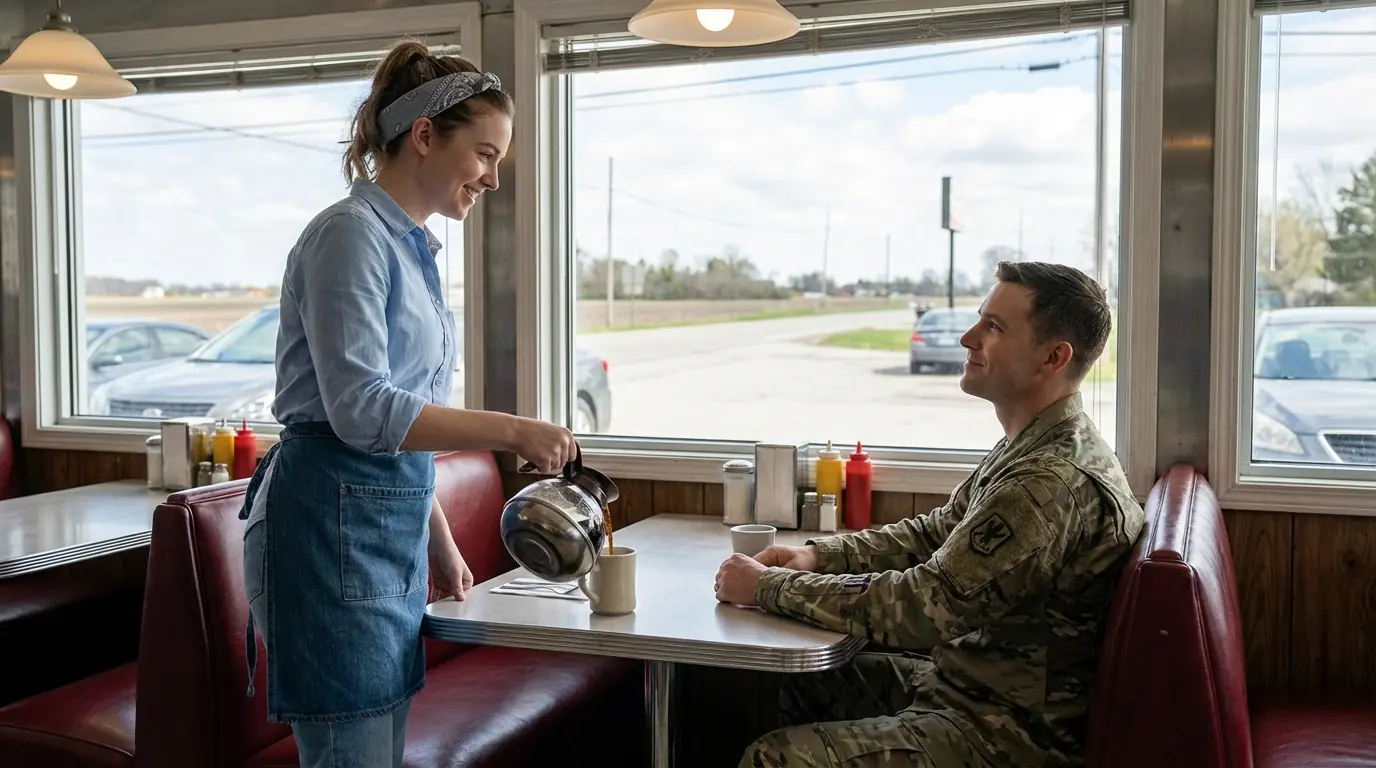
The familiar banter felt surreal given the tension coiling in her chest, but it was necessary. These people were her cover, her camouflage in a world where being unremarkable meant staying alive. They'd unknowingly protected her for eight years simply by accepting her as part of their daily routine.
At 10:15, the morning rush began to thin out. The logging crews headed to the forests. Frank returned to his patrol rounds, and the diner settled into the quieter rhythm of mid-morning. Sierra used the lull to perform what appeared to be routine cleaning, but was actually a systematic security sweep. She wiped down tables while checking sight lines and exit routes. She restocked the coffee station while noting which vehicles remained in the parking lot and which belonged to people still inside. She swept the floor while listening for unusual engine sounds or radio chatter from the direction the black SUVs had traveled.
Everything appeared normal, but Sierra's instincts screamed otherwise. In her experience, the most dangerous moments were often the quietest ones, the calm before operators moved into position.
“Sierra, honey, you want to take your break?” Betty called from behind the counter. “I can handle things for a few minutes.”
“Thanks, but I'm good,” although part of her wanted to disappear into the woods behind the diner and activate every escape protocol she'd spent years preparing. Instead, she forced herself to maintain the routine. Breaking pattern now would only draw attention.
At 10:15, her first real test arrived in the form of two strangers who entered the diner with the kind of casual alertness that screamed law enforcement. They were good, dressed like traveling salesmen, moving with the relaxed confidence of people who belonged. But Sierra's trained eye caught the telltale signs: the slight bulge of concealed weapons, the way they automatically chose seats with clear views of all entrances, the microsecond pause as they scanned the room upon entry.
“Morning, gentlemen,” Sierra said, approaching their table with coffee pot in hand. “What can I get you?”
“Coffee would be great,” the taller one said, his accent carrying hints of Virginia. “We're passing through, wondering if you might recommend some local sites.”
Sierra poured their coffee with steady hands while her mind raced. The question was innocuous enough, but the timing was suspicious. “Depends what you're interested in. We've got some nice hiking trails up in the mountains, though with this storm coming in, you might want to stick closer to town.”
“Actually,” the shorter man said, “we heard there might be some interesting history around here. Stories about people who've made this place home after traveling extensively.”
The phrase was carefully chosen, designed to probe without being specific. Sierra recognized the technique: intelligence gathering disguised as casual conversation. They were fishing, testing to see if she'd react to coded language.
“Well, Timber Creek's got its share of folks who came here looking for a quieter life. Mountains have a way of attracting people who prefer privacy. More coffee?”
She refilled their cups while memorizing every detail: the way the tall one kept his right hand free and positioned near his waist, the small earpiece barely visible in the shorter man's left ear, the fact that neither had actually touched their coffee despite claiming to want it.
“That's interesting,” the tall one pressed gently. “We're particularly interested in stories about people with specialized backgrounds, military perhaps.”
Sierra's blood chilled, but her expression never wavered. “You might want to talk to Frank Delaqua, our sheriff. He was Army back in the day. Loves sharing war stories with anyone who will listen.”
“Frank Delaqua,” the shorter man repeated, as if filing the name away. “Anyone else? Maybe someone who served more recently.”
The directness of the question confirmed Sierra's suspicions. These weren't random travelers. They were advance scouts gathering intelligence before a larger operation moved in. The black SUVs had been reconnaissance. These men were the follow-up.
“Well, we appreciate the coffee and the conversation,” the tall one said, leaving a $20 bill on the table, far too much for two cups of coffee, and clearly intended to ensure they'd be remembered positively.
As they left, Sierra watched through the window as they walked to a sedan parked across the street. The vehicle had been positioned for optimal surveillance of the diner's front entrance. They sat inside for several minutes making phone calls and taking notes before driving slowly out of town on the same mountain road the SUVs had used.
Betty appeared at Sierra's shoulder. “Strange fellas. Didn't drink their coffee.”
“Probably just nervous about the storm,” Sierra said, but her mind was already racing through contingency plans. The scouts would report back. A decision would be made. And soon, possibly within hours, her carefully constructed world would come crashing down.
She spent the next hour serving lunch to locals while internally cataloging everything she'd need to survive what was coming. Her go-bag was ready, her escape routes memorized, and her weapons cache fully stocked. But leaving meant abandoning eight years of painstaking identity construction and putting everyone in Timber Creek at potential risk. More importantly, running meant never knowing why they'd found her or what they wanted. In Sierra's experience, unknown threats had a way of becoming persistent problems. Sometimes the only solution was to face them head-on.
As the afternoon wore on and storm clouds continued gathering over the mountains, Sierra Blake made a decision that would change everything. She wasn't going to run. Not yet. Instead, she was going to wait and see exactly what kind of hell was heading her way. Because after eight years of being invisible, Mirage was curious to know who'd been clever enough to find her.
Wednesday morning arrived with the kind of stillness that preceded violent storms. Sierra unlocked the Blue Moon Diner at 5:30 a.m. as usual, but every movement was calculated, every gesture deliberate. She'd spent the night in her basement, running through contingency scenarios and checking equipment she hadn't touched in years. The familiar weight of a concealed Glock 19 now rested against her ribs, hidden beneath her uniform shirt.
The morning routine played out with deceptive normality. Frank Delaqua arrived at 6 sharp, settling into booth 3 with his usual grunt of acknowledgement. The logging crews filtered in throughout the early hour, their conversations focused on weather concerns and work schedules. Betty emerged from the kitchen with fresh pies, chattering about her granddaughter's upcoming graduation. But Sierra's attention was divided between serving coffee and monitoring the mountain road through the diner's front windows. She'd positioned herself to maintain clear sight lines while appearing to focus on her work. Every vehicle that passed received her scrutiny. Every unfamiliar face got cataloged and assessed.
At 7:45 a.m., her patience was rewarded. Three black SUVs crested the hill leading into town, moving with the same precise formation as the previous day. But this time, they didn't drive past. They turned into Timber Creek's small downtown area, navigating the narrow streets with purpose that made Sierra's pulse quicken.
“Expecting company?” Frank asked, following her gaze to the approaching vehicles.
“Not that I know of,” Sierra replied, refilling his coffee cup with hands that remained perfectly steady despite the adrenaline flooding her system. “Probably just more tourists getting an early start before the storm hits.”
But Frank's law enforcement instincts were already engaged. “Tourists don't usually travel in convoy formation,” he observed quietly. “And those vehicles have government plates.”
Sierra's blood went cold. If Frank could read the plates from this distance, the operation had moved beyond covert reconnaissance into open approach. Whatever they wanted, they'd decided stealth was no longer necessary.
The lead SUV pulled into the Blue Moon's parking lot, followed by the other two vehicles, positioning themselves to block potential exit routes. Sierra counted at least eight figures moving with military precision as they disembarked. Too many for a simple arrest, not enough for an assault. This was a controlled approach designed to minimize resistance while maintaining overwhelming tactical advantage.
The diner's bell chimed as the first man entered, and Sierra felt eight years of careful camouflage evaporate in an instant.
He was tall, broad-shouldered, with the kind of alert posture that screamed special operations. His civilian clothes were expensive but practical, chosen to blend in while allowing for immediate action. Most tellingly, his eyes swept the room with the systematic thoroughness of someone trained to identify and neutralize threats.
Behind him came two more men with similar bearing, followed by a fourth figure that made Sierra's breath catch in her throat.
Lieutenant Commander Ryan Garrett moved with the fluid confidence she remembered from another life, his presence filling the small diner like a gravitational force. His dark hair was shorter now, his face marked by years of command responsibility, but she'd have recognized him anywhere.
“Morning,” Garrett said to the room in general, his voice carrying the kind of calm authority that made people instinctively pay attention. “Beautiful little place you have here.”
The logging crew sensed the shift in atmosphere immediately. Conversations died. Coffee cups paused halfway to lips. And the easy camaraderie of small-town morning routine evaporated under the weight of focused attention. Even Betty emerged from the kitchen, drawn by the sudden tension. Frank's hand moved instinctively toward his service weapon, cop instincts recognizing a situation rapidly moving beyond normal parameters.
“Help you gentlemen with something?”
“Just looking for some coffee and conversation,” Garrett replied smoothly, his eyes finding Sierra across the room. “Heard this place serves the best breakfast in the county.”
Sierra felt the moment of recognition hit him like an electric shock. His expression didn't change, years of training ensured that, but she caught the slight dilation of his pupils, the micro-pause in his breathing. Ryan Garrett had found what he'd come looking for.
“Well, you heard right,” Betty said, bustling forward with the kind of aggressive hospitality that masked her own nervousness. “Sierra, get these gentlemen seated and bring them some coffee.”
The use of her assumed name and Garrett's presence felt like a gunshot in the confined space. Sierra watched him process the information, connecting the dots between the woman he had once known and the small-town waitress standing before him.
“Sierra,” he repeated softly, as if testing the weight of the name. “That's a beautiful name. Very distinctive.”
She approached their table with the coffee pot, every step measured and controlled. Up close, she could see the barely concealed shock in Garrett's eyes, the way his team positioned themselves to cut off her escape routes without appearing threatening to the civilians.
“What can I get you, gentlemen?” she asked, her voice carrying the same cheerful professionalism she'd perfected over eight years of hiding.
Garrett studied her face for a long moment before answering. “Actually, we're not here for breakfast. We're here because we need to talk to someone about a matter of national security.”
The words hit the diner like a bomb blast. Frank's chair scraped as he stood, his hand now openly resting on his weapon. The logging crews began shifting nervously, uncertain whether they should stay or go. Betty's face went pale as she realized her quiet employee had somehow become the center of a federal operation.
“National security?” Frank demanded, his sheriff's authority asserting itself. “In my jurisdiction, I'm going to need to see some identification and know what this is about.”
Garrett reached into his jacket with deliberate slowness, producing a leather folder that he handed to Frank. “Lieutenant Commander Ryan Garrett, Naval Special Warfare Command. We're here on urgent military business.”
Frank examined the credentials with the thoroughness of someone who'd seen his share of federal agents. “This doesn't give you jurisdiction over civilian matters in my county,” he said firmly. “Whatever you think you're here for, it goes through me.”
“Sheriff,” Garrett said respectfully, “I appreciate your position, but this is a matter of immediate national importance. We're not here to arrest anyone or cause trouble. We just need to speak with someone who might have information vital to ongoing operations.”
Sierra felt the walls closing in as every eye in the diner focused on her. The careful identity she'd constructed was crumbling under the weight of attention she'd spent years avoiding. But she also sensed something else in Garrett's approach: desperation masked by professionalism, urgency that went beyond routine investigation.
“What kind of information?” she asked quietly, setting down the coffee pot with hands that showed no tremor.
Garrett's eyes locked with hers, and in that moment, eight years collapsed into nothing. “The kind that only someone with very specific training and experience would possess. Someone who might have served in highly classified operations. Someone who might have been known by a different name in a different life.”
The challenge hung in the air like smoke from a fired weapon. Sierra felt the weight of decision pressing down on her shoulders. Maintain the lie and hope they'd leave, or acknowledge the truth and face whatever consequences followed.
Frank stepped forward, his protective instincts overriding his confusion. “Now, hold on just a minute. Sierra's been part of this community for eight years. She's a waitress, not some kind of military operative.”
“Eight years?” Garrett repeated meaningfully. “That's a very specific time frame, Sheriff. Coincidentally, it's exactly how long ago certain classified operations were concluded and certain personnel were reassigned.”
Sierra realized that running was no longer an option. These men had done their homework, connected too many dots, gathered too much evidence. The only question now was what they wanted and whether she could give it to them without destroying everything she'd built.
“I think,” she said carefully, “you gentlemen might want to be more specific about what you're looking for.”
Garrett smiled, and Sierra caught a glimpse of the man she'd once trusted with her life. “What we're looking for, ma'am, is someone who used to be known by the call sign Mirage. Someone who specialized in impossible extractions and deep-cover operations. Someone who died officially eight years ago, but might still be alive and serving coffee in a small Oregon town.”
The silence that followed was deafening. Sierra felt the careful facade of Sierra Blake cracking like ice under pressure, revealing glimpses of the operator she'd once been. The question was whether Mirage was ready to answer the call one more time.
The diner remained frozen in tableau for what felt like an eternity. Sierra could hear her heartbeat in her ears, the tick of the wall clock behind the counter, the distant rumble of thunder from the approaching storm. Every person in the Blue Moon seemed to be holding their breath, waiting for her response to Garrett's impossible accusation.
Frank broke the silence first, his voice tight with protective anger. “That's enough. I don't know what kind of game you people are playing, but Sierra Blake is a respected member of this community. She's not some kind of—”
“It's okay, Frank.”
Sierra's voice cut through his protest with quiet authority that made everyone look at her differently. The hesitation was gone, replaced by something harder, more certain. “They're not wrong.”
The transformation was subtle, but unmistakable. Her posture straightened, her movements became more precise, and her eyes took on the thousand-yard stare of someone who'd seen too much. The nervous waitress dissolved like morning mist, revealing something far more dangerous underneath.
Betty's face went pale. “Sierra, what are they talking about?”
Sierra looked at the woman who'd been her employer and unwitting protector for eight years, feeling the weight of necessary betrayal. “My name isn't Sierra Blake. That identity was created to keep me safe after I left military service.”
“Left,” Garrett interjected gently, “or were extracted after Operation Black Tide went sideways?”
The code name hit like a physical blow, dragging memories Sierra had spent years suppressing back to the surface. Mogadishu, the embassy extraction that became a massacre. Seventeen operatives went in. Only three came out alive. She'd been declared KIA along with the rest of her team, their sacrifice buried under layers of classification to protect ongoing operations.
“That operation is classified above your clearance level, Commander,” she said, falling back into military formality despite herself.
“Was classified,” Garrett corrected. “Recent developments have changed the security protocols around Black Tide assets, which is why we're here.”
Frank stepped between them, his hand openly resting on his service weapon. “I'm going to need everyone to slow down and explain what's happening in my town. Sierra, are you telling me you're some kind of federal agent?”
“Former,” Sierra said quietly. “Very former.”
She moved to the coffee station, using the familiar routine to buy time while her mind raced through implications. Garrett's presence meant something had gone catastrophically wrong. Naval Special Warfare Command didn't send teams to retrieve ghosts unless a situation was desperate.
“What's the threat assessment?” she asked, slipping into operational language as naturally as breathing.
“Critical,” Garrett replied immediately. “We have reason to believe Admiral Nathan Holloway has been selling classified operational intelligence to hostile foreign entities. Intelligence that includes detailed files on Black Tide personnel and their current identities.”
The implications hit Sierra like ice water. If Holloway had access to their extraction protocols, their new identities, their current locations, then nowhere was safe. Not for her, and not for the other survivors of operations that officially never existed.
“How many others?” she asked.
“We're not sure, but three former operatives with Black Tide connections have died in the past six months. All apparent accidents, all bearing Holloway's signature.”
Betty sank into a nearby chair, overwhelmed by revelations that transformed her quiet employee into something from a spy thriller. “Sierra, who are you really?”
Sierra met her eyes, feeling the weight of eight years of deception. “My real name is Chief Petty Officer Sierra Martinez. I was part of Naval Special Warfare Development Group, assigned to classified operations that involved deep-cover infiltration and high-value target extraction.”
“Navy SEAL,” Frank said, recognition dawning in his voice. “You're a goddamn Navy SEAL.”
“Was,” Sierra corrected. “Officially, I died in Somalia eight years ago during a classified mission. Sierra Blake was created as my civilian identity for protective resettlement.”
One of Garrett's team members approached their table, speaking in low, urgent tones. Garrett's expression darkened as he listened, then nodded grimly. “We have a problem. Satellite imagery shows hostile movement in the area. At least two teams, possibly more, approaching from different vectors. Someone knows we're here.”
Sierra's training kicked into high gear. “Holloway's people.”
“Most likely. Our retrieval op was supposed to be covert, but it appears we've been compromised.”
The use of her former rank and the return to operational necessity felt like putting on clothes she'd forgotten she owned. Sierra's mind automatically began cataloging terrain features, defensive advantages, and escape routes she'd memorized years ago as part of her security protocols.
“The old fire lookout tower on Cascade Ridge,” she said without hesitation. “Single access road, clear fields of fire, hardened communications equipment. If you're planning to make a stand, that's your best option.”
“Can you get us there without using main roads?”
Sierra almost smiled at the question. She'd spent eight years exploring every game trail, logging road, and deer path in a 30-mile radius. “I could get us there blindfolded.”
The tactical discussion was interrupted by the sound of distant helicopters. Multiple aircraft approaching from the south. Through the diner's windows, Sierra could see black dots against the storm clouds moving with military precision toward Timber Creek.
“Contact,” one of Garrett's men reported tersely. “Four birds inbound. Estimated time to arrival: six minutes.”
Betty grabbed Sierra's arm, her voice shaking. “What's happening? Are we in danger?”
Sierra looked at the woman who'd unknowingly harbored a ghost for eight years, feeling the familiar weight of protecting civilians who'd been drawn into operational parameters through no fault of their own. “Yes,” she said honestly. “You need to get everyone out of here now.”
Frank stepped forward, his duty as sheriff overriding his confusion. “I'm not leaving my town.”
“Frank, those helicopters aren't coming for a friendly chat. They're coming to eliminate witnesses and clean up loose ends. That includes anyone who might have information about my real identity.”
The reality of the situation finally penetrated the diner's shocked atmosphere. The logging crews began moving toward the exits, their earlier curiosity replaced by survival instincts. Betty started toward the kitchen, probably to grab her purse and car keys.
Garrett checked his watch. “Five minutes. Chief, we need to move.”
Sierra looked around the Blue Moon Diner one last time, at the coffee-stained counter where she had served thousands of cups, at the booth where Frank had eaten breakfast every morning for eight years, and at the walls decorated with local high school graduation photos and community achievement awards. This place had been her sanctuary, her proof that normal life was possible, even after everything she had done and seen. Now it was about to become a battleground.
“I need two minutes,” she told Garrett. “There's equipment I need from my cabin.”
“Negative. We don't have time for personal effects.”
Sierra's smile was sharp as a blade. “Commander, I'm not talking about souvenirs. I'm talking about weapons, communications gear, and tactical equipment that's going to keep us alive through whatever Holloway has planned.”
Garrett studied her face, seeing the transformation from waitress to operator finally complete. “Two minutes, then we move with or without you.”
As they prepared to abandon her carefully constructed life, Sierra felt the familiar calm that preceded combat operations. Sierra Blake had been a beautiful dream, but dreams ended when nightmares came calling. Mirage was going back to work.
Sierra's cabin sat 200 yards behind the Blue Moon Diner, connected by a worn path that wound through stands of Douglas fir and Oregon pine. What had taken her eight minutes to walk leisurely every morning now became a two-minute sprint through terrain she knew better than her own reflection. Garrett and his team followed her with the fluid precision of operators who'd trained together for years, their movements coordinated despite the urgency.
Behind them, the sound of approaching helicopters grew steadily louder, the distinctive whop-whop of military rotors cutting through the mountain air like mechanical thunder.
“Thirty seconds,” Garrett called as they reached her front porch.
Sierra didn't waste time with keys. A sharp kick to a specific point on the doorframe triggered the hidden release mechanism, and the door swung open to reveal what appeared to be a modest cabin interior. But appearances, as always with Sierra Blake, were carefully designed to deceive.
She moved directly to the stone fireplace, pressing a concealed switch that caused the entire hearth to rotate on hidden hinges. Behind it lay a staircase descending into the reinforced basement that had been her real sanctuary for eight years.
“Jesus Christ,” one of Garrett's men whispered as they followed her down into what was essentially a military-grade armory disguised as a root cellar.
The basement was a masterwork of preparation and paranoia. Weapons lined reinforced walls in precise military order: assault rifles, sniper systems, explosives, and enough ammunition to sustain a small war. Communications equipment hummed quietly in one corner, maintaining encrypted links to networks that officially didn't exist. Maps covered every surface, marked with escape routes, cache locations, and defensive positions within a 50-mile radius.
But Sierra moved past all of it with purpose, heading directly to a wall-mounted case containing what appeared to be a standard tactical vest. As she lifted it down, Garrett could see the name stitched inside the collar: Mirage.
“My old kit,” she explained, strapping on the vest with movements made automatic by years of training. “Modified for deep-cover operations.”
She moved through the armory with the efficiency of someone who'd rehearsed this moment countless times, selecting weapons and equipment with tactical precision: a suppressed HK416 assault rifle, ceramic body armor, night-vision goggles, and enough high explosives to level a city block.
“Chief,” Garrett said urgently, “we need to move.”
“Almost finished.”
Sierra was loading magazines with the kind of mechanical precision that came from muscle memory. “Commander, I need to know exactly what we're walking into. What's Holloway's endgame?”
“Intelligence suggests he's been selling operational details to a consortium of hostile foreign entities. Names, locations, capabilities of assets from Black Tide and at least six other classified operations.”
“That's espionage, not elimination protocol,” Sierra observed, shouldering her rifle. “Why the kill teams?”
“Because the sale is happening tomorrow night. High-value intelligence auction in international waters. If he can eliminate the assets before the sale, he can guarantee the buyers that their investment won't come back to haunt them.”
The implications were staggering. Dozens of operators who'd sacrificed everything for their country, now marked for death by the very system they had served.
“How many assets are we talking about?”
“Forty-three confirmed identities compromised. Maybe more.”
Sierra's jaw tightened. Forty-three ghosts who'd earned their anonymity through blood and sacrifice, now hunted by the very system they had served.
“And you came for me because—”
Garrett's voice carried an urgency that went beyond professional necessity. “The sale is happening on a private yacht in international waters, heavily defended, multiple security layers. Extraction would be nearly impossible.”
“Nearly.”
“You've done it before. The Jakarta extraction, 2018. Similar target. Similar defenses.”
Sierra remembered: a floating fortress disguised as a luxury yacht, protected by military-grade security and international law. She'd gotten in, eliminated three high-value targets, and extracted with intelligence that prevented a terrorist attack on American soil. Officially, the mission never happened.
“That was different,” she said, leading them back up the stairs.
“This time you have us,” Garrett said simply.
The helicopters were directly overhead now, their rotor wash shaking the cabin's windows. Through the trees, Sierra could see dark figures rappelling toward the diner, moving with military precision toward the place she'd called home for eight years.
“Commander, I need to ask you something, and I need a straight answer.”
“Go ahead.”
“Why should I trust you?” Sierra's question carried the weight of eight years' worth of paranoia and survival instincts. “How do I know this isn't another Holloway operation designed to draw me out?”
Garrett met her eyes steadily. “Because of this.”
He pulled a photograph from his jacket, a picture Sierra recognized immediately: five operators standing in front of a helicopter in the Somalia desert, faces blackened with sand and exhaustion. In the center stood a younger Sierra, barely visible beneath tactical gear and camouflage paint. Next to her was a man she'd thought dead for eight years.
“Alex Martinez, your brother. He survived Black Tide.”
Sierra's world tilted on its axis. Alex had been part of the embassy extraction team listed among the KIA when the mission went catastrophically wrong. She'd mourned him for eight years, carried the guilt of being unable to save him, built her new life on the foundation of his sacrifice.
“That's impossible,” she whispered.
“He was captured, held in a black-site prison for three years before we could extract him. Spent another two years in military medical facilities recovering from what they did to him.” Garrett's voice was gentle, but relentless. “He's alive, Sierra, but he's one of the 43 assets Holloway plans to eliminate.”
The photograph trembled in Sierra's hands as eight years of grief and guilt transformed into something far more dangerous: hope mixed with homicidal rage.
“Where is he?”
“Safe house in Virginia, but not for long. Holloway's teams hit three locations yesterday. Alex's position is compromised. We estimate 12 hours before they find him.”
Sierra felt the last vestiges of her civilian identity burning away like paper in a furnace. Alex was alive. Alex was in danger. And Admiral Nathan Holloway was responsible for both facts.
“What do you need me to do?”
“Help us get to that yacht. Stop the intelligence sale. Eliminate Holloway before he can finish cleaning house.”
Sierra checked her weapon one final time, feeling the familiar weight of impending combat. Outside, hostile forces were closing in on her sanctuary. Ahead lay a mission that would either save dozens of lives or get them all killed. But for the first time in eight years, Chief Petty Officer Sierra Martinez felt like she was exactly where she belonged: between her brother and the people who wanted him dead.
“I'm in,” she said simply. “But we do this my way, with my rules, and nobody gets left behind.”
Garrett nodded grimly. “Understood. But first, we need to get out of here alive.”
Sierra's smile was sharp and lethal. “Follow me, and try to keep up. We've got a war to win.”
Part 5 (Final)
The concealed exit from Sierra's basement opened into a natural depression 20 yards from the cabin, hidden beneath a camouflaged hatch that appeared to be nothing more than forest floor. She'd spent two years perfecting the escape route, anticipating exactly this kind of scenario—hostile forces closing in while she needed to disappear without a trace.
"Impressive," Garrett murmured as they emerged into the Oregon wilderness, already moving at a tactical pace through terrain that would challenge most civilians.
"Paranoia keeps you alive," Sierra replied, automatically falling into point position as they navigated through dense undergrowth.
Behind them, the sound of breaching charges echoed across the mountains as Holloway's team hit her cabin. They'd find the basement armory eventually, but the forensic evidence would suggest she'd been gone for hours.
The forest around Timber Creek was Sierra's domain—mapped and memorized through eight years of solitary hikes and training exercises. She led Garrett's team along game trails invisible to untrained eyes, moving with the silent efficiency that had earned her legendary status in the special operations community.
"Contact," whispered Torres, Garrett's communication specialist, pressing his earpiece. "Multiple vehicles surrounding the town. They're setting up a perimeter."
Sierra wasn't surprised. Holloway's people were professional—probably former military themselves. They had approached the problem systematically: contain the area, eliminate witnesses, sanitize the evidence. Standard protocol for black operations that couldn't be allowed to leave loose ends.
"How many?" she asked, pausing behind a massive Douglas fir to assess their tactical situation.
"Satellite shows at least thirty personnel, possibly more. Four helicopters, eight ground vehicles, and what appears to be a mobile command center."
Garrett studied Sierra's face in the filtered forest light. "They brought an army."
"Good," Sierra said grimly. "Means they're taking me seriously."
She pulled out a ruggedized tablet, calling up topographical maps she'd stored for exactly this contingency. The display showed their current position relative to multiple escape routes, supply caches, and defensive positions she had established throughout the mountains.
"We need transportation and a secure communications link to coordinate with your people," she said, marking locations on the digital map. "There's a ranger station 12 miles north with vehicle access and hardened communications equipment."
"Twelve miles through hostile territory," Reeves observed.
"Not hostile," Sierra corrected. "Home-field advantage."
As if to emphasize her point, she led them off the trail entirely, navigating through terrain that seemed impassable to anyone lacking her intimate knowledge of the landscape. They moved through narrow ravines, across fallen logs that bridged rushing streams, and along ridge lines that provided concealment while offering clear views of the valleys below.
Twenty minutes into their movement, Sierra held up a closed fist—the universal military signal for immediate halt.
Through the trees ahead, she could see movement that didn't belong to the natural rhythm of the forest.
"Patrol," she whispered, pointing toward two figures in tactical gear moving along a logging road 50 yards from their position. "They're good, but they're not thinking like locals."
Garrett's team automatically spread into defensive positions, weapons ready but not yet aimed. These were operators who understood the difference between preparation and escalation.
Sierra studied the patrol through her rifle scope, noting equipment, movement patterns, and communication protocols.
"Former military, probably private contractors. Expensive gear, professional discipline—but they're following standard search patterns."
"Can we go around?" Garrett asked.
"We could," Sierra said, her voice carrying a dangerous edge. "But they're between us and innocent civilians who are probably hiding in their homes right now, wondering why their quiet town has turned into a war zone."
The implication was clear. Sierra wasn't just thinking tactically—she was thinking protectively.
"Chief, we can't engage every patrol between here and the objective," Garrett said quietly. "We need to maintain operational security."
Sierra's smile was sharp as winter steel.
"Commander, operational security is exactly what I'm thinking about. If we eliminate this patrol cleanly, their command structure will assume they've moved out of radio range. Standard procedure in mountainous terrain."
She was already moving before Garrett could object, flowing through the underbrush with the fluid silence that had made her nickname appropriate. Mirage didn't just disappear—she appeared exactly where enemies least expected her.
The two-man patrol never knew what hit them.
Sierra emerged from their blind spot like a shadow given substance, using non-lethal takedown techniques that left them unconscious but alive. In 30 seconds, two professional operators were zip-tied and hidden in brush so thick they wouldn't be found until the snow melted.
"Jesus," breathed Williams, the youngest member of Garrett's team. "I've never seen anyone move like that."
"Now you know why they called her Mirage," Garrett said, with something approaching reverence. "The stories weren't exaggerated."
Sierra was already stripping useful equipment from the unconscious men—radio frequencies, tactical maps, operational codes that would give them insight into Holloway's deployment. Everything she found confirmed her assessment.
"This is a major operation with significant resources and professional personnel," she said. "They're using standard encirclement tactics, but they're thinking conventionally—assuming I'll try to break contact and run."
"You're not running?" Torres asked.
Sierra's expression was the kind that had once terrified enemies across three continents.
"I spent eight years running from my past. Today, my past comes running to me."
She keyed the captured radio to monitor Holloway's command frequency, listening to status reports that revealed the full scope of their situation. Teams were sweeping through Timber Creek systematically, checking every building, questioning every resident.
"They've got Betty," she said quietly.
"Who's Betty?" Reeves asked.
"The woman who gave me a job when I needed to disappear. The woman who invited me to Christmas dinner every year because she thought I was alone."
Her voice carried a cold fury.
"The woman who's in danger because she helped me without knowing what she was protecting."
Garrett recognized the shift immediately—personal stakes overriding pure tactics. Dangerous, but also what made operators like Sierra unstoppable.
"What do you want to do?" he asked.
Sierra stood, shouldering her rifle with absolute certainty.
"I want to remind Admiral Holloway why they used to send me into situations where everyone else had already failed."
She turned—not toward escape, but back toward Timber Creek.
"Chief, that's not tactically sound," Garrett warned.
"Commander," Sierra replied without slowing, "tactical soundness is for people who fight fair. I fight to win."
As dawn broke over the Pacific Ocean, Sierra stood on the deck of a Coast Guard cutter, watching the disabled yacht being secured by federal agents. Around them, the ocean was dotted with rescue vessels and captured boats.
"It's over," Alex said quietly.
"This part is," Sierra replied. "But there are still forty-three assets out there who need protection."
Colonel Santos approached, her expression satisfied.
"Chief Martinez, your actions have prevented a catastrophic compromise of American intelligence."
Sierra nodded. "What about the others?"
"They're safe. New identities if needed. Full protection."
"And Sierra Blake?"
Santos smiled. "She earned her retirement."
As the cutter headed toward shore, Sierra stood at the rail, watching the sunrise paint the ocean in gold and crimson.
For eight years, she'd hidden from her past.
Now she had a choice.
"You're going back?" Alex asked.
Sierra smiled softly.
"I'm going home."
To the people who protected her without knowing.
To the life she built herself.
"Besides," she added, "Timber Creek's going to need a waitress who can handle herself when trouble comes calling."
As the ship carried them toward shore, Sierra Martinez—once Mirage—finally stepped into a future she chose for herself.
No more hiding.
No more lies.
Some ghosts were meant to become legends.
Others were meant to come home.