Elijah Peterson rode slow. He always did now. There had been a time he rode like a man who had somewhere to go, someone to meet, something to earn. But those days had dried up like the riverbed behind him, and what remained was a steady rhythm of hoofbeats and breath, and the occasional cough from his old mare, Lucy. He wasn't a lawman, wasn't a hunter, and no longer anyone's husband. Just a man with broad shoulders, hands marked with calluses, and eyes dulled by grief that had long since learned to stop weeping.
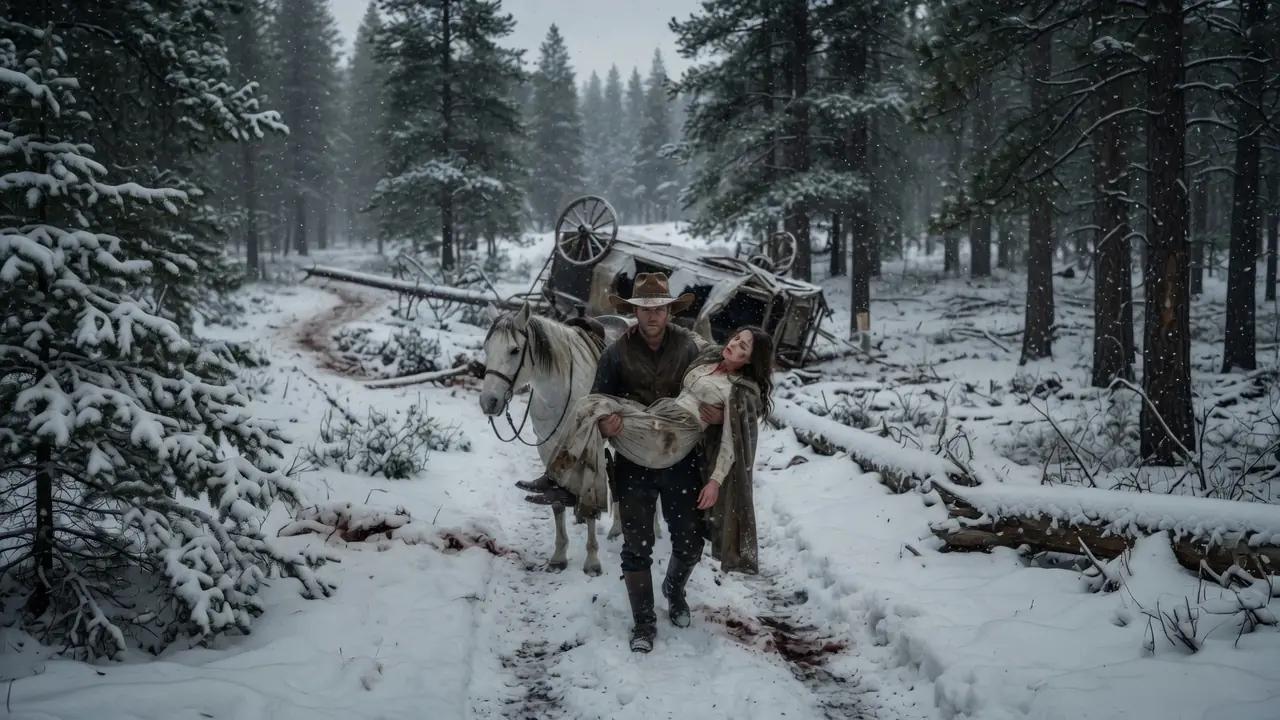
He moved without hurry, but not without care. His steps were quiet, though the dead had no ears. A small hand, still clutching the edge of a bonnet, poked out from beneath a blanket. Another man had fallen face first into the coals of a burned-out campfire. The stench of char and old gunpowder lingered in the air like smoke from a bad dream. Elijah knelt, not to pray. He'd stopped believing words could undo such things, but to listen. And it was then, tucked behind the scorched remains of a wagon wheel, that he heard it, the faintest sound, a breath that was almost not a breath. A girl, no, a woman alive. She lay curled beneath a fur-lined cloak, face streaked with ash and blood, hair tangled like storm clouds, her hand clutched at nothing, fingers twitching as if dreaming or dying. He bent down, let his hand hover near her face, and felt it, a whisper of warmth, fragile as a moth's wing. She was older than he'd expected. Not a girl from a Sunday school wagon, but a woman shaped by time. Her dress was fine, now torn, lace at the collar, still stubbornly clinging to grace. One glove remained on her right hand, pearl buttons glinting faintly in the light. Her left was bare, knuckles scraped, fingers swollen. He didn't speak. There was no need. Instead, he slipped his arms beneath her, surprised by how little weight she carried, as though loss had already taken most of her. Her head fell lightly against his chest. For a moment, he thought she might open her eyes, but they remained closed. Lucy didn't protest as he mounted with her in his arms, though the old mare snorted at the scent of blood. The sun had nearly dipped below the horizon, smearing red across the land like a final warning. Elijah didn't look back.
His cabin stood 5 miles to the west, tucked into the shoulder of a small hill, hidden beneath cottonwoods and silence. He built it 3 years ago with his own hands after the sickness had taken Mary. Back then, building something felt like fighting back. Now it just felt like remembering. The fire was already going, low and orange, fed by the last of the sycamore logs. He laid her gently on the cot, her breath still faint but steady. He fetched water, ran a clean cloth over her wounds, then wrapped her fingers in oil-soaked linen. The blood had crusted like rust at the corner of her lip. He cleaned it without flinching. Night settled thick around them. Crickets began their solemn choir. Outside, an owl mourned the moon. Elijah sat beside her, back against the wall, long legs stretched out in front of him, arms crossed. He did not sleep. He only watched the rise and fall of her chest, made sure she stayed. The next morning arrived slow, draped in mist, and the smell of dew on warm dirt. She stirred, just a flutter of her eyelids at first, then a sharp breath, as though waking inside a memory she didn't trust. Her eyes opened halfway, then fully wide with confusion. She tried to speak. Don't try, he said quietly. His voice was deep and worn, like a riverbed after flood season. You're safe. She blinked, trying to focus, her gaze darting around the room, the wood stove, the single chair, the old portrait of a woman in a faded frame. Elijah's rifle leaning against the wall. She didn't speak again, just nodded once. He brought her a tin cup of water. She drank with both hands trembling as if she feared the cup might vanish before she finished. Afterward, she set it down carefully and looked at him as though expecting something more. But he only stood adjusting the blanket around her, then returned to the chair by the stove. You got a name? he asked after some time. She looked down at her gloved hand. A long pause. Then softly, my name. I don't remember. That was a lie. He could feel it in the way her jaw tightened, but he didn't push. Everyone has their reasons. He nodded once. Then I guess we'll wait till you do.
For 2 days, she said little else. Slept mostly. Ate small spoonfuls of broth. Her hands remained clasped even in sleep. Once she wept, not loudly, just a silent stream down her cheek as she stared at the ceiling. Elijah never asked why. He worked outside, cutting wood, feeding the animals. Came in only to check on her or sit by the fire. She began to notice the way he moved. Slow, intentional, without waste, not cold, not distant, just quiet, like a man who had learned long ago that the world listened best when spoken to gently. By the third morning, she was strong enough to walk to the door. He found her there, wrapped in his old coat, staring out across the prairie. The wind teased her hair, but she stood still. You'll catch cold, he said, though his words didn't carry urgency. I needed to see sky, she whispered. To know the world still turns. It does, he said, whether we ask it to or not. She looked at him then for the first time fully. Not through haze or pain. Her eyes were a color he couldn't name. Stormlight maybe. There was something both noble and shattered in them. I shouldn't be alive, maybe. But you are. She turned back toward the hills, voice barely audible. I don't know who I am now. He stood beside her, watching the wind move the tall grass. Then don't rush it, he said. Let it come when it's ready. They stood there side by side, saying nothing more. But something passed between them, unspoken, unnamed, not affection. Not yet, just the first thread of trust, drawn thin as gossamer between two quiet hearts. And in the distance, far beyond the line of the hills, a crow lifted into the sky, its wings slicing through the dawn like a blade, and the land held its breath as if it too was waiting for what might come next.
Morning sunlight spilled through the window in golden bands, catching on the dust that floated lazily in the quiet air. It gave the room a kind of hush, the kind one finds in old chapels or long-forgotten attics. The woman stirred beneath the wool blanket, eyes twitching behind shut lids as though trying to escape a dream before it escaped her. Elijah was already at the stove, stirring something in a tin pot. His shoulders moved with the rhythm of a man used to long silences. He turned when he heard the slight rustle of blankets behind him. And for a moment he just watched her. Her breathing had grown steadier over the last day, her cheeks less pale, but the bruise near her collarbone had darkened, blooming like violets under fragile skin. She blinked up at the ceiling, confusion swimming behind her eyes, as if unsure whether she had woken into another nightmare or something quieter. Her lips parted. No words came. You're all right, Elijah said, voice gentle but firm. His hand hovered over the ladle like he'd forgotten it mid-stir. Her eyes moved slowly toward him. Recognition didn't light them, nor did fear, only tiredness, heavy and bone deep. This is my place, he added. You were the only one left. At the wagon site. There was a flicker in her face, then a crack in the calm. She sat up too fast, gasped, and clutched her side. Easy. You've been through hell. You need rest more than answers. She looked at him again, this time differently. Appraising, guarded, but not hostile. Her voice was when it came. How long? Three nights. You've been in and out. Her fingers reached for the edge of the blanket as if it might tell her something about where she was, who she was. She looked down and paused. The lace on her wrist singed but still intact. A delicate thing out of place in this weathered cabin. Her other glove was gone. You took care of me. Did what I could. Why? He stirred the pot again slowly. Because someone should have. She didn't answer. Just sat there wrapped in stillness and the smell of broth. Her fingers brushed the side of her face, wincing at the tenderness. Elijah walked over, offered her the tin bowl. She hesitated before taking it. Their hands didn't touch. The soup was plain potatoes and wild onion, but she ate with quiet gratitude. Between spoonfuls, her eyes drifted to the wooden walls, the hand-carved rocking chair, the boots by the door. Everything was modest, kept. This was a man who built things to last. He sat across from her, not watching her too hard, but not looking away either. You got a name? She swallowed slowly. Her eyes held his. Not one I'd care to use. He nodded, didn't press. You? Elijah. Elijah Peterson. The name felt strange in her mouth. She didn't say it aloud, only tucked it somewhere behind her ribs, next to whatever was left of her name. He leaned back in the chair, the wood creaking softly under his weight. There was a rifle resting against the wall, and beside it, a small portrait of a woman. The frame had a chip in one corner. She glanced toward it, then quickly away. She tried standing, her knees wobbled. He was at her side in an instant, hands steadying her without asking permission. She let him only for a moment, then pulled away. Pride shimmered in her spine like steel. I need air, she murmured. He opened the door and stepped aside. She moved slowly, but with a quiet dignity of someone who had once known how to walk in rooms that noticed her. The wind lifted strands of her hair, brushing her face like a forgotten lullaby. The prairie opened before them in all directions. Endless soft hills rolled toward a pale horizon. Wild flowers stubbornly pushed through the dust near the fence posts. Somewhere a hawk called out, circling above the cottonwoods like a sentinel. She took it in like a first breath. Then beneath it all, her voice again. They killed everyone, didn't they? Yes. She didn't cry, didn't tremble, only stood watching the sky like it might offer absolution. Did you bury them? I marked them best I could. Storm came before I could finish. She nodded once, her throat working around silence. Elijah watched her without intruding. She wasn't the sort you rushed. The wind picked up slightly. She wrapped his coat tighter around her shoulders. Its weight was comforting, oddly fitting despite its bulk. You're not from here, he said after a while. Oh, where then? A long way off. Accent says east. Dress says something else. You speak like a man who used to care and stopped trying. He didn't smile, but something like acknowledgement passed between them. Used to be someone's husband, he said softly. Mary, she passed. I never much left the cabin after that. Her face softened, not with pity, but a flicker of familiarity, as if grief was a language only certain people truly understood. I was on my way to a place I didn't want to go, she said. That wagon was never going to take me anywhere I hadn't already lost. You're running. She met his eyes. Aren't we all? He looked out toward the hills, the way the clouds leaned their shadows across the land. I'm not running anymore, he said. Just waiting for the world to settle. She considered that, then turned toward the cabin. I'd like to stay a while, she said. Not long, just while I remember how to breathe. His answer was simple. You can. That night, she helped peel potatoes. Her hands were unsteady, fingers still stiff with bruises, but she worked through it. He watched her hands more than her face, saw the way she moved with muscle memory rather than comfort. When she finished, she leaned back in the chair and exhaled like someone who just climbed a hill. He poured her tea without asking. You got a husband? Did he die? Oh, she didn't explain. He didn't ask. They sat in silence, the fire casting long shadows on the floor. She traced the edge of the tin cup with her fingertip. He carved a new handle for a broken drawer. The world outside could have been a million miles away. Before bed, she paused at the door of the small side room. The guest cot was neatly made, wool blanket folded with care. She turned to him. You don't ask many questions. I don't believe in earning trust with noise. She nodded.