Take that off. That jacket has no place in my courtroom. The words hit the room like a gavel strike. Sharp, deliberate, and mean. And every single person in that courtroom turned to look at the woman standing alone in front of the bench.
32 years old, blonde, quiet, wearing a worn black leather jacket that had seen more road and more heartbreak than most people would ever know. Judge Richard Whitmore stared down at her like she was something he'd scraped off the bottom of his shoe. And she just stood there holding her ground, holding that jacket. Victoria Hayes had been in difficult rooms before.
She had stood in trauma bays where the air smelled like blood and burning where machines screamed and people wept, where there was no margin for hesitation and no one to tell her what to do next. She had pressed her hands into wounds and spoken calmly to people who were convinced they were dying. She had done it at 2 in the morning and she had done it on 3 hours of sleep and she had done it without anyone ever knowing her real name. She knew how to stand still when everything around her was unraveling. So when Judge Richard Whitmore looked down at her from his elevated bench that Tuesday morning and spoke those words, "Take that off."
That jacket has no place in my courtroom. Victoria did not flinch. She did not cry. She did not reach for the zipper.
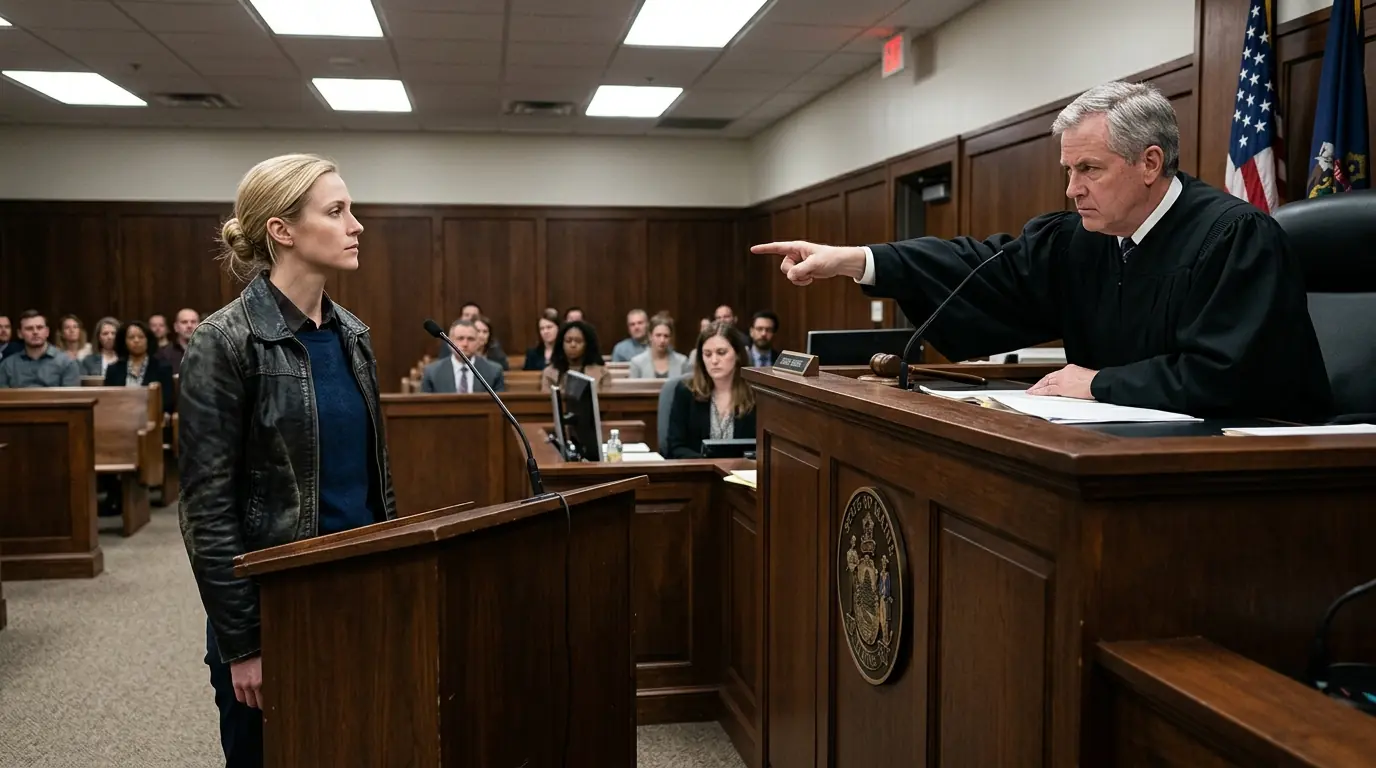
She simply looked up at him and waited. The courtroom itself was the kind of space designed to remind you of your own smallness. High ceilings, dark wood paneling, fluorescent light that turned everyone's skin a shade too pale. The gallery was only half full, a scattering of lawyers checking phones, a few family members pressed together near the back, and two journalists who had come expecting a routine assault case and were already sensing something had shifted in the air. Ethan Cole sat at the defendant's table with his court-appointed attorney, Dennis Marsh.
Ethan was 23 years old with a jaw that looked like it had healed wrong from an old break and eyes that were doing their very best to hold steady. He wore a collared shirt that someone had clearly pressed that morning and his hands were clasped on the table in front of him like he was holding himself together from the inside. Victoria had spoken to him for exactly 4 minutes in the hallway before the session began. "You okay?" she had asked. "
No," he said. "Are you? I've been in worse rooms." He looked at her jacket, then the black leather, the faded stitching, the silver zipper pull that had been replaced twice over the years. His eyes moved to the name stitched in small letters along the inside collar just visible when the jacket fell open.
Silver Angel. He had read it and looked up at her. She had said nothing because Ethan Cole knew what that name meant, even if he had never been told it directly. He had grown up around people who spoke of Silver Angels, the way other people spoke of things they weren't sure were real. Reverently quietly like the name itself carried weight.
Like saying it too loud might disturb something that needed to rest. He had not expected to see that name walking into this courtroom. And now the judge was trying to make her take it off. Dennis Marsh leaned over toward Ethan and whispered something. Ethan kept his eyes forward, his jaw tightened, his hands still clasped on the table, pressed harder against each other.
Victoria stood at the witness stand. She had not yet been sworn in. Judge Whitmore had stopped the proceeding the moment she entered the moment. He clocked her jacket and the moment he decided with the casual confidence of a man who had never once been made to feel out of place in a room that she was wrong before she had opened her mouth. Ma'am, the judge said again his voice had the particular patience of someone who was not patient at all.
This is a court of law, not a biker rally. You will remove that jacket before you take the stand. Victoria looked at him with respect. Your honor," she said. "My jacket has no bearing on the accuracy of my testimony."
A soft ripple moved through the gallery, not loud, but present. Judge Whitmore set his pen down. He did it slowly. It was the kind of gesture men make when they want everyone to understand they are choosing not to be angry. "It is a distraction," he said, "and it sends a message to this jury that I am not comfortable with." "
What message is that?" Victoria asked. The room got quiet in a different way. Even the journalist stopped typing. Dennis Marsh, closed his eyes briefly.
The prosecutor, a man named Carl Ree, 45, with a habit of touching his tie when things surprised him, touched his tie. Judge Whitmore's expression shifted. He leaned forward. Ms. Hayes, he said, I will hold you in contempt. I understand that, Victoria said.
I'm still asking the question. She had not come here to make a scene. That was the thing people would misunderstand later when the story spread. When it traveled through the community, the way these stories do told and retold until the sharp edges softened into legend, they would assume she had walked in wearing that jacket as a statement, a challenge, a way of announcing herself. But Victoria Hayes had worn that jacket for the same reason she wore it every time she was somewhere hard, because it helped her breathe.
She had owned it for 9 years. She had bought it secondhand from a woman outside a diner in West Texas who had priced it at $40 and thrown in a cup of coffee. The leather had been stiff, then unyielding, smelling of someone else's history. Over the years, it had softened against her body until it fit like something grown rather than purchased. The scars it sometimes covered were older than the jacket, but both of them had been with her on the worst night she had survived.
It was not a costume. It was armor of a very particular kind. The kind that worked not because it stopped anything from hitting you, but because it reminded you that you had already survived the last time something did. She had not planned to be here today. 3 weeks ago, she had received a call from Ethan Cole's attorney.
Dennis Marsh had explained the situation in the careful measured language of a man who understood his case was weak and needed a miracle and was too professionally cautious to call it that. He had medical questions, timing questions. He had heard through channels. He chose not to specify that Victoria Hayes might have expertise relevant to the physical evidence. She had asked Dennis directly, "Who told you to call me?"
He had paused, then said a mutual contact. She had let it go because the case itself, when she reviewed the materials, made her stomach go cold. Ethan Cole had been charged with aggravated assault. The supposed victim was a man named Derek Pullman, 41 years old, business owner, well-dressed, widely respected in local civic circles. Pullman had appeared at a hospital emergency room with a broken nose and a fractured wrist.
And his statement to police described an unprovoked attack by Ethan outside a bar on Crestston Avenue. Except that when Victoria looked at the medical documentation, the injury patterns, the timing, the specific fractures, something didn't line up. She had spent 20 minutes with the files and then sat very still for a while because what the injuries described was not someone who had been attacked. It was someone who had attacked first. The fractures on Pullman's wrist were consistent with a blocking injury, the kind the body produces when someone throws a punch and the intended target deflects it.
The nose fracture angle suggested impact from below, not from the forward strike position the police report described. And the contusions on Ethan's body photographed at booking, but barely referenced in the prosecutor's case, told the rest of the story with a clarity that should have been impossible to ignore. Someone had ignored it. Someone with enough authority or enough incentive to shape the documentation that ended up in the court file. Inside the courtroom, Victoria had now been standing at the witness stand for 7 minutes without being sworn in because Judge Whitmore had not moved past the jacket.