The boy's voice did not carry far, but it carried far enough.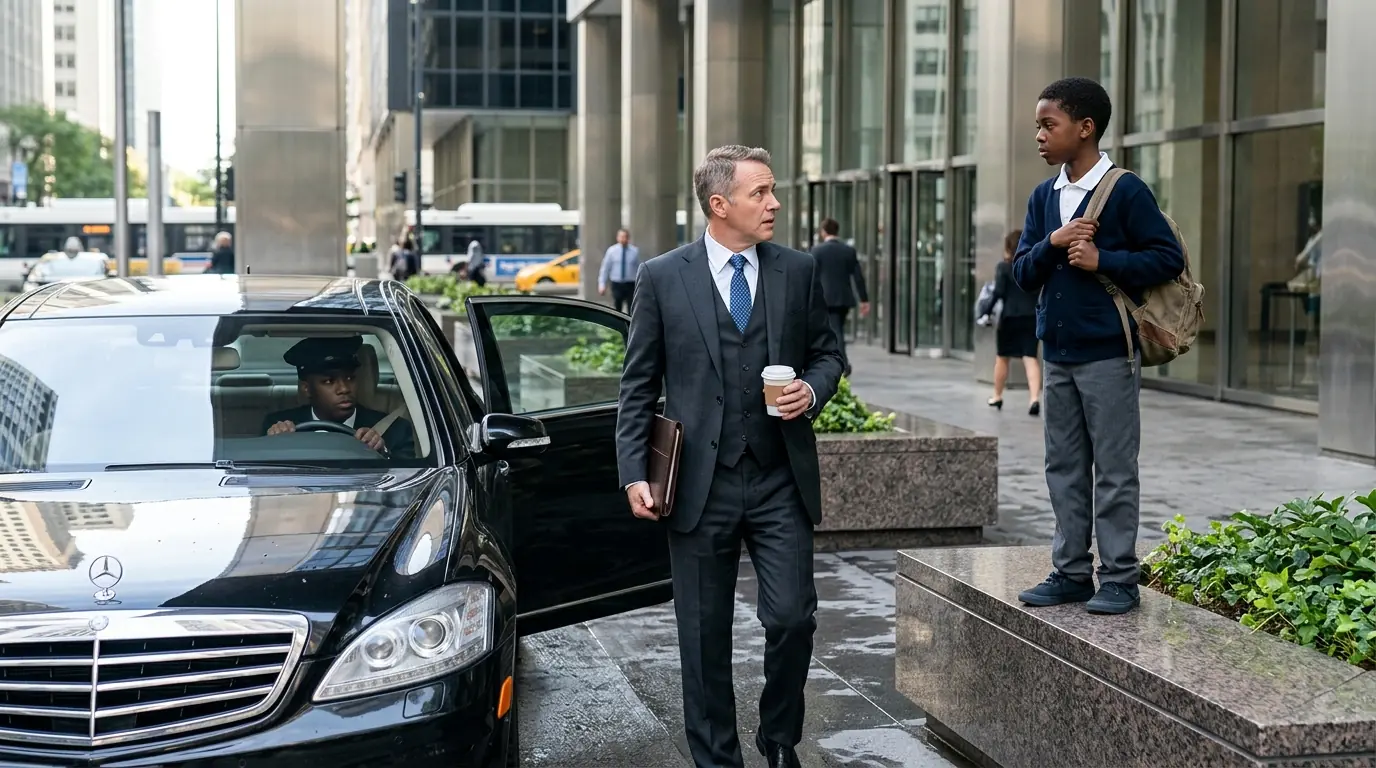
"That's not your driver, sir."
Harlan Whitfield, who had been three steps away from the open rear door of the black sedan idling in front of the Whitfield Tower, stopped without turning his head. He was holding a leather portfolio in one hand and a paper cup of coffee in the other, and for a moment, the only thing that moved was the small line of steam rising from the lid.
The morning was bright and clean. The street smelled of rain that had ended an hour earlier. Forty floors above him, the windows of the building that bore his name caught the light in long sheets of gold.
He turned his head slowly.
The boy was standing on the wide stone planter that bordered the entrance, the way children sometimes stand when they want to be seen by a particular adult and no one else. He was thin and small for his age—maybe ten, maybe eleven—wearing a navy school sweater and gray pants that had been carefully pressed but were just slightly too short at the ankles. His backpack hung from one shoulder. His other hand was gripping the strap as though he had been holding it that way for a long time before deciding to speak.
"Excuse me?" Harlan said.
"That's not your driver." The boy did not point. He kept his hands where they were. "Your driver is the man with the gray hair and the limp, the one who always opens the door first and then puts your bag in second. That man in the car is not him."
Harlan glanced toward the sedan. The driver was sitting behind the wheel with his face turned slightly away, one elbow resting on the door, the other hand on the gearshift. He was wearing a dark jacket and a chauffeur's cap pulled low. From this angle and this light, in the three short seconds Harlan had to look, the man could have been anyone.
The car was right. The plate was right. The hour was right. Harlan had walked toward that car at exactly this time on exactly this corner on roughly two hundred mornings of his life, and not once in any of those mornings had he looked carefully at the man behind the wheel.
He looked now.
The driver did not turn his head. He should have. By now, a driver who had been waiting for almost three minutes while his passenger stood on the sidewalk talking to a child should have at least glanced in the side mirror. This driver was looking straight ahead at the empty street, very still—the kind of stillness a person becomes when they are listening hard and trying not to be seen listening.
Harlan brought his eyes back to the boy. "What's your name, son?"