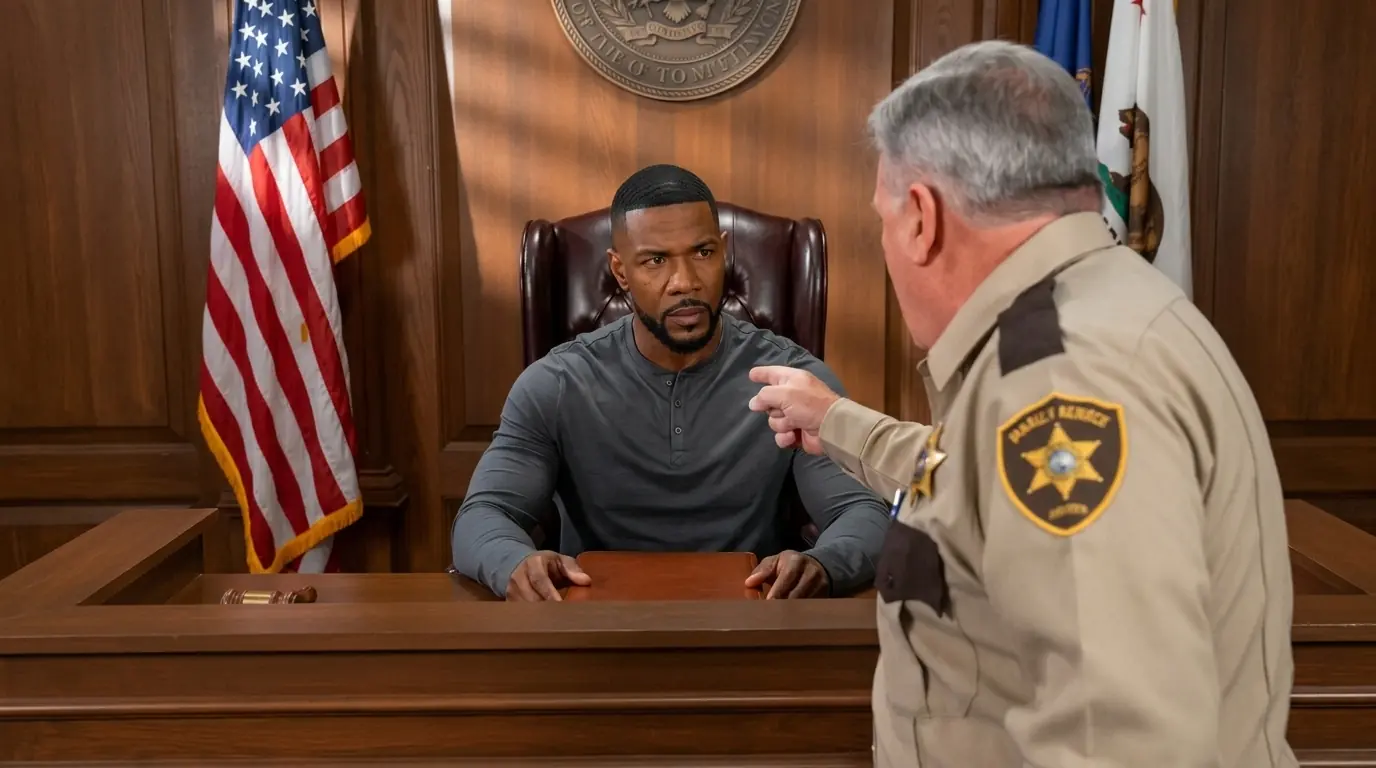
At 7:32 on a cold Monday morning, Adrian Holloway unlocked the private corridor behind Courtroom Six and stepped into the room where he was supposed to begin the next chapter of his life. The courthouse was still mostly asleep, with only a custodian working near the rear benches and a deputy checking the emergency exit beside the jury box. Adrian paused behind the bench, looking at the polished wood, the flags, the empty counsel tables, and finally the small brass plate centered in front of the chair. It read: HON. ADRIAN J. HOLLOWAY.
He touched the plate lightly with two fingers. Not because he needed proof that the appointment was real, but because seventeen years earlier he had entered his first courtroom carrying a borrowed briefcase and wondering whether everyone could tell how nervous he was. For twelve years, he had argued cases before judges from the other side of that bench, and for the last five he had served as deputy solicitor general for the Commonwealth of Virginia. Now, at forty-six, Adrian was about to spend his first official day deciding instead of persuading.
He had deliberately arrived early. Court would not begin until nine, and he wanted one hour before lawyers, witnesses, clerks, families, reporters, and deputies turned the room into a place where everyone needed something from him. His new robe hung inside chambers, freshly pressed, but Adrian had not put it on yet. He wore a navy merino sweater, gray trousers, black shoes, and no visible badge.
That was also deliberate. Adrian had spent most of his career believing titles were useful but dangerous when people allowed them to substitute for judgment. His father, a high-school principal who died three years earlier, used to tell him the same thing whenever Adrian got too confident as a teenager. Find out before you decide, he would say. Adrian wrote the phrase in the margin of the first file on his morning docket.
Twenty-three matters waited for him. Arraignments, a commercial lease dispute, two probation hearings, a guardianship petition, an emergency protective order, and several scheduling motions that would matter enormously to the people involved and almost not at all to anyone outside the building. Adrian liked that. He had never wanted to become a judge known for speeches.
He opened the first file. The leather chair made a soft sound beneath him, and for a few minutes the courthouse gave him exactly what he had wanted. Quiet. No applause from the appointment ceremony, no photographers, no colleagues shaking his hand.
Then the public courtroom door opened.
Adrian looked up.
A courthouse bailiff stepped inside carrying a large ring of keys and a folded security checklist. His name was Dennis Mallory, and Adrian recognized him vaguely from previous appearances in the building, though they had never spoken directly. Mallory was fifty-eight, white, thick through the shoulders and waist, with closely cropped silver hair, a square jaw, and the permanent expression of a man who had spent decades expecting instructions to be followed the first time.
Mallory scanned the gallery. Then the witness stand. Then the jury box.
His eyes stopped on Adrian.
Adrian returned to the file.
“Hey.”
Adrian looked up again.
“Good morning.”
Mallory frowned.
“What are you doing back there?”
Adrian glanced at the papers before him.
“Reading.”
The answer was simple.
Mallory heard attitude.
“Get out from behind the bench.”
The custodian near the last row stopped wiping a railing.
Adrian closed the file.
“Excuse me?”
“You heard me.”
Mallory walked farther into the courtroom.
“That area is restricted.”
“I know.”
“Then move.”
Adrian studied the man for a moment. Mallory had not asked a name, requested identification, checked the assignment posted outside chambers, or called the clerk whose desk sat less than thirty feet away. He had gone from seeing Adrian to deciding Adrian did not belong in the chair with almost no space between those two events.
Adrian kept his voice calm.
“Officer Mallory, I recommend you ask who I am before we continue.”
Mallory looked down at his own name badge, then back at Adrian.
“You know my name?”
“It’s printed on your shirt.”
“Cute.”
Adrian said nothing.
Mallory pointed toward the aisle.
“Out.”
Adrian rested both hands on the closed folder.
“You have several ways to verify whether I’m authorized to be here.”
“I don’t need you telling me how to do courthouse security.”
“I’m suggesting you use courthouse security procedures.”
Mallory’s face tightened.
“Stand up.”
Adrian remained seated.
The custodian quietly moved her cart closer to the rear wall but did not leave.
Mallory stepped toward the bench.
“I’m going to make this very simple.”
“So am I.”
“You are sitting in a restricted judicial area before the courthouse is open.”
“The courthouse is open to staff.”
“You are not staff.”
Adrian looked at him.
“What is that conclusion based on?”
Mallory gave a short laugh.
“Do you want to do this the hard way?”
Adrian felt something familiar settle into place. Not panic, not anger, but the mental stillness he had learned during depositions when an opposing attorney became more committed to a theory than to the facts. He had seen it in boardrooms, police reports, agency investigations, and occasionally in courtrooms. Once someone decided what the story was, every new question could sound like resistance instead of information.
“You should check the assignment sheet.”
Mallory pointed toward the door.
“You should check the hallway.”
“Why?”
“Because that’s where you’re going.”
Adrian looked at the clock.
7:39.
Mallory moved another step closer.
“If you don’t stand up, I will remove you.”
Adrian leaned back slightly.
“How?”
Mallory stared.
“Don’t test me.”
“I’m asking what action you intend to take.”
“I’ll take your arm.”
“And if I don’t cooperate?”
“You’ll be restrained.”
The custodian’s eyes widened.
Adrian looked toward her, then back at Mallory.
“Before you put your hands on me, I want you to remember that I specifically told you to verify my identity.”
Mallory’s expression sharpened.
“Is that a threat?”
“No.”
Adrian’s tone never changed.
“It’s documentation.”
Mallory laughed once.
“You think using legal words scares me?”
Adrian almost smiled.
“No.”
“Then get up.”
Mallory glanced at his watch.
“I’m giving you five seconds.”
Adrian said nothing.
“Five.”
The public door remained open behind Mallory.
“Four.”
The courthouse clock ticked.
“Three.”
Adrian sat exactly where he was.
“Two.”
The private clerk’s door opened.
A woman entered carrying three red file folders, a laptop, and a large paper cup of coffee. Margaret Ellis, the senior courtroom clerk, had worked in Richmond County Circuit Court for twenty-two years and possessed the rare ability to identify judges by their footsteps before they reached the door. She took two steps into the room, saw Mallory beside the bench, saw Adrian seated behind it, and stopped so suddenly that coffee spilled onto the lid.
“Dennis?”
Mallory turned.
“Morning, Margaret.”
He gestured toward Adrian.
“Give me a second. I’ve got somebody in a restricted area.”
Margaret stared.
Adrian watched her face.
Disbelief first.
Then alarm.
Then anger.
“Dennis.”
“What?”
“Move away from the bench.”
Mallory frowned.
“I’ve got it.”
“No.”
Her voice became sharper.
“Move away from the bench right now.”
Mallory looked at her as though she had lost her mind.
“Why?”
Margaret placed the folders on counsel table.
“Because that is Judge Holloway.”
The room became completely silent.
Mallory looked at Adrian.
Then Margaret.
Then back again.
“What?”
Margaret pointed toward the brass nameplate.
“Judge Adrian Holloway.”
Mallory’s face changed slowly.
Adrian had spent years watching witnesses realize a document had just contradicted their testimony. The transformation was always fascinating. Confidence disappeared first, then the mind searched desperately for an alternate explanation.
“You’re the new judge?”
Adrian opened the file again.
“Yes.”
Mallory looked toward the side door.
“The ceremony was Friday?”
“Yes.”
“Why aren’t you wearing your robe?”
Margaret closed her eyes.
Adrian looked up.
“Because court starts in eighty minutes.”
Mallory swallowed.
“I didn’t recognize you.”
“That is obvious.”
“I thought you were—”
Adrian raised one hand.
“Stop.”
Mallory stopped.
Adrian looked toward Margaret.
“Who supervises courthouse security this morning?”
“Chief Wallace should already be downstairs.”
“Please ask him to come here.”
Mallory shifted.
“Judge, I can explain.”
“You will.”
For one second, relief appeared.
Adrian continued.
“After the incident is preserved.”
Relief disappeared.
Margaret reached for the phone.
Mallory glanced toward the custodian.
Adrian noticed.
“Ma’am.”
The custodian looked toward him.
“Yes?”
“What’s your name?”
“Rosa Delgado.”
“Ms. Delgado, were you in the room from the time Officer Mallory entered?”
“Yes, sir.”
“You may be asked for a statement.”
She nodded.
Mallory rubbed one hand across his mouth.
“This really doesn’t have to become a major issue.”
Adrian looked at him.
“What doesn’t?”
“This.”
“What is ‘this’?”
Mallory hesitated.
“A misunderstanding.”
Adrian leaned back.
“You believed someone had entered a restricted judicial space.”
“Yes.”
“That is not minor.”
Mallory frowned.
“I mean now that we know—”
“No.”
Adrian shook his head.
“We now know I’m a judge.”
He gestured toward the gallery.
“What if I were an attorney allowed in early?”
Mallory said nothing.
“What if I were an IT employee checking courtroom equipment?”
Silence.
“A clerk?”
Adrian glanced toward Rosa.
“A maintenance worker?”
Mallory’s face tightened.
“You were in the judge’s chair.”
“Yes.”
“That’s different.”
“Why?”
“Because regular staff don’t sit there.”
Adrian nodded.
“Then asking who I was would have solved the issue immediately.”
Mallory looked away.
At 7:48, Chief Robert Wallace entered through the rear door. Wallace was sixty-two, tall and narrow, with dark-rimmed glasses and the permanently tired expression of someone whose job depended on preventing other people’s bad mornings from becoming official problems. He took one look at Margaret and understood that whatever happened was not going away quietly. Then he noticed Adrian.
“Good morning, Your Honor.”
“Chief.”
Wallace looked toward Mallory.
“What happened?”
Adrian gestured toward Margaret.
“I’d rather you hear the sequence from someone who was not part of the confrontation.”
Margaret explained.
Mallory entered.
Saw Adrian behind the bench.
Ordered him out.
Used profanity.
Threatened restraint.
Adrian told him to verify identity.
Mallory did not.
Margaret arrived before physical contact occurred.
Wallace listened without interruption.
Then looked at Mallory.
“Accurate?”
Mallory inhaled.