Cedar Flats was the kind of town that kept its memories in dust.
Not in plaques or clean little museums, not in neat displays behind glass. It kept them in the cracked sidewalks along Route 70, in the old motel sign that still blinked VACANCY though the rooms had been empty for years, in the faded paint on gas station walls, and in the wind that dragged sand through every open doorway by noon.
Most afternoons, nothing much happened there.
Trucks passed through. Trains moaned somewhere beyond the grain lots. Old men sat outside the feed store and argued about weather they could not change.
Then, at 3:05, Maple Ridge Elementary opened its gates.
Children poured out in bright waves.
Backpacks bounced against small shoulders. Lunch boxes swung. Jackets slipped down arms. Construction-paper projects bent in the wind. Parents lined up in pickup trucks, minivans, dusty sedans, and the occasional SUV too clean for the town it was parked in.
At the corner of Ashby Road and Main, the school crossing light blinked yellow.
Blink.
Blink.
Blink.
Most drivers had learned to slow down there.
Not because of the sign.
Because of Nolan Cross.
You heard his motorcycle before you saw him.
It came from the east end of town, past the shuttered motel, past the welding yard, past the little taco stand with red umbrellas faded almost pink by the sun. The sound rolled low over the asphalt, not wild, not showing off, just heavy enough to make people look up.
Every school day, at exactly 3:06, Nolan pulled his black Harley to the curb.
He shut off the engine.
For one second, the silence felt larger than the noise had been.
Then he swung one boot to the pavement.
Nolan was fifty-six years old, though he looked older on bad days and younger when he laughed, which was rare. He had a gray beard, sunburned skin, shoulders still wide from years of hauling metal, and hands that looked like they belonged to a man who had fixed things, broken things, and carried more than he ever admitted.
He wore black boots.
Black gloves.
A black helmet.
A black leather vest with a faded patch on the back from a small riding club called the Dust Saints.
People in Cedar Flats liked to pretend the Dust Saints were trouble.
But when a roof caved in after a storm, they showed up with tarps. When Mrs. Howell’s husband died and she could not afford the burial escort, twelve motorcycles followed the hearse anyway. When the food pantry ran out of canned goods before Thanksgiving, it was the Dust Saints who rolled up with saddlebags full of beans, soup, and peanut butter.
Still, Nolan looked like the kind of man parents warned children about.
That made what he carried even stranger.
From his saddlebag, he pulled out a small pink stop sign.
It was plastic, chipped around the edges, and decorated with stickers. A glittery rainbow curled near the handle. A cartoon cat, missing one ear from weather and use, smiled crookedly from the center. The word STOP had been written over twice in black marker because the original letters had faded.
The sign looked like it belonged in a kindergarten play.
Not in the hands of a biker with scars across his knuckles and a tattoo of a broken chain on his neck.
At first, people mocked him.
Quietly.
Then openly.
Then not at all.
Because Nolan stepped into the street with that ridiculous little sign, and somehow traffic obeyed.
He did not yell.
He did not pound on hoods.
He did not drag children by the shoulders or bark orders like a crossing guard who enjoyed authority.
He simply watched.
That was what I noticed first.
My name is Maren Ellis, and my son Toby was in second grade at Maple Ridge that year. Like most mothers, I watched everyone who stood near my child. Teachers, volunteers, bus drivers, coaches, men fixing power lines, teenagers leaning on bikes outside the fence.
Especially men like Nolan Cross.
I asked about him.
In a town like Cedar Flats, you rarely get the whole truth on the first question. You get scraps. You get rumors shaped like warnings. You get old stories people tell because it makes them feel safer to believe they understand someone.
Nolan had worked at a metal fabrication shop outside town for almost thirty years. His club called him Anchor because, according to one version, he once held a trailer chain with his bare hands long enough to keep it from sliding downhill and crushing a man under it.
He had been married once.
Divorced.
He had a daughter in Tucson who sent Christmas cards but never came to visit. He had spent three months in county jail in his thirties after a bar fight that started over a woman and ended with two broken chairs, a shattered window, and a man who forgave him only after Nolan paid the hospital bill in cash.
Nobody called him innocent.
But nobody called him useless either.
He was not the kind of man Cedar Flats put on school volunteer posters.
He was just the man standing at the crosswalk every afternoon with a pink sign.
And there was one thing nobody explained.
On the right side of his leather vest, low below the smaller Dust Saints patch, there was a dark stain.
Brown.
Uneven.
Almost hand-shaped.
It looked like something had soaked into the leather and refused to leave.
People guessed it was oil from the shop.
Maybe rust.
Maybe something from a bike wreck years before.
Nolan never corrected anyone.
Every day, before the bell rang, he touched that stain with two fingers.
Just once.
Then he stepped into the road.
I noticed because mothers notice stains.
On shirts. On sidewalks. On car seats. On bandages. On places where something bad happened and people stopped talking about it because silence was easier than memory.
One Wednesday afternoon in March, I drove past Nolan’s garage on the far side of town after picking Toby up from a dentist appointment.
The garage door was half open.
Inside, sparks jumped blue-white from a grinder. A brown dog slept near the shade with one eye open. Tools hung neatly on the wall. A fan turned slowly overhead, moving more dust than air.
Near the workbench, hanging from a nail, was a child’s crossing vest.
Bright orange.
Tiny.
Too small for any adult.
I slowed without meaning to.
Nolan looked up.
For one second, his face changed.
Not angry.
Not irritated.
Afraid.
Then he reached for the garage door and pulled it down.
That was when I knew the stain was not oil.
I did not yet know what it was.
But I knew it belonged to a story nobody in town had finished telling.
The second sign came in April.
It was a hot, dry Thursday, the kind where spring felt like a lie and summer was already pressing its face against the glass. State testing had ended that morning, and the children came out of Maple Ridge louder than usual, wild with relief.
Freedom makes children forget the world can still hurt them.
Nolan arrived at 3:06.
The same low rumble.
The same quiet after the engine died.
The same boots on the pavement.
The same pink sign in his hand.
Toby stood beside me holding a paper rocket he had painted green. He looked at Nolan and whispered, “Mom, why does the motorcycle man always look like he’s mad at cars?”
I almost laughed.
Then I looked at Nolan’s face and realized Toby was right.
Nolan did not look angry at the children.
He looked angry at every bumper, every tire, every driver glancing down at a phone, every careless adult who thought a blinking light was only a suggestion.
“He’s careful,” I said.
Toby considered that.
“Careful looks scary.”
“Sometimes.”
The truck came from the west.
A white work truck with ladders on top, dust along the doors, and a driver wearing mirrored sunglasses. He was not swerving. He was not drunk. He was not the kind of danger people recognize quickly.
He was worse in a common way.
He was late.
And he believed his lateness mattered more than everyone else’s safety.
Three children had stepped off the curb before anyone noticed.
One was skipping.
One was dragging a backpack.
One was turning around to wave at a friend behind the fence.
Nolan noticed first.
His head turned.
His shoulders went tight.
He moved into the street with the pink sign raised.
Not fast like a young man.
Fast like an old wound remembering how to run.
The truck braked hard.
The tires screamed.
Children froze.
The truck stopped less than three feet from Nolan’s knees.
Dust rolled over his boots.
For one long second, nobody moved.
Then the driver slammed his palm against the horn.
The sound tore through the afternoon.
Kids jumped.
A teacher screamed.
The driver shoved his door open and climbed out.
“What the hell is wrong with you?” he yelled.
Nolan lowered the sign.
His hands were trembling.
That stayed with me.
Not the truck.
Not the shouting.
His hands.
They shook like the horn had reached inside him and pulled something old awake.
The driver stormed toward him.
“I had the light!”
Nolan said nothing.
“You don’t have a badge. You don’t have a uniform. You’re some washed-up biker playing hero with a toy sign.”
Still, Nolan said nothing.
A father near the curb started recording with his phone.
Mrs. Carden, the principal, came out of the school holding a walkie-talkie with one hand and pressing the other to her chest. Deputy Luis Moreno turned in from Main Street thirty seconds later, lights flashing but no siren.
The driver kept yelling.
Then he did the stupidest thing he could have done.
He slapped the pink sign out of Nolan’s hand.
It hit the asphalt and skidded toward the gutter.
Every adult there felt the moment change.
Because that was when we all expected Nolan Cross to become the version of himself the town had whispered about.
His fist closed.
His jaw tightened.
The muscles in his neck rose like rope under skin.
For one breath, every old story about Nolan stood in the street with him.
Then he looked down at the sign.
The cartoon cat sticker had scraped white against the pavement.
His fist opened.
Slowly, he walked to the gutter, picked up the sign, and carried it to a little girl crying near the curb.
“Hold this for me, sweetheart,” he said.
His voice was rough.
But not frightening.
The girl took the sign with both hands.
Nolan turned back to the driver.
“If you’re in a hurry,” he said, “then be in a hurry after the kids cross.”
The driver scoffed.
“You blocking traffic now?”
Nolan looked at him.
“I’m blocking a funeral.”
No one spoke after that.
Deputy Moreno stepped between them.
“Nolan.”
The way he said the name told me they knew each other.
Not just from tickets or town gossip.
From something older.
“Nolan, step back.”
Nolan looked at the three children still frozen on the curb.
“Not yet.”
The driver demanded charges.
The principal looked sick.
Parents whispered.
Deputy Moreno finally wrote Nolan a citation for obstructing traffic.
Nolan took it, folded it once, and tucked it into his vest pocket without reading it.
Then he retrieved the pink sign from the little girl.
“Come on,” he said to the children.
And he walked them across.
That should have been the story.
Biker stops reckless truck.
Town argues.
Paper prints a short article.
Half the people call him brave, half call him a menace, and everyone goes back to being late by Monday.
But a woman had been watching from a dark blue minivan across the street.
She had not recorded.
She had not shouted.
She had not gotten out during the argument.
She sat behind the wheel with both hands locked around it, staring at Nolan like she had seen a ghost wearing leather.
In the back of the van, I saw a folded wheelchair.
After the last child crossed, the woman opened her door.
Nolan turned at the sound.
And the man who had not backed down from a truck went completely still.
Her name was Renee Carter.
I knew her by sight, though not well.
Most of us in Cedar Flats knew her son’s name.
Isaiah Carter.
Four years earlier, Isaiah had been eight years old and in third grade at Maple Ridge Elementary. He was bright, fast-talking, and famous among the children for wearing mismatched sneakers because he said matching shoes were “for people with no imagination.”
On October 11, Isaiah stepped into that same crosswalk after school.
A sedan rolled through the blinking light.
The driver was not drunk.
She was not evil.
She was looking at her phone.
That was all.
That was enough.
The sedan hit Isaiah in the middle of Ashby Road.
People in town still lowered their voices when they talked about it.
They said he was thrown several yards. They said his backpack ripped open and spelling worksheets scattered across the pavement. They said the sound of his mother screaming when she arrived was something no one forgot.
What most people did not say was that Nolan had been at the gas pump on the corner when it happened.
He had heard the impact.
He had dropped the nozzle, left gasoline spilling onto the concrete, and run.
He reached Isaiah first.
Before the teachers.
Before the ambulance.
Before Renee, who was stuck on the far side of the tracks behind a freight train and arrived too late to see anything except flashing lights and strangers holding each other back.
Isaiah was face-down on the hot road.
Blood spread beneath him.
Crayons lay around him like bright, useless little bones.
Nolan lifted him.
He was not supposed to.
People always say not to move an injured child.
But Nolan later told Deputy Moreno, “His cheek was burning on the pavement. I couldn’t leave him there.”
He held Isaiah against his chest until the paramedics arrived.
The blood soaked into the right side of his vest.
That was the stain.
Not oil.
Not grease.
A child’s blood.
Carried every day above a man’s ribs because some guilt does not know how to leave the body.
Renee walked toward him slowly.
The street quieted around her.
Even the angry truck driver shut his mouth.
She stopped in front of Nolan.
“You were there,” she said.
Nolan looked at the pavement.
“Yes, ma’am.”
“You held my son.”
His voice was almost too low to hear.
“Yes, ma’am.”
“I never knew your name.”
“Nolan.”
The way he said it sounded like an apology.
Renee looked at the pink sign.
Then at the vest.
Then at the stain.
“Is that…” She stopped.
Nolan touched the dark mark with two fingers.
Just once.
“I tried to clean it,” he said. “Leather took it in.”
Renee’s face changed.
She covered her mouth.
For years, she had lived with the terrible belief that the town remembered Isaiah mostly as an accident. A traffic meeting. A newspaper clipping. A warning told to children in October. A name spoken softly, then less often, then only when safety grants came up.
But Nolan had carried him.
Not metaphorically.
Literally.
Every afternoon.
Renee whispered, “I thought people forgot.”
Nolan looked up then.
His eyes were wet.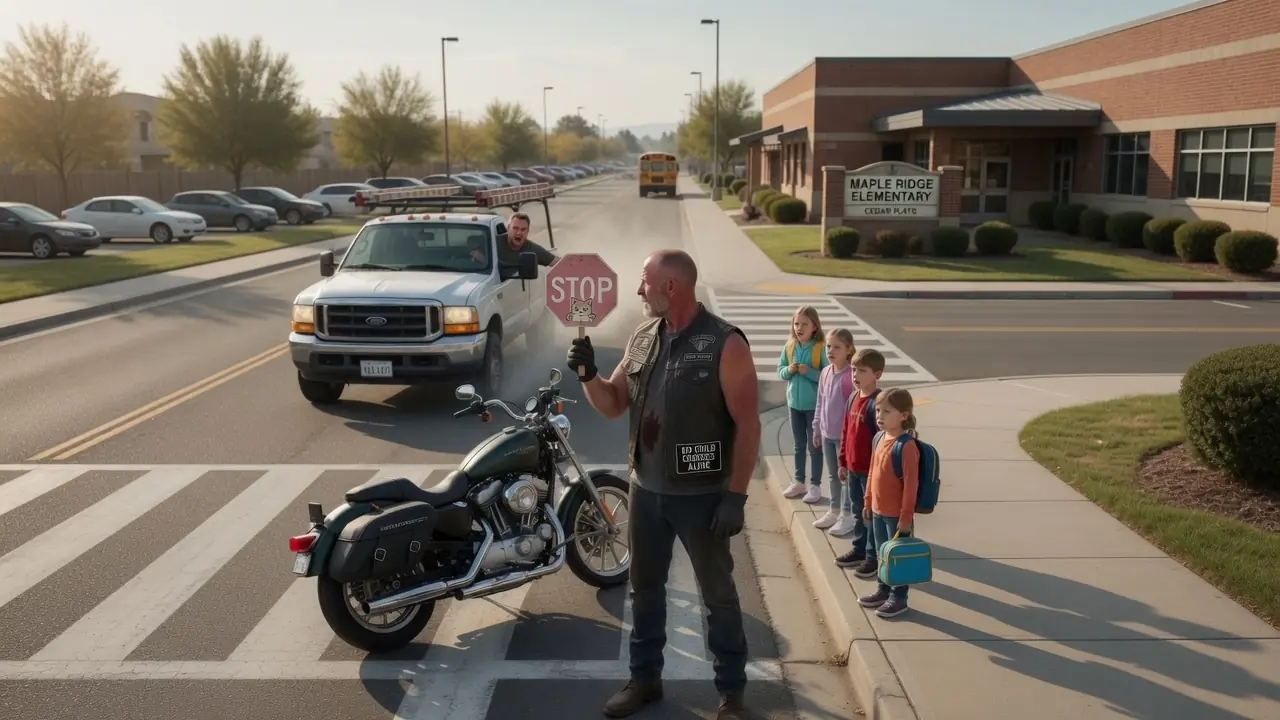
“Your boy never left this crossing.”
Mrs. Carden began crying near the gate.
Deputy Moreno removed his hat and looked down at the road.
The driver stepped backward toward his truck, suddenly desperate to become invisible.
Renee reached out toward Nolan’s vest and stopped before touching it.
“May I?”
Nolan nodded.
She placed two fingers on the stain.
Her hand shook.
Not like she was touching leather.
Like she was touching the last place her child had been held before the ambulance doors closed.
Then she said something that changed the whole street.
“Isaiah is alive.”
Several people looked up sharply.
Renee wiped her cheek with the heel of her hand.
“He’s alive. He’s at therapy right now, and he’s going to be furious when he hears I came here without him. He hates being left out of important drama.”
A broken laugh escaped her.
Then turned into a sob.
Nolan stared at her.
“I know he made it,” he said. “I heard. But I didn’t know if he’d want…”
His voice failed.
Renee finished the sentence.
“If he’d want to see you?”
Nolan nodded once.
“I didn’t think I had the right.”
Renee looked at him, and her grief sharpened into something almost like anger.
“You held my son when I couldn’t get to him.”
Nolan flinched.
“I was there and still didn’t stop it.”
“You did not hit him.”
“I heard it happen.”
“That is not the same.”
“It is in my head.”
The sentence landed hard because there was no decoration around it.
Just truth.
Renee understood.
We all did.
Nolan Cross had not been standing at that crosswalk as a volunteer.
He had been serving a sentence no judge had given him.
Renee pulled out her phone.
Her fingers trembled as she opened a photo.
Isaiah was twelve now. He sat in a wheelchair on a basketball court, one hand on the wheel, the other lifted in a peace sign. He still wore mismatched sneakers, one blue, one orange. His grin was wide enough to challenge the whole world.
Nolan looked at the photo.
The big biker’s mouth parted slightly.
“He got taller.”
“He got bossier,” Renee said.
A faint smile moved through Nolan’s beard.
“Good.”
“He remembers you.”
Nolan’s face went still.
Renee held the phone closer.
“He remembers your vest. He remembers gasoline. He remembers somebody saying, ‘Stay with me, little man.’ He does not remember the car.”
The street blurred in the heat.
Or maybe that was my eyes.
Nolan looked away.
For the first time since I had known of him, he looked smaller than his own shoulders.
Renee said, “He wants to meet you.”
Nolan took one step back.
The man who stood in front of speeding cars every day looked terrified.
“Not today if you can’t,” Renee said softly. “But don’t stand here thinking he forgot you.”
The schoolyard was empty by then.
The children had gone home.
The teachers had drifted back inside.
The angry driver sat in his truck with both hands on the wheel, staring forward like a man who had finally seen the ditch beside the road.
Nolan stood in the crosswalk alone.
Except he was not alone anymore.
That was the first afternoon Cedar Flats began to understand him.
Not fully.
Towns never understand anyone fully.
But enough.
The next Monday, Nolan came back at 3:06.
Same Harley.
Same boots.
Same vest.
Same pink sign.
But people moved differently around him.
Parents no longer rolled their eyes when traffic slowed. A few parked farther back so the curb stayed clear. Mrs. Carden ordered new orange cones. Deputy Moreno drove past at 3:15 and did not stop, though he lifted two fingers from the steering wheel.
The Dust Saints came that Thursday.
Nine motorcycles rolled in from the east, slow and steady.
Not roaring.
Not showing off.
Just present.
They parked along the shoulder in a line, chrome catching sun. Some were old men with gray ponytails and stiff knees. One was a woman named Jo Rivas who wore red lipstick and had once towed a stranded bus with a pickup older than half the teachers.
Nolan looked irritated when he saw them.
That meant he was grateful.
A rider named Amos “Church” Delgado handed him a bottle of water.
“You look parched.”
“I look fine.”
“You look like beef jerky with boots.”
“Go sit down.”
“Can’t. We’re volunteering.”
“I didn’t ask.”
“Didn’t say you did.”
By the next week, the Dust Saints had somehow become unofficial school-crossing support.
They carried backpacks.
Tied shoelaces.
Fixed a bike chain.
Helped a kindergarten boy find his grandmother’s car.
One of the riders let a little girl put a unicorn sticker on his helmet. He forgot about it and rode through town wearing it. Nobody told him until evening because everyone agreed it improved him.
Then Renee brought Isaiah.
It was the second Thursday in May.
The van came just before dismissal. Nolan saw it from half a block away. His whole body went still, not frozen exactly, but braced against something no road could show him how to dodge.
Renee lowered the ramp.
Isaiah rolled himself down backward, fast enough that she said, “Slow down,” and he ignored her in the practiced way of beloved children everywhere.
He wore one green sneaker and one red sneaker.
His wheelchair had flame stickers on both sides.
A patch on the back read: MOVE OR MOVE OVER.
He rolled straight up to Nolan.
“You the guy with the ugly sign?”
Nolan blinked.
Behind him, Amos coughed hard into his fist.
“Yes,” Nolan said.
Isaiah looked the sign over.
“This thing is tragic.”
“A girl named Kayla decorated it.”
“She got talent?”
“She was five.”
“That’s a no.”
Renee laughed, covering her mouth.
Nolan’s expression shifted.
Not quite a smile.
Something trying to remember how.
Isaiah looked at the Harley.
“That yours?”
“Yes.”
“Can it go fast?”
“Yes.”
“Can I sit on it?”
Renee said, “Isaiah.”
Nolan said, “Not today.”
Isaiah narrowed his eyes.
“That means maybe.”
“That means not today.”
“Still maybe.”
Nolan looked helplessly at Renee.
She shrugged.
“He negotiates like that.”
Then Isaiah’s eyes moved to the vest.
To the dark stain.
The humor faded from his face.
“My mom says that’s mine.”
Nolan’s jaw tightened.
“Yes.”
“You kept it.”
“Yes.”
“Why?”
Nolan looked down at him.
A truck passed slowly behind them.
Children shouted on the playground.
The crossing light blinked yellow over their heads.
“Because I couldn’t carry you that day and then act like you were just something that happened,” Nolan said.
Isaiah studied him.
Children have a way of looking at guilt without feeding it.
Then Isaiah lifted his fist.
Nolan stared.
Amos muttered, “Don’t leave the kid hanging, Anchor.”
Nolan bumped Isaiah’s fist gently.
Isaiah nodded.
“Okay. You can keep it.”
That nearly ended Nolan.
He turned his head, pretending to scan traffic.
But his shoulders shook once.
Just once.
After that, Isaiah came every Thursday when therapy allowed.
He parked his wheelchair near the curb and appointed himself assistant crossing commander.
“Slow down, truck guy!”
“Your brakes work! Try them!”
“Phone down, lady! Nobody texts good enough to kill me twice!”
Renee apologized the first day.
Nolan said, “Don’t.”
She stopped apologizing.
The crosswalk changed.
Not into something cheerful exactly.
It still held memory.
But memory learned another posture.
It did not crouch in shame anymore. It stood in sunlight, loud sometimes, bossy sometimes, wearing mismatched sneakers and correcting grown adults who drove like fools.
Every afternoon, before Nolan stepped into the street, he still touched the stain.
Two fingers.
Once.
But now, on Thursdays, Isaiah tapped his own chest back.
At the end of the school year, Cedar Flats repainted the crosswalk.
The lines went down bright white across Ashby Road. New signs were installed. The school held a safety day with lemonade, folding chairs, and a microphone that squealed every time the mayor touched it.
The local paper wanted a photo of Nolan in the center.
He refused.
“Put the kid there.”
So they did.
Isaiah sat in the middle of the new crosswalk, grinning in his wheelchair with one yellow sneaker and one purple sneaker. Renee stood behind him with both hands on his shoulders. Nolan stood off to the side, half out of frame, arms folded, looking as uncomfortable as a man can look while being loved by an entire town.
The paper called him a hero.
He hated that.
“Heroes don’t need citations,” Amos told him.
“I got one.”
“Frame it.”
“I burned it.”
“You would.”
But Cedar Flats knew better than to turn him into something simple.
Nolan was not a saint.
Not clean.
Not easy.
He was a man who had made mistakes, survived some, repeated others, and then found one place in the world where he could stand between children and the thing he could not undo.
That mattered more than perfection.
A month after school ended, I saw Nolan at the crosswalk on a Saturday evening.
No children.
No teachers.
No cars lined up.
Just the long orange light of sunset and the empty road cooling after a hot day.
The pink sign leaned against his motorcycle.
He stood near the curb, looking at the white stripes.
I almost kept driving.
Then I saw the blue van pull up.
Renee got out first.
Then Isaiah rolled down the ramp.
In his lap was a folded piece of black fabric.
Nolan watched them approach with the wary look of a man who trusted engines more than surprises.
Isaiah held out the fabric.
“For your vest.”
Nolan took it.
It was a patch.
Black background.
White letters.
NO CHILD CROSSES ALONE.
Nolan stared at it.
For a long time, he did not speak.
Renee said, “We wanted it above the stain. Not covering it.”
Nolan looked up.
She held his gaze.
“Some things should not be hidden. But they can be carried with something stronger over them.”
His eyes shone.
He removed the vest slowly.
Right there beside the crosswalk.
Renee pinned the patch above the dark stain while Isaiah supervised.
“Crooked,” Isaiah said.
“It is not crooked,” Renee answered.
“It’s emotionally crooked.”
Nolan made a sound that might have been a laugh.
When the patch was secure, Renee handed the vest back.
Nolan put it on.
For the first time, the stain did not look like the only story on that leather.
It looked like part of one.
Below: blood.
Above: promise.
A week later, he began riding again after school, not straight home to the garage, but out past the edge of town where the highway opened wide and the desert took the sound of the engine without asking questions.
Sometimes Isaiah rode behind him in a sidecar Nolan built himself with extra bracing, a custom harness, and more safety checks than NASA probably required.
Renee objected at first.
Then she saw Isaiah’s face.
That settled it.
On the first ride, Isaiah wore one red shoe and one blue shoe, a helmet with flame stickers, and the expression of a boy who had just stolen joy back from the universe.
Nolan rode slow.
Painfully slow.
Amos followed behind and said later that Nolan rode like he was carrying the president, an egg carton, and a bomb all at once.
Isaiah called it “acceptable.”
That was high praise.
Years later, when people in Cedar Flats told the story, they usually began with the biker at the crosswalk.
They described the Harley.
The pink sign.
The truck that nearly hit the children.
The mother who came forward.
The blood on the vest.
Those were the dramatic parts.
But I remember the quieter things too.
The way Nolan never let a child cross while a driver’s eyes were down.
The way Renee touched the stain like grief and gratitude could live in the same fingers.
The way Isaiah looked at the man who had carried him and gave him permission to keep carrying the memory.
The way the town changed not because it became good overnight, but because one man’s daily grief forced everyone else to slow down.
That is how change often arrives in small towns.
Not as policy first.
Not as speeches.
Sometimes it arrives as a biker with a pink sign, standing in a crosswalk at 3:06 every afternoon, daring the world to pay attention.
The last time I saw Nolan that school year, he was leaning against his Harley while the crossing light blinked above him.
Children moved safely across the street.
One.
Two.
Three.
Four.
He counted them all.
His fingers touched the stain.
Then the patch.
Blood below.
Promise above.
And when the final child reached the curb, Nolan stepped out of the street, started his motorcycle, and looked once toward Isaiah’s van parked beneath the cottonwood tree.
Isaiah lifted one fist from his chair.
Nolan lifted his back.
Then the engine rolled low across Cedar Flats, past the motel sign, past the feed store, past the garage where a tiny orange vest still hung on the wall.
The town kept its memories in dust.
But after that, it kept one in leather too.