The Bentley sat at the curb like a black mirror.
It was parked beneath a row of maple trees in Briar Glen, one of those quiet suburban neighborhoods where every lawn looked measured, every mailbox matched, and every porch light came on at exactly the right hour. The houses were large without looking loud. Brick fronts, white columns, expensive shutters no one actually closed.
Darius Whitaker stood beside the driver’s door with his keys in one hand and a grocery bag in the other.
He had lived there for sixteen days.
Long enough to learn which neighbor watered his roses at sunrise, which dog barked at every delivery truck, and which curtains moved whenever Darius stepped outside. Not long enough, apparently, for anyone to believe he belonged there.
That afternoon, he had just returned from the store.
Milk. Bread. Coffee. A small box of chocolate cookies because his daughter loved them, and because she was coming to visit that weekend for the first time since he moved in.
He had not even opened the Bentley’s door when a voice cracked across the street.
“Get away from that car.”
Darius turned slowly.
A woman in a pale blue tennis skirt was marching across the road with her phone already raised. Her name was Denise Caldwell. She lived three houses down in a white colonial with hydrangeas in front and an American flag that never seemed to move, even when the wind blew hard.
Her face was tight with the confidence of a person who believed fear became virtue if she said it loudly enough.
“I said get away from that car,” she snapped. “You don’t own that.”
Darius looked at the Bentley.
Then at the keys in his hand.
“Ma’am,” he said carefully, “this is my car.”
Denise laughed.
It was not amusement.
It was accusation wearing perfume.
“Your car?” she said. “You expect me to believe that?”
By then, two garage doors had opened.
A man paused in his driveway with a leaf blower hanging from one hand. Another woman stepped onto her porch with a coffee mug and no intention of drinking from it. Curtains moved across the street.
Briar Glen was waking up for the show.
Darius felt the familiar exhaustion settle into his shoulders.
Not surprise.
Not fear.
Exhaustion.
He had built companies, negotiated deals worth more than half the homes on that street combined, sat across from bankers who smiled while trying to underestimate him, and learned years ago that some people did not need facts to form a verdict.
They only needed his face.
“I live at number 18,” he said.
Denise’s eyes narrowed.
“No, you don’t.”
“I moved in two weeks ago.”
“You mean you’ve been watching the neighborhood for two weeks.”
The grocery bag grew heavy in his hand.
The milk was sweating through the paper.
Darius took one breath, then another.
“I bought the old Ralston house.”
Denise turned toward the porches as if asking the neighborhood to appreciate the absurdity of the claim.
“The Ralston house?” she said. “That property was owned by a family trust. It wasn’t sold to some random man off the street.”
“It was sold to me.”
A man in a navy polo walked down from the corner lot.
His name was Victor Landry, president of the Briar Glen Homeowners Association. He was the kind of man who wore loafers on weekends and carried himself like property lines were moral boundaries.
He had ignored Darius at the community mailbox six times.
Now he approached like a judge.
“What’s going on here?” Victor asked, though his eyes were already on Darius.
Denise pointed at the Bentley.
“This man is trying to steal Mr. Ralston’s car.”
Darius blinked.
“Mr. Ralston moved to Arizona.”
“And left his Bentley behind?” Denise said.
“No,” Darius replied. “This Bentley is mine.”
Victor looked him over from shoes to collar, not subtly.
Darius wore dark jeans, a gray sweater, and a watch that cost more than Victor’s golf cart. But men like Victor only noticed wealth when it arrived in the shape they expected.
“And you can prove that?” Victor asked.
“Yes.”
“Then prove it.”
Darius looked around.
More neighbors had come outside.
Phones were out now.
Some held low near pockets.
Some openly recording.
A teenage boy on a bike stopped near the curb and whispered to someone on speakerphone. A woman across the street shook her head with slow, satisfied sadness, as if she had always known trouble would come once “the new owner” arrived.
Darius set the grocery bag gently on the hood.
Then he removed it immediately, because he loved the car and because he refused to let them make him careless.
“My registration is in the glove compartment,” he said.
Denise stepped forward quickly.
“Don’t you dare open that door.”
Darius stopped.
The keys rested in his palm.
“You’re telling me not to open my own car?”
“I’m telling you not to reach inside a stolen vehicle before police arrive.”
Police.
There it was.
Denise lifted her phone.
“I already called them.”
Darius looked at Victor.
Victor did not look away.
“Good,” the HOA president said. “Then we can clear this up properly.”
Darius almost laughed.
Properly.
That word had done a lot of ugly work in American neighborhoods.
Instead, he picked up his grocery bag again and stepped back from the Bentley.
“Fine,” he said.
Denise smiled.
It was small.
Triumphant.
“You people always think you can intimidate everyone.”
Darius’s face changed only slightly.
But Victor noticed.
So did the teenage boy with the bike.
“So that’s what this is,” Darius said softly.
Denise folded her arms.
“This is about crime.”
“No,” he said. “It rarely is.”
For eleven days, Darius had said nothing.
When someone left a handwritten note in his mailbox that read WRONG NEIGHBORHOOD, he photographed it and put it in a folder.
When his garbage cans were kicked over at midnight, he checked the camera feed and saved the footage.
When a smear of white paint appeared across the Bentley’s passenger door, he filed an insurance claim and sent the video to his attorney.
When eggs dried across his windshield three mornings later, he washed the glass in silence while Victor Landry watched from his driveway and pretended to inspect his hedges.
Darius did not confront them.
Not because he was weak.
Because he was patient.
And because patience, in the hands of a man with evidence, was not surrender.
It was strategy.
The police arrived eight minutes after Denise’s call.
Two patrol cars turned onto Briar Glen Drive and rolled slowly past the crowd of neighbors. Red and blue lights flashed against the polished sides of the Bentley, against the neat lawns, against the windows where people still watched from behind curtains.
The first officer out was a woman named Officer Elena Ruiz.
She was in her early forties, composed, with tired eyes that suggested she had seen enough neighborhood drama to know it often dressed itself up as public safety. Her partner, Officer Blake Morris, younger and less readable, approached from the second car.
Denise hurried toward them.
“Officers, thank God. That man is trying to steal that Bentley.”
Darius stood beside the curb, grocery bag in hand.
Officer Ruiz looked at him.
Then at the car.
Then at the crowd.
“Sir, is that your vehicle?”
“Yes, ma’am.”
Denise scoffed loudly.
Ruiz glanced at her.
“Ma’am, I’ll speak with you in a moment.”
That quiet correction irritated Denise more than shouting would have.
Victor stepped forward, clearing his throat.
“I’m Victor Landry, president of the Briar Glen HOA. We’ve had concerns about this individual for several days.”
Darius turned toward him.
“This individual has a name.”
Victor ignored him.
“He claims to live here. Many of us have never seen him before. The previous owner of that home drove luxury vehicles, and now this man appears beside one. Naturally, residents became concerned.”
“Naturally,” Darius repeated.
Officer Morris opened his notebook.
“Sir, can I see your driver’s license and registration?”
Darius nodded.
“My license is in my wallet. Registration and insurance are in the glove compartment. I’m going to reach for my wallet now.”
He said it clearly.
Slowly.
Not because he owed the crowd a performance.
Because he knew exactly how fast a harmless movement could become a sentence in someone else’s report.
Officer Ruiz noticed.
Something in her expression shifted.
“Go ahead,” she said.
Darius took out his wallet and handed her his license.
Morris stood near the Bentley while Darius unlocked the passenger side and retrieved the documents. Denise leaned forward as if expecting stolen evidence to fall out.
It did not.
Ruiz read the registration.
Then the insurance card.
Then the license again.
Her eyebrows lifted slightly.
“This vehicle is registered to Darius Whitaker.”
The crowd quieted.
Not fully.
Just enough for embarrassment to begin searching for exits.
Officer Morris checked the plate.
“Plate matches,” he said. “VIN matches too.”
Denise’s mouth tightened.
“That doesn’t mean anything. Cars can be fraudulently registered.”
Ruiz looked at her.
“Ma’am.”
Denise rushed on.
“He doesn’t belong here. Ask anyone. Nobody knows him.”
Darius looked at Victor.
“Victor knows me.”
Victor stiffened.
“I do not.”
Darius tilted his head.
“You stood beside me at the mailbox last Tuesday. I said good morning. You looked directly at me and walked away.”
Victor’s face colored.
“I meet many people.”
“You also watched someone throw eggs at my car from your driveway.”
A ripple moved through the crowd.
Victor’s eyes flashed.
“That is an outrageous accusation.”
“No,” Darius said. “It’s a recorded one.”
Officer Ruiz turned to him.
“Recorded?”
Darius set the grocery bag on the ground and opened his briefcase, which had been sitting in the back seat.
Denise took a step forward.
“What is that?”
“Evidence,” Darius said.
He removed a tablet and tapped the screen.
The first video showed his driveway at 12:43 a.m. four nights earlier.
A hooded figure crossed the lawn carrying a carton of eggs.
The camera angle shifted from another hidden lens near the porch light. The figure lifted his head.
It was Kyle Landry.
Victor’s twenty-two-year-old son.
The crowd murmured louder now.
Victor barked, “That could be anyone.”
Darius swiped to the next video.
This one showed Kyle returning to his father’s driveway seconds later, laughing. Victor Landry stood near the garage in pajama pants and a robe, watching.
Not stopping him.
Watching.
Officer Morris looked up from the tablet.
Victor’s face lost some of its color.
“That video is taken out of context,” he said.
Darius swiped again.
Another night.
A woman in running clothes approached the Bentley and dragged a key along the rear door. She turned toward the streetlight.
Denise Caldwell.
The sound she made then was small.
“No,” she whispered.
Darius looked at her.
“You left a note the same night.”
He opened a folder and handed Officer Ruiz a plastic sleeve containing the paper.
WRONG NEIGHBORHOOD.
Denise’s eyes darted around.
The woman who had been so loud ten minutes earlier suddenly seemed offended by being heard.
“That could have been placed there by anyone,” she said.
Darius swiped again.
A camera over the mailbox showed Denise opening it and sliding the note inside.
No one spoke for a moment.
The silence was not peaceful.
It was the silence of people watching a lie lose its balance.
Officer Ruiz took the tablet.
“Mr. Whitaker, how many incidents are documented?”
“Seven.”
“Over what period?”
“Eleven days.”
Morris looked at the neighbors.
“Seven?”
Darius nodded.
“Vandalism. Harassment. Trespassing. Mailbox tampering. One attempted break-in at my side gate.”
Victor raised both hands.
“This is getting out of control. Maybe some residents overreacted, but we have a right to protect our community.”
Darius laughed then.
Once.
Not loudly.
But enough to make everyone look at him.
“Your community,” he said.
Victor’s jaw tightened.
“Yes. Our community.”
Darius reached into the briefcase again.
This time, he removed a thick envelope.
Cream-colored.
Legal.
Stamped.
He walked to the hood of the patrol car and laid the envelope flat against it.
Officer Ruiz watched him carefully.
“What is that?” she asked.
Darius looked toward the line of homes stretching down Briar Glen Drive.
“This is the part everyone should hear clearly.”
He opened the envelope.
Inside was a deed packet.
Not for one house.
For many.
Victor took one step closer, frowning.
Darius spoke quietly.
“I did not buy only number 18.”
Denise looked confused.
“What does that mean?”
“It means,” Darius said, “that eight days ago, Whitaker Urban Holdings closed on the entire Briar Glen rental portfolio.”
Victor’s eyes widened.
Darius continued.
“Forty-one homes. Every property from the corner at Hawthorne Lane to the cul-de-sac past the pond. Including yours, Mrs. Caldwell. Including yours, Mr. Landry.”
The crowd went still.
Someone whispered, “What?”
Victor’s mouth opened.
No sound came out.
Darius looked directly at him.
“The Ralston family trust didn’t just sell my house. It sold its entire investment package. Most of you were never homeowners. You were long-term leaseholders under old private agreements you barely read because the rent was comfortable and the neighborhood looked like ownership.”
Denise shook her head.
“That’s impossible.”
Darius turned one page and pointed.
“Your lease transfers with the property. So does Mr. Landry’s.”
Officer Ruiz read the top document.
Then the next.
Then looked at Darius.
“You own these properties?”
“My company does.”
Victor’s voice cracked.
“You’re saying you’re our landlord?”
Darius met his eyes.
“No,” he said. “I am saying I was your landlord when your son threw eggs at my car.”
The sentence landed like thunder.
The porches seemed farther away now.
The lawns less perfect.
The air heavier.
Denise’s phone lowered slowly from her hand.
Victor looked at the officers.
“This has to be some kind of corporate trick.”
Darius nodded slightly.
“It is called a legal purchase.”
“You can’t just come into a neighborhood and—”
“Own it?” Darius asked.
Victor went silent.
Darius’s voice stayed calm.
“You were fine when you thought old money owned it from a distance. You were comfortable living under paperwork you never questioned. You were only offended when the owner looked like me.”
No one answered.
There are truths people hear and truths they understand.
This one had arrived with signatures.
Officer Morris cleared his throat.
“Mr. Whitaker, do you wish to press charges for the documented vandalism and harassment?”
Denise’s face snapped toward him.
“Charges?”
Darius looked at her.
For the first time, real fear entered her expression.
Not fear of danger.
Fear of consequence.
Victor stepped closer.
“Let’s not be rash. We can discuss this like neighbors.”
“Neighbors?” Darius repeated.
He looked down the street at the faces that had watched him be accused of theft beside his own car.
“Where were my neighbors when paint was poured on my driveway?”
A woman on the porch across the street looked down.
“Where were my neighbors when my mailbox was tampered with?”
The teenage boy got off his bike and stood beside his mother.
“Where were my neighbors when Denise called me a filthy animal?”
Denise flinched.
No one defended her.
Darius turned back to Officer Ruiz.
“I want charges filed for every incident supported by evidence.”
Ruiz nodded.
“And regarding today’s false report?”
Darius looked at Denise.
Her lips trembled.
“I was concerned,” she said quickly. “Anyone would have been concerned.”
“No,” Darius said. “Anyone decent would have asked my name.”
Officer Ruiz closed her notebook.
“We’ll take statements from everyone present.”
That was when the neighborhood finally understood the afternoon was no longer entertainment.
It was evidence.
Victor tried to speak privately to Officer Morris.
Morris told him to wait.
Denise tried to delete something from her phone.
Ruiz saw her and said, “Ma’am, stop.”
Kyle Landry stepped out of his house halfway down the street and froze when he saw officers walking toward him.
A few neighbors quietly went back inside.
Ruiz called after them.
“No one leaves until we have names.”
Darius picked up his grocery bag.
The milk was warm now.
The bread had been crushed slightly.
The cookies survived.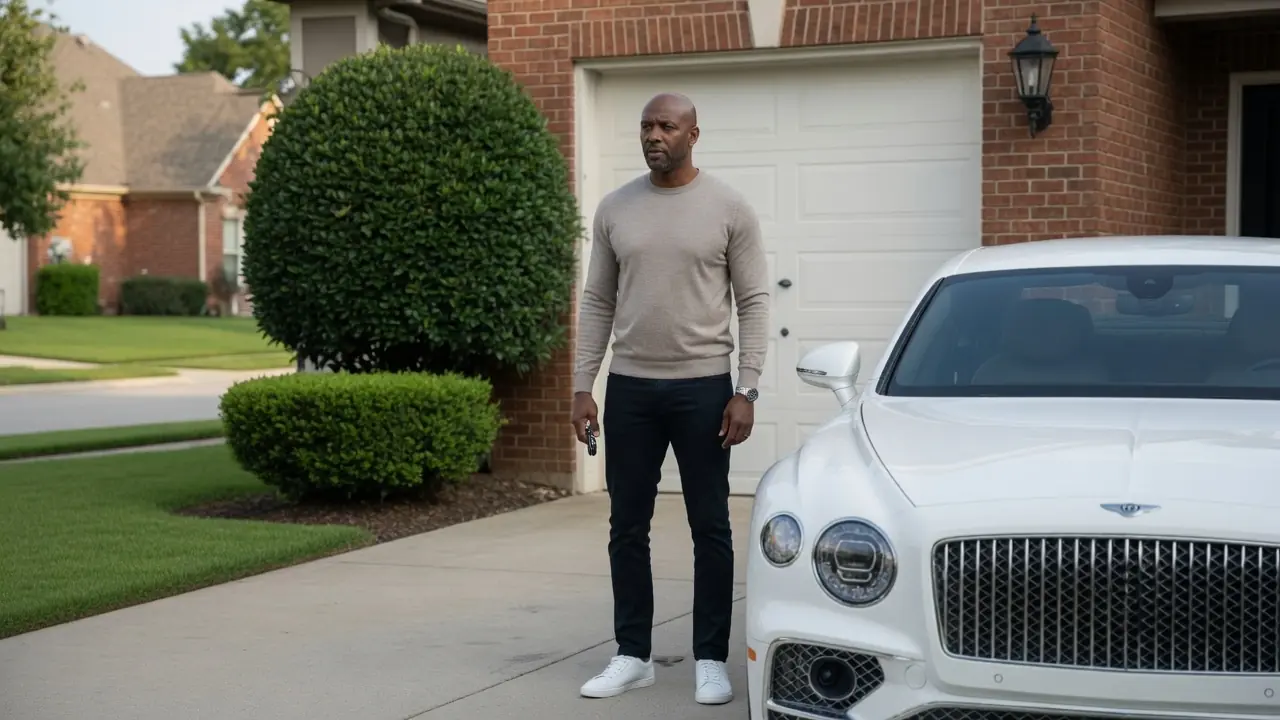
That small mercy almost made him smile.
A little girl from across the street stood near her porch steps, watching him with wide eyes. She could not have been more than seven. Her mother tried to pull her back, but the girl stayed where she was.
“Is that really your car?” she asked.
Her voice was innocent enough to hurt.
Darius looked at her.
“Yes.”
“Are you really everybody’s landlord?”
A few adults shifted uncomfortably.
Darius crouched slightly, not too close.
“My company owns the houses,” he said. “But people still have homes. There’s a difference.”
She thought about that.
“My mom says renters should act grateful.”
Her mother’s face went white.
Darius looked at the woman.
Then back at the child.
“Your mom is wrong about that,” he said gently. “People should act respectful. Owners too.”
The girl nodded as if filing that away for later.
Three hours passed before the patrol cars left.
By then, Briar Glen no longer looked like a postcard.
It looked like a place caught with its mask halfway off.
Denise Caldwell was cited and later charged for vandalism, harassment, and filing a false report. Victor Landry’s son was charged for property damage and trespassing. Victor himself faced charges related to conspiracy and intimidation after more footage showed him directing his son where to avoid street cameras.
The HOA board held an emergency meeting that evening.
Darius attended by video from his kitchen.
He wore a plain black shirt and drank coffee while neighbors who had ignored him for two weeks now stumbled over apologies with the stiff panic of people trying to repair themselves in public.
Victor was not there.
His resignation had arrived by email ten minutes before the meeting began.
Denise appeared on screen once, crying.
“I made a mistake,” she said.
Darius watched her carefully.
“No,” he replied. “You made a series of choices.”
She wiped her face.
“I was scared.”
“Of what?”
She had no answer.
That was the problem.
Fear without evidence often borrows old hatred and calls it instinct.
The meeting grew silent.
An older man named Paul Whitcomb, who lived at number 9, cleared his throat.
“I saw the eggs,” he said.
Several faces turned toward him.
“I was up late. Couldn’t sleep. Saw Kyle near your driveway.” He looked at Darius through the screen. “I should have said something.”
“Yes,” Darius said.
Paul nodded.
“I’m sorry.”
Darius did not rush to forgive him.
That made the apology sit longer in the room.
Then Darius spoke.
“Here is what happens next. Effective immediately, the old HOA is dissolved pending legal review. My company will establish a resident council, but it will not have authority to harass, exclude, or police belonging.”
Several neighbors shifted.
He continued.
“Lease agreements will be reviewed for fairness. Rent will not increase this year. Necessary repairs will be completed, beginning with roofs, drainage, and accessibility issues that the previous owners ignored.”
A woman named Marcy leaned forward.
“Wait. Rent won’t go up?”
“No.”
“But after all this…”
Darius looked at her.
“I did not buy Briar Glen to punish tenants. I bought it because the previous trust planned to sell the land to a developer who intended to clear every house within eighteen months.”
That stunned them.
“What?” Paul said.
Darius opened another document.
“The offer was already drafted. My company outbid them. You would have received notice before summer.”
The same people who had treated him as an intruder now stared at him as if he had pulled them from a burning building.
That, too, irritated him.
He did not want gratitude from people who had given him suspicion first.
He wanted them to understand the difference.
“You were so busy deciding I didn’t belong here,” he said, “that you never asked why I came.”
No one spoke.
Darius ended the meeting ten minutes later.
That night, after his daughter came over, she found him sitting alone on the back patio.
Her name was Maya.
She was fourteen, sharp-eyed, and already old enough to understand that her father’s calm often covered wounds. She wore her school hoodie and carried the box of chocolate cookies he had bought earlier.
“You okay?” she asked.
He looked at her.
“I’m tired.”
“Because of the neighbor thing?”
He sighed.
“You heard?”
“Dad. It’s online.”
Of course it was.
Someone had posted the video.
By midnight, thousands of people had seen Denise accusing him. Thousands more had watched the moment he placed the deed on the patrol car hood and told the neighborhood he owned the street.
Comments flooded in.
Some called it justice.
Some called it karma.
Some made jokes.
Some argued.
Most saw the twist.
Few saw the exhaustion.
Maya sat beside him.
“Are you going to move?”
Darius looked out at the dark line of manicured backyards.
“No.”
“Why not?”
He took one of the cookies from the box and turned it between his fingers.
“Because I bought this place to build something better than what was here.”
“They were horrible to you.”
“Yes.”
“So why help them?”
He looked at his daughter.
That question deserved honesty.
“Because if I only help people who deserve me, I become small.”
Maya frowned.
“That sounds unfair.”
“It is.”
“Do you forgive them?”
“No.”
She looked relieved by that.
He almost smiled.
“Forgiveness is not a rent discount,” he said. “And accountability is not revenge.”
Maya leaned back in her chair.
“You sound like one of your interviews.”
“I was trying to sound like your father.”
She opened the cookies.
“You sound like both.”
Over the next few weeks, Briar Glen changed in ways people could see.
The matching mailboxes stayed.
The lawns stayed trimmed.
The white columns still gleamed in late afternoon light.
But the old certainty had cracked.
Security cameras came down from places they had been pointed at Darius’s driveway. The anonymous neighborhood chat, once full of coded suspicion and polished cruelty, was shut down and replaced by a moderated resident portal where every message showed a real name.
Darius hired a property manager named Carla Nguyen, who had no patience for suburban theater.
At the first resident council meeting, someone complained that the new rules felt “strict.”
Carla looked at the room.
“The old rules allowed vandalism and racial harassment. So yes, these will feel different.”
Maya laughed so hard when Darius told her that later that she nearly dropped her phone.
Repairs began.
The cracked sidewalk in front of number 12 was replaced.
The drainage problem near the cul-de-sac was fixed.
A wheelchair ramp was added to the community clubhouse after an elderly tenant admitted she had not attended a single meeting in three years because she could not climb the steps and had been too embarrassed to say so.
Darius noticed who helped.
He noticed who did not.
Paul Whitcomb brought coffee to the repair crew.
Marcy organized a neighborhood cleanup.
The teenage boy on the bike, whose name was Ethan, came over one Saturday and asked if Darius needed help washing the Bentley.
Darius studied him.
“You were recording that day.”
Ethan looked ashamed.
“Yes, sir.”
“Why?”
“I thought…” He stopped.
Darius waited.
“I thought something bad might happen.”
“To me or because of me?”
Ethan looked down.
“At first, because of you.”
“And then?”
“Then to you.”
Darius nodded slowly.
“That distinction matters.”
“I’m sorry.”
“Good.”
Ethan looked up.
“Does that mean I can help?”
Darius handed him a clean towel.
“It means you can start with the wheels.”
Not everyone changed.
Denise moved out before her court date.
Victor fought the charges, then lost his job when the video and investigation became public. He sent one letter to Darius through an attorney, claiming the neighborhood had been “under stress due to uncertainty in ownership.”
Darius framed none of it.
He did not need trophies of cowardice.
But one letter he kept.
It came from the little girl across the street.
Her name was Sophie.
She wrote in purple marker on lined notebook paper.
Dear Mr. Whitaker,
I am sorry people were mean about your car. My mom says she is learning. I think your car is pretty. I also think people should ask before they yell.
From, Sophie.
Darius taped that one inside his office cabinet.
Not because it fixed anything.
Because sometimes change began as a child noticing what adults tried to explain away.
Three months after the incident, Briar Glen held its first real block party.
Not the old HOA version with wine tables, polite cliques, and rules about approved decorations.
A real one.
Folding chairs in driveways.
Music from someone’s speaker.
Kids chalking on the street.
Food from different kitchens, not all of it matching, most of it better than anything the HOA had ever catered.
Darius almost did not go.
Maya made him.
“You own the street,” she said. “You can survive potato salad.”
“I’m not afraid of potato salad.”
“You’re avoiding awkward white people.”
“Maya.”
“What? Am I wrong?”
He could not honestly say she was.
So he went.
The Bentley stayed in the garage.
He walked down Briar Glen Drive in a short-sleeved shirt, carrying a tray of peach cobbler his sister had made because she said store-bought dessert would dishonor the ancestors.
Conversation dipped when he arrived.
Then recovered.
Awkwardly.
But it recovered.
Paul waved him over first.
Carla Nguyen was already there, eating ribs and looking like she had personally defeated nonsense for the day. Sophie ran up to ask if Maya could help judge the sidewalk chalk contest.
Maya said yes before Darius could ask what the rules were.
There were no rules.
That was the point.
Near sunset, Darius stood by the curb where Denise had first shouted at him.
The street looked softer now.
Children ran where patrol cars had parked. Music floated across lawns where accusations had once gathered. A few neighbors still gave him too much space, but others had begun learning how not to perform friendliness like a legal defense.
Officer Ruiz stopped by near the end of the party.
Off duty.
No uniform.
She carried a paper plate and nodded toward the street.
“Looks different.”
“It is different.”
“Better?”
Darius watched Ethan and Maya trying to help Sophie draw a purple dragon across the pavement.
“Maybe.”
Ruiz smiled slightly.
“That’s cautious.”
“That’s honest.”
She looked at him.
“You stayed.”
He folded his arms.
“Yes.”
“Why?”
Darius thought about the deed packet.
The police lights.
The phones.
The ugly words.
He thought about Maya asking why he would help people who had not deserved him.
Then he looked at the houses, the repaired sidewalks, the open doors, the children writing over the asphalt with chalk.
“Because leaving would have made their story true,” he said.
Ruiz nodded.
“Which story?”
“That I didn’t belong.”
She looked down the street.
“And now?”
Darius watched Sophie place a chalk crown on the dragon’s head.
“Now they have to live with the fact that I do.”
The video of that first day never fully disappeared.
People still shared it sometimes.
They loved the moment when Darius said he owned every house on the street. They loved Victor’s face, Denise’s silence, the stunned neighbors, the sudden reversal. Online, people called it the perfect comeback.
Darius understood why.
But that was not the part he remembered most.
He remembered the milk getting warm in the grocery bag.
He remembered saying his movements aloud before reaching for his wallet.
He remembered the little girl asking if the car was really his.
He remembered how quiet people became when evidence demanded more courage than gossip ever had.
The twist was satisfying.
The truth was harder.
Owning the street did not make the insult painless.
Money did not make racism less sharp.
A deed did not undo the way neighbors watched him for sixteen days and chose suspicion over welcome.
But it did give him something.
Leverage.
And Darius had learned long ago that leverage, used well, could become protection for people who came after you.
A year later, Briar Glen no longer belonged to Whitaker Urban Holdings.
At least, not in the same way.
Darius converted the portfolio into a tenant-ownership cooperative, allowing residents to buy shares of their homes over time at fair rates. Some people cried when they signed the new agreements. Some apologized again. Some never quite knew what to say.
Victor’s old house became a community legal clinic twice a month.
Denise’s former house went to a young family who had been priced out of three other neighborhoods.
The Bentley still sat in Darius’s driveway sometimes, polished black under the maple trees.
No one called the police about it again.
One afternoon, Darius stood beside the car while Maya leaned against the passenger door, scrolling on her phone.
Ethan, now taller and less awkward, walked by with a bucket and sponge.
“Wheels again?” he asked.
Darius tossed him a towel.
“You’re improving.”
“That means yes?”
“That means start before I change my mind.”
Sophie rode past on her scooter and shouted, “Ask before you yell!”
Maya burst out laughing.
Darius watched the little girl disappear down the sidewalk, then looked at the street that had once tried to reject him.
The houses were the same.
The lawns were the same.
The maple shadows still stretched long across the pavement in the afternoon sun.
But something underneath had shifted.
Not perfectly.
Not completely.
But enough to matter.
Because on the day they called the police to prove he did not belong, Darius Whitaker placed a deed on the hood of a patrol car and showed them the truth.
He did not steal the Bentley.
He did not sneak into the neighborhood.
He did not need their permission to stand beside what was his.
And by the time the whole street understood that, the lie they had told about him had already collapsed under the weight of his name, his evidence, and every signature they never thought a man like him would hold.