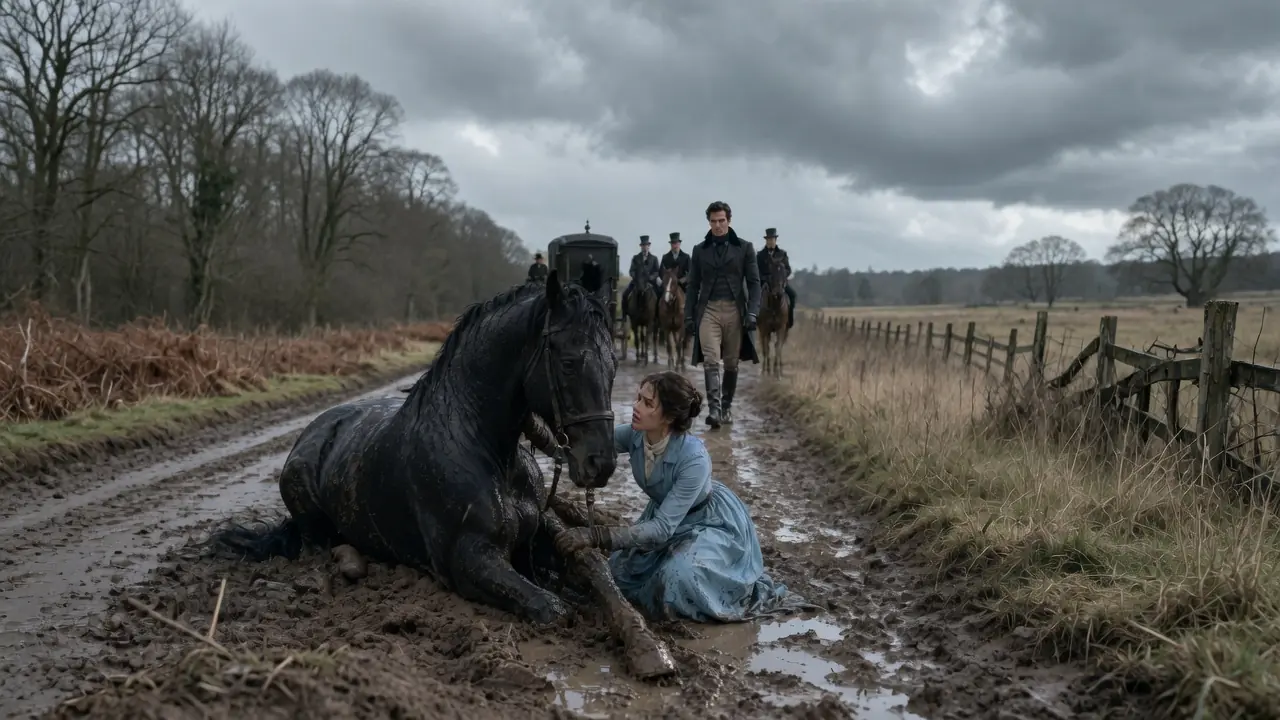
The mud had nearly swallowed the horse whole. It stood trembling in the middle of the road, one foreleg sunk too deep to draw free, the rest of its weight shifting with a desperation that threatened to worsen its plight. The rain had ceased only an hour before, yet the earth still held the storm within it. Each movement of the animal drew a wet, pulling sound from the ground, as though the road itself resisted release.
Miss Georgina Blackmere saw it from the carriage window and knew at once that it would not survive without intervention. "Stop," she said. The driver hesitated only long enough to glance back at her, then obeyed. By the time the wheels had settled, she had already opened the door.
The mud took her boots at once, but she did not pause. The horse's head lifted sharply at her approach, eyes wide, breath uneven, its strength wasting itself in panic. "Hush," she said, low and steady as she drew nearer. "You will only tire yourself."
It did not understand her words, yet it quieted under her voice. That she recognized. Not obedience, but attention. She came within reach and did not touch it at once.
Instead, she waited, allowing the animal to study her, to measure whether she was threat or relief. Only when its breathing slowed did she lay a hand against its neck. The muscles were rigid beneath her palm. She kept her touch firm, unhurried, and spoke again, not for meaning, but for rhythm.
Gradually, the violent shifting eased. The horse stood as still as the mud allowed, its fear not gone, but contained. "Good," she murmured. "We shall do this properly."
It took time. She worked the earth away from the trapped leg with her hands, heedless of the cold. Each small gain mattered. Each inch freed lessened the danger of a break.
When at last the leg came loose, the horse staggered, then steadied, its weight returning where it belonged. Only then did she step back. The sound of approaching riders reached her before she turned. Hooves struck the firmer ground beyond the flooded stretch with a force that spoke of urgency held under control.
The party did not slow until it had nearly reached her. At its head rode a man whose presence required no introduction. He dismounted without haste. His coat was dark, unmarked by travel, his posture exact, his expression composed to the point of severity.
There was mud upon the road, upon the horse, upon Georgina herself. There was none upon him. "Stand away," he said. The command was not raised.
It did not need to be. Georgina did not move at once. She kept her hand upon the horse's neck until it settled again under her touch. Only then did she step back, leaving the space between them clear.
The man's gaze moved first to the animal. What passed across his face was brief and controlled, yet unmistakable to one who watched closely. Recognition. Concern.
Something deeper, restrained at once. He approached the horse with care that did not match his voice. The animal shifted, then stilled again, though its attention returned unmistakably to Georgina. "This is yours?" she asked.
He did not look at her immediately. His hand rested along the stallion's shoulder, testing, assessing. When he did turn, his expression had returned to its earlier composure. "Yes."
There was no elaboration. None was required. "It was caught fast," she said. "It would not have freed itself."
"I am aware." The words were even. They carried neither gratitude nor dismissal, only fact. Georgina inclined her head, more acknowledgement than deference.
"Then it is well that it has been freed." A pause followed. One of the riders behind him shifted, as though uncertain whether something more should be said. The man did not appear to share that uncertainty.
"You have done a service," he said at last. "You will be compensated." The statement was delivered with the same precision as the command that had preceded it. Georgina met his gaze without alteration.
"There is no need, my lord." His attention sharpened, though his posture did not change. "You decline?" "I do."
The horse moved then, a small step, its head turning toward her again. She did not reach for it this time. She merely watched to see that it remained steady. "It is sound?" he asked.
"It will be if it is kept from strain," she replied. "It is not injury that threatened it. It was panic." A second pause.
This one longer. "You handled it," he said. "Yes." "It does not permit handling."
"It did today." That at last altered something in his expression. Not softened, focused. Georgina drew her gloves back into place with hands still marked by mud.
She inclined her head once more and turned without waiting for dismissal to be repeated. By the time she had reached the carriage, she did not look back. Behind her, the Duke of Faulkington remained where he stood, his hands still upon the neck of a horse that had never before yielded so easily. He did not call her back, but he did not forget her.
Chapter 1: The Road, the Storm, and the Stranger.
The mud had nearly swallowed the horse whole. The road that cut through the lower stretch of Witchfield Crossing had never been reliable after heavy rain, and the storm that had passed through the night before had been neither brief nor gentle. What remained in its wake was not merely wet ground, but something closer to living earth, soft, dark, and hungry, pulling at anything that dared press into it. The wheel ruts left by earlier carts had filled with standing water the color of weak tea.
The verge on either side had lost its distinction from the road entirely. It was the kind of terrain a sensible traveler recognized and avoided. Those without the luxury of choice simply endured it. Miss Georgina Blackmere had not chosen this road so much as been delivered onto it by circumstances she had not yet found the language to refuse.
The hired cart beneath her was modest, the driver taciturn, and the countryside through the window gray and stripped of anything that might pass for comfort. She had been watching it without seeing it for the better part of an hour, not from idleness, but because her thoughts had taken up the whole of her attention and left nothing available for the landscape. The letter folded inside her traveling bag had been read twice and required no third reading. Its contents had arranged themselves in her mind with the orderly unpleasantness of things that could not be undone.
Her brother Robert had written plainly, as he always did, and plainly was precisely what made it difficult to argue against. The word arrangement had appeared three times. The name attached to it had appeared once, which was once more than she had wished. She did not allow herself to dwell.
Dwelling had never served her. She turned her attention to the window instead, and that was when she saw the horse. It stood in the middle of the road, or what remained of the road, at a slight turn where the ground dipped toward a natural channel now swollen with runoff. One foreleg had gone in deep.
Not merely wet ground deep, but the kind of depth that gripped rather than released, the kind that responded to resistance by tightening. The animal's attempts to free itself had worsened its position. The leg was sunk past the knee. The surrounding mud bore the evidence of repeated effort, a wide, churned radius of disturbed earth where the horse had fought and failed again and again to pull itself clear.
Its coat was dark with sweat beneath the mud. Its breathing came in visible bursts against the cold morning air. The eyes were wide and white-rimmed, not the wide eyes of simple alarm, but of a creature that had begun to understand, in whatever way animals understand such things, that its strength was failing it. Every shift of its weight drew a wet, sucking sound from the earth.
Every attempt to free the trapped leg threatened to torque the joint at an angle nature had not designed it to sustain. A horse that panicked fully in that position would drive itself deeper, or break the leg entirely, or do both in rapid succession. Any of these outcomes ended the same way. The animal was not merely in difficulty.
It was running out of time, and it knew it, and the knowing was making everything worse. Georgina's hand was on the door before the thought had fully formed. "Stop," she said. The driver turned on his box, unhurried by instinct.
He looked at the horse. He looked at the road. He looked at the mud with the expression of a man who had spent sufficient years among such conditions to have formed a settled opinion about entering them voluntarily. "Miss," he began.
"Stop the cart," she repeated. He stopped the cart. She was already on the ground before he had set the brake. The mud took her boots at the first step, not a gentle sinking, but an immediate, deliberate grip, as though the earth had been waiting.
She adjusted her weight, kept her footing, and moved forward without haste. Speed would not serve here. Nothing about this moment called for speed. The horse heard her approach, and its head came up sharply, neck rigid, another surge of panicked effort gathering in its frame.
"No," she said, quite even. "Be still." It was not a command so much as a fact stated aloud. She did not slow her approach, but she kept every movement deliberate.
No sudden angle, no sharp gesture, nothing that would register as threat. Her voice continued low and unhurried, beneath the words rather than above them, a sound more than a sentence. She was not speaking to it in the way one speaks to a person. She was speaking to the part of it that existed beneath fear.
The horse shifted, did not charge. Its breathing remained ragged, but it stopped fighting the mud. She came within arm's reach and did not touch it yet. That mattered.
She had learned it young, from the stable hands her father had employed before the money ceased to make their employment possible, and she had not forgotten it. You did not reach for a frightened animal. You waited. You made yourself known as something other than a threat, and you let the animal's own intelligence do the rest.
She stood in the mud, cold soaking through to her stockings, and waited. The horse's head lowered by a fraction. Then she laid her hand against its neck. The muscles beneath her palm were iron tense, vibrating with the effort of contained panic.
She did not rub or stroke. She pressed, steady, warm, unmoving, and kept her voice beneath it all like a low current. Gradually, by degrees too small to name individually, the rigidity began to yield. Not to calm, not entirely, but to something that sat between panic and collapse, a kind of exhausted attention.
She began to work the mud. It was slow, cold, unpleasant labor. She used her hands, pressing into the earth beside the trapped leg, relieving pressure from the sides rather than pulling upward. The ground resisted.
She persisted. She spoke throughout, not meaningfully, but continuously, because silence would have been its own kind of signal, and she could not afford the horse to startle. The driver had descended from his box by this point and stood at a cautious remove, unwilling to approach and too uncertain to leave. The leg came free in stages.
First the hoof, then the fetlock, then the rest, with a sound like something slowly relinquishing its claim. The horse staggered at the release, its weight redistributing sharply, and Georgina braced against its shoulder without thinking. It did not knock her aside. It leaned into her briefly, as a tired thing leans toward the nearest steady surface.
She kept her hand where it was and said nothing for a moment. The horse breathed. She breathed. The mud settled around their feet in silence.
She heard them before she saw them. Hooves striking firmer ground at a pace too deliberate to be casual and too urgent to be anything other than purposeful. The sound came from the north. Three horses, she judged, possibly four, moving at a controlled canter that slowed only as the condition of the road became apparent.
She did not turn immediately. She kept her attention on the stallion, one hand still at his neck, waiting until the rhythm of his breathing told her he was sufficiently settled to be left. Only then did she step back and turn. The party had halted at the edge of the flooded stretch.
Four riders. Three of them had pulled up in rough formation, uncertain of the footing. The fourth had continued forward and dismounted onto the firmer ground at the verge's edge with the deliberate economy of a man who acted only when he had already decided what to do. He was tall, broad in the shoulder, dressed for riding in a coat of deep charcoal that had not acquired a single mark from travel.
His bearing did not invite approach. It was not the bearing of a man performing authority. It was the bearing of a man to whom authority had long since become simply the shape of his existence. His face, as he came nearer, was composed to a degree that struck Georgina not as pleasantness, but as control, the particular stillness of a man who had trained his expression to reveal nothing it did not intend to reveal.
He looked at the horse first. Whatever he felt in that moment, it was brief, and he closed it quickly. But it had been there, a fraction of a second in which his composure gave way to something unguarded, and Georgina had seen it before it was gone. He approached the stallion with measured care, his hand extended, palm out.
The horse shifted. Its attention moved between the man and Georgina, then returned unmistakably to Georgina. The man's gaze followed the same path. "How long," he said, "was it in the ground?"
His voice was even, precise, and pitched low enough that it did not carry further than necessary. It was not a voice that had acquired the habit of softening itself. "I cannot say with certainty," Georgina replied. "Long enough to exhaust it."
The earth was packed around the foreleg. "You freed it." "Yes." He said nothing for a moment.
His attention moved back to the stallion with the focus of a man conducting an assessment. He ran his hand along the animal's foreleg, checking the joint, the tendon, the hoof. The horse tolerated it, though its head turned toward Georgina twice during the process. "It is sound," he said at last.
This appeared to be directed at himself as much as anyone. He straightened and regarded her with the same focused attention he had given the horse, though the nature of it was different. He was not assessing damage. He was measuring something else, something she could not immediately name.
"You are traveling alone," he said. "With a driver," she replied. "Who is there?" She indicated the man who had retreated a further yard during the examination and looked as though he would have preferred a further yard still.
"Where are you bound?" "That is not a matter that concerns the road, my lord." The pause. One of the riders behind him shifted in the saddle.
The duke, for she had identified him by then, though she did not yet have a name, showed no reaction to the mildness of her correction. "You have rendered a considerable service," he said. "I shall see you compensated for the inconvenience." "There is no need."
"There is every need." "The animal is" He stopped. A slight adjustment in his posture. "The animal is of particular value."
"I did not assist it on the grounds of its value," she said. "I assisted it because it required assistance. The compensation you propose would suggest a transaction. There was none."
The silence that followed this was not hostile. It was, if anything, more attentive than what had preceded it. She became aware, then, that the stallion had moved. Not far, a single step, but the step had brought it closer to her rather than to the man who owned it.
Its shoulder was nearly at her arm. It did not press, did not demand. It simply positioned itself in her proximity with a quiet preference that required no explanation. The duke observed this without expression, or rather, with the expression that served him in place of expression, the composed, measuring stillness of a man absorbing information he had not anticipated.
"It does not permit handling," he said. "It permitted mine." "I am aware." The beat.
"That is unusual." "Perhaps," Georgina said, "it found the handling familiar enough not to resist it." He studied her for a moment longer than was strictly necessary for a stranger on a public road. Not with impropriety, nothing in his bearing permitted that reading, but with a degree of attention that did not pretend to be less than it was.
"Your name," he said. "Miss Georgina Blackmere." He inclined his head, the gesture fractional and precise. "Frederick Stanhope, Duke of Faulkington."
She did not alter her expression. She had suspected rank. The confirmation changed nothing she intended to alter. "Your grace," she said, and it was acknowledgement rather than submission.
Something in his face shifted, not toward warmth, but toward a kind of recalculation. She was not certain he was accustomed to the distinction. "You may go, Miss Blackmere," he said. "The horse will be seen to."
"Keep it from strain for a fortnight," she said. "The joint is sound, but it has been under considerable stress. Cold water on the foreleg, morning and evening, for the first week." He received this without visible response.
"I have a head groom." "Then tell him," she said simply, and turned toward the cart. She did not look back as she climbed in. She did not look back as the driver urged the horse forward, nor as the cart moved past the flooded stretch and onto firmer ground.
Whatever had passed in those minutes on the road, it was finished. She had a letter in her bag and a destination she had not yet chosen how to face, and neither of those things had changed. Behind her, on the road, the Duke of Faulkington stood with his hand on the neck of the horse that had not yet taken its attention from the retreating cart. He did not call after her.
He did not need to. He had her name. He had seen what the horse had shown him. And he was not, whatever else might be said of him, a man who failed to recognize when something of genuine rarity had passed briefly within his reach.
He looked at the stallion. The stallion looked after the cart. He understood the sentiment entirely.
Chapter 2: The Summons and the Estate.
The letter arrived before breakfast. Georgina was already at the small table by the window of the inn when the landlord's daughter brought it up, folded and sealed with plain wax, her name written on the outside in a hand that was precise without being ornate. She did not recognize it. She turned it over once, broke the seal, and read.
It was brief. The Duke of Faulkington did not appear to be a man who used language for purposes beyond communication. He wrote that his stallion had refused all handling since its return to Faulkington Hall the previous afternoon. He wrote that this refusal was not without precedent, but that the circumstances of its current recovery made it a matter requiring resolution rather than patience.
He wrote, without elaboration, that he wished to engage her services on a temporary basis for the purpose of overseeing the animal's recovery and daily management, and that she would be accommodated at Faulkington Hall for the duration. A figure was named. It was not an extravagant figure, but it was a precise one, and precision, she had learned, was more trustworthy than generosity. She set the letter down and looked at the window.
The view from the inn offered little, a narrow yard, a gray sky, the sound of a cart on cobblestones below. She had been at this inn for two nights, which was one night longer than she had originally intended, because the question of where to go next had not yet produced a satisfactory answer. Her brother Robert's letter remained in her traveling bag, still folded, still legible in her memory without requiring retrieval. The arrangement he proposed was with a Mr. Aldous Fenwick of Sutton Grange, a widower of 51 years, solvent, respectable, and possessed of a temperament described by Robert as steady, which Georgina had understood to mean immovable.
Robert had not asked whether she wished to meet Mr. Fenwick. He had asked whether she could be available to do so by the end of the month. She was 24. She was not without capability.
She was, however, without income, without her father, and without any of the protections that would have made refusal straightforward. The small sum she had saved from the two years she had spent managing her father's household had lasted well and was now lasting less well. It would not outlast the season without either income or the particular compromise her brother called a sensible resolution. She picked up the Duke's letter again.
Temporary, he had written. Functional. The horse required a specific form of management he could not currently provide. She was, by apparent accident of character or circumstance, the only person who could provide it.
There was nothing in the proposal that required her to feel anything about it beyond the practical. She did not need to admire the Duke or find Faulkington Hall agreeable. She needed the income it represented and the time it would purchase her to decide what came next without Robert's calendar pressing against her back. She called for paper and ink.
Her reply was as brief as his letter had warranted. She accepted. She would arrive the following morning. She requested only that her role be clearly defined upon arrival and that her accommodation be separate from the household staff, as her position was neither servant nor guest, and she intended to conduct herself accordingly.
She signed it, sanded it, and sent it before she had finished her tea. It was not a romantic decision. It was the only sensible one available to her, and she made it with the same composure she had applied to the mud. Faulkington Hall announced itself a full quarter mile before the carriage reached its gates.
The avenue of approach was lined with elms, old and uniform, planted at intervals so exact they suggested not natural growth but instruction. The gate posts were stone, unornamented, and without the small signs of weather and age that might have lent them familiarity. The iron between them had been maintained to a standard that bordered on severity. Everything about the entrance communicated order, sufficiency, and a complete indifference to whether the approaching visitor found it welcoming.
Inside the gates, the grounds continued in the same spirit. The lawns were level. The gravel had been raked. The hedges held their geometry with a precision that required consistent labor and a very particular kind of attention.
It was a beautiful estate in the way that formal gardens were beautiful, through the application of will rather than the permission of nature. The house itself was large, late baroque in its proportions, faced in pale stone that the morning light rendered almost colorless. Its windows were tall and regularly spaced, its chimneys symmetrical, its steps swept clean. Nothing about it was neglected.
Nothing about it was quite warm. The housekeeper who met her at the door was a woman of middle years named Mrs. Alcott, whose manner was impeccable and whose expression managed to be entirely correct without ever approaching approachable. She welcomed Georgina with the exact degree of courtesy appropriate to a person of uncertain station, showed her to a room on the upper floor that was neither lavish nor spare, explained the household's general hours, and departed with the efficiency of someone who had delivered this orientation many times and saw no reason to vary it. The staff, as Georgina observed them over the first hour, moved through the house with the same quality.
They were not unhappy, as far as she could determine. They were simply exact, precise in their tasks, silent in their transitions, self-contained in a way that suggested not contentment but long training. She passed two footmen in the corridor who acknowledged her presence with the correct degree of acknowledgement and nothing additional. She passed a housemaid near the stairs who stepped aside without looking up.
The house ran like a mechanism, thoroughly, reliably, and without the small frictions of ordinary human feeling that usually accumulated in places where people spent their days. What it lacked, she identified clearly before noon. It lacked the sound of conversation that was not functional. It lacked the kind of movement that existed for its own sake, a kitchen maid humming, a groom whistling, the small unauthorized noises that any collection of people eventually produced regardless of what they were told.
These were not major things. They were not things a person would list as requirements for a habitable household, but their absence was its own kind of fact, and Georgina noted it with the same attention she gave to everything else. She asked to be taken to the stables directly after her room. The head groom, a compact and weathered man named Partridge, received her with a weariness that was at least honest.
He had been given instruction by the Duke, evidently, and was prepared to comply with it, though his compliance had the quality of a man submitting to an arrangement he found unnecessary. He led her to the stallion's box without comment. The horse knew her before she reached the door. She heard it, a shift of weight, a low sound, attention rather than alarm, and when she drew the bolt and stepped inside, it turned toward her with a recognition that was immediate and unambiguous.
She stood and let it come to her, which it did, its nose dropping toward her shoulder with the ease of a much longer acquaintance. She kept her hand at its neck and checked the foreleg, which was cool and showed no swelling. Partridge, watching from outside the box, said nothing for a moment. He put a hoof through the wall this morning, he said at last.
When Thomas went in. Did Thomas make any sudden movements? The pause. Thomas is a careful lad.
Careful is not the same as unhurried, Georgina said. It reads intention before it reads action. If the intention is uncertain, it responds to the uncertainty. Partridge looked at the horse, which had settled its weight against Georgina's side with the ease of a dog.
He did not comment directly on this. His Grace said you were to have authority over the handling. Yes, she said. For now, I should like no one to enter this box without my knowledge.
Not from distrust of your staff, but because consistency will settle it faster than rotation. He nodded once, shortly, and withdrew. The Duke received her in the estate's ground floor study that afternoon. The room was as she might have expected, ordered, substantial, undecorated by anything not in active use.
Maps and ledgers occupied the large table near the window. A correspondence tray on the desk held papers arranged by size. The fire was lit but not generous. He was standing when she entered, which was not precisely a social courtesy.
It had the quality of a man who spent little time seated when he could be standing. Miss Blackmere, he said, I trust your accommodation is satisfactory. Entirely, your Grace. Good.
He moved to the desk, not to sit at it but to stand before it, which put the surface between them with the naturalness of long habit. I will be direct with you. I would prefer it, she said. He studied her briefly, as though confirming that this was genuine rather than performed.
The stallion's name is Caspian. He is 7 years old and has been in my possession for four of those years. His temperament has always required careful management, and the accident on the road has compounded what was already a complicated matter. My head groom is competent.
The animal will not permit him near it at present. I observed that, she said. It is not a permanent state. It requires time and a consistent approach.
I do not require your assessment of the permanence. I require the problem resolved. He said this without heat. It was a statement of fact, as his communications tended to be.
Your role here is temporary. You will oversee Caspian's recovery and reintroduce him to regular handling. When he can be managed by my staff without incident, your engagement concludes. That is understood, she said.
I have two conditions. The word conditions appeared to give him a fractional pause, though he did not show it in any large way. Proceed. I will not be countermanded in the stable yard.
If I give an instruction regarding Caspian's handling, your staff will follow it. I will not undermine Mr. Partridge's general authority, and I will explain my reasoning when it is asked for. But in the matter of this horse, I must be consistent, and consistency is not possible if it can be overridden. And the second, I should like access to the grounds for early morning exercise.
I find that early hours are the most useful for the work, and I will not require accompaniment. He looked at her for a moment in the way that had already become recognizable, the focused, even assessment of a man who was not deciding whether to agree but whether the agreement would hold. Both conditions are acceptable, he said. Thank you, Your Grace. She turned to leave.
Miss Blackmere. She paused at the door. You said this morning, he continued, that it reads intention before action. Yes.
You meant the horse. I did, she said, and left him to determine whatever he wished to make of it. The mornings at Faulkington Hall began early and for Georgina in the stables. She arrived each day before the yard was fully active in the gray interval between dark and proper light, when the horses were still and the air held the particular quiet of a place not yet populated by purpose.
She worked with Caspian in that quiet, not drilling, not demanding, but simply being present. She moved around him, handled his legs, introduced the sounds and objects that belonged to ordinary stable life, and allowed him to determine the pace at which familiarity returned. He recovered steadily. The foreleg remained cool.
His appetite, which Partridge had noted as poor in the first days, improved by the end of the first week. His willingness to be approached by others, the gradual, supervised reintroduction that she managed with care, moved more slowly, but it moved. She noticed, around the fifth day, that the stable hands had begun to linger slightly longer in the yard during her morning hours than their duties strictly required. Not obtrusively.
Not in a way that invited comment. They simply found reasons to be nearby. Young Thomas, who had suffered the incident with the wall, began asking quiet questions, not about Caspian specifically, but about horses in general, their temperaments, the way they communicated what words could not. She answered him plainly and without making an occasion of it, and he absorbed the answers with the seriousness of someone who intended to use them.
Mrs. Alcott, by the second week, began to say good morning with something that resembled sincerity beneath its correctness. The duke came to the stables on the fourth morning. He came on the sixth. By the ninth, it had become, without either of them having agreed to it, a regular occurrence.
He did not interfere. He stood at the box door or near the yard fence with the stillness of a man accustomed to watching things that required patience, and he watched. Occasionally, she spoke to him, a brief report on the foreleg, an observation about Caspian's progress. He received these with the same measured attention he gave everything.
On the 11th morning, he asked how long she had worked with horses. Since I was old enough to follow the stable hands without being sent back, she said, not looking up from Caspian's foreleg, which she was checking with habitual care. He said nothing for a moment. You were not sent back, he said.
Not often, she replied. Eventually, they stopped trying. It was not a story. It was not an invitation.
It was simply a fact offered in the same practical spirit as everything else she said. But she heard, in the pause that followed it, something she had not heard from him before. Not warmth. Not yet.
But attention of a different quality, not the assessment of a problem requiring resolution, but the attention of a man who had heard something that interested him and had not yet decided what to do with that interest. Caspian shifted under her hand, easy and unhurried. Georgina kept her eyes on the horse. The horse, she had long believed, did not respond to force or volume or the performance of confidence.
It responded to the presence of something genuine, something that did not need to announce itself because it simply was. You could not deceive it. You could not perform your way past it. It knew.
She had not yet decided whether the same was true of the duke. But she was beginning to suspect it.
Chapter 3: Intimacy, Truth, and Fracture.
It began, as most things of consequence do, without announcement. There was no single morning on which the quality of their exchanges changed. There was no identifiable afternoon on which the formality between them thinned to something more personal. It happened the way a season changes, not in a moment, but across a series of small accumulations, each one unremarkable in itself, each one building upon the last until the sum was undeniable.
Georgina noticed it first in the stables, which was where she noticed most things, because the stables were where pretension became impractical. A person standing in a stable yard at half past six in the morning, cold-fingered and purposeful, did not have the resources to also perform social distance. The duke, whatever else he was, appeared to understand this. He came to the yard each morning in his riding clothes, without the apparatus of his rank, and he watched her work with the focused attention of a man who had learned to observe before he acted.
The questions began in the second week. They were practical at first, about Caspian's progress, about the methods she used, about whether the foreleg would bear full work by spring. She answered directly, and he received her answers without the habit some men had of repeating them back in slightly altered form to suggest the thought had originated with themselves. He simply listened, and then he asked something further.
By the third week, the questions had moved past Caspian. He asked about her father's estate. Not intrusively, as one asks about geography, to understand the shape of a landscape. She told him it had been modest, well-managed for most of her childhood, and less well-managed toward the end.
She did not elaborate on the end. He did not press. She asked, in return, whether he had always preferred this particular breed of horse. It was a small question.
He paused over it longer than its size warranted before answering that he had come to prefer it in his mid-twenties, and that the preference had outlasted the circumstances that had produced it. She noted the qualification and did not pursue it. The library entered their routine by accident. She had gone one evening to find a volume on equine anatomy.
She had mentioned to Partridge that the estate library might hold something useful, and Partridge had looked at her with the expression of a man who had never entered the library for any purpose and could not confirm or deny its contents. The duke was already there when she arrived. He did not appear surprised to see her, which suggested either that he had been told she might come or that very little genuinely surprised him. He showed her where the natural philosophy texts were shelved without being asked, and when she found what she needed and ought to have left, she did not immediately leave.
There was a conversation about land drainage that began with a map on the table and concluded, somehow, with a discussion of which parts of the county had been worst affected by the previous autumn's flooding. She was not certain how they arrived there. She was certain that when she finally did leave, the fire had burned After that, the library became a possibility on certain evenings. Not a scheduled one.
Not an agreed-upon arrangement. Simply a place where, on occasion, both of them happened to be, and where the conversation that had begun in the stable yard could continue without the cold. The corridors offered something different. Unplanned encounters had their own particular quality.
They removed the small preparatory distance a person assembled before an expected exchange. She rounded a corner near the east wing one afternoon and nearly walked into him, and for a fraction of a second, before composure reasserted itself on both sides, she saw something unguarded in his face. Not distress. Simply presence.
A man, unrehearsed, inhabiting his own expression. It lasted less than a breath, but she did not forget it. He had begun, she realized, to look for her. Not obtrusively.
Not in any way that could be named and examined directly. But a person who spent sufficient time in a house learned its rhythms, and she had begun to identify the particular quality of attention in a room that had, moments before, contained him. She did not examine what she felt about this. She allowed it to exist without inspection, because inspection had a way of changing things, and she was not yet certain she wanted this thing changed.
She learned about the brother on a Tuesday, from Partridge. It was not deliberate on the groom's part. They had been discussing Caspian's reintroduction to the outdoor paddock, and she had asked, practically, without particular significance, whether the horse had always been kept at Faulkington Hall. Partridge had said no.
He had said the horse had come from the adjoining estate, Larkmere, following a reorganization of its stables. He had said this with the particular carefulness of a man choosing words that avoided other words, and that carefulness was what made her ask further. What she received, in pieces and with the reluctance of a man who considered it not entirely his to give, was this: The Duke had a younger brother. His name had been Edmund.
He had been 22 years old and by all possessed of the kind of ease and natural warmth that his elder brother had never displayed and in private may have valued precisely because of its rarity. Edmund had ridden well, but not carefully. He had been, in the way of younger brothers who grow up in the shadow of a formidable elder, somewhat inclined to prove himself at inconvenient moments. Three years ago, on the grounds of Larkmere, he had attempted a jump his horse refused, been thrown, and struck the stone wall of the field boundary in a manner that no one who was present had subsequently found easy to describe.
He had not recovered consciousness. He had died the following morning with his brother at his side. Caspian had been Edmund's horse. Georgina stood in the paddock for some time after Partridge retreated to the yard.
Caspian moved beside her, unbothered, cropping at the winter grass with the contentment of an animal whose world had narrowed to immediate and manageable pleasures. She kept her hand at his shoulder and looked at the far tree line and did not speak. She thought about the Duke's face on the road, that brief, controlled fracture of composure when he had first seen the stallion in the mud. She thought about the way he handled the animal, with care that did not match his voice.
She thought about what it meant to keep a horse that was both a reminder and a wound, to refuse to part with it, to maintain it at the highest standard, to require that it be treated well even when it would not permit treatment. She had read him incorrectly. Not entirely. His severity was real, his control genuine, but she had read them as character when they were, at least in part, history.
The coldness was not simple nature. It was grief that had been running too long without outlet, compressed into the shape of discipline. He had not become unreachable because he did not feel. He had become unreachable because he felt too much and had found, in the aftermath of Edmund's death, that the only survivable option was to feel it in perfect silence.
That evening, when they were in the library, she looked at him differently. He noticed, because he noticed everything, and his gaze met hers with a directness that asked the question without language. She did not pretend the look had not occurred. "I spoke with Partridge today," she said.
The pause. His expression did not alter, but something behind it settled, the way a person settles when they have been waiting for something and it has finally arrived. "I see," he said. "I am sorry," she said, "about your brother."
He was quiet for a moment. "It was 3 years ago." "Yes," she said. "That is not very long."
He did not answer this. He turned toward the fire and she allowed him the angle, and they sat in a silence that was different from the silences that had preceded it, not the silence of two careful strangers, but the silence of two people who had arrived at the same understanding from different directions. After some time, he said, "He was the better rider." "By instinct."
"He had a lightness with horses that I have never possessed." The pause. "He rode Caspian as though the animal had been made for him." Georgina said nothing.
She understood that this was not a moment for response, but for receipt. "I could not sell him," he said, "after." "No," she said quietly. "I imagine you could not."
The storm arrived on a Thursday evening without significant warning. It had been threatening since midday, a low gray pressure in the sky, the particular stillness of air before it becomes wind, but it held its restraint until after supper, when it abandoned restraint entirely. The rain struck the windows in successive waves. The candles in the library guttered when the draft found the gaps in the casements, which it did persistently, and the fire required frequent attention to remain useful.
Georgina had come to return a volume and had not left, partly because the rain made leaving impractical and partly because the conversation had not concluded. They had been discussing, of all things, the matter of land inheritance as it related to entailment, which had arisen from something she had read and which he had views on, precise and unsentimental. She had disagreed with one of them. He had not responded to her disagreement with the performance of patience that men sometimes produced when women contradicted them.
He had responded with a counterargument, which she had found more respectful than agreement would have been. The storm deepened. The candles required relighting. At some point, the hour had advanced beyond what either of them had tracked.
"You are not what I expected," he said. It was stated without preamble, in the way he stated most things, directly, as though the conclusion had been reached through deliberate process and warranted delivery without softening. "What did you expect?" she asked. "Someone more cautious."
"I am cautious," she said. "I am cautious about the things that warrant it." He looked at her. The firelight was the primary source of illumination by then, the candles on his side of the room having burned low without replacement, and it gave the room a warmth the rest of the house generally withheld.
"And I do not warrant it?" he asked. The question sat between them with a weight it had not carried in earlier conversations. She was aware of the hour, of the fire, of the storm against the glass, of the particular quality of a room when it has contracted around two people and the rest of the world has temporarily ceased to make its claims. "I have not yet decided," she said.
He was still. The kind of stillness she had come to distinguish from mere composure, not absence, but the presence of something held with great deliberateness. "Georgina," he said. It was the first time he had used her name without her title.
Neither of them remarked on it. Neither looked away. Then a door opened somewhere in the corridor, a servant on some late errand, the sound of footsteps that approached and then receded, and the room's particular quality shifted, the spell broken not by anything dramatic, but by the simple reinsertion of the household around them. Not physically, he did not move.
But the stillness changed its nature, returned to composure, and the moment that had been forming quietly between them withdrew to wherever such moments went when they were not permitted to complete themselves. "It is late," he said. "Yes," she agreed and rose and said good night with the steadiness of a woman who had not just felt the ground move beneath her, though she had. The letter from Robert arrived on Friday morning.
It was in tone more pressing than his previous correspondence. He had received no firm answer regarding Mr. Fenwick. He wished her to understand that Mr. Fenwick's patience was not unlimited. He wished her further to understand that her current engagement, whatever its practical merits, was not a permanent solution to circumstances that required a permanent solution, and that a woman of her age and position could not afford to mistake temporary employment for independence.
She read it twice. She folded it. She placed it in her bag alongside the first one. She might have managed it, set it aside, continued the mornings with Caspian, continued the evenings in the library, continued the slow and unannounced thing that had been building between herself and the Duke, had it not been for what Mrs. Alcott said that afternoon.
It was not said with intention. It was said in passing, in the way that household intelligence moved through the staff of any large estate, quietly, between tasks, without full awareness of consequence. Mrs. Alcott had been speaking to the under housekeeper in the corridor outside the linen room, and Georgina had been approaching from the far end, her footsteps quieted by the runner, when she heard her own name used in conjunction with a phrase she had not expected. The inheritance matter, and then, clearly, "His Grace is said to require a family connection on the northern side before the new year, or the Faulkington entail passes to the Cresswell branch."
She stopped walking. She stood in the corridor and heard, in the silence that followed her stopping, the pieces of the past weeks rearrange themselves with the cold efficiency of a new interpretation. The summons. The precise figure in the letter.
The conditions accepted without resistance. The library evenings. The questions. The attention of a man who had previously given his attention to very little beyond his estate and his grief.
She had read it as something emerging, something genuine, something that moved at the careful pace of two people who did not move carelessly. She had not asked why she had been summoned beyond Caspian. She had not thought to ask, because the answer had seemed apparent. She walked to the stables.
She stood with Caspian for a long time, her hand at his neck, his breathing steady beneath her palm. He leaned into her with the trust of an animal that had given itself over entirely and expected, on the basis of all available evidence, to be held safely. She thought about what it felt like to discover that the ground had been less solid than it appeared. She did not weep.
She was not built for it, and it would not have helped. But something that had been quietly, carefully opening inside her over the preceding weeks drew itself closed again with the precision of a thing that had survived being wrong before and knew how to contract in order to survive being wrong again. She would not wait to be used or dismissed. She would not remain as a convenient solution to a legal complication dressed in the language of feeling.
Caspian turned his nose toward her shoulder. She steadied herself against his warmth and she began quietly and without drama to think about leaving.
Chapter 4: Separation, Confession, Resolution.
She packed with the same economy she applied to everything else. There was not a great deal to pack. She had come with a single trunk and a traveling bag and neither had acquired much in the weeks at Faulkington Hall beyond a few additional items purchased from the village. A length of practical wool, a second pair of gloves, a small volume on Northumbrian land management she had found in a second-hand stall and could not leave behind.
These she folded and arranged with care not because the task required it but because having something deliberate to do with her hands kept the rest of her from being too loud. The decision had been made on Friday evening after the stables, after Caspian. She had returned to her room, sat with the two letters from Robert arranged before her on the small writing table and examined her position with the honesty it deserved. Caspian was recovered.
His foreleg had been sound for a week. He accepted Partridge's handling now without incident and young Thomas could enter the box without drama. The purpose for which she had been engaged was by any practical measure complete. She had already remained longer than the original arrangement strictly required and she had told herself this extension was warranted by the horse's continued adjustment.
She understood now that she had not been telling herself the full truth. She had been staying because she wished to stay. Because the mornings had become something she moved toward rather than simply into. Because the library had become a room she associated with the particular pleasure of a mind meeting its equal without ceremony.
Because the Duke of Faulkington had ceased somewhere in the past weeks to be a problem she was solving and had become something she did not have adequate language for and the inadequacy of the language had felt briefly like possibility. She was not naive. She had never been naive. But she had allowed herself in the warmth of accumulating evidence to stop asking the question that ought to have been asked at the beginning.
Why, precisely, had she been summoned? Not why had the letter been sent, that she had accepted at face value, but why had the terms been so specific, the accommodations so deliberately positioned, the engagement extended so easily beyond its original scope? The inheritance matter. A family connection on the northern side before the new year.
She was the daughter of a gentleman with northern holdings, however diminished. She was unmarried. She was already within the house. She was, if one looked at it without sentiment, convenient.
That word had appeared in Robert's letter in a different context, but it sat in her mind now with new and unwelcome application. She would not be convenient. She would not allow weeks of genuine feeling, because it had been genuine, she was sufficiently honest to acknowledge that, to be resolved into a practical transaction dressed in the borrowed clothes of intimacy. If she was wrong about his motives, leaving would reveal it.
If she was right, leaving was the only dignified response available to her. She continued packing. The house had changed since her arrival and she was aware of this in a way that made the leaving heavier than it might otherwise have been. Not dramatically changed.
Faulkington Hall was not a place that admitted drama. But the small, accumulated differences were visible to anyone who had known it before and after. The stable yard held more noise than it had. Thomas had begun to whistle, not boldly, but in the private way of someone who had forgotten to suppress it.
Mrs. Alcott's morning greetings had developed a quality that was not warmth but was at least its near neighbor. The footmen in the east corridor had begun to acknowledge her with something approaching actual recognition rather than performed invisibility. Even the rooms, she thought, felt less like a mechanism and more like a house. She could not stay to observe it further.
She folded the last item, closed the trunk and sat down to write the letter she would leave for the Duke. It would be brief and clear. It would thank him for the engagement, confirm that Caspian was fully recovered, state that her role was therefore concluded and wish him well in terms that were correct without being cold. She would not explain herself at length.
Explanation required a foundation of certainty she no longer possessed and she would not construct one from feeling alone. She wrote the letter. She sealed it. She set it on the table where it would be found.
She did not sleep easily that night but she had not expected to. He learned of it from Partridge. This was not how Partridge had intended it. He had come to the study on Saturday morning for the routine weekly report on the stable accounts and somewhere in the course of delivering it he had mentioned, with the carefully neutral tone of a man who had formed a view he was not being asked for, that Miss Blackmere's trunk had been carried to the front hall and that she had asked him to thank the stable staff on her behalf.
The Duke received this information without visible response. He completed the stable accounts review. He asked the three questions he habitually asked. He thanked Partridge and indicated the meeting was concluded.
Partridge withdrew with the discretion of a man who had said what he had intended to say and considered his part in the matter complete. Frederick remained at the desk. He had known, in the way that a man knows things he has not permitted himself to examine directly, that this had been coming. The letter from her brother, he was aware of its arrival as he was aware of most things that entered his house, had not been answered, which meant it was being answered in other ways.
He had watched her in the library on Thursday evening after the almost moment that neither of them had named and he had seen the particular quality of a person recalibrating. He had told himself it was the hour, the storm, the firelight. He had been, for a man of his established habits of self-honesty, considerably less than honest. He had not acted.
He had returned to his composure, which was where he returned to everything, and he had applied to the situation the same management he applied to all situations that threatened to exceed the boundaries he had constructed around himself. He had waited. He was good at waiting. He had been waiting for 3 years in one form or another and the skill had become so practiced that it had started, at some unmarked point, to feel like choice rather than avoidance.
She had not waited. That was the difference between them and it struck him now with a clarity that his composure could not quite absorb. He stood. He moved to the window and looked at the front drive, not because he expected to see anything of use there but because motion of any kind was preferable to the stillness that had been pressing at him since Partridge left the room.
The morning was clear, cold and indifferent to his interior state. The elms along the avenue held their positions with the reliability of things that did not require feeling in order to function. He thought about Edmund. He thought about the way grief, when it had no legitimate outlet, found its own channels regardless.
He had directed his into discipline, into order, into the perfect management of an estate that ran without friction and felt without warmth. He had believed, because it was easier to believe, that this was sufficient. That a life maintained to the highest standard of function was a life being lived rather than a life being administered from a careful distance. She had entered that distance without asking permission.
Not through force, there was nothing of force in her, but through the steady, unhurried application of a presence that did not adjust itself to make him comfortable. She had been honest when honesty was inconvenient. She had contradicted him when she thought him wrong. She had sat with him in a library while a storm threw itself against the windows and spoken to him as though he were simply a man and the simplicity of it had been, after 3 years of being regarded as weather rather than a person, very nearly more than his composure could bear.
He had said her name. Just that, her name without the title, without the formal distance it represented and in the fraction of a second before the door in the corridor had interrupted what was forming, he had seen in her face that she had received it. That she had understood. And then he had retreated.
As he always retreated. Into the safer architecture of civility. He turned from the window. She was not going to remain as a convenient resolution to anything.
He had understood this about her from the road, from the moment she had declined his offer of compensation with a directness that had left him, briefly, without the usual available responses. She would leave and she would be right to leave and Faulkington Hall would return to its prior condition of perfect, uninhabited order and he would administer it from his careful distance until there was nothing left of him worth administering. He was already moving before the thought had formally concluded. She was at the foot of the entrance steps when he came through the door.
She had said her goodbyes to Mrs. Alcott, who had received them with the expression of a woman suppressing something she had not been asked to express. The hired carriage was on the drive. Her trunk had been loaded. She had her bag in hand and had turned to descend the last step when she heard the door behind her and recognized, without turning, the particular weight of his footfall.
She stopped. She did not turn immediately. Miss Blackmere. His voice was even.
It was always even, but there was something beneath the evenness that she had not heard in it before. Not volume, not heat, but a quality of effort, as though the composure was being maintained at a cost it did not usually carry. She turned. He was standing at the top of the steps.
He had come without his coat, which for a man of his habits indicated a degree of haste that he would not ordinarily have permitted himself. His expression was composed, but his eyes were not. Your grace, she said. The title was not coldness.
It was a door held open that he could choose to step through or not. He descended two steps, stopped. Caspian is recovered, he said. Yes.
You consider your engagement concluded. It is concluded, she said, by its own terms. The pause. The carriage horse moved in its traces.
The morning air was still and cold. I am aware of what you heard, he said. The inheritance matter. She met his gaze and did not look away.
Then you understand why I am leaving. I understand why you believe you should leave, he said. I am asking you to hear me before you do. She waited.
He came down the remaining steps. He stopped at a correct distance. Not the distance of a man performing propriety, but the distance of a man who understood that what he was about to say would only mean something if it was said without the appearance of pressure. I did not summon you to Faulkington Hall for the inheritance, he said.
The matter exists. I will not pretend otherwise, but it had no part in the letter I sent you, and it has had no part in any day of your presence here. He paused. I am not a man who speaks easily of what he feels.
You know this. You have known it for some weeks, I think, and you have been patient with it in the way you are patient with things that require time rather than force. She said nothing. Her hands were steady at her sides.
You did not only recover the horse, he said. You are aware of this. I believe you have been aware of it for longer than I have, because you see things before I have finished deciding whether to look at them. Something in his expression shifted.
Not softened, not broken, but opened in the way a room is opened when a window is raised and the air that enters is cold and necessary and entirely real. You reached what I had closed. I do not know that I can explain what that means to a man who had not understood, until it happened, that it had been closed at all. The silence between them was full rather than empty.
Edmund, she said quietly. Edmund, he confirmed. And everything I made of his absence. She looked at him.
The controlled severity of him, the careful posture, the eyes that were not controlled at all, not now, and she felt, beneath her resolution, the particular ache of a feeling that had been present for some time and had never been anything other than genuine. I have a condition, she said. I know, he said. I will not remain as a private arrangement.
I will not be the convenient solution to a legal matter or the quiet attachment of a man who chooses his feelings only in rooms where no one observes him. If you choose me, you choose me where it can be seen. Without shame, without qualification, without the suggestion that I am here for any reason other than the one that is true. She held his gaze.
I will not accept less than that. Not from any man and not from you. The pause that followed was not uncertainty. She could see that it was not uncertainty.
It was a man arriving fully and without reservation at a place he had been traveling toward without knowing the destination. There is no qualification, he said. There is no shame. There is no version of this that I intend to keep private.
He looked at her with the directness that had always characterized him, stripped now of everything that had complicated it. I am asking you to stay, Miss Blackmere. Not as a temporary engagement, not as a convenience, as the woman I intend, with your agreement, to make my wife openly, correctly, and without ambiguity. She breathed.
Then I will stay, she said. The house knew before the afternoon was out. She could not have said precisely how it traveled, whether Mrs. Alcott had observed the steps from the upper window, or whether Partridge had read the situation in the Duke's expression when he returned through the stable yard an hour later with Georgina at his side and said, in his usual even tone, that Miss Blackmere would not be departing and that her trunk should be returned to her room. However the knowledge moved, it moved at the speed that household knowledge always moves in large estates.
Swiftly, completely, and with a particular quality of news that people had been waiting to receive. Mrs. Alcott greeted her at the door with an expression that had, at last, abandoned its ambiguity. It was not effusive, this was not that kind of household, and Georgina did not require effusion, but it was warm and it was real and it required no interpretation. Thomas was in the stable yard when they came to see Caspian.
He was working quietly, unhurried, and he nodded at her with the uncomplicated acknowledgement of someone whose world had arranged itself correctly. Partridge stood at the fence with the expression of a man who had, in some small and unofficial way, contributed to the outcome and did not intend to mention it. Caspian stood in the paddock in the pale winter light. He was, by every measure, recovered.
His foreleg bore weight without hesitation. His coat had returned to the deep, even luster of a well-kept animal. He moved through the paddock with the calm authority of a horse that had remembered what ease felt like and had decided to remain inside it. When Georgina came to the fence, he raised his head and walked toward her with no urgency, only the steady, deliberate pace of something that trusted both the approach and the arrival.
She let him come. She did not reach for him until he reached her first. The Duke stood beside her at the fence. He did not touch her, not yet.
They were in the yard, and there would be proper occasions for what came next, managed in the correct and orderly way that both of them, in their different fashions, would prefer. But he stood close enough that the distance between them was no longer the distance of careful strangers. It was simply the distance of two people who had not yet closed it formally and who were in no great hurry now that the closing was certain. He is well, she said.
Yes, the Duke replied. She glanced at him. He was watching the horse with the expression she had first seen in a fraction of a second on the road, that brief, controlled fracture of composure, except that it was no longer brief and it was no longer controlled and it was no longer a fracture. It was simply his face, inhabited honestly, without the armor that grief and habit had built around it.
Still formidable, still precise, but reachable in the way that things become reachable when someone has stood patiently at the edge of them long enough to be let in. Caspian lowered his head over the fence and rested his nose against her shoulder. She placed her hand at his neck, steady and unhurried, and felt the warmth of him in the cold morning air. She had come to Faulkington Hall because she had needed the income and the time.
She had stayed, in the end, because something here had been worth staying for. Not the estate, not the title, not the resolution of her brother's anxious letters, though that resolution would now arrive without her having compromised a single thing she valued. She had stayed because a frightened horse had trusted her, and the man it had led her to had proven, beneath everything he had built to protect himself, worth the patience it had taken to reach him. She stood beside Frederick Stanhope, Duke of Faulkington, in the yard of his estate, by her own choice, in the full light of a winter morning, and felt, without drama, without the performance of happiness, but with a quiet and settled certainty that she recognized as the real thing, that she was exactly where she had decided to be.
That was sufficient. That was, in fact, everything.