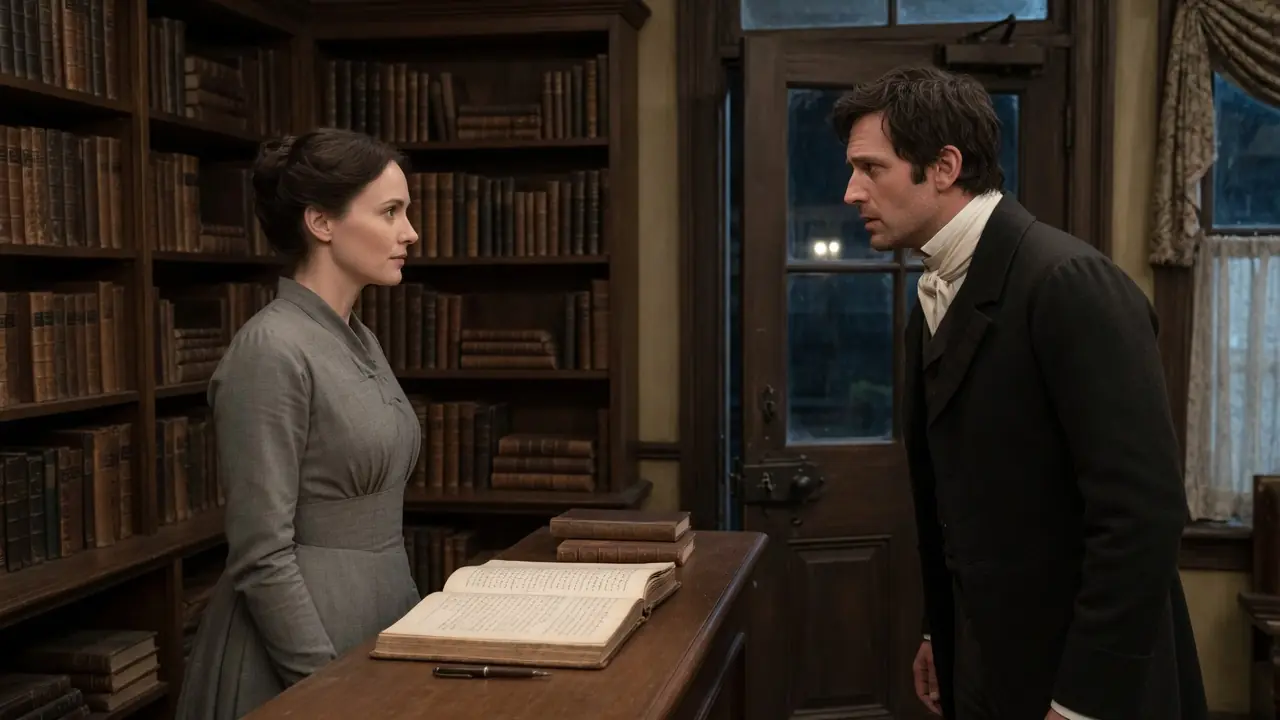
"I need a wife by tomorrow." The words hit the lending room like a dropped book. "Then you need to..." Mary Darcy did not flinch. She set down the ledger in her hand and looked at the man standing in her doorway as though he had asked for a candle, not a wife. He was tall, dark-coated, and his eyes carried the particular exhaustion of a man who had not slept in days and did not expect to sleep again soon.
She knew his face from the parish register of names whispered with reverence and fear. The Duke of Caromere. Edward Vale. He had never once set foot in her shop before tonight. Mary did not ask him to repeat himself.
She walked to the door, turned the lock, and drew the curtain over the front window with the same steady hand she used to close every evening, as if a duke demanding marriage were simply the last customer of the day. "Sit," she said, nodding toward the back room. He hesitated, unused to being given instructions in his own county. Then he followed her because he had nowhere else to go and no one else left to ask.
She closed the door behind them and folded her hands. "Before I answer anything, Your Grace, you will tell me the truth. All of it. I do not bargain with half a story." Edward sat down. For a long moment, he said nothing, and Mary watched the muscles in his jaw work as though the words themselves cost him something to release.
"My wife is dead eight months," he said finally. "My daughter has not spoken a full sentence since the funeral." Mary's expression did not change, though something behind her eyes sharpened. He continued, the words coming faster now, as though once begun, he could not stop them. "Her name is Anne. She is six years old. She does not cry. She does not laugh. She sits in rooms and watches doors as if waiting for someone who will not come back."
He paused. "Her mother's family has decided this silence is proof that Caromere cannot raise her." Mary's voice was even.
"Proof for what purpose?" "There is a clause in the marriage settlement," Edward said. My late wife's trustees have authority to remove Anne to her maternal relations if they judge the household lacks, in their words, "proper feminine guidance". They meet tomorrow morning. If I cannot show them a respectable duchess, a woman of character already established in the household, they will take her.
He looked at Mary directly for the first time since sitting down. This is not a court of law. No judge will weigh evidence. It is four men in a drawing room deciding whether my daughter belongs to me or to people who have called her grief a defect for eight months.
There had not been time. The girl had not come back the next day or the day after, and by the time anyone went looking, looking was no longer enough. Mary had left teaching three months after that, and she had not stood in front of a frightened child since without hearing, somewhere beneath her own voice, the silence of the desk that stayed empty. She had built a quiet life out of lending books and asking nothing of anyone, precisely so she would never again be the adult who waited too long.
"Your daughter is not a clause, Your Grace," she said, and her voice had lost its careful neutrality. "She is not a settlement to be argued over by men who have never sat with her in the dark. I have heard children discussed as property before. I will not do it again and call it conversation." Edward did not answer immediately.
Something in his face shifted as though he had expected refusal, or worse, false comfort, and had received neither. "Then you understand what I am asking." "I understand what you are asking," Mary said. "I have not agreed to it." She rose, crossed to the small window, and stood with her back to him for a moment before turning. "If I do this, it will not be a performance, and it will not be silent on my part, either.
You will hear conditions, and you will agree to every one of them before I sign anything." Edward inclined his head, the closest thing to permission he had left to give. Mary returned to her chair and spoke plainly, the way she once addressed a classroom that needed certainty more than comfort. "Anne comes before everything. Before your name, before the trustees, before whatever this marriage is meant to solve for you.
If there is ever a choice between her welfare and your convenience, you already know which one I will choose." "Agreed," Edward said. "Her mother is not to be erased from that house," Mary continued. "Not her portrait, not her belongings, not her memory in front of the child. I will not have Anne taught to forget in order to make me comfortable.
"Agreed." "You will not force her to call you Papa before she is ready, and you will not force her affection toward me. Children are not won by demand. If she comes to either of us, it will be because she chose to, not because we required it of her. Edward's throat moved.
"Agreed." "I will have real authority in that nursery. Not the appearance of it. If I say a thing is needed for her, it will be done, not debated by your staff or your in-laws." "Agreed." "And there will be no pretense of love for Anne's benefit, Mary said, quieter now. She has already lost a mother.
She will not be handed a lie dressed as a family. Whatever this is between us, she will be told only what is true at a measure she can carry. Edward was silent for a long moment. When he spoke, his voice had lost its former edge entirely.
"I accept every condition, Miss Darcy. I would have accepted them whether you demanded them or not, though I admit I had not thought to put them into words until you said them aloud." He looked at her with something that was not yet trust, but was no longer simply desperation either. "I can secure a special license tonight. We would need to marry before the trustees convene." Mary felt the full weight of what she was agreeing to settle over her like a coat too heavy for the season.
She thought of a girl who never came back and of a six-year-old somewhere in a cold house watching doors. "Then we marry in the morning," she said, "and you will not waste another hour pretending this is anything other than what it is." Edward rose, and for the first time that evening, something in his shoulders eased, however slightly. Outside, the village had gone dark and quiet, unaware that before the sun rose again, a schoolmistress who had once failed to act in time would stand in front of strangers and promise to do, this time, exactly what she had not done before. The marriage took eleven minutes.
There were no flowers, no music, no gathered well-wishers pressing close to admire a bride. Only a clergyman roused before dawn, two witnesses pulled from the kitchen staff, and a special license that smelled faintly of the ink that had dried it only hours before. Mary wore the same gray dress she had closed her shop in the previous evening, having had no time and no wish to dress as though this were a wedding rather than the settling of an emergency. Edward wore the look of a man signing a contract he had not had time to read twice.
When the clergyman asked them to repeat their vows, Mary's voice did not waver, but it carried none of the softness brides were meant to offer. She spoke the words the way she once recited lessons to a room of children who needed certainty, not warmth. Edward matched her, plain and unadorned, his eyes fixed on her rather than on the clergyman, as though he needed to see that she meant what she said. When it was finished, there was no kiss, only a long look between two people who understood exactly what they had agreed to and exactly what they had not.
There had been no breakfast, no toast offered, no moment set aside to mark what had changed. Edward had simply handed the clerk his fee, folded the certificate into his coat, and asked if she was ready to leave, as though the next task on a long list of urgent tasks was already waiting. Mary found she did not mind the absence of ceremony. She had not married for ceremony.
She had married because a child somewhere in a cold house needed an adult who would not vanish, and the vows, however bare, had been a true accounting of that purpose rather than a lie dressed in lace. By eight o'clock, they were in the carriage to Caromere, neither speaking. The silence between them was not unkind, but heavy with everything still ahead. By nine o'clock, they stood before the trustees, and Mary understood that the wedding had been the easy part of the morning.
The room was cold despite the fire. Four men sat at a long table, papers arranged before them like evidence in a trial that had already reached its verdict before either Mary or Edward entered. They asked Mary why she had married so quickly, whether she understood the duties of a duchess, whether she believed herself capable of raising a child of rank she had met only the day before. Mary did not soften her answers to please them.
"I did not marry for romance," she said, "and I will not insult this room by pretending otherwise. A child in grief does not need a performance of affection. She needs steadiness. She needs adults who do not vanish the moment a responsibility becomes difficult." One trustee exchanged a glance with another, unsettled by a woman who offered no tears and no charm, only a flat accounting of what a frightened child required.
But her plainness left no room to accuse her of scheming, and after a long, reluctant silence, they agreed that Anne would remain at Caromere under her father's roof, with the new duchess installed as her guardian in fact as well as name. Lord Ashcombe did not hide his displeasure. He was Anne's maternal uncle, and he had arrived expecting to leave with his niece and the management of her inheritance settled in his own hands by nightfall, having spent eight months suggesting that a household run by a grieving widower was no place for a delicate child. Instead, he watched a stranger walk away with both the child and the trust of the room.
As the trustees gathered their papers, his eyes followed Mary with the attention of a man already composing his next argument, turning her overnight marriage into evidence of ambition rather than urgency. "A woman married overnight," he said to no one in particular, loud enough to be heard, "married for a title she did not earn and a child she does not know." Mary heard him. She did not turn. She had learned long ago that some battles were not won by answering the first insult, only by surviving long enough for the truth to outlast it.
Ashcombe watched her go, already certain this was not finished. Anne was waiting in the nursery when Mary climbed the stairs that afternoon, alone, having asked the housekeeper to let her go in without ceremony or announcement. The child sat very still in a chair too large for her, her hands folded with a stiffness no six-year-old should have learned, her dark hair pulled back so neatly it looked as though someone had tried, in the only way they knew how, to keep some order in a world that had stopped making sense. She did not rise when Mary entered.
She simply studied her, the way one studies a stranger who has walked uninvited into a room that used to be safe, cataloging every detail as if searching for the lie she expected to find. "Are you here to replace my mother?" Anne asked, her voice flat, already braced for the answer to be a lie dressed up as kindness, the way so many adults had dressed their lies in the months since the funeral. Mary did not answer quickly, and she did not answer from across the room. She crossed the floor slowly, giving the child time to watch her approach, and knelt so they were level, so that nothing about her posture suggested authority or pity.
"No," she said. "No one can replace a mother who was loved. I would not try, and I would not insult her by pretending I could." Anne's expression did not change, not visibly, not in any way a careless observer might have noticed. But something behind her eyes shifted, faint as a held breath finally released halfway, the smallest loosening in a child who had spent eight months bracing for every adult to disappoint her in the same tired way.
It was the first sentence anyone had given her since the funeral that had not asked her to feel differently than she felt, that had not urged her to smile for her father's sake or stop asking questions that made the household uncomfortable. Mary said nothing further. She had learned, in another classroom, in another year, with another frightened child, that some did not need to be filled with words. They needed to be believed.
That evening, Mary asked that the portrait of the late duchess remain exactly where it hung in the nursery, refusing the housekeeper's quiet offer to remove it for her comfort, as though Mary might wish the dead woman's face out of sight before claiming the room as her own. "It stays," Mary said simply, before the housekeeper could finish the offer. "It is the only mother Anne has, and I will not be the reason she loses sight of her face." She brought Anne a small wooden box with a brass lock and a single key threaded on a ribbon, and told her it was hers alone to keep whatever of her mother's things she wished to protect from being lost, given away, or quietly tidied out of the house by well-meaning hands. Anne took the box without speaking, turning it over once in her lap, running a finger along the seam of the lid as though testing whether this, too, was a promise that might later be broken.
But she held it the way a person holds something they have been afraid to ask for, and that evening she carried it to her room without letting it leave her arms. From the doorway, unseen, Edward watched the exchange and understood, for the first time since his wife's death, that his daughter's silence had never been stubbornness. It had been guardianship. She had been standing watch over the only pieces of her mother she had left, certain that no adult around her would think to help her keep them safe, certain she alone bore the burden of remembering, certain that if she once let her guard down, even those small things would be taken from her, too.
Mary had understood this within a single hour. He had lived beside his daughter's grief for eight months and had missed it entirely. The first weeks were hard in a way that had no single moment to point to, only a long accumulation of small refusals. Anne would not come down for lessons unless fetched twice.
She would not look at Edward across the breakfast table, choosing instead to study her plate as though it required her full attention. She spoke to Mary only when speech was unavoidable, answering questions in the fewest words she could manage, as if every sentence given freely was a coin she could not afford to spend. Mary did not chase her. She had learned long ago that children who had been failed by adults did not trust the ones who arrived eager to be loved, only the ones who simply stayed day after day without asking for anything in return.
So, she built a routine instead of a courtship. Breakfast at the same hour, lessons after, a walk in the garden when the weather allowed it, an hour of quiet reading before the light failed, and always, without fail, a space left open in the evening for Anne to speak of her mother if she wished, never hushed, never redirected toward something more cheerful. At first, Anne said nothing in that space. She simply sat with her hands folded, watching Mary the way one watches weather, waiting to see if it would turn.
Slowly, almost without seeming to test anything at all, Anne began testing whether Mary would stay. She left her shoes by the door instead of carrying them upstairs, a small carelessness that asked whether anyone would scold her for it. She came down to breakfast a few minutes late, watching from the doorway to see if Mary would still be there, plate already set, as though lateness might be allowed without consequence. She asked once, almost too quietly to hear, whether Mary intended to leave when Anne's father grew tired of her.
Mary answered without flinching that she had not married to be discarded, and that Anne would not wake one morning to find her gone. Anne did not respond, but the question itself, asked aloud rather than carried silently, was its own kind of progress, the first crack in a wall built to keep disappointment from reaching her twice. Edward tried too hard, in the way men do when guilt has made them clumsy. He brought Anne a porcelain doll from the village, then a set of paints, then a small gray pony he had arranged to have stabled before he had thought to ask whether she even wished for one.
Each gift was offered with a forced brightness that did not suit him, a smile held too long on a face unused to performing warmth, and each time Anne accepted the gift with a quiet thank you, and then withdrew further, as though the gift itself were a debt she had not asked to owe. Mary watched this happen twice before she said anything. The third time, after Edward returned from the village with a length of ribbon he clearly hoped might make Anne smile, Mary followed him into the study and closed the door. "She does not need ribbons," Mary said.
"She needs you to stop trying to buy back eight months in a single afternoon." Edward's jaw tightened, the old reflex of a man unused to correction. "I am trying," he said. "Trying is not the same as understanding what she needs," Mary answered. "Guilt is not parenting, Your Grace.
It is a performance for your own comfort, dressed up as generosity for hers. She can tell the difference, even if you cannot. The words landed harder than she had intended, but she did not soften them. Edward stood very still for a long moment, and when he spoke again, his voice had lost its defensiveness.
"Then tell me what she needs." "Patience," Mary said. "Not performance. Sit with her without expecting anything back. Let her ignore you.
Let her be unimpressed. That is not failure. That is a child deciding in her own time whether you are safe." Edward listened badly at first, returning the ribbon to his pocket, but still hovering too close, still watching Anne's face for signs of approval she was not yet ready to give. But slowly, over the following days, he learned to sit nearby without speaking, to offer nothing and ask for nothing.
And Mary noticed that his respect for her had deepened precisely because she had refused to flatter him, because she had told him the truth when every instinct in him had wanted comfort instead. The winter fever came without warning, the way illness always seemed to arrive in that house, choosing the coldest night to take hold. Anne's forehead burned by midnight, and by one o'clock she was murmuring in her sleep, calling for her mother in a voice thin by fever, asking why no one would answer her. Edward stood in the doorway of the nursery, frozen, his face draining of color as though the sound of his daughter calling for a woman who could never come back had undone something he had spent eight months holding together.
"This is my fault," he said, his voice breaking. "If I had been here from the start." Mary did not let him finish. "Not now," she said, sharp enough to cut through the spiral before it could take hold of him entirely. "Guilt will not cool her skin.
Send for the physician. Bring water and more cloths than you think we need. Sit beside her and stay awake. Be useful, Edward, or leave the room." It was the first time she had used his name without the title attached, and something in the bluntness of it seemed to steady him more than comfort could have.
He went. He returned with water before she had finished asking. He sat through the long hours of the night with a cloth pressed to his daughter's forehead, flinching every time she called for her mother, but staying exactly as Mary had ordered, because staying was the only thing left within his power. Mary did not leave, either.
She managed the physician when he arrived near three o'clock and kept her own voice low and even, so that even in her fever, Anne might hear steadiness rather than panic surrounding her. By morning, the fever had broken. Anne's eyes opened slowly, clearer than they had been in hours, and the first thing she saw was her father still sitting beside the bed, exactly where he had been all night. His shirt creased and his eyes red from exhaustion he had refused to acknowledge.
She did not call him Papa. She was not ready for that. But she reached out without being asked and let her small hand rest in his, and Edward sat perfectly still, as though afraid that any movement at all might cause her to take it back. The household began changing in small, unannounced ways, none of them dramatic enough to mark with a date, all of them noticed only in hindsight.
Anne allowed Mary to sit beside her in the evenings while she read, no longer retreating to the far end of the room, sometimes leaning her shoulder against Mary's arm without seeming to realize she had done it. Edward began joining them in the nursery after supper, not as an intrusion, but as a quiet presence in the corner chair, and the room did not grow stiff with his arrival the way it once had. He learned to ask Anne about her drawings rather than her feelings, to comment on the goats in the garden rather than the empty chair at the table where her mother used to sit, and slowly Anne began answering him in full sentences, then occasionally in sentences that carried something like warmth. Mary said little about the change.
She simply continued the routine she had built from the first week, never announcing the progress for fear of frightening it away. But Edward noticed. He watched his house breathe differently than it had in eight months. The silence in its halls replaced by the ordinary sounds of a child's footsteps on the stairs, a book closing, a low conversation drifting from the nursery at an hour the house used to hold only grief.
He understood, slowly and without alarm, that he no longer thought of her as the woman who had solved his emergency on a desperate evening in a village shop. He thought of her now as the woman who had walked into a house full of silence and taught it, patiently and without asking for credit, how to speak again, how to breathe, how to be a home rather than merely a roof over a grieving child. Lord Ashcombe returned three months later with the trustees gathered once more around the same long table, and this time he had come prepared. He argued that Mary was a rushed duchess, a woman of convenience installed overnight with no true claim on the child's affection, and that Edward had married her not out of any genuine concern for Anne's welfare, but simply to block her maternal family from gaining the influence that was rightfully theirs.
A marriage formed in a single evening, he said, his voice carrying the practiced confidence of a man who had rehearsed this argument in front of a mirror more than once, cannot be mistaken for a household built on years of trust. "I ask the trustees to consider whether Anne would not be better served among her mother's own blood, where her grief might be understood by those who shared it, rather than left in the care of a woman who married a stranger before the ink on her own widowhood papers had dried." The trustees turned to Mary, and one of them asked, not unkindly but directly, why she had truly married a stranger overnight, and whether she could honestly claim any bond with the child beyond the convenience of a title. Mary did not flinch from the question, nor did she dress her answer in anything softer than the truth. "I married because a child was being discussed as property by men who had never once sat with her in the dark," she said.
"I will not pretend that was love. It was not. But I did not leave when the danger passed, and I have not stayed for a title I never wanted. I stayed because Anne became dear to me in ways I did not expect and cannot undo." The room was quiet after she spoke.
Ashcombe's mouth tightened, sensing that her honesty had cost her nothing and given him nothing to seize upon, no contradiction, no performance he could expose as false. He had expected a woman who might crumble under direct questioning, or one so practiced in flattery that her answers would ring hollow. Instead, he faced a woman who admitted exactly what was true and exactly what was not, and the trustees, watching her, seemed to find that more convincing than any declaration of devotion could have been. It was Anne, brought into the room at the trustees' request, who settled what argument remained.
One of the trustees knelt slightly to her level and asked, gently, where she felt safest, careful to keep his voice free of pressure or suggestion. Anne did not look to her father for guidance, nor to Mary, though both stood near enough to touch. She answered as though she had already considered the question many times before anyone thought to ask it aloud. "Caromere," she said, "because that is where Mama's things are kept safe, and no one has ever tried to take them from me there." She paused, glancing once at Mary before continuing.
"Mary tells me the truth, even when it is not the answer I want. And Papa stays even on the days I am angry at him and do not want him near me." The room went very still. Ashcombe opened his mouth as though to argue the point further to suggest the child did not understand what was truly being decided, but no words came. A six-year-old had answered a question about inheritance and guardianship with nothing more than the plain account of who had been honest with her and who had stayed, and there was no clever rebuttal that could survive being weighed against that.
Mary felt something tighten in her chest, not triumph exactly, but a quiet ache at hearing herself named, unprompted, as someone who told the truth. Edward's hand found the back of a chair to steady himself, his eyes fixed on his daughter as though she had just handed him something he had not known he was waiting for. Ashcombe's case, built over months of careful letters and quiet persuasion at dinner tables and in private drawing rooms, had been undone in under a minute by a child who had simply told the truth as she understood it. Blood claims and family pride, it turned out, were no match for a little girl's plain certainty about where she felt safe, and Mary's quiet consistency, built one ordinary day at a time with no audience and no expectation of reward, had proven sturdier than any argument constructed in a drawing room.
The trustees confirmed, with little further discussion, that Anne would remain at Caromere under her father's roof and Mary's guardianship, and Ashcombe left the room without another word. His careful architecture of persuasion reduced to nothing by a child's honest answer. That evening, after the house had gone quiet and Anne had been settled to sleep, Edward found Mary in the small sitting room she had claimed as her own since the wedding. He stood in the doorway for a long moment before speaking.
"I want you to know," he said, "that you are free of this marriage if it is freedom you want. I will keep every promise I made you that first night. I will not use Anne to bind you to a life you did not choose for yourself." Mary set down the book she had not truly been reading and studied him carefully. "Is that what you want?" she asked, "For me to leave?" Edward was quiet for a long time, longer than the question should have required, and when he finally answered, his voice had none of the formal distance it once carried.
"No," he said. "I needed a wife by tomorrow, that night in your shop. I did not expect to find a woman who would teach me how to become a father. I did not expect to watch you walk into a house full of silence and make it speak again.
I am not offering you freedom because I want you gone, Mary. I am offering it because I promised you honesty, and I owe you the truth that the choice is still yours to make." Mary looked at him for a long moment, weighing the offer not as an escape, but as the plainest proof yet that he had kept every condition she had set that first night, down to the smallest of them. She had expected, when she agreed to marry a stranger to save a grieving child, that the marriage itself would remain a transaction long after its purpose was served, a quiet arrangement maintained out of obligation rather than feeling. She had not expected to feel, standing in that room with the fire burning low and Edward waiting for her answer, that leaving would cost her something real.
Mary admitted, finally, what she had not allowed herself to say aloud until that moment. "I came for Anne," she said. "I will not pretend otherwise. But I stayed because this house became something I had not expected to find again, a place that felt like home rather than a duty I was discharging." Edward crossed the room and took her hand, not as a duke claiming what was owed to him, but as a man asking permission with the smallest of gestures.
They chose the marriage honestly that night, neither pretending it had begun as anything other than what it was, nor pretending that it had remained only that. Months later, on a bright morning with frost still silvering the chapel windows, they held a small blessing in the chapel at Caromere. Nothing grand, only family and the few neighbors who had watched the strange arrangement unfold over the better part of a year. Anne stood between them at the altar, holding a small posy of winter flowers she had chosen herself from the conservatory.
She did not call Mary mother during the service, and no one expected her to, least of all Mary, who had promised long ago that no one would ever ask Anne to forget. But during the prayers, when the room fell quiet and the vicar's voice settled into something solemn, Anne reached out and took Mary's hand without being asked, holding it the way she once held the small wooden box containing her mother's ribbons, carefully, as something precious that had earned its place beside her. Edward watched the two of them, his wife and his daughter, Anne joined in the hush of the chapel, and understood that the bargain struck in a closing shop on a desperate evening had become, against every reasonable expectation, a family that had chosen to stay. Mary had never set out to replace anyone.
She had only ever meant to do what she had once failed to do, to act before it was too late. In the end, that was enough. She had not become a replacement duchess. She had become the woman who stayed.