The letter had arrived on a Tuesday. Wade remembered that detail with the kind of precision a man reserves for moments that rearrange his life. He'd been out mending fence line on the eastern pasture when his ranch hand, a bow-legged old-timer named Cobb Perkins, had ridden out to deliver it. Cobb had the letter pinched between two fingers like it smelled bad, which told Wade something before he even broke the wax seal.
"Come up from Billings," Cobb said. "Rider said it was urgent." Wade pulled off his gloves, cracked the seal, and read. He read it twice, then he folded it very carefully, tucked it into his breast pocket, picked up his fence pliers, and went back to work.
He stayed out there another 2 hours, working in silence, while the October wind came raking across the high grass, cold enough to make his knuckles ache. When he finally rode back to the house at dusk, he sat at the kitchen table with the letter unfolded in front of him and a glass of whiskey he did not touch. The letter was from Gerald Ashcraft's estate lawyers in Boston. Formal language, the kind that costs by the word. The substance of it was simple enough.
The Ashcraft family was prepared to invoke the marriage contract signed by Wade's father, Robert Holloway, in the winter of 1874. Under the terms of that agreement, which Wade had always treated as a distant, faintly embarrassing family footnote, Wade was to marry the eldest Ashcraft daughter by the following spring, or face repayment of the full debt plus accrued interest, $42,000. He didn't have $42,000. He didn't have half that.
The Holloway Ranch, Copper Ridge, was technically his now. It had been since his father passed eighteen months ago, but it was his the way a drowning man owns the water around him. The drought two years back had taken most of his cattle. A bad winter had taken the rest. He'd borrowed to restock, borrowed again to repair the north barn, borrowed a third time just to keep the payroll going.
The ranch was operating barely on credit and stubbornness. His father had signed that contract because he'd had no other choice. The drought of 74 had been catastrophic. The Ashcraft money had saved Copper Ridge from foreclosure, saved the land that three generations of Holloways had carved out of Montana rock.
The price had been a handshake promise sealed in formal language that when the time came, the families would be joined. The time had come. Wade sat at that table for a long while. He thought about his options.
He thought about what it would mean to lose the ranch. He thought about his father's grave out behind the cottonwoods and what the old man would say. Then he poured the whiskey back into the bottle, went to bed, and in the morning sent a reply to the lawyer saying he would honor the agreement. The bride would arrive in 3 weeks.
He told Cobb first because Cobb had been on the ranch since before Wade was born and had the kind of institutional knowledge that made him hard to replace and easy to confide in. Cobb's response was to take off his hat, scratch the back of his neck, and say, "Boston woman. " "That's right. " "On a cattle ranch. " "On a cattle ranch. " Cobb put his hat back on and looked out across the yard for a moment. "Well," he said finally, "I suppose stranger things have happened. " He didn't name any. Wade told his two other permanent hands, Marcus, who was 22 and had been with the operation two years, and a quiet, meticulous man named Denny Oaks, who handled most of the horsework with similar brevity.
He was bringing a wife home from Boston. She was arriving by train on the 15th. He expected them to be respectful and professional. That was all.
What he didn't say, what he kept turning over privately in his own head, was the picture he'd constructed of Vivien Ashcraft. He'd never met her. The only information he had came from the brief note attached to the lawyer's letter, which described her as 26 years old, educated at a private academy in Cambridge, and accustomed to the finer appointments of Eastern society. That phrase alone had done significant work on his imagination.
He saw someone pale and overdressed, likely horrified by anything that wasn't a parlor or a cobblestone street. He saw someone who would arrive, look at Copper Ridge, and begin making his life difficult in ways he hadn't fully anticipated yet. He spent those three weeks in a low-grade state of dread. The night before he was to drive into Milhaven to meet the train, he walked the length of the house in the dark, looking at it honestly for what he thought was probably the first time.
The main building was solid, built of timber and stone, two stories with a wraparound porch that sagged on the west end where the posts had settled. The floors were clean but bare. The kitchen was functional. The parlor had his father's chair and a bookshelf that had seen better decades and curtains that had probably been put up by his mother before she died and had not been replaced or even seriously washed since.
The second bedroom, which had been his father's, smelled of tobacco and time. He moved his father's old pipe collection to a box in the closet and aired the room out. He bought new curtains from the dry goods store in town. He put a pitcher and basin on the dresser.
He did these things with the grim efficiency of a man preparing for an inspection he expected to fail. Milhaven was not a large town. It had a hotel, two saloons, a bank, a dry goods store, a church, a small school, a blacksmith, and a train depot that had been built with optimistic intentions and then weathered down to reality. Wade parked the wagon outside the depot and went in to check the board.
The train from Billings was on time. It would arrive at 2:15. He bought a cup of coffee from the woman who ran the depot waiting room and sat with it, watching the clock. Two other men were waiting, one clearly there to collect freight, the other nervously grooming himself in a way that suggested he was meeting someone important.
Wade's coffee went cold. He didn't notice. At 212, he heard the train. By the time it pulled in, he was standing on the platform with his hat in his hands, which he realized too late was a posture that made him look like he was at a funeral.
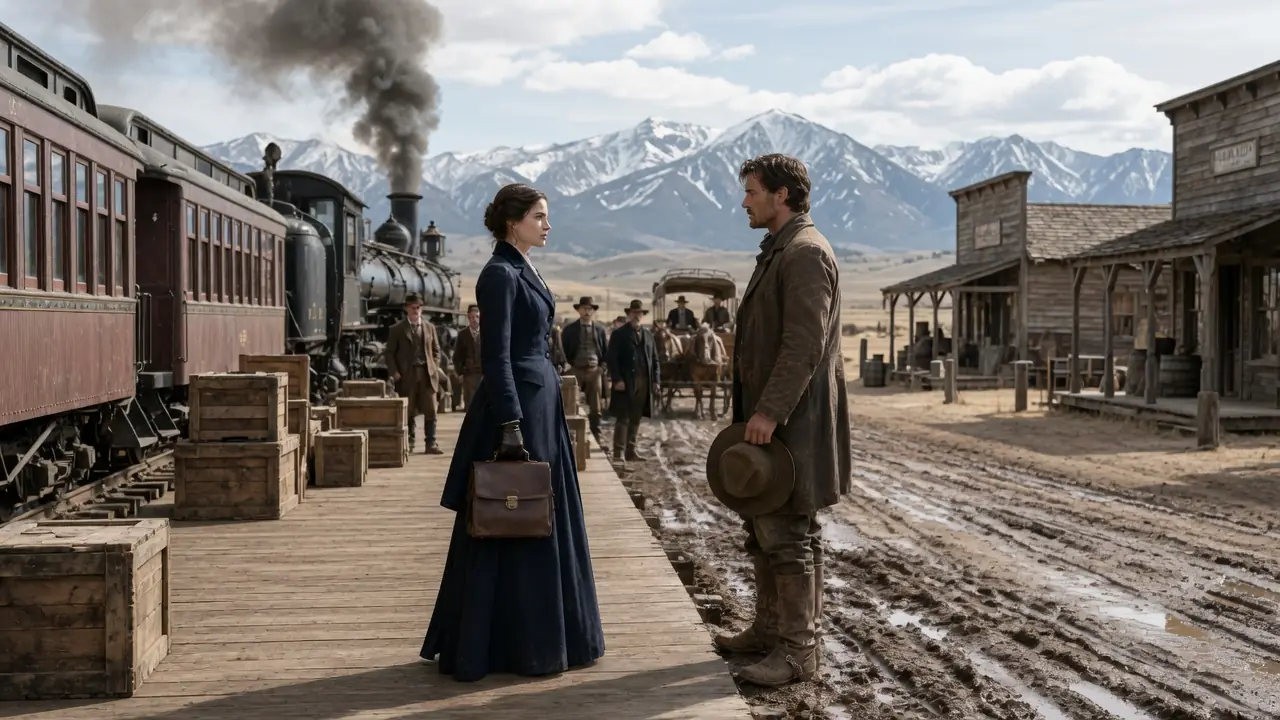
He put the hat back on. The train hissed and settled. Three passengers got off. a heavy set man in a traveling suit, a woman with two young children who were immediately absorbed by their mother's frantic counting of luggage. And then last off the rear car, Vivien Ashcraft.
Wade's first clear thought was that she was not what he'd expected. His second thought, which arrived almost immediately, was that this was going to be a significant understatement. She was not overdressed. That was the first thing.
She wore a practical wool traveling coat, dark blue, not new, but well-kept, and her hair was pinned up in a way that looked like she'd done it herself that morning without spending much time on it. She carried a small leather bag, just um just the one, and she came off the train steps without hesitation, without looking for someone to help her, scanning the platform with sharp gray eyes that moved over everything quickly and with evident purpose. Those eyes landed on him. She walked toward him with a stride that belonged on someone who had somewhere to be.
She stopped at a reasonable distance, not too close, not retreating, and looked him over the way he'd been looking at her. "Mr. Holloway," she said. It wasn't a question.
"Miss Ashcraft. " He touched the brim of his hat. "Welcome to Montana. " She looked past him briefly at the depot, at the street visible through the open end of the platform, at the big pale sky above the low buildings. Her expression did not communicate dismay. It didn't communicate much of anything he could easily read.
Is there more luggage coming? He asked. No. She lifted the bag slightly.
Just this. He looked at the bag. That's all you brought. I'm practical, she said.
"I can buy what I need when I know what I'll actually need." He wasn't sure how to respond to that, so he said, "The wagon is out front." The drive from Milhaven to Copper Ridge took about forty minutes when the road was good. The road was not particularly good that afternoon. The recent rain had worked on it enthusiastically, and the wagon lurched through ruts and soft spots with regularity.
Wade drove and waited for her to complain. She didn't complain. She sat on the bench beside him, her bag in her lap, watching the land. "How much acreage? " she asked, maybe 15 minutes in.
"About 11,000 deeded acres. " "Another 3,000 acres I run cattle on under a grazing lease. " "How many head? " He glanced sideways at her. "Little over 400 right now. Was closer to 1,200 before the drought. " "And you haven't rebuilt the herd to prior numbers because of the credit situation. " He looked at her more directly this time. What do you know about my credit situation?
My father's lawyers gave me a summary of the ranch's finances when the contract was being reviewed. She said it simply without apology. They thought I should understand what I was entering into. Wade turned back to the road.
He felt something uncomfortable settle in his chest. Not quite embarrassment, more like the specific unease of realizing someone has seen something you'd rather they hadn't. And he said, "And it's manageable. " She said, "The debt isn't disqualifying. The fundamentals of the land are sound. " She paused.
"The operating decisions are another question. " "The operating decisions? " he repeated. "Several of them. " He let that sit for a moment. The wagon hit a rut, and they both grabbed for balance without comment. "I've been running this ranch for eighteen months," he said finally since my father passed.
"I know," she said. "I'm not criticizing you. I'm telling you what I saw in the numbers. You read financial summaries.
My father taught me. She said he didn't have sons. He had me. And he thought it was more practical to teach me how to read a balance sheet than to pretend the numbers weren't there.
She looked at him. "Is that going to be a problem? " He thought about several things he might say. He chose the honest one. I don't know yet.
She accepted that with a small nod. "Fair enough," she said. They rode the rest of the way in silence that was not entirely comfortable, but was at least honest. The ranch revealed itself gradually as they came over the last rise.
The main house first, then the north barn, then the outbuilding scattered at practical distances, the corral empty in the pale afternoon light, the cattle visible as dark shapes on the far eastern pasture. Wade watched her take it in. It's bigger than I expected, she said. It's a working operation, he said with some defensiveness he hadn't intended.
I know. I mean that as a compliment. She was looking at the barn. The barn roof needs work on the east side.
He followed her gaze. She was right. He'd been planning to get to it before winter and had not gotten to it yet. I'm aware, he said.
The pasture rotation looks like it's been fixed for a while. she continued, more to herself than to him, her eyes moving across the land with that same focused assessment. That explains some of the grazing losses. He stopped the wagon in the yard and turned to look at her fully. Where did you learn about pasture rotation?
Wade sat with that for a moment. He'd spent the past 3 weeks building a mental picture of who Vivien Ashcraft was, and she had now, in less than an hour, completely dismantled it. The picture he'd had was gone, and he didn't yet have a replacement, and that uncertainty sat uneasily in a man accustomed to reading situations quickly. "Come inside," he said.
"I'll show you the house," She moved through the house with careful attention. She opened cabinet doors and closed them. She looked at the kitchen stove, the state of the wood pile stacked by the back door, the single water pump inside, and the well outside. She examined the structural points, the window frames, the floor joints, the ceiling where a past leak had left its signature.
She did all of this quietly, touching things lightly, making no commentary until she had gone through every room. Then she came back to the kitchen where Wade had been standing with his arms crossed, watching her. "It's a good house," she said. "Solid.
The west porch needs attention before it gets worse. The upstairs window on the north side doesn't seal. You'll lose heat. " "I know about the window," he said. "The seal material is already ordered. " She nodded.
"What's the water situation in winter? Pumps never frozen in 1four years, but I keep wood stacked at the outdoor well as backup. " "Good. " She set her bag down on the kitchen table. Mr. Holloway "Wade," he said.
It came out before he'd thought about it. If we're going to be married, you might as well use my name. Something shifted in her expression. Not warmth exactly, but something adjacent to it.
Wade, she said, I want to tell you something before we go any further because I think it'll save time. You waited. I did not come here to be a decoration, she said. I came because this is a business arrangement that can work if we are both willing to be honest with each other and work toward the same objectives.
I am not going to pretend to know nothing and stay out of your way. I am also not going to try to take over what you've built. What I'm proposing is that we treat each other as partners. He looked at her for a long moment.
And if I don't want a partner, then we'll have a more difficult time of it, she said, and there was no particular heat in it, just honesty. But I think you'll find I'm more useful than problematic. He didn't have an answer for that either, which was becoming a pattern. The room at the top of the stairs, he said.
I aired it out and put new curtains up. It was my father's room. Thank you. She picked up her bag.
Supper's at 6, he said. I usually cook something myself. Nothing fancy. Tonight it's salt, pork, and beans.
She paused on her way to the stairs. I'll cook, she said. If you don't mind. you cook? " She gave him a look that was direct without being unkind. We established that my father had no sons, she said.
"We didn't have a large household staff. " "Yes, I cook," she continued up the stairs. "Don't eat before 6. " She made salt, pork, and beans, the same basic ingredients, but she did things with them that Wade hadn't thought to do. Seasoned them differently. added dried onion from a small tin she'd carried in that leather bag, turned the cornbread somehow, so it came out properly risen instead of the flat, dense thing he usually produced. It wasn't elaborate.
It was just noticeably better than anything he'd eaten in his own kitchen in a year and a half. Cobb appeared at the back door at 550, as was his custom, and Wade waved him in. The old man stopped when he saw Vivien at the stove, hat in hands, and said nothing for a full 3 seconds. Cob Perkins, Wade said.
This is Miss Ashcraft. Mrs. Holloway, she said, correcting him with a matter-of-fact tone. And both men looked at her, and she turned from the stove with a brief expression that might have been amusement.
The paperwork was done in Boston, she said. We're already married, legally speaking. The ceremony here will just be a formality. Wade had known this.
He had somehow, in the business of everything, not thought about it in exactly those terms. Cobb looked at Wade. Wade looked at the table. Cobb sat down.
"Smells good," Cobb said. "Thank you," Vivien said. Supper was eaten largely in silence, which suited everyone. Cobb asked Vivien about her journey.
She described the train from Boston briefly and without complaint. Cobb said he'd never been east of Billings. She said Billings was perfectly fine. Wade ate and thought about several things at once.
After supper, Cobb left. Vivien washed the dishes. Wade dried them, standing beside her at the basin, because it seemed rude not to. The kitchen was narrow enough that they were close, closer than they'd been at any point since the train platform.
"I want to look at the accounts," she said. "The ledger books, the contracts, the debt records. " "I can put them out for you tomorrow. " "Tonight," she said, "if that's all right. I'd like to get oriented before I sleep. " He looked sideways at her. She was focused on the pan she was washing, her sleeves pushed up past her wrists, and her expression was exactly what it had been since the train, purposeful, slightly contained, revealing very little.
"Why tonight? " he asked. She stopped washing and turned to look at him. There was something careful in her face, something she was deciding whether to say. "Because I want to understand exactly where we are," she said.
"Before I start worrying about where we're going," he nodded. He dried the last pan, put it on the shelf, and went to get the ledger books. They sat at the kitchen table until almost 10:00 that night, which was later than Wade usually stayed up, and apparently later than she had intended. He opened the ledgers, explained the filing system, which was his own and somewhat idiosyncratic, and watched her work through the numbers.
She asked questions. They were specific questions, precise questions. And he noticed that she didn't ask anything twice. When she didn't understand something, she asked clearly without embarrassment.
And when he explained, she moved on. He noticed other things, too. The way she tracked figures across multiple pages without losing her place. The small notation she made in the margins of a paper she'd produced from her bag.
The particular quality of her attention, which was total and almost physical in its intensity. Around 8:30, she set her pen down and looked at a specific page for a long moment. this water rights contract, she said. The one with Burrell Creek. What about it?
The renewal terms. When did you last look at them? My father signed it. I inherited it.
He signed it in 1871. She said, "The renewal clause gives the Burrell family first right of refusal on your eastern pasture water access at the 1871 rate, which was below market even then. If they invoke this in a dry year, they haven't," Wade said. They haven't yet, she said.
Wade, this clause could be catastrophic in a drought. Did your father's lawyer ever review this? He was quiet for a moment. My father handled a lot of things himself.
He said he didn't like lawyers much. I understand that. She said it without judgment, but this needs to be renegotiated as soon as possible. Do you have a relationship with the Burrell family?
Orton Burrell doesn't like me much, Wade said. We've had a couple disagreements over fence lines. She wrote something on her paper. Tell me about those disagreements.
He told her. She listened. She asked follow-up questions. And somewhere in the process, Wade became aware that he was doing something he hadn't done since his father died.
Something he hadn't done with Cobb or with Marcus or with anyone. He was thinking through a problem out loud with someone who was fully engaged in it, who was pushing back on his assumptions and offering angles he hadn't considered. It was strange. He wasn't sure yet if it was a good kind of strange or a bad kind.
The grazing lease, she said, moving to another page on the north parcel. What about it? The rate you're paying per acre is high. Comparable leases in this region, she referenced something in her notations.
You're paying roughly 30% above what other ranchers are paying for similar land. Lyall Murdoch owns that parcel. Wade said he's been in this valley longer than anyone. He charges what he charges.
Has anyone ever asked him not to? Wade looked at her. Has anyone sat down with him with actual comparable numbers and made a case for renegotiation? She pressed.
People don't negotiate with Lyall Murdoch, Wade said. He's not that kind of man. Most men are that kind of man, Vivien said. When you come to them with numbers instead of arguments.
She set the ledger down and looked at him. I'd like to meet him. He won't talk to you. Why not?
Because you're He stopped. She watched him. Because you're new here, he finished. It wasn't what he'd started to say, and they both knew it.
Vivien looked at him for a long moment with those gray eyes, and then she looked back down at the ledger. "We'll see," she said. "Well," The formal ceremony was held 4 days later in the Milhaven Church, small and plain, attended by Cobb and Marcus as witnesses, and no one else by design. Wade had told people he was getting married because in a town that small, you couldn't not tell people, but he hadn't invited anyone and he hadn't asked anyone to come.
Several people came anyway. They crowded into the back of the church and watched with the undisguised curiosity of people whose entertainment options were limited. Vivien wore the same blue traveling coat. She'd done something more deliberate with her hair.
She stood very straight beside Wade in front of the minister and said her vows clearly and without sentiment, and he said his, and it was done in under 15 minutes. Afterward, outside on the church steps, a woman named Hattie Doyle, who was married to the banker and considered herself the social arbiter of Milhaven, maneuvered close enough to speak to Vivien. "What a journey you must have had," Hattie said. "All that way from Boston.
You must find it all terribly different. " very different," Vivien agreed pleasantly. "Such a small town," Hattie continued with a smile that was doing something more complicated than smiling. "I do hope you won't find it too quiet. " "After what you must be accustomed to, I grew up in a fairly quiet house, actually," Vivien said. "My father liked the evenings to himself," Hattie pressed on.
"And the ranch life, it must be quite an adjustment, all that physical labor, a brief accessory pause. " Of course, I suppose you'll manage the household while Wade manages the actual ranch work. There was a small silence. Vivien turned to look at Hattie Doyle with an expression that was perfectly polite and absolutely clear. I think you'd be surprised, she said, how much of what you'd call actual ranch work is really just applied arithmetic.
She smiled, excused herself, and went to find Wade by the wagon. Cobb had been standing close enough to hear all of this. He fell into step beside Wade as they walked to the wagon and said very quietly, "I like her. " "You've known her 4 days," Wade said. "That's usually enough," Cobb said.
The first month was an education in proximity. "A ranch house in Montana in the late fall is not a large space. There's the kitchen, where most life happens, the parlor, where little life happens, because no one has time to sit in parlors. The two upstairs rooms separated by a hallway that creaks in specific ways at specific points.
So you know when someone is moving around at night. Wade was accustomed to solitude. He had spent eighteen months living alone in that house, which was itself a change from growing up with his father present, but his father had been a quiet man, and the transition hadn't been dramatic. He was used to the house making only his sounds.
It made different sounds now. Vivien rose early, earlier than he did most mornings, and he would come downstairs to find the stove already going and coffee made, and her at the kitchen table with papers spread out around her, writing in that precise hand of hers, or reading something from the stack of books she'd borrowed from somewhere. He wasn't sure where, since the Milhaven library was not extensive. She didn't make conversation in the mornings, which he appreciated.
She was focused on whatever she was doing, and she let him be focused on his own thinking. In the evenings after supper, they had fallen into a pattern of reviewing the ranch accounts together, which had started that first night and continued because neither of them had suggested stopping it. Vivien had begun building what she called a complete picture, mapping every debt, every contract, every income stream, every operating cost against every asset and piece of land. She filled pages with numbers that gradually resolved into something she could read the way Wade could read the land from the saddle.
"You're losing about $400 a year in unnecessary operating costs," she told him one evening, about 3 weeks in without preamble. He looked up from the section of harness he was mending. "$400, maybe more. " "Feed purchases primarily. You're buying from the wrong supplier, or rather the only supplier you've established a relationship with, and he's charging you on that basis. There are two other feed suppliers within reasonable distance who come in lower.
She turned to Paige. Also, the veterinarian charges. Doc Harland is billing you at a city rate. I spoke to him.
Wade set down the harness. You spoke to Harland about my accounts? I told him I was reviewing the ranch expenses and wanted to understand the standard rates in the region. She said he was very forthcoming.
He'd been billing your father at the same rate for years. And he said, and I'm quoting him, that he'd been meaning to adjust it and simply hadn't gotten around to it. Wade looked at her for a long moment. How do you get people to tell you things like that?
She considered the question. I ask, she said, and I don't argue. I just ask and listen. She looked back at her papers.
Harland's actually going to lower the rate starting this spring. He felt bad about it. He picked up the harness again. He worked on the buckle that was giving him trouble.
Outside the window, the wind had come up and was moving through the cottonwoods with that particular winter sound. $400, he said. Minimum, she said. He thought about $400. That was a significant animal purchase.
That was a month of payroll. That was any number of things he needed. What else? He said.
She turned another page. Well, she said, let me tell you about the Burrell Creek water contract. The Burrell Creek water contract turned out to be even worse than Vivien had initially described. She'd spent a week digging into it, reading the original 1871 document three times, then writing to a land attorney in Billings for a plain language interpretation of the renewal clause, then cross-referencing the creek's documented flow rates against the acreage it served.
By the time she sat Wade down to explain what she'd found, she had a six-page summary written in the same precise hand he'd come to recognize as her working voice. Clear, sequential, no wasted words. The Burrell family can, in any calendar year where rainfall falls below a threshold defined in 1871, which is a threshold that modern measurement would consider a moderate drought, not a severe one. invoke priority access to Copper Ridge's eastern creek intake.
She said they could legally reduce your water access by up to 60% during any period they choose to define as a shortage. Wade stared at the contract page she'd pushed across the table. He'd read it himself years ago when he'd taken over from his father and understood it the way you understand something you're not fully equipped to understand in general terms with a vague awareness that the details existed somewhere underneath. My father never mentioned this.
I don't think he understood it either, she said, not cruy, just factual. The language is buried in the third renewal addendum and it references a chart in an appendix that was attached separately and may not have been filed with the original copy. She paused. It's the kind of clause that a lawyer on the other side put in deliberately to be overlooked.
Orton Burrell's father, Wade said. Would be my guess. He sat back in his chair and looked at the ceiling for a moment. Has Orton ever tried to invoke it?
Not that I can find, but Orton Burrell is 6three years old and his son Fletcher runs most of the day-to-day operation now. She folded her hands on the table. Fletcher Burrell is 29. He's been expanding aggressively.
He bought two parcels east of the creek last spring. Wade brought his eyes back down to her. You've been asking around. I've been listening, she said.
People talk at the dry goods store. He was quiet for a moment. The stove ticked. Outside, one of the horses shifted in the corral and the sound carried in the cold.
What do you want to do about it? He said, "I want to renegotiate," she said before Fletcher Burrell figures out what he has. I told you Orton doesn't Orton is not who I want to talk to, she said. I want to talk to both of them together and I want to do it before the spring thaw while water isn't on anyone's mind yet.
He looked at her for a long time. He was trying, not for the first time, to locate some angle of dishonesty in her assessment, someplace where the confidence outran the actual understanding. He couldn't find it. All right, he said, I'll set it up.
Setting it up was its own project. Orton Burrell was not a man who accepted invitations easily, and Wade asking for a meeting through the usual channels, meaning running into Orton's ranch hand at the feed store and passing a message, produced a response that was polite in wording and hostile in spirit. Orton would be available sometime in February, maybe if the weather allowed. Vivien took a different approach.
She wrote Orton Burrell a letter. Wade didn't see the letter until after it had been sent, which he discovered when Orton's response arrived at the ranch 10 days later. A handwritten note in an old man's careful script, saying that he and Fletcher would receive them on the first Thursday of January at 2:00 in the afternoon. "What did you write to him? " Wade asked, holding the note.
"I told him the truth," she said. that I was new to the territory and hoped to introduce myself properly to the neighboring families, and that I had some questions about the water contract that I suspected had never been fully discussed between the families, and that I would very much appreciate the opportunity to sit down together before the spring season. That's all. I also mentioned that I'd brought a bottle of good bourbon from Boston and would be happy to bring it as a gift. He looked at her.
Orton Burrell is known to appreciate bourbon, she said without apparent embarrassment. Cobb told me that the Burrell ranch was larger than Copper Ridge in acreage, but showed its age in ways that spoke of either long stability or slow neglect. It was hard to tell from the outside which one. The main house was low and sprawling, built in stages over decades, each addition in slightly different timber.
A man in his 60s met them on the porch with the careful expression of someone who had agreed to this meeting and was now taking the measure of whether he'd made a mistake. Fletcher Burrell came out behind his father. He was thicker built than Orton, with a watchful face, and the particular quality of stillness that Wade associated with men who were calculating something. They sat in Orton's front room, which smelled of pipe smoke and old wood, and Vivien produced the bourbon and set it on the table without ceremony, and Orton poured four glasses without asking if anyone wanted any, and they drank, and for about 20 minutes the conversation was general.
Orton asked about Boston. Vivien answered briefly and without ornamentation, then asked about the Burrell family's history in the valley, and Orton talked for 10 minutes without much encouragement because the history was long, and he'd clearly told it before and enjoyed the telling. Fletcher Burrell watched Vivien the whole time with those calculating eyes. Then Vivien said, "I'd like to talk about the water contract, if you're willing. " Orton's expression didn't change.
"What about it? " the renewal clause," she said. The priority access provision in the third addendum. Fletcher's stillness shifted very slightly. "Something behind his eyes sharpened. " "What about it? " Orton said again.
"I want to propose that we renegotiate it," Vivien said. "Not because we believe the Burrell family would ever invoke it improperly, but because I think the current language creates uncertainty for both sides, and I think we can find terms that are more equitable and clearer for everyone involved going forward. " There was a silence in the room. Orton looked at Wade. "Your wife reads contracts," he said.
"She does," Wade said. Orton poured himself another measure of bourbon. He didn't offer the bottle around this time. He looked at it for a moment.
"What kind of renegotiation are you talking about? " "Modified threshold," Vivien said. "We'd propose a drought definition based on current weather service standards rather than the 1871 benchmarks. In exchange, we'd offer a fixed annual payment to the Burrell family that compensates for the access limitation more predictably than the current arrangement. What kind of payment?
Fletcher said. It was the first thing he'd said directly to her. Vivien quoted a number. It was not a large number, but it was a specific one presented with the steadiness of someone who has done the arithmetic and is confident in it.
Fletcher shook his head. That's low. It's fair for the access limitation, she said. But I'm open to discussion.
What followed was forty minutes of the most uncomfortable conversation Wade had ever sat through in a professional context. Fletcher Burrell pushed back on every point. Vivien pushed back on every counter. Orton watched and occasionally interjected with the perspective of a man who had been negotiating since before these two were born and could appreciate the form of it, even when he had a stake in the outcome.
At one point, Fletcher said flatly, "With respect, Mrs. Holloway, this isn't really your area. " The room went quiet in a specific way. Vivien looked at him. Her expression didn't harden.
It didn't need to. Which area would that be? She said. Fletcher gestured vaguely.
Business negotiation, land contracts, this kind of I've been reviewing financial contracts since I was 17, she said still in the same even tone. My father ran three separate business concerns out of Boston for thirty years, and I was involved in the accounting for all of them by the time I was 20. I understand what I'm reading, Mr. Burrell.
A pause. Do you want to discuss the terms, or would you like to keep discussing whether I'm qualified to discuss the terms? Fletcher's jaw tightened, but Orton unexpectedly made a sound that might have been a short laugh, quickly suppressed. They left an hour later without a signed agreement, but with a clear counterproposal from the Burrells and a handshake, understanding that the conversation would continue.
On the drive back, Wade didn't say anything for a long time. Fletcher Burrell isn't going to forget that, he said finally. No, she agreed. But we'll get the contract renegotiated.
How do you know? She looked at the road ahead. Because Orton wants it settled before he dies, and he knows Fletcher would have invoked that clause within three years. He doesn't want that to be his legacy with the neighbors.
She pulled her coat tighter against the cold coming off the open country. He's a difficult man, but he's not a dishonest one. Wade thought about that. "You got all that from one meeting and from listening at the dry goods store," she said, and something in her voice was close to dry humor, which was as near as he'd seen her come to joking.
The renegotiation was finalized in March, six weeks later. The new terms were not everything Vivien had originally proposed, but they were materially better than what the original contract had provided, and they included a drought threshold definition that would have required a catastrophic rainfall failure before Burrell Creek access could be restricted. Wade signed the new document in Orton Burrell's front room with Fletcher watching from the doorway with an expression that communicated a range of things he hadn't put into words. The same week, Vivien switched feed suppliers.
It happened without drama. She had been to see both alternative suppliers during a trip to Billings in February. She'd asked to accompany Wade on a routine supply run and had spent most of the day in meetings Wade hadn't been invited to and hadn't known she was scheduling. She returned to the wagon at 4 in the afternoon with a contract for feed delivery from a supplier 20 m north of Milhaven at rates that were 18% below what Wade had been paying.
"Did you tell Harmon you were switching? " Wade asked. Harmon Schultz had supplied Copper Ridge for 1five years. He was a neighbor in the loose Montana sense of the word. I told him I was reviewing the ranch's purchasing arrangements and that I had found more competitive rates.
She said I gave him the opportunity to match them. He couldn't match them. He chose not to, she said. He told me that Wade Holloway had always paid his rate and he didn't see why that should change.
She looked at the passing road. I told him the operation was under new management jointly and that we needed to run things on a sound financial basis going forward. Wade absorbed this. He won't like it.
He already doesn't like it. She said he said some things about women and bookkeeping that I won't repeat. Viv, I know. She said, I know it creates friction, but we're losing money we don't have to lose. and Harmon Schultz's feelings about who manages the accounts are not a sound reason to keep paying above market rates.
She turned to look at him directly. "Unless you want me to go back and undo it." He thought about it. He thought about Harmon at the saloon or at the feed store saying things about Copper Ridge's new situation. He thought about the 18% which over a full year of feed purchases added up to something significant.
Leave it, he said. She turned back to the road. Spring arrived the way Montana spring usually did, not with any particular welcome, but with a grudging withdrawal of the worst of the cold and mud, and then one or two days that felt genuinely warm before the next cold snap came to remind everyone where they were. Wade started the season with a clearer picture of the ranch's finances than he'd had in two years. partly because he'd been paying more attention and partly because it was impossible not to see clearly when someone was laying the numbers out in front of you on a regular basis.
Copper Ridge was still in debt. That wasn't going to change quickly. But the bleeding had slowed in ways that mattered. The excess costs Vivien had identified were coming under control.
The Burrell contract was resolved. The feed situation was resolved. She had also, without telling him until after the fact, renegotiated the terms on two of the three operating loans, not the principal, which was fixed, but the repayment schedules, buying them a more manageable cash flow through the lean summer months. "You talked to Doyle," he said when he found out.
Gerald Doyle was the Milhaven Bank's primary officer, and as Hattie Doyle's husband, a man Wade had some reason to navigate carefully. "I did," she said. He agreed to adjust the schedule. He wasn't enthusiastic, she admitted, "But the math supports the request, and he knew it.
If we default on a compressed schedule, the bank loses more than if we renegotiate to a longer one. " She shrugged slightly. "It's not complicated. Gerald Doyle doesn't particularly," He stopped. Like women in his office, "Yes," she said.
"He was very clear about that in his way. He asked twice if you'd sent me and whether you'd reviewed what I was proposing. She looked up. I told him you had, which I know isn't entirely accurate, but I thought it would smooth things.
He should have been annoyed at that. He was surprised to find he wasn't. What exactly did you commit to? She told him.
It was reasonable. It was actually better than what he would have proposed himself because he hadn't known you could propose it. It was around this time that Cobb said something to Wade that he found himself returning to more than once afterward. They had been working on the fence line together, a long stretch of it on the north boundary, and Cobb had mentioned with deliberate casualness that he'd overheard some talk at the saloon about the changes at Copper Ridge.
"What kind of talk? " Wade said, "The usual kind," Cobb said. "Men who don't know what they're talking about talking about it about Vivien. " about you mostly," Cobb said. "Whether you'd lost your head over a Boston woman, whether she'd have you running the place into the ground by fall. " Wade drove a staple and didn't answer. "You know what I think? " Cobb said.
"I usually find out. I think your daddy would have liked her. " Cobb said, "She reminds me of him some. The way she looks at problems straight on without drama. " That sat in the air for a moment with just the wind and the sound of the work between them. He didn't like people in his business, Wade said.
No, Cobb agreed. But he liked people who knew what they were doing. He stretched his back and picked up the next post. Difference between the two in your daddy's mind was considerable.
The summer brought two things close together. The first real indication that Copper Ridge was beginning to recover, and the first serious test of whether Vivien's methods could survive contact with the wider community. The recovery showed in the numbers first. By June, the operation was running a modest surplus for the first time in two years.
Not enough to retire debt, but enough to cover operating costs with something left over, which was a position Wade hadn't been in since before the drought. The new grazing rotation that Vivien had proposed, which he'd been skeptical of, and which had drawn some pointed commentary from neighboring ranchers when word got around, was showing real results. The pastures that had been overgrazed were showing recovery. The cattle moved through them differently and the difference was showing up in the animals' condition by midsummer.
The test came at a community meeting in July called by the Milhaven Cattleman's Association to discuss range management across the valley. It was a regular summer gathering held in the back room of the hotel attended by the dozen or so significant ranching operations in the region. Wade went because he always went. Vivien asked to come.
He said yes without thinking about it too hard. He probably should have thought about it slightly more. The room noticed her immediately. That was unavoidable.
She was the only woman present, and she sat beside Wade at the long table without apparent self-consciousness with a notebook open in front of her in the same focused quality of attention she brought to everything. Tom Greer, who ran the second largest operation in the valley, and who considered himself something like the informal chairman of these gatherings, opened the meeting and moved through the agenda items without acknowledging her existence directly. The other men followed his lead, conducting the conversation as though she were furniture. Vivien took notes.
She didn't speak for the first forty minutes. Then during a discussion about the seasonal water allocation from the main valley wershed, a recurring argument that had been going around the same track for three years without resolution, she said quietly but clearly, "The problem with the current arrangement is that the allocation formula is based on 1860s acreage surveys that don't reflect the current distribution of productive land. " The room went quiet. Tom Greer looked at her the way you look at something you hadn't expected to make noise. Beg your pardon?
The water allocation? She said again, "The formula divides the seasonal flow based on each operation's deeded acreage as recorded in the original land surveys, but several of those operations have changed significantly in size and productive capacity since those surveys. " The formula isn't distributing water based on actual need or use. That's why the argument keeps recurring. The underlying math is wrong.
There was a silence in which several men looked at each other and at least two looked at Wade. Greer said, "Mrs. Holloway, this is a matter that's been under discussion for three years, she said. I know.
I asked Wade about the history before we came. She looked at Greer directly. Have any of the previous discussions included an updated survey of productive acreage? Greer's expression did something complicated.
That would be a significant undertaking. It would take about 2 weeks and cost perhaps $40 split between the valley operations. She said, "I've looked into it. There's a surveyor in Billings who does this kind of work.
She paused. I can write to him if the association would like me to. The silence in that room was different from the first one. It had a different quality, less dismissal, more the particular discomfort of people confronting something they'd been avoiding.
An older rancher named Cal Fitch, who had been in the valley longer even than Orton Burrell, and who had the credibility that came with that, said from the end of the table, "That's not a bad idea. Two or three others nodded. Greer, who was not a stupid man, whatever else he was, recognized the room. I suppose we could look into that, he said carefully.
On the drive home, Wade said, "You knew Tom Greer wasn't going to like that. I knew he might not, she said. But the point needed making. You could have let me make it.
She looked at him. Would you have made it? He thought honestly about that. He'd been to three years of those meetings.
He'd sat through three years of the same circular argument. He had known vaguely that the underlying formula was the problem, but he'd never pushed it because pushing it meant to fight with Greer and he hadn't had the energy for the fight. "Maybe not," he said. "Then someone needed to," she said.
"Not triumphant, just matter of fact. " She looked out the wagon window at the passing summer dark. "They'll talk about it," she added quietly. At the saloon, at the feed store, there'll be more comments. There already are.
I know. She was quiet for a moment. Does it bother you? The question was direct enough that it stopped him.
He thought about how to answer it honestly. It bothers me, he said, that people think less of you for it. She turned to look at him. It was a different quality of look than usual, less analytical, more searching.
That's not what I asked, she said. He kept his eyes on the road. The horses moved through the dark at a steady pace, and the stars were out over the valley in the particular way they were in Montana in July. Too many to count and too close to ignore.
"No," he said finally. "It doesn't bother me. " She didn't say anything to that, but she didn't look away from him for a moment either, and in the dark beside him, he was aware of some small thing shifting between them. Not dramatic, not named, just a small and quiet change, like the first warmth of a fire in a cold room. Too subtle to point to, but real nonetheless.
The surveyor from Billings came out in August. His name was Peter Aldis, a thin, precise man who wore the same expression whether he was measuring fence lines or eating lunch, which was the expression of someone doing arithmetic in his head. He spent eleven days moving across the valley with his equipment. And when he was done, he produced a document that confirmed with the authority of actual numbers what Vivien had said in the hotel back room.
The water allocation formula was distributing the seasonal watershed flow based on land surveys that bore only a passing resemblance to the current reality of who was running what and where. The updated survey cost $43 split seven ways. Cal Fitch paid his share without comment. Tom Greer paid his with the face of a man swallowing something he'd rather not.
Three of the other ranchers paid and said privately to Wade at various points that it was probably overdue. One rancher named Ellis Pruitt refused to pay on principal and then complained loudest when the new formula was applied which surprised no one. The new allocation was ratified at the September meeting. Copper Ridge gained a modest increase in its seasonal draw.
Not dramatic but real. And in a dry summer, real was the only kind that mattered. What Vivien had said in that hotel room, which had embarrassed some of those men and irritated others, had saved the valley's ranchers a fourth consecutive year of arguing about something that could be fixed. This fact existed.
It sat in the room at the October meeting like furniture nobody wanted to acknowledge having moved. Wade noticed that Tom Greer spoke to Vivien directly for the first time at that October meeting. He asked her a question about the updated acreage numbers, a technical question, and she answered it without making a production of the fact that he was asking. Afterward, riding home, she didn't mention it.
Wade didn't either, but he thought about it. The idea that would change everything came out of a bad afternoon in late October. Wade had ridden out to inspect the north herd and found two animals down, a breeding cow and a two-year-old heifer with a respiratory condition that Doc Harland rode out the following morning identified as a strain that had been moving through Valley Herd since August. He'd lose three more before it ran its course.
Five animals was not a catastrophic loss by most measures, but when you were still climbing out of drought losses and working on margins that didn't forgive mistakes, five animals was the kind of thing that kept you awake. He was at the kitchen table that night with the loss tallied and the herd numbers adjusted, staring at figures that had been trending upward for months and were now, because of five animals and bad luck, back to where they'd been in June. Vivien sat across from him with her own papers and said nothing for a while. She had a way of reading a room, specifically reading him, that he'd stopped finding unsettling and had started finding useful because it meant she didn't talk when talking wasn't what was needed.
Eventually, she said, "What's the breeding stock situation in the valley generally? " "What do you mean quality of bloodlines? Average herd genetics? What's the regional standard? " He looked up. "Average," he said.
Most of the operations here are running whatever survived the last drought. Nobody's been in a position to invest in quality breeding stock. It's expensive and it's a long-term return. But quality breeding stock would change the per-animal value of a herd significantly.
Over time, yes, good bloodlines, properly managed. He stopped. He looked at her. What are you thinking?
She turned a page in her notebook. There's a ranching operation in Wyoming, she said. Outside Cheyenne. I've been corresponding with a man named Theodore Marsh who manages a breeding program there.
He's developed a line of cattle specifically adapted to high altitude winter conditions with above average weight gain on limited forage. She paused. The animals are expensive, significantly more expensive than what valley ranchers are currently paying for breeding stock. Viv, let me finish.
She said, they're expensive to acquire, but the return per animal over a 3-year cycle is documented. Marsh has the records. I've seen them. She looked at him directly.
What if we acquired a core breeding group, not immediately, next spring when we have more cushion, and positioned Copper Ridge as a regional source for quality breeding stock, not just running cattle, selling genetics. The kitchen was quiet. Outside, the wind had come up again, the seasonal wind that arrived in October and didn't fully leave until April, and Wade listened to it move along the eaves while he thought about what she'd said. That's a different business, he said.
It's an additional business, she said. One that doesn't require additional land. One that uses what we already have, the improved pasture rotation, the better forage management to produce something the valley can't currently get without shipping animals from Wyoming or Colorado. He thought about the numbers.
He thought about the capital required. He thought about the risk, which was real and specific. Quality breeding stock was expensive. A failed breeding season was a significant loss, and they were not, despite the improving picture, operating from a position of comfortable surplus.
"What does Marsh want for a core group? " he asked. She told him, he winced. "That's most of what we've recovered this year," he said. "It's most of what we've recovered," she agreed.
"Yes. " "And if the breeding program doesn't perform, then we've set ourselves back considerably," she said. I know she didn't dress it up. He'd noticed that about her from the beginning. She had no instinct for softening the risk side of a proposal.
She laid the numbers out both directions and let them sit there. Why are you confident it works? He said, "Because the forage management changes we've made mean our animals are already outperforming the valley average in weight gain. " She said, "That's the foundation. Quality genetics on top of better land management compounds.
It's not a speculation. It's arithmetic. He was quiet for a long time, long enough that the stove needed more wood, and he got up and added it and sat back down. I want to write to Marsh myself, he said.
I want to see the records directly. Of course, she said, I was going to suggest that. And I want to write out and look at the pasture situation on the east section before we commit to anything. If we're running a breeding program, we need to think about dedicated pasture management separately from the main herd. "I already thought about it," she said, and turned three pages back in her notebook to a hand-drawn diagram of the Copper Ridge pasture layout with notations he recognized as a proposed rotation adjustment.
He looked at it for a long moment. He looked at her. "When did you do this? " he said. "About 3 weeks ago," she said.
"I didn't want to bring it up until I had the numbers from Marsh. " "You've been sitting on this for 3 weeks. I didn't want to bring you a half-formed idea," she said. you don't like half-formed ideas. He didn't say anything to that. It was accurate.
It was also the kind of accurate that made a man aware that someone had been paying attention to him. He wrote to Theodore Marsh in November. Marsh wrote back within two weeks a detailed letter, 12 pages, that included three years of breeding records, weight gain documentation, veterinary assessments, and a list of current clients with contact information. Wade wrote to two of the clients independently.
Both wrote back with responses that aligned closely with what Marsh's own records claimed. He told Vivien about the client letters at supper one evening. I know, she said. You know, I wrote to both of them myself separately two months ago.
She said, "I didn't want to tell you in case the responses were negative. " She passed him the bread. They weren't. He sat with that for a moment. We've been running parallel investigations and arrived at the same conclusion.
She said, "That should be reassuring. It's slightly maddening," he said. Something crossed her face that was close to a real smile. Not the polite version she deployed in public, but something quicker and more private.
Only slightly, she said. He found to his own mild surprise that he was smiling back. Word got out as word always did in a valley where 14 major operations shared the same two saloons, three dry goods stores, and one post office. By December, the fact that Wade Holloway was looking at a breeding program with Wyoming stock had traveled through Milhaven and out to most of the surrounding ranches.
And the responses ranged from skeptical to openly dismissive. Tom Greer said at the December Cattleman's meeting that it was an expensive gamble for an operation still working its way out of drought losses. He said it looking at Wade, but everyone in the room understood he was talking about the judgment behind the decision. And the judgment behind the decision had a name.
Ellis Pruitt, who had not recovered his good humor since the water allocation dispute, said at the saloon, and this got back to Wade within 48 hours, because it always did, that it was what you got when you let a Boston woman run your books, and that before the year was out, Wade Holloway would be selling off land to cover his losses. Cobb heard this and reported it to Wade with the flat economy of a man delivering a weather report. What did you say? Wade asked.
I told him I'd been on Copper Ridge for thirty years, Cobb said. And I'd seen a lot of things tried that people said wouldn't work and a lot of things not tried that people said would. And I hadn't found much correlation between what people in saloons said and what actually happened. That's diplomatic of you.
I also told him to mind his own ranch before commenting on someone else's, Cobb said, which was perhaps less diplomatic. Wade didn't tell Vivien about Pruitt's comments. He wasn't sure why initially. He thought about it afterward and decided it was because he didn't want her to feel responsible for the friction which she hadn't created.
She'd only made the friction visible that had been there in various forms since she arrived. The valley's opinion of women in ranch management was not her fault and was not going to be changed by knowledge of what Ellis Pruitt said in saloons. He did tell her about Greer. Greer is careful.
She said he says what he says in public because it insulates him if the decision fails and if it succeeds. He'll find a way to have had doubts that stopped short of real opposition, she said. That's how careful men work. She was quiet for a moment.
He's not wrong that it's a risk. I know he's not wrong, Wade said. That doesn't mean we shouldn't take it. She looked at him.
There was something in her expression he couldn't read exactly. Something that might have been gratitude or might have been something more complicated than that. No, she said it doesn't. They bought the breeding stock in March.
It was a harder decision at the actual moment of commitment than it had been in the abstract. Wade signed the purchase order for 11 animals, two bulls and nine cows of breeding-age, the nucleus of what Marsh called a foundation group, with the awareness that the sum represented most of Copper Ridge's liquid position and a good portion of what they'd rebuilt over the past year. His hand was steady on the pen. Afterward, he walked outside and stood in the yard for several minutes in the cold spring air.
Vivien came out and stood beside him. She didn't say anything. "Well," he said after a while. "Well," she agreed, "if this goes wrong, it could go wrong," she said.
"I've told you that from the beginning. I know. " He looked at the barn, at the corral, at the land running out beyond. "My father built this place over thirty years. If I lose it in three, you're not going to lose it, she said.
But she said it in a specific way, not the hollow reassurance of someone trying to make him feel better, but with a quality that was closer to refusal, like she was not willing to entertain the premise. He looked at her sideways. I'm not going to let that happen, she said. And neither are you.
She turned and went back inside. He stood there another minute, then he followed. The animals arrived from Wyoming in April, transported in stages with careful attention to the stress of travel on breeding stock. Marsh himself accompanied the second group, which Wade hadn't expected, but which turned out to be valuable.
The man spent 4 days at Copper Ridge walking the pastures, evaluating the forage situation, assessing the herd management practices, and offering adjustments with the directness of someone who had done this enough times to be past politeness. On the third day, Marsh sat at the kitchen table with both Wade and Vivien and worked through the breeding calendar for the first season. He was thorough in a way that Wade appreciated. No assumptions, no glossed-over uncertainties.
At one point, he asked Vivien a specific question about the pasture rotation schedule, a technical question, and she answered it with enough precision that Marsh looked at her for a moment and then said, "You did your homework. " "I tried to," she said. Who taught you pasture management? He said books, she said. And a professor in Ohio I wrote to for about a year.
Marsh looked at her again with the expression of a man recalibrating something. The Ohio fellow, he said. Greenfield. Yes, she said surprised.
Do you know him? He trained under the same man I did, Marsh said. In Pennsylvania 20 years ago. He looked at the rotation diagram she'd produced.
He taught you well. Vivien said nothing for a moment. When she spoke, her voice was careful. I'll tell him that when I write to him next.
Marsh left on the fifth day. On his way out, he shook Wade's hand and then he shook Vivien's hand, too, which Wade noticed because it was not a routine gesture for a man of Marsh's generation and background. "Good operation," Marsh said. "Better in a few years. " "That's the plan," Wade said.
The first summer with the breeding program was the hardest summer Wade could remember since the drought years and for entirely different reasons. The pressure of managing the additional animals, the specific dietary requirements, the health monitoring, the separate pasture rotation, the documentation that Marsh had insisted was essential and which Vivien maintained with meticulous consistency was relentless and unforgiving. Marcus worked harder than Wade had ever asked him to. Denny worked longer hours with the horses.
Cobb, who was 61 and whose back made itself known in the mornings, did not complain once. Wade did not sleep well. He woke most nights somewhere around 3 or 4, thinking about the breeding schedule, about the animals, about the numbers. Sometimes he would lie in the dark for an hour and then give up and go downstairs.
Twice he found Vivien already at the kitchen table when he came down, her lamp lit, working through something in her notebook. The first time it happened, he stopped in the doorway. "You couldn't sleep either," he said. "I don't sleep as well in the summer," she said without looking up.
"The light wakes me early. " He made coffee. He sat across from her. They worked in parallel silence for a while, each at their own set of problems. The second time she already had the coffee going when he came down.
She pushed his cup across the table without comment. He sat down. The Henderson cow, he said. It was the animal they'd both been watching.
A breeding-age cow from Marsh's group that had shown inconsistent weight maintenance over the summer. I know, she said. I want Harland to look at her this week. I'll ride for him tomorrow.
Thank you. She didn't look up. Her pen moved across the page in that small, precise hand. Outside the Montana summer dark was going thin at the edges with the early coming of first light.
He drank his coffee and watched her work and thought about the fact that six months ago he had dreaded this marriage with the comprehensive dread of someone who has built a life exactly to his own specifications and does not want it rearranged. He thought about how wrong that had been. Not wrong in the way that life sometimes surprised you pleasantly. Wrong in a deeper and more specific way. the way you could be wrong about the nature of something rather than just its quality.
He had thought a partner meant someone in your way. He was still working out what it actually meant, but it was nothing like that. The Henderson cow recovered. Harland found a mineral deficiency and corrected it within 2 weeks, and by August, she was back to normal weight maintenance, and her first breeding results were promising.
It was a small thing in the context of the whole operation, but Wade felt it the way you feel a thing that has been worrying you quietly for months suddenly let go. The Valley noticed the breeding program differently as the summer went on. What they noticed first was that Copper Ridge's animals looked different. Not dramatically.
These things moved slowly. But to the eyes of men who spent their lives looking at cattle, there was something in the quality of the animals coming off the Holloway pastures that was distinct from what they'd been seeing for the past several years. Weight and structure primarily. The marsh bloodlines were doing what Marsh said they'd do.
Cal Fitch rode over in July to see for himself. He was the kind of man who simply showed up without much preamble and said he'd heard things and wanted to look at them. Wade showed him the breeding herd, the records, the pasture rotation. Fitch asked specific questions and Wade answered them.
And at the end, Fitch stood at the corral fence looking at the animals with the long silence of a man thinking seriously. These marshbulls, Fitch said. What's the calendar for the next breeding group? Vivien manages the calendar, Wade said.
Fitch looked at him. Can I talk to her about it? Wade found this in some quiet way he didn't make a production of satisfying. "Sure," he said.
"Come inside. " Fitch and Vivien sat at the kitchen table for forty minutes. Fitch asked and listened and occasionally pushed back, and Vivien answered without embellishment or theater, just the numbers and the timeline and the reasoning behind both. When Fitch left, he shook her hand at the door. I may want to talk to you again in the fall, he said about acquiring some of your second-generation animals.
We'd be glad to discuss it, she said after he'd written out. Wade said Cal Fitch doesn't come to other people's ranches. I know, she said. Cobb told me.
She picked up her pen. We should make sure the records for that conversation are documented. If he comes back in the fall, I want to be ready with a proper pricing structure. He looked at her, bent over the notebook, writing already, and thought about what Cobb had said months ago about his father.
He thought the old man had been right, and he thought something else, too. Something he turned over in his mind for a while before he said it. "Viv," he said. She looked up.
"I want you to know something," he said. He stopped. He was not a man who said things like this easily. The words didn't arrange themselves on request. what we're doing here.
It wouldn't be happening without you. " She looked at him for a moment with that gray gaze that had always been hard to read and was perhaps lately slightly less hard. "It wouldn't be happening without both of us," she said. "I know," he said. "But I want you to know I know. " She held his gaze for another beat.
Then she looked back down at her notebook. "Then write it down somewhere," she said. "In case I ever need to remind you. " He laughed. It came out before he thought about it. a real laugh, short and unexpected, and he couldn't remember the last time something had caught him that cleanly.
She glanced up with the corners of her mouth doing something that was close to a smile, and then looked back at her work, and the kitchen settled around them both with the particular quiet of a place where two people have stopped being strangers to each other without quite deciding when it happened. Cal Fitch came back in September, as he'd said he might. He brought his son with him this time, a quiet young man named Garrett, who managed the day-to-day operations of the Fitch Ranch, and who had clearly been briefed on what his father had seen at Copper Ridge, because he arrived with his own list of questions written on a folded piece of paper that he consulted without embarrassment. Wade liked him immediately for that.
A man who wrote his questions down was a man who took the conversation seriously. They sat at the kitchen table, all four of them, with Vivien's records spread between them and the afternoon light coming through the west window at the low autumn angle that turned everything slightly golden. The conversation lasted 2 hours. By the end of it, Cal Fitch had committed to purchasing eight second-generation animals from Copper Ridge's first breeding cycle. animals that wouldn't be ready for delivery until the following spring, but which he was willing to contract for now at a price that made Wade keep his expression carefully neutral, while Vivien wrote the numbers into the agreement with her usual steadiness.
After the Fitches left, Wade stood in the yard and looked at the figure Vivien had written at the bottom of the contract page. "That's a good price," he said. "It's the right price," she said. "Not high enough to seem opportunistic, high enough to establish the value of the bloodline. " She folded the contract and put it in the household records file she'd built over the past year.
A thick bound collection that lived on the kitchen shelf beside the ledger books. Garrett Fitch will talk to other ranchers. He already is. Wade said he's been asking questions in town for 2 weeks.
Cobb heard him. She nodded like this wasn't surprising because it wasn't. She had a way of anticipating how information moved through the valley that Wade had stopped questioning and had started simply trusting. the way you trust a well- read compass when your own sense of direction is uncertain. What neither of them fully anticipated was how fast it moved.
By October, three other ranching operations had made inquiries. By November, when the cold came down hard off the mountains and the valley pulled inward the way it did each year, Copper Ridge had contracts or letters of intent with five separate buyers for animals from the spring breeding cycle. The total value of those commitments exceeded what the entire main herd had been worth at the lowest point of the drought years. Wade did not make a production of this.
He was not a man given to celebration of numbers on paper because numbers on paper had a way of not always becoming what they promised. But he did one evening in late November open a bottle of good whiskey that he'd been keeping for no particular occasion and pour two glasses and put one in front of Vivien without explanation. She looked at the glass. She looked at him.
"What's this for? " "Five contracts," he said. She picked up the glass. "Five letters of intent," she corrected. Three of them aren't signed yet.
"Vivien. " "I'm not being contrary, she said. I'm being accurate. I know, he said. Can you be accurate after one drink?
She considered this with the seriousness she brought to most things. "Probably," she said, and drank. He drank two, and they sat at the kitchen table in the good silence that had become their particular variety of comfortable. And outside the November wind moved through the cottonwoods with that low sound that was almost a voice, and the lamp put a warm circle on the table between them and their papers.
"We need to talk about next year," she said after a while. "I know the breeding program needs to expand if we're going to meet the demand we're building," she said. which means additional animals from Marsh, which means capital, which means the Doyle loan, he said. The Doyle loan. She had a page already out, which told him she'd been sitting on this conversation the way she'd sat on the Wyoming idea, waiting until the numbers were ready.
We've been making regular payments. The schedule Gerald agreed to has been working, but if we want to expand the program meaningfully, we need to renegotiate again. Not the schedule this time, the ceiling. He looked at her.
You want to borrow more? I want to borrow the right amount to do this properly, she said. There's a difference between borrowing more and borrowing strategically. Gerald Doyle is not going to love this conversation.
"Gerald Doyle is going to look at five letters of intent from established valley ranchers and recognize that Copper Ridge is a better lending proposition than it was eighteen months ago," she said. "That is his job." He may not enjoy it, but he'll do it. Wade turned his glass in his hands.
You've already thought through what you're going to say to him. I've thought through several versions, she admitted, depending on how he opens the conversation. He almost said something about that, about the way she prepared for things. The way she walked into rooms having already mapped the likely paths through them.
He'd found it unsettling when they first met. He found it something else now. Reassuring wasn't quite right. It was more like standing on ground that had been tested before you put your weight on it.
Set the meeting, he said. Gerald Doyle received them in his office at the Milhaven Bank on a Thursday in December, which was a gray close day with the smell of snow in it. The office was warm and smelled of pipe tobacco and wood polish, and the particular mustiness of paper that had been filed and refiled for decades. Doyle was a careful man with careful eyes behind careful spectacles, and he had the quality of attention of someone who had learned through long experience to say very little and let other people fill the silence.
Vivien didn't fill the silence. She let it sit. She placed the five letters of intent on Doyle's desk along with the breeding records and the pasture documentation and a single page summary she'd written that laid out the expansion proposal in language that was clear enough to require no explanation. and detailed enough to require no assumption. Then she sat back and waited.
Doyle looked at the papers for a long time. He looked at the letters of intent one by one. He looked at Cal Fitch's name, which carried weight in this valley the way certain names do when they've been attached to sound judgment for long enough. He looked at the numbers.
This is a significant expansion, he said. It is, Vivien said. and your current repayment standing consistent with the agreed schedule for 14 consecutive months. She said, "I have the payment records if you'd like to review them. " Doyle looked at Wade. Wade had decided in the wagon on the way over that his role in this meeting was to be present and to confirm when confirmation was needed that he was in full agreement with everything being proposed.
He had discussed this with Vivien and she had said, "You don't have to do that. You're the rancher. You should speak. " He had said, "You're better at this than I am. " She had said, "That doesn't mean you shouldn't be in it. " He had thought about that for a while and decided she was right, as she usually was, but that his particular contribution to this meeting was going to be his presence and his credibility in this valley, not his ability to read loan structures. "The expansion program is sound," Wade said.
"We've done the work. The demand is real. " "The Fitch family," Doyle said. He looked at the letter again. Cal Fitch doesn't do things speculatively.
Wade agreed. "He doesn't." Doyle set the papers down. He took off his spectacles and cleaned them with a cloth from his desk drawer, which was a thing he did when he was thinking, and everyone who had spent any time in that office knew it.
He put them back on. The terms I'd be able to offer, he said, and began outlining them. What followed was forty minutes of negotiation that was different in character from the Burrell water contract conversation. Quieter, more technical, conducted in the specific language of lending and collateral and rate structures.
Doyle was not a man who yielded easily, but he yielded on two of the three points Vivien raised, and the third he conceded to a middle position that was close enough to what she'd wanted that the difference was marginal. Walking out of the bank into the December cold, Wade said he conceded the collateral assessment. He knew it was inflated, she said. He didn't want to argue a number he couldn't defend.
He tried to defend it for about 4 minutes, she said. Her breath made small clouds in the cold air. She pulled her coat closed at the collar and looked at the street, the familiar short main street of Milhaven, the hotel and the saloons and the dry goods stores and the small ordinary life of a frontier town. moving through its Thursday with an expression he'd come to recognize as her processing face, the look she had when she was already thinking about the next thing. "What? " he said.
"Nothing," she said. "I'm glad that's done. " He looked at her. "You nervous about it? " She was quiet for a moment. "I'm always nervous about the money conversations," she said.
"I don't show it because it doesn't help to show it. " But she stopped. She didn't finish. He hadn't known that. In two meetings with Gerald Doyle and one long session with Orton and Fletcher Burrell, she had been so composed, so absolutely controlled in her presentation that the idea of her being nervous had not occurred to him.
He felt something adjust slightly in his understanding of her. You're good at not showing it, he said. My father taught me that, too, she said. He said the room reads you whether you want it to or not, so you'd better decide what the room reads.
Smart man, Wade said. He had his faults. She said it was brief and not elaborated on, and he didn't push it. Then the snow came that week and settled in for the winter, and Copper Ridge pulled into the particular interior life that a Montana ranch has in the deep cold months.
A life of close quarters and careful resource management and long evenings. The lamp burned later. The stove worked harder. The distances between people, already reduced by the proximity of a ranch house in winter, reduced further.
It was in those months that Wade and Vivien stopped being two people managing a shared enterprise and became something he didn't have an easy word for. It wasn't dramatic. There was no single moment he could have pointed to. It was the accumulation of winter evenings and shared concerns and the specific intimacy of two people who had been through a difficult year together and come out the other side of it changed.
It was the way she said his name, no longer with the careful neutrality of the early months, but with the ease that had come from somewhere she hadn't been when she arrived. It was the way he'd started watching for the light in the kitchen window when he came in from the cold, because it meant she was up and the coffee was on and the day had a shape to it. She told him sometime in January about her father's business failures. He hadn't asked.
They had been sitting after supper, which had become a time when the conversation went places that the business hours didn't, and she'd said out of some internal context he wasn't privy to. My father lost two of his three businesses before I was 15. He waited. He recovered from both of them, she said.
But I watched it happen, the loss and the recovery. I watched him go to men who wouldn't see him and come home with less than he'd hoped and go back the next day and try again. She turned her cup in her hands. That's where I learned that the conversation is almost never actually over.
It's just paused. Is that why you went back to Doyle when the schedule needed renegotiating the first time? He said, "Most people would have said the original terms were fixed. " "Most people are wrong about what's fixed," she said. He was quiet for a moment.
"What happened to the third business, the one that survived? He sold it," she said, two years before he died. for enough to cover the Ashcraft family debt and the estate costs and the contract with your family. She paused. There wasn't much left over.
He looked at her. You knew that when you came here. Yes. So when you arrived, I arrived with one bag and this ranch's account summaries, she said, because that was what I had and this was where I was going.
She met his gaze. It was one of those direct moments that she'd had from the beginning, but it sat differently now. I wasn't going to make it worse than it was. I could make it better, so I did.
He thought about the woman he'd imagined stepping off that train, the silk gloves, the tearful horror at the mud and the cattle and the wind. He thought about how completely wrong he'd been, and about the specific quality of wrong. Not just mistaken about her preferences or her personality, but wrong about what she was made of. I owe you an apology, he said.
She looked at him. For what? for what I expected. He said, "Before you arrived, what I thought you were going to be. " She held his gaze for a long moment. "You didn't know me," she said.
"You don't apologize for not knowing someone before you've met them. " "I'd already decided," he said. "That's different from not knowing. " She looked at him with an expression he couldn't fully read, something careful in it, something that was weighing something. Then she said, "What did you decide that you were going to be a problem? " he said. She was quiet.
Then the corner of her mouth moved. "And now, now," he said. "I think you might be the best decision this ranch ever made. " She looked back down at her cup. Her expression settled into something he couldn't quite name.
Not exactly moved, not exactly deflecting, somewhere between. He'd said something that landed, and she was deciding what to do with where it landed. "Go to sleep, Wade," she said quietly. We have an early start.
He went to bed. He lay in the dark for a while, not sleeping. Across the hall, he heard her moving around for a bit longer, and then the quiet of the house at depth, and the wind outside, and whatever it was that the winter was working on in both of them, working still. Spring arrived and the second breeding cycle began and the five letters of intent became five signed contracts and one additional purchase inquiry from an operation 40 mi north that had heard about Copper Ridge from Garrett Fitch.
The work of that spring was harder than the previous year in the specific way that expansion is always harder than beginning. More to manage, more to lose, more moving parts requiring coordination. Wade found himself by April doing things he hadn't done since his father was alive, which was delegating with real confidence. He sent Marcus to handle the northern pasture, monitoring independently.
He trusted Denny to manage the breeding herd schedule on his own 4 days out of seven. He told Cobb to hire a third hand, which Cobb did with his customary brevity, producing a 20-year-old named Arthur from somewhere Wade didn't entirely track, who was strong and quiet and willing. He was able to do all of this because Vivien had the numbers. She had the numbers the way a navigator has a map, not just the current position, but the shape of where things were going.
She knew when a problem was starting before it arrived because she was looking at the data that preceded it. and she had spent a year and a half building the habit of telling Wade what she saw in time to do something about it. This was not a frictionless arrangement. They argued that was the fact of the year. They argued about the pace of the herd expansion in May when Wade wanted to move faster than Vivien thought the pasture rotation could support.
They argued about a contract dispute with the Northern Buyer in June where Wade's instinct was to hold firm and Vivien's was to negotiate a middle position and she turned out to be right which he told her directly and she accepted without making it a bigger moment than it was. They argued in July about whether to hire an additional ranch hand or hire part-time help during peak season. And that argument didn't get fully resolved and they tabled it and moved on and came back to it in August when the question answered itself through circumstance. The arguments were productive in a way that arguments between two people who trust each other can be because neither of them was trying to win.
They were trying to find the right answer and two people trying to find the right answer argued differently than two people trying to prevail. Fletcher Burrell came to see them in August, not Orton. Fletcher alone, arriving without announcement on a Tuesday morning when Wade was in the south pasture and had to be sent for. Fletcher waited in the yard, turning his hat in his hands.
And when Wade rode in, he was standing by the corral fence, looking at the breeding herd with an expression that had none of his father's calm and all of his own complicated feelings visible on its surface. "Fletcher," Wade said, swinging down. "Wade, a pause. " "Your wife around? She's in the house," Wade said carefully.
"You want to talk to her? " "I want to talk to both of you," Fletcher said. if that's all right. They sat at the kitchen table, the three of them. Vivien poured coffee without being asked. Fletcher wrapped both hands around his cup and looked at the table for a moment before he looked up.
Dad's not well, he said. Wade said, "I'm sorry to hear that. It's been since spring," Fletcher said. "He's managing, but he's not going to be managing the ranch the way he was. " He looked at his cup.
"I've been running most of it since March. " There was a silence in which no one said anything unnecessary. The breeding program, Fletcher said. The marsh bloodline animals. I've been looking at what Fitch got from you last spring and what his herd numbers look like now.
He stopped. He started again. I made comments in town at the association meetings about the program about He stopped again. About my wife's role in it.
Wade said Fletcher met his eyes. Yes, he said it flatly without dressing it up. I was wrong to say the things I said. I want you to know I know that.
He looked at Vivien. I was wrong. Vivien looked at him for a moment. Thank you for saying so, she said.
No theatrical forgiveness, no making him feel worse, just receipt of the thing he'd come to say. Acknowledged and sat down. Fletcher nodded. I want to talk about acquiring animals from your next breeding cycle, he said. if you're willing to deal with us.
Vivien pulled her notebook toward her. We're willing, she said. Tell me what your operation looks like right now, and we'll figure out what makes sense. By the fall of that second year, something had shifted in the valley that was hard to name precisely, but was visible in specific ways.
The shift was in how Copper Ridge was discussed and more particularly in how Vivien was discussed. When Copper Ridge came up, it wasn't that the resistance was gone. Ellis Pruitt still said things. There were men in the valley who would always frame what was happening at Copper Ridge as something Wade was doing that his wife was helping with because that frame was the one their understanding of the world could accommodate.
Wade didn't fight those men directly. Vivien certainly didn't, but Cal Fitch's herd numbers were documented now and they were good. And Cal Fitch was not a man who kept that kind of information private when it might benefit the valley. And Garrett Fitch talked to people and the renegotiated water allocation was delivering results across multiple operations.
And the Burrell contract, the details of which had gotten around, as details always did, had given people a specific example of what happened when a problem that had been filed away and ignored for 20 years was looked at by someone with fresh eyes and no investment in the status quo. Tom Greer asked Vivien a question at the October Cattleman's meeting, a substantive question about land development patterns and their interaction with water rights, asked in the same tone he used to ask questions of other men in the room. He did not preface it or qualify it. He just asked it because he wanted the answer and she was the person who had it.
She answered him. The meeting continued. Nobody made a thing of it. Driving home, Wade said.
Tom Greer. Yes, she said. That's different from 6 months ago. People change when the evidence changes, she said.
Some of them, anyway. She looked out at the dark valley, the mountains visible as a darker dark against the sky. the ones who don't you work around. He thought about that. He thought about all the working around they'd done.
The saloon talk and the loaded silences and the questions directed to him that were really aimed at her in the room that went quiet when she spoke at that first association meeting. He thought about how she'd navigated all of it without bitterness and without backing down, which was a combination he'd found rare in himself and rare in anyone else. Viv, he said. She turned her head.
What would you have done? He said, "If it hadn't worked, the breeding program, if the animals hadn't performed or the market hadn't been there or the Fitch deal had fallen through. " She considered the question seriously, the way she considered everything. "The same thing my father did," she said, gone back the next day and tried again. The wagon moved through the dark.
The stars were out over Montana in their October abundance, and the cold had a clean edge to it, and somewhere to the north a coyote called once and was not answered. "You would have," he said. "It wasn't a question. " "Yes," she said simply. "Because there's nothing else to do. " He drove and thought about that, about the specific quality of stubbornness that wasn't stubbornness at all, but something quieter and more fundamental. the refusal to accept that the last answer was final.
He thought about where Copper Ridge had been two years ago and where it was now, and how much of the distance between those two points could be traced back to the woman sitting beside him on this wagon seat, who had arrived with one bag and her father's arithmetic and an unshakable willingness to try again. He reached over and took her hand where it rested on her knee. Not a grand gesture, just a thing he did without thinking about it first. She looked down at his hand over hers.
Then she laced her fingers through his and looked back at the road. And neither of them said anything. And the wagon carried them home through the Montana dark with the mountains all around and the future somewhere out ahead of them. Not certain, not promised, but real in the way that things you have built yourself are real.
Three years after Vivien Ashcraft stepped off a train in Milhaven with one leather bag and a set of ranch account summaries she'd read on the journey west, Copper Ridge sold its hundredth breeding animal. It was not a ceremony. There was no particular acknowledgement of the number on the day it happened. The buyer was a rancher from up near the Idaho border named Stanton, who had driven two days to collect a pair of bulls and a group of breeding-age cows. He loaded them efficiently and paid in full and shook both Wade and Vivien's hands and drove back north.
The hundredth animal loaded into a wagon and disappeared up the road the same as the first one had, which was a heifer sold to Garrett Fitch on a cold April morning that felt like a long time ago now. Wade mentioned the number at supper that evening. 100, he said. Vivien looked up from the page she was writing.
I know, she said. I counted. Of course you did, she set down her pen. It's a good number, she said with the particular understated quality she had when something mattered more than she wanted to perform about it.
It's a very good number, he said. She picked her pen back up. He watched her write for a moment, the lamp between them, the house around them settled into its evening sounds, the stove, the wind, the distant sound of one of the horses shifting in the corral. and he thought that if you had told him four years ago that this would be his life, this specific quiet with this specific person, he would not have known what to do with the information. He still didn't know what to do with it exactly, but he'd stopped needing to.
The ranch by that third autumn was a different operation than the one Vivien had mapped in her notebook on a rainy November evening when she was still learning the sound of the house at night. The debt to Doyle's bank had been reduced by more than half. The breeding program had expanded to the point where Wade had needed to negotiate an additional parcel of dedicated pasture, not the Burrell lease, a separate arrangement to the south, with a widow named Clare Reeves, who was glad to have a reliable tenant, and said so plainly. The main herd had been rebuilt past the pre- drought numbers and then beyond them because the improved genetics and the better land management were producing animals that justified the investment in more of them.
Marcus had been promoted to something that functioned as a foreman, though Wade used the word loosely since Marcus was 25 and still learning. Denny had brought his younger brother onto the operation. Arthur, the young hand Cobb had produced from somewhere, had developed into one of the most reliable workers on the property and had quietly started courting a girl from town, which Cobb reported with the air of a man who had arranged it himself. Cobb himself was 63 and moved with more deliberateness in the cold months.
But he was there every morning, and Wade had stopped worrying about a day when he wouldn't be, because worrying about it didn't change anything, and the man showed no signs of accommodating the worry. Vivien had become pregnant in the second spring, which she announced at the kitchen table one evening in the same tone she used to announce that the feed contract needed renewing. Wade had sat very still for a moment. Then he'd said something that he afterward could not exactly recall, which she told him later had been largely incoherent, and she had looked at him with the expression that was her closest approach to warm amusement, and said, "Go outside for a minute if you need to. " He had not needed to go outside.
He had after the initial moment felt something that was too large and too specific to name and he had reached across the table and taken her hand and said nothing and she had let him hold it and that had been enough. Their daughter was born in November of that year. delivered by the valley's physician with an efficiency that Doc Harland described afterward as the most organized birth I have ever attended because Vivien had prepared for it with the same systematic thoroughess she brought to every other significant undertaking. They named her Ruth, which had been Vivien's mother's name, and which Wade said suited her immediately, which it did. Ruth Holloway arrived in the world with gray eyes exactly like her mother's and a quality of attention even in her first weeks that made Cobb say she was already taking inventory.
A boy followed eighteen months later. They named him James, which had been Wade's grandfather's name. James was louder than his sister from the first day and did not share her apparent interest in observing things carefully before acting on them, which suggested he had inherited something distinct from each parent and arranged it in his own particular way. The children changed the house in ways that were inconvenient and irreplaceable in roughly equal measure.
They changed the work patterns and the sleep patterns and the amount of noise present at any given hour. They changed what mattered when you came in from a hard day and what you thought about in the quiet before sleep. Wade had not known before Ruth that he had that specific capacity to feel that much about something so small and so dependent. It had been one of the genuine surprises of his adult life and he was a man who didn't surprise easily.
It was in the fourth year that a young man named Owen Crayle appeared at the gate of Copper Ridge on a morning in early spring. He came on a horse that had seen better years and was carrying a weather-beaten saddle bag that didn't appear to contain much. He was maybe 24 with the particular look of someone who had been working hard without much result for long enough that the effort was showing in his face before its time. Wade was in the yard when he rode up and could read the situation before the man said a word.
It was the look of someone who had ridden somewhere specific because they had run out of other options. "Mr. Holloway," the young man said, pulling up. "My name's Owen Crayle.
I've got a small ranch up near Copperhead Creek, north of the valley. I heard I've been hearing about your operation for about a year now from different people. Garrett Fitch mentioned you. Cal Fitch mentioned you before he passed.
Cal Fitch had died the previous December, which the valley had felt the way it feels when an old tree comes down. The space left behind suddenly visible and surprising in its size. Wade had been one of six men who carried the casket. I'm sorry about Cal, Owen said.
I didn't know him well, but he spoke highly of what you've built here. Come inside, Wade said. Owen Crayle's situation, laid out at the kitchen table over coffee, while Vivien sat across from him with her notebook, was not unfamiliar. A small ranch, marginal land, a debt that was serviceable in good years and destructive in bad ones, livestock numbers that had been reduced by two consecutive hard winters, to a point where recovery was becoming difficult to sustain alone.
He had a wife. He mentioned her briefly with a look that told you the situation was weighing on her too, and that he was carrying the weight of that. And no children yet, which he said without elaboration, but which carried its own kind of meaning. What are you asking for?
Vivien said. Not unkindly, just directly. Owen looked at his hands around the cup. I don't entirely know, he said.
That's honest. I came because I heard you'd built something here that didn't used to be here. And I thought I thought maybe if I could understand how you did it, I'd have something to work from. He looked up.
I'm not asking for money. I want to be clear about that. I'm asking for I don't know what to call it. Guidance, maybe.
Wade looked at Vivien. She was looking at Owen with the focused qualities she had when she was assessing something. Not the man's character, but the shape of his problem. the way a doctor looks at a patient to find where the actual trouble is under the presented symptoms. Tell me about the land, she said.
The acreage, the water situation, what you're running on it, Owen told her. She asked questions. He answered. She asked more questions, the kind that went deeper than the surface of what he'd said, the kind that had a direction to them that he began to sense after a while.
She was building something in that notebook, a picture of what his operation actually was versus what he thought it was or feared it was. Wade had sat on his side of that particular process enough times to recognize it and to feel. Watching Owen's face as the conversation progressed, something he recognized as his own past experience reflected back at him. They talked for nearly 3 hours.
By the end, Vivien had filled six pages in her notebook, and Owen Crayle was sitting differently in his chair than he'd been when he arrived. Not relieved exactly, because nothing had been fixed yet, but with the specific posture of someone who has been given a clear view of their own situation, and found it marginally less overwhelming than the blurred version they'd been living inside. "The land is workable," Vivien said finally. "The water right situation is the most urgent problem.
If you can't resolve that before the dry season, everything else is secondary. She turned the notebook toward him so he could see the diagram she'd made of his creek access relative to the neighboring property she'd asked him about. You need to look at this clause here. If I'm reading what you've described correctly, you have more legal standing than you think you do.
Owen looked at the diagram. He looked at her. How do you know about water rights law? I've spent four years learning everything I needed to know, she said.
I didn't know any of it when I arrived. He absorbed that for a moment. What did you know when you arrived? She glanced at Wade very briefly with something in her expression that was almost private.
How to read a balance sheet? She said, and that the conversation is almost never actually over. They didn't fix Owen Crayle's ranch in a morning. That was not how it worked.
And Vivien made that clear to him before he left. not to discourage him, but because she had no patience for giving people false pictures of how difficult things actually were. She had never done that for herself, and she didn't do it for other people. What they gave him was a starting point. She wrote out in her precise hand a list of the specific things he needed to address in order of urgency, with notes beside each one explaining why the ordering mattered.
She wrote down the name of a land attorney in Billings, who could look at the water rights question. She wrote down Theodore Marsh's address in Wyoming with a note of introduction. She told him to come back in 2 months and show her what progress he'd made. He came back in 2 months.
He'd made some of it and not the rest. And they went through what he'd done and what he hadn't and why. And she adjusted the list and he took it back with him. He came back four more times over the following year.
Each time he was further along, each time the conversation was shorter because the picture was clearer. His wife came with him on the third visit, a quiet, capable woman named Nora, who reminded Wade of no one so much as Vivien at the train station, looking at an unfamiliar landscape with the specific expression of someone deciding to be competent about it rather than frightened. Nora and Vivien sat at the kitchen table together for two hours on that third visit while Wade and Owen walked the south pasture and Owen asked questions about the breeding program with the focus of a man who was already thinking about where his operation needed to be in five years. Coming back toward the house, Owen said, "Your wife is not what I expected. " "What did you expect? " Wade said.
Owen thought about it. "I don't know exactly something more. " He stopped. "I'd heard she was sharp. I'd heard she knew the numbers.
I didn't expect her to. He stopped again. To what? To actually care about whether we figure it out, Owen said.
That's what I didn't expect. Wade looked at the house where the lamp in the kitchen window put its small warm square of light against the afternoon. No, he said. Most people don't expect that part.
Word of the trail visit spread as word in the valley always spread. By the following spring, two other struggling operations had contacted Copper Ridge, asking for similar conversations, and Vivien had set aside two afternoons a month to receive them. She did this without ceremony and without considering it remarkable, which was characteristic. She saw a problem that could be addressed and addressed it the way she'd been addressing problems since she arrived.
What was different about this particular problem was what it revealed about why the work of the past four years had mattered in ways that exceeded the acreage and the herd numbers and the figures in the Doyle Bank's ledger. The breeding program had changed what was possible on Copper Ridge. But the conversations at the kitchen table with Owen, with Nora, with the other ranchers who came in after them were changing something broader. Something that moved out through the valley in the way that good things sometimes do when they're allowed to. slowly, without announcement, accumulating in the decisions people made and the options they understood themselves to have.
Tom Greer came one afternoon which surprised Wade more than almost anything that had happened in four years. He came alone without prior notice and he sat at the table and said without preamble that his son had taken over the management of the southern portion of the Greer operation and was struggling with a pasture management problem that Greer himself didn't know how to solve. He said this with the exact degree of difficulty you would expect from a man of his particular pride, which was considerable, and Vivien received it with the exact degree of tack the situation required, which was also considerable. She helped him.
She helped his son by extension through Greer. And Greer left that afternoon with the notes she'd given him, and an expression that was not warm, but was no longer what it had been. the specific blankness of a man who has put something down that was heavier than he wanted to admit he'd been carrying. After he left, Vivien stood at the kitchen window for a moment, watching his horse move down the drive. That took him a while, Wade said.
Pride is expensive, she said. He knew it was costing him. He just needed the cost to get high enough. She turned from the window.
His son will be fine. The problem isn't complicated. He just needed someone to lay it out. You always say that, Wade said.
The problem isn't complicated. Most problems aren't, she said. They feel complicated because you're inside them. She picked up James, who had appeared at her knee, making the specific sound that meant he required attention immediately, and settled him on her hip with the practiced ease of someone who had been doing it long enough to do it without thinking.
The hard part is getting far enough outside them to see the shape. He watched her with the boy who was pulling at her collar with the determined purposefulness of a 2-year-old who has identified an objective. Ruth was somewhere in the back of the house, engaged in something quiet, which was her usual mode. Outside, the spring afternoon was doing what spring afternoons in Montana do when they're being genuine about it.
The light was wide and clean, the distance between things visible in a way it wasn't in the compressed gray of winter. "I want to tell you something," he said. She looked at him over James's head. "Four years ago," he said, "when I went to that train station, I had a glass of whiskey the night before that I did not drink because I was that wound up about it.
I'd convinced myself that whatever was coming off that train was the end of what I'd built here. " She waited. "I've thought about that man a lot," he said. "The one sitting at that table with the undrunk whiskey. And I want to tell you, sus, the thing he was afraid of losing and the thing he actually had, those were two different things.
He was protecting a version of this place that was already failing. He just didn't know it yet. She was quiet for a moment. James had found something in her collar that satisfied him and subsided.
"He wasn't wrong to be afraid," she said. "Fear of losing what you've built is legitimate. " "He was wrong about what saving it required," Wade said. She looked at him for a long moment with those gray eyes that he had spent four years learning to read and still found occasionally beyond him. Yes, she said he was wrong about that.
Ellis Pruitt sold his ranch in the summer of that fourth year to a buyer from outside the valley who paid below market and moved in with plans that the valley regarded with collective skepticism. The sale was attributed in the talk that went around to years of poor decisions compounded by the man's own stubbornness. Wade heard this at the cattleman's meeting and said nothing. Vivien, when he told her at home, said nothing either.
There was nothing useful to say. A man had run his operation into the ground by refusing to look at his problems clearly, and the result was what the result always was. What mattered that summer was that three of the ranches that had come to Vivien's kitchen table were showing measurable improvement. Owen Crayle's water rights dispute had been resolved in his favor by the Billings attorney, which had freed up enough operational confidence for him to pursue the breeding stock question seriously, and his first marsh bloodline animals were running on Copperhead Creek pasture.
The valley's water allocation continued to function on the updated formula. The renegotiated Burrell contract had held through a dry summer without incident, and Fletcher Burrell, who had become a regular buyer of Copper Ridge breeding stock, no longer had the calculating look he'd worn at his father's table three years ago. Orton Burrell had died in February quietly in his own house, and Fletcher had sent a note to Wade that was brief and plainly written, and said, among other things, that his father had respected the Holloways and that he intended to continue the working relationship. Wade had kept the note.
The territory's agricultural office sent a man out in August. He was a young government official named Carver recently posted to the region who had been told by several sources he named Garrett Fitch and a representative from the Billings land office as among them that Copper Ridge was operating a breeding program worth documenting and that the ranching methods in use there were producing results. The territorial government was interested in understanding for broader application. He arrived with a notebook and a formal letter of introduction and the slightly overwhelmed look of a man who had been briefed extensively and was now encountering the actual thing.
Vivien received him at the door while Wade was coming in from the pasture. By the time Wade washed up and came inside, they were already at the table and she was walking Carver through the pasture rotation methodology with the kind of focused clarity she deployed when she'd decided someone was worth the full explanation. Carver was writing fast and occasionally asking questions that she answered and then extended because she'd learned over years of these conversations when a question was the surface of a deeper one. Wade sat down and listened.
He did this sometimes, just listened to her explain the thing they'd built together and found in the listening a quality he couldn't fully articulate. Something between pride and wonder and the specific satisfaction of a man who has done a difficult thing with someone he trusts completely. Carver stayed for dinner. He left the following morning with 40 pages of notes and a letter of introduction to Theodore Marsh, which Vivien wrote at his request, and an open invitation to return if the territorial office had further questions.
"What do you think you'll do with it? " Wade asked after the wagon had moved off down the drive. "Write a report," she said. "Maybe, too. Maybe eventually someone reads them and something happens. " She turned back toward the house. or maybe not, but the information is out there now.
It doesn't unexist. " He followed her inside to the kitchen that had been the center of four years of work and argument and early mornings and late evenings and the slow accumulation of a life, where Ruth was sitting on the floor with a book she couldn't read yet, but was turning the pages of with the gravity of someone doing important work, and James was somewhere producing the sounds of a person engaged in vigorous independent research. That winter, the fifth one, was the winter Wade finally paid off the original debt entirely. Not the expansion loan from Doyle that had years remaining, but the debt that had preceded everything, the one his father had carried, and that he had inherited, and that had been the reason a letter arrived on a Tuesday, and an eastern woman had stepped off a train, and his life had become something different than he thought it would be. He paid it in December in Doyle's office and walked out into the Milhaven cold with the receipt in his breast pocket, which was where his father's letter had been four years and a lifetime ago.
He stood on the wooden sidewalk for a moment in the December air and thought about his father, about the particular kind of man Robert Holloway had been. Proud and stubborn and genuinely skilled at the work of the land, and desperately wrong sometimes about which problems required stubbornness, and which required something else. He thought about the contract his father had signed, the desperate act of a man trying to save something. He thought about how that act born of failure and fear had produced the most important thing in Wade's life.
And he thought that was the kind of thing you couldn't plan for and couldn't predict and could only after the fact be honest about. The most important decisions of your life rarely announced themselves as such. They come sideways through desperation or chance or obligation, and you don't know what they are until you're well past them. The letter that had arrived on a Tuesday.
The woman at the train station with one bag. the first night at the kitchen table with the ledger books. He hadn't known at any of those moments what was actually happening. He'd only known what he'd feared. Fear, he'd learned, was not a reliable guide to what mattered.
It was a guide to what you were attached to, which was different and sometimes smaller than you'd thought. He walked back to the wagon where Vivien was waiting, having done her own errand in town while he was in the bank. She looked at his face and read it the way she read most things, quickly without unnecessary processing. "Done," she said.
"Done," he said. She nodded. She didn't make a speech. She handed him the reins and he climbed up and they turned the wagon north toward home.
They drove in the companionable quiet that four years of shared work and shared life and shared stubbornness had built between them. The kind of quiet that doesn't need filling, the kind that is itself a form of conversation. The valley spread out on both sides in the winter afternoon light, the mountains above it doing what mountains do, indifferent, enormous, making everything humansized feel appropriately modest. Owen wrote," she said after a while.
"Good news or bad? " "Good. His second breeding cycle numbers are strong. He thinks he'll have animals to sell by spring. " She paused. He asked if we'd be willing to look at his pricing structure.
He doesn't want to undervalue them. "Tell him to come in January," Wade said. "Bring Nora. " She nodded. She was quiet again.
Then she said, not looking at him, looking at the road, I've been thinking about writing to the agricultural college in Bozeman. There's talk of a new land management program. I thought, if they're looking for practitioners to consult on curriculum or to speak to students, you should write, he said. They may not be interested.
"Write anyway," he said. "The conversation is almost never actually over. " She looked at him. It was a quick look, but it was the kind that carried something in it. the recognition of her own words coming back at her and something beneath that, something that was gratitude or its close neighbor, a feeling for which she still sometimes lacked the right language, and which showed instead in these brief unguarded looks she gave him when he wasn't quite who she'd expected him to be. He kept his eyes on the road and said nothing, because there was nothing to say that the silence didn't already contain.
Copper Ridge came into view as they crested the last rise. The same view it had always been. The main house and the barns and the outbuildings at their practical distances, the corral and the pastures running out into the winter afternoon, the cottonwoods bare along the creek and the mountains behind everything. The same view, completely different from what it had been.
In the kitchen, a lamp would be burning because Cobb had the children and Cobb believed in lit lamps. Ruth would be doing something deliberate. James would be doing something loud. The accounts on the shelf would show a ranch that had climbed out of its own wreckage and built something that other people were now using as a map.
The animals in the south pasture carried bloodlines that were changing what was possible in the valley. The contracts in the file represented a web of obligations and trust that extended across the region and would continue to extend. None of it had been inevitable. None of it had been easy.
None of it had looked at the beginning like what it turned out to be. What Wade Holloway understood driving toward that house with his wife beside him in the winter cold of a Montana afternoon was that the story people told about Copper Ridge, the recovery, the breeding program, the woman who had changed the way the valley did business was true as far as it went and incomplete in the way that all stories told from the outside are incomplete. The real story was the one that happened at the kitchen table at 10:00 at night and in the arguments that didn't have clean resolutions and in the early mornings with the coffee going and the lamp lit and the work of another day beginning before the light did. The real story was that two people who had started as a contract had become something the original document had no language for and that the ranch, which had been a thing one man was trying to hold together alone, had become the foundation of a life that was larger than either of them had arrived at it expecting.
You couldn't plan that. You couldn't negotiate it in advance. The only way to it was through the work and through the willingness to be wrong about what you thought you needed and through the harder willingness to trust someone who had not yet earned the trust, but who showed you in small specific ways that the trust was worth extending. Wade had extended it imperfectly and not without resistance.
Vivien had extended it too in her own way, arriving in a place that had every reason to dismiss her and choosing to show up for it anyway, day after day until the place had no reasonable grounds for dismissal anymore. That was the thing nobody outside the kitchen table fully saw. Not the intelligence or the system or the numbers, though all of those were real. The thing underneath all of it was simpler and harder. the repeated daily choice to show up for something difficult with someone you were still learning to trust and to keep making that choice past the point where it was comfortable until the difficulty became the foundation of something neither of you could have built alone.
The wagon turned into the copper ridge drive. The lamp in the kitchen window put its small, steady light against the winter dusk. From somewhere inside, James produced a sound that carried out to the yard, which meant he had either achieved something or discovered something, both of which, at two years old, sounded identical. Vivien got down from the wagon without waiting for help, which she had always done, and which Wade had long since stopped pretending to take as a slight.
She paused at the foot of the porch steps and looked at the valley once, the long view south toward Milhaven and beyond, the mountains holding the last of the afternoon light along their ridges. Then she went inside. Wade unhitched the horses, took his time about it, and followed her home.