The Duke sat at his desk in the great house and looked at the letter one more time. The candle near his elbow had burned down to a small stub. The wax smelled sweet and a little bitter, like honey left too long in the sun. The room around him was quiet. Only the fire made any noise, and even that was soft, just small pops and the gentle hiss of a log settling deeper into the grate.
His name was Alistair Crane, the Duke of Hollow, and he was tired in a way that sleep could not fix. The letter was from his mother. She had written to him about a young woman named Marin Ashford. Marin was the daughter of a country gentleman whose land sat near the western edge of the Duke's own estate. The match, his mother wrote, would be sensible.
The girl was said to be kind. The girl was said to be modest. The girl was said to have a soft voice and a gentle hand, and all the proper accomplishments that a duchess might need. Alistair set the letter down. He had read those same words before about other young women, and each time the words had lied.
He had been told that Lady Beatrice was sweet, and found out she only spoke sweetly to those above her station. He had been told that Miss Hanbury was modest, and found out she had a list of every titled gentleman in three counties, and which one she would settle for at each age. He had been told many things, and each time he had walked into a drawing room and seen the same painted smile, the same careful curtsy, the same eyes that looked not at him, but at his name and his land and his rooms full of silver. He was eight and twenty years old.
He had inherited the title at one and twenty. For seven years, he had been hunted. He had been chased through ballrooms by women who had been taught to chase. He had been pursued at country dinners by mothers who pretended not to be pursuing. He had been written to by fathers who pretended their letters were about hounds and were really about daughters.
He was tired of it. He was so very tired of it. He picked up the letter again and read the last line. Pray, my son, do not refuse this one before you have at least laid eyes upon her. He sighed.
The breath was long and slow and made the candle flame bend. Then he had an idea. It was not perhaps a kind idea. It was certainly not a proper idea, but it was, he thought, the only way left to him. If he could not trust what he was told, he must see for himself.
And he could not see for himself if every door opened wide the moment his title was spoken. Titles changed people. Titles made people perform. He would not arrive as a duke. He would arrive as no one at all.
The next morning, Alistair stood in the small back room of his manor with his old valet, Mr. Penn. The valet was an old man with a long face and hands that shook a little when he poured tea, but his eyes were as sharp as they had been when Alistair was a boy. Penn had known the Duke's father and the Duke's father before that. He knew when to speak and when to keep his mouth closed. I will need clothes, Alistair said.
Plain ones, good enough not to be turned away at a kitchen door, but rough enough that no one will think I am more than a clerk or a messenger or a man traveling through. Penn studied him. Plain coat, sir, brown wool boots that have been used. A neckcloth that has been washed more than once, but not torn. I have such things in a trunk from the old groom who left us last winter. He was about your size.
Find them. Penn did not ask why. He simply nodded. By midday, Alistair was dressed. The brown coat was a little thick at the shoulders.
The boots smelled of old leather and saddle soap and something earthy that he could not name. His neckcloth was cream colored and not quite straight. He looked at himself in the long mirror in the hall and almost smiled. He looked, he thought, like a man who would be told to use the back stairs. That was what he wanted.
He took a small bag with two shirts, a single comb, a razor, and a few coins. He took no signet ring. He took no fine pocket watch. He left his sword behind. He saddled a plain bay horse, not the gray that everyone in the county knew was his, but a quiet older mare that had once been used to bring letters up from the village.
He set out for the Ashford estate at noon. The road was muddy from a night of rain. The smell of wet earth rose up around him as the mare's hooves cut into it. Somewhere in the hedges, a thrush sang twice and then stopped. The wind smelled of cold grass and of the smoke of a far kitchen fire.
He let the mare set her own pace. He had not been a free man on a quiet road in a very long time. The Ashford estate was not large. The house was made of pale gray stone with ivy climbing the south wall. The windows were small but clean.
A low wooden fence ran around the kitchen garden, and Alistair could see the green tops of carrots and the silver dust of cabbage leaves as he came up the lane. He did not ride to the front door. He went round to the side, where a stable boy was carrying a pail of water. "Pardon, lad," Alistair said. He pitched his voice lower than usual and a little rougher.
"Is there a place I might rest the horse? I am traveling to the next village, and the mare has gone lame in the off hind." The boy looked up. He was perhaps twelve, with red hair and a smear of mud across his cheek. She does not look lame to me, sir. Alistair almost laughed.
The boy was right. The mare was perfectly sound. It comes and goes, Alistair said. The boy shrugged, as if to say grown men were strange and there was no helping it. You may put her in the third stall.
Master is not at home, but Miss Marin will not mind. Miss Marin, the young lady. She runs the place when her father is away, which is most of the time these days. Alistair dismounted. His boots sank a little into the wet ground.
"Thank you," he said. The boy nodded and went back to his pail. Alistair led the mare into the stable. The smell of hay rose up around him, sweet and dry, mixed with the warm animal smell of horses and the cooler smell of stone. He took his time settling the mare in the stall.
He brushed her down with his own hands. He had not brushed a horse himself in five years. The motion came back at once, easy and steady, and he found that he liked the feel of it. The brush hissed softly against the mare's coat. The mare leaned into the pressure, sighed, and closed her eyes.
She was small, but not slight. She wore a plain blue dress with a wide white apron tied around her waist. Her sleeves were rolled to the elbow. There was a smudge of flour on one of her forearms. Her hair was the color of dark honey and was caught up in a simple knot at the back of her head, with a few strands fallen loose at her temples.
She walked closer, and now he could see her face. She was not beautiful in the way ladies in town were beautiful. Her mouth was a little too wide. Her nose had a small bump near the bridge, as if she had broken it once as a child and it had set crooked. Her eyes were gray, and they were watching him with frank curiosity, not flirtation, not fear.
All wrong, he said. She came into the stall without asking permission. She smelled of bread dough and lavender water and the faintest trace of cold smoke from a kitchen fire. She took the brush from his hand. Her fingers brushed his, and they were warm and a little rough at the tips, the way the hands of a working woman are rough.
You are pressing too hard on her shoulder. She said she has a sore there. See, you can feel it under the coat. There is a little knot in the muscle. She moved his hand to the place.
He could indeed feel a small hardness under the smooth hair. She has been carrying her saddle wrong. The girth is too far forward. Ah, he said. "You should brush around it, not over it. And when you get home, tell whoever saddles her to move the girth a finger's width back and put a fold of cloth under the front of the saddle for a week."
He stared at her. She was not looking at him. She was looking at the mare. Her hand moved slowly over the mare's neck. You know horses, he said.
My father raised me in a stable yard, she answered. He wanted a son. He got me. He decided I would have to do. She said this without bitterness. She said it the way one might mention the weather.
And does he still wish for a son? She glanced at him. Her gray eyes were steady. He is, I think, mostly resigned. He has gone to London to find me a husband since I have failed to find one for myself.
Now, she added, "Are you going to tell me your name, or shall I keep calling you sir until the mare is well?" He had been ready for this question. He had thought of the answer on the road. "Alistair Penn," he said. He took the name of his old valet without quite knowing why.
Perhaps because it was the first true name that came to his lips. I am a clerk in the service of a gentleman in the north. He has sent me with letters. To whom? To a name I do not know. I was given the village name only. I am to inquire when I arrive.
She nodded. She did not look as if she believed him exactly, but she did not look as if she did not believe him either. She seemed to be a person who set most things aside until they proved useful. Well, Mr. Penn, she said, "You cannot ride that mare anywhere tonight. The shoulder needs rest. You will stay in the loft above the stable. It is clean. We have no other room."
"The house is half closed up while my father is away, and the maid and I are the only ones in it. The boy will bring you bread and cheese, and there is water from the pump. Is that acceptable?" More than acceptable. I will pay. You will not pay, she said.
We do not take coin for a night in the hay, especially from a man whose horse needs rest. He bowed his head. Thank you, Miss Ashford. She paused just for a heartbeat and looked at him. I did not tell you my name.
He felt the heat rise in his face. He had walked into his own snare in the second minute. The stable boy mentioned a Miss Marin, he said. "I supposed." She turned back to the mare. You suppose well, Mr. Penn.
She went out of the stall, and the smell of her bread and lavender and a touch of wood smoke went with her. Alistair stood for a long moment after she had gone, his hand still resting on the mare's warm side. He had come here to see if a young woman was a fraud. He had not expected the young woman to take a brush out of his hand and tell him he was holding it wrong.
He climbed up to the loft as the sky began to turn gold. The hay smelled sweet and dry. The boy brought him bread and cheese and a tin cup of weak beer. He ate slowly, sitting on a folded blanket, while through the open door he watched the last of the light fade from the yard. Then he heard her voice again.
Below, she was speaking to someone. Not him, not the boy. A man's voice answered low and rough. Three days, miss, the man said. I cannot wait more than three days.
You shall have it in three days, she answered. Her voice was calm. I told you I will sell the bay colt at the Tuesday market and bring the money myself. Your father said two weeks ago. My father said many things. I am telling you what will be done.
You have known me since I was six years old. Have I ever lied to you, Mr. Haly? A pause. No, miss. You have not.
Then go home to your wife and eat your supper and trust me three more days. Footsteps. The creak of the gate. Silence. Alistair sat very still.
He could just see through a gap in the boards of the loft the top of her head as she stood alone in the yard. She did not move for a long minute. She lifted one hand and pressed it against her forehead. Then she lowered it. Then she walked back into the house without a sound.
He thought about her then for a long time, lying on his back in the hay. The straw smelled like summer fields cut down. A mouse made a small noise in a far corner. Somewhere outside, an owl called low and slow. She had been alone with that man.
She had been firm. She had not raised her voice. She had not pleaded. And then, in the moment when she thought no one was watching, she had pressed her hand to her head as if to keep something inside it from breaking out. That, he thought, was not a performance.
The next morning, he was up at first light. The dawn smelled of cold dew and of the iron tang of frost on the gate latch. He went down to the pump and washed. The water was so cold it stung his face like a slap. He cleaned the mare's stall with a fork he found in the corner.
He had not done such work since he was a boy, when his father had insisted that he learn what other men's hands did so that he would never look down on them. Marin came out of the kitchen door as he was finishing. She wore the same blue dress, but the apron was different. This one was striped, and she carried a basket over her arm. "You did not have to do that," she said, looking at the clean stall.
"The mare cannot rest in a dirty stall." "No," she agreed. "She cannot." Her eyes flicked over the work he had done, and he saw a small change in her face. Just a small one, as if she had been ready to find one thing and had found another.
You worked in a stable before you were a clerk. When I was a boy. Hm, that was her favorite word, he was beginning to think. It was a sound that meant she was filing something away to consider later. May I help you with anything today? he asked.
I would not wish to stay another night without earning my keep. She tilted her head. Can you mend a fence? I can try. That is an honest answer. Come.
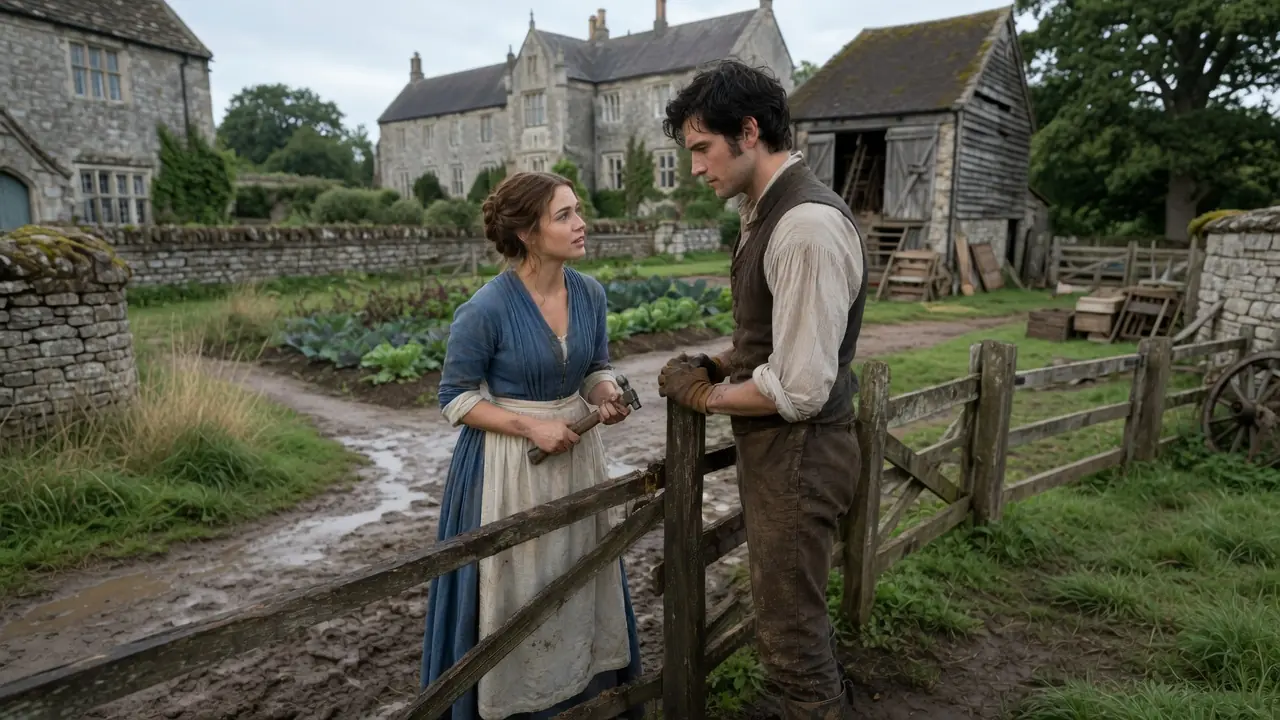
The garden fence is down where the pigs got into the cabbages. If you can hold the post while I drive the nail, we will do well enough. So he held the post. The post was rough oak, and it had splinters that bit into his palms. He had not gripped anything that hard in many years.
The hammer in her hand rose and fell. Her arm was small, but the muscle in it was clear under the skin. She did not miss the nails. She bit her lower lip when she swung. Her hair came further loose.
The wind smelled of mud and of bruised cabbage leaves and of the iron of the nails warming in her hand. "You hold a post well, Mr. Penn," she said after the third nail. "My great talent." She almost laughed. It was a small sound, and it surprised her.
He could see that on her face. She did not, he thought, laugh often. When they were done, the sun was high. They sat on the low wall at the edge of the kitchen garden, and she gave him a piece of brown bread with butter and a slice of cold ham. The butter was fresh.
It tasted of grass and salt. He had eaten in palaces. He had eaten food prepared by men who had cooked for kings. He could not remember when bread had last tasted this good. "You eat as if you have not eaten in three days," she said.
"I have not eaten anything I made myself in three days." "There is a difference," she nodded. She seemed to think this was a reasonable thing to say. She did not press him on what he meant. He found himself wanting to ask her things.
Why does your father not see what you are? Why does he leave you here alone to deal with men like Haly at the gate? Why are you not bitter? But he could not ask any of these things without giving himself away. So he asked something safer.
Will you go to London too when your father returns? She looked out at the field beyond the wall. The wind moved her hair across her cheek. She did not brush it away. I expect so, she said.
He has written to me. There is a duke, apparently, who has been told I might do. His chest went still. A duke? he said, keeping his voice flat. The Duke of Hollow.
They say he is rich. They say he is proud. They say he has been hunting for a wife for years and turning them all away. I imagine I will be turned away too. Why do you imagine that?
She turned to look at him. Then her gray eyes were very direct. Look at me, Mr. Penn. I have a crooked nose. I have hands like a stable boy.
I cannot dance well. I do not sing at all. I do not know how to flirt, and I have no taste for trying. My father will dress me in something foolish and march me into a drawing room, and the Duke will look at me for less than a minute and decide he has wasted his journey. I do not blame him in advance.
I would not marry me either if I were a duke. He could not speak for a moment. You speak ill of yourself, he said at last. I speak the truth. Those are not the same thing.
She blinked at him. The wind blew the hair off her cheek, and she did not catch it. Mr. Penn, she said slowly. You are a strange clerk. I have been told so.
She looked at him for another long heartbeat, and he felt the world go quiet around them. The sound of the wind dropped away. The buzz of a bee at the cabbage leaves went silent in his ears. He saw very clearly the small mark at her temple where a strand of hair had stuck to damp skin. He saw the tiny crease at the corner of her mouth, the place where laughter would go if she ever let it.
He saw the rise and fall of her breath at her throat. Then a hen squawked in the yard, and the world started again. She stood. She brushed the crumbs off her apron. I have work in the house, she said.
There is a man in the village who needs paying tomorrow and the books to be set right before then. If you will be useful again, you may chop the wood by the kitchen door. The boy is too small for it, and the maid is not strong. He chopped the wood. He chopped wood for two hours.
His shoulders began to ache in a way they had not ached in a very long time. The axe was old. The handle was smooth where many hands had held it before his. The wood split with a clean, dry crack each time. The smell of fresh cut pine rose into the air, sharp and clean.
Somewhere in the kitchen, he could hear a kettle whistle. Somewhere further off, a cow lowed. The boy came out and stacked the split wood without being asked, his small face serious. Alistair worked until the pile was twice the size she had asked for. Then he set the axe against the wall and washed his hands at the pump.
That night, he sat in the loft again with his bread and cheese, but he did not eat at once. He sat with his back against a beam and thought. He had come here to test her. He had come here to find out whether his mother's letter had told him the truth. He had told himself he would stay a day, perhaps two, and then ride home and write a polite letter and be done with the matter.
He could already feel in the place beneath his ribs that he was not going to ride home in two days. The next afternoon he met the rest of them. He had walked into the village to send a letter, a false one, to keep up the story of the clerk traveling north. On the way back to the Ashford lane, he had stopped at a small alehouse to drink a cup of cider and rest. The bench he sat on was hard.
The cider tasted of apples and of something a little gone, but it was cold and it was good. He listened. He had not been there ten minutes when a man in a fine green coat sat down two tables away. The coat was too fine for the alehouse. The buttons were silver.
The man's hair was very black and very combed. Brandy, the man said. Not your worst. The innkeeper grunted and went off to find a bottle. A woman in a feathered hat came in after the man.
She sat beside him. She was perhaps thirty, with red lips and a long thin neck. She held a fan even indoors. It is a sad place, Sherwin, she said. But we cannot be seen at the great houses while we wait.
You said three days. Three days, the man agreed. He took the brandy from the innkeeper without thanks. Three days and the old fool will be back from London with his daughter, and I will have my talk with him. He will agree.
He has no choice. And the girl, Sherwin laughed. It was not a kind laugh. The girl will agree to whatever her father agrees to. She has been alone in that house too long.
She will be glad of a husband. Any husband, even me. The woman in the feathered hat smiled. And then the land. And then the land, Sherwin said.
There is a strip along the western edge that runs into Hollow ground. The Duke will pay any price for it. Any price? You are certain? I have a cousin in his household. The Duke has spoken of that strip for three years.
He cannot get at the river without it. The old man Ashford has never sold. But the old man Ashford is in debt now, and the daughter knows it, even if he does not yet. The match will be made because there is no choice. The land will be mine.
The land will be sold. We will be rich, my dear. We will be richer than you have dreamed of. Alistair sat very still. The cider was sour in his mouth now.
He did not turn his head. He did not look at them. He let his eyes rest on the dark planks of the table in front of him. He was learning more in three days as a clerk than he had learned in seven years as a duke. So Marin did not know the depth of her father's debt.
So this Sherwin, whoever he was, planned to buy her with a wedding ring and sell the land underneath her feet. So Alistair himself, the Duke that no one in the room knew was three feet away, was apparently the unwitting reason for the whole scheme. He stood. He paid for the cider with a small coin. He walked out of the alehouse without looking at the man in the green coat once.
He did not return to the Ashford house at once. He walked the long way along the lane where the hedges were thick with the last white blooms of summer. The smell of the bloom was heavy, almost too sweet. The dust on the road was warm under his boots. A dog barked twice at a far farm and then stopped.
He thought of her at the wall, biting her lip as she swung the hammer. He thought of her saying, "I would not marry me either if I were a duke." He thought of the man in the green coat, saying she would be glad of any husband. He found by the time he reached the gate of the Ashford yard that he was angry. Not coldly angry the way he had been angry with the painted daughters of London.
Hotly angry, personally angry, as if the man in the green coat had threatened something that belonged to him. That, he thought, was a problem. He had no claim on this girl. He had only known her three days. He had lied to her about his name.
And yet that night he did not go up to the loft. He stood in the yard and waited. She came out at last with a lantern in her hand. The light made a small gold circle around her. She wore a shawl over the blue dress.
Her hair was down. He had not seen it down before. It fell in a heavy honey wave to the middle of her back. She stopped when she saw him. Mr. Penn, you should be asleep.
I would speak with you a moment if you will. She studied his face in the lantern light. Whatever she saw there made her set the lantern down on the low wall and fold her arms. Speak then. He drew a breath.
The night smelled of cold dew and of the small bitter smoke from the kitchen fire banked for the night. An owl called far off. There is a man in the village, he said. His name is Sherwin. He wears a green coat.
Do you know him? Her mouth tightened. I know him. He is a distant cousin of my father's. He has visited twice this summer. I do not care for him.
He is here in the village. He has been waiting for your father to return. She stood very still. How do you know this? I overheard him today by accident at the alehouse.
I should not tell you what I heard. It is not my place. But I have decided that I will because if I do not, you will walk into a trap with your eyes shut. Her gray eyes did not move from his face. Tell me, she said.
So he told her. He told her about the green coat and the woman with the fan. He told her about the talk of debt. He told her about the strip of land along the western edge that ran into Hollow ground. He told her carefully, watching her face, about Sherwin's certainty that she would say yes to any husband because she had been alone too long.
He did not tell her that he himself was the duke whose money was meant to crown the scheme. Not yet. He could not yet. The words sat in his mouth, and he held them there. She listened without moving.
Her arms stayed folded. Her face was very still. When he was done, she did not speak for a long minute. The owl called again. A small wind moved through the hedge and stirred the loose hair around her face.
Mr. Penn, she said at last, and her voice was low and even. Why have you told me this? Because it was not right not to. You are a stranger here. You arrived three days ago.
You owe me nothing. You could have ridden on tomorrow and never thought of me again. Yes. Then why? He could not say.
Or rather, he could say, but he could not say it as Mr. Penn, the clerk. So he said only, "Because you held the lantern up for me when I asked for shelter, and because the boy in your stable likes you, and because Mr. Haly at the gate trusts you when you say three days. A person who has earned those things ought to be warned when someone has plans for her." She looked at him for a long moment. "You are a strange clerk," she said again, but softer this time.
So you have told me. Will you come into the kitchen? I cannot think well in the yard. I will make tea. He came into the kitchen.
It was a small, low-ceilinged room with a deep hearth and a long scrubbed table. A copper kettle hung above the fire. The fire had been banked for the night, but she stirred it back to life with quick, practiced motions. The smell of wood smoke and old beeswax filled the room. A cat, a large gray one with a white throat, uncurled itself from a basket by the hearth, looked at him without interest, and curled back up.
She made tea. She did not speak while she made it. He sat on the bench at the table and watched her hands. She moved without waste. She did not rattle the cups.
The cups were good porcelain, but one of them had a chip on the rim. She gave him the one without the chip. My father, she said at last, sitting opposite him with her hands wrapped around her own cup, is not a wicked man. He is only a tired one. He has tried to manage the estate alone since my mother died.
He has made mistakes. He has hidden them from me because he believed that a daughter should not be troubled by such things. Her mouth twisted just a little. I am twenty-three years old. I have managed this house for six of those years.
He still believes me a child. Did you know about the debt? I knew there was less money than there had been. I did not know it was so bad. I should have.
I would have if I had pressed him. She looked into her cup. I did not press him because I am a coward. You are not a coward. She lifted her eyes.
Mr. Penn, you do not know me. I know you held off a man at your gate three nights ago when you thought no one was listening. I know you took a brush out of my hand and were not afraid to tell me I was holding it wrong. I know you chop your own kindling and pay your own debts, and you have not once in three days asked me for a single thing you could do for yourself. You are not a coward.
She looked at him. Her eyes were bright in the firelight. "And what shall I do now?" she said. The voice was very low. If my father comes home with the Duke's offer in one hand and Sherwin's offer in the other, and I refuse them both, we will lose the house.
If I take the Duke, I have not met him. I do not know him, and I have heard he is proud and cold. If I take Sherwin, I will be putting myself into the hands of a man who would sell the ground I walk on for the price of a brandy bottle. What would you do if you were me? He could not answer her at once.
The fire snapped. The cat made a small sleeping sound. The smell of the tea, strong and dark, with a faint trace of something like dried rose, rose up between them. He looked at her hands. They were red at the knuckles.
There was a small scar across the back of her left thumb. He thought for a long, slow moment of how easy it would be to reach across the table and lay his hand over hers. He did not reach. The moment stretched. He let it stretch.
The world narrowed down to the small flame of the candle she had set between them, to the steady rise and fall of her breath, to the way the firelight made the gray of her eyes look almost gold. "I would not marry Sherwin," he said at last slowly. "If I were you, I would not marry Sherwin, even if it cost me the house." "And the Duke?" He drew a breath.
"I would meet the Duke," he said, "before I decided anything about him. Men are not always what the gossip says they are. And neither," he added after a small pause, "are women." She studied him. Mr. Penn, she said, "Who are you?"
The kitchen went very still. He did not answer. He could not. The words sat behind his teeth, and he could not get them out. He told himself he would tell her tomorrow.
He told himself he would tell her in a way that did not feel like a slap. He told himself that he needed only a little more time. I am a clerk, he said, and he hated the words even as they came out. I am only a clerk. She watched him.
She did not believe him. He could see that she did not believe him. But she did not push. She set her cup down. She folded her hands together on the table.
Then I thank you, only a clerk, for what you told me tonight. She rose. He rose. They stood on either side of the kitchen table and looked at each other across it. The candle wavered.
"Good night, Mr. Penn." "Good night, Miss Ashford." He climbed up to the loft. He did not sleep. He lay on his back in the hay and looked up at the dark beams above his head and thought about what kind of man he had become.
He was the Duke of Hollow. He had pretended to be a clerk. He had sat at her table and let her ask him who he was, and he had lied to her face. He thought he had been clever. He thought he had been wise.
He thought he had been protecting himself against another false young lady. He had not thought in any of his planning what it would feel like if the young lady was not false. The next morning, he was up before dawn. He found the boy in the stable and gave him a coin and a quiet instruction. The boy went off at a run.
By the time the sun was a finger above the horizon, Alistair had ridden the mare two miles down the lane toward the village. There was a small wood there and an old beech tree on a rise where one could see the road for half a mile in both directions. He waited. He waited two hours. At last, he saw what he had been waiting for.
A man in a green coat on a black mare riding alone toward the Ashford gate. Alistair rode out into the lane. Mr. Sherwin, he said. The man pulled up. He looked at Alistair without recognition.
He saw a clerk in a brown coat on a tired-looking horse. You are in my way, fellow. I have a message for you. Yes, you are Mr. Sherwin, are you not? Cousin to Mr. Ashford?
The man's eyes narrowed. What of it? Alistair leaned forward in his saddle. His voice did not rise. You will leave this village today, he said.
You will not call upon Miss Ashford. You will not call upon her father when he returns. The land you have been counting on will not be yours. There is no duke in your future. There is no fortune in your future.
There is only, if you stay here past noon, a great deal of trouble. Sherwin stared at him. Then he laughed. It was the same unkind laugh from the alehouse. And who, my good clerk, do you think you are to give me such an order?
Alistair looked at him for a long moment. He thought of all the years of being chased through ballrooms. He thought of all the painted smiles. He thought of the woman with the feathered fan planning a sale that was not hers to make. I am the man, he said quietly, whose money you have been planning to spend.
He saw it land. He saw the laugh go off Sherwin's face. He saw the color drain from it. He saw the small, horrible understanding flicker across the man's eyes as he looked again and looked harder and saw past the brown coat and the worn boots. Hollow, Sherwin whispered.
Hollow, Alistair agreed. Now ride. Sherwin rode. Alistair watched him go until the green coat was only a dot on the long road. Then he turned the mare.
He rode slowly back toward the Ashford gate. The wind smelled of cut hay and of the warming road dust. A lark was singing somewhere over the field, high and clear and far away. He had perhaps an hour, maybe less. By noon, the boy he had sent at dawn would have reached Hollow with the message for Penn, and Penn would come, and Penn would bring the carriage and the proper clothes and the things that proved who he was.
By tonight, the Ashfords' true neighbor would be standing in their parlor, and not the clerk who had chopped their wood. He had to tell her first. He had to tell her himself. She was in the kitchen garden. She was bent over a bed of late herbs, cutting sprigs of something green into a basket.
She did not look up when he came in through the gate. "Mr. Penn," she said. "The boy says you were gone before sunrise." I rode out to meet a man on the road. She straightened.
Her gray eyes were on his face at once. Sherwin. Sherwin, and he has left the village. He will not return. She set the basket down very slowly. She set the small knife down beside it.
She stood up. She wiped her hands once on her apron. You frightened him off. Yes. A clerk frightened off a gentleman in a green coat. Yes, Mr. Penn.
Her voice was quiet, but it had a hard edge that he had not heard in it before. "I asked you last night who you were. You told me you were a clerk. Will you tell me now?" He did not look away from her face. "I told him my name," he said.
"I would like to tell you mine first before he has the chance to spread it. Will you walk with me a little? Just past the gate. I would not say it in the yard." She looked at him for a long beat. Then she nodded once.
They walked out through the gate, past the low fence, down the lane a small way until they came to the bend where the hedge was tall and they could not be seen from the house. There was a fallen log on the verge. She did not sit. He did not either. He took off his cap.
He held it in his hands. He felt the rough wool against his palms. My name, he said, is Alistair Crane. She did not speak. I am the Duke of Hollow.
For a long moment, she did not move. The wind moved her hair. A bee hummed somewhere along the hedge. Then she said very quietly, I see. That was all.
I came here, he said, and now the words came out fast because if he stopped, he was afraid he would not start again, because my mother had written to me of you. I have been written to of many young women. I have met many of them. I have found again and again that what I was told and what was true were two different things. I had decided I could not trust what I was told.
I had decided I had to see for myself without my name, without my title. So I came to your house in this coat, and I asked the boy where to put my horse, and I told you I was a clerk named Penn. I lied to you. I knew I was lying to you. I told myself it was reasonable.
It was not reasonable. It was a coward's path. I am sorry. She was looking past him at something in the hedge. Her face was very still.
"Miss Ashford." "Be quiet a moment, please," she said. Her voice was perfectly polite. It cut him deeper than shouting would have. He was quiet. She stood there for what felt like a very long time.
He watched her hands. They were closed into small fists at her sides. Then they opened. Then they closed again. So I sat at my kitchen table last night, she said at last, and I told you about my father's debt, and I asked you what I should do, and I asked you whether I should marry the Duke of Hollow, and the Duke of Hollow was sitting opposite me.
And he did not say so. Yes. I told a strange man in my kitchen that I had a crooked nose and could not dance well, and the Duke would turn me away in less than a minute. And the strange man was the duke. Yes.
I asked you who you were, and you said you were only a clerk. Yes. She looked at him then. Her gray eyes were not gold in the morning light. They were the color of cold rain on stone.
You let me make a fool of myself in front of you for three days. You were never a fool. Not once, not in any moment of the three days. You should not be the judge of that, your grace. The title came out of her mouth like a small, clean knife.
She did not say it cruelly. She said it precisely. He felt it. You are right, he said. I should not.
Go away from me, please. Marin. Miss Ashford. He bowed his head. Miss Ashford, I will go. But I would say one more thing first if you will let me say it.
Just one. She did not say yes. She did not say no. She turned her face a little away from him. He took it as permission because he could not bear not to take it as permission.
You asked me last night what you should do. I told you I would meet the Duke before I decided anything about him. He drew a breath. I told you the gossip is not always true. I said it as a clerk.
I meant it as a man. I do not ask you to marry me. I do not ask you to forgive me. I ask only that when your father returns and the offer is made, and it will be made, you do not refuse it before you have met me again. Meet me.
Not the duke who I pretended not to be. Not the clerk who I pretended to be. Meet me as I am. After that, refuse me if you wish. I will not contest it.
I will tell my mother the match cannot be made. I will write a letter to your father that frees you from any obligation. You may have the land along the western edge as a gift with no condition, and your father's debt will be paid out of my own purse. There will be no marriage required. None.
I would not buy you. I would not have you bought. She turned then. Her face was wet. He had not seen her cry the night before. He had not seen her cry when Haly was at the gate.
He had not thought she would cry now. The tears were silent. She did not wipe them. You would do that. It is already done.
I have already decided it. Whether or not you ever speak to me again, it is done. The debt will be cleared this week. The land is yours. That is not the price of meeting me.
That is what I owe you for the lie. She closed her eyes. The breath she drew in was uneven. Go now, please, just for today. I cannot, I cannot speak to you anymore today.
He bowed. He turned. He walked. He did not look back, though every step he took along the lane felt as if it were pulling something out of his chest. He stayed at an inn in the next village that night and the night after.
He did not write to her. He did not send the boy with a message. He had told her he would give her time. He gave her time. On the third day, Penn came in the great carriage with the proper clothes and the signet ring and a small case of papers.
Alistair signed the papers that cleared the Ashford debt. He signed the papers that transferred the western strip of land. He sent the papers by Penn's hand to Mr. Ashford, who had returned from London the day before, with a short note in his own hand. Sir, these matters are settled and require nothing of you or your daughter. I will call upon your house in three days.
If your daughter does not wish to receive me, I will go away again without offense taken. Yours, Hollow. He waited. On the third day, he rode to the Ashford house in his own coat, the dark blue one with the silver buttons, on the gray horse that everyone in the county knew was his. The boy in the yard looked at the horse and then at him and went very white.
"Your grace," the boy whispered. "It is the same man, lad. Do not worry." Mr. Ashford met him at the door. He was a thin man with kind, tired eyes.
He had not slept much, Alistair thought. He bowed lower than he needed to. Your grace. I, I cannot, the papers, sir. My daughter, is she at home, sir?
She is in the garden. She said she would receive you if you came. Beyond that, I, sir, I do not know what is to be said. Then let me speak with her, and we shall find out. He walked round the side of the house, past the kitchen garden where he had held the post, past the low wall where they had eaten bread together.
He did not see her at first. Then he did. She was in the orchard under an old apple tree. The tree was heavy with hard green fruit. The leaves rustled above her.
The grass at her feet was long. She had on a different dress today, still plain, but a soft gray, the color of her eyes in the morning. Her hair was up. There was no flour on her arms. She turned when she heard him.
For a long moment, neither of them spoke. He took off his hat. He did not bow. He did not wish to bow at this moment. He wished to stand on the same ground as her.
Miss Ashford. Your grace. He flinched. He hoped she did not see it. She did. She saw everything.
My father showed me the papers, she said. And your letter. Yes. You did all of it. You did not wait for me to say yes. You did not make it a price.
No. Why? He thought before he answered. The orchard smelled of grass and of warm applewood. A pair of finches argued in the tree above her.
The shadows moved across her face. Because if I had made it a price, he said, you would not have been free. And the whole reason I came here in that brown coat was to find a woman who would meet me free. I would not waste that by making you my prisoner at the end of it. She looked down at her hands.
Then up. You asked me to meet you as you are. Yes. I do not know who you are. I knew Mr. Penn for three days.
I do not know the Duke at all. They are the same man, Miss Ashford. The same hands, the same eyes, the same opinions about cabbage pigs. The Duke does, I am afraid, hold a stable brush wrong. The Duke does eat bread as if he has not eaten in three days.
The Duke did mean every kind word he said to you in the kitchen and meant every word he did not say more than he meant the words he did. The coat changes. The man does not. She was quiet for a long while. The finches argued.
The wind moved. You said, she said slowly in the lane, that you would not have me bought. I would not. Then I will ask you something. As one person to another, as Marin Ashford to Alistair Crane, not as a girl to a duke.
Ask. What did you see in the three days you were Mr. Penn? What made you want to come back? He did not answer at once. He looked at her face.
He thought of all the small things, and he understood that this was the moment, and that the answer mattered more than any answer he had ever given in his life. You told a man at your gate, he said quietly, that you would have his three pounds in three days, and you stood there alone in the yard after he left. And you pressed your hand to your head when you thought no one was looking. You did not pretend you were not afraid. You only pretended for the man at the gate because his fear would have been worse than yours.
I saw that. That is what I saw. She did not move. You took a brush out of my hand, he said, because the mare's shoulder mattered to you more than my pride did. That is the second thing I saw.
You told me I was wrong to call myself ugly. You did not flatter me. You said it as a matter of fact, as if you were correcting a sum. That was the moment I knew you were not a clerk. No clerk in England would dare to correct a stranger about her own face.
But it was also the moment I knew, whoever you were, that I would not forget you. He stopped. She lifted her hand. She pressed it against her mouth. Above them, the finches went quiet at last, as if even they could feel the air change.
"Your grace," she said through her fingers. "Alistair, if you can bear it, just for now." She lowered her hand. She drew a breath that shook a little and then steadied. "Alistair," she said.
The orchard went very still around them. He could hear the small dry rattle of a leaf falling somewhere in the row. He could smell the grass under his boots and the faint sweet smell of the apples above. He could see very clearly every fleck of green in her gray eyes. He could see the small bump on her nose that she had told him made her ugly, and he could not, looking at her now, understand what she had meant.
He did not reach for her. He had promised himself he would not. He had promised her in his own heart that she would not be bought. But he held out his hand, palm up, open. He held it across the small space between them and waited.
She looked at his hand for a long moment. Then she put hers into it. Her fingers were warm. The small scar across the back of her thumb pressed into his palm. He did not close his hand on hers.
He let her rest. She rested. I am not promising anything yet, she said. You understand that? I understand.
You will have to come back as Alistair many times. You will have to eat at our table with my father knowing who you are. And you will have to chop wood by the kitchen door knowing that I know who you are. You will have to be the same man in both coats. Exactly the same man every single day.
I will. I will tell you when and only when I have decided. It may take a long time. It may take as long as you wish. She looked down at their hands.
She looked up. Then come back, she said. Tomorrow, if you can. I have a fence post that has gone loose again, and the boy is still too small for it. A clerk in a brown coat held it for me well enough.
Perhaps a duke in a blue one will manage, too. He smiled. He could not help it. The smile was small and slow, and it felt on his face like something he had not done in years. I will hold any post you ask, Miss Ashford.
Marin. Marin. He came back the next day. He held the post. He chopped more wood. He sat at the kitchen table and ate brown bread and butter while her father, pale and uncertain, watched him from the other end of the bench and slowly began to believe that he was real.
He came back the day after that and the day after that. The weeks turned. The apples on the tree went from hard green to soft red. The hedges thinned. A first frost lay one morning on the kitchen garden, and the cabbages were brought in.
Mr. Haly came to the gate one more time, very nervous, and was told by Miss Marin herself that the matter was settled and that he should give her mother his very best regards. Mr. Haly went away weeping a little with a small bag of coins in his pocket that he had not asked for. The boy in the stable taught the Duke of Hollow how to brush a horse properly. The Duke of Hollow accepted the lessons with grace. The boy told everyone in the village ever after that he had once corrected a duke.
No one quite believed him. He did not mind. In the second month, Marin found out by way of the maid, who had it from the boy, who had it from Mr. Haly's wife, that the Duke had quietly paid a year's rent for the cottage of an old woman in the village whose roof had blown off in a storm. He had done it through Penn, in another name, so that the old woman would not feel a duke's pity. The old woman thought it was the parish.
Marin learned the truth by accident. She did not mention it to him. He never mentioned it either. But the next time she handed him a cup of tea, her hand stayed against his for a heartbeat longer than it needed to, and he understood that she knew, and that she understood that he had not done it for her to know. In the third month, on a cold, clear morning, when the breath came out of their mouths in small white clouds, he asked her in the orchard under the bare apple tree if she would marry him.
She did not answer at once. She looked at him for a long, slow moment. The world stretched the way it had stretched in the kitchen on the night he had not told her his name. He saw the small mark at her temple. He saw the rise of her breath.
He saw the small movement at the corner of her mouth that meant a laugh was waiting somewhere behind it. "Yes, Alistair," she said. "I will." He did not kiss her. Not then.
He took her hand, and he turned it over in his own, and he pressed his thumb very gently against the small scar across the back of hers. "Thank you," he said. A year later, the orchard was heavy with fruit again. The hedges were thick with white bloom. The kitchen of the manor at Hollow smelled of bread and lavender water and the faint smoke of a banked fire.
A gray cat with a white throat had been brought over from the Ashford farmhouse and now slept by the new hearth. A bay mare, sound at last in both shoulders, grazed in the home paddock. In the small back room where the Duke had once kept the brown coat folded in a cedar trunk, the coat was still there. He had not thrown it away. He never would.
In the long drawing room, his mother sat with a cup of tea and watched her daughter-in-law walk along the line of windows with a basket of cut herbs over her arm. The young duchess had on a plain gray dress and a wide white apron. There was a smudge of flour on one of her forearms. Her hair was the color of dark honey, and a few strands had fallen loose at her temples.
My dear, the Duke's mother said softly, more to herself than to anyone else. You do not look like a duchess at all. Marin turned. She smiled. It was a small smile and slow, but it reached her eyes.
"No, my lady," she said. "I look like myself. He preferred it that way." In the corner of the room, the Duke set down the book he had been pretending to read. He did not say anything.
He did not have to. He only looked at her across the long, warm room, in the way of a man who has finally seen in plain daylight the one true thing that all his years of titles and ballrooms and painted smiles had never quite managed to show him. She looked back. The room was quiet around them. The fire made its small soft sound. Outside, a thrush sang twice and then stopped.