The first thing Nora Bell wrote was not the title.
It was her mother’s name.
Ruth Bell.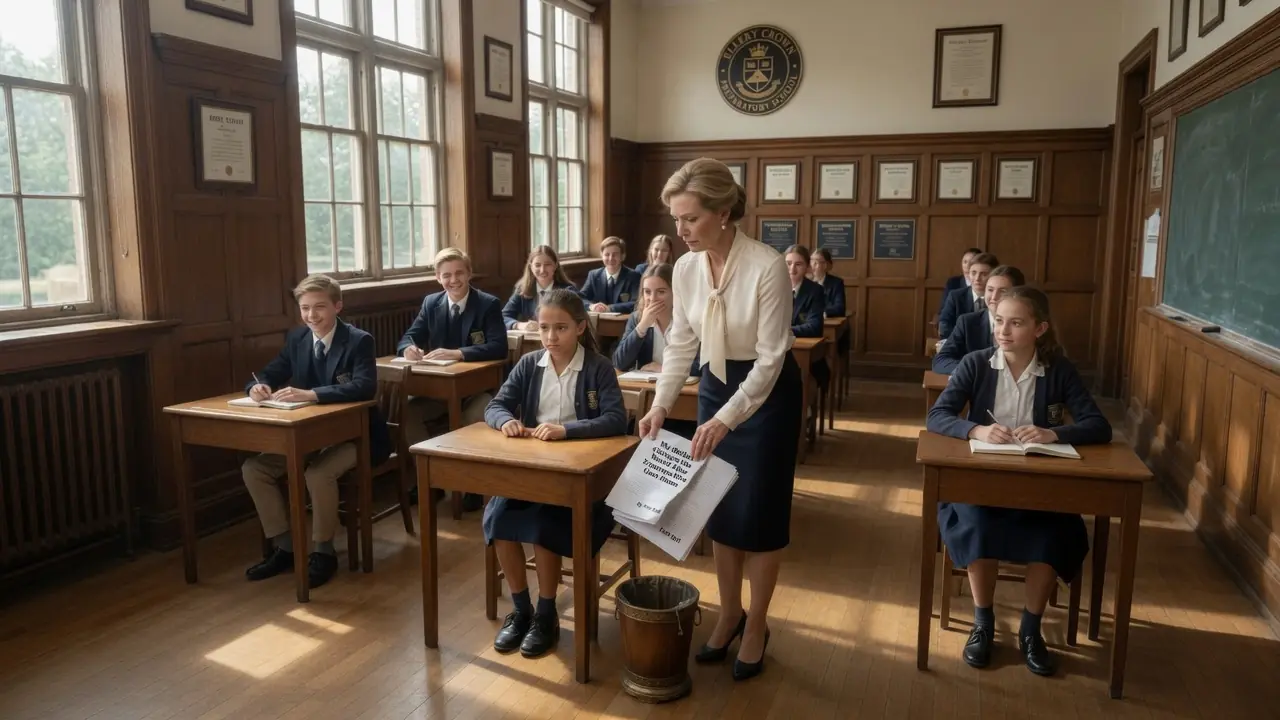
She wrote it slowly in the top corner of the page, pressing her pencil harder than she needed to, as if the graphite could make the name stay where the world kept trying to erase it.
Then she sat at the kitchen table of their basement apartment on Hollow Pine Street and listened to the sound of her mother’s keys turning in the lock.
It was 11:47 p.m.
The pipes above the ceiling groaned. A neighbor’s television murmured through the wall. The small electric heater near the couch rattled like it was trying its best but had not been built for miracles.
Nora was twelve years old, with thin brown hair she usually tied back with a fraying blue ribbon, dark eyes too watchful for a child, and hands that always seemed to carry pencil smudges. She attended Ellery Crown Preparatory School on a partial scholarship that covered tuition but not shame.
Shame had its own expenses.
Uniform skirts that were never quite new.
Shoes polished over cracks.
Field trips that required fees quietly placed in white envelopes.
Lunches that looked different from everyone else’s.
Nora knew all of that before she ever learned algebra.
Her mother stepped inside wearing her gray janitor’s jacket, the one with CleanWay Services stitched over the pocket. Her shoulders sagged from a twelve-hour shift. A yellow rubber glove stuck out of one coat pocket, and her hair, usually braided neatly before work, had loosened around her face.
Still, when Ruth saw Nora at the table, she smiled.
“You’re awake, little bird.”
“I’m writing my essay.”
“At midnight?”
“It’s due tomorrow.”
Ruth set down her keys and tried to hide the way her fingers trembled from fatigue.
“What’s the topic?”
Nora looked at the paper.
A Person Who Changed My Life.
She had known what she wanted to write the second Mrs. Celeste Farnham announced the assignment.
Not a president.
Not a famous scientist.
Not a war hero.
Not a billionaire inventor or a founder with a building named after him.
Her mother.
The woman who cleaned offices where other people made money.
The woman who came home smelling faintly of bleach and lemon floor polish.
The woman who knew how to stretch one roasted chicken into four dinners, how to patch a school blouse so the stitches disappeared, and how to laugh quietly on the worst nights so Nora would not learn fear too early.
“You,” Nora said.
Ruth stopped taking off her jacket.
“Me?”
“Yes.”
“Oh, honey.” Ruth laughed, but it came out nervous. “There are more interesting people to write about.”
“No, there aren’t.”
Ruth hung her jacket on the chair and walked closer.
The apartment was small enough that everything was close. Kitchen, living room, homework table, folding bed, one narrow bedroom behind a curtain. But Ruth had made it clean. Always clean. Even poverty, Nora had learned, could be scrubbed with enough love and stubbornness.
Ruth looked at the first line.
My mother changes the world after everyone else goes home.
Her face softened.
“Nora.”
“It’s true.”
“I just clean buildings.”
“No,” Nora said. “You make places ready for people who don’t even know you helped them.”
Ruth pulled out the chair beside her daughter and sat.
For a moment, she looked older than thirty-eight.
Then she touched Nora’s hair.
“Write what you see,” she said. “That’s all writing is.”
So Nora did.
She wrote about waking up some mornings to find her mother asleep at the table with a grocery list under one hand and a work schedule under the other.
She wrote about Ruth cleaning the public library after closing and bringing home discarded books from the lost-and-found shelf when no one claimed them.
She wrote about how her mother had once found a wallet in an office trash can, called the owner, and returned it with six hundred dollars still inside, even though they needed groceries that week.
She wrote about a night when Ruth cleaned a hospital wing and stayed an extra hour sitting beside an old man whose family had not come yet.
She wrote about hands.
Her mother’s hands.
Cracked from chemicals.
Strong from carrying buckets.
Gentle when checking Nora’s forehead for fever.
She wrote until the heater clicked off and the apartment grew colder.
Ruth fell asleep on the couch halfway through, still in her work pants, one hand resting open near her face.
Nora looked at that hand for a long time.
Then she wrote the final line.
My mother is not famous, but every place she leaves behind is better than it was before she entered it, and that is the kind of greatness I trust.
The next morning, Nora folded the essay carefully and slipped it into a blue folder.
Ellery Crown Preparatory School sat on a private road lined with ornamental trees that had little plaques naming the families who donated them. The main building looked like a courthouse crossed with a museum, all pale stone columns, wide steps, and bronze doors that made every student feel either important or warned.
Parents liked to say Ellery Crown built leaders.
Nora sometimes wondered what it built them out of.
Her classmates arrived in cars that smelled like leather and expensive coffee. They wore the same uniform she did, but somehow theirs looked different. Sharper. Cleaner. Less afraid of laundry day.
Nora took the bus to the edge of campus and walked the remaining half mile.
She liked the walk.
It gave her time to become the version of herself Ellery Crown required.
Chin up.
Shoulders straight.
Do not look impressed.
Do not look hungry.
Do not look poor.
Her English class met on the second floor in Room 214, where sunlight came through tall windows and landed across polished wooden desks. The walls displayed framed student essays from past years, all written by children whose last names appeared on library wings and scholarship plaques.
Mrs. Celeste Farnham stood at the front of the room wearing a cream blouse, a pearl necklace, and the expression of someone who had never raised her voice because she had never needed to.
She had taught at Ellery Crown for eighteen years.
Parents admired her.
Students feared disappointing her.
Nora had once admired her too.
At the beginning of class, Mrs. Farnham collected the essays in a neat stack.
“Today,” she said, “we will discuss the difference between personal emotion and meaningful subject matter.”
That sentence made Nora look up.
Mrs. Farnham lifted the stack of papers.
“Writing is not merely confession. It is selection. A writer must choose a subject worthy of the reader’s attention.”
Several students nodded as if they understood.
Nora’s stomach tightened.
Mrs. Farnham began reading titles aloud.
“My Grandfather, the Senator,” by Preston Vale.
“The Surgeon Who Saved My Brother,” by Marissa Whitcomb.
“How My Father Built ArdenTech,” by Lila Crest.
“Coach Halden and the Meaning of Victory,” by Theo Birch.
Then she paused.
Her fingers found Nora’s essay.
The blue folder.
The room seemed to wait.
Mrs. Farnham looked at the title.
“My Mother Changes the World After Everyone Else Goes Home,” she read.
A few students turned.
Preston Vale smirked.
Lila Crest whispered something to Marissa, who covered her mouth.
Mrs. Farnham looked at Nora over the top of the paper.
“Nora Bell.”
Nora sat straighter.
“Yes, ma’am.”
“Would you mind telling the class what your mother does?”
Nora felt heat rise in her face.
“She works for a cleaning company.”
“A cleaning company,” Mrs. Farnham repeated.
Not cruelly.
Worse.
Gently, with polished disappointment.
“And you chose this as the person who changed your life?”
“Yes.”
Preston snorted.
Someone whispered, “Of course she did.”
Mrs. Farnham unfolded the essay and scanned the first page.
Her mouth tightened.
“Nora, this assignment was an opportunity to reach beyond the obvious.”
Nora gripped the edge of her desk.
“My mother isn’t obvious.”
Mrs. Farnham’s eyebrows lifted.
A warning.
“I understand you feel affection for her. That is natural. But affection is not the same as literary importance.”
The class had gone very still.
Nora could hear the clock above the door.
Could hear someone tapping a pen softly against a desk.
Mrs. Farnham continued.
“Students, this is an instructive example. A piece may be sincere and still be insufficient.”
She held up Nora’s essay.
“The language is emotional, but the subject lacks scale. A janitor may be admirable in a private sense, but writing must elevate. It must not settle for the ordinary.”
The word janitor struck Nora like a slap.
Not because it was false.
Because Mrs. Farnham said it as if Ruth Bell’s work belonged somewhere below human dignity.
Nora stood without meaning to.
“My mother isn’t ordinary.”
A few students laughed.
Mrs. Farnham’s face cooled.
“Sit down, Nora.”
“She works harder than anyone here.”
More laughter now.
Preston leaned back in his chair.
“My dad owns three buildings. People like her clean them.”
Nora turned toward him.
“Then maybe your dad should be grateful.”
The room gasped.
Mrs. Farnham’s voice sharpened.
“Enough.”
Nora sat down.
Her hands were shaking under the desk.
Mrs. Farnham looked at the essay again.
Then she did something Nora would remember for the rest of her life.
She tore it.
Once down the middle.
Then again.
The sound was small.
Paper does not scream.
But Nora felt it in her chest like something living had been split apart.
Mrs. Farnham dropped the pieces into the wastebasket beside her desk.
“This,” she said to the class, “is what happens when sentiment is mistaken for substance. Nora, you may rewrite the assignment properly and submit it Monday. Choose someone with broader significance.”
Nobody moved.
Then Preston laughed.
That gave permission to the others.
A few giggles.
A whisper.
Lila Crest murmured, “Maybe she’ll write about the lunch lady next.”
Nora looked at the wastebasket.
She did not cry.
That seemed to disappoint some of them.
She only stared at the scraps of paper where her mother’s name had been.
For the rest of the class, she did not hear a word.
After the bell rang, students filed out quickly, energized by someone else’s humiliation.
Mrs. Farnham called after her.
“Nora, a word.”
Nora stopped near the door.
Mrs. Farnham stood beside the wastebasket.
Her voice softened into the tone adults use when they want cruelty to sound like guidance.
“You are a capable student. But scholarship students must be particularly careful. You are being given an opportunity many children would envy. Do not waste it on resentment.”
Nora looked at her.
“I wrote about my mother.”
“Yes,” Mrs. Farnham said. “And perhaps one day you’ll understand why that was not enough.”
Nora walked out before she said something that would cost her the scholarship.
She made it to the girls’ bathroom before she began shaking.
Not crying.
Shaking.
She locked herself in the last stall and pressed both hands against her mouth.
She thought of Ruth falling asleep on the couch.
Ruth’s cracked hands.
Ruth saying, Write what you see.
Then Nora did something Mrs. Farnham had not expected.
She waited until the hallway emptied after lunch, walked back to Room 214, and found the wastebasket still beside the desk.
No one was there.
Her torn essay lay on top.
She reached in and took every piece.
Some had shoe dust on them.
One corner had coffee from Mrs. Farnham’s paper cup.
Nora carried the pieces to the library.
Mr. Alden looked up from the circulation desk.
He was a gentle man with silver hair, round glasses, and cardigans that always had pencils in the pocket.
“Nora?”
She held the torn paper to her chest.
“Do you have tape?”
His face changed.
He did not ask questions first.
That was why Nora trusted him.
He led her to the back table, brought tape, scissors, and a clean sheet of paper. Together, in silence at first, they pieced the essay back together like a broken map.
When the title was readable again, Mr. Alden stopped.
My Mother Changes the World After Everyone Else Goes Home.
He looked at Nora.
“May I read it?”
She hesitated.
Then nodded.
He read the whole thing slowly.
Once.
Then again.
When he finished, his eyes were wet.
“Nora,” he said, “this is not insufficient.”
Her throat tightened.
“Mrs. Farnham said it was too ordinary.”
Mr. Alden removed his glasses and wiped them.
“Some people call things ordinary when they have never had to depend on them.”
Nora looked down.
“She tore it in front of everyone.”
His face hardened in a way she had never seen.
“I’m sorry.”
“I don’t want to rewrite it.”
“Then don’t.”
“She’ll fail me.”
“Perhaps.”
“I can’t lose the scholarship.”
Mr. Alden was quiet for a moment.
Then he reached into a file tray behind the desk and pulled out a printed flyer.
The National Young Voices Essay Competition.
Open to students grades 6–8.
Theme: The Unsung Hero Beside Me.
Grand prize: $5,000 educational award, publication, and school recognition ceremony.
Nora read the flyer.
Her heartbeat changed.
Mr. Alden tapped the title.
“Deadline is tonight.”
“I can’t send a torn essay.”
“You can type it.”
“I don’t have a computer.”
“You have a library.”
He said it simply.
As if the answer had always been there.
That afternoon, Nora missed the late bus.
She stayed in the library until the sky outside turned violet and the hallway lights clicked on. Mr. Alden sat nearby pretending to organize catalogs while she typed the essay on an old computer near the biography shelves.
She fixed nothing important.
Only spelling.
Only a comma or two.
She did not remove the part about the cracked hands.
She did not remove the word cleaner.
She did not make Ruth sound grander, richer, or more famous.
She wrote what she saw.
When the online submission form asked for a parent email, she used the one Ruth checked on her phone during breaks.
When it asked for teacher sponsor, she froze.
Mr. Alden leaned over.
“Use mine.”
“Are librarians allowed?”
“They are when they believe in a student.”
Nora typed his name.
Edwin Alden.
School Librarian.
Before she clicked submit, she looked at him.
“What if they laugh too?”
Mr. Alden’s voice was quiet.
“Then the world is poorer than I thought. But send it anyway.”
She clicked.
The screen loaded.
Submission received.
Nora exhaled.
Then she gathered the taped original, folded it carefully, and put it in her backpack.
At home, Ruth was worried.
“You missed the bus.”
“I stayed at the library.”
“With permission?”
“Yes.”
That was true enough.
Ruth studied her face.
Something had happened.
Nora knew her mother saw it.
But Ruth did not force the door open.
Instead, she heated leftover soup and placed a bowl in front of Nora.
“Bad day?”
Nora nodded.
“Want to talk?”
“Not yet.”
“All right.”
They ate quietly.
Nora almost told her.
Three times.
But she could not bear to describe Mrs. Farnham’s hands tearing the paper. She could not bear to watch Ruth pretend it did not hurt. So she kept the secret folded inside her backpack like the repaired essay.
On Monday, Nora submitted a new essay to Mrs. Farnham.
Not about her mother.
About a famous architect named Warren Phelps, whose museum design she found online.
It was neat.
Empty.
Acceptable.
Mrs. Farnham wrote Good improvement in red ink at the top.
Nora looked at the words and felt nothing.
Winter passed slowly.
The competition became something she almost convinced herself to forget.
Life at Ellery Crown continued.
Preston Vale still smirked when she walked by.
Lila Crest still whispered.
Mrs. Farnham treated Nora with extra patience, which felt worse than dislike.
But something had changed.
Nora no longer tried to admire her.
Respect, she had learned, could expire.
In January, the heat failed in their apartment for two nights.
Ruth brought home extra blankets from the laundromat and slept on the floor near the heater to make sure it did not spark. Nora woke at three in the morning and found her mother sitting awake, rubbing her hands.
“You should sleep,” Nora whispered.
“So should you.”
“Your hands hurt?”
“A little.”
Nora thought of the essay.
Of the torn paper.
Of the sentence Mrs. Farnham had said.
A janitor may be admirable in a private sense.
“What does admirable mean?” Nora asked.
Ruth looked surprised.
“Worthy of respect.”
Nora stared at the ceiling.
“Who decides?”
Ruth was quiet for a while.
Then she said, “Careful people do.”
That answer stayed with Nora.
In February, a white envelope arrived at the apartment.
Ruth brought it in with the mail, balancing groceries in one arm.
“Nora, something from Young Voices Foundation.”
Nora nearly dropped a can of beans.
Ruth noticed.
“What is this?”
“I entered something.”
“What something?”
“An essay.”
Ruth set the groceries on the counter.
“Nora Bell.”
“It was after school. Mr. Alden helped. It was allowed.”
Ruth looked at the envelope.
“Open it.”
Nora’s fingers shook so badly she tore the envelope crooked.
Inside was a letter on thick paper.
Dear Nora Bell,
Congratulations.
She stopped.
Her eyes blurred.
Ruth stepped closer.
“What?”
Nora forced herself to read.
Your essay, “My Mother Changes the World After Everyone Else Goes Home,” has been selected as the national first-place winner of the Young Voices Essay Competition.
Ruth sat down.
Not gracefully.
Just down.
The chair scraped against the floor.
Nora continued reading through tears.
The judging committee was moved by your clarity, moral insight, and extraordinary attention to unseen labor. We would be honored to present your award at Ellery Crown Preparatory School during a public recognition ceremony.
Ruth covered her mouth.
“No.”
“Yes.”
“Nora.”
“I wrote about you.”
Ruth began to cry.
This time, not quietly enough to hide.
Nora went to her, and Ruth pulled her close, letter crushed between them.
“Little bird,” Ruth whispered. “You shouldn’t have.”
“Yes,” Nora said into her shoulder. “I should have.”
The Young Voices Foundation contacted Ellery Crown the next day.
The school reacted exactly as Nora expected and not at all as Mrs. Farnham deserved.
Headmaster Lionel Breck announced it over the intercom with a voice full of surprise he tried to turn into pride.
“We are delighted to share that one of our own students, Miss Nora Bell, has earned first place in a national essay competition.”
Cheers sounded in some classrooms.
In Room 214, nobody moved.
Mrs. Farnham stood by the board with a marker in her hand.
Her face had gone still.
Preston looked at Nora.
Lila’s mouth opened slightly.
Marissa Whitcomb whispered, “What essay?”
Nora looked straight ahead.
Mrs. Farnham cleared her throat.
“Well,” she said. “That is… unexpected.”
Mr. Alden appeared at the classroom door ten minutes later.
He held a printed schedule.
His face was calm, but his eyes were bright.
“The judging committee will come next Friday,” he said. “They’ve requested to present the award in assembly.”
Mrs. Farnham took the paper.
“Of course.”
Her voice sounded brittle.
After Mr. Alden left, Mrs. Farnham looked at Nora.
For the first time, the teacher seemed unsure of what expression to wear.
“Nora,” she said, “may I see the final version you submitted?”
Nora met her eyes.
“You already did.”
The room froze.
Mrs. Farnham’s fingers tightened around the paper.
Nora’s voice did not shake.
“You tore it up.”
No one laughed.
Not this time.
The week before the assembly felt strange.
People who had ignored Nora now smiled too brightly.
Students asked to read the essay.
Teachers congratulated her in hallways.
Headmaster Breck called Ruth and used phrases like “school pride” and “remarkable achievement” until Ruth finally interrupted and asked whether Nora would be allowed to speak.
There was a pause.
Then he said yes.
Mrs. Farnham did not mention the torn essay.
Not once.
But Nora saw her watching.
Fear looks different on adults.
Children often wear fear openly.
Adults dress it as irritation.
On Friday morning, Ellery Crown’s auditorium filled with students, teachers, parents, and administrators. A banner hung above the stage:
YOUNG VOICES NATIONAL ESSAY AWARD
HONORING NORA BELL
Ruth sat in the second row wearing her best navy dress and black shoes she had polished twice.
She had taken the morning off work.
That meant losing pay.
Nora knew.
Mr. Alden sat beside her, holding a program.
Mrs. Farnham sat with the faculty near the aisle.
She wore a pale blue suit and kept smoothing the program in her lap until the edges bent.
Three judges from the Young Voices Foundation took the stage.
The lead judge was a woman named Dr. Helena Price, tall, silver-haired, with a voice that filled the room without needing force.
She spoke about the competition first.
Thousands of submissions.
Every state region.
Essays about firefighters, doctors, astronauts, entrepreneurs, soldiers, coaches, scientists, activists.
“All of those subjects can be worthy,” Dr. Price said. “But the winning essay did something rarer. It made the judges see someone most of us have been trained not to notice.”
Nora looked at Ruth.
Her mother’s hands were clasped tightly in her lap.
Dr. Price continued.
“Nora Bell wrote about her mother, Ruth Bell, a cleaner who works after hours in buildings where others receive the credit for morning order.”
A murmur moved through the auditorium.
Nora saw Mrs. Farnham close her eyes briefly.
Dr. Price lifted a printed copy of the essay.
“I would like to read a brief passage.”
Nora’s breath caught.
Dr. Price read.
“My mother changes the world after everyone else goes home. She does not stand on stages or cut ribbons. She turns off the lights in rooms where important people forgot to notice the mess they left behind. She wipes fingerprints from glass doors so the next person can walk through believing the world was always clear.”
The auditorium went silent.
Not bored silent.
Listening silent.
Dr. Price read another passage.
“Her hands are cracked because clean places cost someone something. People say the building is beautiful in the morning. They do not know my mother’s knees ached at midnight so their beauty could arrive on time.”
Ruth bowed her head.
Nora saw her shoulders shake.
Dr. Price lowered the paper.
“This essay won because it understands dignity. It reminds us that greatness is not measured by fame, income, or social position, but by the care a person gives to work no one applauds.”
She looked toward Nora.
“Nora, would you join us on stage?”
Nora stood.
Her legs felt weak.
The walk to the stage seemed much longer than it was.
Students watched.
Teachers watched.
Mrs. Farnham watched.
When Nora reached the podium, Dr. Price shook her hand and handed her a framed certificate. Another judge presented a check for the educational award. A photographer took pictures.
Then Dr. Price leaned toward the microphone.
“Nora has asked to say a few words.”
Headmaster Breck looked surprised.
So did Mrs. Farnham.
Nora unfolded a small paper from her pocket.
Her hands shook, but she did not hide them.
“My mom told me writing is saying what you see,” she began.
Her voice sounded small in the auditorium.
Then the microphone caught it and carried it farther.
“So I wrote what I see. I see my mother come home tired and still ask about my day. I see her clean places where people don’t know her name. I see her do honest work with hands that hurt.”
She looked down at the paper.
Then up.
“I also learned that some people think ordinary work means ordinary worth.”
The auditorium changed.
Mrs. Farnham’s face went pale.
Nora continued.
“But I don’t think people are ordinary because other people don’t notice them. I think maybe not noticing is the ordinary thing. My mother is not small because her work happens after hours. She is important because she makes life easier for people who may never thank her.”
Her voice trembled now.
She looked at Ruth.
“This award is for my mom. But it is also for every person who cleans, cooks, carries, fixes, drives, lifts, and stays late so someone else can walk into a better day.”
Someone in the back began clapping.
Then more.
Then the whole auditorium rose.
Not all at once.
But enough.
A standing ovation is loud in a school auditorium. It echoes off the walls, bounces from ceiling to floor, fills the body.
Nora stood on stage holding the certificate while her mother cried openly in the second row.
Mr. Alden wiped his eyes.
Students turned to look at Ruth.
Not as a cleaning woman.
As the subject of the best essay in the country.
When the applause finally faded, Dr. Price returned to the microphone.
“There is one more matter,” she said.
Headmaster Breck’s smile froze.
Dr. Price looked toward the faculty section.
“We were informed, after our selection, that this essay was initially dismissed in class. More than dismissed, actually. Destroyed.”
The auditorium went very still.
Nora had not told the foundation.
Mr. Alden had.
With her permission.
Dr. Price’s voice remained calm.
“I will not name the educator involved. That is for the school to address. But I will say this to every teacher and parent here: when a child brings you truth, your first duty is not to decide whether it is prestigious enough. Your first duty is to recognize the courage it took to bring it.”
Mrs. Farnham stared at her lap.
Dr. Price continued.
“Had Nora believed the judgment of that moment, this essay would have been lost. A national audience would have been poorer. And a mother’s unseen labor would have remained unseen in one more room.”
No one moved.
“Do not make children shrink their love to fit adult prejudice.”
That sentence stayed in the air long after she stopped speaking.
After the assembly, people gathered in the lobby around Nora and Ruth.
Some congratulated them sincerely.
Some awkwardly.
Some because it was now socially safer to admire what they had once mocked.
Ruth accepted every handshake with more grace than Nora thought she could have managed.
Preston Vale approached with his mother behind him.
He looked miserable.
“I’m sorry,” he said.
Nora waited.
“For laughing,” he added. “And for what I said.”
Ruth looked at Nora, letting her answer.
Nora studied Preston.
“Do you know what my mom’s job is now?”
He swallowed.
“She cleans buildings.”
“No,” Nora said. “She makes places ready.”
Preston nodded.
“Right.”
It was not much.
But it was a start.
Mrs. Farnham came last.
She waited until the crowd had thinned and Ruth was speaking with Dr. Price near the display table.
Nora saw her approaching and felt her chest tighten.
Mrs. Farnham stopped a few feet away.
For once, she did not look polished.
“Nora,” she said.
Nora held the certificate against her side.
“Yes, Mrs. Farnham?”
“I owe you an apology.”
Nora said nothing.
The teacher’s mouth trembled slightly.
“What I did was wrong. Not only because the essay won. It was wrong before anyone else recognized its value. I confused status with significance, and I humiliated you for loving your mother honestly.”
Nora listened.
The apology sounded real.
That did not make it light.
Mrs. Farnham continued.
“I have submitted my account of the incident to Headmaster Breck. I will accept whatever decision the school makes.”
Nora looked at her hands.
The same hands that had torn Ruth’s name.
“Why did you tear it?” she asked.
Mrs. Farnham’s eyes filled.
A simple question can be crueler than accusation.
“Because it made me uncomfortable,” she said quietly. “Because it honored work I had trained myself not to see. Because I was wrong.”
Nora nodded.
She did not say it was okay.
Because it was not.
She did not say she forgave her.
Because she was not ready.
Instead, she said, “You should read it again.”
Mrs. Farnham blinked.
Nora held out a printed copy.
Not the framed one.
Not the award copy.
A plain page from the library printer.
Mrs. Farnham took it with both hands.
“I will.”
“No,” Nora said. “I mean really read it.”
Mrs. Farnham’s face crumpled.
“I will.”
In the weeks that followed, Ellery Crown changed in visible and invisible ways.
Mrs. Farnham took a leave of absence.
By spring, she resigned.
In her final letter to parents, she wrote that teaching without humility becomes performance.
Some parents called the sentence dramatic.
Mr. Alden framed it and kept it behind the library desk.
Headmaster Breck announced a new writing program called The Unseen Lives Project, requiring students to interview people whose labor supported the school community. Custodians, cafeteria workers, bus drivers, groundskeepers, aides, receptionists, security guards.
Nora thought the program was a little too neat.
Adults liked programs.
They made moral repair look organized.
But then something happened.
A boy named Theo interviewed Mr. Greer, the night custodian, and learned he had been a jazz drummer for twenty years before arthritis changed his hands.
Lila Crest interviewed the cafeteria manager, Mrs. June Barlow, and discovered she came in at 5 a.m. every day because several students relied on school breakfast.
Preston interviewed a bus mechanic named Ray Solon and wrote, badly but sincerely, that brakes were more important than paint.
The essays were displayed in the hallway.
Not all were good.
Some were stiff.
Some were clearly written by students still learning how not to sound superior.
But they were attempts.
And attempts mattered when they turned eyes toward people who had been standing there all along.
Ruth’s life changed too, though not overnight.
The prize money went into an education account for Nora, but the publicity brought attention Ruth did not expect. A nonprofit cleaning cooperative in Graymere County offered her a supervisor position with better pay and health benefits.
Ruth hesitated for two weeks.
“I don’t want pity work,” she said.
Nora looked up from homework.
“Is it pity if you’re good at it?”
Ruth smiled.
“Careful. You’re starting to sound like your essay.”
“Good.”
Ruth took the job.
On her first day, she wore a clean navy jacket with her name stitched over the pocket.
Ruth Bell.
Operations Supervisor.
Nora took a picture before she left.
Ruth protested.
“My hair looks tired.”
“Your hair is allowed to have a job too.”
Ruth laughed.
It was the kind of laugh that filled the apartment and stayed in the corners.
The national essay was published online in April.
Messages came from people Nora had never met.
A janitor in another state wrote that he printed the essay and taped it inside his supply closet.
A nurse wrote that she read it after a night shift and cried in her car.
A teacher apologized for times she had praised famous subjects more easily than honest ones.
One message came from a girl named Amara, who said her father cleaned office buildings and she had always been embarrassed until reading Nora’s essay.
Nora showed that one to Ruth.
Ruth sat down and read it twice.
“That,” she said softly, “is worth more than the award.”
Nora thought so too.
At the end of the school year, Ellery Crown held its annual student showcase.
Families walked through hallways looking at science boards, art projects, history timelines, and essays. In the main corridor, the school displayed the winning Young Voices essay under glass.
Nora stood in front of it with Ruth.
The page looked strange framed.
Too clean.
Too official.
Nora remembered the torn version better.
She remembered picking paper scraps from a wastebasket. Remembered tape. Remembered Mr. Alden reading with tears in his eyes. Remembered typing in the quiet library after the late bus had gone.
Ruth touched the glass lightly.
“I still don’t know how you saw all that in me.”
Nora looked at her mother.
“I live with you.”
Ruth wiped one eye.
“You make everything sound simple.”
“Some things are.”
Mrs. Barlow from the cafeteria walked by and stopped.
“Ruth Bell?”
Ruth turned.
Mrs. Barlow held out her hand.
“I wanted to meet you. Your daughter made half this school act like they discovered working people were human.”
Ruth laughed.
“That sounds like Nora.”
“It was overdue,” Mrs. Barlow said.
Then she looked at Nora.
“Keep writing, honey. Makes people nervous in a useful way.”
Nora smiled.
“I will.”
Near the end of the night, Headmaster Breck approached with a visiting donor couple.
“This is Nora Bell,” he said warmly. “Our national essay winner.”
Nora noticed the word our.
It sat oddly in her ear.
The school had learned quickly how to claim success.
But she also noticed something else.
When the donor asked what Nora planned to write next, Headmaster Breck stepped back and let her answer for herself.
That was small.
It was not enough.
But it was better than speaking over her.
“I’m writing about my street,” Nora said.
The donor smiled politely.
“What about it?”
Nora looked toward Ruth, then back.
“All the people who leave before sunrise.”
The donor blinked.
Ruth smiled into her hand.
Mr. Alden, standing nearby, looked delighted.
Summer came warm and bright.
Nora and Ruth moved out of the basement apartment in July, into a second-floor unit above a bakery on Larkspur Avenue. It had bigger windows, better heat, and a kitchen table that did not wobble.
On the first night there, Ruth made spaghetti with garlic bread, and Nora set the framed certificate on the windowsill until they could decide where to hang it.
“Not the living room,” Nora said.
“Why not?”
“Too showy.”
Ruth raised an eyebrow.
“You won a national award and now you’re worried about showy?”
“It should go near the desk.”
“What desk?”
Nora grinned.
“The one we’re going to get.”
Ruth shook her head but smiled.
They found the desk at a thrift store the following weekend.
It was scratched and too heavy, but Mr. Alden arrived with his old station wagon and helped carry it upstairs. He brought a lamp too, brass with a green shade.
“Every writer needs a good lamp,” he said.
Nora ran her fingers over the desk’s worn surface.
For the first time, she had a place meant only for writing.
Not homework squeezed between bills and dinner plates.
Writing.
That night, after Ruth fell asleep, Nora sat at the desk and opened a fresh notebook.
She wrote the date.
Then her mother’s name.
Ruth Bell.
This time, she did not press the pencil too hard.
She did not need to.
The name had already stayed.
Years later, people at Ellery Crown would still talk about the day the national judges came.
Some remembered Mrs. Farnham’s face.
Some remembered Dr. Price’s speech.
Some remembered Nora standing on stage in a plain cardigan while her mother cried in the second row.
But Nora remembered the sound of paper tearing.
She did not remember it because it broke her.
She remembered it because it did not.
That was the lesson she carried.
A careless person can tear a page.
A cruel person can mock a subject.
A powerful person can try to decide what counts as worthy.
But truth has a stubborn life when someone is brave enough to gather the pieces.
Nora had gathered hers from a classroom wastebasket.
She had taped them back together in a library.
She had sent them into the world with shaking hands.
And the world, for once, had answered correctly.
Not because her mother became important after the award.
Ruth Bell had been important at midnight, scrubbing floors no one thanked her for.
She had been important when her hands cracked.
Important when she returned the lost wallet.
Important when she sat beside a hospital stranger.
Important when she came home tired and still smiled at her daughter.
The award did not create her dignity.
It only forced other people to see it.
And that, Nora decided, was what good writing could do.
It could walk into a room full of polished people, place a cleaner’s hands under bright light, and ask everyone who had looked away to explain themselves.
Most of them could not.
That was all right.
Nora had never written the essay for them anyway.
She had written it for the woman who changed the world after everyone else went home.
And this time, everyone had to stay long enough to notice.