The goats were already in the shade behind the farm stand when the last truck pulled away from the Saturday market. They were standing around a pile of crooked zucchini, split tomatoes, wilted lettuce, bruised apples, bent carrots, and pumpkins that had grown into shapes nobody was ever going to pay full price for. From the road, it looked like Aaron Miller had lost his mind. a grown man in muddy boots standing behind a table full of vegetables he had spent months growing watching a bunch of goats eat what looked like garbage. The goats did not care what it looked like.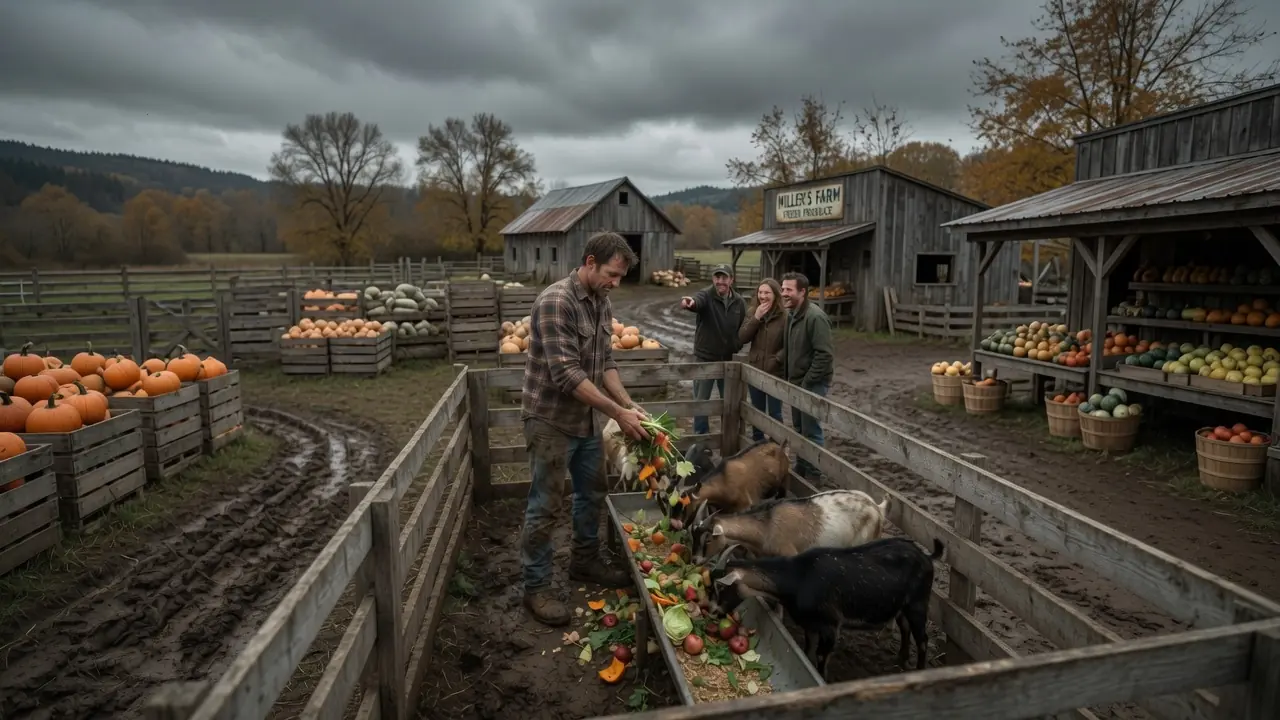
They pushed their noses into the pile, grabbed mouthfuls of leaves, shook carrot tops like flags, and made the kind of chewing noises that sounded rude if you listen too closely. One black and white dough climbed halfway into a crate of cabbage leaves before Aaron pulled her back by the collar. "Not the crate," he said. The goat looked at him like the crate was part of the meal. Aaron sighed, but he was smiling because what most people saw as waste, he had started seeing differently.
A year earlier, every bit of that pile would have been a problem. The cracked tomatoes would have gone soft in the packing shed. The bent carrots would have dried out in a bin. The oversized cucumbers would have sat there until they turned yellow. The lettuce that looked perfect at sunrise, but tired by afternoon would have become another thing Aaron had to carry, dump, and clean up after.
It was not that the vegetables were bad. They just were not pretty enough, fresh enough, straight enough, or convenient enough for the people walking past the stand with $20 bills and reusable grocery bags. That was one of the things nobody told you when you said you wanted to grow food for a living. You could do almost everything right and still end the week with a truck bed full of things you could not sell. Aaron ran a small vegetable farm outside a little town in western Oregon.
Not the kind of farm with a big sign on the highway and a gift shop full of candles. just 12 acres, a packing shed, two green houses, one old tractor, a cooler that complained all summer, and more work than one person should admit to taking on. He grew salad greens, carrots, squash, onions, tomatoes, beans, pumpkins, herbs, and whatever else seemed like a good idea back in January when seed cataloges made every plan look easy. By August, none of it felt easy. Fertilizer had gone up again.
Compost delivery had gone up. Fuel had gone up. The little pump repair that was supposed to take one afternoon had turned into 3 days, two trips to town, and a bill that made Aaron sit quietly at the kitchen table for a long time. And then there was the waste. Not waste in the dramatic sense.
Not mountains of food rotting in the field, just steady, stubborn, everyday waste. A crate here, a bin there, a row of lettuce that bolted too fast after a hot week. Carrots that forked because they hit a hard layer of soil. Tomatoes that split after rain came at the wrong time. Pumpkins that looked like they had been sat on by a cow.
Every week, Aaron told himself he would handle it better. Every week, there was another pile. He tried giving some away. That helped, but not enough. He tried composting all of it.
That worked, but the pile got too wet if he did not balance it right. And then it smelled like failure with flies on top. He tried feeding some to the neighbors chickens, but chickens could only do so much before they started looking offended. The truth was simple. He was growing food, selling part of it, and spending too much time dealing with the part nobody wanted.
The soil crusted faster after rain. Some rows dried out quicker than they used to. The carrots did not push as cleanly. The greens needed more help. Everything still grew, but it took more effort every season to get the same result.
He kept a notebook in the glove box of his truck. Mostly because his grandfather had done that and because Aaron had learned the hard way that memory was too polite. Memory said it was not that bad. A notebook said, "You dumped seven bins of unsold produce behind the shed last Saturday and bought two pallets of compost 3 days later. A notebook was not polite.
A notebook was useful. " On a Tuesday morning in early spring, Aaron drove into town for mineral mix, bailing twine, and a new handle for a shovel he had broken, trying to lever a rock out of a carrot bed. He stopped at a feed store called Wilks Farm and Garden. The kind of place where the coffee was always too strong, the floor always had a little dirt on it, and everybody behind the counter knew your business without asking too many questions. That was where he first heard about the goats.
He was looking at fence clips when a woman named Laura Bennett came in with mud on her jeans and the tired face of somebody who had already done half a day of work before 9 in the morning. I'm telling you," she said to the man at the counter, "I can't keep doing it. They need somebody who actually wants them. " The man at the counter laughed. Most people want goats until they get goats.
Laura shook her head. "These are good milkers. They're not bad animals, but my mother's hip surgery changed everything, and I can't milk twice a day, run the kids to school, work my job, and keep chasing them out of the hay barn. " "How many? " the man asked.
Eight does, one weather, and two young ones, 11 total. I'll sell them cheap if they go together. Aaron kept looking at the fence clips, but he was listening. Goats had a reputation. Everybody knew that.
They yelled. They climbed. They tested fences like lawyers reading contracts. They ate things you did not want them to eat and ignored things you thought they should eat. They got into places that looked impossible.
they could turn a clean morning into a circus before breakfast. Aaron had never planned to own goats, but he had been thinking about animals more and more. Not animals as pets, not animals as decoration for families to point at during pumpkin season. Animals as part of a farm system. His grandfather had kept pigs behind the old barn years ago.
They ate garden scraps, whey from a neighbor's dairy, windfall apples, and anything else that made sense. Nothing fancy, nothing with a label, just food moving through the farm instead of leaving it. Aaron did not want pigs. Pigs were strong in a way that made him nervous. But goats?
Goats could turn rough feed into milk. They could handle leaves, vines, trimmings, and cover crop growth if a person managed them right. They made manure that did not come in a plastic bag. They were trouble, sure, but Aaron already had trouble. The question was whether this kind of trouble could be put to work.
Laura was still talking when Aaron walked up to the counter. "What kind of goats? " he asked. She turned and looked at him. Mostly Nubian and Alpine crosses, she said.
"A couple son mixes. Good enough milk. Not show goats. I don't need show goats. What do you need?
Aaron looked down at the fence clips in his hand. That was a good question. I've got a vegetable farm, he said. I've got a lot of produce that doesn't sell cover crops, too. I've been wondering if goats could fit into that.
The man behind the counter smiled like he had just been handed free entertainment. You want goats to clean up vegetables? Maybe. Laura folded her arms. They'll clean up vegetables.
They'll clean up your roses, too, if you let them. I don't have roses. You have fences? Some? Then you don't have fences, she said.
That should have ended it. It did not. That evening, Aaron drove out to Laura's place just to look. That was what he told himself. Just look.
The goats were in a paddic behind an old barn, standing on stumps, climbing a wooden spool, chewing on each other's ears, and yelling at Laura's truck like it owed them money. They were not beautiful in a clean calendar photo way. They were bony in places, round in others, sharpeyed, loud, and busy. One brown dough had a white stripe down her face, and the confidence of a sheriff. Another had ears so long they looked borrowed from a rabbit.
The two young ones bounced off a feed tub for no reason at all. Laura walked Aaron through the routine. Milking in the morning, milking in the evening, hay, minerals, water, hoof trimming, fencing, shelter, parasite checks, no moldy feed, no mystery weeds, no letting them eat everything just because people think goats can eat anything. That last part stuck with him. People always said goats could eat anything.
Laura said people were wrong. They'll try anything. She said, "That's not the same as being able to live on it. " Aaron nodded. He understood that a farm could try a lot of things, too.
That did not mean every idea belonged in the system. He stood there for a long time, watching the goat's nose through a pile of hay. " The brown dough with the white stripe walked over and tugged on the corner of his jacket. Laura laughed. "That's Maple.
She thinks pockets are a personal challenge. " Aaron looked down at the goat. Maple looked back like she had already decided he was slow but trainable. How much for all of them? He asked.
Laura told him. It was less than he expected. Still more than he wanted to spend. That was how farm decisions usually worked. By Saturday, the whole town knew Aaron was getting goats.
That was how small towns worked. Bad news traveled fast. Strange news traveled faster. News about a vegetable farmer buying 11 goats traveled fastest of all. At the farmers market, a man who sold honey asked if Aaron was opening a petting zoo.
A woman buying kale said goats would eat his whole farm down to the dirt. The bread guy said, "Well, at least if the vegetables don't sell, you can teach the goats to run the register. " Everybody laughed. Aaron laughed too because sometimes it was easier, but he did not explain the whole idea. Explaining an unfinished idea in public was a good way to have people step on it before it grew legs.
He took the goats home the next week in a borrowed livestock trailer that smelled like sheep, rain, and old straw. Loading them took 40 minutes. Unloading them took five. One of the young goats escaped immediately, ran in a circle around the truck, jumped onto a stack of empty harvest crates, and looked proud of herself. Aaron caught her with a scoop of grain and a prayer he did not say out loud.
That was day one. He wrote it down. Day one, goat's home. Fencing already not good enough. He did not turn them loose in the vegetable fields.
That was the part people expected him to do. That was exactly why he did not do it. Animals did not become useful just because a person had a good idea. You had to build the place where their natural behavior could go without wrecking everything else. So Aaron started small.
He cleaned out an old equipment bay and turned it into a goat shelter. He built sleeping platforms from scrap lumber because Laura said goats like to be up off the ground. He set up water tanks, mineral feeders, hay racks, and a milking stand he bought used from a woman two towns over. A woman two towns over. Then he built a sorting area for produce.
That was the part nobody saw. He made three piles. Safe feed, compost, only trash. The safe feed pile got carrot tops, outer cabbage leaves, lettuce, squash, pumpkins, apple drops, beet greens, pea vines, sunflower heads, and clean vegetable trimmings. The compost only pile got things too slimy, too old, too questionable, or too much of one thing.
The trash pile stayed small, but it mattered. Aaron learned quickly that a goat system was not a garbage disposal. It was a living system. Living systems had limits. He called the county extension office and asked questions that made him feel slightly foolish.
How much produce was too much? What should never go to goats? How fast could he change their diet? How should he handle manure from a small dairy herd? The woman on the phone did not laugh.
She sounded relieved that somebody was asking before doing something stupid. "Go slow," she said. "Keep their diet steady. Use the vegetables as part of the ration, not the whole ration, and manage the manure like it matters, because it does. " Aaron wrote that down, too.
Manage it like it matters. The first week was chaos. The goats yelled every morning before sunrise like they had been abandoned in the wilderness instead of placed inside a dry barn with hay, water, minerals, and better care than Aaron gave himself. Maple learned how to open the latch on the outer gate by the third day. The young goat, which Aaron started calling Cricket, even though he told himself he was not naming them, climbed onto the hood of the old tractor.
One white dough stuck her head through a cattle panel and decided she could not possibly reverse the decision. Aaron had to push her ears back through while she screamed like he was the problem. At milking time, three of them behaved. Two kicked the bucket. One put her foot directly into the milk pail and looked surprised by the consequences.
Aaron spilled more milk than he saved that week. He also learned that goats had opinions, strong ones. They liked carrot tops. They loved pumpkin. They liked wilted lettuce until they decided they did not.
They treated zucchini as acceptable but not exciting. They believed cabbage leaves were worth arguing over. They did not like being rained on, even though they lived in Oregon and should have adjusted their expectations. Every evening, Aaron wrote notes. 5 gallons.
After spills, manure collected, three wheelbarrows, escapes, two regrets temporary. By the second week, he had a routine. Morning milking hay first, then measured vegetable scraps, clean water, check fences, move bedding, collect manure and wet straw, added to the compost bay with leaves, old hay, and chipped branches from the windbreak. turned the pile when he could, not when he felt like it, when it needed it. That was the difference between a pile of waste and a system.
A pile waited for somebody else to deal with it. A system gave everything a job. The goat's first real job came after the early pea harvest. Aaron had a patch of spent pea vines, chickweed, and a cover crop mix that needed to come down before the next planting. Normally he would mow it, let it wilt, and work it in.
This time he fenced a narrow strip and brought the goats in after the harvest was done and the crop was safe. They hit the vines like they had been waiting their whole lives. Heads down, tails moving, leaves disappearing. They did not do it perfectly. They trampled some things.
They ignored some stems. They all wanted to stand in the same corner for reasons known only to goats. But two days later, the strip looked different. Not clean, not finished, different. Aaron walked it in the evening and made notes.
Prip goats reduce top growth fast. Need tighter fencing. Move sooner next time. That became the pattern. Small area, short time, move, rest, observe.
He did not trust the goats to know what the farm needed. He trusted them to be goats. His job was to make being goats useful. By the fourth week, the produce pile behind the packing shed had changed. It used to grow as the week went on.
Now it shrank. Market leftovers came home, got sorted, and much of it went straight into the goat ration over the next few days. Not all of it, enough to matter. The compost pile changed, too. Before the goats, Aaron's compost was uneven.
Too wet one week, too dry the next. Too many soft vegetables in one spot, not enough carbon, too much smell. With goat bedding, straw, manure, and vegetable scraps mixed carefully, the pile started heating right. He could feel it when he put his hand near the turn center. Warm, alive, working.
That was the first moment he thought, "Maybe this was not just a crazy side project. Maybe this was the missing loop. " He marked one bed near the lower greenhouse for a test. Half of it got the compost he had made with goat bedding and vegetable scraps after it finished curing. The other half got his regular amendment plan.
He planted lettuce and radishes in both. Then he waited. Farmers spend a lot of time waiting while pretending they are not waiting. Two weeks in, he saw a difference. Not huge.
Not the kind of difference a person could photograph and brag about online without exaggerating, but real. The goat compost side held moisture a little better after a windy day. The soil broke apart softer in his hand. The lettuce looked steadier, less stressed. The radishes pushed more evenly.
Aaron did not celebrate. Not yet. He had been fooled by early signs before. He wrote it down and kept watching. At the Saturday market, people started noticing the milk.
At first, Aaron brought a small cooler with a few jars for customers who had already asked about raw milk rules, herd shares, and what was allowed in their county. He was careful. He asked questions. He did not want to turn a good idea into a legal problem. Then, a woman who made soap asked if he ever had extra goat milk.
sometimes. He said, "I make small batch soap. " She said, "Lavender, oatmeal, that kind of thing. Goat milk sells better than plain. " Aaron thought about maple kicking the bucket over on day six.
Funny, he said. "It doesn't feel fancy at 5:00 in the morning. " The woman laughed. "Most fancy things don't. " She bought some milk through the proper arrangement and two weeks later she came back with a few bars of soap wrapped in brown paper.
The label said made with milk from Miller Creek Farm Goats. Aaron stared at it longer than he meant to. He had seen his farm name on boxes of lettuce, on tomato signs, on pumpkin bins. But this was different. This was not a crop.
This was a loop. Vegetables fed goats. Goats made milk. Milk made soap. Goat bedding made compost.
Compost fed vegetables. The farm was starting to talk to itself. By early summer, the comments around town began to change. Not all at once. People do not like changing their minds in public.
They do it slowly, one careful sentence at a time. The honeyman stopped joking about the petting zoo and asked whether goats could eat blackberry canes. The bread guy asked if goat manure compost would be too strong for his wife's flower beds. A woman who had laughed about goats eating the whole farm asked if Aaron would sell a few bags of finished compost when he had extra. A school teacher asked if her class could visit in the fall to see the recycling goats.
Aaron did not love that phrase, but he understood why people liked it. It was simple and mostly true. The real turning point came in October. Pumpkin season was good that year. Good in the way that meant long days, muddy parking, kids trying to lift pumpkins too big for them, parents taking pictures, and Aaron answering the same five questions every hour with a smile that got thinner by late afternoon.
But after Halloween, he had the usual problem. Leftover pumpkins. Too small, too scarred, too weirdl looking, too many. Normally, those pumpkins would sit in a pile until he smashed them for compost or hauled them out to a field edge. This year, customers started asking, "Can we bring our old pumpkins back for the goats?
" Aaron had not planned on that. The first person brought three. Then, another family brought six. Then, somebody posted a picture online of Maple eating a jacko'-lantern with one triangle eye still visible. By the next weekend, Aaron had a pumpkin drop off sign by the farmstand.
Clean pumpkins only, no candles, no paint, no glitter, no mold. The goats became local celebrities for about 10 days. They did not handle fame with humility. Maple bullied the smaller goats away from the best pumpkins. Cricket got her head stuck inside one and ran backward into a fence.
Kids laughed so hard one little boy fell into a hay bale. Aaron stood there watching families bring back pumpkins that would have gone into trash cans and thought about how strange farming could be. A year earlier he had been trying to hide waste. Now people were bringing him more of it because they wanted to be part of the solution. Of course, it was not perfect.
Nothing on a farm ever is. In November, three straight days of rain turned the goatyard into a mess and Aaron had to lay gravel in the hightra spots. In December, milk production dropped and he had to adjust his expectations. In January, one compost pile went sour because he had added too many wet scraps and not enough dry bedding. In February, a neighbor complained about the smell after a warm spell.
The neighbor was not completely wrong. That was one of the hardest lessons Aaron had to keep learning. Just because an idea worked did not mean every part of it was pleasant. The goats were useful. They were also loud.
The compost was valuable. It could also stink if he got lazy. The milk added income. It also added chores every single day. The system saved waste.
It did not save Aaron from work. It gave the work a better direction. Near the end of winter, Aaron sat at the kitchen table with his notebook, receipts, seed orders, feed bills, compost records, and a mug of coffee that had gone cold an hour earlier. He ran the numbers twice, then once more, because farmers trust numbers more after they have annoyed them. The farm had thrown away less produce, not none, less.
He had bought less outside compost and fertilizer. Not zero, less. He had sold some milk through the right channels, traded some, supplied a local soap maker, and sold a small amount of finished compost at the farm stand. Not enough to buy a new tractor, enough to matter. The vegetable beds amended with the goat compost had done well.
Not magically, honestly. The soil looked better. The farm stand had more customers asking questions. The goats had become part of the farm's story, not as a gimmick, but as proof that Aaron was trying to build something that wasted less and connected more. He wrote one sentence at the bottom of the page.
Waste is only waste when it has nowhere to go. Then he sat there for a while. Outside, the goats started yelling. Of course they did. They yelled when they were hungry.
They yelled when they were not hungry. They yelled when a bird landed on the fence. They yelled when Aaron was 3 minutes late. They yelled because goats had never believed silence was useful. Aaron got up, pulled on his boots, and walked out into the cold morning.
The farm was quiet except for them. The vegetable beds were mostly empty, covered in winter rye, leaves, and rain. The greenhouse plastic moved a little in the wind. The compost pile steamed faintly behind the shed. The goats crowded the gate like they had been waiting for him since the beginning of time.
Maple shoved her face between two boards and stared at his coat pocket. "You are not getting my notebook," Aaron said. She sneezed. He opened the gate and carried hay to the feeder. The goats rushed in like every meal was a miracle and an emergency.
He watched them for a moment. A year earlier, he would have looked at leftover vegetables and seen a headache. He would have looked at manure and seen a chore. He would have looked at goats and seen trouble. To be fair, they were trouble.
They broke latches. They kicked buckets. They yelled at sunrise. They climbed things that were not meant to be climbed. They made simple days complicated.
But trouble was not the whole story. Sometimes a thing is messy because it is moving energy from one place to another. Sometimes a thing is loud because it is alive and asking to be managed, not ignored. Sometimes the thing everybody calls a problem is only a resource waiting for someone patient enough to build the right system around it. Aaron did not turn waste into value because he bought goats.
He turned waste into value because he paid attention. He sorted what belonged and what did not. He built fences. He cleaned bedding. He asked questions.
He made mistakes small enough to learn from. He kept records when guessing would have been easier. And he let the farm teach him that the answer was not always outside the gate. Sometimes it was already there, sitting in a cracked tomato, a bent carrot, a pile of straw, and an animal stubborn enough to make use of it. By spring, the goats had a permanent yard, a cleaner milking space, a better compost bay, and a reputation around town.
Miller Creek Farm still sold vegetables. That was the center of it. But now the sign at the farm stand had a few more lines. Fresh vegetables, seasonal flowers, goat milk soap, finished compost. Ask us about the goats.
People did ask. Aaron answered honestly. He never told them it was easy. He never said goats fixed everything. He told them goats made him pay attention to things he used to push aside.
He told them waste had a cost even when nobody sent a bill. He told them soil remembered how it was treated. He told them a small farm did not survive on one big miracle. It survived on loops. One thing feeding another.
One problem becoming part of a solution. One small margin stacked on top of another until the whole place had a better chance. One Saturday, a little girl stood by the fence with her father and watched Maple chew a pumpkin rind left over from a cooking class at the farm stand. The girl pointed. "That goat is eating trash.
" Aaron leaned on the fence. "Looks like trash," he said. "But it isn't trash to her. " The girl thought about that. "What is it then?
" Aaron looked at the goats, then at the compost pile, then at the rows beyond it, waiting for planting. It's next year's vegetables, he said. The girl frowned like that answer was too big to fit inside one pumpkin rind. Then Maple burped. The girl laughed.
Aaron did too. And maybe that was the whole story. Or at least the part worth remembering. A crooked squash can still feed something. A bruised apple can still move through a farm and come back as soil.
A loud, stubborn goat can still become part of the answer. And a farmer who feels buried under waste, bills, and tired ground might not need a perfect solution. He might just need to stop asking, "How do I get rid of this? " and start asking, "Where does this belong? "